
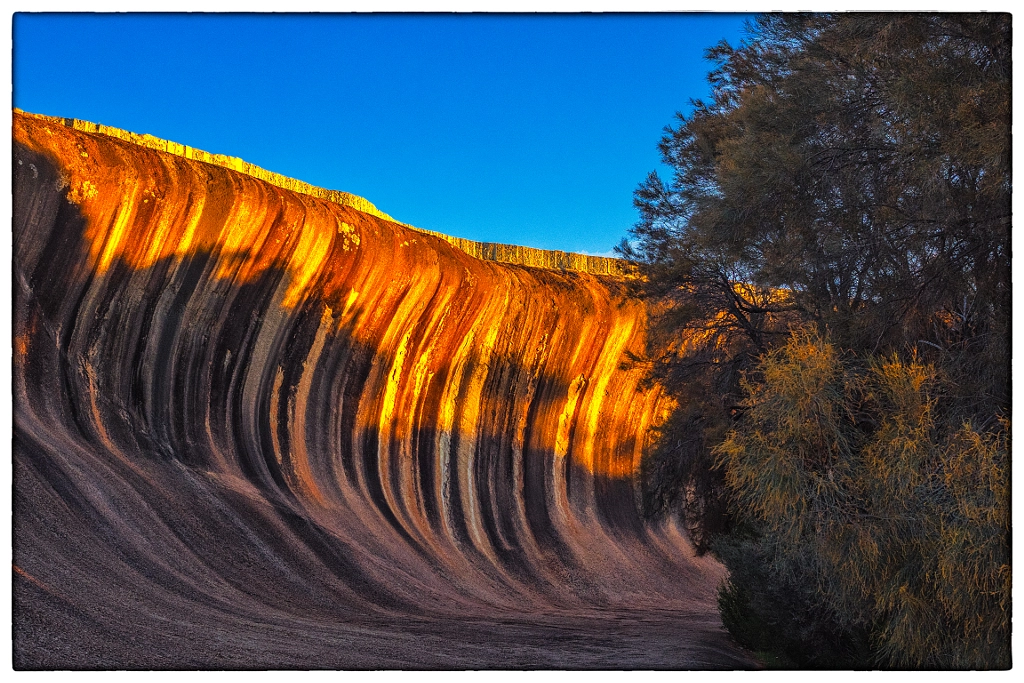
Hyden Seek

Wave Rock by Paul Amyes on 500px.com
Wave Rock at sunset. Hyden, Western Australia. Olympus OMD EM1 mki with Olympus m.Zuiko 12-40 f2.8 lens. Exposure: 1/160 th sec, f5.6, ISO 200.


Every day tour buses stop over in York on their way to Wave Rock near Hyden. The Northern Territory has Uluru (formerly known as Ayres Rock) and Western Australia’s tourism industry markets Wave Rock as our equivalent. I often feel sorry for the tourists, particularly the Chinese and Japanese ones, as they drive out from Perth to the middle of nowhere to see a large rock that looks like an enormous ocean wave frozen for posterity. I wonder what they think when they get there.

A week or so ago we went out to Hyden to visit Wave Rock. It’s not the first time we’ve visited, we first went in 2008. I find it very hard to be enthusiastic about it – it is just a curved rock face. My over all feeling is that Wave Rock is more marketing than substance. What I find more interesting is the way people interact with it. The majority of people just pull up in the car park and jump out to quickly take a selfie with their phone or a couple of seconds of video on a GoPro on one of those annoying sticks that they nearly poke someones eye out with as they are too busy on making strange faces for the camera. They then jump back into their cars and race off to the next destination on their itinerary. The next group of people are harried parents herding their bored looking children around and eventually persuading them to have their photo taken while they pretend to surf the perfect stone wave. The best was a young Chinese couple – he was shooting “glamour” photos of her while she was standing halfway up the curve in skimpy attire and the most incredible high heels – the sort that you need a ladder to get into and induce vertigo. My immediate reaction was not to perv the girl, but one of how the hell did she get up their dressed like that. The answer was obvious – when he finished taking photos he threw a bag up to her and she changed into a pair of track pants, a t-shirt and trainers and slid down on her backside.
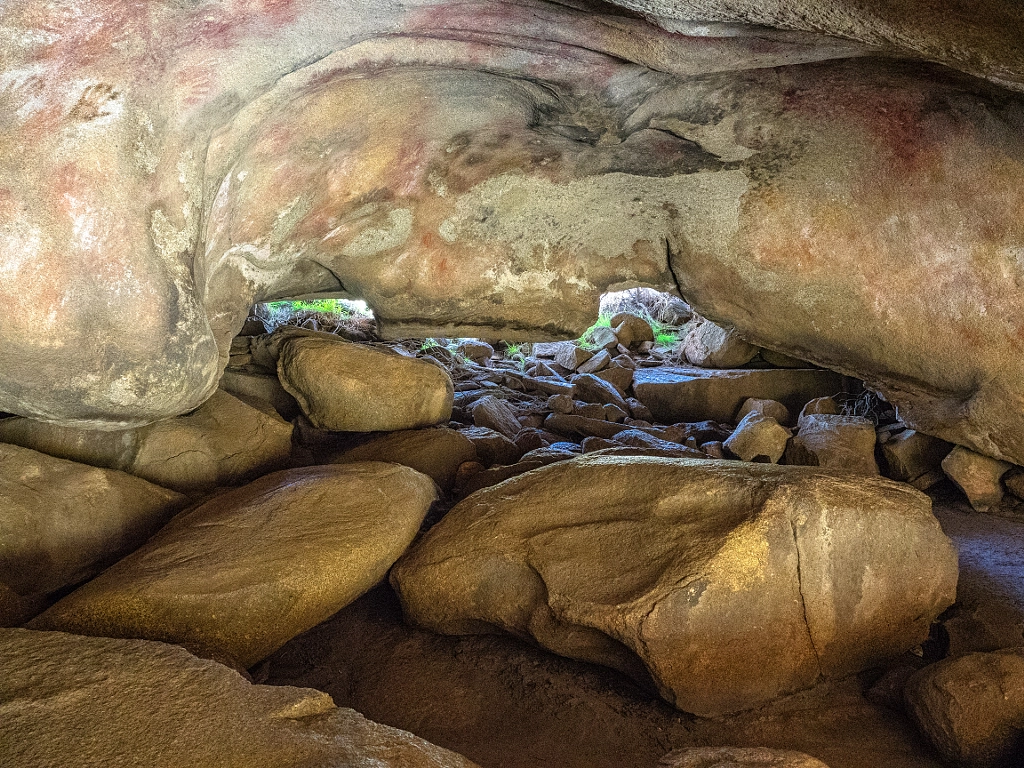
 

Mulka's Cave by Paul Amyes on 500px.com
Mulka’s Cave in the Humps Nature Reserve is a site of special significance to the Nyoongar people. Apart from being the subject of local folklore it also has the largest collection of rock paintings in the south of Western Australia. Olympus OMD EM1 mki with Olympus m.Zuiko 12-40 f2.8 lens. Exposure: 1/30 sec, f5.6, ISO 3200.


Sixteen Kilometres north-east of Wave Rocks is The Humps Nature Reserve. It’s not a very appealing name and probably doesn’t help with marketing to the tourist hordes. The Humps are a massive granite outcrop some 2 km x 1.5 km in area and rises to 80 m above the surrounding plain which was and is of huge cultural significance to the Nyoongar people. Mulka’s Cave is a gallery for 452 motifs which makes it the largest collection in southern Western Australia.It is thought that the paintings were produced over the last two or three thousand years and it feels like the people who made them are reaching out from the past to the present day. It really reinforces the impression of spirit of place and of belonging to the land. To me this is what makes The Humps more special than Wave Rock, it engenders a feeling to that felt at Uluru or Ubirr. Powerful stuff. Mulka’s Cave is named after one of its inhabitants about which there is a gruesome Dreamtime story.

‘Mulka was the illegitimate son of a woman who fell in love with a man to whom marriage was forbidden. As a result, Mulka was born with crossed eyes. Even though he grew up to be an outstandingly strong man of colossal height, his crossed eyes prevented him from aiming a spear accurately and becoming a successful hunter. Out of frustration, Mulka turned to catching and eating human children, and he became the terror of the district. He lived in Mulka’s Cave where the impressions of his hands can still be seen much higher than those of an ordinary man. His mother became increasingly concerned with Mulka and when she scolded him for his anti-social behaviour, he turned on his own mother and killed her. This disgraced him even more and he fled the cave, heading south. Aboriginal people were outraged by Mulka’s behaviour and set out to track down the man who had flouted all the rules. They finally caught him near Dumbleyung 156 km south-west of Hyden, where they speared him. Because he did not deserve a proper ritual burial, they left his body for the ants – a grim warning to those who break the law.’

R.G.Gunn, Mulka’s Cave Aboriginal rock art site: its context and content, Records of the Western Australian Museum 23: 19-41 (2006).
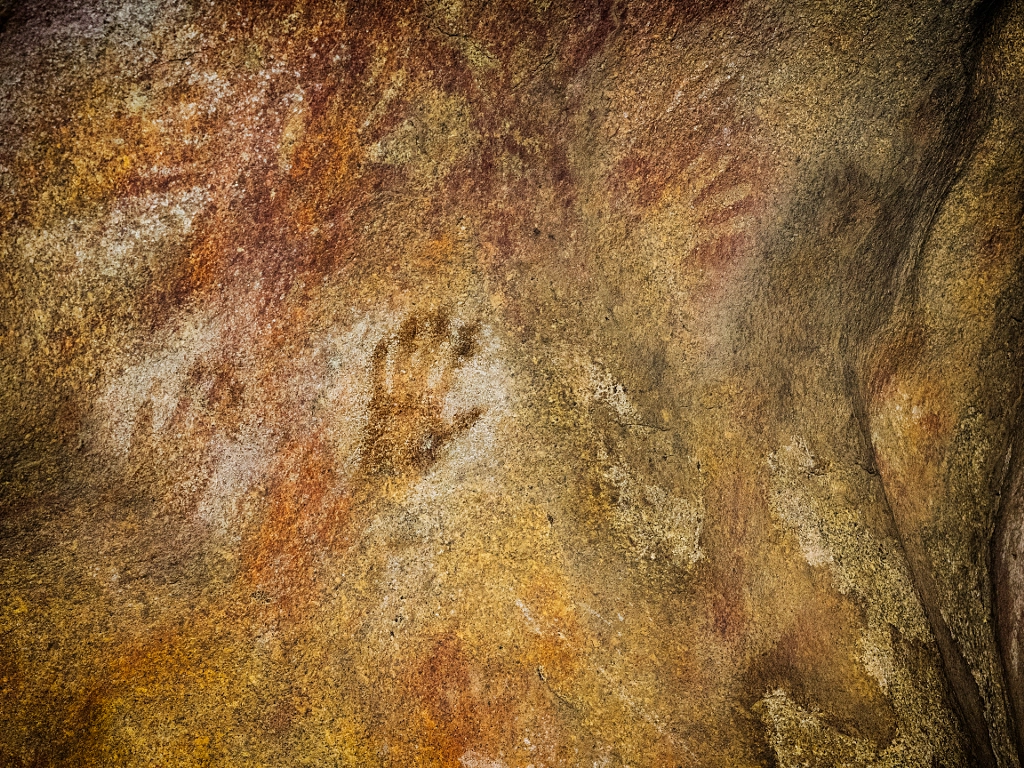
 

Reaching Out From The Past by Paul Amyes on 500px.com
Nyoongar hand prints reach out from the past in Mulka’s Cave. Hyden, Western Australia. Olympus OMD EM1 mki with Olympus m.Zuiko 12-40mm f2.8 lens. Exposure: 1/100 sec, f4, ISO 1600.


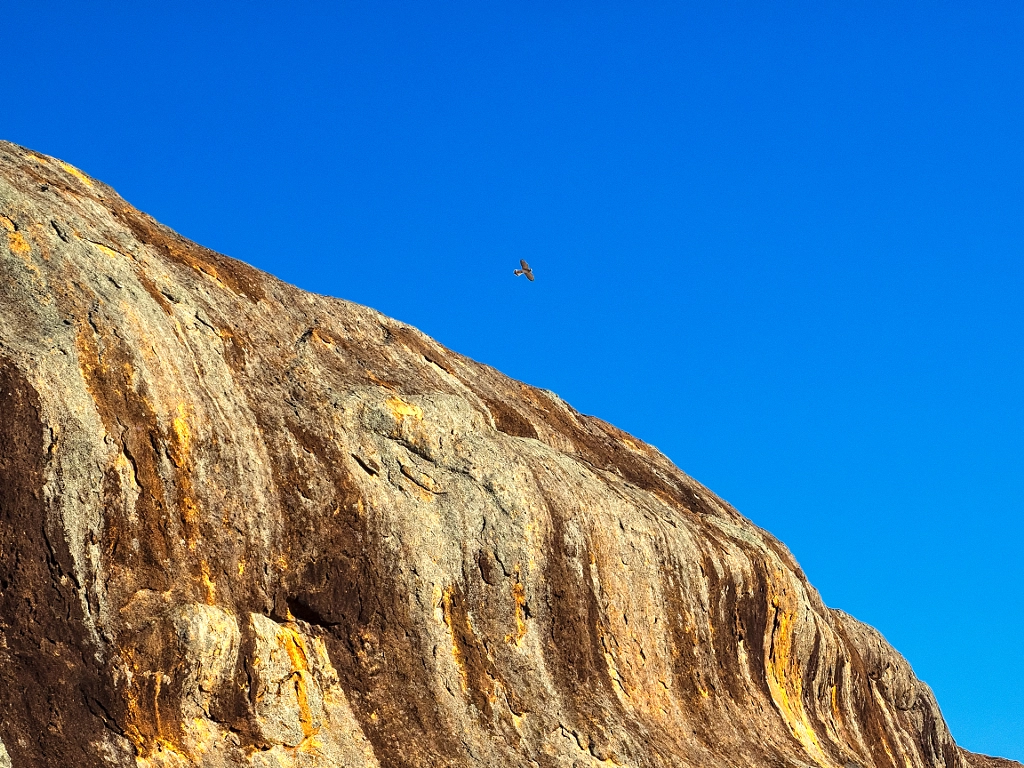
There are a couple of walks in the reserve – The Gamma Trail a 1.2km interpretative walk explains the significance of the area to the local Nyoongar people, and the Kalari Trail, a 1.6 Km trail climbs to the summit. The early morning walk to the summit was fantastic. There were kangaroos amongst clumps silver princess trees (Eucalyptus caesia), nankeen kestrels were riding the thermal currents looking for prey and there were hosts of wrens bathing in the shallow pools of water on the rock surface. You get the feeling that this is a place where everything has been stripped back to the elemental essentials. Time was standing still. Of course the moment was lost as the multitudes of tourists pulled up in the car park jumped out to grab a selfie in the cave and use the toilet, their chattering voices carrying up to the summit shattering the tranquility. For a brief couple of hours on top of the humps I was somewhere else quite magical.
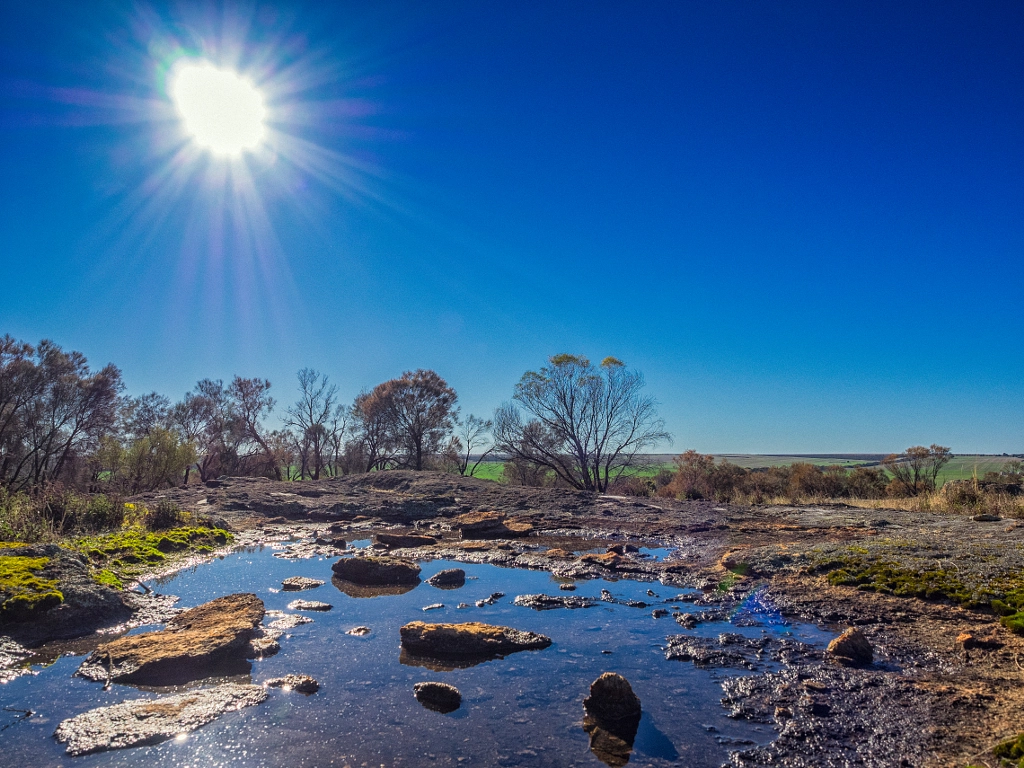
 

Rock Pool On The Humps by Paul Amyes on 500px.com
Rock pool on the Humps. The Humps are a large granite outcrop to the north-east of Hyden, Western Australia. Olympus OMD EM1 mki with Olympus m.Zuiko 12-40mm f2.8 lens. Exposure: 1/640, f8 at ISO 200.


Soaring Over The Humps by Paul Amyes on 500px.com
A nankeen kestral soaring the summit of the Humps. Hyden, Western Australia. Olympus OMD EM1 mki with Olympus m.Zuiko 12-40mm f2.8 lens. Exposure: 1/500, f9, ISO 200.


The Black Hole Of Babakin

Plus One by Paul Amyes on 500px.com
Plus One – a winter spider orchid (Caladenia drummondii) and its visitor. Sorenson’s Reserve, Western Australia. Canon EOS 6d with Canon EF 100mm f2.8 IS L macro lens. Exposure: 1/250 sec, f11, at ISO 400.


Yesterday I decided to go on a little road trip to Babakin in search of the winter spider orchid. You’ve got to be mad to do a round trip of 320Km in the hope of finding one very small flower. It was a good day for it, the weather was cloudy and overcast, perfect for this type of photography, and I had nothing else scheduled. So packed my camera gear into the car, made sure the mobile was loaded with music and set off to the teeming Wheatbelt metropolis of Babakin. Now Babakin is in the local government area of Bruce Rock, which according to the Australian Bureau of Statistics covers an area of 2,727 square kilometres (1,053 sq mi) and has a population as of 2015 of 939 people. Babakin itself has a population of 25 – it is safe to assume that the local canine population out numbers the people – so there’s not a lot out there except wheat fields.


The drive was great, a lot of it on dirt track so plenty of red dust, and the time and distance just flew by thanks to the music. The shuffle play threw up some golden oldies – the best being Crazy On You by American group Heart. Put that one on full-bore. I wasn’t exactly head banging but lets say that the bouncing around of the car wasn’t entirely due to the road surface.  Oh that took me back to the Chichester RocSoc at the New Park Road Community Centre.

Now these days we rely an awful lot on technology, I’m no exception,  I was using my mobile phone for music and navigation. As I got close to my destination the phone just cut out – no more navigation,  no more music. No mobile network coverage could explain the first but not the later. I switch to my TomTom SatNav and that packed up – couldn’t get a signal. OOOOeeeeeerrrrrr! Luckily I was nearly there. When I got to the nature reserve I did what I normally do and that is switch on my handheld GPS and mark the position of the car. These reserves have no facilities of any kind, not even paths or tracks, so I do this so I can just wander around in the bush and then when I’ve had enough I just follow the GPS to get me back. So off I walk. After an hour and a half I eventually find a single tiny specimen and proceed to photograph it. I use off camera flash fired by radio triggers to light my pictures of orchids. I set everything up as usual took a shot and noticed the flash didn’t go off. Tried again – nothing. Checked everything was firmly in place – nothing. Changed the batteries in the transmitter and receiver – still nothing. Bugger! Had a rummage around in my camera bag and found an old TTL cable so that got me out of the fix. Eventually I packed up and started walking to the car.  I looked at the GPS screen and saw that it was blank. Bugger! I replaced the batteries – nothing. Another set of batteries and still NOTHING!!! Buggeration with bloody great knobs! A rising tide of panic starts to wash over me. Wash? No it was more like a tsunami. After a little pep talk I heard a truck go past. Now remember how I said earlier that this was a sparsely populated area? Yes? Well I can tell you I have never been so glad to hear a truck. I walked off in that direction battling through the scrub and eventually hit the road about 300 metres from the car. Phew!

The drive home was quiet – no phone, no SatNav, no music. When I got there after an hour and a half I carried everything into my office and started my usual post shoot ritual of zeroing all the camera settings, downloading the images and checking batteries prior to packing everything away. I almost jumped out of my skin when my phone beeped and started to play music. I checked the SatNav and it was picking up a signal, as was the handheld GPS. I tentatively got the flash triggers out and checked them and they were working just fine. WEIRD! Perhaps there’s just something about Babakin.

I can’t go without putting a YouTube video up for Heart’s Crazy On You. It’s a cracking track and this time I’ll put up a live recording from 1978 and from 2013 so you can see how the band has fared over time. All I can say is that Anne and Nancy Wilson can still strut their stuff in their sixties. Respect!


Summer Break

Wilson Inlet by Paul Amyes on 500px.com
Helen and Frida pausing for a sit down while following the Bibbulmun Track alongside Wilson Inlet, Denmark, Western Australia. iPhone panorama.


Normally summer is pretty full on here in the vast Wheatbelt Metropolis that is York – temperatures hovering around the 40 ℃ (104 ℉) mark. Consequently most people here plan on getting away to the coast during summer for some respite from temperatures more akin to a low oven setting rather than the weather. I say “normally” as this years weather is really topsy-turvy, but as we had to make the accommodation booking some 6 months in advance we went any way. Our preferred escape York/the heat destination is Denmark – no not the country, the town on the south coast of Western Australia.


Private Jetty by Paul Amyes on 500px.com
Walking round Wilson Inlet on the Bibbulmun Track. Denmark, Western Australia. iPhone panorama.


We rent the same house on Wilson Inlet as it enables us to walk the Bibbulmun Track that follows the edge of the Inlet for some distance. The track has been an abiding interest for us for many years, Helen has end to ended on it, me I’ve just done one over night and lots of day walks. It is always a great pleasure to get out into the bush.


Looking Up by Paul Amyes on 500px.com
Looking Up. Walking up to Mount Hallowell on the Bibbulmun Track, Denmark, Western Australia. Olympus OMD EM1 with Olympus m.Zuiko 12-40mm f2.8 lens. Exposure: 1/100th sec, f8, at ISO 200.

For a more strenuous walk we climbed Mount Hallowell, Helen reckons it is one of the harder sections on the whole track. We managed it relatively easily – which probably has more to do with the fact that we weren’t encumbered by 10Kg back packs.


Follow the Snake by Paul Amyes on 500px.com
Follow the Snake – the Wagyl trail markers. Helen on the granite outcrops on Mount Hallowell. Denmark, Western Australia. Olympus OMD EM1 with Olympus m.Zuiko 12-40mm f2.8 lens. Exposure: 1/160 th sec, f4, at ISO 400.


We walked up Mount Hallowell – which is more of a big hill than a mountain, and then on to Monkey Rock, which is a granite outcrop on the southern side of the hill that gives 270 degree views over the surrounding karri forest, southern coastline and Wilson Inlet. Despite the stunning views I took no photos as the air was very hazy. Still there’s always next time!


Sun Up by Paul Amyes on 500px.com
Sun Up. The sun comes up over the peak. Mount Hallowell, Denmark, Western Australia. Olympus OMD EM1 with Olympus m.Zuiko 12-40mm f2.8 lens. Exposure: 1/400th sec, f8, at ISO 200.


Hillside

Hillside Farmhouse
Hillside Farmhouse


Hillside Farmhouse was designed by Sir Talbot Hobbs, a leading architect and built in 1911 for Morris Edwards in the historic Wheatbelt town of York in Western Australia. Sony A7r with Olympus OM Zuiko 35-105mm f3.5-4.5 lens mounted via a Fotodiox adapter,  Cokin circular polarizing filter and +3 stop graduated neutral density filter. Exposure 4 seconds, f16, ISO 50.

Quirky Quairading

Quairading Railway Station
Aboriginal art at Quairading Railway Station, Western Australia. Sony A7r with Olympus OM Zuiko 24mm f2.8 lens. Exposure 1/4000 f8 ISO 400.


Situated 166 Km (or 103 miles for the imperially minded) east of Perth is the small Wheatbelt town of Quairading. If you can’t pronounce it you’re not a local! Really it is just a blip on the map, one of countless small Australian country towns. Gazetted in 1907 the town was built around the rail terminus. Typical of many Wheatbelt towns is the CBH grain handling facility built near the station to ship the crop out at harvest time. The railway line has since closed and the grain moved by road. For many towns this would possibly be the last straw, but Quairading carries on. As you drive into town you are met


Quairading CBH Grain Bins
The land around Quairading was cleared for farming and in 1932 two grain elevators were built and wheat from the district was transported via rail. The railway shut in 2013 and now the grain travels by road. Canon EOS 550d with Sigma 17-50mm f2.8 OS EX lens. Exposure: 1/100, f8, at ISO 400.


by members of the grain family – cartoon characters based on grains of wheat created by local artist Lyn Whyte. Some of the businesses in the town centre shut down long ago but their buildings have been repurposed. The old bank is now someone’s home and has been called the Brass Razoo Bank, which is Australian slang for having no money and is kind of appropriate.


Wesley Wheat
Wesley Wheat a member of the Grain Family. He and his siblings Basil Barley, Ollie Oat and Lucy Lupin are the concept of local artist Lyn Whyte, the family can be seen in quite a few locations around the Quairading district.


One of the old shops has a huge street frontage and this now houses a collection of cars straight out of the 1970’s. Just a few doors down is the antique/collectables shop whose contents spill out onto the pavement. The items displayed are often arranged in odd juxtapositions which often cause passers-by to do a double take to see what is going on.


Flowers of Quairading
Flowers of Quairading. A street side shop display from the antique shop in Quairading. Sony A7r with Voigtlander 15mm f4.5 Super Wide – Heliar. Exposure: 1/5000 sec, f16 at ISO 6400.


The Car Dealership From The 1970's.
The Car Dealership From The 1970’s. Sony A7r with Olympus OM Zuiko 24mm f2.8 lens. Exposure: 1/200 sec, f16, ISO 1600.


Mercedes Truck
An old Mercedes truck sits in a paddock slowly rusting. Quairading, Western Australia. Sony A7r with Voigtlander 75mm f2.5 Color-Heliar lens. Exposure: 1/4000, f2.5 at ISO 400.


100 Years of ANZAC
The Anzac memorial in Quairading. Western Australia. Sony A7r with Voigtlander 15mm f4.5 Super Wide – Heliar lens. Exposure: 1/250 sec, f16 at ISO 1600.


The real highlight is the people – friendly, upbeat and generous. My partner walked into the local tourist office cum art centre cum civic museum and walked out with a free pumpkin. What more could you want?


York Motorcycle Festival

Just a few shots from today’s motorcycle festival here in York, Western Australia.

2016 York Motor Cycle Festival
Royal Enfield trade stand at the York Motorcycle Festival. Olympus EM1 with Olympus 12-40 f2.8 lens. Exposure: 1/250, f4 at ISO 400.


2016 York Motor Cycle Festival
Grow old disgracefully with the Ulysses Club. York Motorcycle Festival. Olympus EM1 with 12-40 f2.8. Exposure: 1/640 sec, f4 at ISO 400.


2016 York Motor Cycle Festival
ASP FMX Team at York Motorcycle Festival.. Olympus EM10 with Olympus 12-40 f2.8 lens. Exposure: 1/500 sec, f9 at ISO 200.


2016 York Motor Cycle Festival
ASP FMX Team at York Motorcycle Festival. Olympus EM10 with 12-40 f2.8 lens. Exposure: 1/2000 sec f4 ISO 200.


2016 York Motor Cycle Festival
ASP FMX Team at York Motorcycle Festival. Olympus EM1 with Olympus 40-150mm f2.8 lens. Exposure: 1/3200 sec f2.8 ISO 200.


2016 York Motor Cycle Festival
Dog in a helmet. York Motorcycle Festival. Olympus EM10 with Olympus 12-40 f2.8 lens. Exposure: 1/50 sec, f4 ISO 200.


The Great Divide

King William Range
King William Range


The Great Divide in Tasmania on the Lyell Highway marks the point where the geology of the Tasmania changes from the quartzite in the west to the dolerite of the east. It also marks where the weather systems of Tasmania change from the Roaring 40’s of the west to the moisture laden winds from the Southern Ocean. Sounds a bit boring when you describe it like that, but when you see the King William Ranges rising out of the button grass moorlands and bogs it all takes on a majestic splendour. As you drive along the Lyell Highway there is a lay-by which is quite popular, next to it is an information sign explain what the Great Divide is. Hardly anyone reads the sign, they are all too busy looking at and photographing the scenery.

Pipe Dreams

Big Pipes
Stopped off at Tarraleah to admire the pipes and electricity pylons as they cross the valley.


There’s no doubt about it Australians love a dam. Build one and the accompanying recreation area will be full of happy Aussies burning sausages while commenting sagely on rainfall and water levels. On our recent jaunt around the Tasmanian North West we stopped at Tarraleah to admire the hydro and the Art Deco cottages that were built to house the workers when being constructed. They are now part of a swank resort where you can admire massive pipes and electricity pylons as they cross the valley.


Big Pipes
Big Pipes


The building of the dams polarised the community and gave birth to Australian green politics and the conservation of the Tasmanian Wilderness. Sounds odd doesn’t it? Renewable energy is supposed to be good for the environment, but not when you destroy the wilderness and make entire species extinct in the process. The Hydro Electric Commission (HEC) was set up in 1914 to capitalise on Tasmania’s topography and high rainfall which made it eminently suitable for the generation of hydro-electricity. The whole thing progressed smoothly until the HEC wanted to build three dams on the Upper Gordon River with the aim of attracting industry to the State with the incentive of cheap energy. In December 1982, the Franklin River dam site was occupied by protesters, leading to widespread arrests and world-wide dismay and condemnation. The Hydro and the Tassie government were dismissive of any criticism and saw it as outsiders meddling in Tasmanian affairs. As happened in 1930’s America where the photographs of the High Sierras by Ansel Adams were paramount in changing public opinion and convincing politicians to do more to conserve the natural environment, the photographs of Peter Dombrovskis brought the spectacular Tassie wilderness to the attention of the wider public and they were used in a media campaign that helped bring down the government of Malcolm Fraser at the 1983 election. The new government, under Bob Hawke, had promised to stop the dam from being built. The resulting stoush between the Tasmanian State government and the Australian Federal government ended up going all the way to the High Court which ended up as landmark decision in favour of the federal government. The building of the dams gave birth to Australian green politics and the conservation of the the Tasmanian Wilderness.