Cosina Voigtländer 35mm f2.5 Color Skopar Lens

A close up of the 35mm f2.5 Color Skopar. The clearly marked aperture ring, the focus distance and the hyperfocal settings mean that it is a great for street photography as it is a breeze to use zone focusing.


The above video is a shortened version of this entry.


Cosina are a Japanese lens manufacturer who produce lenses under their own and under companies names. In 1999 they leased the licensing of the Voigtländer name and started making camera bodies and lenses. Sadly they have stopped making cameras but are still making lenses in the following mounts:

VM – or Leica M
Sony E Mount or Nex
M4/3
Nikon F

There is no need to worry about Cosina’s ability to manufacturer lenses as Carl Zeiss has them make many of their lenses.


The Cosina Voigtlander 35mm f2.5 Color Skopar lens is very small and compact. The optional vented lens hood practically doubles its size.


This article is about the 35/2.5 P type II VM mount MC version. Which is a way of saying that there have been several versions of this lens with different mounts and lens coatings and this model was introduced in February 2004, I purchased it new that year, and it is still in production. Physically the lens is similar in styling to the Leica pe-aspheric 35mm f2 Sumicron right down to the inclusion of the finger tab on the focusing ring. The vented lens hood is an optional but essential extra, so if purchasing new budget for it, if buying second-hand look for a copy with it included. Readers not familiar with range finders may scoff at the design of the lens hood but the design was necessary so that the hood would not obstruct the view through the viewfinder. Not necessary when adapting the lens to the Sony A7 cameras but it does make the lens look cooler. Yes my copy has a dented lens hood, the lens has been very well used over the years. It also shows that a lens hood provides more protection against damage than a filter ever could.


Optical construction of the Cosina Voigtländer 35mm f2.5 Color Skopar Lens P type II VM mount MC showing 7 elements in 5 groups.


The Cosina Voigtlander 35mm f2.5 Color Skopar lens can be adapted to mount on the Sony A7 and A9 series of cameras by means of an adapter such as the Fotodiox DLX Stretch Leica M to Sony Nex adapter.

Lens Vital Statistics


The construction is all metal and for such a tiny lens it has a reasonable heft and feels very dense. So as you can see this is truly a “pancake” lens and makes a very nice all day walk around pairing with a Sony A7. Street and landscape photographers rejoice! The lens also has marked on its barrel along with the focusing scale depth of field markings, this makes zone focusing and setting the hyperfocal distance a breeze. Set at an aperture of f22 everything from 1 metre to infinity will be in focus. The focusing ring has a smooth throw of around 90º coupled with the afore-mentioned finger tab and focusing while the camera is at eye level is just so easy. The aperture ring while admittedly very thin has two tabs on it opposite each other that help you find the ring by touch and adjust without taking your eye from the viewfinder. So while it would be easy to dismiss the lens because of its retro styling these little inclusions show that this is a lens that is meant to be used. To use it on anything other than an M mount camera you will need an adapter.


Mounted to my Sony A7r how does it perform? Unsurprisingly for a pancake lens vignetting is quite apparent wide open at f2.5 along with a magenta colour cast along the edges and in the corners of the frame. The vignetting is a result of the optical design, the magenta cast the result of putting a true 35mm lens in front of a digital sensor designed to use retro-focused lens designs. The lens was designed for film so it didn’t matter that the rear element was so close to the film plane as the silver halide crystals in the emulsion didn’t care whether the light rays were hitting them perpendicularly or not. Digital sensors do require the light rays to hit perpendicular to the sensor plane, if they don’t you get light fall off, smearing and colour fringing. The Sony A7 cameras because they are mirrorless designs have micro lenses on the sensor that help pick up the light rays at acute angles, but the camera needs to know what the lens is before any correction can be applied. This lens has no electronic communication with the camera so the cast remains. The performance of the lens improves considerably as the lens is stopped down, so the vignetting is all but gone by f8 but the magenta fringing continues throughout the aperture range. Happily the colour cast can be removed in post. If you use Adobe Lightroom there are correction profiles for the Voigtländer lenses – the video accompanying this article shows how they work. If you use other processing software have a look at Cornerfix which is a little app that allows you to build lens profiles.


At f2.5 vignetting is very apparent. It is also apparent that there is a magenta colour cast in the corners and along the edges caused by the proximity of the lens’ rear element to the camera sensor.


By f8 it has all but disappeared. The magenta cast remains throughout the aperture range.


When it comes to distortion – there is some barrel distortion, but that is easily fixed in post as is the small amount of chromatic aberration. Sharpness at f2.5 in the centre of the images is very good with nice edge contrast befitting a modern multi-coated lens. The edges are considerably softer with less contrast. The wide angled rangefinder lens in front of a digital sensor problem comes into play here. A lot of people will complain that there is smearing of detail, and that is true it does happen (Spoiler Alert!) and wait until you see my review of the CV 15mm f4.5 as that has it in spades, but with this moderate wide-angle and it’s fairly sedate maximum aperture of f2.5 the light rays are not being forced to hit the sensor at extreme angles so there is no visible evidence of detail smearing in the corners of an image. Like most lenses used on a 35mm sensor diffraction sets in at f16, it’s not disastrous. Diffraction is not like falling off of a cliff – at f11 everything is sharp then at f16 everything is out of focus. No there is a slight loss of edge definition which is a little more noticeable at f22. Flare is well controlled, but I would still recommend the lens hood and the 10 aperture blades produce nice sun stars.


100% enlargements from the centre and edges of the frame. Click on the image to see larger.

My verdict.

Well lets look at pricing first. B&H Photo sell this puppy new for just over $400 USD sans lens hood at the time of writing. There are dealers on eBay that sell them for $350 USD and second-hand copies can be found starting at just over the $200 USD mark. This is not a sexy fast aperture lens and the price reflects that. There are only 7 lens elements with no fancy shapes. What you are getting is very compact moderately wide angled lens with a modest maximum aperture of f2.5. It is well designed and for stills photography is a delight to use. For video it is possible to use it, but the focus throw is a little on the short side, the small size makes operating the lens a little harder while filming and the small filter size makes the use of variable neutral density filters a little cumbersome. It is not a lens that lens snobs would consider, but it is a very fine workman like tool that I won’t ever sell because it is well made, functions well and is optically very consistent. If you like manual lenses and see one at a good price buy one. Like the many people who left reviews on the B&H web page you won’t be disappointed.


Examples
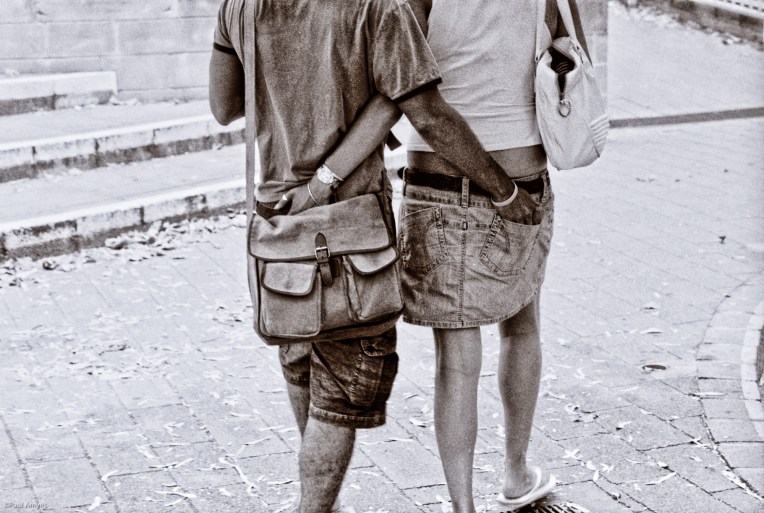
Young lovers walk arm in arm through Northbridge in Perth, Western Australia. Voigtlander Bessa R2 with 35mm f2.5 Color Skopar with red filter and Ilford Delta 400.


Curry Laksa – one of life’s essentials. Golden York Chinese Restaurant, York, Western Australia. The Fotodiox DLX Stretch adapter is extended to give a minimum focusing distance of 30 cm instead of the usual 70cm.


Testing the Voigtlander 35mm f2.5 Color Skopar on the Sony A7r. Mount Brown, York, Western Australia.


Young kids on the Avon Walk Trail in York, Western Australia.


St Mary’s Cathedral in Perth, Western Australia. Veiling flare with the 35mm f2.5 Color Skopar. While resistant to flare it is possible induce it even when using a lens hood.


The vintage Shell petrol pump outside the York Motor Museum on Avon Terrace in York, Western Australia.


Jules Cafe on Avon Terrace in York, is a friendly alternative cafe well patronised by locals and tourists alike. Distortion is very well controlled and corner to corner sharpness at f8 is good.

Olympus EM-10 Redux


It's Wet
It’s been raining – a lot! Most unusual for the Wheatbelt.


Well here I am back with another look at the EM-10 now I’ve had it in my possession for a month. First I’d like to thank reader Mike Hendren who set me straight about the bracketing feature. Thanks to him I’ve found that if you go into the HDR function then you can find lots of bracketing features. The camera is capable of in camera HDR and it processes the images as a jpg. The camera shoots a burst of four shots each with a different exposure and you have a choice of two settings for the output – one is more “dramatic” than the other.


Marwick's Barn
Marwick’s Barn, a large stone and timber structure with a high-pitched iron roof was built in the 1870s. Single exposure with just a little sharpening in Lightroom.


Marwick's Barn
In camera HDR from Olympus EM-10 using the “dramatic” setting.

Not a lot of difference really, just a flatter image. Scrolling past the in camera processing you can choose to bracket your exposures and then process the images on your computer. You have a choice of 3, 5 or 7 frames at -/+ 2 stops,  3 and 5 frames at -/+ 3 stops.  The picture below was 3 5 frames at -/+ stops and processed in Lightroom and HDR Efex Pro 2.


Marwick's Barn
Using the HDR bracketing function of the EM-10 to make 5 exposures -/+2 stops and then process in Google’s HDR Efex Pro.

If HDR is your bag then I think you have a definite idea of how you want your photos to look and will choose to blend the images in software on your computer. However, the function could be just the ticket if you’re a confirmed jpg shooter. Speaking of bracketing and jpgs,  then the Art Filter bracketing may prove to be a boon if you ever feel a little indecisive about how you want an image to look. You can choose as many of the filters as you like, but bear in mind that you will need a bit of patience while you wait for the buffer to be cleared.


This slideshow requires JavaScript.

I must say that I’m pretty impressed with the robustness of the files the EM-10 produces, they hold up to post processing very well.

Albion
Detail of a vintage car radiator grill. Avon Tce, York, Western Australia. ORF processed in Lightroom and then in the desktop version of Snapseed.
Curly
Curly wire on a fence post. Focusing the Color-Heliar 75mm f2.5 wide open using focus peaking.Raw file processed using Lightroom and Snapseed.
Two's Company
Two horses kept on a property on the banks of the Avon River in York, Western Australia. Shooting with a 35mm Color-Skopar lens wide at f4 with focus peaking. Raw file processed using Lightroom and Snapseed.


Ceramic Flock
Sheep garden ornaments. Color-Heliar 75mm f2.5 wide open focused with focus peaking on the new Olympus EM-10. Raw file processed using Lightroom and Viveza 2.

Noise, both colour and luminance, seem very well controlled as this shot Diego my cockatiel shows.

Diego
High ISO noise test. Diego my cockatiel at ISO 6400. No noise reduction applied.
Diego's beak
High ISO noise test. Diego my cockatiel at ISO 6400. Close up of Diego’s beak to show noise.


Olympus has always had a good track record when it came to metering systems. The OM 3 and 4 introduced multi-spot reading with shadow and highlight priority, which made them very popular with adherents of the Zone System pioneered by Ansel Adams. The Om 40 saw the introduction of ESP metering which meters from several areas of the image and it is a more sophisticated version of this using 324 areas is present in the EM-10. Spot metering,  high light and shadow spot metering are also present, but multi-spot metering is not present. The metering is very accurate and backlit subjects don’t fool it into under exposing.

Razor Sharp
The ESP multizone metering handled this well with good detail being maintained in both the shadows and the highlights. Straight out of camera jpg.

A few readers asked questions about the capabilities of the camera. Several wanted to know whether the EM-10 was suited to BIF. Sorry the only biff I know about is jujitsu and aikido. Seriously I don’t have a lens long enough to attempt birds in flight, and when I try with my 40-150 they certainly take flight but can only be seen as tiny specks. I do have a sequence of Frida, my English Bull Terrier, doing a “bully run” .


Bully Run
Twelve frame sequence on low continuous shooting of my dog running towards me using the 40-150mm zoom. On some of the frames the focus tracking lost focus but then quickly reacquired.

I mentioned in the previous part of the review that I had used the EM-10’s pop up flash to act as a controller for off camera flash and several people asked how I did this. Well the video below should answer that question.

Another reader asked about using the inbuilt WiFi function. This is the first camera I have used with this function and I have to say I think it is really great. I used my iPad and it was brilliant to use it as a gigantic screen to aid with composition and focusing. The only downsides are that it uses up the camera battery real quick and you can’t use to in movie mode.


So, as I’ve got to know the camera have my feelings changed? Well I have to say when I first picked it up I felt that the camera felt unnecessarily complicated and frustrating to use. Four weeks on I have to say that we’re starting to establish a relationship, I’ve largely set the camera up so I don’t have to do much menu diving which means I can just get on and shoot. The metering is reliable and the files are great, so for still photography I think the EM-10 has the makings of good camera. As for video, well I’m still out to lunch on that one. As I said at the beginning of this entry it has been very wet here and so I’ve not had enough time to get out and shoot anything. I’m hoping to get out in the next week or two and shoot a small project with it, so when that is ready I’ll post my thoughts about it. Stay tuned for the next thrilling instalment.

Absence Makes The Heart Grow Fonder

God Loves Everyone – Even Christians. South Beach, Fremantle, Western Australia. Voigtlander Bessa R2 & Voigtlander 35mm f2.5 Colour Skopar . Ilford Delta 400 developed in D76.


Now it has been nearly 4 weeks since my last post, but far from sitting around and just doing nothing myself and the myriad of staff here at the head quarters of the global juggernaut that is Paul Amyes Photography have been remodelling the commodious facility. Endeavouring to maintain our cutting edge style we undertook the massive task. At times I must confess that it seemed like a Sisyphean task, but now basking in freshly designed and decorated centre of operations , I can say that it was all worth it.

Sisyphys (1548–49) by Titian, Prado Museum, Madrid, Spain


Having just posted after a long absence I must confess that the blog will be taking another break of 3 weeks while  I go and intrepidly explore the Tasmanian wilderness. Now observant regular readers will note that it was not even 12 months ago that we visited that far off land. Well the pull of the wonderful scenery, excellent food and the outstanding beverages is too great to resist. The trip will not be all beer and skittles though, no my shutter finger will be getting a very strenuous workout as I endeavour to capture the beauty that is ubiquitous in Tassie.

So see you in three weeks.