Follow the blue poles for the Werillyiup Trail in Whiteman Park.
The Werrillyiup Trail in Whiteman Park is a 3Km jaunt around an area called Horse Swamp. So called because back in the early days of the Swan River Colony if horses escaped they invariably ended up at the swamp. The word Werrillyiup is is Nyoongar for “a swampy place” so from all this you’d expect to see quite a bit of water. Well for much of the year it is dry and really only fills in June with the coming of the winter rains. Each time I’ve been it’s been akin to walking around a large puddle. That’s not to detract anything away from it, it is just a statement of fact. What you will see though is an important wildlife refuge in a large ever-growing city. Western Grey Kangaroos are the most visible residents but there is a huge variety of birdlife here particularly in winter, spring and early summer. I’ve had more luck seeing raptors here than at any other location in Perth. EBird Australia has a listing of 101 species that can be seen at various times of the year around the swamp.
Western Grey Kangaroo, macropus fuliginosus, Whiteman Park, Western Australia.
Australian Hobby (Falco longipennis longipennis). Whiteman Park, Western Australia.
A pair of Whistling Kites seen flying round the aviaries on the edge of Whiteman Park.
A white-faced heron looks out from its tree top perch over Horse Swamp. Whiteman Park, Western Australia.
Australian Shelduck, Tadorna tadornoides, Whiteman Park, Western Australia.
After your leisurely walk around the swamp you can be revived at the excellent Guerrilla Hub Kiosk with a great coffee and some of their wonderful food. And if after all that you feel as if you’ve not communed enough with the wildlife you can always nip up to Caversham Wildlife Park and have your picture taken with a wombat.
Refreshment after a hard mornings walking and bird watching at the Guerrilla Hub kiosk in Whiteman Park.
Yours truly with one of Caversham Wildlife Park’s staff and a wombat.
As usual there is a video for those that prefer or the full written piece is below.
The Olympus m.Zuiko 45mm f1.2 PRO lens mounted on an EM1 mk ii.
The Olympus m.Zuiko 45mm f1.2 Pro Lens was announced in by Olympus back in October 2017 as one of their trio of f1.2 lenses. The others being the 17mm and 25mm. According to Olympus they were designed to “have beautiful defocusing effects” and “beautiful feathered bokeh to make your image stand out” (https://shop.olympus.com.au/m-zuiko-ed-45mm-f1-2-pro). In the case of the 45mm (and I suspect the other two) the lens is designed so that spherical aberration is not fully corrected. This means that as light rays enter the lens only those that pass through the centre of the lens are made to come together at the focus point. The rays at the edges focus slightly in front of that point and this causes the bokeh to have a gentle roll off – the so-called “feathered bokeh”. Olympus themselves claim this matches “classic” older lens designs. At this point it should be noted that spherical aberration and chromatic aberration are different. Spherical aberration occurs when a single wavelength of light or colour cannot be focused whereas chromatic aberration occurs when a lens cannot focus the red, green, and blue wavelengths on a single point. Although Olympus claims to match the performance of older classic lenses they have chosen a lens design that is very different from them.
Lens Construction and Build Quality
Olympus 45mm f1.2 lens has 14 elements in 10 groups with one ED element, four HR element, and one aspherical element.
Focal Length
45mm (90mm in full frame equvalence)
Angle of view
27º
Minimum focusing distance
50cm
Maximum magnification
0.1 X
Lens construction
14 elements in 10 groups with one ED element, four HR element, and one aspherical element
Maximum aperture
F1.2
Minimum aperture
f16
Diaphragm
9 curved blades
Focusing
Auto focus – yes, MSC mechanism making fast and silent AF possible in video mode.
Manual focusing – the focusing ring can be pulled back to engage a clutch mechanism with hard stops at each end.
Filter size
62mm
Dimensions
85mm (h) x 70mm ⌀
Weight
410g
Other features
Hermetic sealing making the lens dust proof, splash proof, and freeze proof. 60529 IPX1 IP rating.
The lens mount of the Olympus 45mm f1.2 lens. The mount has an ‘o’ ring that contributes to its 60529 IPX1 IP rating.
To see how this differs from an older classic design lets compare it to Olympus OM Zuiko 50mm f1.4 which was first produced in 1971 and remained in production until 1984.
Olympus OM Zuiko MC 50mm f1.4
Focal length
50mm
Angle of view
On 35mm 43º, on micro four thirds 21º
Minimum focusing distance
45cm
Maximum magnification
0.15 X
Lens construction
7 elements in 6 groups
Maximum aperture
f1.4
Minimum aperture
f16
Diaphragm
8 curved blades
Focusing
Manual focus with a straight helicoid
Filter size
49mm
Dimensions
36mm (h) x 60mm ⌀
Weight
230g
The 45mm f1.2 dwarves the f1.8 version.
Comparing the Olympus 45mm f1.2 to the Canon EF 50mm f1.8. On their respective bodies they both offer a similar field of view.
The 45mm f1.2 mounted on an Olympus EM1 mk i compared to the Voigtänder 75mm f2.5 Color-Heliar mounted on a Sony A7r. Both a ideal focal lengths for portraiture.
Physically this is a large lens. It dwarfs my Olympus 50mm f1.4, my Canon EF 50mm f1.8 and my Sony FE 50mm f1.8. It is a smidge larger than the Olympus m.Zuiko 12-40 f2.8 Pro and 27g heavier. The 45mm f1.2 follows the look of the other lenses in the Pro line and it also has a L-Fn button which can be programmed to various functions on Olympus cameras. In the hand the lens is reassuringly solid, it has that dense feeling that quality optics have. The focusing ring is nice and large and has the same ribbing that all the other lenses have in the Pro line. Like the other Pro lenses the 45mm f1.2 enables manual focusing by pulling back the focusing ring to engage a clutch to give a nice smooth focus throw of about 110º that has hard stops at either end. Combined with focus peaking this makes for manual focusing nirvana. As to what the lens is made out of this is hard to say, the lens mount is chrome plated brass, parts of the lens barrel have a metallic feel, and other parts feel plastic. Is this a problem? I don’t think so. For certain applications metals can be a poor choice and high quality engineering plastics such as ABS make better sense. In fact Sigma makes a big deal out of the use of their Thermally Stable Composite (TSC) which is substantially stronger than conventional polycarbonates while having similar thermal expansion properties to aluminium. Bottom line the 45mm f1.2 feels nice in the hand and is easy on the eye.
Optical Performance
The Olympus m.Zuiko 45mm f1.2 PRO lens is sharp wide open.
Lens sharpness test at f1.2 and f4. Click on the image to see it larger.
Image sharpness in the centre of the frame wide open is good and reaches its best at f4. The corners wide open are less sharp than the centre, however, by f2.8 the sharpness and contrast improves considerably and the lens reaches optimum sharpness at f4. By f8 the image starts to soften due to diffraction. Vignetting is also present wide open but this disappears at f4. There is a minute amount of pincushion distortion present, but unless you are shooting very demanding architectural work then it is largely unnoticeable. Chromatic aberration is present on high contrast edges, but it is very slight and easily removed in post. Longitudinal chromatic aberration is also present, but it too is very slight and not painfully obvious which is good as it is quite difficult to get rid of in post. All this is managed using firmware corrections. I like to turn these off using RAWTherapee to see how much correction is going on beneath the hood so to speak. The amount of vignetting is greater than the corrected images but it still clears up by f4. The pincushion distortion is also more evident. All in all the firmware corrections plus topnotch lens design make a lens that performs very well.
Chromatic aberration is well controlled and what little there is is easily fixed in post.
Longitudinal Chromatic aberration.
With regard to resistance to lens flare pointing the 45mm f1.2 at a very point light source shows it is quite prone to ghosting flare – images of the lens diaphragm as colourful bright spots. This is more evident on lenses with complex constructions with lots of lens elements. The red blobs in the photo are not lens defects. They are caused by light being reflectedoff of the sensor surface back onto the rear element. As each pixel is reflected it causes a grid pattern. Unfortunately the smaller lens flange distances on mirrorless cameras means this phenomena is more apparent than on a DSLR with their great lens flange distance.
The Olympus 45mm f1.2 is quite prone to flare so it is advisable to use the included lens hood.
The Olympus 45mm f1.2 is quite prone to flare so it is advisable to use the included lens hood. At f16 the sun stars are quite pronounced.
f1.2 bokeh balls test. In the centre of the frame nice round and smooth bokeh balls with no evidence of any onion rings. At the edgeges you can see cats eye shapped balls. Click on the image to see it larger.
Olympus make great claims about the bokeh, or more importantly the feathered bokeh of this lens. Up until the announcement of this line of lenses I’d never heard the term feather bokeh before and to be honest I’m not all that sure about what it is and how that you quantify it. I guess in simple terms Olympus means that edges of the bokeh balls are not harsh and to quantify how feathered they are we’ll have to make some comparisons. At f1.2 the centre of the frame has nice round bokeh balls with no evidence of any onion rings. Onion rings occur with the use of ground aspheric lens elements. Basically the grinding process leaves a series of ridges which can be seen with a defocused point source. The biggest problem with them is that for most people they go unseen, but once seen they can’t be unseen. At the edges of the frame there is cats eye shaped bokeh – this is caused by mechanical vignetting from the lens barrel.At f5.6 I was quite surprised to see star burst effects forming around specular highlights, I was expecting them to start appearing at the f11 mark. By f16 the bokeh balls in the corners have become spherical.
So the question is what to compare the Olympus 45mm f1.2 to? The most obvious contender is the 45mm f1.8. In their advertising blurb for the f1.2 Olympus compare the lens on an Old EM1 mk ii to a full frame DSLR with 85mm lens. Interestingly having made such a bid deal about the bokeh the only comparison is made with weight so I’ve decided to make the comparison using weight and bokeh quality with the Canon EF 50mm f1.8 on a Canon EOS550d. The 50mm lens has an equivalent focal length of 80mm in full frame terms. The nearest full frame equivalent I’ve got on hand is the Cosina Voigtländer 75mm f2.5 Color-Heliar on a Sony A7r2. Finally as I’ve already talked about the Olympus OM Zuiko 50mm f1.4 I’ll add it to the list with it mounted to the Olympus EM 1 mk ii. The older Olympus and the Canon and Voigtländer are also considered classic lens designs.
Olympus OMD EM1 mk ii with Olympus 45mm f1.2 Pro lens
984g
Olympus OMD EM1 mk ii with Olympus 45mm f1.8
737g
Canon EOS550d with Canon EF 50mm f1.8 mk ii
601g
Sony A7r2 with Voigtländer 75mm f2.5 Color-Heliar
932g
Olympus OMD EM1 mk ii with Olympus OM Zuiko 50mm f1.4
980g
So the Olympus 45mm f1.2 combo is the heaviest. Lets look at the bokeh. With the three Olympus lenses I’ll just compare the lenses at widest aperture of the slowest lens. With the other two I’m going take equivalency into account so 45mm f1.2 on the Olympus is roughly equivalent to 50mm f1.8 on the APSC sensor and the Olympus’ f1.2 is equivalent to f2.5 on the full frame sensor.
Bokeh comparison between Olympus 45mm f1.2 and the Olympus 45mm f1.8. Click on the image to see it larger.
First cab off the rank is the Olympus m.Zuiko 45mm f1.8 lens. It has an optical construction of 9 elements in 8 groups, weighs in at 116g and has a 37mm filter thread. This little lens is an absolute gem and I use it a lot to do both stills and video product shots. It currently retails for $1300 AUD less than the f1.2. Wide open at f1.8 there is vey little to distinguish it from the more expensive lens at f1.8. So I would have to say unless you absolutely need an aperture of f1.2 then save your money.
Bokeh comparison between the Olympus 45mm f1.2 and the Olympus OM 50mm f1.4 at f1.4. Click on the image to see it larger.
The Olympus OM Zuiko 50mm f1.4 was introduced way back in 1972 with the original OM1. The lens used here is the revamped version with improved coatings that came out in 1984.The lens construction is very simple with 7 elements in 6 groups and no fancy glass. Wide open it is not the sharpest lens and the bokeh balls are irregularly shaped, but stop it down to f2 and the bokeh is just as good as the 45mm f1.2 at f2. It’s possible to pick this lens up for about $100 on eBay and for $150 you can get it with a film SLR such as an OM1 or 2.
Bokeh comparison between the Olympus 45mm f1.2 at f1.2 and the Canon EF 50mm f1.8 at f1.8. Click on the image to see it larger.
When you put the Canon EF 50mm f1.8 on an APS-C camera such as my EOS550d it has a focal length that is equivalent to 80mm on full frame. It has a simple double-gauss design of 6 elements in 5 groups. This model is the mk ii version which was introduced in 1991 and is sometimes called the “plastic fantastic” because of its plastic body and lens mount. At the edges and in the corners of the frame the Canon has more pronounced cats eye bokeh, but at the centre it is nice and round. Thanks to only having a diaphragm consisting of 5 blades the bokeh becomes polygonal as it is stopped down. No longer in production it can be picked up for around $60 on eBay or you could really push the boat and buy the latest version which retails for $200 AUD.
Bokeh comparison between the Olympus 45mm f1.2 at f1.2 and the Voigtländer 75mm f2.5 Color-Heliar at f2.5. Click on the image to see it larger.
The last lens is the Voigtländer 75mm f2.5 Color-Heliar mounted on a full frame body.The original Heliar design was developed in 1900 by Dr. Hans Harting as a symmetrical 5-element variant of the simple anastigmatic and well colour-corrected Cooke triplet. In 1902 the design was revised correcting astigmatism, curvature and coma better than the original design. That new design was asymmetrical six elements in five groups. In 1950 Dr. A.W. Tronnier refined the design even further to produce the Color-Heliar. When Cosina revitalised and relaunched the Voigtländer line they revived the Heliar concept with the 75mm f2.5 Color-Heliar. Cosina wanted to recreate the German optical aesthetic and engineering quality from the 1950s. The lens construction by modern standards is pretty basic with 6 elements in 5 groups and the 10 aperture blades bodes well for nice bokeh. Wide open at f2.5 it has the same depth of field characteristics as the Olympus at f1.2. It is not as sharp as the Olympus wide open but the tonal transitions are very smooth. The bokeh balls are nice and round at the centre, but at the edges and corners they take on the elliptical cats eye shape. This lens is longer in production and for a while it was possible to pick one up for around the $300 mark second hand, but the interest in adapting classic lens to mirrorless cameras has seen prices rise to almost $700.
Auto Focus Performance
the reluctant bull terrier test
Shooting stills the AF is very quick and accurate. Using the reluctant bull terrier test I shot a sequence of 25 frames using continuous autofocusat 10 frames per second with an EM1 mk i which does not have the latest iteration of Olympus’ on sensor phase detection AF. At f4 all the shots were in focus. Switching out the mk i for the mk ii with its better AF systemI shot a 71 frame sequence at f2 at 10 frames a second and only 6 frames were slightly soft.
Shooting video on the Olympus EM 1 mk ii using face tracking the camera and lens responds quickly and smoothly without hesitation. Many m4/3 users shoot video using Panasonics cameras so I put the 45mm f1.2 on my G85 and set it it use face tracking. The results were dismal. There was a lot of hunting, and if and when the camera acquired focus it would quickly drift off. Having had good success with the EM1 I can only put this down to Panasonic’s use of DFD contrast based autofocus and not the lens.
Conclusion
The fantastic little 45mm f1.8 is only $500 new and is just as sharp. The only place where it is found wanting is the maximum aperture.
There is no doubt that the Olympus m.Zuiko 45mm f1.2 PRO lens is a very good lens. It is well built and optically performs very well. The only thing that counts against it is its price when compared to other options. In the last quarter of 2020 Olympus ran a promotion in many parts of the world enabling purchasers of the EM1 to claim a free lens from the f1.2 trinity. If you were one of those and chose the 45mm then you got a great lens and I hope that you really enjoy it. If you are a committed Micro Four Thirds user and were wanting to purchase this lens today at the street price of $1800 I would suggest that your money could be better spent. The fantasticlittle 45mm f1.8 is only $500 new and is just as sharp. The only place where it is found wanting is the maximum aperture. If you are not so wedded to the idea of 45mm but just wanted a fast short telephoto then I’d seriously consider the Sigma 56mm f1.4 which at $750 is great value and a seriously good performer.
If you are just getting into photography and want a camera and lens combo that gives enormous creative control over depth of field then you’ve got to look at full frame cameras ($1800 will get you a new one less if second hand) and pick up an 85mm f1.8 where Canon, Sony and Nikon all have offerings between $600-900 new.
For video the 45mm f1.2 is a nice option as on the right camera it can autofocus extremely well and the the provision of a manual focus clutch that gives hard stops makes it very useful for manual focus pulls. If autofocus isn’t important to you then there are a huge number of older classic f1.2 and f1.4 lenses that can be picked up very cheaply.
Example Images
Wide open the Olympus m.Zuiko 45mm f1.2 PRO lens gives a nice please rendition with gentle tonal transitions.
The close focusing capabilities of the Olympus 45mm f1.2 are impressive and couple this with pleasing bokeh it makes for a very nice lens with which to do product photography or still life.
The Olympus 45mm f1.2 also makes for a good lens for equine portraits.
York and its surroundings have have taken on a definite yellow tinge of late. This is mainly due to the canola crops in the fields but soursob and yellow daisies are also to blame. It’s not a warm and inviting yellow but rather a green tinged acidic looking yellow. Nevertheless it sends the tourists wild and as you drive round you can see countless people standing in canola fields having their picture taken or taking a selfie even though many of the fields have signs up asking people not to. I don’t know when this became a trend – I can’t remember people doing this when I grew up in Kent and Sussex. Mind you back then it wasn’t canola it was oil seed rape. I think it’s probably got something to do with mobile phones and Instagram, but as somebody who has only just started an Instagram account I can’t be too certain of that so don’t quote me.
Oh did I mention I’ve now joined the 21st Century and got an Instagram account? I’m not really au fait with it yet. That’s probably because I don’t really like messing about with images on my phone – I’d rather do it my computer but Instagram won’t let you upload from a computer. If anyone knows of a way to load photos to instagram from a desktop please let me know.
As the nights are getting longer and colder the local horses have been put into their winter coats. Another two photos from the shoot with the Olympus OM Zuiko 50mm f1.4 lens.
*This week’s post title was inspired by Paul Kelly’s song “Winter Coat”
Seen Better Days. An old car wreck on the banks of the River in York, Western Australia. Sony A7R with Olympus OM Zuiko 50mm f1.4 lens. Exposure: 1/320 sec, f4 at ISO 100.
It would be tempting to say that this picture is a metaphor for these COVID19 times, but actually that would be quite crass. While all the restriction have been in place I’ve been determined to have some creative output and this is part of it. Over the last week I’ve been making myself go out in the evening to photograph. To make things a little more interesting I decided to impose a restrictions on myself. In this case I would use a focal length that I don’t particularity like (50mm) and an old vintage lens on a digital camera.I’ve walked past this wreck many times with the dog and really not taken any notice of it. Well on this particular evening the local farmers had been burning off and the smoke in the air was creating a nice warm light as the setting sun shone through it. I thought that the rust of the car complemented the warm lighting.
Australian summers are hot and dry, and while we are not in a drought cycle like the Eastern States, it does get very warm here in York. 45º C is not unheard of. The hot weather and the lack of rain means that the Avon River largely dries up with the exception of a few deep pools, and so I often go walking along the dry river bed with Frida my faithful canine companion as it allows me to view quite a variety of wildlife that congregates around the pools.
Female Western Whistler, sometimes called the Western Golden Whistler, (Pachycephala occidentalis). York, Western Australia. Olympus OMD EM10 with Olympus M.Zuiko Digital ED 75-300mm f/4.8-6.7 II lens. Exposure: 1/1000sec, f7.1 at ISO 500.
A Southern Scrub Robin, Drymodes brunneopygia, achives vertical take off. The Nyoongar name is Djibot. York, Western Australia. Olympus OMD EM10 with Olympus M.Zuiko Digital ED 75-300mm f/4.8-6.7 II lens. Exposure: 1/1000 sec, f7.1 at ISO 500.
White-faced Heron (Egretta novaehollandiae). York, Western Australia. Panasonic Lumix G85 with LEICA DG 100-400/F4.0-6.3 lens. Exposure: 1/1000 sec, f6.3 at ISO 250.
Brown Honeyeater, Lichmera indistincta.The Nyoongar name is Djindjoko. York, Western Australia. Panasonic Lumix G85 with Panasonic LEICA DG 100-400/F4.0-6.3 lens. Exposure: 1/1000 sec, f6.3 at ISO 3200.
Sacred Kingfisher, Todiramphus sanctus. Known by the Nyoongar as Koonyenok. Avon River, York, Western Australia. Canon EOS 550d with a Sigma 150-600mm f/5-6.3 DG OS HSM Contemporary lens. Exposure: 1/1000 sec, f6.3 at ISO 250.
It’s not just birds we see, there are small fish in the ponds (difficult to photograph) and masses of different insects like this damselfly below.
Blue ringtail damselfly (Austrolestes annulosus,) at rest on the Avon River, York, Western Australia. Canon EOS 550d with a Sigma 150-600mm f/5-6.3 DG OS HSM Contemporary lens. Exposure: 1/1000 sec, f6.3 at ISO 1250.
Frida usually takes my photographic hijacking of her morning walks with good grace. She usually waits for me either in some convenient shade or as shown below standing in some water. She’s not as daft as she looks!
Frida waiting patiently in the cool of a water pool.
The other morning we were quite surprised to have a fox pop out of the long grass on the river bank and on to river bed. Initially it took off, but when it saw that Frida wasn’t in hot pursuit slowed down and turned back. The fox and Frida then played a mad game of chase up and down taking it in turns to be the chaser and the the chasee. Quite delightful to watch. It was like the canine equivalent of Kevin Costner’s film Dances With Wolves. Unfortunately by this time the battery in the camera had run flat so I was unable to take any photos of this rather special occurrence. Although this being a predominantly farming community most round here would not regard it as such as they belong to the “only good fox is a dead fox” brigade. A couple of days later we went back to see if the event could be repeated and I had a pocket full of batteries to ensure that I got some photos. We did find the fox in the same location but this time both it and Frida were indifferent to each other and the fox disappeared into the undergrowth on the opposite bank. Again I stuffed up the photography and all I got was the slightly blurred image below. Perhaps we’ll try again.
Red fox (Vulpes vulpes) on the Avon River river bed. York, Western Australia.
The soundtrack for summer in the Western Australian bush is provided by Broome based band the Pigram Brothers and their track Dry River Bed provided the title and inspiration for this blog entry.
When your drifting on the ocean
and the sea is a perfect blue
But those storm clouds on the horizon
are keeping you true to who are you
So take me away ‘cross the spinifex plains
where the true mirage never ends
And the smell of the rain is a long way away
lay me down on my dry river bed
Don’t have no white picket fence,
don’t have no green english lawn
Just got heat waves dancing for me,
on the red dirt where I was born
Feel the heart of my country,
beating to them lonely blues
Gotta get back there, gotta get back there,
I’ll be back there real soon
Pigram Brothers – Dry River Bed Music and Words: ( S Pigram/A, D, G, P, S Pigram, P Mamid)
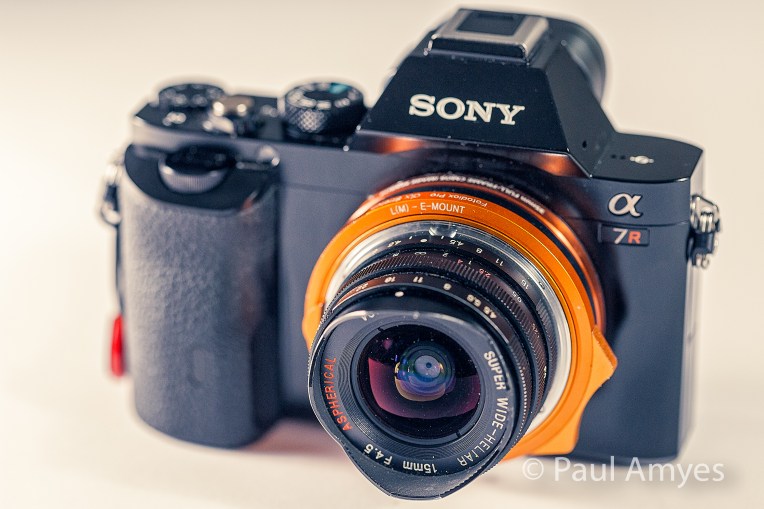
Cosina Voigtlander 15mm f4.5 Super Wide-Heliar lens mounted to a Sony A7r via a Voigtlander VM Adapter II. and Voigtlander L39 to M mount adapter.
I’ve been meaning to write a review of this lens for a long time – well over a year in fact – and it has proven difficult for a number of reasons which will become apparent as we proceed. In an ideal world all lenses would be wonderful for every possible use we put them to, and to be fair with modern lens their computer aided design makes this happen for the most part. Things get sketchy when we are dealing with older designs on modern digital cameras. High resolution digital imaging has placed a great deal of strain on lenses. With film only a few people had the time, ability, resources and inclination to examine the optical performance of lenses. This was largely the province of a few magazines (remember them?) and they would accompany a review with a couple of graphs which would reference the resolving capabilities with fine grains low ISO black and white films developed in special developers designed to minimise grain and maximise acutance. Now anyone can open up an image in Photoshop and zoom into 200% and see a lenses faults. This is why Canon, Nikon and independents such as Sigma are going through their catalogue of lenses and updating them, and this need for optical improvements explains why lenses are getting bigger, heavier and more expensive. Back to the matter at hand. The video below is the short version.
Cosina Voigtlander 15mm f4.5 Super Wide-Heliar Lens.
The Voigtländer 15mm f4.5 Aspherical Super wide-Heliar to give its full name is really the antithesis of modern lens design. It is small, light, affordable and not heavily optically corrected. But having said that this is the lens that really put Cosina’s re-launch of the Voigtländer brand on the radar of photographers. I can remember when this lens first came out a friend of mine borrowed one and ran around madly shooting roll after roll of film with a silly look on his face enthusing about it wildly. Up until then the widest lens in Leica M mount was the Zeiss 15mm f8 Hologon of which only 225 were made and currently change hands for around the $10,000 USD for one in mint condition.
The Voigtländer 15mm f4.5 is now discontinued but can be obtained as new old stock for approximately $600 USD, or second-hand on Ebay for around the $400 USD mark at the time of writing.
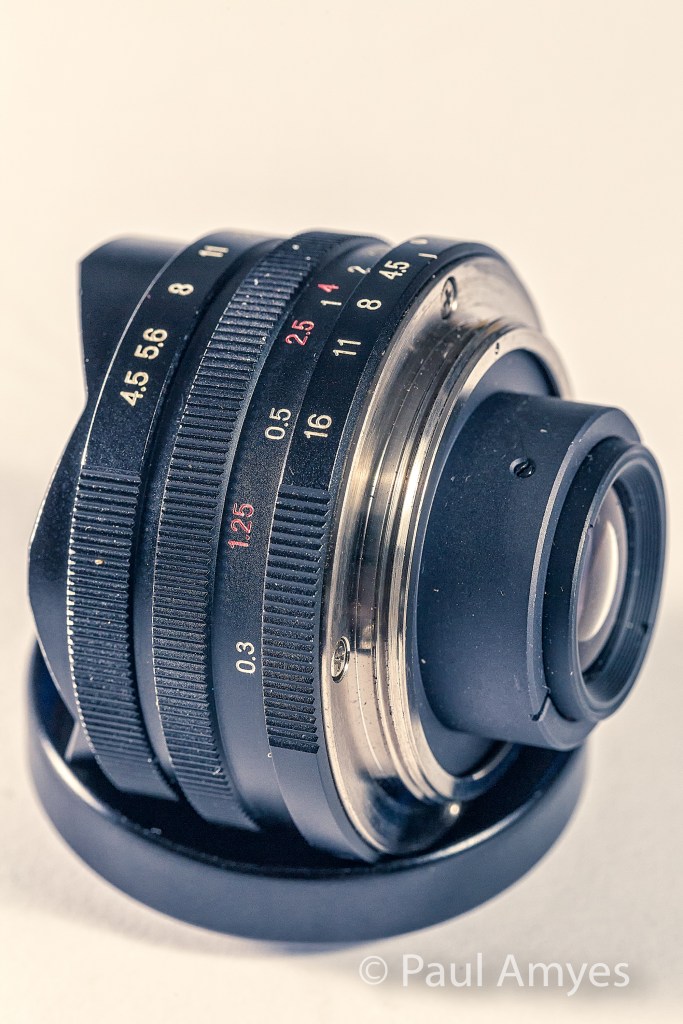
Cosina Voigtlander 15mm f4.5 Super Wide-Heliar lens showing the Leica L39 screw mount.
Cosina Voigtlander 15mm f4.5 Super Wide-Heliar lens showing the Voigtlander L39 to M mount adapter.
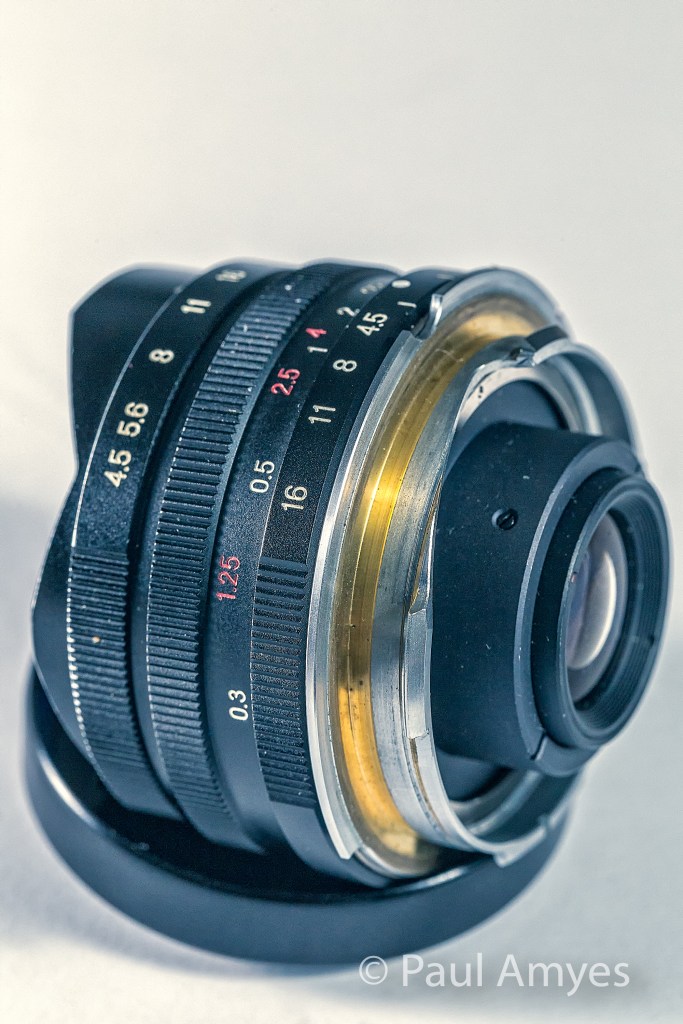
Cosina Voigtlander 15mm f4.5 Super Wide-Heliar lens showing the Voigtlander VM adapter II Sony E mount adapter.
Specifications
Mount – Leica thread or L39
Angle of view – 110º
Lens construction – 8 elements in 6 groups with one aspherical element
Number of aperture blades – 10
Aperture range f4.5 – f22 in half click stops
Minimum focusing distance – 29.85cm or 11.75 inches
Weight – 113g or 4oz
Diameter 49.6mm or 1.94 inches
Length – 30.7mm or 1.2 inches
Filter thread – N/A
Lens hood – built in tulip style
Rangefinder coupling – no
The lens is very well made – up to Cosina’s very high standards and it has, despite its diminutive size a solid feel and satisfying heft. The aperture ring is at the front of the lens, as is usual with rangefinder lenses, and turns nicely with satisfying half stop click indents. The focusing action is very smooth and has an approximate 100º throw. I found that I tended to use hyper focal distances to zone focus the lens in use as the short focal length means that the DOF is immense. The lens has a very clearly marked scale to make this easy. An aperture of f8 means that everything from 0.5m to infinity is in focus. Conversely lovers of shallow depth of field should really be looking elsewhere.
Test Results
Cosina Voigtlander 15mm f4.5 Super Wide-Heliar lens mounted to a Sony A7r via a Voigtlander VM Adapter II.
Cosina Voigtlander 15mm f4.5 Super Wide-Heliar lens mounted to a Sony A7r via a Voigtlander VM Adapter II.
Years ago Clint Eastwood made a film called “The “Good, The Bad, The Ugly” (a movie which had the coolest theme tune ever, actually that is an exaggeration as everyone knows Shaft had the coolest, but it’s a close run thing) well this lens is all three. Good, bad and ugly. The good comes when you use the lens as intended on a film rangefinder body. The bad when you mount it on a digital m4/3s body and the ugly when you put in from of the A7r’s 36Mp sensor. This lens is one of the worst I’ve ever had on a digital camera – the worst was a $20 25 mm f/8 Holga lens in m4/3s mount which I tried using on my Olympus EP2 several years ago, but that is, as they say, another story. My friend who I mentioned earlier abused Kodak Tri-X by pushing it, developing in Rodinal and then lith printed the results. He wouldn’t have noticed what I’m about to describe. So this is how it was on the Sony A7r.Right from the get go there is obvious barrel distortion. Wide open there is considerable vignetting which has a very obvious magenta cast. No matter how far you stop down this does not go away (kind of like Mormon missionaries on your doorstep). Wide open the centre sharpness is quite good and remains so until f22 when diffraction rears its ugly head. The corners are smeared and out of focus, things improve a little by f11 but they never get to the level of sharpness of the centre of the lens. Chromatic aberration is also present throughout the aperture range. Flare for such a wide lens is remarkably well controlled and lovers of sunstars should be happy as the 10 aperture blades produce nice results.
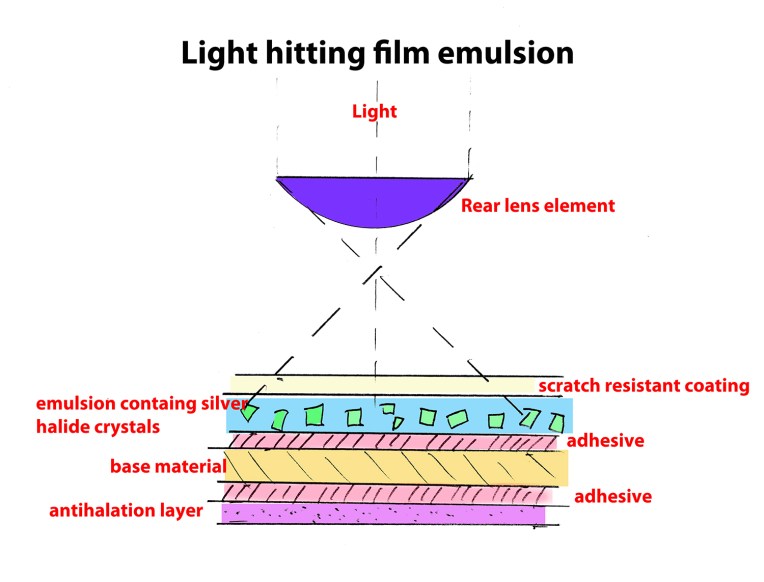
With film the light-sensitive silver halide crystals don’t care at which angle light hits them.
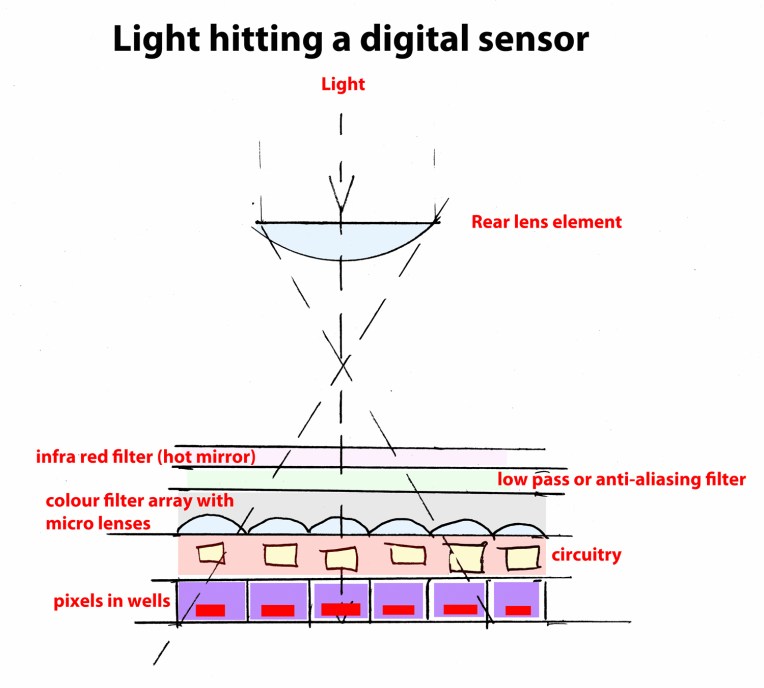
The reasons for this are that Voigtländer 15mm was designed for use with film and the silver halide crystals in the film emulsion did not care at what angle lights hits them to provide the necessary reaction to form the latent image. But with a digital sensor it is a whole different ball game because the sensor is no longer just a gelatine substrate coated with an emulsion containing silver halide crystals it is a complex sandwich of filters, lenses and electronic componentry as the schematics show. For best performance the light needs to enter micro lenses at 90º, when the incidence of the light is severely off perpendicular then not all of it reaches the pixel at the bottom of its well this can cause vignetting, smearing with loss of detail, and severe colour fringing. This is what stopped Leica initially developing a digital range finder. Kodak developed a special sensor with offset micro lenses for Leica to help overcome this along with in camera software correction the digital M became a reality.
For light to hit the pixel in its well it needs to travel as near to perpendicular to the sensor plane as possible.
In Use
For stills photography the 15mm f4.5 could be a consideration if you don’t have the current fixation of razor sharpness corner to corner i.e. if the hero of your shot is central to the frame and you don’t mind loss of sharpness at the edges. Working in monochrome would help get rid of the magenta cast of the edges as well. Have said that the magenta cast and vignetting are removable in post, the accompanying video shows how this can be done in Lightroom. In the gallery of example pictures below I’ve left the magenta cast in some of the photos so you can see what it looks like. If you’d like to see the photos larger they can be seen here.
This slideshow requires JavaScript.
Video is another matter. Ideally this lens should be perfect for vlogging on a Sony A7 but the smearing, colour cast and vignetting make it quite unsuitable. Also it has no filter threads so it is impossible to use a variable neutral density filter which further adds to its unsuitability.
Conclusion
To be completely fair we are demonstrating uses for this lens that it was never designed for. With film and optical/chemical printing it is an amazing lens at very cheap price. When looking at it from a digital imaging point of view, whether stills or video, it really can’t be recommended unless you already own it and are prepared to put up with its short comings. If you are looking for an ultra wide the are better options available such as the Laowa 15mm f/2 Zero-D Lens.
I’m always pleasantly surprised by the things I find while pootling along the back roads of Western Australia. Last weekend was a case in point. I was driving along the bucolic Ferguson Valley in the south-west of the state when I came across something that just expressed a sense of spontaneous anarchistic fun. That something was Gnomesville. We’ve all seen garden gnomes haven’t we? You know those kitsch garden ornaments usually made out of plaster and sometimes out of cement that can be found in gardens all over the world. Usually they are seen singly, occasionally in twos or threes. Sometimes you come across a garden that has maybe a couple of dozen and that is regarded as a bit OTT. So imagine a place with thousands of gnomes. That’s right thousands. The exact number is not known, but some reckon the figure could be as high as 5000. They are not in a garden, it’s not some commercial tourist attraction. Gnomesville is found on the verge by a roundabout in a very rural setting.
Welcome to Gnomesville. A small gathering of the inhabitants. Western Australia. Sony A7r with Olympus OM Zuiko 35mm f2 lens. Exposure: 1/60th sec, f8 at ISO 320.
The whole thing is absolutely bonkers. So how did it start? Well there is the legend of Gnomesville which is as follows:
“A long, long time ago, a Gnome was travelling on an Australian country road. It was at night and far from anywhere. All around was leafy and green. A pleasant place.
By and by, he came to a fork in the road. He followed the road, which seemed to go around and around.
Now, being a little person, he could not see over the curb. If he did, the story would have ended here.
He walked all night with the feeling he was going nowhere. Roads branched off every so often. By the morning, he was exhausted. Then it was clear. He had come across a ROUNDABOUT—a circular intersection in the middle of (almost) nowhere.
This was something he had never seen as a country traveller.
But it was a nice place and reminded him of home. There was a bubbling brook and shady trees. So he stayed a while. And another while. Other Gnomes passed and visited, and many stayed. Word passed around.
Gnomes from far and wide left their gardens and came to visit. But they stayed. This was something new for the mostly solitary Gnomes. There was something irresistible about the place. It was as if the ROUNDABOUT was casting a spell.
Peak hour in Gnomesville. Western Australia. Sony A7r with Sony FE 28-70mm f/3.5-5.6 OSS. Exposure: 1/200th sec, f4 at ISO 200.
For people who need the real actual true story well Kevin and Vicki Campbell were a local couple who played a large part in the creation of Gnomesville. The local shire had annexed some land from a neighbour to create a T junction at the bottom of a hill. The local residents weren’t too keen as they felt that it would be unsafe. So after a public meeting and some toing and froing it was decided that a roundabout would be built instead. Not long after a gnome appeared in a hollow tree by the roundabout. It was in fact the very spot where Vicki used to leave her bicycle when she caught the school bus as a child. It was the start of a gnome sit in protest. Soon there were twenty gnomes all showing solidarity. And so Gnomesville was born. I prefer the legend. Now people come from quite literally all over the world to leave a gnome. When I was there a young couple with their son had come all the way from Malaysia to leave a gnome. There are Dutch gnomes, gnomes from Japan, even from Finland. Gnomesville is a very cosmopolitan place.
Gnomesville attracts gnomes from all over the world. This is the Japanese contingent. Gnomesville, Western Australia. Sony A7r with Cosina Voigtlander 15mm f4.5 Super Wide-Heliar lens. Exposure: 1/60th sec, f8 at ISO 400.
So if you are in the vicinity of Bunbury and are kicking your heels wondering what to do take a drive out to the Ferguson Valley and enjoy the sights of Gnomesville. You could even stop off and buy a gnome to leave there.
Warning – gnomes crossing. Gnomesville, Western Australia. Sony A7r with Olympus OM Zuiko 35mm f2.0 lens. Exposure: 1/160th sec, f2.8 at ISO 200.
*apologies to Wally Johnson and Bob Brown for corrupting the title to their all time Aussie favourite song “Home Among The Gum Trees”







You must be logged in to post a comment.