Cowslip Orchid, Caladenia flava subs. flava. Williams, Western Australia
I’ve been a bit miffed lately with Olympus/OM Systems. A lens that I bought recently was not functioning properly and has spent more time at the service department than with me. Then there’s my Olympus STF-8 a supposedly rugged, weatherproof and very expensive macro flash whose buttons have fallen off and is now inoperable and unrepairable (as in it’s not designed to be repairable but be disposable). I’ve been so miffed that of late I’ve stopped using my Olympus kit and relegated it to the cupboard while having thoughts of getting rid of it all and changing systems. In fact I’d already decided which ship I was going to jump on – Sony – and which items I’d buy after watching a lot of YouTube videos.
Clubbed Spider Orchid, Caladenia longiclavata. Williams, Western Australia.
To that end for last weeks road trip to Williams in search of the Common Dragon Orchid I dug out my much neglected Sony A7r2 and some lenses to reinforce this new plan and familiarise my self with the Sony ecosystem again.
Banded Greenhood, Pterostylis vittata. Williams, Western Australia.
The trip to Williams was great – it was a beautiful day and there were plenty of orchids to photograph. The only fly in the ointment was the photographic experience. It should be easy – I’ve done it so many times before. Find an orchid. Set up the camera on a tripod and point it at the orchid. Take the picture. What could go wrong? Well for this type of photography I rely heavily on the rear LCD screen and I’d forgotten that the screen on the Sony A7r2 is unusable in bright sunlight. Secondly I’ve become very reliant on having touch control on the rear LCD so I can easily select the focus point and trip the shutter. There’s no such function on the Sony and there is a very convoluted system of setting the AF point. Then there is the woeful battery life of the Sony A7r2. I went through 4 batteries in two hours where as with the Olympus I wouldn’t even get through 1/2 a battery. I could continue with more points of frustration and irritation, Lord knows there were loads of them, but I’ll refrain. By the end of the morning I was wishing I’d taken my Olympus EM1 mk ii with me. Were there any positive points? Well yes I love the files from that 42Mp Sony sensor. I really like the Sigma 105mm macro lens. But, unfortunately the negatives outweighed the positives and it made me realise why I’ve stopped using the Sony A7r2.
Banded Greenhood, Pterostylis vittata. Williams, Western Australia
I’ve already started to get things together for this week’s trip and my Olympus kit, minus the flash, has gone back in the bag. As to whether I will change will depend upon whether OM Systems Australia returns my lens in a functioning state.
Common Dragon Orchid, Caladenia barbarossa.Williams, Western Australia
Clubbed Spider Orchid, Caladenia longiclavata. Williams, Western Australia
For me now the orchid season here in the Wheatbelt of Western Australia is effectively over until next May. This year instead of going here there and everywhere I decided to concentrate on what was just around York, with the exception of a trip to Augusta. Despite that limitation I still managed to photograph over 90 different species and the video below is made up of just a small selection of those photos.
A few days ago I made the 260Km round trip out to Corrigin to try and find the Pygmy Orchid, Corunastylis tepperi. I’d never seen it before and it is an early start to the orchid season. I also wanted to try out some new ideas for photographing orchids before the season proper starts. I knew roughly where to look, but once there it was like looking for a needle in a haystack. The plant lives up to its name – it is very small. The flowers are about 3mm and they can be found on a stalk 2-3 cm tall. As the the orchid prefers leaf litter found in mallee woodlands this makes them even harder to find.
Pygmy Orchid, Corunastylis tepperi. Corrigin, Western Australia.
When I drove up to the spot my heart sank a little as I had hoped that having just come up a fresh green plant would be fairly easy to spot, but as luck would have thanks to some rains we had a few weeks ago some grasses had begun to sprout as well. The area was covered in litter – not recent, it was old, very old. There were rusty steel ring pull cans all over the place. Now I’ve been in Australia thirty three years and drinks cans were aluminium back then, so I would say they were forty years old at least. The beer bottles looked even older. Take your litter home folks and then you can collect the 10c deposit on each item. As luck had it I found a whole patch of the pygmy orchids about 700m from where I’d parked the car.Having finished so quickly I decided to head off to experience the delights of downtown Corrigin.
Pygmy Orchid, Corunastylis tepperi.
Now besides orchids Corrigin’s other claim to fame is its association with dogs. The town holds the world record for the most dogs in a ute. Non Australians probably will be a bit perplexed by this but for a few years it seemed like very country town wanted to cram as many dogs as physically possible into a ute. The town also has a dog cemetery which has become quite a big tourist attraction so I made a quick stop there. It’s not the first time I’ve visited but I wanted to see if there was anything new as the owners of the dogs erect memorials and I’m fascinated with how their love for their dogs expresses itself.
The entrance to Corrigin Dog Cemetery, Western Australia.
One of the good things with photographing orchids as opposed to photographing wildlife and in particular birds is that you don’t have to get up at stupid o’clock. In fact some species of orchids will only be at their best in the middle of a bright sunny day. So by the time I hit down town Corrigin it was well past lunch time so I went into one of the two cafes and ordered a BLT sandwich. Two minutes later the waitress informs me that there is no sliced bread would I mind it being in a roll. Another two minutes and I’m informed there’s no lettuce. A further two minutes passes and I’m told there’s no tomato. At this point I’m starting to think that I’ll be told there’s no bacon when the waitress brings this enormous baguette with half a pig in it. It is literally the biggest bacon roll I’ve ever seen.
Hooch’s grave in Corrigin Dog Cemetery.
The night before we’d watched the movie “The Dry” staring Eric Bana. Although we’ve not had a drought the drive out to Corrigin reminded me very much of the movie. I love driving through the Wheatbelt – you get the feeling that the roads could go on forever and the movie very much captured that feeling. If you’ve never seen the movie give it a watch as I thought it was very good.
OK that maybe a little bit melodramatic, but there was no doubt that getting out and about after a few weeks of lockdown was a bit of a rush! So where did I go? What did I do with this new found liberty? Well I went to Wongamine Reserve near Toodyay to look for two types of orchid and do the walk trail. Pretty sad eh?
The main entrance to Wongamine Nature Reserve, Toodyay, Western Australia.
The reserve isn’t really visited any more the gates are locked and many of the signs broken or over grown. In fact speaking of overgrown the walk trail is so overgrown in places that I suggest that if you do want to visit and walk there that you take a GPS and download the walk track from Trails WA and follow that.
The reserve was closed a while ago and many of the trails and signs have fallen into a state of disrepair. Wongamine Nature Reserve, Toodyay, Western Australia.
Some of the vehicle tracks have not been used for a long time allowing termites to build mounds on them. Wongamine Nature Reserve, Toodyay, Western Australia.
This was one of only two trail markesr on the walk trail. Wongamine Nature Reserve, Toodyay, Western Australia.
Was there anything positive about the visit? Well yes there was actually. The woodland is home to quite a variety of bird life – I didn’t photograph any as I was not carrying a suitable lens as I had gone to photograph orchids. I would expect from walking through the bush that would be quite a display of wildflowers in spring which would make the journey well worth while. There were quite a few species of dragonflies as well which at the time surprised me for some reason.
Australian Emperor Dragonfly (Anax papuensis) Wongamine Nature Reserve, Toodyay, Western Australia.
Did I find the orchids? Well the Winter Spider Orchid is only 6cm tall with a 2cm flower and the Crinkle-leafed Bunny Orchid is 10cm tall with a 9mm flower and considering that the reserve is 330 ha of bushland I think I did well to find anything at all. I didn’t find any Winter Spider Orchids, I have photographed them before at Babakin, but I found lots of the Bunny Orchids. In fact I never seen so many Crinkle-leafed Bunny Orchids before. So all in all it was a great day out.
Red Capped Robin, Petroica goodenovi, Avon Walk Trail, York, Western Australia. Panasonic G85 with Panasonic Leica 100-400mm f4-6.3 lens. Exposure: 1/500 sec, f6.3 at ISO 1000 with -2/3 stop exposure compensation.
Tomorrow here in Western Australia is the first day of spring. I don’t think Mother Nature got the memo as the bush around York sprung into life a couple of weeks ago. Flowers are bursting into bloom and the birds are in a frenzy of nest building and dancing around trying to attract mates. This means that I have also sprung into action trying to document as much of thais activity as possible. The cameras are working over time.
The unusual lutea or “yellow” form of the common donkey orchid (Diuris corymbosa). Talbot Hall, Western Australia. Canon EOS 6d with Canon EF 100mm f2.8 IS L macro lens. Exposure: 1/800 sec, f8 at ISO 400.
Green Spider Orchid, also known as the Fringed Mantis Orchid (Caladenia falcata). Talbot Hall, Western Australia. Canon EOS 6d with Canon EF100mm f/2.8L Macro IS USM lens. Exposure: 1/160 sec, f5.6 at ISO 400.
White Spider Orchids, Caladenia longicauda, Wambyn Reserve, Western Australia. Canon EOS 6D with Canon EF100mm f/2.8L Macro IS USM lens. Exposure: aperture priority with off camera flash 1/50 sec, f11 at ISO 100 with -1 stop exposure compensation.
Winter Donkey Orchid, Diuris brumalis, Wambyn Reserve, Western Australia. Canon EOS 6d with Canon EF100mm f/2.8L Macro IS USM lens. Exposure: 1/25 sec, f8 at ISO 100.
Brown Honeyeater, Lichmera indistincta, Avon Walk Trail, York, Western Australia. Panasonic G85 with Panasonic LEICA DG 100-400/F4.0-6.3 lens. Exposure: 1/500 sec, f13 at ISO 200 with -2/3 stop exposure compensation.
Female Western Whistler, Pachycephala occidentalis,, Avon Walk Trail, York, Western Australia. Panasonic G85 with Panasonic LEICA DG 100-400/F4.0-6.3 lens. Exposure: 1/500 sec, f11 at ISO 200.
This could have been titled Hyden – the return. Hyden is a small town in the middle of the Wheatbelt in Western Australia some 292Km east of Perth. Regular readers will remember that we’ve been before and maybe somewhat perplexed as to why we’d bother to visit again. Well Hyden’s claim to fame is Wave Rock which is a large granite rock face that has been eroded in the shape of a perfect breaking wave. More than 100,000 tourists make their way there very year. Most just stay about an hour before zooming off to another destination to get the perfect instagram shot without taking any time to see what else is there. A great shame really as there is so much more to offer. When I wrote about our previous visit I concentrated more on other sites and the Aboriginal heritage of the area. This time I’ll look at what Hyden has to offer in terms of the natural world.
We decided to make a three day trip and on our way we’d stop off in Corrigin whose main claim to fame is the being the holder of the world record for the number of dogs in a ute and being the home to a dog cemetery. You’d be forgiven for thinking that Corrigin is a bit obsessed with dogs. Anyway it was a nice spot to break the journey, stretch the legs, make the bladder gladder etc. Corrigin does have a pretty impressive wildflower drive which begins just opposite the dog cemetery just on the outskirts of town. Most people just pull up in their car, jump out and walk a couple of metres. They then declare that there’s nothing to see and rush off in a cloud of red dust. Just take your time and have a poke about and you’d be amazed at what you can find. Here are a few examples.
Sugar Candy Orchid, Caladenia hirta subsp. hirta. Wildflower Drive, Corrigin, Western Australia. Panasonic Lumix G85 with Olympus mZuiko 60mm f2.8 macro lens and Metz 15MS-1 flash. Exposure: AE priority 1/200 sec, f4 at ISO 400 with -1 stop exposure compensation.
Chameleon Spider Orchid, Caladenia dimidia. Wildflower Drive, Corrigin, Western Australia. Panasonic Lumix G85 with Olympus mZuiko 60mm f2.8 macro lens and Metz 15MS-1 flash. Exposure: AE priority 1/100 sec, f4 at ISO 400 with -1 stop exposure compensation.
Blood Spider Orchid, Caladenia filifera. Wildflower Drive, Corrigin, Western Australia.
Slender Spider Orchid, Caladenia pulchra. Wildflower Drive, Corrigin, Western Australia.
Sugar Orchid, Ericksonella saccharata. Wildflower Drive, Corrigin, Western Australia.
When we got to Hyden we drove out to the Wave Rock Resort on the shore of Magic Lake which is where we were staying. The lake is quite startling. It’s not very big but is comprised of crystal clear salt water with a gypsum base. That pale coloured lake bed combined with the water makes a giant reflector that takes on the colours of the sky so as the day progresses the lake changes colour. To add to it’s other worldly qualities is that it lies in the middle of a salt plain which is fairly uniform in colour and is covered in mainly scrubby bush and a smattering of trees. It all made me want to get the tripod and graduated neutral density filters out.
Magical Magic Lake. A canoe on Magic Lake beach at sunset. Western Australia. Panasonic G85 with Panasonic Leica 8-18mm f2.8-4 lens and +3 stop graduated neutral density filter. Exposure: AE priority 1/8 sec, f11 at ISO 200 with +1 stop exposure compensation.
Magical Sunset. Magic Lake at sunset. Hyden Western Australia.
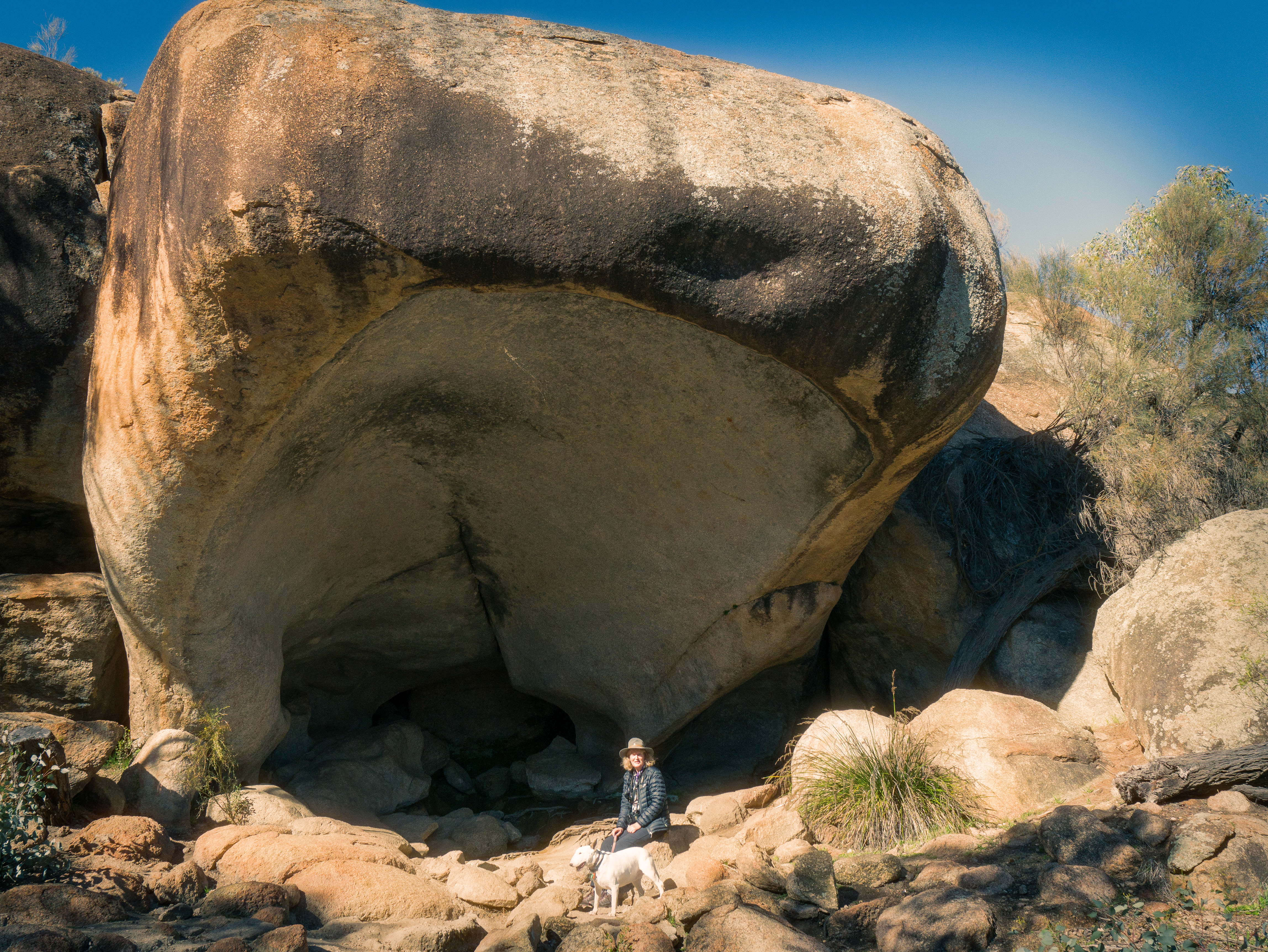
The next day we decided to combine the Wave Rock Walk Circuit with the Hippo’s Yawn Loop and the Breakers Trail to create a loop that would take us from the resort up to the Hippo’s Yawn then along the bottom of the rock out to the Breakers picnic area and then back to our accommodation at the resort. The best part of it was that we could take the dog as it is all very pet friendly. Along the way we hoped to see more orchids and birds as we passed through the salt plain and into the bush at the base of the rock.
Old fence posts march across the salt flats at Magic Lake near Hyden in Western Australia. Panasonic Lumix G85 with Panasonic Leica 100-400mm f4-6.3 lens. Exposure: 1/250 sec, f8 at ISO 200.
Crested pigeon, Ocyphaps lophotes, Magic Lake, Hyden, Western Australia. Panasonic G85 with LEICA DG 100-400/F4.0-6.3 lens. Exposure: Shutter priority 1/500 sec, f6.3 at ISO 200 with -1/3 stop exposure compensation.
Known to the Nyoongar as Kayibort the Black-faced woodswallow, Artamus cinerus, can be seen on the shores of Magic Lake, Hyden, Western Australia. Panasonic G85 with LEICA DG 100-400/F4.0-6.3 lens. Exposure: shutter priority 1/500 sec f6.3 at ISO 200.
Salt Lake Spider Orchid, Caladenia exilis subsp. exilis. Magic Lake, Hyden, Western Australia. Panasonic g85 with OLYMPUS M.60mm F2.8 Macro lens. Exposure: aperture priority 1/640 sec, f4 at ISO 200 with +2/3 stop exposure compensation.
Yellow Spider Orchid, Caladenia denticulata subsp. denticulata. Magic Lake, Hyden, Western Australia. Panasonic G85 with OLYMPUS M.60mm F2.8 Macro lens. Exposure: aperture priority 1/125 sec, f8 at ISO 1000 with -1/3 stop exposure compensation.
When we got to the base of the rock the vegetation changed from the scrub of the salt plain to thick bush fed by the water run off from the rock. We both enjoyed pocking around in the undergrowth looking for flowers, taking photos of each other and trying to dissuade Frida, our dog, from trying to climb up the rock face in search of interesting holes. It was amazing to see so many orchids – the blue beards were like a carpet in places. It was absolutely wonderful to see.
Helen and Frida at Hippo’s Yawn near Hyden in Western Australia.
Jug orchid, or recurved shell orchid (Pterostylis recurva). Wave Rock, Western Australia.
Blue beard or blue fairy orchid (Pheladenia deformis),. Wave Rock, Western Australia.
All in all we had a great time. There is so much to see and do that we’re already talking about going again. If you are planning a trip to Wave Rock there is a whole lot more to it than posing for a selfie for Facebook on the rock.
The Emu Fence at Wave Rock Resort. Hyden, Western Australia. iPhone SE in panorama mode. Exposure: 1/1400 sec, f2.2 at ISO 25.





You must be logged in to post a comment.