“Weaving spiders, come not here…

…Hence, you long legged spinners, hence!”

Willian Shakespeare. A Midsummer Night’s Dream (Act 2, Scene 2)


“Run Harry! Run!”


I must say at the outset that I don’t like spiders very much. The bloody great hairy jobs in the Hobbit, Lord of The Rings and Harry Potter movies didn’t help much either. Coming to Australia has meant that the chances of coming into contact with some horrible large spider with a venomous bite have increased. However, of late that maybe changing. That could be because I’ve seen some rather cute jumping spiders and the rather spectacular looking Jewel Spiders. It maybe that I’ve just become desensitised by seeing so many, referred to as “flooding” in psychotherapy. Nah! Got to be honest the large hairy ones still give me the heebie-jeebies.


Shaggy Red-headed House Hopper (Hypoblemum villosum) sitting on the flex of our iron in the laundry. They grow between 4-8mm long.


A different view of the Shaggy Red-headed House Hopper (Hypoblemum villosum). They grow between 4-8mm long.


A male jumping spider (Sandalodes superbus), another species of Jumping Spider, found in the garden. I like the way they look up at you.


I think it was the jumping spiders that made me more comfortable about spiders as they are sort of cute with that turret head and the way that they look at you. I was particularly enamoured with the Shaggy Red-headed House Hopper (Hypoblemum villosum) I found in the laundry. He was tiny, no bigger than 5mm. Since then I’ve seen other varieties around the garden – they’re a bit bigger but I can tolerate them.


Jewel spiders (Austracantha minax) are often called Christmas spiders as they are commonly found during December and January. Oyster Bay, Western Australia.


Christmas spiders or jewel spiders (Austracantha minax) can be readily found in the usndergrowth surrounding Thomsons lake in Western Australia.


The Christmas Spider or jewel spider (Austracantha minax) is associated with the comming of Christmas in Western Australia.


The jewel spiders are also quite attractive to look at. They come out around Christmas time, hence their more common name of Christmas Spider. What they and the jumping spider have in common is that they are not large nor are they poisonous.


The Golden orb weaving spider, Nephila edulis., is so called because of its web that takes on a golden sheen. York Western Australia.


A female Golden Orb-weaving Spider (Nephila edulis) in our front garden. That messy tangled bit hanging down is the larder.


Male Nephila edulis or Golden Orb Web Spider. He’s only 6mm in length while his mate can be up to 4cm. Let’s hope he doesn’t end up in the larder after the deed is done.  Oswaild Sargent Reserve, York, Western Australia.


The next spider I’ve become reasonably  tolerant to is the Golden Orb Weaver (Nephila edulis). Now these are big – well the females are at 4cm in body length, the males don’t get much bigger than 6mm. Thankfully they are very reluctant to bite and when they do according to the Australian Museum “Symptoms are usually negligible or mild local pain, numbness and swelling. Occasionally nausea and dizziness can occur after a bite. Seek medical attention if symptoms persist.”. Re-reading that I now don’t  feel reassured. The webs are what attracts me to them. They are magnificent creations at over 1 metre in diameter and the golden silk that they are made from shimmers spectacularly in the early morning light.  I can’t walk past one without stopping to take a photo. So it’s very convenient that I’ve got one just outside the front door.


The huntsman spider (Delena cancerides) can grow to the size of the palm of your hand and is often found in peoples homes. You don’t need a macro lens to photograph these. As far as I’m concerned a long telephoto helps keep the distance between me and it.


So far it sounds like I’m fairly tolerant to spiders. Well let me tell you there is one species that can induce a full on panic reaction  that is the Huntsman Spider. It’s not that they are big – they are flippin’ big and have a leg span of 15cm and a large hairy body to boot. It’s the way they move and the speed of them as they run across the walls and disappear behind the sofa.  They are the stuff of scary movies. If you should try and swat one with a rolled up newspaper or magazine they’re just as likely to snatch it off you and give you a good walloping. I don’t care how beneficial they are to have in the garden or that they are relatively harmless. “Relatively harmless” – who decides these things? That’s like saying Donald Trump is relatively harmless unless you live in the Middle East. Sorry I’ve gone off piste.  Huntsman Spiders – well I don’t like having them in the house. They make me do the spider dance – it’s where you manically hop from leg to leg while swating the imaginary spiders on your body and screaming like an adolescent girl in a slasher B movie. Thankfully we have our resident house geckos and spider wasps to keep them away.


My saviour! Bibdjool or Marbled Gecko, aka house gecko (Christinus marmoratus) on our back window at a previous house. York, Western Australia.

A Raucous Dawn Chorus

As summer draws to a close dawn comes round a little later meaning that I don’t need to get up early. It gives an opportunity to enjoy a leisurely cup of that all important morning coffee and head out.


A New Morning by Paul Amyes on 500px.com
Wayan or White-faced Heron (Egretta novaehollandiae) greets the new morning. York, Western Australia.


Once down at the river I’m met with sight of the sun just peaking through the clouds and it was a joy to behold. Then the moment is shattered as several hundred Little Corellas take to the air in a whirling squawking mass. Successive waves of birds fly over me each one noisier than the one that preceded it. It was an incredibly intense experience. Eventually the birds all decided to settle in the gum trees along this section of the river bank. Physically they may have settled but their incessant squawking didn’t stop. I was transfixed. I didn’t bother continuing along the river bank I just stayed and watched and photographed. 


Playing Around by Paul Amyes on 500px.com
As the sunrises the Manatj or Little Corellas (Cacatua sanguinea) start to become active.


Manatj by Paul Amyes on 500px.com
Then as the sun rises over the horizon the Little Corellas take to the air en masse.


Manatj by Paul Amyes on 500px.com
Eventually they begin to settle in the trees.


Manatj by Paul Amyes on 500px.com
Some continue to cry out.


I
While others are content to perch quietly.


A Over T

If you are a regular reader you may recall that I recently wrote about having one of those magical days where everything goes right. Well yesterday was the anthesis of that.


Noolarko by Paul Amyes on 500px.com
Noolarko or Black-faced Cuckoo Shrike (Coracina novaehollandiae) waiting for the clouds to break and the first rays of the sun to light up the day.


We had decided to get up early and walk along the River Avon here in York, so come 5am I bounced out of bed (Haha! As if!) and quickly got dressed. As I quickly had a coffee and piece of toast the rain began to fall. It was one of those summer downpours with big fat lazy raindrops that hit the parched dirt and release that wonderful petrichor. These downpours don’t generally last long and this one was no different so we headed out. On arriving at the river it was quiet, very quiet. In fact unnervingly quite. A complete absence of bird sound apart from a rooster making it’s presence known, but, that doesn’t count. It’s very unusual to be out at dawn and not hear birds singing. I thought normal activity would be resumed when the sun broke through the clouds so we carried on walking. A pair of Black-faced Cuckoo Shrikes perched high up in a dead tree gave me something to point my camera at. Not thrilling photos but a start nonetheless. A bit further on and the clouds had now cleared and we were greeted by a brilliant cobalt blue sky and a steady procession of Galahs flying in formation. I managed to get some photos of them. I’d wanted for ages to get a shot of Galahs flying against a back drop of a brilliant blue sky – the contrast of their pink feathers and the blue. Doing something I never normally do I looked at the rear of the camera and when I saw the sequence of photos  I could see that I had achieved that goal. I was at this point feeling rather pleased with myself. The Bible warns us that “Pride comes before a fall” (Proverbs 16:18) and little did I realise that I was about to become literally acquainted with it.


Djakal-ngakal by Paul Amyes on 500px.com
Djakal-ngakal or Galah (Cacatua roseicapilla) fly past.


Turning round we walked back the way we had come and then onto a spot where we could access the river bed. As we broke cover from the bushes we set what seemed like every duck in York flying. Whoops! Then I had this urge to see what if anything was around the corner. When suddenly it happened. You know how people often say that when something catastrophic happens time slows down and everything happens in slow motion? Well that didn’t happen. One minute I’m vertical the next bang and I’m prostrate in the mud with incredible pain shooting up my arm and from my hip. Necessity meant that I just lay still for a bit to see if the pain subsided. I quickly realised at this point that I wasn’t seriously hurt because I was more concerned that my camera had survived the cataclysm than about any injuries I’d sustained. I also became aware of the beloved significant other calling out. She had tried to get over to me but hadn’t got very far as she didn’t want to befall the same fate. Gingerly I got onto all fours and crawled to a firmer spot and got up. I was covered from head to toe in evil smelling river mud – my camera wasn’t much better.


After a dramatic fall while out birding this morning the Olympus EM1x and OM System 100-400mm look a little worse for wear.


Sitting here writing this my camera and I have scrubbed up well. It works perfectly – a testament to ruggedness of Olympus cameras. Me – I’m a bit sore, but there is no major damage.

Note to self: don’t go walking along the river bed just after it has rained – it is very slippy.

Chance…

… favours the prepared mind.”  Louis Pasteur, December 7, 1854, and in 161BC the Roman playwright Terrance said that “fortune favours the brave” in his play Phormio.


All of which basically means that if you have the necessary mind set be bold enough to seize the opportunities that present themselves. That is what happened the other evening. We had found a new possible nesting site for Rainbow Bee-eaters here in York and the beloved significant other suggested we go and have a closer look the other evening. So I picked up my Sony A7r2 with Sigma 150-600mm lens and we drove down to the location. On getting there there was not a Rainbow Bee-eater to be seen. In fact there weren’t many birds about at all. Scanning the tree tops we soon found out why. In the top of a dead tree were a pair of Australian Hobbys. These beautiful birds of prey will take small flying birds so everything had taken cover. The Hobbys looked magnificent against the bright blue sky. I only managed a short burst before they resumed flying up and down the river bank looking for something to eat.


Wowoo by Paul Amyes on 500px.com
Wowoo or Australian Hobby (Falco longipennis) are often seen in pairs whilst out hunting.


The adapted Sigma 150-600mm doesn’t focus very fast on the Sony A7r2 and the 5 frames per second burst rate isn’t exactly the best, but, it was all good enough for the task in hand.

One Of Those Days

The other day was was one of those days. Not the sort where everything goes mammaries up and you wish you hadn’t got out of bed. No it was one of those days when everything goes stupendously well – like unbelievably well. The other day was just one of those.


Bulland by Paul Amyes on 500px.com
Bulland or Little Egret (Egretta garzetta subsp. nigripes)


Bulland by Paul Amyes on 500px.com
Bulland or Little Egret (Egretta garzetta subsp. nigripes) are quite rare up in the Avon Valley although they are common elsewhere.


I was walking along the River Avon in Northam and it was proving to be a fruitful morning. Black-fronted Dotterels, Black-winged Stilts, Dusky Moorhens, and even a rare (well rare in these parts) Little Egret. After a couple of hours of sheer bliss I decided to call it a day and walk back to the car. As I was walking I thought to myself “You know what would cap off a perfect day? A Sacred Kingfisher.” And lo and behold within seconds of thinking that thought one appeared on a branch right in front of me. The best part was it could clearly see me and didn’t give a stuff. I was in raptures! It was hunting for large insects in the grass and every few minutes it would swoop down catch one and return to the branch and eat it. This kept going on for twenty minutes or so. In the end I called it quits after taking hundreds of photos and it stayed there. A brilliant finale to a brilliant day.


Nidoolyorong by Paul Amyes on 500px.com
A gratuitous shot of a Nidoolyorong or Black-fronted Dotterel (Elseyornis melanops).


Djandjarak by Paul Amyes on 500px.com
This Djandjarak or Black-winged Stilt (Himantopus himantopus) was too busy looking for food to bother about me.


Kanyinak by Paul Amyes on 500px.com
The icing on the proverbial cake. Kanyinak or Sacred Kingfisher (Todiramphus sanctus). Isn’t he magnificent?


Kanyinak by Paul Amyes on 500px.com
Having a bug for breakfast.


Kanyinak by Paul Amyes on 500px.com
Having a laugh.

The last few of weeks I’ve been observing some very interesting bird behaviour (well interesting to me) and I’ve found trying to record it just using photographs wasn’t capturing what was happening. So I’ve decided to shoot more video footage. Up until now I’ve found doing both photography and video very difficult. That’s because I was taught in order to shoot video well you had to have your camera on a tripod, limit your shutter speed to twice that of the frames per second which means faffing around with neutral density filters, use manual focus, take an accurate colour temperature reading and set the camera accordingly, and record good sound. All that takes the spontaneity out of it. If an animal pops up suddenly I like to be able to react in an instant and with stills photography you do that. Video requires (or so I thought) so much preparation that the animal has been and gone. So I came to the conclusion that I only do this for my entertainment so it doesn’t matter if I break “the rules”. So I set my camera up to shoot in programme mode, set auto white balance, auto ISO, I use the camera’s built in microphone for sound, and auto focus. I’m not carrying a tripod so I’m shooting handheld. If I see something interesting I snap off a few photos and then press the video record button. This approach has added a new dimension to my photography and I’ve been very happy with the results so far. Below are a few clips from my brilliant day in Northam. 


Has anyone else added video to their photography?

Feed Me!

At this stage in summer most of the birds are busy feeding their young, with the majority about to fledge soon. The constant foraging for food and hunting must be exhausting for the parents especially in the 40ºC + days we’ve been having lately. Over the last couple of weeks I’ve stumbled across a few nests with demanding offspring and I’ve observed a range of different behaviours designed to get food from a parent.


Kanamit by Paul Amyes on 500px.com
Hungry Kanamit or Welcome Swallow (Hirundo neoxxena) chicks demanding to be fed. Avon Terrace, York, Western Australia.


Kanamit by Paul Amyes on 500px.com
The food arrives.


Kanamit by Paul Amyes on 500px.com
The two larger chicks get fed while the little one at the end misses out.


On Avon Terrace, the main drag in York, a lot of the shop fronts have Welcome Swallow nests tucked away in the shade of the verandas. Most people walk along the street under them not even aware of what is happening above them. I spent an hour watching this particular nest. The adults returned every five minutes or so with food for the three chicks. Two chicks got the bulk of the food as is often the case in birds. I don’t know if the little runt of the brood managed to survive until fledging or not.


Kaaka-baaka by Paul Amyes on 500px.com
Kaaka-baaka or Yellow-billed Spoonbill (Platalea flavipes) adolescent demanding food from its parent.


Yellow-billed Spoonbills
Click to play the video clip.


In Northam, on the banks of the River Avon, I witnessed something I’d never seen before. There were two Yellow-billed Spoonbills in a tree, one a mature adult and the other an adolescent. The adolescent was trying hard to get the parent to regurgitate some food and it did this by first bobbing its head vigorously while flapping its wings. After a while of this it would then start rubbing the parent on the side of its head. The photos don’t do it justice, the video is better.


Djidi-djidi by Paul Amyes on 500px.com
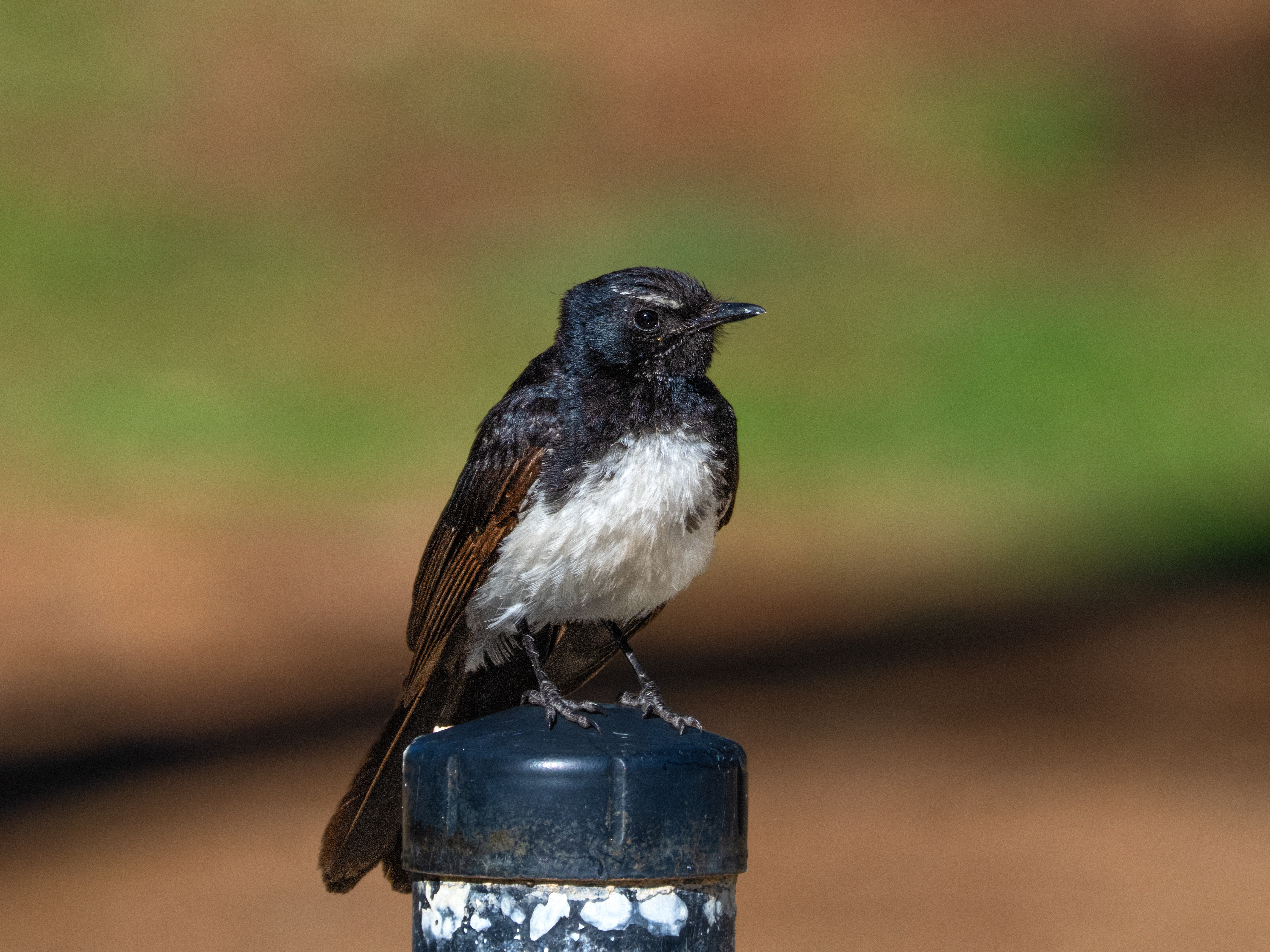
Djidi-djidi or Willie Wagtail (Rhipidura leucophrys) chicks that have out grown their nest.


The unusually placid Djidi-djidi or Willie Wagtail (Rhipidura leucophrys) parent.


Willie Wagtails make incredibly tiny nests – smaller than a tea cup. The typical clutch of eggs is 2-4 which is fine until they hatch and then overcrowding sets in. I spotted this nest while walking back to the car. It looked quite a comical situation – 2 adolescent Willie Wagtails just about ready to fledge crowding round this tiny nest with one in it. All three looked incredible grumpy – it’s the eyebrow and the down turned mouth that gives that impression. One of the parents was sat on a fence post just 5m away closely watching. I was very surprised it didn’t try to chase me off as Willie Wagtails are incredibly aggressive and territorial. Perhaps it was too knocked form taking care of the chicks.

Home On The Range

Events at home over the last few weeks have meant that I haven’t had the opportunity to do very much photography. Most of the blog entries are written a few weeks before they are published because of the vagaries of finding wildlife so that backlog  came in handy for when I couldn’t get out and about. But now the well has run dry.


Crusader Bug Nymph by Paul Amyes on 500px.com
Crusader bug (Mictis profana) instar nymph.


What little photography I have done recently has been in our back garden. Thankfully we have quite a lot of wildlife visit that I can point a camera at. Most of it has been of the usual suspects, the more common species that can be found in gardens in this part of the world, but there have been a couple of unexpected visitors which was very nice. For the best part of a year we had a problem with stray cats killing a lot of the birds and reptiles. But one of our neighbours has taken the main culprit in and the wildlife numbers are climbing back to what they were. 


Wall Skink by Paul Amyes on 500px.com
Wall Skink or Fence Skink (Cryptoblepharus buchananii) cooling off in the bird bath.


Yoorn by Paul Amyes on 500px.com
Yoorn or Bobtailed Lizard (Tiliqua rugosa)


Kanyinak by Paul Amyes on 500px.com
Kanyinak orSacred Kingfisher (Todiramphus sanctus) on our TV aerial with a freshly caught Bombay Runner (Periplaneta americana).


Bambon by Paul Amyes on 500px.com
Bambon or Rufous Whistler (Pachycephala rufiventris). It is a joy to hear this bird sing every morning.


Nye-nye by Paul Amyes on 500px.com
Nye-nye or Zebra Finch (Taeniopygia guttata) looking for food on the back lawn


Djida by Paul Amyes on 500px.com
Djida or Yellow-rumped Thornbill (Acanthiza chrysorrhoa).


Cabbage White Butterfly by Paul Amyes on 500px.com
Cabbage White Butterfly, Pieris rapae.


Giant Grass Hopper by Paul Amyes on 500px.com
Giant grasshopper or hedge grasshopper (Valanga irregularis) resting on the garden fence.


The garden provided a great deal of solace over a difficult time and it always amazes me how restorative being in nature can be. Hopefully, over the coming weeks we’ll be able to get out and about more.


Honey Bees by Paul Amyes on 500px.com
Honey Bee, Apis mellifera.


Settling Down

Spring is now almost over and most of the wildlife has now settled down to domestic duties – having and raising young.

A recent visit to Bernard Park in the Wheatbelt metropolis of Northam showed this to be true. The Australian Reed Warblers were still building nests and it won’t be long before the serious business of egg laying starts.


Koordji-koordji by Paul Amyes on 500px.com
Koordji-koordji or Australian Reed Warbler (Acrocephalus australis subspecies gouldi) gathering nesting material. Northam, Western Australia.
Koordji-koordji by Paul Amyes on 500px.com


Koordji-koordji by Paul Amyes on 500px.com


The Welcome Swallows were mostly content to hang out together between hunting forays, but we did see a couple which did seem to be in the middle of a domestic alternately screeching at each other. Do birds separate and divorce? No idea. Perhaps I anthropomorphising them too much, but it is hard not to project human feelings into animal interactions.


Kanamit by Paul Amyes on 500px.com
A contented pair of Kanamit or Welcome Swallows (Hirundo neoxxena) taking a breather under the Peel Terrace Bridge. Northam, Western Australia


Kanamit by Paul Amyes on 500px.com
These two seemed to be in some sort of domestic dispute.


Kanamit by Paul Amyes on 500px.com
It wasn’t one sided either. Both were carrying on like pork chops in a frying pan. Perhaps a referral to Relationships Australia is in order?

A Reconciliation…

…of sorts. I wrote recently about my attempt to abandon my Olympus cameras and move to Sony and how it was an unhappy experience. Well last weekend I went out orchid hunting in Wandoo National Park and I took my Olympus kit with me and it made for a far happier experience.


Pink Enamel Orchid, by Paul Amyes on 500px.com
Pink Enamel Orchid, Elythranthera emarginata. Wandoo National Park, Western Australia.


Pink Enamel Orchid, by Paul Amyes on 500px.com
Close up of a pink enamel orchid.


The main reason was weight. Looking for orchids in the Wandoo National Park is a matter of walking lots. It is a big park – 463.68 square Km – and while you can drive in on numerous gravel roads and 4WD tracks it only gets you so far and then you have to walk over quite varied terrain to find anything. Humping heavy photographic equipment, water, food, extra layers, first aid kit etc gets old really fast. So anything that can reduce the load is most welcome.


Little Laughing Leek Orchid, by Paul Amyes on 500px.com
Little Laughing Leek Orchid, Prasophyllum gracile. Wandoo National Park, Western Australia.


Pouched Leek Orchid by Paul Amyes on 500px.com
Pouched Leek Orchid, Prasophyllum cyphochilum. Wandoo National Park, Western Australia.


The second reason was the rear LCD panel. Having one I could actually see in bright sunlight again was in a word fantastic. Add to that it was of the flippy flappy variety which meant I could twist it to see it irrespective of the camera position meant that I didn’t have to contort myself into impossible positions. It’s amazing how such small things can make life so much easier and more pleasurable.


Custard Orchid by Paul Amyes on 500px.com
Custard Orchid, Thelymitra villosa. Wandoo National Park, Western Australia.


Custard Orchid by Paul Amyes on 500px.com
Close up of a custard orchid.


The orchids were scarce this year. Where there would be literally a carpet of custard orchids there were just one or two specimens. But, although the numbers were down there were plenty of different species to look at and photograph. I went primarily to photograph leopard orchids and I only found them after about 5 hours of looking. It was like the day’s grande finale.


Leopard Orchid, by Paul Amyes on 500px.com
Leopard Orchid, Thelymitra benthamiana. Wandoo National Park, Western Australia.


All in all I was a very happy boy when I got home.


Purple Enamel Orchid by Paul Amyes on 500px.com

Purple Enamel Orchid, Elythranthera brunonis. Wandoo National Park, Western Australia.