
Ambling In The Avon Valley – part 2

York

York Town Hall and the Imperial Hotel on Avon Terrace.

The pearl in the Avon Valley, York is approximately 100 Km east of Perth. First settled in 1831 it is WA’s oldest inland town and it prospered as an important agricultural centre. The Gold Rush saw York become an important commercial centre and fueled its rapid growth. Many of York’s historic buildings date from this era and it is the number of intact Colonial and Federation buildings that has earned the town its National Trust classification of historic town. The main focus of activity is Avon Terrace and walking along it is like stepping back in time. The town hall was built in 1897 and was renovated in 1911 to give it the large and grandiose Romanesque entrance hall that is seen today. Next door is the Imperial Hotel opened in 1886 and is a particularly fine example of a railway hotel. It was the first two storey commercial building in York to be made out of local stone.

The historic streetscape of York’s Avon Terrace, Western Australia’s oldest inland town. The old Saregent’s Pharmacy building, and the Castle Hotel are fine examples of Gold Rush era colonial architecture.

The Castle Hotel , just a little further up Avon Terrace, has the distinction of being the oldest inland hotel in WA and was built by ticket of leave men from the York Convict Hiring Depot in 1853.  Other significant buildings on Avon Terrace are the Courthouse and Gaol Museum  and Settlers House .

York Motor Museum on Avon Terrace in York.

Also on the terrace is the York Motor Museum  which houses the Peter Briggs collection of one hundred and fifty vehicles that range from an 1894 Peugeot to a Williams FW07 which Alan Jones drove on his way to becoming the 1980 World Grand Prix Champion. The  Residency museum on Brook Street ((08) 9641 1751) is all that remains of the original Convict Hiring Depot which was built in 1852. In 1867 the building became the residence of the colonial governor and now houses an interesting museum. Close by is the old hospital building which opened in 1896 in response to a cholera outbreak in the Goldfields.

An old farmhouse sits derelict on a hill just outside York in Western Australia.
Parts of Mount Brown, in York Western australia, are covered in a carpet of pink everlastings.
White spider orchid, caladenia longicauda, is one of Western Australia’s most well-known orchids. Mokine, Western Australia.

In spring the surrounding areas of York become festooned with a huge variety of wildflowers, many of which can be found on the roadside verges. If you wish to see more prolific displays the main wildflower sites are:

  •  Mokine Reserve  has great many different species of wildflower with silky blue orchids, white spider orchids, donkey orchids, leschenaultia, and fringed lily being just a few.
  • St Ronan’s Reserve just off the Great Southern Highway does not have the density or variety of Mokine Reserve, but if you have time to walk around it will not disappoint.
  • Wallaby Hills Reserve off the Goldfields Road also puts on an impressive display including climbing fringed lilly, calytrix, yellow hibertia, rosy cheeked donkey orchids, paperlilly, peabush, cowslip orchids, and dryandra.
  • Mt Brown in York itself is also a great spot for everlastings and donkey orchids.
  • The roadside verges along Wambyn Road, which is a turn off from the Great Southern Highway, have blue leschenaultia, blue/purple dampiera, yellow/orange pea flowers, cowslip orchids, Donkey orchids, everlastings, white candle flowers, kangaroo paws, fringed lily flowers, and running postman creeper.

Beverley
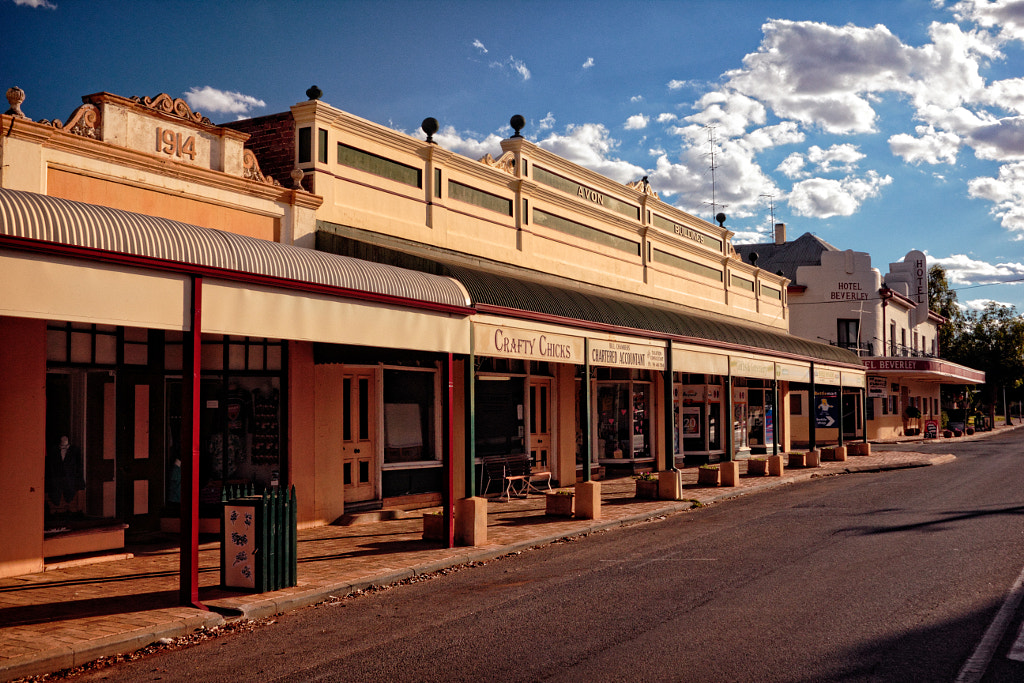
Beverley by Paul Amyes on 500px.com
Beverley is 130Km east of Perth in the historic Avon Valley. It is a quiet agricultural town with a unique blend of architectural styles that gives its characterful appearance.


Beverley is 130 Km east of Perth and is a quiet agricultural town with its own distinct character which has been created by the wide range of architectural styles used to build it. A walk down Vincent Street will take you from Colonial, to Federation, to art deco to a 1960’s geodesic dome. It all sounds a bit of a hodge podge but it really hangs together well. There is a collection of farm machinery at Ferguson’s Machinery Shed on Hunt Road that recalls Beverley’s by-gone years as an important agricultural hub.
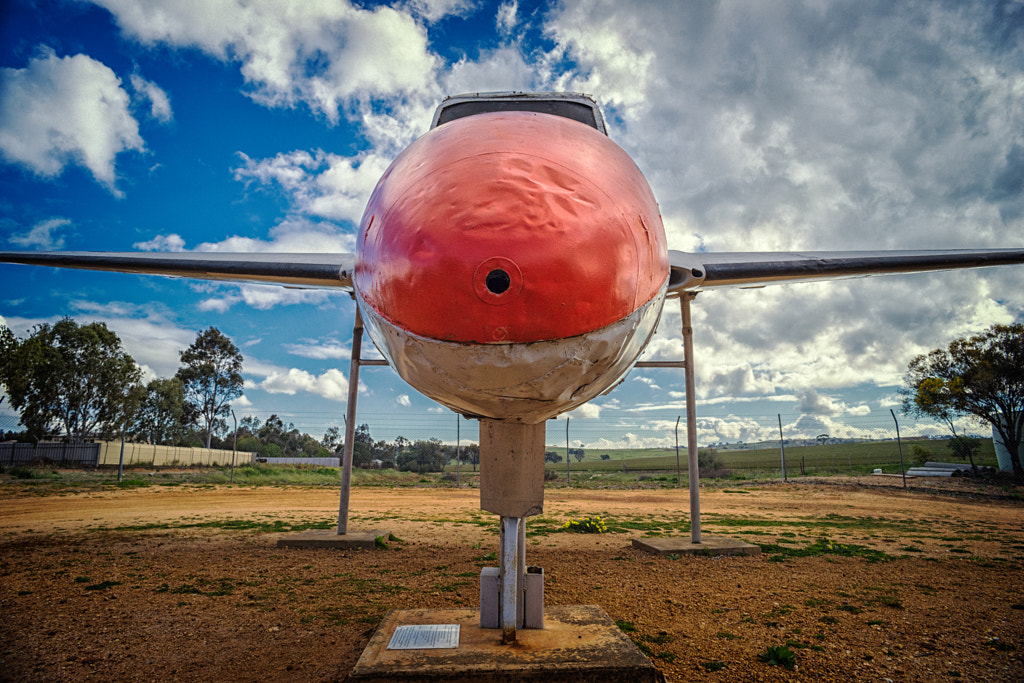
 

Vampire by Paul Amyes on 500px.com
A Vampire jet on the Beverley-York Road


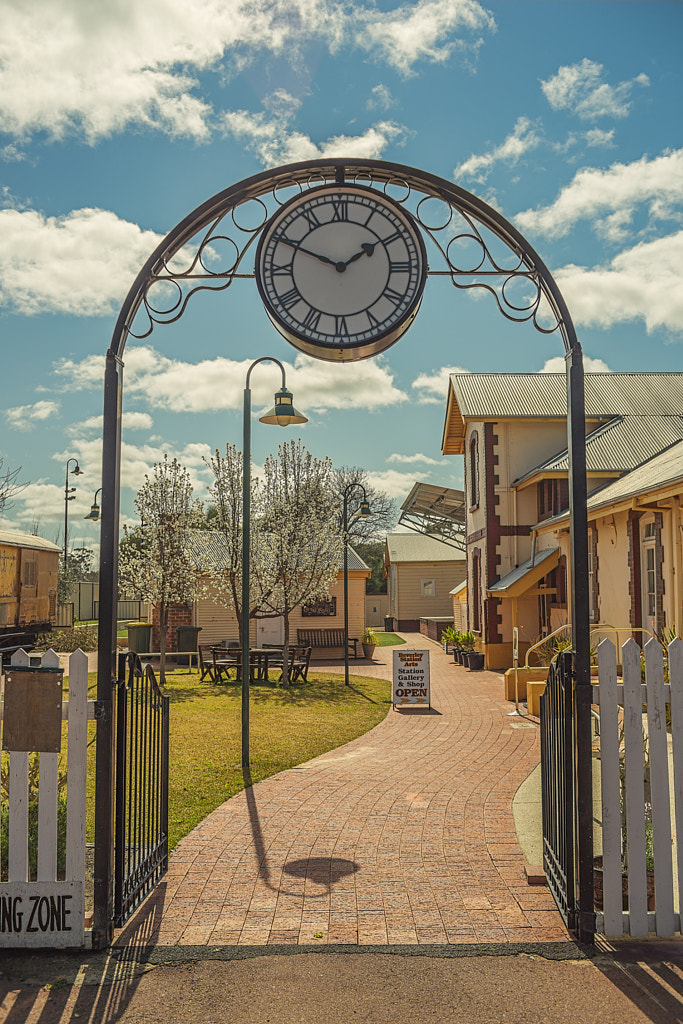
Beverley Station Arts by Paul Amyes on 500px.com
The entrance to Beverley Station Arts in the Western Australian town of Beverley.


The Railway Station was designed by George Temple-Poole and built in the Victorian Tudor style in 1886. It ceased to be a working station some years ago and has been renovated and converted into an arts centre. The Beverley Art Collection is on permanent display, there are resident artists, workshops and an outdoor theatre. The Dead Finish Museum was originally a hotel of the same name, its displays give an insight into what life was like in the early days of the district.

Dead trees ring Lake Yenyenning which became a salt lake after the land surrounding it was cleared for agricultural use. Beverley, Western Australia.

Outside of town are the Yenyenning Lakes which are a haven for birdlife and used for water sports, for directions ask at the Visitor Centre. Also out-of-town is Avondale Discovery Farm  which has an 1850’s era homestead and is a working farm run by the National Trust using historic agricultural machinery and techniques.
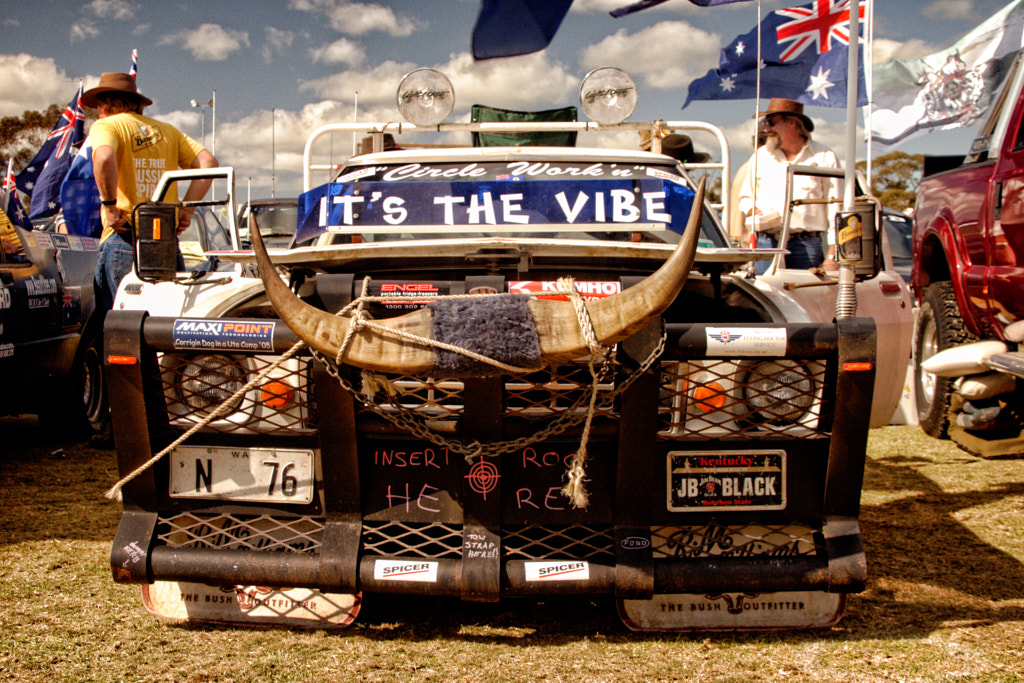
 

Beverley by Paul Amyes on 500px.com
Ute Muster at The Beveley Agricultural Show.


Events:

All the details for these events can be found at www.beverleywa.com/calendar.html .

  •  Beverley Ester Art Exhibition – a very popular event which attracts lots of visitors to the town.
  • Beverley Clydesdale and Vintage Day has demonstrations of horse-drawn ploughing and vintage tractors and is held at the Avondale Discovery Farm in June.
  • The Great Southern Working Sheepdog Society Finals coincide with the above event and are also held at Avondale.
  • Beverley Agricultural Show is  a real agricultural show. There are jam and cake competitions, pony events, tug of war, competitions for the best poultry, sheep, and cattle, and displays of country crafts. It is held in August of every year.
  • Beverley Harvest Festival at Avondale has displays of historic harvesting methods, working dogs, local produce to taste all capped off with music and dancing.
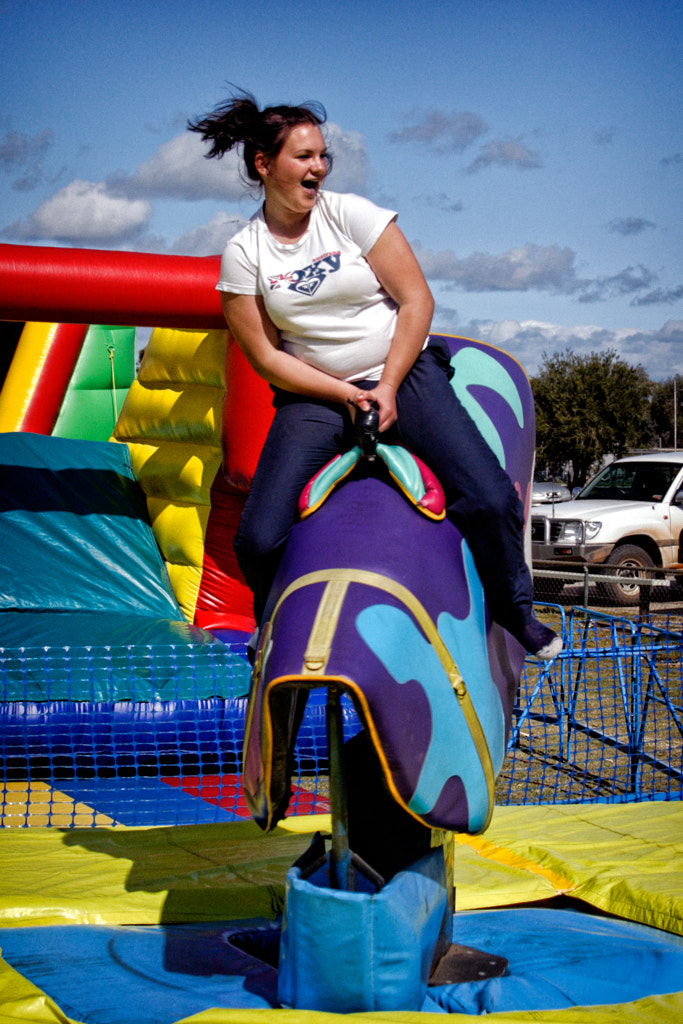
 

Beverley by Paul Amyes on 500px.com
Riding the mechanical bull at the Beverley Agricultural Show.


Ambling in the Avon Valley – part 1

The Avon valley was officially discovered by Ensign Dale in 1830 when Governor Stirling saw that the newly established Swan River Colony was going to starve unless it found some decent arable land. Of course the Nyoongar people knew about its existence all along and the upper reaches of the Avon were very important to their dream time stories. As we drive out of Perth on the Great Eastern Highway it’s difficult to imagine how hard it was for Dale all those years ago. What takes us an hour today in a car took him nine days of sheer heart breaking slog. The going was so bad that his horses became bogged in mud and it took all day just to travel one mile or 1.6 Km and he named one spot the Vale of Misery. Ensign Dale opened up a parcel of land the size of Tasmania, although in many cases it was not until the 1860’s that the townsites were established. In the tradition of Nineteenth Century explores he named many of the places after his friends, family and places back in England where he grew up.

Standing on top of Mount Brown and looking across towards Mount Bakewell and the town of York in Western Australia’s historic Avon Valley. A 4 image stitch done in Adobe Photoshop CS5. Camera used Panasonic Lumix LX-5. Focal length equivalent to 35mm in full frame terms. Exposure: 1/800 s at f/4.0 ISO 80.

Ensign Robert Dale of the 63rd Regiment of Foot is perhaps one of the great unsung heroes of early colonial exploration. Everyone remembers Burke and Wills, and Leichhardt because they lost their lives and that heroic failure mythologized them. Ensign Dale’s exploration and surveying of the Avon Valley, the Canning River and Mount Barker region was of vital importance to the survival of the early settlers in Western Australia. His survey of King George’s Sound in Albany was considered an important work then and is seen as an important artistic and historical document today. While undertaking this achievement he never got lost, he did not loose any men and he maintained excellent relations with the local aboriginal population. In total he mounted seven official expeditions and the journals from them were published in 1833. He was appointed to the post of temporary assistant government surveyor and promoted to the rank of Lieutenant. He acquired a lot of property with two town allotments in Albany, a thousand hectares in York and a further 750 hectares in the Swan Valley. But as quickly as his star had risen it fell. He was placed under virtual house arrest by his commanding officer in mid 1832. Soon after he became embroiled in the ugly saga of Yagan’s murder where he was ordered to take Yagan’s pickled head back to England and explain the situation to the Colonial Office and they stripped him of his rank of Lieutenant. Disenchanted Dale resigned from the military and went into business with his brother Thomas importing mahogany. In 1853, at the age of forty-four, he died of tuberculosis in the English town of Bath on the banks of the River Avon.

Today tourists drive out to the Avon Valley to see historic heritage towns, atmospheric homesteads, rocky outcrops and to picnic along the banks of the River Avon. A pleasant spring time trip would be to drive out to Toodyay  and then follow the Avon down through Northam, York and Beverley returning to Perth via Westdale and the Brookton Highway. If time permitted you could arrange to stay overnight in Northam or York to get the most out of the trip.

Toodyay

Toodyay by Paul Amyes on 500px.com
Connors Mill in Toodyay, situated in the Avon Valley of Western Australia.


85 km northeast of Perth Toodyay was settled in 1836 and named after the Nyoongar name for the area “Duidgee” which means place of plenty. The original townsite was prone to flooding so it was abandoned in the 1850’s and relocated 5 km and renamed Newcastle. In 1911 the name was changed back to Toodyay because people confused Newcastle in WA with Newcastle in NSW. The Heritage Council of WA list over one hundred places of historical significance in or around Toodyay. Some of these are:

  • Newcastle Gaol – this was constructed in the 1860’s using convict labour in response to Moondyne Joe’s repeated escapes .
  • Connor’s Mill on Stirling Terrace was built in 1870 and was as the name suggests a flour mill, it was then converted into an electricity generating plant, and is now the Toodyay Visitors Centre.
  • Toodyay Post Office – designed by George Temple-Poole and built in 1897
  • Toodyay Fire station – designed by Ken Duncan and built in 1938


Toodyay by Paul Amyes on 500px.com
Stirling Street is the main drag in Toodyay and is full of colonial and federation architecture.


Toodyay plays host to several events throughout the year, the major ones are:

  • The Moondyne Festival is held on the first Sunday of May and celebrates Moondyne Joe’s life with re-enactments of Colonial life.
  • The Avon Descent – see the Northam entry for more details.
  • The Festival of Food coincides with the Avon Descent and provides culinary delights from all over the world, cooking demonstrations and free entertainment.
  • Theo’s Run is a convoy of classic cars and motorbikes that starts in Midland and travels to Dowerin via Toodyay.
Black powder demonstration. On the first Sunday of May the Avon Valley town of Toodyay celebrates Moondyne Joe’s life with the Moondyne Festival and the townsfolk re-enact the towns colonial past in the main street. The Perth Volunteer Rifle and Artillery Regiment 1860 is a Living-History group that seeks to portray the military and social life of a volunteer soldier in Western Australia during the period 1860 to 1901. Canon EOS5d with Canon EF28-135mm f/3.5-5.6 IS USM lens. Exposure 1/80 s at f/8.0 ISO 200.


Toodyay’s  Moondyne Festival is the story of Western Australia’s favourite Bushranger, Joseph Bolitho Johns, aka Moondyne Joe is a classic case of where truth is stranger than fiction. Transported to WA as a convict, given a ticket of leave and released, some would say that Johns was a victim of society while others would see him as a recidivist, but what ever your viewpoint it is a fascinating story of a man who is hard done by, has a disdain for authority, who makes repeated escapes from custody and ends up spending his last days in Fremantle Asylum suffering from dementia.


A convivial chat at the Moondyne Festival in Toodyay.


Moondyne Joe on the run up Stirling Street in Toodyay.


The Toodyay Moondyne Festival has Joe and his gang running riot in the streets of Toodyay. He holds people up, consorts with floozies, avoids the incompetent police and the annoying temperance ladies, is arrested, put on trial and escapes. With local people dressing up in period costume the end result is a gigantic al fresco pantomime with heaps of audience participation (chants of “Free Joe” and “Behind you” ). Alongside the theatrical mayhem there are bush poets, market stalls, displays from the 1860 Regiment, vintage cars and mustache and cleavage competitions. A brilliant day out for all the family.

Northam

Hot air balloons flying over the Avon River at Northam in Western Australia.


Northam is 98 Km from Perth on the Great Eastern Highway and it is the largest town in the Avon Valley. With its central location in the valley it makes the perfect base from which to explore. Up until 1891 it was the poor relation to York, but this changed with the coming of the railway linking Perth with the Goldfields and the town became an important staging post. During the 1940’s and 50’s Northam became an important centre  for housing displaced European refugees and migrants, in fact the Northam Accommodation Centre was the third largest such facility in Australia. By the time it closed some 23,000 people had passed through its gates. There is a photographic exhibition telling the story at the Northam Visitor Centre. There is a historic town walk that enables visitors to experience the town’s history, some of the significant places on the trail are Morby Cottage  – home of the founder of Northam and built in 1836 – and the Old Railway Museum which was built in 1886. More details for both venues can be had by contacting the Visitor Centre. The town hall on Fitzgerald Street is a wonderful example of concrete carbuncle architecture from the 1970’s.


A Yellow-billed Spoonbill (Platalea flavipes) flying back to its nest on the Avon River. Northam, Western Australia.


Northam's Concrete Carbuncle by Paul Amyes on 500px.com
Northam’s Concrete Carbuncle. The town hall on Fitzgerald Street is a wonderful example of concrete carbuncle architecture from the 1970.


Northam is also the eastern terminus of the Kep Track a 75 km long mountain bike and walking trail that starts in Mundaring and follows the water pipeline the engineering genius CY O’Connor built to take water out to the Goldfields of Western Australia. The name Kep comes from the local Nyoongar word for water. The Golden Pipeline Heritage Trail  follows the pipeline in its entirety all the way from Mundaring Weir to Kalgoorlie 650 km to the east, and it also passes through Northam.


The paddlers get ready to start the Avon Descent. Northam, Western Australia.

Northam is the staring line for The Avon Descent, which was first held in 1973, and there were only forty nine competitors. The event has grown so much now that this year there were over 800 competitors and 2000 plus support crew. In more ways than one it deserves the title the “world’s greatest white water event”. The 134 km two day event starts at Northam and finishes at the Riverside Garden in Bayswater with an over night stop at the Boral Campsite just outside Toodyay. For the majority of entrants the aim is just to complete the course, but for the elite athletes it is a chance of competing in a unique endurance race. The race happens on the first weekend of August every year. It kicks off on the Friday night in Northam with a float parade and firework display. On Saturday morning the event kicks off proper.

The Spring Flush Continues

Jug Orchid, Pterostylis recurva, Mount Observation, Western Australia. Canon EOS 550d, Sigma 105mm macro, I/125 sec at f8, ISO 1600 with fill flash.

My shoulder has recovered well from the recent surgery and I’ve been able to get out and about round York. The other day I took a speculative drive out looking for dancing spider orchids when I found this solitary little jug orchid. Normally not seen up in the wandoo forest and when found they are usually in largish colonies. So it was a nice little find and compensated for not finding the others.

Parts of Mount Brown, in York Western Australia, are covered in a carpet of pink everlastings ( Rhodanthe chlorocephala ssp rosea ). Panasonic Lumix LX-5. Exposure: AE priority 1/250 s at f/8.0, ISO 80 with -1 stop exposure compensation and -1 stop flash exposure compensation. Focal length the equivalent of 24mm lens on full frame

Every other day I’m walking up on Mount Brown, which is in York, with the dog and it is now covered with a carpet of flowers that are a riot of pinks and yellows. Even the weeds are looking fantastic!

Non-native yellow daisy Arctotheca calendulae. Mount Brown, York, Western Australia. Panasonic Lumix LX-5. Exposure – aperture priority 1/640 s at f/8.0, ISO 80, with -1 stop exposure compensation with fill flash with -1 stop flash exposure compensation.

Of course me on my hands and knees crawling among the flowers created a lot of amusement for Frida, my bull terrier. It took ages to clean the dog slobber from off the front element of my lens.

Frida running through a meddow of pink everlastings on Mount Brown in York, Western Australia.

If you are interested in purchasing any of the photos click on the image and go through to my online gallery.

Blimey that was quick!

Spring is here and the bees are hard at work pollinating the almond trees in my garden.

It only seems like the other day I was blogging about winter coming and getting my wood supply in. Now after a very mild winter spring is breaking out all over. The fruit trees in my garden have been keeping the local bees very busy. And further afield the native terrestrial orchids are starting to bloom. I’ve never known them start quite so early, and I thought that last year was a prolific year, but this spring is looking to be even more bountiful.

A cowslip orchid being pollinated. Mokine, Western Australia.


Rosy-cheeked Donkey Orchid, Diuris aff. corymbosa, larger than the common donkey orchid and has reddish-brown labellum lobes hence the name.


A lemon scented sun orchid (Thelymitra antennifera) also known as vanilla orchid. Mokine, Western Australia.

Clicking on the photos takes you through to my gallery if you wish to make a purchase.


Should I? Shan’t I?

There comes a time in every photographers life behind the lens when they get asked to do something for free. There are a whole heap of reasons why we apparently should in this post industrial, post modern and peak everything media interconnected world, but there are also a lot of reasons why we shouldn’t.

Looking back to the clubhouse from the court.

The reason why I’ve brought this up is that in the last couple of weeks two people have asked me to do some work pro bono (for the good not for the singer). I’ve done work for free before, namely work for some churches, a human rights organization, and some weddings where the photos were my wedding present for the bride and groom. So as you can see I do have form here. Unfortunately it has also been my experience that doing work for free can often lead to an unpleasant experience, and this tends to happen where you feel taken advantage of. The first job was a little complicated as it not only involved photography, but writing copy and graphic design as well. But what should have taken just an afternoon ended taking up the best part of the week as it happened that the person who “commissioned” didn’t have a clue and despite protestations to the contrary was completely computer illiterate and did not know what to do with the product and would n’t listen when told. To cap it all there was no acknowledgment or thanks for the work. The second job was a straight forward cover an event and provide some photos suitable for handing out to sponsors and to promote it in the future. Photos delivered the day after and they were followed by a very nice email thanking me for the work put in. Reading it left me with a nice warm fuzzy feeling and restored my faith in human nature.

58 Cadillac Coupe by Paul Amyes on 500px.com
58 Cadillac Coupe – York Motor Show

The problem is that we now live in an age where the camera is ubiquitous and we are bombarded with slick imaging every day. What this has done is devalue the work of the photographer because to coin an oft quoted phrase “We’re all photographers now”. There is also the perception that in the digital age photography is free as there is no film and processing to pay for. In fact the situation is such that even multi-nationals and  national media outlets are all expecting content providers to work for nothing with the premise that doing so  will “further” our careers. But if we work for free how do we pay for our equipment, and important stuff like food and housing? So should we work for free? I guess that we all do it at some time in our life, but I would like to say that when you do it do you feel taken advantage of or manipulated? If you do then you probably are and these are the freebies to avoid.

I’m A Lumberjack And I’m Ok

Working hard to get the woodpile stocked for winter.


The shift  into winter is speeding ahead and there many tasks that have to be done before it arrives , chief among them is getting the winter wood in. As we are off to Hobart in Tasmania next week I had to get the job done quickly so over the last couple of weeks I’ve cut a tonne and a half (1.65 tons for our US based readers) of wood, split and stacked it. For all you budding environmentalists and tree hugging types firstly all this wood is windfall, no tree was harmed in the harvesting. Secondly burning hard woods such as White Gum  (Eucalyptus wandoo) or York Gum (Eucalyptus loxophleba) in a slow combustion wood stove is a clean renewable energy source and so my inner hippy can relax knowing that I’ve not brought about a climatic catastrophe of apocalyptic proportions. So all this is a long-winded way of saying that I haven’t taken many photos of late, and those that I have are just snapshots.

Walking the dog along the banks of the Avon River in York Western Australia looking towards Mount Bakewell.

This is one of the snapshots I took this morning while walking my faithful canine companion Frida. It was very nice this morning, the fog was just being burnt off by the morning sun, the Avon River actually looked nice because we’ve had some rain. Usually after a summer it is a dried salt encrusted riverbed with fetid and smelly pools that look like they could be harbouring some new toxic life force that is about to star in the next episode of Doctor Who. So I had my point and shoot camera with me and fired off a few frames judiciously bracketing the exposure. I loaded them into Lightroom and then played with them in Nik Software’s HDR Efex Pro 2 and Color Efex Pro 4 and so liked what I came up with that I have posted it here on my blog. Now a short while ago I was going to buy the complete suite and it was $600 AUD (mainly because software companies believe they can price gouge us Antipodeans) and I wasn’t too sure. It was a lot of moolah for something I wasn’t too convinced I’d use a lot, and I’m basically tighter than a fish’s eyelid. Then the quandary was solved when big bad Google bought out the company and everyone thought well that’s that then – no more nice plugins. Well I was wrong and Google have now launched the complete suit under their branding for measly sum of $149 USD. I mean that is what they were charing for just one of their products not so long ago. Do your self a favour do the magic www thing and head over and down load a trial and see what you think.

Anyways as I said earlier I’m off to Tassie on Monday for 2 weeks so I’ve generously given all the staff at the global headquarters of Paul Amyes Photography the time off as well and so there will be no further posts until I’m back.

Very Adaptable

Olympus Pen EP-2 with a 17mm lens. This gives a 35mm equivalent. For wide angle lenses it is cheaper and easier to use native m4/3 lenses.

Not so long ago I was lucky enough to be given an Olympus Pen EP-2, it was an old superseded model, but still a very fine camera. My eyes were quickly opened up to the advantages of having a small light high quality camera with interchangeable lenses and it became, and still is, my most used camera. A little while later I was having a clear out of stuff and I “found” six “orphaned” lenses from film cameras that I no longer had. They were to me so good that I could never bring myself to part with them so I had kept them with the vague notion that one day if I ever got some surplus cash I would get a film body for them. However despite my nostalgia for film the reality is that I live a long way from any lab and I no longer wish to run a darkroom so any new found enthusiasm for film would quickly evaporate because of the inconvenience. One day while perusing a forum dedicated to M4/3 I discovered the whole subculture of using adapted lenses. My interest was piqued. There are a couple of reasons to use adapted lenses. The first and most sensible is that you do so because an equivalent focal length is not yet manufactured for your camera. The second reason is that it is just good fun to use old lenses that you already own or can get very cheaply.

From left to right is a 75mm Color-Heliar, a Sigma 70-210, an Olympus Zuiko 50mm, on the camer is a 35mm Color-Skopar, Olympus Zuiko 35-105, and a Tamron 28mm.

Olympus made adaptors for OM and 4/3, Panasonic for Leica R and M, and Novoflex and Voigtländer make adapters for older manual focus legacy lenses, but they are in the $200 bracket. If you look on E-Bay there are a myriad of adaptors all hailing from China and Hong Kong with prices starting at $12 AUD. So here is what to look for. For manual focus lenses the basic requirement is a rigid body and a well-built lens mount that allows infinity focus.  I would recommend either a chrome plated brass or stainless steel mount as they are more resistant to wear. Cheaper adaptors are often built deliberately to focus beyond infinity as it means tolerances do not have to be so tight. Initially this is a little disconcerting in use but you get used to it. Some of the cheaper makes can be a bit sloppy and this makes focusing accurately difficult. Forums such as Micro Four Thirds User have discussions on how to fix this quite easily, but this can be avoided by buying better quality ones such as those made by Metabones. If you believe the sales pitch by Voigtländer and Novoflex  you are risking your camera to cheap Chinese adaptors as swarf and dirt can fall onto your sensor and ruin it. The easiest thing to do is give them a wipe with a cloth and then a blast of compressed air to dislodge anything prior to mounting. In the end only you can decide on how much you want to spend, personally I took the view that this would be an experiment and I bought two $12 jobs in OM and M mount with the thought that if they were duff I could replace them and they had not cost a lot. With more modern auto focus lenses with stabilization and electronic aperture control things are a little more complicated. Firstly you will have to accept the loss of AF and IS. The cheaper adaptors also offer no control over the aperture, so the lens defaults to its widest aperture.
The Olympus Pen EP-2 with optional viewfinder and an Olympus Zuiko Om 50 mm f1.4 lens mounted via an adapter.

In day-to-day use is all this worth the hassle? Well there is no easy answer, it all depends upon whether you are prepared to accept work arounds and sometimes less than perfection. Digital capture does impose a lot of demands upon a lens as the sensor behaves very differently from film. The sensor is actually a very reflective surface and this means that modern lenses made for the digital era are multi-coated on the rear lens elements as well as the front to prevent glare. Some lenses, especially single coated ones, are also very susceptible to glare so I would definitely use a lens hood and be prepared for less than stellar images when shooting into the light. Older lenses designed for film are sharp in the centre but the edges and corners can let them down. Thankfully as of this time all the CSCs use a sensor that is smaller than 35mm film, and this means that the sensor is only using the best part of the lens. Talking of sensor size it is the crop factor of the various digital formats that causes the biggest problem for many users of adapted lenses as your wide angles cease to be wide angles.  A moderate wide-angle of 28mm becomes a short standard on APS having the same field of view as a 42 mm lens on full frame, or a long standard on M4/3 with a field of view similar to a 56mm. My favourite 35mm Color-Skopar is now a short telephoto on my EP-2, and my old Olympus Zuiko OM 35-105 ceases to be standard zoom but becomes a telephoto zoom. Voigtländer made a 12mm and 15mm lenses in either Leica screw (L39) or Leica M, but their performance on smaller formats leaves lots to be desired with most users complaining of excessive smearing in the corners. So the loss of wide angles is a problem for many, but on the other hand the multiplying effect of the smaller formats also brings many benefits. My 75mm f2.5 Color-Heliar becomes a very nice compact 150mm equivalent, and my Sigma 70-210mm becomes a very small 140-400mm equivalent. So if you are a frequent long lens user you will be very happy. Older manual lenses are also very suited to video usage because the focusing action has a long throw and is damped making it easy to get very precise manual focus. Throw in wide aperture lenses and your mirrorless camera becomes a very capable tool for giving beautiful “filmic’ footage. The biggest hurdle to using adapted lenses is manual focusing. I am at that age where my arms are not long enough to use the rear LCD screen for focusing so an electronic viewfinder that allows me to magnify the subject is a must. Thankfully the EP-2 and all the later variants can all take one. An alternative to an LCD viewer is a loupe designed to go over the rear LCD screen. The brand named one is by Hoodman  and sells in Australia for about $110, if that is a bit steep for you there are plenty of cheap Chinese knock offs for the $20 mark on E-Bay.
Olympus EP-2 in video mode showing the Zuiko 50 mm f1.4 mounted via an adapter, a Hoodman Loupe and the Olympus SEMA external microphone.

All in all my own personal conclusion is that it has been great fun to re-visit some old lenses I’d already got and use them in different ways. Plus there is the added fun of trawling through websites such as E-Bay and Gumtree looking for cheap interesting lenses. The other thing in its favour is that if you are a little financially embarrassed and you want to explore digital photography as a hobby then using old lenses maybe just the ticket.

Frida, my Bull Terrier co-operating nicely. Olympus EP-2 with OM Zuiko 50mm f1.4 lens. Exposure 1/60 sec, f1.4 at ISO 3200 processed in Lightroom and Silver Efx Pro 2 by Google.

50!

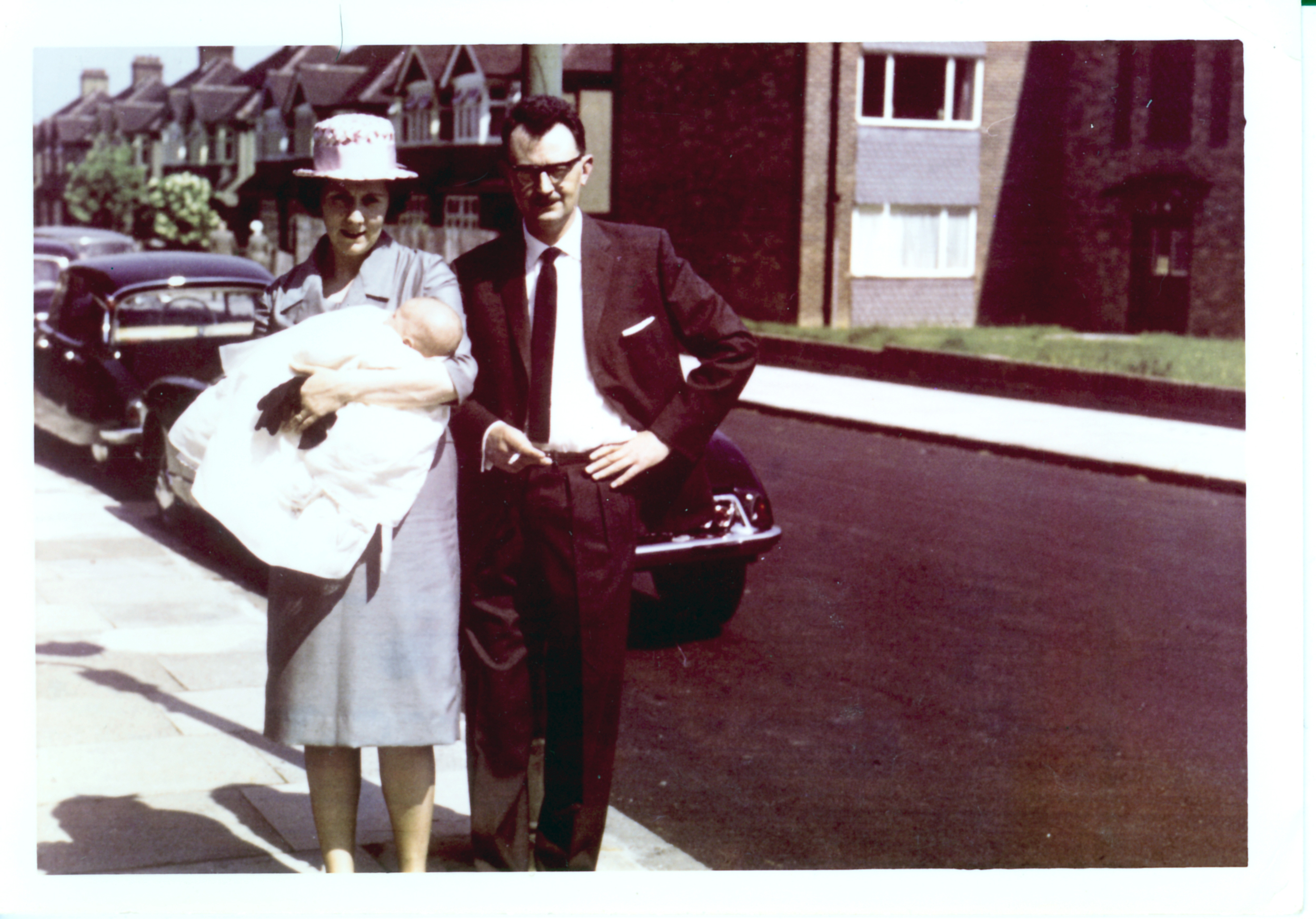
Roy and Beryl Amyes on Paul’s Christening day, Bromley.

On Saturday 6th April 1963 I was born in Bromley, Kent, England. Fifty years later on 6th April 2013 in York Western Australia I’m celebrating my birthday. All in all looking at the two photos here I don’t think I’ve changed that much!

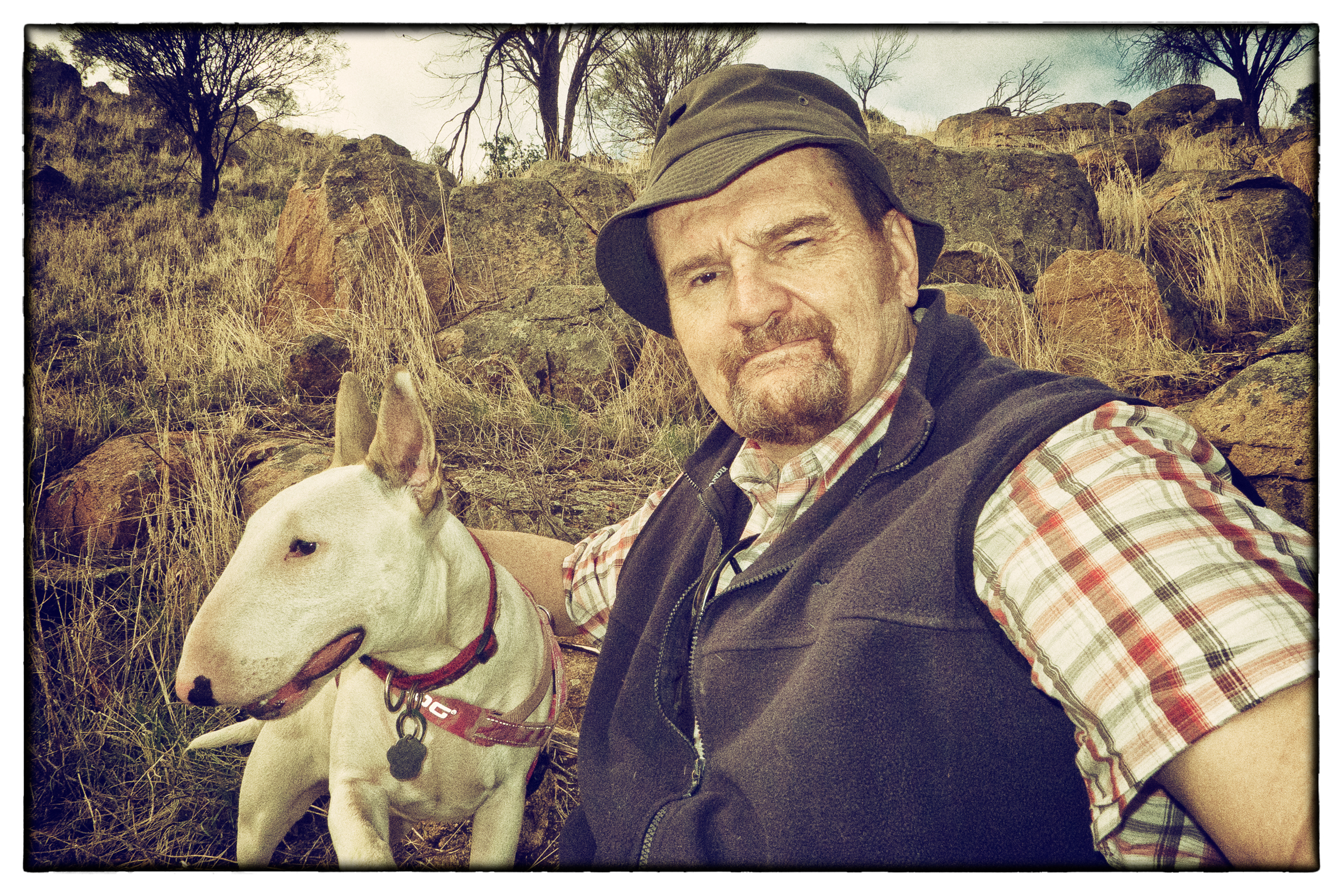
Paul and Frida out on Mt Brown in York, Western Australia on the morning of his 50th birthday.

I must say I don’t take “selfies” very often, but this morning I thought I would as it is not every day you turn 50 and I wanted to mark the occasion somehow.I’d left the house to take Frida (aka the puppy piranha) for her morning run and I’d put my Panasonic LX5 in my pocket. When the creative urge struck I thought this’ll be a piece of cake – birthday or otherwise – as I’ll just put the camera in self-portrait mode and snap away. On checking the LCD screen I saw that the shots were a dismal failure – the sky was over exposed and I was under exposed. Thankfully over the course of my fifty years I have learnt a photographic trick or two so I put the camera in manual and set a shutter and aperture combination to under expose the general scene by 2 stops. I then activated the pop up flash and set it to under expose by 1/2 a stop. The icing on the cake was getting Frida to sit with me while I took the shot. On getting home the image was fed through Lightroom and I played around with newly re-launched Nik Software Collection to make my visage suitably aged and distressed looking.