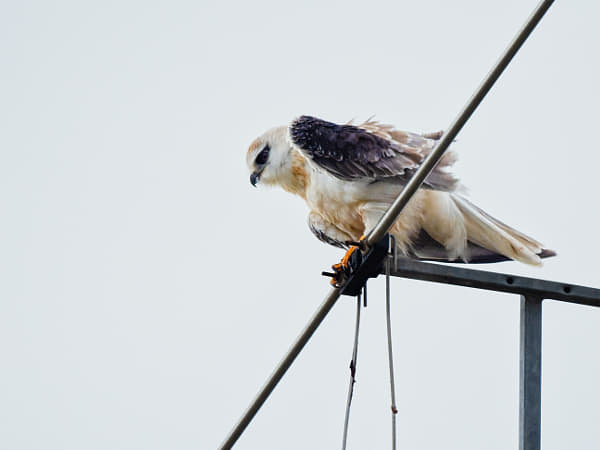
According to the Cambridge Dictionary to say someone is as “high as a kite” is to say they are either intoxicated or extremely happy. Currently I’m in the extremely happy category as we have been having regular visits from a juvenile Black-shouldered Kite. It spends mosts of its time perched on the TV aerial and can often be heard chattering away – sort of a cross between a chirp and a squawk. We had a bit of a mouse plague earlier and this bird is probably the result of that. Normally Black-shouldered kites breed only once a year in the period August to January, but when there is an abundance of food they will breed twice.
A juvenile Black Shouldered Kite, Boorh-ga in Nyoongar, perching on our TV areial. (Elanus axillaris). York, Western australia. Olympus EM1x with OM System 100-400mm lens.
The photos are the best I’ve managed to get so far, but the up the chuff view point (a bird photography technical term) is never a good look. I’ve seen it hunting over the open fields in front of us so hopefully I’ll manage to get some birds in flight shots soon.
Ooooerrrr! That’s probably not the best thing to say in a blog about bird photography. Rest assured no ducks were harmed in the making of this blog entry.
No ducks were harmed in the production of this blog. Ngoonan or Grey Teal (Anas gracilis). York, Western Australia.
A little while ago I wrote about how my ability to photograph birds had deserted me. Well I can now report that yesterday morning I had a stonker of a morning. I parked up at my usual spot on the River Avon and before I had got my camera bag out of the car I could hear a couple of Brown Goshawks calling out to one another. I could only find one of the birds and it was obligingly sitting in the top of a tree and the first light of dawn was illuminating it nicely. I could hardly believe it! It just kept sitting there unfazed by my proximity and it was I who eventually moved on leaving it there calling out to its mate. This was the best start I’ve had in a very long time and if I’d seen nothing else this would have been tremendous. Just 20m further on and I found a pair of Nankeen Night Herons. By this time I had a grin that went from ear to ear. Walking up to Mile Pool things just got better and better.
Karkany or Brown goshawk (Accipiter fasciatus) basking in the dawn light. York, Western Australia.
Ngalkaning or Nankeen Night Heron (Nycticorax caledonicus subsp mannillenis). York, Western Australia
Mimal or Australian Darter (Anhinga melanogaster subspecies novaehollandiae). York, WEstern Australia.
Doolor or Silvereye (Zosterops lateralis). York, Western Australia.
Kakak or Little Pied Cormorant (Phalacrocorax melanoleucos). York, Western Australia.
Western Inland Hunter, Austrogomphus collaris. York, Western Australia.
We’ve had some really hot days with temperatures exceeding 40ºC and this has meant there were a lot of birds congregated in the trees around the few remaining pools of water. By 8am the temperature was starting to soar and there was less bird activity. So I changed lenses and went looking for dragonflies and damselflies. I found some but the warmth had supercharged them and they were proving difficult to photograph as they would not sit still for very long. At 8:30am I decided that it was too hot and decided to call it a day. As I started to put my camera away I glimpsed a white bird sitting in the top of a dead tree. At first I thought it was just a corella, but there was something about the way it was moving made me think it was something else. Looking through the camera I could see those unmistakeable red eyes of a Black-shouldered Kite. Panic set in now as I didn’t have the right lens on. So calming myself down I changed lenses and started making my way closer to the bird. Usually what I do is wait for the bird to look in another direction then edge forward by a metre. I then stop take a few photos and then when it looks away again edge forward and take more photos. Like this I managed to get within 20m of the Kite. It looked quite relaxed spending most of its time scanning the ground below looking for food. After a little while it did a dump – birds often do this just before taking off, I suppose it lightens the load – and then took off in a lazy curve towards some taller trees. It was bloody brilliant! My only regret was that because there was insufficient cover I couldn’t get closer, but there’s always next time.
Black Shouldered Kite, Elanus axillaris. York, Western Australia.
Up at dawn to catch the early bird. Bandin or White-cheeked honeyeater (Phylidonyris nigra). York, Western Australia.
It’s a well established wisdom that to photograph most wildlife you have to be in the field at sunrise or just before. I have to say that this is quite pleasurable in summer as it is the coolest part of the day. In fact the last few days it has almost felt cold at just 20ºC. I’ve been heading out looking for black shouldered kites and rainbow bee-eaters. I’ve done my homework found the trees that the kites nest in and the burrows that the rainbow bee-eaters are currently using. I’ve also found out which trees that they like to perch in. Sounds like it is done and dusted, but photographing wildlife is seldom straight forward.
The only photos of Black Shouldered Kites (Elanus axillaris) I’ve got are a sequence of one hunting but I was too far away to get a good photos and this is a heavy crop. The photo does show the distinctive pose of the black shouldered kite when hunting.
The black shouldered kites are incredibly skittish. The closest I’ve ever got to one was while walking the dog. Needless to say I didn’t have a camera with me. So far my efforts have come to naught – the closest I’ve managed to get with a camera is 30 metres. It’s a work in progress.
Birin-birin or Rainbow Bee Eater (Merops ornatus). York, Western Australia.
The Rainbow bee-eaters are in full swing with raising chicks so both parents will be out hunting and returning to the nest with food roughly every 15 minutes. So all that was necessary was to get into position as the sun’s rising and wait for them to appear. Except they didn’t. Seems like I picked the morning when they decided to have a lie in. After an hour an a half I decided to move to “Plan B” which was to cross the river and go to another site I’ve been watching. Here the birds were early risers and were already full swing into the routine for the day. Photographing them in York is more difficult than at Lake Gwelup where they have been habituated to a human presence and perching posts have been put at lower heights – approximately 1-1.5 metres above the ground. The open terrain means that capturing them flying and hunting is easier. Here in York they favour larger trees, but occasionally will perch lower.This particular morning I came across a male bird perched in the top of a dead tree. He wasn’t exhibiting the usual behaviour – in fact he looked downright uncomfortable. After a while it became apparent what was causing his discomfort. He had indigestion. His last meal wasn’t going down smoothly at all and was trying to escape! When they catch something like a dragonfly they take it to their favoured perching spot and then beat it against the branch to kill it. Obviously this bird hadn’t thumped the hapless insect hard enough. Eventually the bird sorted the problem out and flew off looking more comfortable. This was the sort of digestion problem that wouldn’t be fixed with a bit of Mylanta.
“I feel a bit funny. I think something I’ve eaten is disagreeing with me.”




You must be logged in to post a comment.