The Ascent of Mount Trio

Some places get all the attention and others are seldom mentioned. In the Sterling Range National Park everyone concentrates on climbing Bluff Knoll, but there is as I’ve said on previous occasions a lot more than Bluff Knoll. Believe it or not Bluff Knoll is one of the easier climbs in the park. Another one is Mount Trio. Climbing up Bluff Knoll is not a wilderness experience as there are far too many people. With Mount Trio if you see more than two other people its a very busy day.


Mount Trio by Paul Amyes on 500px.com
The sun sets behind Mount Trio in the Stirling Ranges of Western Australia.


The Ascent of Mount Trio by Paul Amyes on 500px.com
Helen at the start of the Mount Trio walking trail in Sterling Range National Park.


Mt Trio comprises three peaks and was once known by its Aboriginal name Warrungup, meaning “three become”. It is 3.7Km to the top and back with an ascent of 418m. The first third of the walk is very steep with irregularly spaced steps. Wildflowers, including the endemic mountain bells (Darwinia leiostyla), are a feature of this walk. Montane thicket on the upper levels of the peaks puts on a colourful display of wildflowers in spring and early summer although we didn’t see this as the area was still recovering from a devastating bushfire and was like walking through a landscape of charcoal sticks. 


The Ascent of Mount Trio by Paul Amyes on 500px.com
The first third of the walk trail is up a steep section with irregularly spaced steps which makes the going quite hard.


The Common Mountain Bell (Darwinia lejostyla) grows in the eastern and central Stirling Range, and can be readily seen on Bluff Knoll and Mount Trio.


Silky Blue Orchid by Paul Amyes on 500px.com
Silky Blue Orchid, Cyanicula sericea. Mount Trio, Western Australia.


The going gets easier once you hit the saddle between the east peak and the north peak. The saddle between the cols is covered in Drumsticks (Kingia australis). These grass trees were often called Black Gin trees, a derogatory racist term now not used. The Nyoongar name for them is Pulonok. The track then follows a more gentle slope to the highest (northern) point at 856 metres. At the summit there is a small cairn of stones which people add to on getting there. From the summit on a clear day you get views of Mt Toolbrunup the second highest peak in the range at 1052m. Then all it is a matter of retracing your footsteps back to the start.


The Ascent of Mount Trio by Paul Amyes on 500px.com
The saddle between the cols is covered in Drumsticks (Kingia australis). The Nyoongar name is Pulonok.


The Ascent of Mount Trio by Paul Amyes on 500px.com
A closer look at some Drumsticks (Kingia australis).


The Ascent of Mount Trio by Paul Amyes on 500px.com
Helen placing another stone on the cairn at the summit of Mount Trio.


The Ascent of Mount Trio by Paul Amyes on 500px.com
Looking out at Mt Toolbrunup from the summit of Mount Trio.


Climbing up was pretty taxing on the legs muscles – all those steps were like a sadistic form of step aerobics. Those steps were even more murderous on the way down. It was the muscles that were complaining this time it was my knee joints. At about 500m from the end my knees announced that they were going to divorce me on the basis of cruelty. Thankfully from this point we could clearly see the car in the car park below us and it spurred us on to one last final effort.


Thomsons Lake – Lakeside Walk


Lakesided Walk - Thomsons Lake by Paul Amyes on 500px.com
Once inside the reserve the walk trail is clearly signposted making it easy to enjoy the walk.


In my last blog post I gave a bit of a mauling to  Forrestdale Lake as I found the whole nature walk experience quite unsatisfactory and frustrating. I mentioned that it was part of the Forrestdale and Thomsons Lakes Ramsar Site and that the experience at Thomsons Lake was much better. So this week I’ve decided to put up an excerpt about Thomsons Lake from my book Perth’s Best Bush, Coast and City Walks 2nd Edition. The Department of Commerce and Financial Affairs would have me remind you this book would make a  perfect Christmas gift for anyone interested in walking in the Perth Metro Area and can be bought at all good bookstores or online for the bargain price of $29.99.


Lakesided Walk - Thomsons Lake by Paul Amyes on 500px.com
The entrance to Thomsons Lake reassembles that of a high security compound with its high electrified fence. This is to keep feral animals such as cats, dogs, and foxes out.


Grade: Medium

Time: 2 hours

Distance: 6.56Km

Season: Autumn, spring and summer. In late November the land around the lake can still be flooded. January to March and the lake dries up.

Where is it? 25Km south of Perth in Beeliar. Drive down the Kwinana Freeway and take the Russell Road exit.

Public Transport: Catch the 525 bus to Russell Rd After Hammond Rd (Stop Number 23864) and then walk 1.5Km to Thomsons Lake.

Parking: Yes

Dogs: No

Further Information: https://parks.dpaw.wa.gov.au/site/thomsons-lake . For more information on birdwatching in the park http://birdingwa.iinet.net.au/sites/beeliar.htm


Lakesided Walk - Thomsons Lake by Paul Amyes on 500px.com
Rainbow Lorikeet, Trichoglossus moluccanus. Thomsons Lake, Western Australia.


Thomsons Lake (aka Jilbup Lake) is perhaps one of the most important freshwater lakes on the Swan Coastal Plain. Since the days of first European settlement 75% of the coastal plain has been drained for urban development. Thomsons Lake is an A class nature reserve of 509 ha of wetland. The lake supports around 10,000 waterbirds, of which are more than 1% of the world’s population of long toed stints (Calidris subminuta) which is a small wading bird that migrates from northern Asia to winter in Australia. The park is home to more than 50 species of waterbird, 86 species of “bush bird”, 9 species of frogs, 23 species of reptiles, 6 species of mammal and 15 species of ground orchid. Consequently getting into the park is like entering a maximum security prison, the reserve is encircled by 9.2 km of 2 m high electrified fence.


Lakesided Walk - Thomsons Lake by Paul Amyes on 500px.com
Australian painted lady (Vanessa kershawi). Thomsons Lake, Western Australia.


This walk ostensibly takes you around the lake’s shoreline, but as you walk round you pass through several distinct eco-systems. On the higher ground is the jarrah / banksia woodland of the coastal plain, there is a zone of flooded gums and swamp paperbarks, and particularly on the eastern side of the lake is a thick belt of rushes and grasses. Tiger snakes are common in wetlands and areas with an abundance of prey such as Thomsons Lake can support large populations. Their venom is very potent and the mortality rate for people who do not receive treatment is over 60%. Thankfully they are a shy creature and it is unlikely you will see one, but it pays to watch where you put your feet when walking through long grass at the lakeside.


Lakesided Walk - Thomsons Lake by Paul Amyes on 500px.com
Western Gerygone (Gerygone fusca). Lakesided Walk – Thomsons Lake


  1. From the car park enter through the double gate, there is an information board just inside on your right. Walk along the track and after 170m you reach a fork in the track take the left down to the lakeside. At the lake turn right.
  2. During winter and spring this area is prone to flooding – I walked here in early November after a wet winter and I thought I was in a remake of the 1951 movie “The African Queen”. The water was knee deep in places and wellingtons would have been more appropriate than the walking shoes I had on. If you are here in late spring in the wet look in the mud at your feet carefully. You might notice small things hoping about. When I first noticed I thought they were just bugs but on closer inspection they were very small black frogs- smaller than a little finger nail. The bush on the lakeside of the path starts to thin out in places and using the cover of the reeds it is possible to move closer to the waterbirds on the lake shore and observe them.
  3. The path dries out here and you return to a mixed woodland of flooded gum and jarrah.
  4. At the Thomsons Lake Drainage Pumping Station you come to a crossroads. The left turning takes you down to the lake and when I went down I noticed a lot of quenda (southern brown bandicoot, Isoodon obesulus fusciventer) diggings along the path edge. As I got closer to the water I started to see the quenda in the long grass. Unfortunately they were too quick for me to take a photograph of them. Carry on straight over at the cross roads to continue the walk.
  5. Another of the park’s access points, keep following the path you are on.
  6. Turn right and follow the path back to where you parked your car.


Lakesided Walk - Thomsons Lake by Paul Amyes on 500px.com
Silvereye, Zosterops lateralis. Thomsons Lake, Western Australia.


Lakesided Walk - Thomsons Lake by Paul Amyes on 500px.com
In winter and spring the track can be covered in water in places. A good excuse to break out the wellies.


Lakesided Walk - Thomsons Lake by Paul Amyes on 500px.com
Blue Ringtail, Austrolestes annulosus. Thomsons Lake, Western Australia.


Lakesided Walk - Thomsons Lake by Paul Amyes on 500px.com
Small White (Pieris rapae). Thomsons Lake, Western Australia.


Lakesided Walk - Thomsons Lake by Paul Amyes on 500px.com
Thomson’s Lake is one of the most important freshwater lakes on the Swan Coastal Plain. It is an A Class nature reserve of 5099 hectares that supports 50 species of waterbird, 86 species of bushbird, 9 species of frogs, 23 species of reptiles, 6 species of mamals, and 15 species of ground orchids.


Lakesided Walk - Thomsons Lake by Paul Amyes on 500px.com
Black swans, Cygnus atratus. Thomsons Lake, Western Australia.


Lakesided Walk - Thomsons Lake by Paul Amyes on 500px.com
Straw-necked Ibis, Threskiornis spinicollis. Thomsons Lake, Western Australia.


Lakesided Walk - Thomsons Lake by Paul Amyes on 500px.com
Australian Shelduck, Tadorna tadornoides. Thomsons Lake, Western Australia.


Choonya by Paul Amyes on 500px.com
Choonya is the Nyoongar name for the Long-necked turtle, aka the oblong turtle (Chelodina oblonga). Thomsons Lake, Western Australia.


Sundown Mob* by Paul Amyes on 500px.com
Sundown Mob*. Kangaroos out grazing in the evening at Thomsons Lake, Western Australia. * the collective term for a group of Kangaroos is “mob”.


Boornarr Dreaming by Paul Amyes on 500px.com
This Monarch butterfly, Danaus plexippus, prepares to roost for the night on a grass tree (Xanthorrhea preissii) flower spike. Thomsons Lake, Western Australia.


As I mentioned before this is an excerpt from my latest walking guide to Perth. It would make a wonderful Christmas present for anyone with an interest in walking.

Tyger Tyger, burning bright…

Tyger Tyger, burning bright, 
In the forests of the night; 
What immortal hand or eye, 
Could frame thy fearful symmetry?
William Blake 1794 from “Songs of Experience“
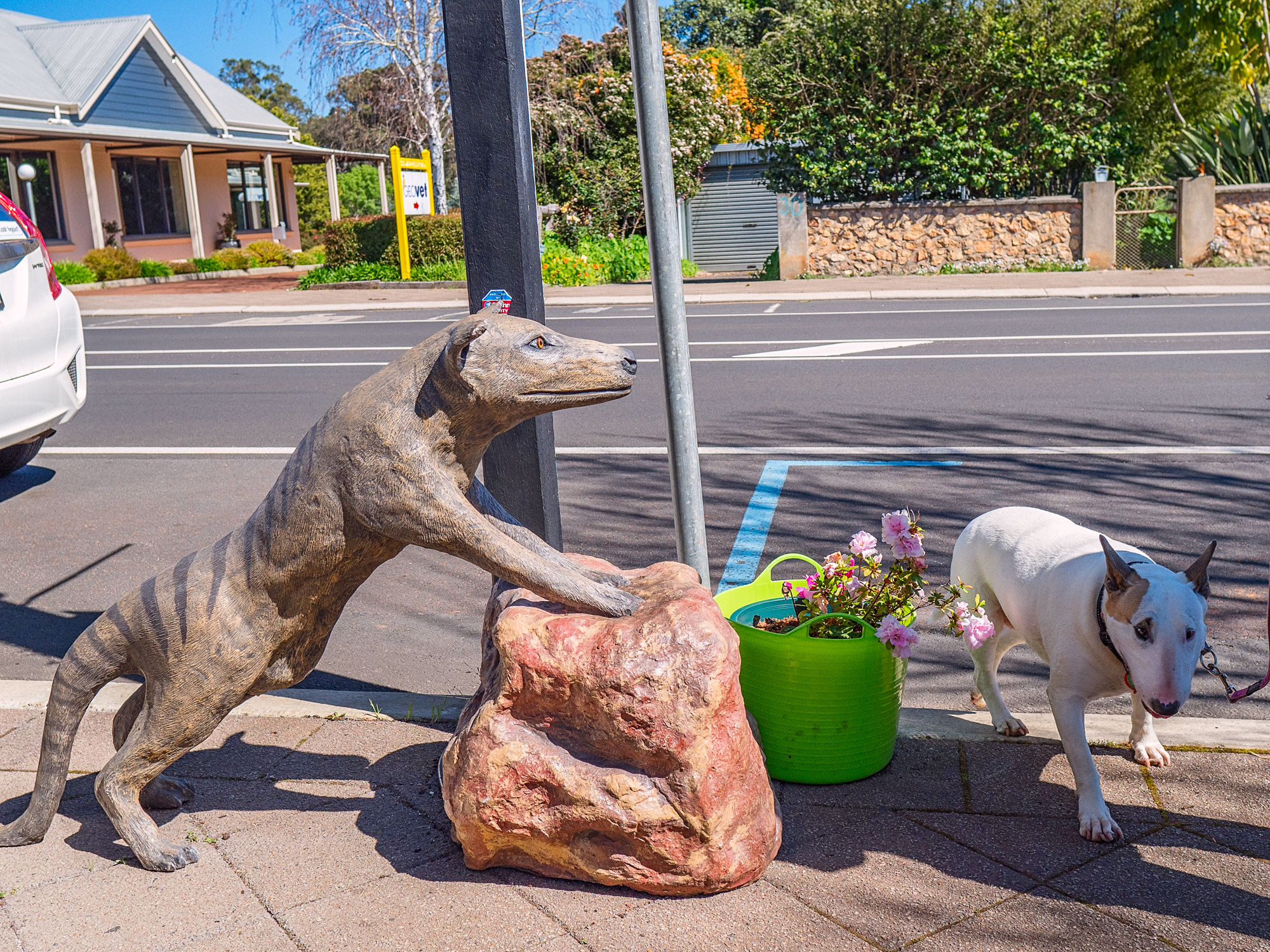
Tasmania does not have a monopoly on the thylacine. Many people believe they can be seen in Western Australia’s Blackwood Valley. Nannup is the focus of Thylacine tourism in Western Australia.
William Blake when he wrote his famous poem was thinking of the Bengal Tiger. We have/had tigers in Australia. Well kind of – hmmmm  not really. The Tasmanian tiger or to give it its proper name the thylacine (Thylacinus cynocephalus) once roamed all over Australia. But by the time the island continent was colonised it was restricted to the rain forests of Tasmania. I wrote a blog post about them a while ago. The thylacine is a tourist draw card in Tassie and it has become an icon for the tourist industry, but they don’t have a monopoly on it. Down in the South West corner of Western Australia, in the Blackwood Valley is the sleepy town of Nannup. Many of the locals are convinced that the Thylacine roams the forests in the valley and consequently it is now part of Nannup’s tourism campaign.


As it would happen we found ourselves in Nannup the other week. We weren’t looking for the tiger, but we certainly found them as we walked up and down the main street. Again like in Tassie the thylacine has been “gnomified” and can be found in front gardens all over the shop.


Frida was none too pleased with her thylacine encounter in Nannup.


It’s not the first time we’d visited the town, but we’d not been for a while and it had changed quite a bit. With the winding down of the forestry industry Nannup is seriously chasing the tourist dollar and the place has been titivated to reflect that. Once you were hard pushed to get a decent coffee now it seems that every other building is a cafe. It presents as a nice up beat place with a friendly vibe.


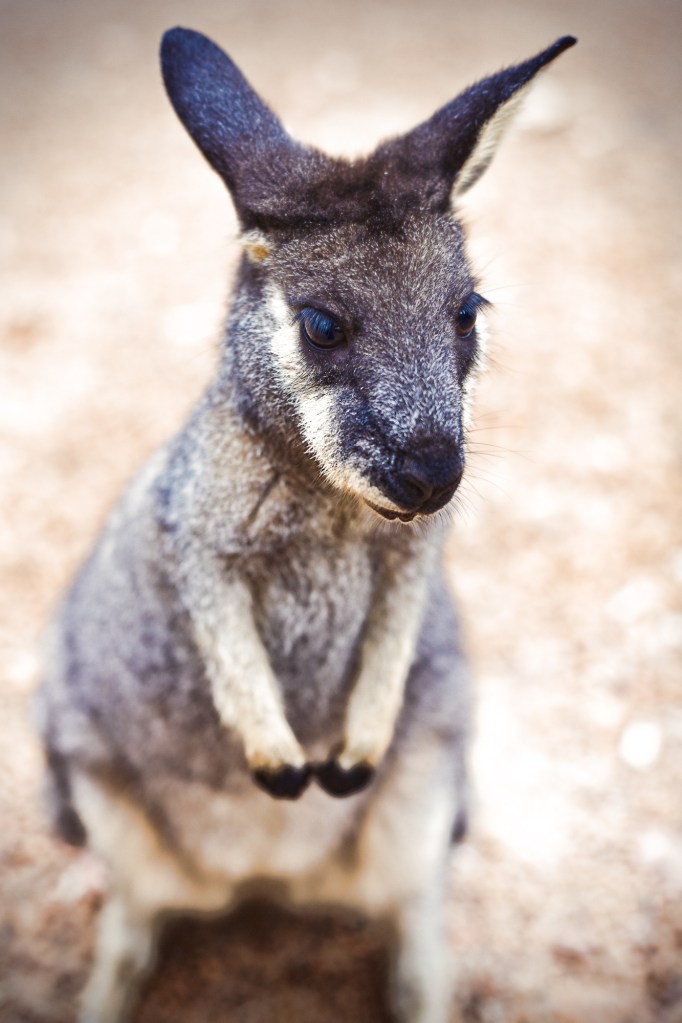
One of the Nannup locals, a Western Brush Wallaby (Macropus irma) also known as the black-gloved wallaby. Nannup, Western Australia.


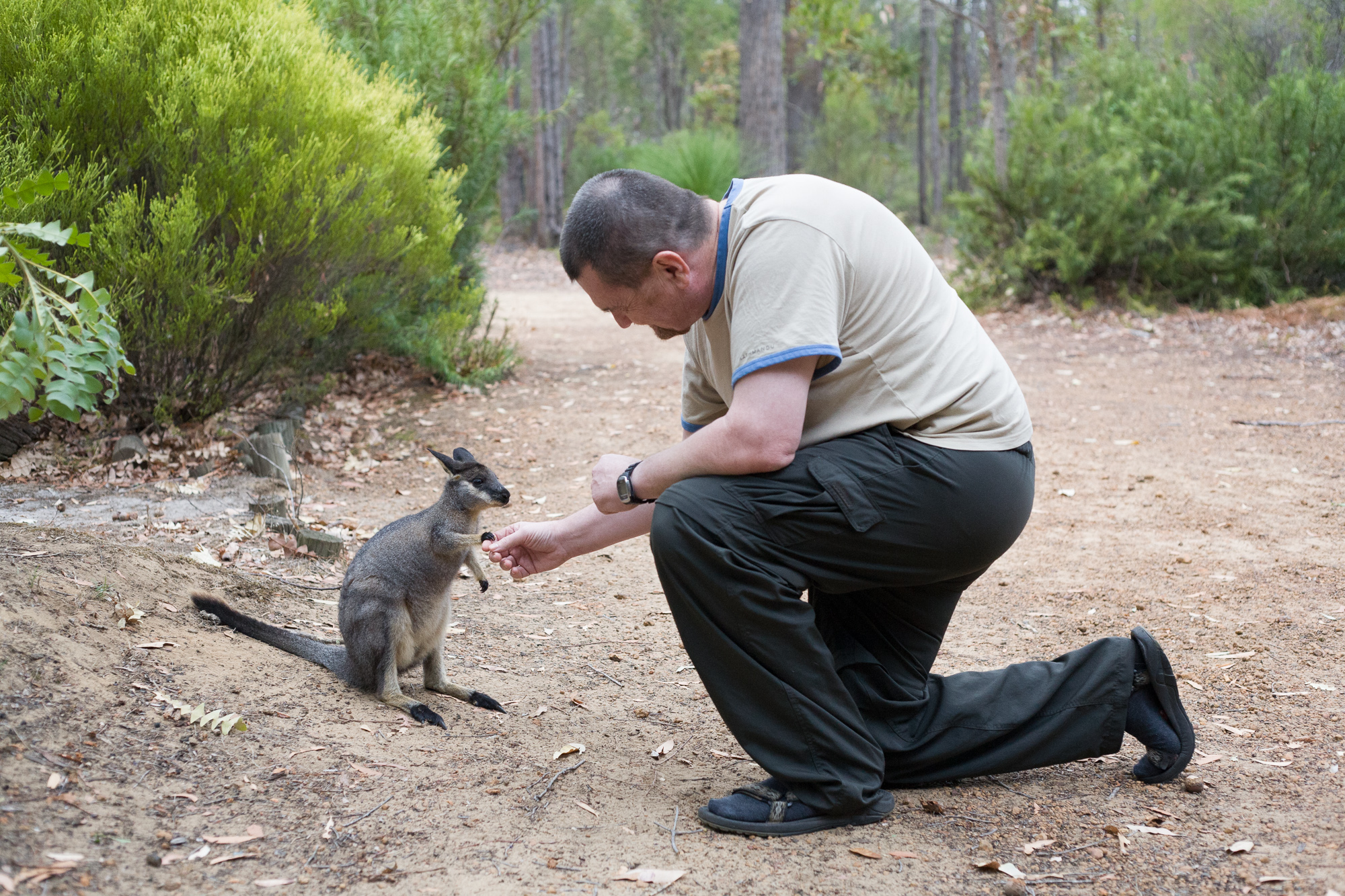
… and they proved to be very friendly.

Our accommodation was ideally located in the forest and only a stone’s throw from Kondil Wildflower Park. The park consists of new growth forest which contains an incredible diversity of flora. There are three walking trails within the park and I walked two of them. The Woody Pear Walk which is a 1 Km easy walk trail and the the Wildflower Wander which according to the information board is 3.5 Km but according to my GPS is 4.9 Km – either way it’s an easy walk on well sign posted trails.


Below are some of the orchids I found while walking around.


Bird Orchid by Paul Amyes on 500px.com
Bird Orchid, Pterostylis barbata. Nannup, Western Australia. Olympus OMD EM 1 mk ii with Olympus m.Zuiko 60mm f2.8 macro lens. Exposure: 1/125 sec, f4 at ISO 1000.


Leaping Spider Orchid by Paul Amyes on 500px.com
Leaping spider orchid, Caladenia macrostylis. Nannup, Western Australia. Olympus OMD EM 1 mk ii with Olympus m.Zuiko 60mm macro lens. Exposure: 1/60 sec, f8, ISO 3200.


Albino Silky Blue Orchid by Paul Amyes on 500px.com
Albino Silky Blue Orchid, Cyanicula sericea. Nannup, Western Australia. Olympus OMD EM 1 mk ii with Olympus m.Zuiko 60mm macro lens. Exposure: 1/125 sec, f4 at ISO 200.


Silky Blue Orchid by Paul Amyes on 500px.com
Silky Blue Orchid, Cyanicula sericea. Nannup, Western Australia. Olympus OMD EM 1 mk ii with Olympus m.Zuiko 60mm f2.8 macro lens. Exposure: 1/100, f5.6 at ISO 1000.


Warty Hammer Orchid by Paul Amyes on 500px.com
Warty Hammer Orchid, Drakaea livida. Nannup, Western Australia. Olympus OMD EM 1 mk ii with m.Zuiko 60mm f2.8 macro lens. Exposure: 1/30 sec, f8 at ISO 64.


Magical Magic Lake

This could have been titled Hyden – the return. Hyden is a small town in the middle of the Wheatbelt in Western Australia some 292Km east of Perth. Regular readers will remember that we’ve been before and maybe somewhat perplexed as to why we’d bother to visit again. Well Hyden’s claim to fame is Wave Rock which is a large granite rock face that has been eroded in the shape of a perfect breaking wave. More than 100,000 tourists make their way there very year. Most just stay about an hour before zooming off to another destination to get the perfect instagram shot without taking any time to see what else is there. A great shame really as there is so much more to offer. When I wrote about our previous visit I concentrated more on other sites and the Aboriginal heritage of the area. This time I’ll look at what Hyden has to offer in terms of the natural world.

We decided to make a three day trip and on our way we’d stop off in Corrigin whose main claim to fame is the being the holder of the world record for the number of dogs in a ute and being the home to a dog cemetery. You’d be forgiven for thinking that Corrigin is a bit obsessed with dogs.  Anyway it was a nice spot to break the journey, stretch the legs, make the bladder gladder etc. Corrigin does have a pretty impressive wildflower drive which begins just opposite the dog cemetery just on the outskirts of town. Most people just pull up in their car, jump out and walk a couple of metres. They then declare that there’s nothing to see and rush off in a cloud of red dust. Just take your time and have a poke about and you’d be amazed at what you can find. Here are a few examples.


Sugar Candy Orchid by Paul Amyes on 500px.com
Sugar Candy Orchid, Caladenia hirta subsp. hirta. Wildflower Drive, Corrigin, Western Australia. Panasonic Lumix G85 with Olympus mZuiko 60mm f2.8 macro lens and Metz 15MS-1 flash. Exposure: AE priority 1/200 sec, f4 at ISO 400 with -1 stop exposure compensation.


Chameleon Spider Orchid by Paul Amyes on 500px.com
Chameleon Spider Orchid, Caladenia dimidia. Wildflower Drive, Corrigin, Western Australia. Panasonic Lumix G85 with Olympus mZuiko 60mm f2.8 macro lens and Metz 15MS-1 flash. Exposure: AE priority 1/100 sec, f4 at ISO 400 with -1 stop exposure compensation.


Pink Candy Orchid by Paul Amyes on 500px.com
Pink Candy Orchid, Caladenia hirta subsp. rosea. Wildflower Drive, Corrigin, Western Australia.


Blood Spider Orchid by Paul Amyes on 500px.com
Blood Spider Orchid, Caladenia filifera. Wildflower Drive, Corrigin, Western Australia.


Slender Spider Orchid by Paul Amyes on 500px.com
Slender Spider Orchid, Caladenia pulchra. Wildflower Drive, Corrigin, Western Australia.


Sugar Orchid by Paul Amyes on 500px.com
Sugar Orchid, Ericksonella saccharata. Wildflower Drive, Corrigin, Western Australia.

When we got to Hyden we drove out to the Wave Rock Resort on the shore of Magic Lake which is where we were staying. The lake is quite startling. It’s not very big but is comprised of crystal clear salt water with a gypsum base. That pale coloured lake bed combined with the water makes a giant reflector that takes on the colours of the sky so as the day progresses the lake changes colour. To add to it’s other worldly qualities is that it lies in the middle of a salt plain which is fairly uniform in colour and is covered in mainly scrubby bush and a smattering of trees. It all made me want to get the tripod and graduated neutral density filters out.


Magical Magic Lake by Paul Amyes on 500px.com
Magical Magic Lake. A canoe on Magic Lake beach at sunset. Western Australia. Panasonic G85 with Panasonic Leica 8-18mm f2.8-4 lens and +3 stop graduated neutral density filter. Exposure: AE priority 1/8 sec, f11 at ISO 200 with +1 stop exposure compensation.


Magical Sunset by Paul Amyes on 500px.com
Magical Sunset. Magic Lake at sunset. Hyden Western Australia.


The next day we decided to combine the Wave Rock Walk Circuit with the Hippo’s Yawn Loop and the Breakers Trail to create a loop that would take us from the resort up to the Hippo’s Yawn then along the bottom of the rock out to the Breakers picnic area and then back to our accommodation at the resort. The best part of it was that we could take the dog as it is all very pet friendly. Along the way we hoped to see more orchids and birds as we passed through the salt plain and into the bush at the base of the rock.


Fence Line by Paul Amyes on 500px.com
Old fence posts march across the salt flats at Magic Lake near Hyden in Western Australia. Panasonic Lumix G85 with Panasonic Leica 100-400mm f4-6.3 lens. Exposure: 1/250 sec, f8 at ISO 200.


Crested Pigeon by Paul Amyes on 500px.com
Crested pigeon, Ocyphaps lophotes, Magic Lake, Hyden, Western Australia. Panasonic G85 with LEICA DG 100-400/F4.0-6.3 lens. Exposure: Shutter priority 1/500 sec, f6.3 at ISO 200 with -1/3 stop exposure compensation.


Kayibort by Paul Amyes on 500px.com
Known to the Nyoongar as Kayibort the Black-faced woodswallow, Artamus cinerus, can be seen on the shores of Magic Lake, Hyden, Western Australia. Panasonic G85 with LEICA DG 100-400/F4.0-6.3 lens. Exposure: shutter priority 1/500 sec f6.3 at ISO 200.


Lets Dance by Paul Amyes on 500px.com
Salt Lake Spider Orchid, Caladenia exilis subsp. exilis. Magic Lake, Hyden, Western Australia. Panasonic g85 with OLYMPUS M.60mm F2.8 Macro lens. Exposure: aperture priority 1/640 sec, f4 at ISO 200 with +2/3 stop exposure compensation.


Yellow Spider Orchid by Paul Amyes on 500px.com
Yellow Spider Orchid, Caladenia denticulata subsp. denticulata. Magic Lake, Hyden, Western Australia. Panasonic G85 with OLYMPUS M.60mm F2.8 Macro lens. Exposure: aperture priority 1/125 sec, f8 at ISO 1000 with -1/3 stop exposure compensation.


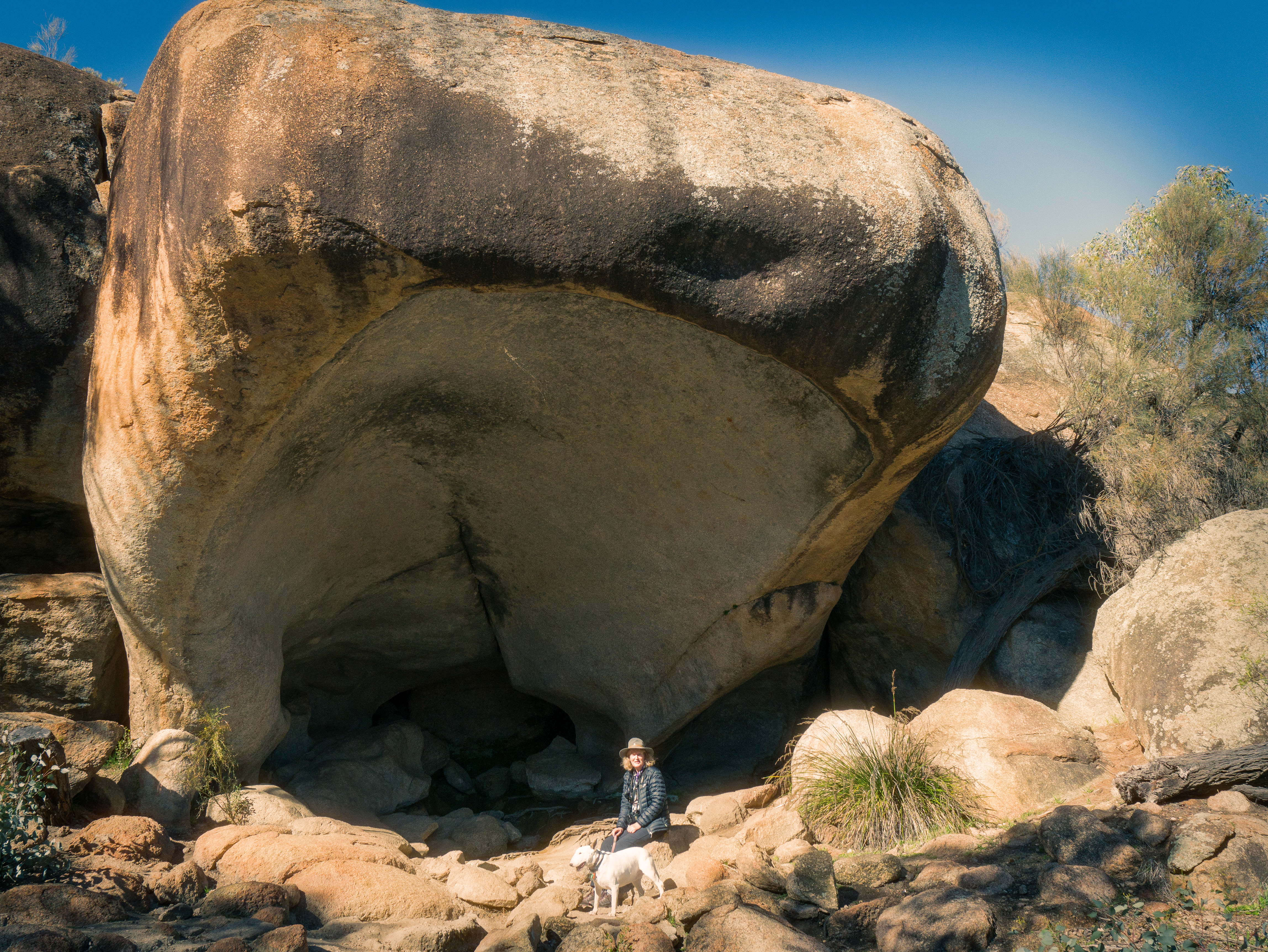
When we got to the base of the rock the vegetation changed from the scrub of the salt plain to thick bush fed by the water run off from the rock. We both enjoyed pocking around in the undergrowth looking for flowers, taking photos of each other and trying to dissuade Frida, our dog, from trying to climb up the rock face in search of interesting holes. It was amazing to see so many orchids – the blue beards were like a carpet in places. It was absolutely wonderful to see.


Helen and Frida at Hippo’s Yawn near Hyden in Western Australia.


Recurved Shell Orchid by Paul Amyes on 500px.com
Jug orchid, or recurved shell orchid (Pterostylis recurva). Wave Rock, Western Australia.


Blue Beard by Paul Amyes on 500px.com
Blue beard or blue fairy orchid (Pheladenia deformis),. Wave Rock, Western Australia.


All in all we had a great time. There is so much to see and do that we’re already talking about going again. If you are planning a trip to Wave Rock there is a whole lot more to it than posing for a selfie for Facebook on the rock.


Emu Fence by Paul Amyes on 500px.com
The Emu Fence at Wave Rock Resort. Hyden, Western Australia. iPhone SE in panorama mode. Exposure: 1/1400 sec, f2.2 at ISO 25.


Wandering Around Woodman Point


My latest pootle took me to Woodman Point south of Fremantle. It’s a very pleasant walk around an area with important Aboriginal, historic and environmental significance. Well worth a visit.

Woodman Point by Paul Amyes on 500px.com
Woodman Point, Western Australia. Panasonic G85 with Panasonic LEICA DG 8-18/F2.8-4.0 lens with a Cokin Harmony variable neutral density filter. Exposure:: 1/3 sec, f16 at ISO 200.


Woodman Point by Paul Amyes on 500px.com
Woodman Point Jetty. Panasonic G85 with Panasonic LEICA DG 8-18/F2.8-4.0 lens with a Cokin Harmony variable neutral density filter. Exposure: 1/3 sec, f16 at ISO 200.


This walk was also from my book Perth’s Best Bush, Coast, and City Walks,  published by Woodslane (ISBN 9781921606793 )  in 2010. It’s available from all good bookstores.

Go West – part 2

Russell Falls
Russell Falls in Mount Field National Park. Tasmania.


Lady Baron Falls
Lady Baron Falls in Mount Field National Park, Tasmania.


Mount Field National Park is one of Tasmania’s oldest and most popular parks. The reason why is that within the park there are rain forest, alpine moorland, glacial lakes and snow gums. In summer the park is a blaze with flowers and in autumn it is a glorious golden hue as the vagus trees (Tasmanian deciduous beech) prepares to shed its leaves. There are a variety of walks within the park that go from being just a 30 minute stroll to 8 hours Alpine walks which require cross country skies in winter. The Russell Falls walk is one one of the most popular walks in Tassie, it takes you through a forest of ferns, eucalypts and myrtles on the way out to the water fall. It is only takes 25 minutes return and is suitable for for wheelchairs and prams. Another popular walk is the Russell Falls / Horseshoe Falls / Tall Trees Circuit / Lady Baron Falls walk. An unwieldy name for for a very pleasant 2 1/2 hour walk that connects three waterfalls and the Tall Trees Walk. It requires a bit more effort but is worth it as it gives you a very good look at the ecosystem of the lower park. My favourite walks the Pandani Grove Nature Walk which is located on the Mawson Plateau in the alpine areas of the park. This is the best way to experience the alpine ecosystem of the park and as you walk around the glacially formed Lake Dobson you pass through a forest of pencil pine and and pandani. This walk takes about 40 minutes. Last time we went to the park we did the Pandani but also tacked on a side trip to Platypus Tarn in the hope of seeing a platypus. This adds another 20 minutes on the walk but takes you on a quite steep and rough path and I’d recommend it only if you have proper walking boots and are prepared for cold and wet weather. We didn’t see any platypuses, but nothing in life is guaranteed.

Forest At The Mountain's Feet
The look out point on the drive up to the Mawson Plateau in Mount Field National Park, From here you can look out over the Derwent Valley and see how the forest changes from dry eucalypt (which is the typical Australian bush) to the wet eucalypt forest which is dominated by trees that can grow up to 90 metres.


Lake Dobson
The Pandani Grove Nature Walk follows the shoreline of Lake Dobson. Mount Field National Park, Tasmania.


Bennetts Wallaby
Bennetts Wallabies regularly can be found grazing near the picnic areas of Mount Field National Park. This was was seen near the information hut on the shore of Lake Dobson on the Mawson Plateau in Mount Field National Park.


What can you see in the park? Well Bennetts Wallaby and pademelon can often be seen grazing in the late afternoon and early evening at the picnic areas. Barred bandicoots are seldom seen in daylight hours but can be seen around the campsite and picnic areas at night looking for insects and worms. Also active at night are brush, ringtail, and pigmy possums. In the more remote areas of the park it may be possible to see Tasmanian Devils, eastern quolls and spotted tailed quolls. Again these animals are only active at night. All of Tasmania’s snake species are active within the park and caution should be exercised if you should see one as they are all venomous. A lot of bird species inhabit Mount Field, with the majority being found in the eucalyptus forest. Here you can see green rosellas, yellow tailed black cockatoos, yellow wattle birds, crescent honeyeaters, grey shrikes and currawongs. Harder to see, but still present in the undergrowth are scarlet and dusky robins and blue wrens. If you are lucky and in the alpine areas you may see wedge tailed eagles soaring on the thermals looking for prey. In terms of flora – basically you have three distinct ecosystems, dry eucalyptus forest, wet euclaypt forest (or rain forest) and the alpine heath. Below 670m you see dry eucalyptus forest which is your typical Australian bushland and is identified by the tall growing trees such as the swamp gum (the tallest hardwood tree in the world growing up to 100m tall) the white gum and the stringy bark. The understory comprises of native musk, and hazel or dogwood. Up to 940m is either closed rainforest or in the transition areas mixed forest. This is dominated myrtle-beech and sassafras with an understory of native laurel. In the gullies formed by the numerous creeks are several species of tree ferns and it is these most people think of when they hear the term temperate rainforest. At 880m and above the Tasmanian snow gum starts to dominate the sub-alpine forest. Past this and you see alpine heath of the pandani which with its palm tree looks can grow to heights of 9m. As you explore the areas around the lakes or tarns ( a tarn is a lake that was formed during the ice age when a glacier created a cirque, corrie or cwm which later fills with water) many shrubs grow mountain berries which introduce a splash of colour to the undergrowth.

Pandani Grove
Walking through the wet forest on the Pandani Grove Nature Walk you can see the stands of pandani for which the walk is named. Pandani (Richea pandanifolia) can grow as tall as 9 metres


Snow Berries
Snow Berries (Gaultheria hispida), Mount Field National Park, Tasmania.


If you want to spend more than a day in the park there is a campground for vehicle based campers near the visitor centre. It has a camp kitchen, shower block with laundry and barbecues. There are some basic huts for walkers in the alpine area, and these have basic facilities such as running water, a wood heater, and bunks with mattresses. All accommodation can be booked through the visitors centre on (03) 6288 11149. There is also some private accommodation outside the park.


20150417Mount_Field-0019_HDR-2.jpg
Pandani Grove Nature Walk


Lake Dobson
Lake Dobson


The best camera….

The Olympus XA4 – a classic capsule 35mm film camera with macro capability. My constant companion for many years.

…is the one you have got with you. It’s an old saying but it is a truism.  I’ve always been a proponent of having a high quality pocket camera for those times when you don’t want to carry a camera. In the days of film it was my Olympus XA or XA4 (see the picture in the heading of the blog), but now it is Panasonic LX-5. The make or model is immaterial, really the main criteria is that it has to fit in my pocket and be able to produce a good quality A4 sized print.  The irony is that most of my best-selling pictures have been taken with such cameras.

The Leica D-Lux compared with the Panasonic Lunix LX5. Looking from the front there is not a lot of difference in the size despite the D_Lux have a sensor much larger than the LX5.

Yesterday was one of those beautiful winter days that makes living in the south-west of Western Australia so worthwhile. It had been a cold clear night and we woke to a crisp morning with temperature expected to rise to 23℃ – better than some country’s summer. So my partner and I decided to walking in the Darling Range just above Perth and we walked along Piesse Brook to a place called Rocky Pool which is a picturesque little spot. Once we got there my partner decided to sit and cool off her feet in the water and I decided to take a couple of shots for the relatives such as this one:


It’s fine as a family snap shot and it records a nice moment in our lives that we can share with family members living in the UK, but pocket cameras are so good these days they are capable of so much more. I turned 180º and looked at the pool at the bottom of the small water fall. It was a pretty vista and I wanted to record it but knew that the dynamic range of the camera’s sensor was not up to recording the huge subject brightness range of the scene. Hmm! What to do? I had no graduated filters, no tripod, no cable release, just my pocket camera. So I set  exposure bracketing dialling in +/- 2 stops and handholding the camera just above the water took a series of shots while crossing my fingers. When I got home I fired up the computer and imported the pictures into Lightroom and then chose to merge them into a HDR using PhotoShop. After a bit of jiggery pokery playing around with curves and a couple of plugins I got this:


Not a great work of art but it is a pleasing shot that sums what a great time we had.

It really is a great time to be a photographer.

Just as a gentle plug a while ago I wrote and illustrated a book on walking in Perth, this walk was included. The book can be bought from tourist offices and good bookshops in Western Australia or it cane be ordered online here:

http://www.booktopia.com.au/perth-s-best-bush-coast-and-city-walks/prod9781921606793.html