I had an appointment in Glen Forest, about an hours drive away, late in the morning and to make the most of the petrol I decided to stop en route at Lake Leschenaultia at dawn. The weather was quite bleak when I got there – cold and damp with thick fog and virtually zero visibility. Knowing I wasn’t going to get anything to blog I decided to experiment and shoot some video.
A few hours later while walking back to the car a young woman walked past me at speed and commented on the seriousness of my camera. A few steps on she stopped and asked whether I’d seen and photographed the little duck. Always seeking local knowledge I asked which little duck in particular as there are quite a few species that call the lake home. She tried to explain that it was a very unusual little duck, completely different from anything she’d seen before. Oooh I thought – something new and unusual. She went onto say that she’d taken a photo with her phone and Googled it and found out that it was the Madagascan Duck. Now I was a bit sceptical as although ducks do migrate with the change of seasons it does tend to transcontinental as opposed to crossing large expanses of open sea. They also do it in large flocks, so if there is one there are probably hundreds. It would seem very unlikely that a single duck would have wandered so far off course as their navigation is pretty impressive. While trying to be helpful and say it was probably one of last summers fledglings she saw I was answered with I still have the photo on my phone. With that she quickly locates it and shows me the photo. It wasn’t a duck. It was an Australasian Grebe (Tachybaptus novaehollandiae). She seemed absolutely delighted with this information said goodbye and walked off.
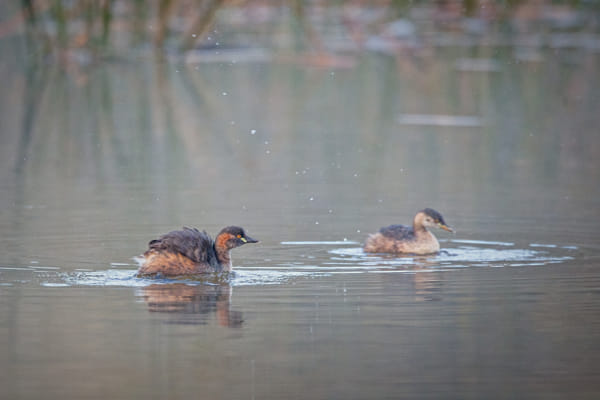
Definitely not a Madagascan Duck but rather Ngoonan or Australasian grebes (Tachybaptus novaehollandiae). Lake Leschenaultia, Western Australia.
On getting home I was a little bemused by the event and decided to Google the Madagascan Duck myself. It threw up the Madagascan pochard (Aythya innotata) which is an incredibly rare species of diving duck which was thought to have gone extinct in the late 1990’s. Some breeding pairs were later discovered and as a result of a captive breeding program there now is a small population of 25 individuals located on two small volcanic lakes in the far north of Madagascar. Whenever I see an Australasian Grebe I shall always think of the Madagascan Duck.
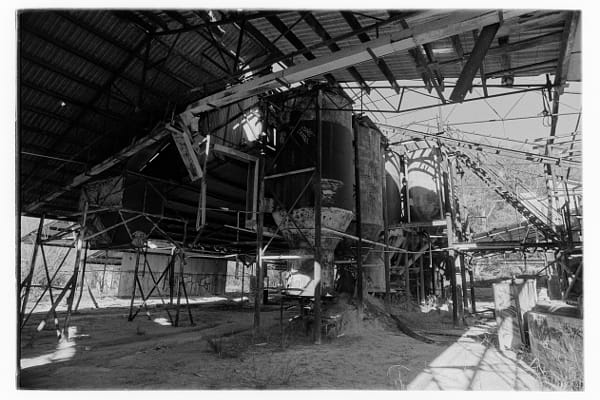
Like most things in Australia the Clackline Refractory came into being more by luck than planning. In 1898 Western Australia was undergoing a gold rush and two blokes by the names of John Ford and James Murray were prospecting in the eastern end of the Darling Range. About 80Km east of Perth they decided to sink an exploratory shaft and instead of finding gold they found fire-clay. Disappointed they moved on. Fast forward a couple of years and it must of dawned upon them that they had stumbled upon a valuable commodity as they decided to extract the clay from what on closer inspection was a limitless supply. Why was the clay so valuable? Well fire-clay is used to make bricks for furnaces and kilns. It is used in the manufacture of crucibles for smelting. Before this discovery Australia was having to import bricks made of fire-clay from Britain at some considerable cost. The refractory was built to produce the bricks and it was found they were more durable than the imported ones. You’d think that having a ready made monopoly would have meant that Messrs Ford and Murray would be laughing all the way to bank. Well no and the refractory changed hands several times before being completely shut down in 1992.
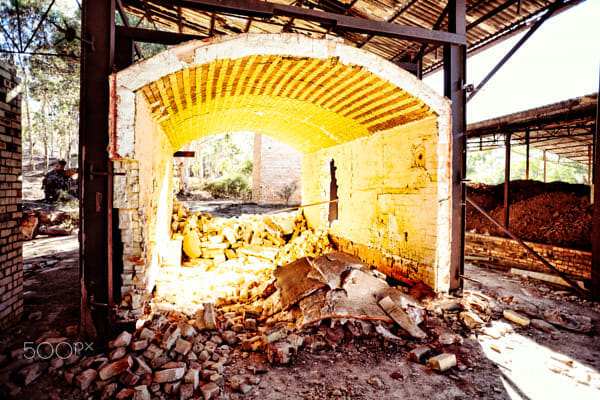
The suns rays reflected on the white walls of a derelict brick kiln at the Clackline Refractory.
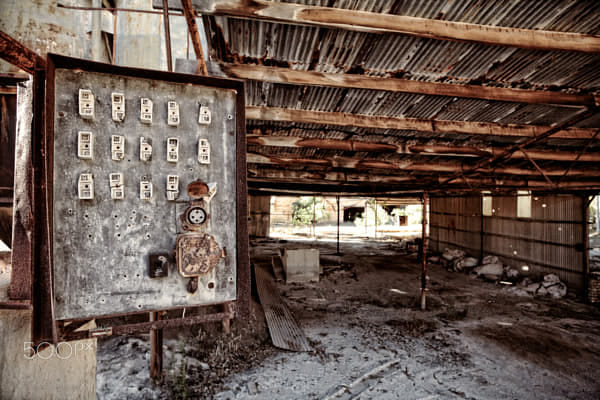
The remains of an electrical control panel at the Clackline Refractory.
I discovered the Refractory completely by accident. I was cycling along the Kep Track and as I was approaching Clackline I saw an enormous brick chimney rising out of the trees. It was definitely industrial looking so I decided to have a shufty and found this huge post industrial site. It had only been shut for a couple of years at that stage and everything looked pretty intact. I went back a few days later and photographed the place early in the morning and the sunlight shining through the huge kilns was magical. On further research I wasn’t surprised to learn that it had been given a heritage listing.
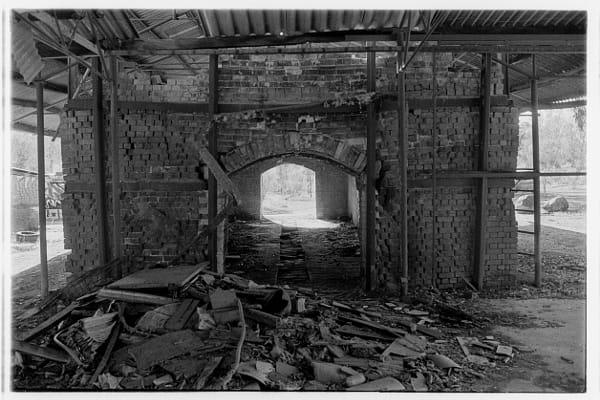
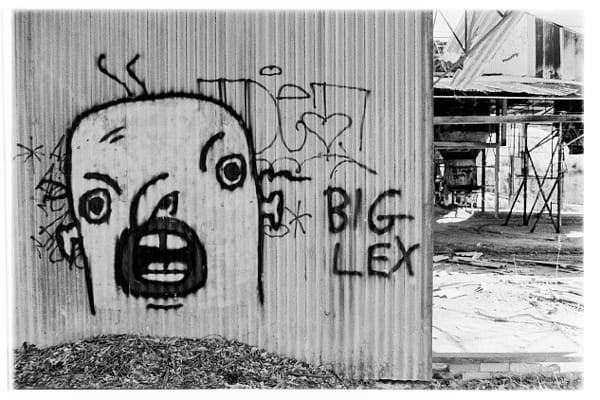
I didn’t think about the refractory again until a couple of months ago. I just purchased a new to me secondhand camera and I wanted to put a roll of film through it to see if it was working OK. My partner wanted to visit Clackline to get some material for a project she’s working on so I decided that the refractory was where I’d test the new camera. When we got there I wasn’t prepared for how much the site had changed. Everything of value had been stripped out, the buildings were in a dreadful state, there was graffiti everywhere along with drug paraphernalia. To add to the sombre mood we met a family there who were visiting to see where a relative had died just a couple of days previously. You couldn’t more get a more gothic atmosphere if you tried and this suited the black white film perfectly. All in all it was quite a strange experience and we moved on after I had shot the roll.
One of the old kilns at Clackline Refractory.
SOOT. Clackline Refractory.
Exit. Clackline Refractory.
Where the clay was mixed prior to being moulded and then fired.
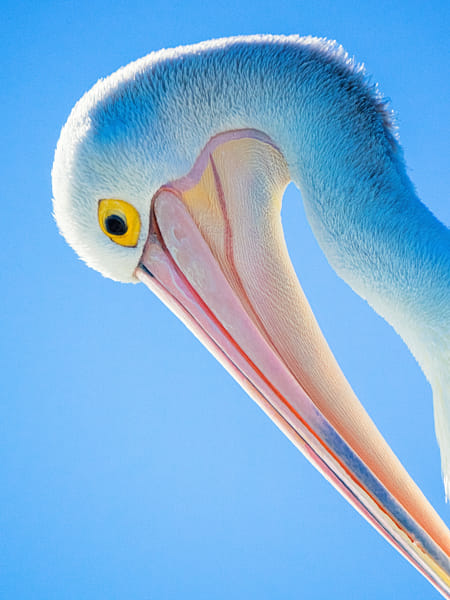
Boodalang is the Nyoongar name for the Australian Pelican (Pelecanus conspicillatus). Woodman Point, Western Australia.
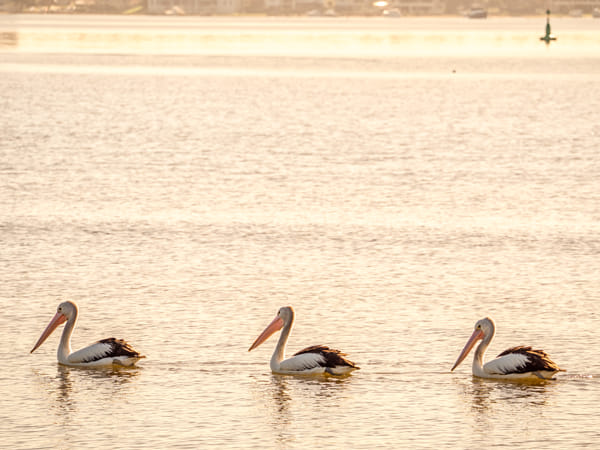
A trio of Australian pelicans swimming in formation off Point Walter on the Swan River.
The Australian Pelican is a familiar sight and can be found in waterways and coastal areas all around Australia. Basically where there are fish there are pelicans. I’m sure that I’m not alone in being slightly amused by the sight of them. That large beak and pouch looks somewhat comical and birds that size shouldn’t really be able to fly – how do they get airborne?
Australian Pelican, Pelecanus conspicillatus, Lake Seppings, Western Australia.
Australian pelicans are the second largest flying bird in Australia, only the brolga is bigger. Although on the small size compared to other pelican species the Aussie comes in 4-13Kg (males are larger than females) and have a wing span of up to 2.5m. That’s a lot of bird. That bill is the largest of any bird measuring up to 50cm in length. They are highly evolved animals that owe their success to a number of strange features.
Trawling at Two Peoples Bay, Western Australia.
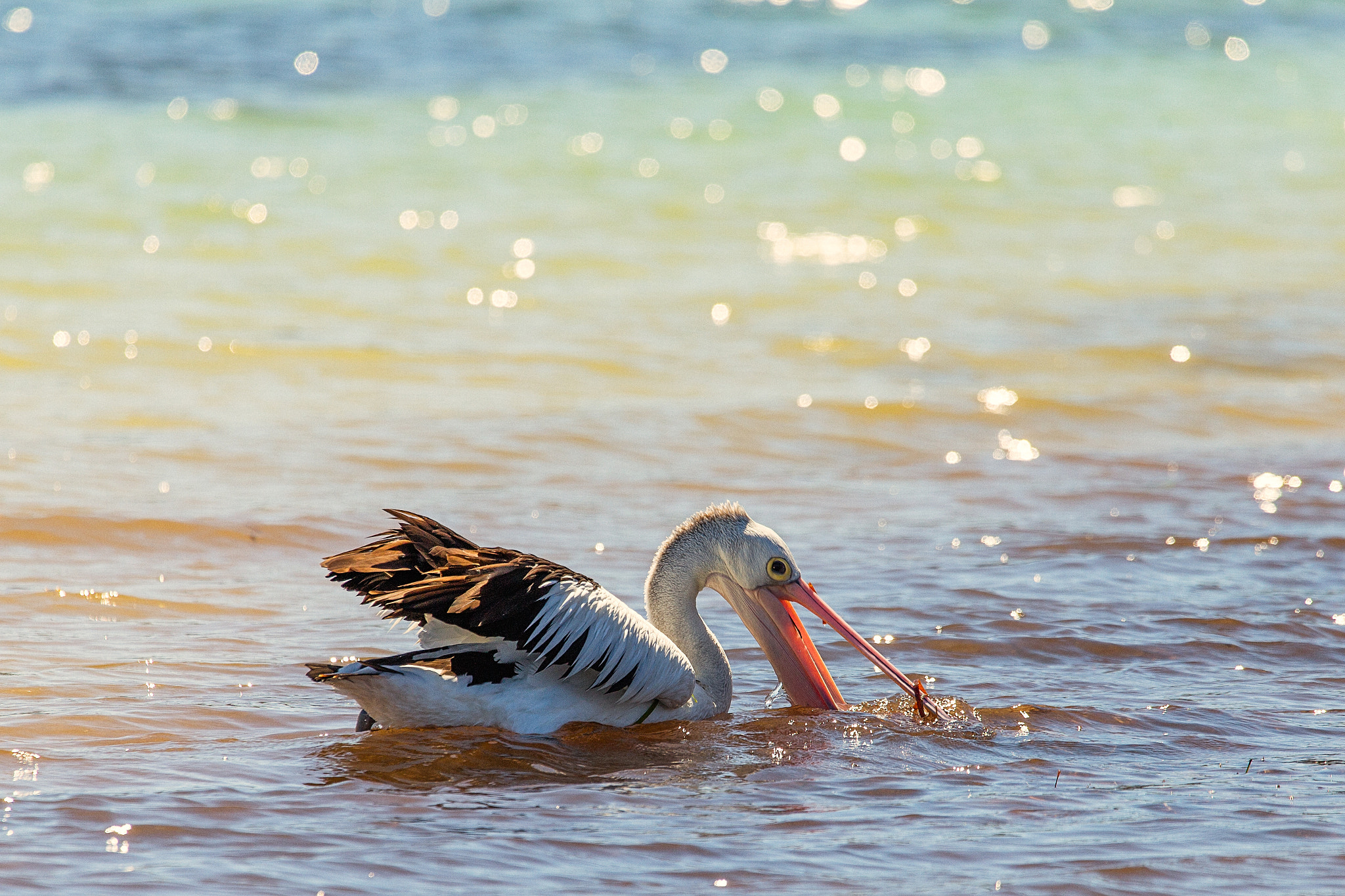
That distinctive bill and pouch is not for storing fish to eat later, but is rather used as a net to trap fish and other marine life. As the pelican trawls the pouch can hold up to 13 litres of water and food. When it is time to eat the bird lifts its bill out of the water and pushes it against its chest to expel the water and then it flips its prey around so that it can be swallowed head first. They don’t just eat marine life, they will eat small ducks, seagulls and small mammals. They will even steal the fish that other birds, such as ospreys, have caught. In all an adult pelican will eat up to 2Kg of fish a day. On a hot day the pouch is also used as a cooling system – the bird swings it about to cool down.
Effortlessly swimming along the Serpentine River in Mandurah, Western Australia.
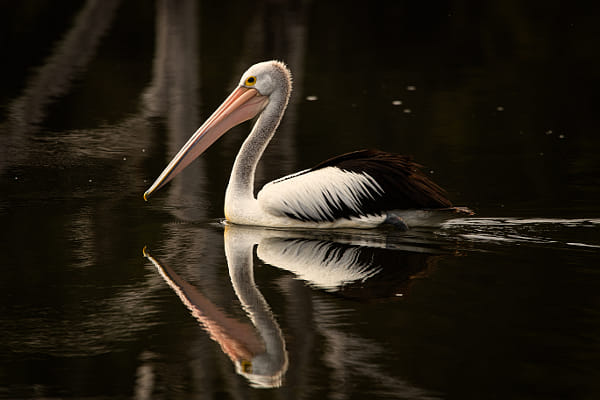
Despite their size they have a light weight skeleton that has air pockets. This means that it weighs less than 10% of the total body weight which enables them to fly and remain buoyant in water. They also have a number of air cells under their skin which are connected to the respiratory system and act as floats. This gives the pelican the ability to float with very little of its body below the surface of the water which has the effect of minimising energy expenditure when swimming.
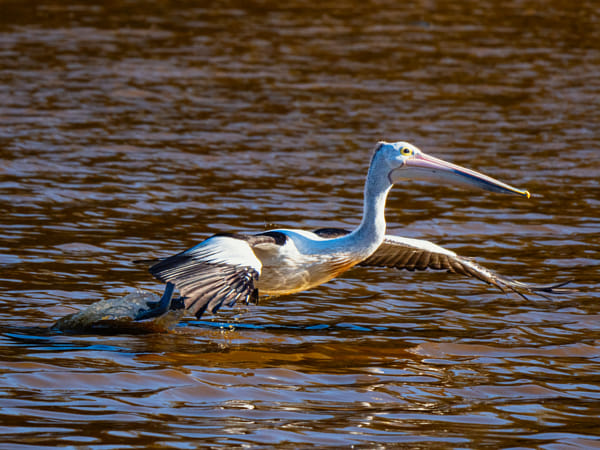
Getting ready. Alcoa Wellard Wetlands, Western Australia.
“We’re off!”
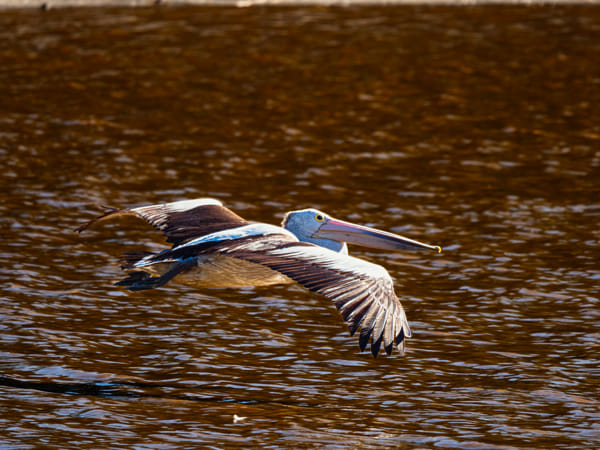
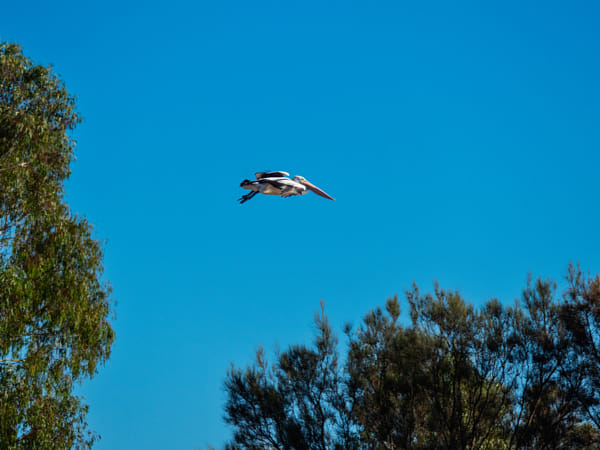
Heading home.
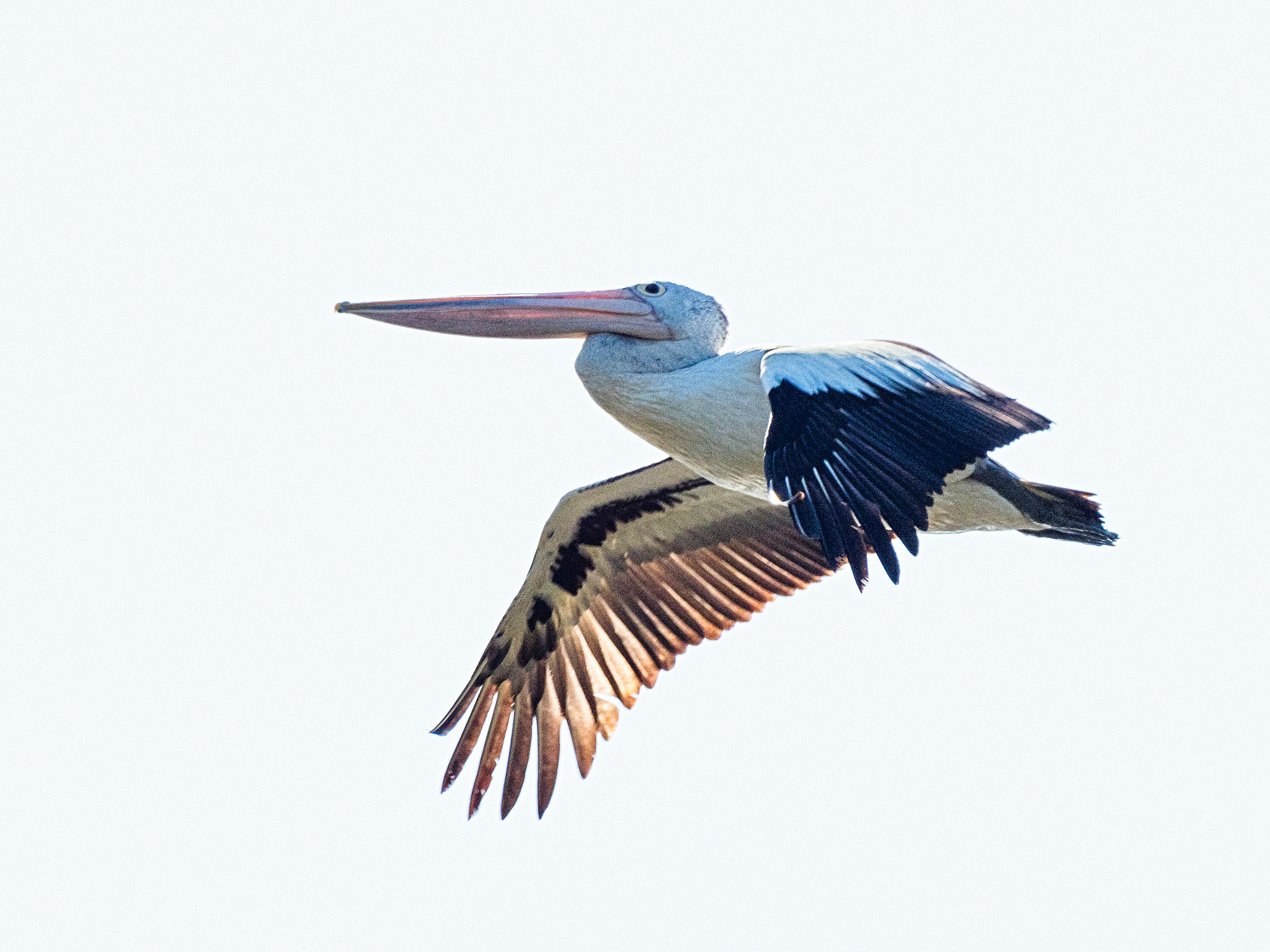
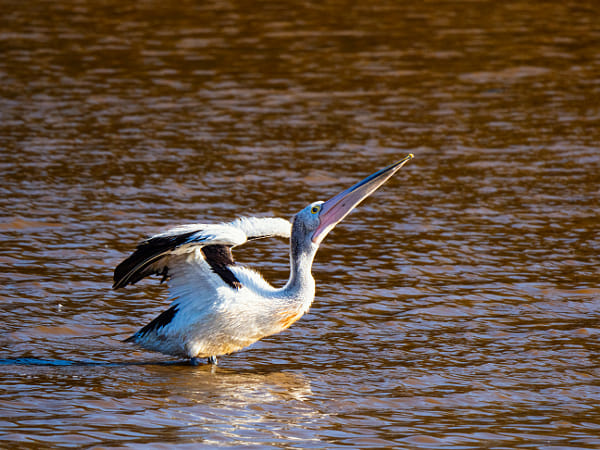
Perhaps the most amazing facts about the Australian pelican are when it comes to flight. Their large wings enable them to soar on thermal currents at altitudes up to 3000m and they can stay airborne like this for up to 24 hours. It makes for an incredibly efficient means of flying. When taking off a pelican will often fly incredibly low over water – they almost skim the surface. By this they take advantage of the “ground effect” which reduces drag and increases lift. The air flows between the wings and the water’s surface where it is compressed and exerts a strong upward force pushing the bird up and this again minimises the amount of energy expended. This energy efficiency is important because an adult pelican will often commute from its nesting site 150Km to find food.
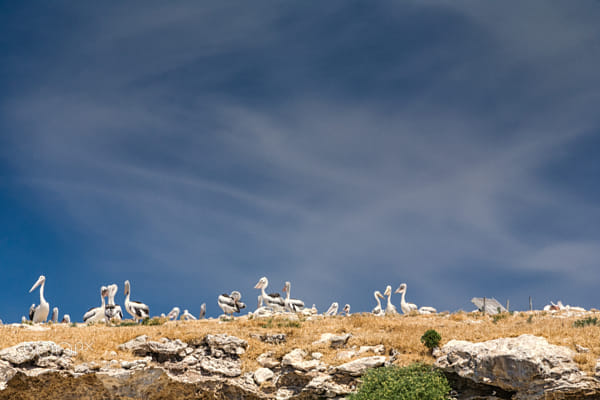
Nearly a thousand Australian pelicans use Penguin Island as a nesting site and breeding colony.
The Australian pelican maybe cut a comical figure, but they look like that for very specific reasons.
I came across a wonderful little piece in the Guardian the other about a photographer whom I’d never heard of before, but on looking at his work I was completely enthralled. The photographer is Raúl Cañibano from Cuba. His work falls into the categories of humanism and surrealism and follows in the traditions of Henri Cartier-Bresson, Elliot Erwitt, Walker Evans, Josef Koudelka and Sebastião Salgado. It is wonderful stuff and I would urge you to have a look at his work and maybe buy his books.
This genre of photography is one that for a number years I really wanted to practice without much success. There is this assumption that it is very easy – all you have to do is walk around and point your camera at everything you see and you’ll end up with “art”. It takes a great deal of dedication, patience and an eye that can spot “a significant moment in the continuous flux of life and captures it in a fraction of a second”. (p 104 Badger, G. 2007 “The Genius of Photography – how photography has changed our lives” Quadrille Publishing Ltd, London). Or to put it another way that nanosecond when all the individual elements of a photograph come together to create meaning. For years I have wanted to take a certain photograph that for me epitomises this ethos. I can see the image in my minds eye, but, I can never manage to make it happen. It is a simple concept but it has eluded me.
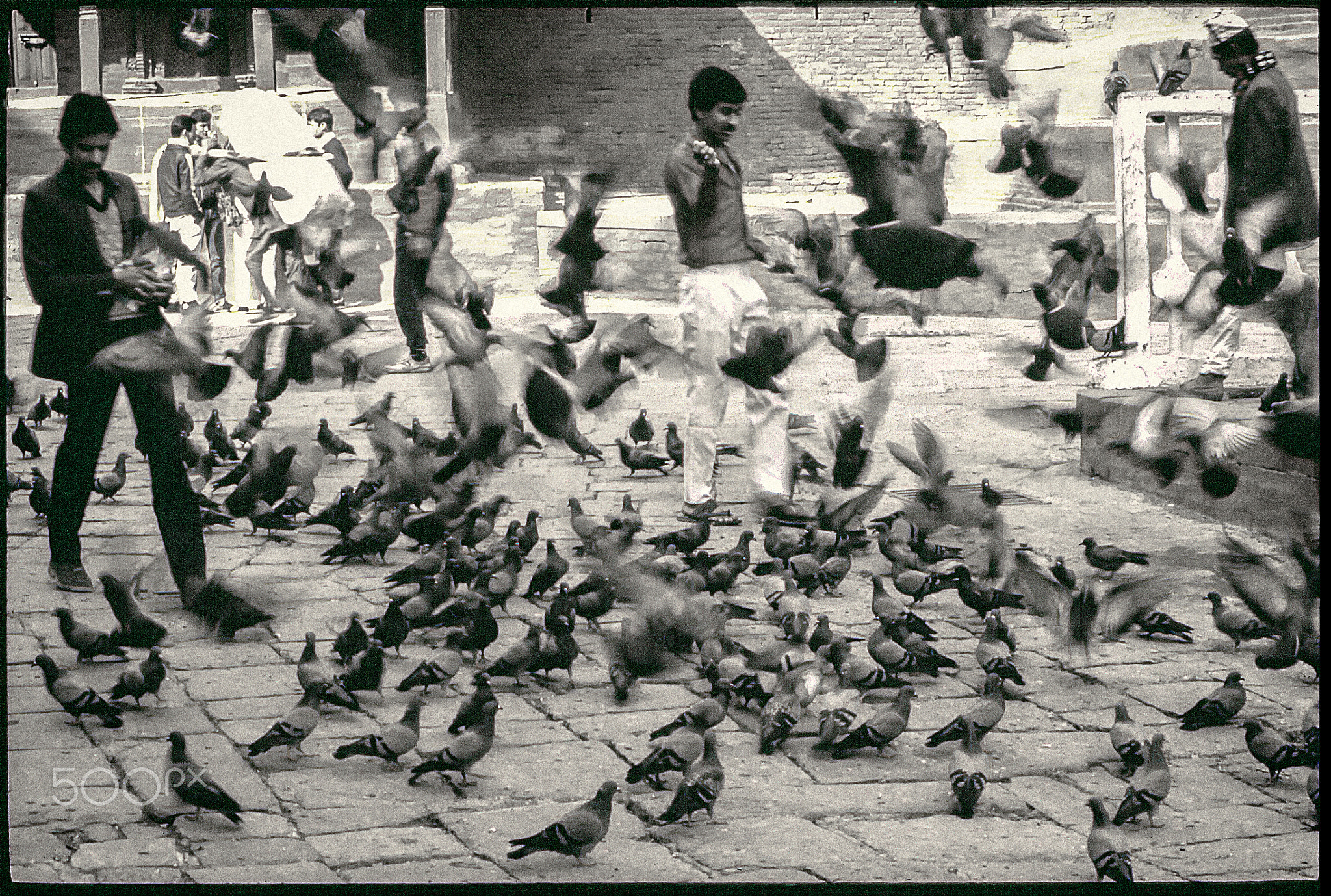
Walking through the feeding pidgeons in Durbar Square Kathmandu. Olympus OM4 with Sigma 75-210 lens, Kodak Ektachrome 100.
The idea is that a person walks into a large flock of pigeons that are feeding on the ground and as they do the birds take flight and we have a photo of a person surrounded by a swirling mass of birds.As I said it is a very simple concept and not original in any shape or form. The occurrence happens frequently yet I just can’t nail it. The best attempt so far is one that I took in Nepal in 1987 (yes it’s been going on that long!). It’s an OK shot on one level, but it is really too cluttered to work. Fast forward to Monday and I was in Perth walking through Forest Place where there was a flock of pigeons feeding on the ground. Suddenly alert to the possibilities I caught out of the corner of my eye a small boy running around in that state of hyper excitement that only small boys can have. I immediately thought that at last it is finally going to happen. So as the little lad approached the birds I quickly framed up and set an appropriate aperture and shutter speed and waited for the decisive moment of the child scattering the flock and them taking flight around him. I could just see the finished photograph. So what happened? Well the little lad did indeed run among the pigeons and they just didn’t react. The whole episode was a tremendous anticlimax. Maybe one day it will happen.
The Kid Among The Pigeons. Forest Place, Perth, Western Australia. Canon 5d with Canon EF 50mm f1.8 ii.
I’ve not been very active of late. I’ve had a few niggling injuries that’ve meant that I’ve not been able to get out and about much. What little photography I’ve done, and it is very little, has been taking piccies of the garden birds. Hopefully over the next week or so I’ll start getting out and about again.
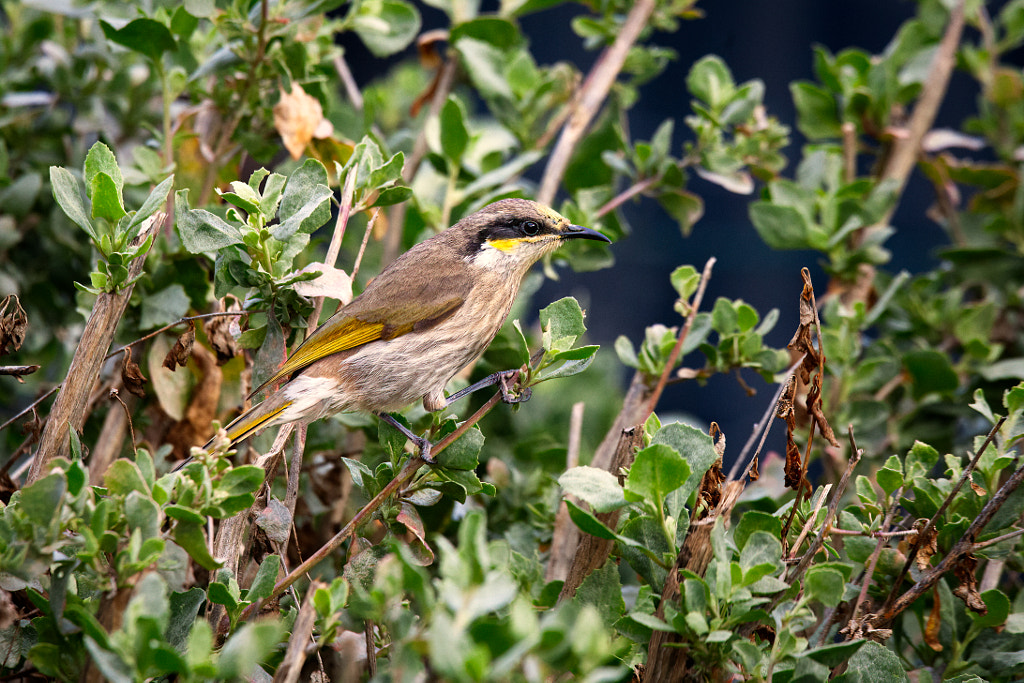
Kool-boort or Singing Honeyeater (Gavicalis virescens) in my back garden.
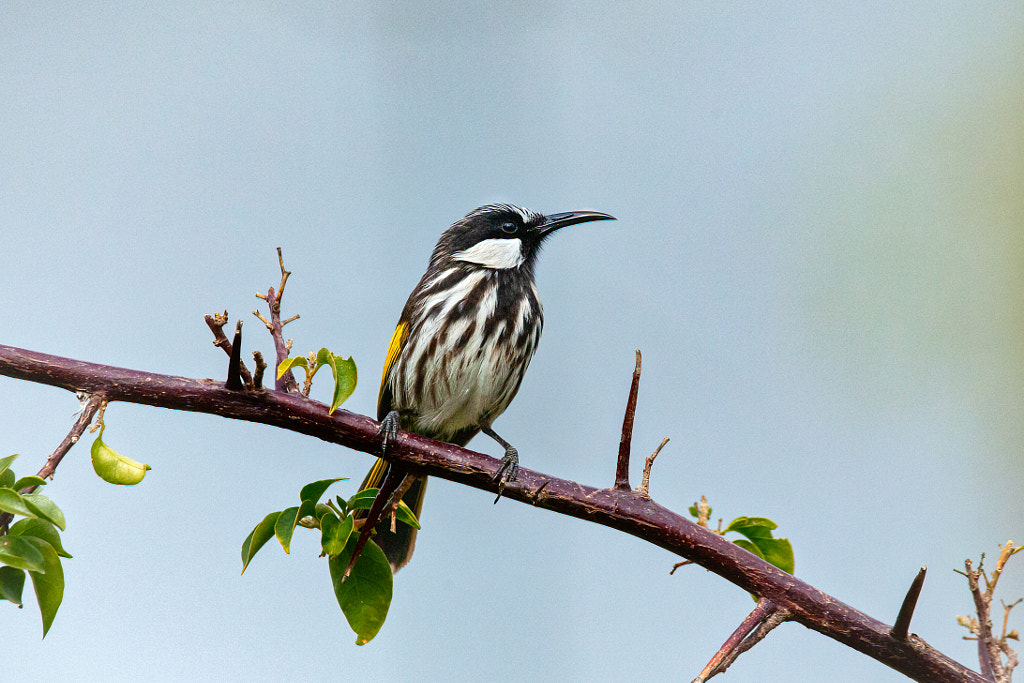
Bandin or White-cheeked honeyeater (Phylidonyris nigra) in my back garden.
By Western Australian standards it is freezing – well 2ºC – and just after dawn. I find myself sitting in a reed bed wondering why I abandoned a nice warm bed to be wet and cold.
Waradja or Spotless Crake (Porzana tabuensis). Lake Leschenaultia, Western Australia. A bit of a grab shot. It was taken with a geriatric Canon EOS 300d and an equally old Canon EF 75-300mm lens. Unfortunately the bird moved too quickly and the camera’s autofocus system wasn’t able to keep up.
Well the answer to that is four weeks ago I was here at Lake Leschenaultia mucking about with an old camera and lens when I spotted a small bird in the reeds that I’d not seen before. I grabbed a quick photo but it disappeared back into the reeds before I could properly sort myself out. When I got home I identified the bird from the blurry grab shot as a Waradja or spotless crake. Since then I’d been full of good intentions to go back and try to get a better photo, but,they were sabotaged by a great deal of procrastination until the other day when I’d decided to resurrect an old favourite camera of mine – the original Canon EOS 5d from 2005. The original batteries had perished and would no longer hold a charge so I got a set of replacements and found a couple of memory cards at the back of a drawer. I just needed something to point it at, and that is when I remembered the spotless crake.
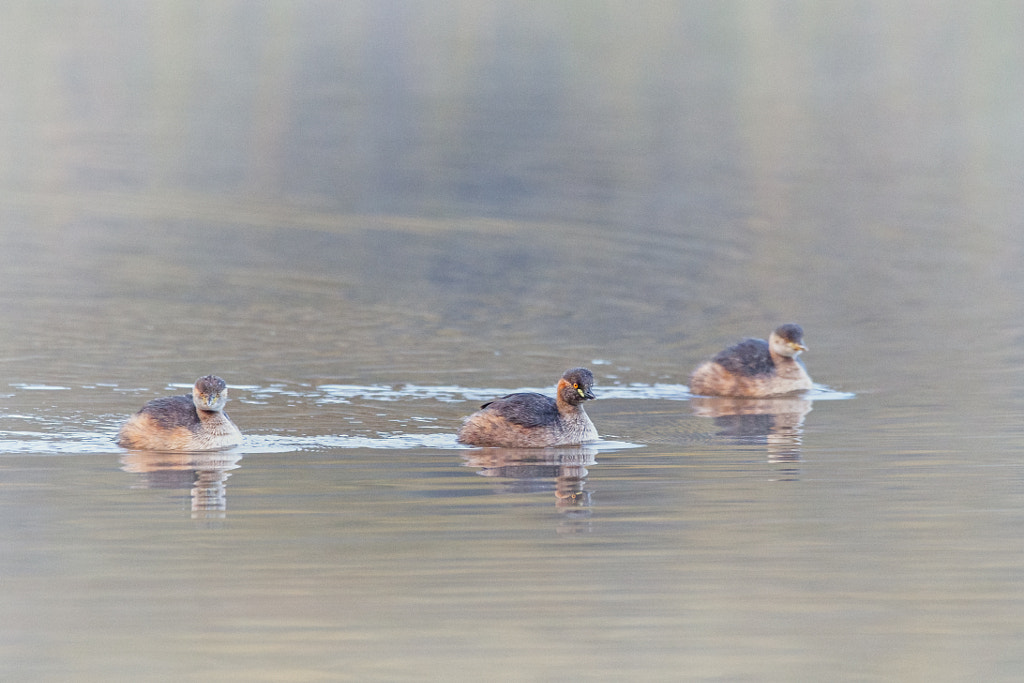
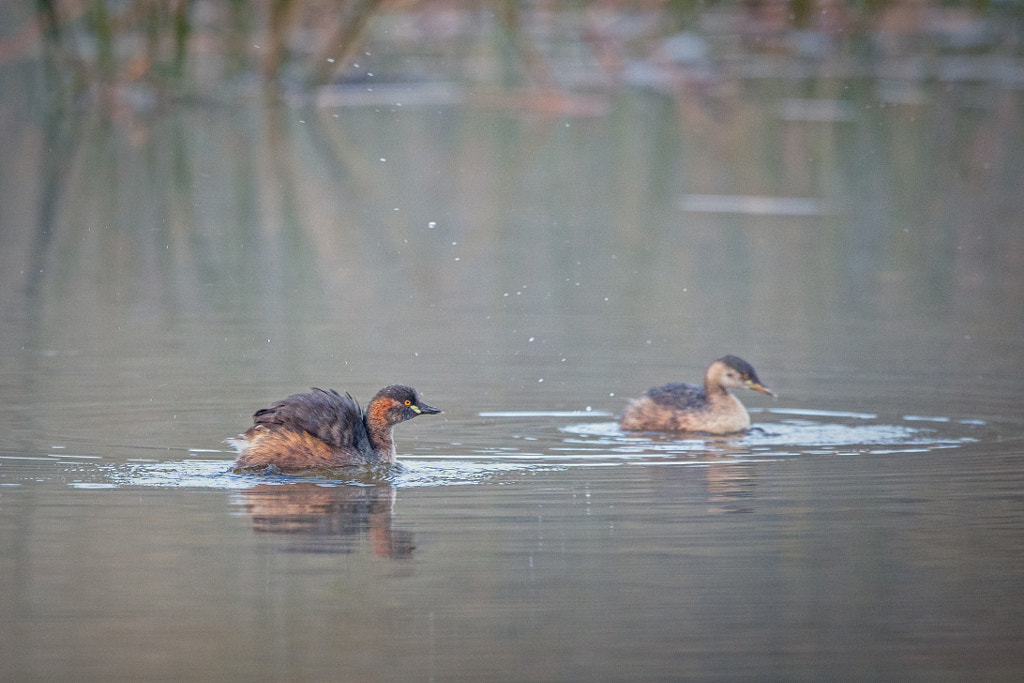
A flotilla of Ngoonan or Australasian grebe (Tachybaptus novaehollandiae) came to check out what I was doing.
After a quick shufti they headed off to the centre of lake.
Things had changed considerably in the ensuing four weeks. There had been a lot of rain and the water levels had risen considerably. So much so that the area where I saw the bird was now under water. The other thing that had changed was that there was a lot of noisy building work going on – and when I mean noisy I mean really loud. Combine this with the cold and it was no surprise that there were no birds on the lake, not even the Eurasian Coots. Undeterred I parked myself in among the reeds as close as I could to the place where I’d seen the spotless crake and just waited. Some large jarrah trees cast their shade over me so I didn’t get the warming effect of the rising sun. After a couple of hours a flotilla of Australasian Grebes approached and gave me the once over and then made off to centre of lake to be in the sun. By now I was really cold and miserable. It was obvious that the spotless crakes weren’t going to put in an appearance so I decided to walk down the other side of the lake to warm up in the sun and restore some feeling back to my feet.
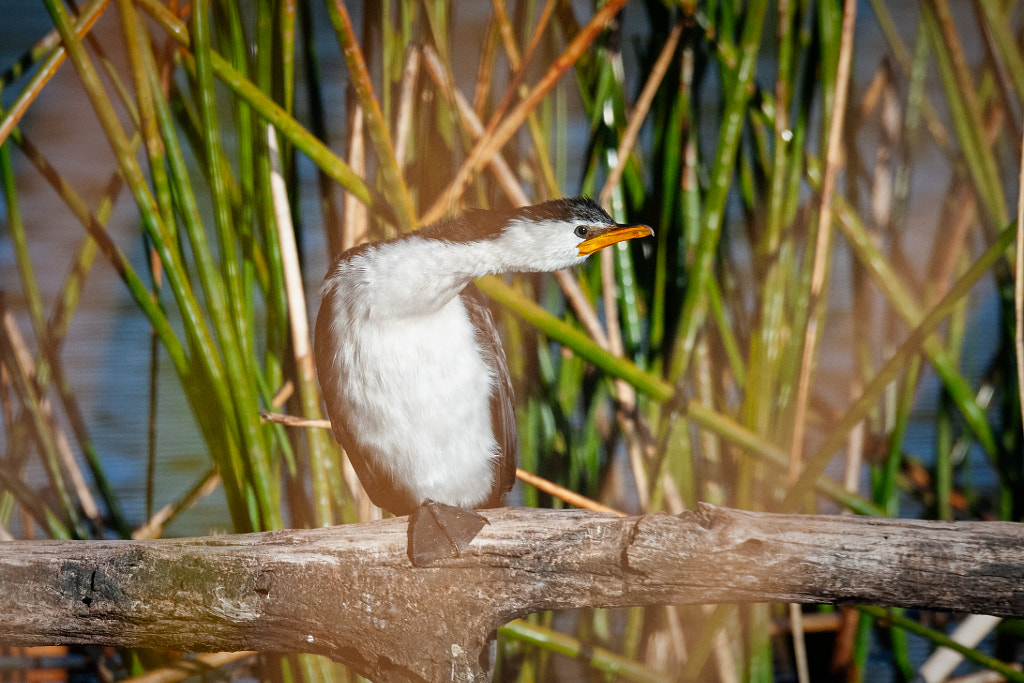
This Kakak or little pied cormorant (Phalacrocorax melanoleucos)was glad to see me move as I was disturbing its morning.
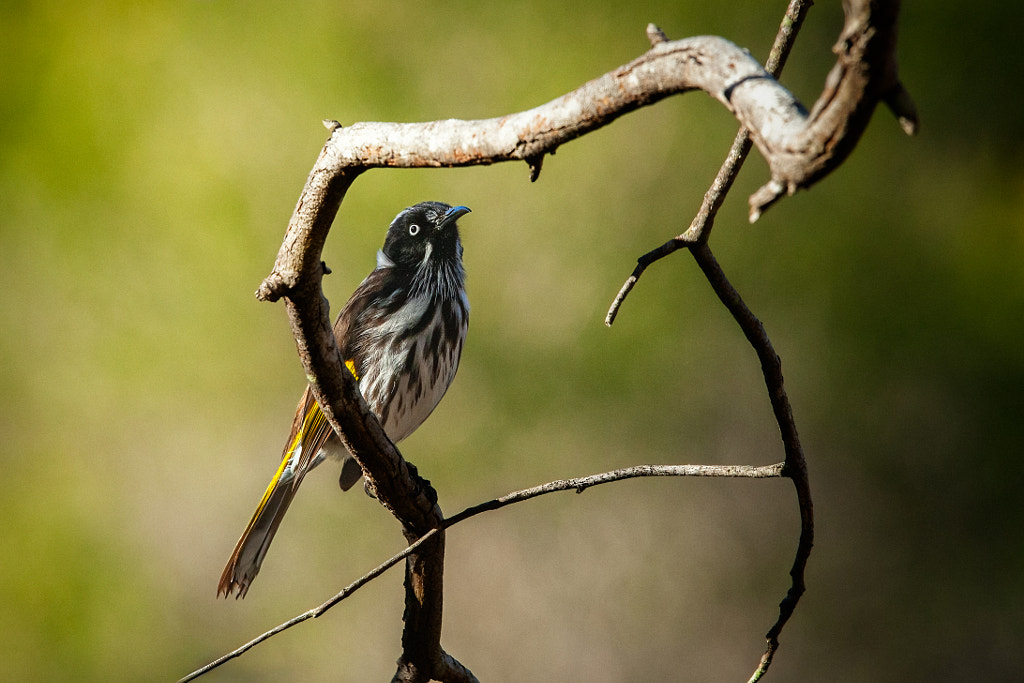
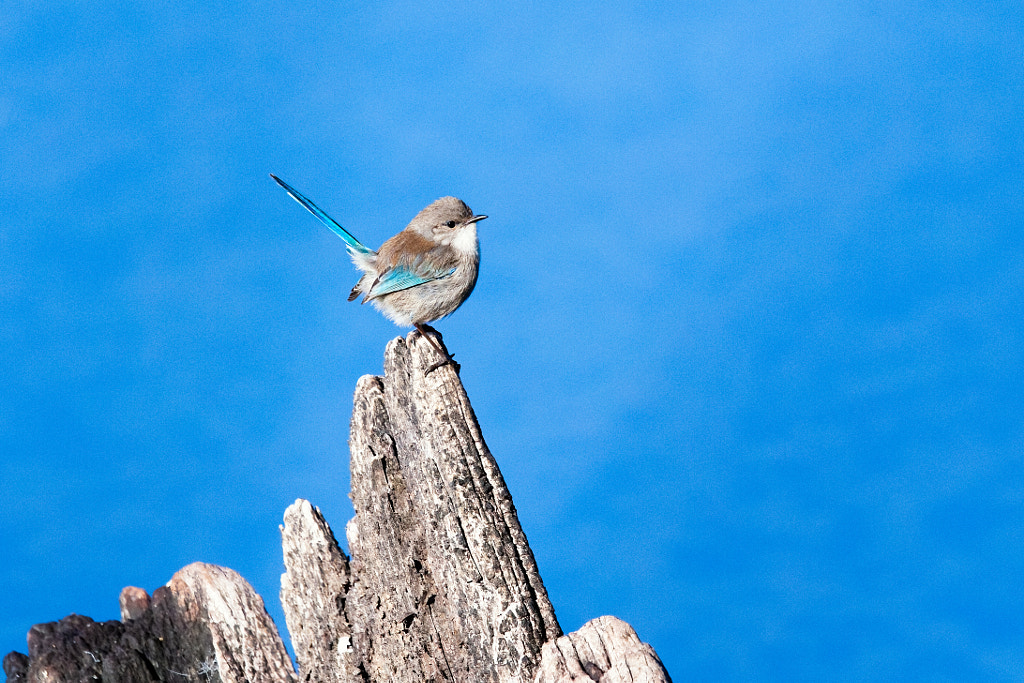
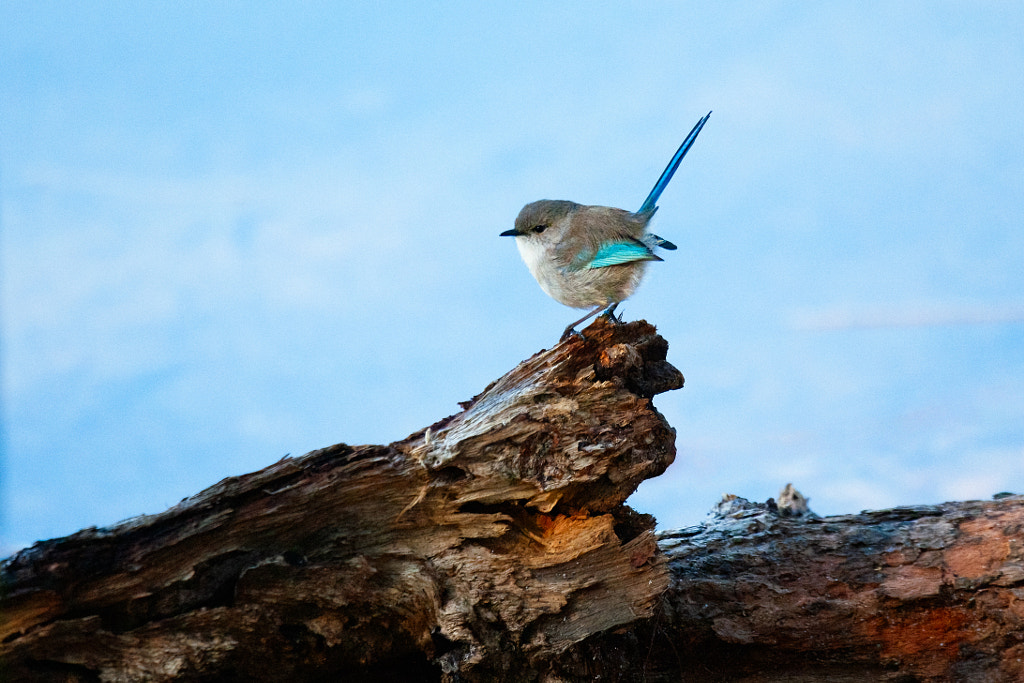
As walked past the dam wall I could hear the commotion of a whole heap of passerine birds moving through the forest understory. There were New Holland Honeyeaters, assorted thornbills, grey fantails and weebills. But, what really caught my attention were the splendid fairy wrens chasing insects at the waters edge. They were chasing small insects and occasionally they would perch on an old log or tree stump. For text twenty minutes or so I just took photos of them and then as quick as you like they were gone.
Bandiny or New Holland Honeyeater (Phylidonyris novaehollandiae) was one of the small passerine birds flitting about in the understory.
Djer-djer or Splendid Fairy-wren (Malurus splendens)catching the warmth of the sun.
Time out from chasing insects.
Is a splendid fairy wren on a log worth an invisible spotless crake in the reed beds ? Yes it was this time.
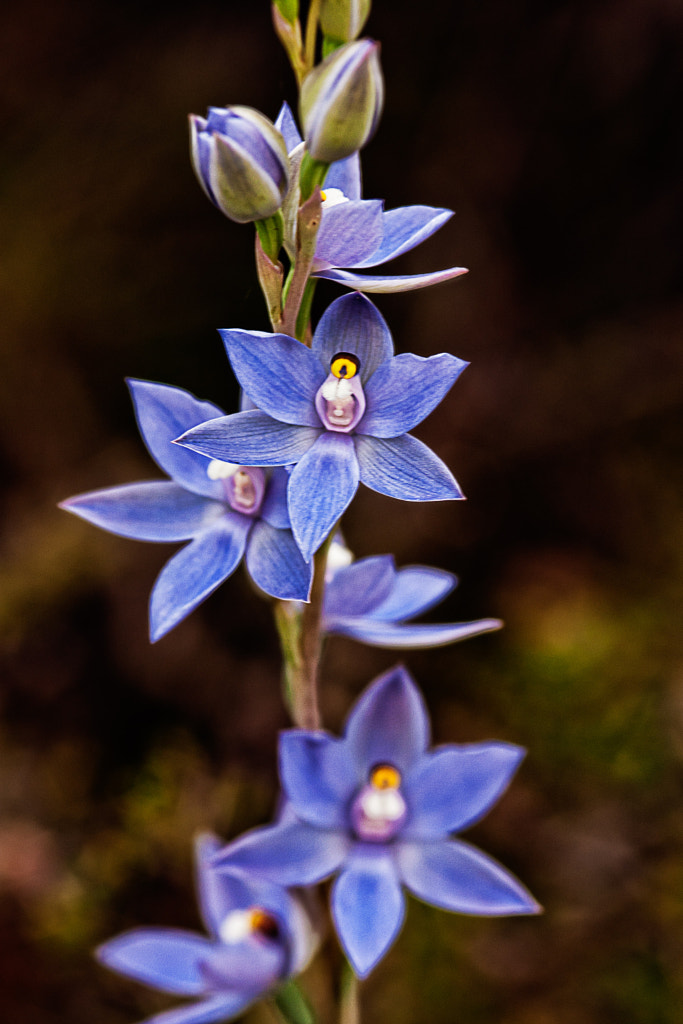
This shot of a Scented Sun Orchid was what I considered my first successful photo of an orchid. The subject is separated from the background making easy to see.
I took what I call my first proper shot of an orchid back in 2008. Back then my technique was very simple – handheld with a macro lens. The problem was that it was often very difficult to isolate the flower from the background while having sufficient depth of field and a low ISO. For every successful photo there were hundreds of duds.
This shot of a Butterfly Orchid is one of the hundreds of duds. The messy background threatens to overwhelm the subject.
After about a year of trial and error (mostly error) I decided to photograph the orchids in the same way I would take a portrait of a person. Get down at “eye” level, use an off axis flash to provide the key light and have the natural light as my fill light at -1 to -2 stops. This was a huge improvement, but I still wasn’t getting the clarity and sharpness in the images I desired.
My first flash rig for photographing orchids. Using a flash brake allowed me to get the flash off of the lens axis and get a more pleasing lighting effect.
The next attempt at better lighting was a heavy tripod and light stand. My back hurts just looking at this photo.
The next evolution was to mount the camera on a tripod and then mount the flash to one of the tripod legs via a “magic arm”. This allowed greater choice in the positioning of the flash and allowed me to use different flash modifiers such as soft boxes, grids and snoots. The arrival of affordable and reliable wireless flash triggersmeant I could use multiple speedlights for more sophisticated lighting. This came a tremendous cost. I have a chronically bad back and all that kit was heavy, the tripod and “magic arm weighed just under 6Kg. Then there was the futzing about setting everything up, taking the shot, breaking it all down, walking to the next subject and then repeating it all again. Suddenly it wasn’t fun anymore. Something had to give and it was my back.
The diminutive Olympus EP-2. Just what the orthopaedic surgeon ordered.
A size comparison of my DSLRs (Canon 5d and 550d) and the Olympus EP-2 which replaced them.
In 2013 I bought an Olympus EP-2 mainly for travel and street photography. It was a revelation – small size, In Body Image Stabilisation (IBIS), and excellent flash implementation. It quickly became my orchid camera of choice. I could chuck out the tripod and become more mobile. It wasn’t all beer and skittles though. The 12Mp sensor wasn’t the best in terms of high ISO performance and dynamic range, the lack of a viewfinder made usage in bright sunlight problematic (solved with the addition of the optional EVF) and the contrast based autofocus system was a bit on the temperamental side. But the positives were enough to keep me using it and when the EM10 came out with a built in EVF, a better IBIS system and an improved sensor then I knew that the system would be just about perfect for what I did. I could walk around in the bush for hours at a time without back pain which meant I could explore further afield. This freedom allowed me to experiment a lot more.
Sigma’s 105mm f2.8 DG DN macro lens attached a Sony A7Rii.
The Tamron 35mm f2.8 lens has excellent macro capabilities.
Curly Locks, Thelymitra spiralis. Wandoo National Park, Western Australia. Sony A7r2 with Sigma 105mm f2.8 DG DN macro lens.
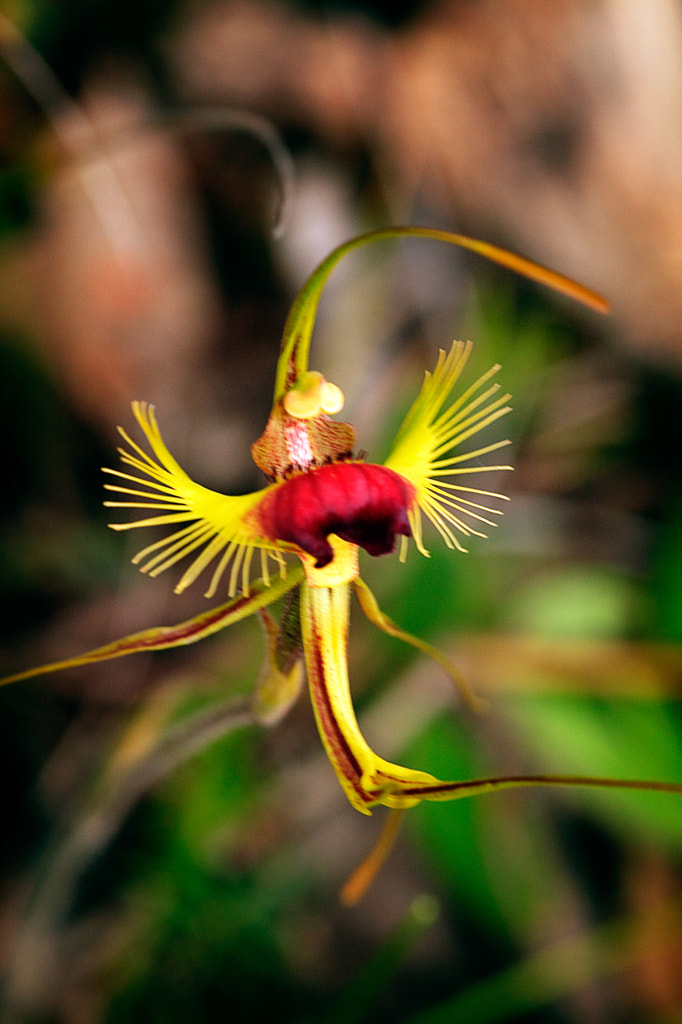
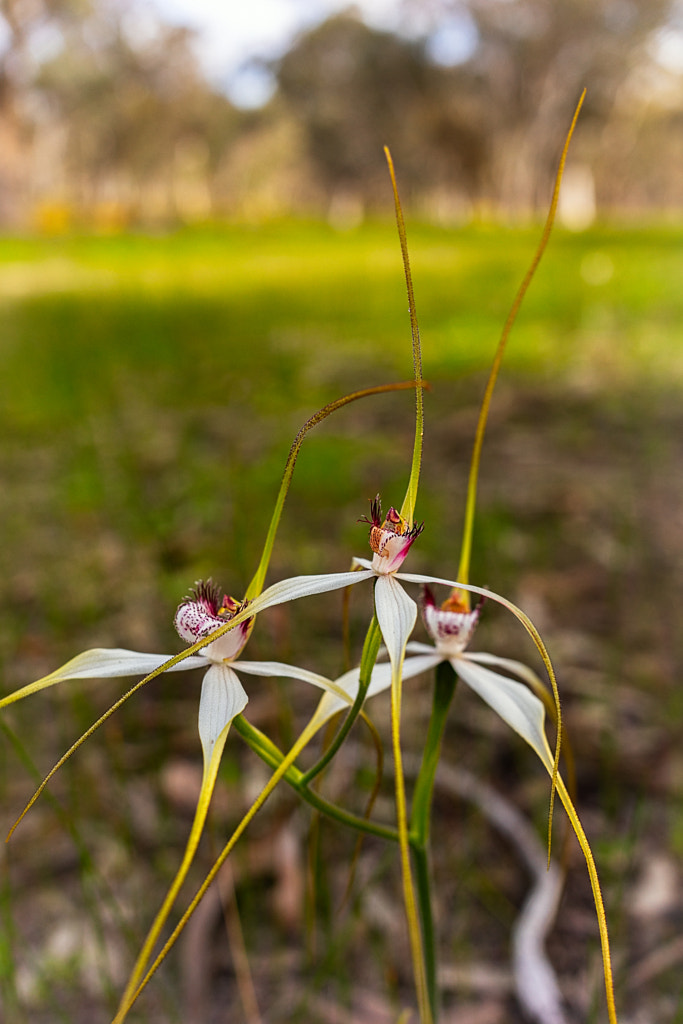
White Spider Orchid, Caladenia longicauda subsp longicauda. Wambyn, Western Australia. Sony A7r with Tamron 35mm f2.8 lens.
In 2021 I felt that I wanted more resolution than the 20Mp EM1 mk ii was giving me. So I tentatively dipped my toe into the world of full frame mirrorless and I went with a second hand Sony A7r2. The image files produced by the camera were absolutely gorgeous. Alongside my usual working method of using flash with macro lens I decided to experiment with environmental portraiture of orchids. For this I used a 35mm lens with a half size macro capability and the results were pleasing. The downsides were as follows. The rear LCD is hopeless in bright light and it has no touch control facility. The IBIS wasn’t as effective as that on my Olympus cameras and the sensor resolution emphasised very tiny camera shake. A tripod was the solution. The sensor is a dust magnet which means that changing lenses enables dust bunnies to proliferate. The answer was to have one camera with the 105mm macro and one camera with the 35mm. Arrrrrgh! I was back carrying a load of heavy equipment. So it was back to the Olympus kit.
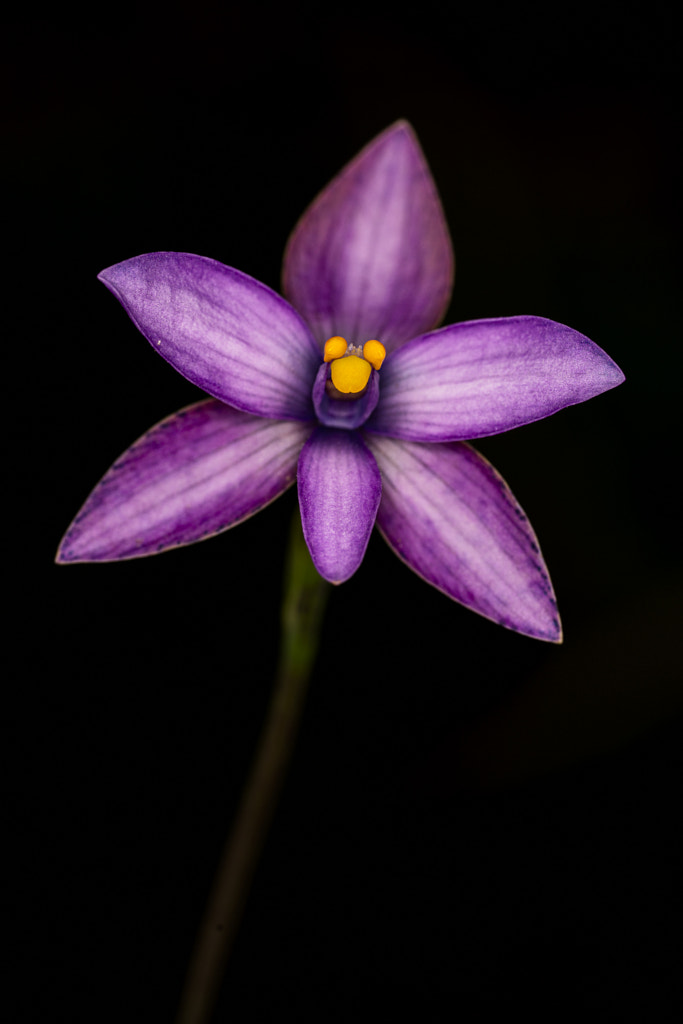
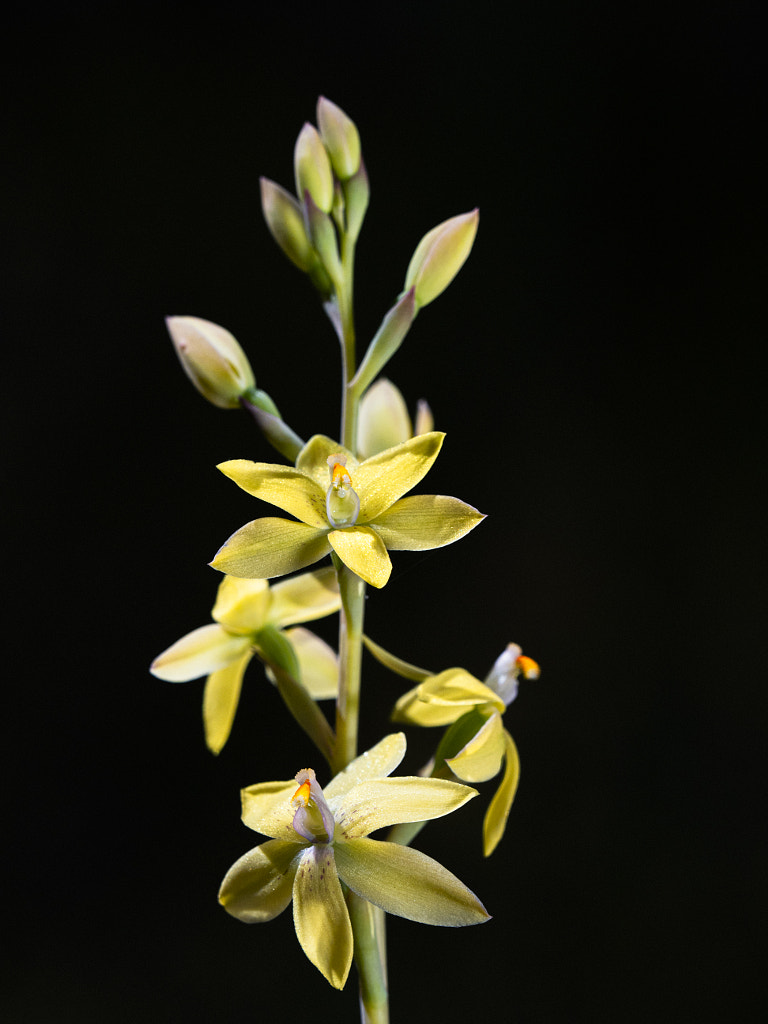
This shot of a Lemon Scented Sun Orchid was made with the Olympus Em1 mk ii, Olympus 40-150mm f2.8 lens with 1.4 x teleconverter and the Olympus FL600R flash using the focus stacking function.
I’m still trying to evolve a style which produces a nice clean portrait of an orchid. One of the great benefits of Olympus’s cameras and lenses is that it allows very long telephoto lenses to have an almost macro capability. The use of such long lenses allows you to throw backgrounds well out of focus by dint of their increased magnification which reduces depth of field. The problem is that that decreased DOF means that it is hard to get your subject rendered sharp whilst retaining all that loverly bokeh. The counter to this is focus stacking which involves taking a series of pictures of the subject while moving the focus point and then blending the images in post. Olympus has a very neat feature that allows you to do this automatically in camera which is fantastic. Unfortunately the function limits your flash usage by restricting your maximum flash sync speed to 1/50th second and you have to manually set the flash exposure. I tried doing this for a while and it was a right royal pain. So now I don’t use the flash and just make the exposure using ambient light. The lens I’m using is the Olympus 40-150mm f2.8 with the the mc-14 1.4 x teleconverter. This gives me a 210mm f4 lens (420mm in full frame terms). Despite shooting wide open this invariably means shooting at a low shutter speed. So while the IBIS is fantastic on my EM1 mk ii using it with a long lens while focus bracketing wasn’t the best way to proceed. So it was back to a tripod. My aluminium Manfrotto 055 tripod is a good tripod but it is that heavy you could use it as a boat anchor. It was time to get a bit of fibre in my life – carbon fibre. So I bought a nice SiruiAM-254 carbon fibre tripod which weighs just a smidge over 1Kg. It doesn’t have a centre column and so a minimum working height of 7.8cm which means you can get down and close to the subject. The results have been excellent and now I feel that using both my normal macro lens and the telephoto zoom with converter I’m getting closer to what I have envisioned.
The Sirui AM 254 tripod in action.
So this has been my journey of finding what works for me. I’ve discovered that learning how your equipment works is just as an important step in developing vision and style as is technique. Continual learning and experimentation will help you develop as an artist and we shouldn’t be afraid to do so. A few times I’ve felt that I was going backwards, but it was worth persevering. I’ve still got a couple of things to sort out, but I feel now I’m on the right track.
The following shots were made this last week.
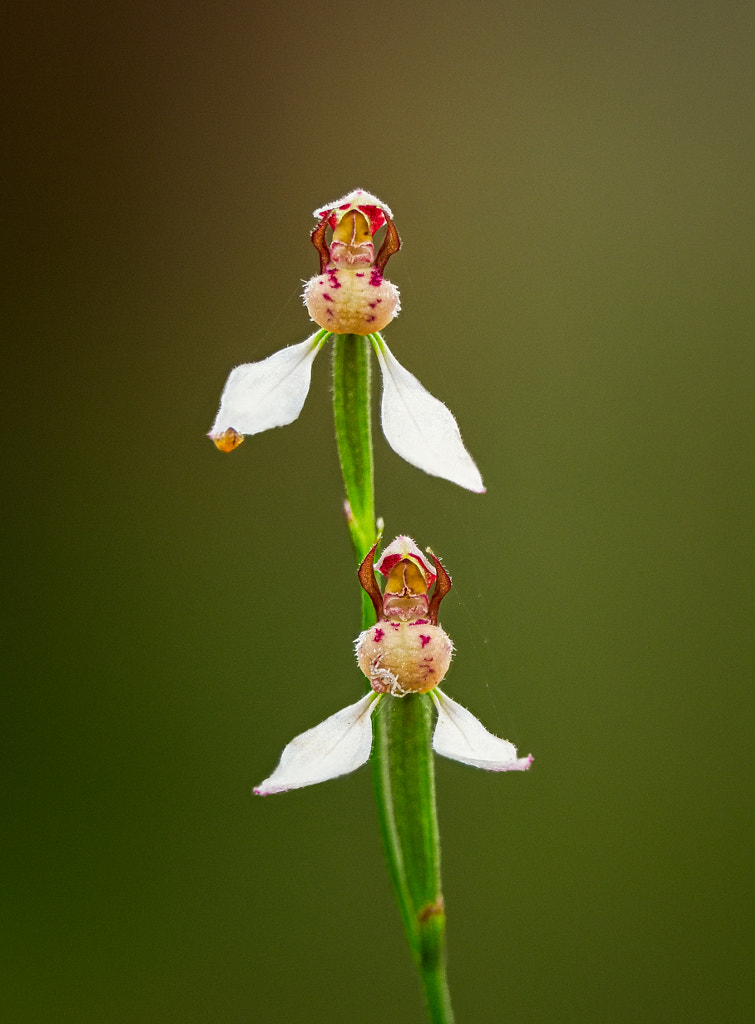
Common Bunny Orchid, Eriochilus dilatatus subsp. multifloris. Oswald Sargent Reserve, Western Australia.A focus stack using the Olympus EM1 mk ii with the Olympus 40-150mm f2.8 lens and 1.4 x teleconverter.
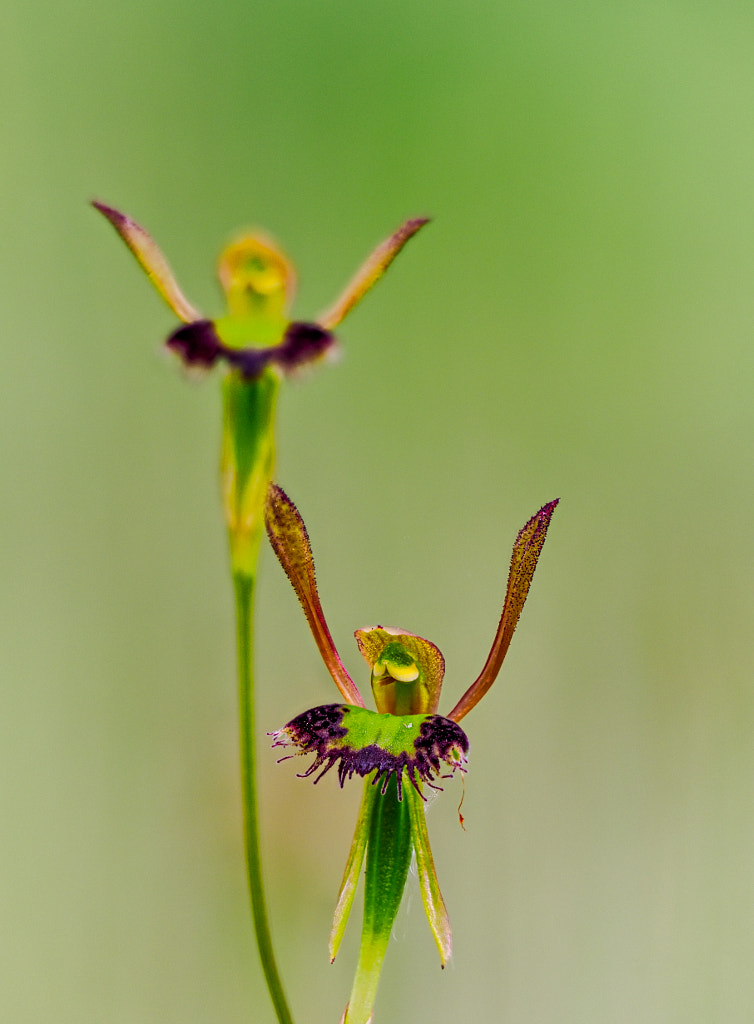
Hare Orchid or Fringed Hare Orchid (Leporella fimbriata). Oswald Sargent Reserve, Western Australia.












You must be logged in to post a comment.