Like most things in Australia the Clackline Refractory came into being more by luck than planning. In 1898 Western Australia was undergoing a gold rush and two blokes by the names of John Ford and James Murray were prospecting in the eastern end of the Darling Range. About 80Km east of Perth they decided to sink an exploratory shaft and instead of finding gold they found fire-clay. Disappointed they moved on. Fast forward a couple of years and it must of dawned upon them that they had stumbled upon a valuable commodity as they decided to extract the clay from what on closer inspection was a limitless supply. Why was the clay so valuable? Well fire-clay is used to make bricks for furnaces and kilns. It is used in the manufacture of crucibles for smelting. Before this discovery Australia was having to import bricks made of fire-clay from Britain at some considerable cost. The refractory was built to produce the bricks and it was found they were more durable than the imported ones. You’d think that having a ready made monopoly would have meant that Messrs Ford and Murray would be laughing all the way to bank. Well no and the refractory changed hands several times before being completely shut down in 1992.
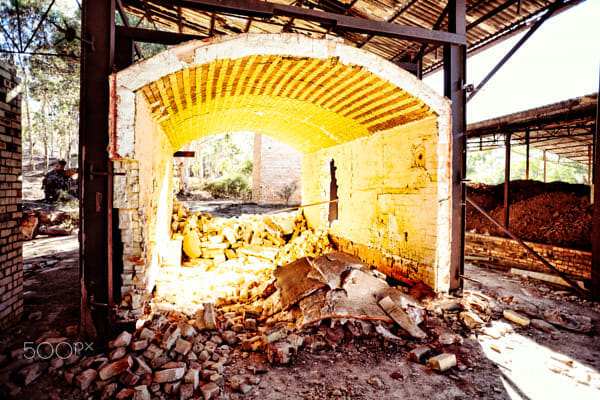
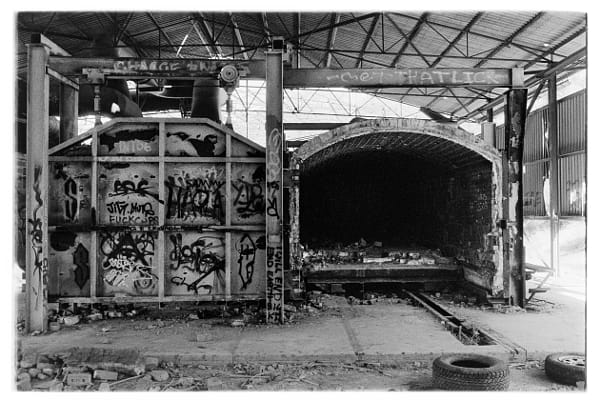
The suns rays reflected on the white walls of a derelict brick kiln at the Clackline Refractory.
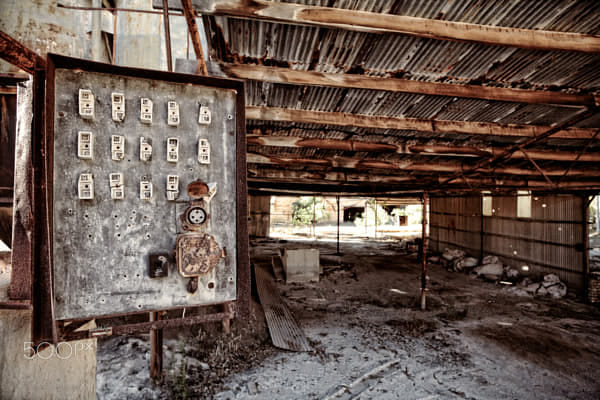
The remains of an electrical control panel at the Clackline Refractory.
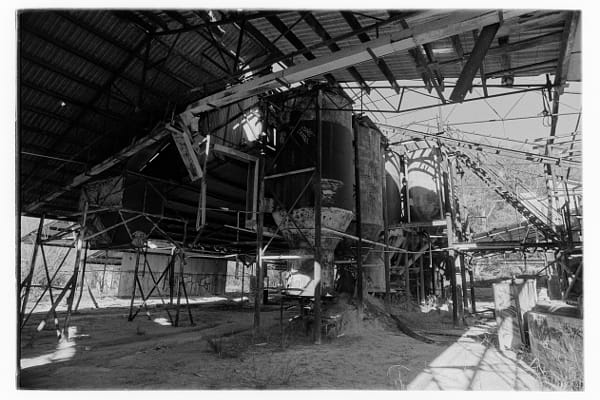
I discovered the Refractory completely by accident. I was cycling along the Kep Track and as I was approaching Clackline I saw an enormous brick chimney rising out of the trees. It was definitely industrial looking so I decided to have a shufty and found this huge post industrial site. It had only been shut for a couple of years at that stage and everything looked pretty intact. I went back a few days later and photographed the place early in the morning and the sunlight shining through the huge kilns was magical. On further research I wasn’t surprised to learn that it had been given a heritage listing.
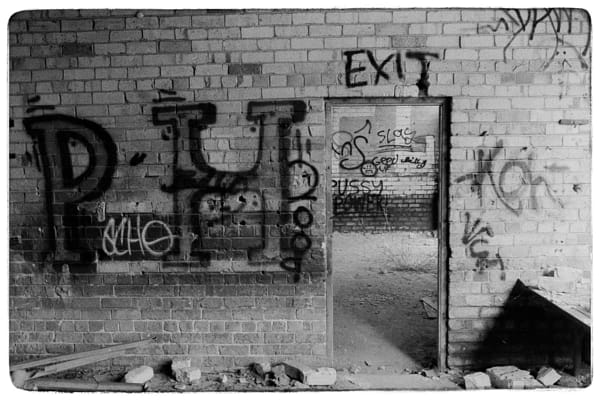
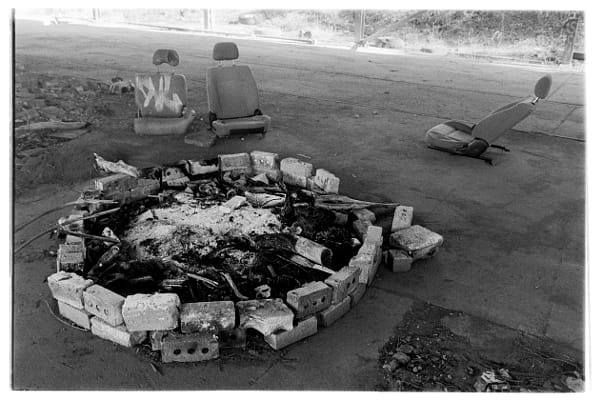
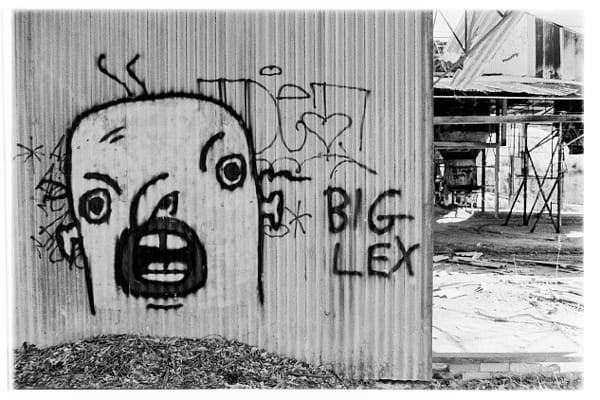
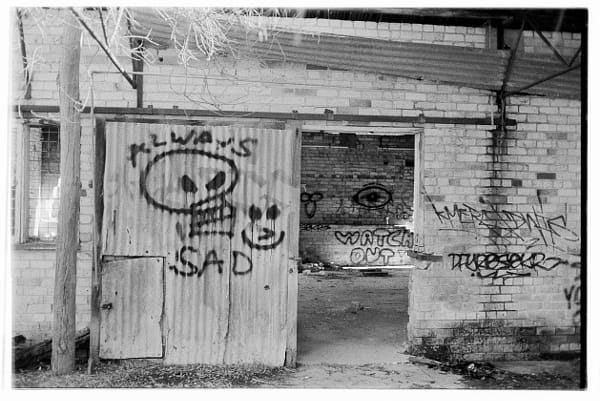
I didn’t think about the refractory again until a couple of months ago. I just purchased a new to me secondhand camera and I wanted to put a roll of film through it to see if it was working OK. My partner wanted to visit Clackline to get some material for a project she’s working on so I decided that the refractory was where I’d test the new camera. When we got there I wasn’t prepared for how much the site had changed. Everything of value had been stripped out, the buildings were in a dreadful state, there was graffiti everywhere along with drug paraphernalia. To add to the sombre mood we met a family there who were visiting to see where a relative had died just a couple of days previously. You couldn’t more get a more gothic atmosphere if you tried and this suited the black white film perfectly. All in all it was quite a strange experience and we moved on after I had shot the roll.
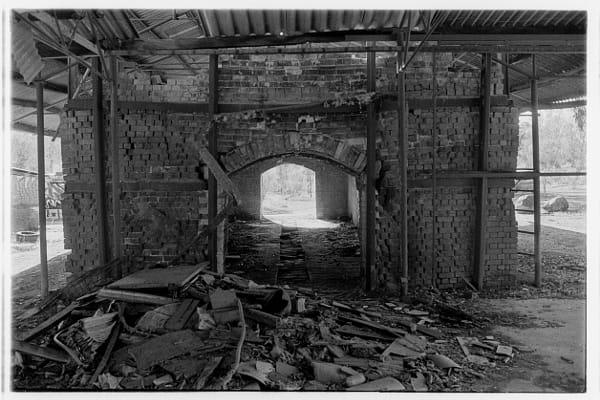
One of the old kilns at Clackline Refractory.
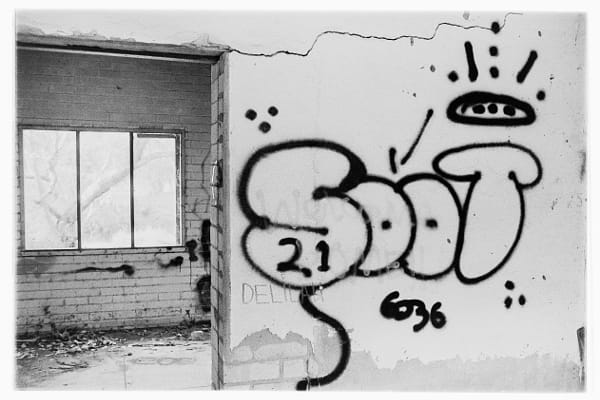
SOOT. Clackline Refractory.
Exit. Clackline Refractory.
Where the clay was mixed prior to being moulded and then fired.
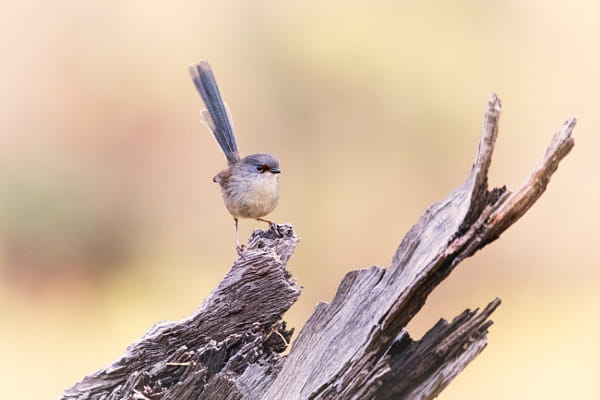
We’ve been to Nannup in the Blackwood Valley several times before and I’ve written about one of this visits before.Last time I photographed orchids this time I meant to do some bird photography. I only managed to take a couple of bird photos on the first day – of a female Red-winged Fairy-wren (Malurus elegans) – as I got distracted and didn’t take the birding stuff out for the rest of the week.
A female Red-winged Fairy-wren (Malurus elegans) called Djoordjilya by the indigenous Nyoongar. . Nannup, Western Australia.
The cause of this distraction. Well as a last minute decision I’d decided to throw a film camera, a 50mm lens and a couple of rolls of film into my bag. At first I was just going to take nature photos while walking along the river foreshore. It was just initially to explore forms and textures. But, it wasn’t long before I was walking up and down the streets of Nannup (there aren’t many) taking pictures of anything that caught my eye. I have a particular fascination with signage – I often find it quite amusing.Anyway the results are below.
Grasses and Bokeh. Wild grasses growing along the banks of the Blackwood River in Nannup.
Lichen growing on a tree trunk. Nannup, Western Australia.
There were arms and legs all over the place. Nannup, Western Australia.
I came across a wonderful little piece in the Guardian the other about a photographer whom I’d never heard of before, but on looking at his work I was completely enthralled. The photographer is Raúl Cañibano from Cuba. His work falls into the categories of humanism and surrealism and follows in the traditions of Henri Cartier-Bresson, Elliot Erwitt, Walker Evans, Josef Koudelka and Sebastião Salgado. It is wonderful stuff and I would urge you to have a look at his work and maybe buy his books.
This genre of photography is one that for a number years I really wanted to practice without much success. There is this assumption that it is very easy – all you have to do is walk around and point your camera at everything you see and you’ll end up with “art”. It takes a great deal of dedication, patience and an eye that can spot “a significant moment in the continuous flux of life and captures it in a fraction of a second”. (p 104 Badger, G. 2007 “The Genius of Photography – how photography has changed our lives” Quadrille Publishing Ltd, London). Or to put it another way that nanosecond when all the individual elements of a photograph come together to create meaning. For years I have wanted to take a certain photograph that for me epitomises this ethos. I can see the image in my minds eye, but, I can never manage to make it happen. It is a simple concept but it has eluded me.
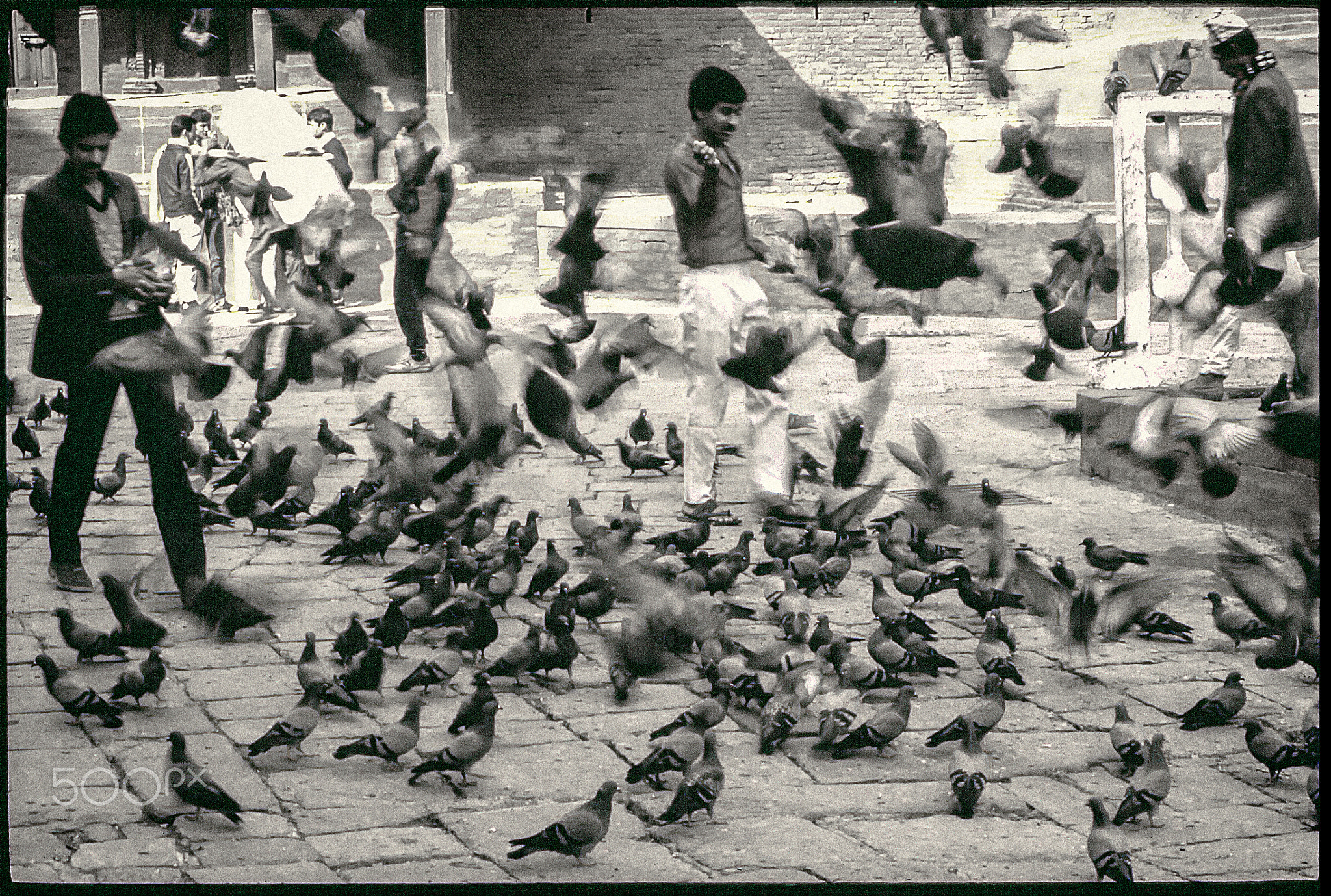
Walking through the feeding pidgeons in Durbar Square Kathmandu. Olympus OM4 with Sigma 75-210 lens, Kodak Ektachrome 100.
The idea is that a person walks into a large flock of pigeons that are feeding on the ground and as they do the birds take flight and we have a photo of a person surrounded by a swirling mass of birds.As I said it is a very simple concept and not original in any shape or form. The occurrence happens frequently yet I just can’t nail it. The best attempt so far is one that I took in Nepal in 1987 (yes it’s been going on that long!). It’s an OK shot on one level, but it is really too cluttered to work. Fast forward to Monday and I was in Perth walking through Forest Place where there was a flock of pigeons feeding on the ground. Suddenly alert to the possibilities I caught out of the corner of my eye a small boy running around in that state of hyper excitement that only small boys can have. I immediately thought that at last it is finally going to happen. So as the little lad approached the birds I quickly framed up and set an appropriate aperture and shutter speed and waited for the decisive moment of the child scattering the flock and them taking flight around him. I could just see the finished photograph. So what happened? Well the little lad did indeed run among the pigeons and they just didn’t react. The whole episode was a tremendous anticlimax. Maybe one day it will happen.
The Kid Among The Pigeons. Forest Place, Perth, Western Australia. Canon 5d with Canon EF 50mm f1.8 ii.
As usual there is a video for those that prefer or the full written piece is below.
The Olympus m.Zuiko 45mm f1.2 PRO lens mounted on an EM1 mk ii.
The Olympus m.Zuiko 45mm f1.2 Pro Lens was announced in by Olympus back in October 2017 as one of their trio of f1.2 lenses. The others being the 17mm and 25mm. According to Olympus they were designed to “have beautiful defocusing effects” and “beautiful feathered bokeh to make your image stand out” (https://shop.olympus.com.au/m-zuiko-ed-45mm-f1-2-pro). In the case of the 45mm (and I suspect the other two) the lens is designed so that spherical aberration is not fully corrected. This means that as light rays enter the lens only those that pass through the centre of the lens are made to come together at the focus point. The rays at the edges focus slightly in front of that point and this causes the bokeh to have a gentle roll off – the so-called “feathered bokeh”. Olympus themselves claim this matches “classic” older lens designs. At this point it should be noted that spherical aberration and chromatic aberration are different. Spherical aberration occurs when a single wavelength of light or colour cannot be focused whereas chromatic aberration occurs when a lens cannot focus the red, green, and blue wavelengths on a single point. Although Olympus claims to match the performance of older classic lenses they have chosen a lens design that is very different from them.
Lens Construction and Build Quality
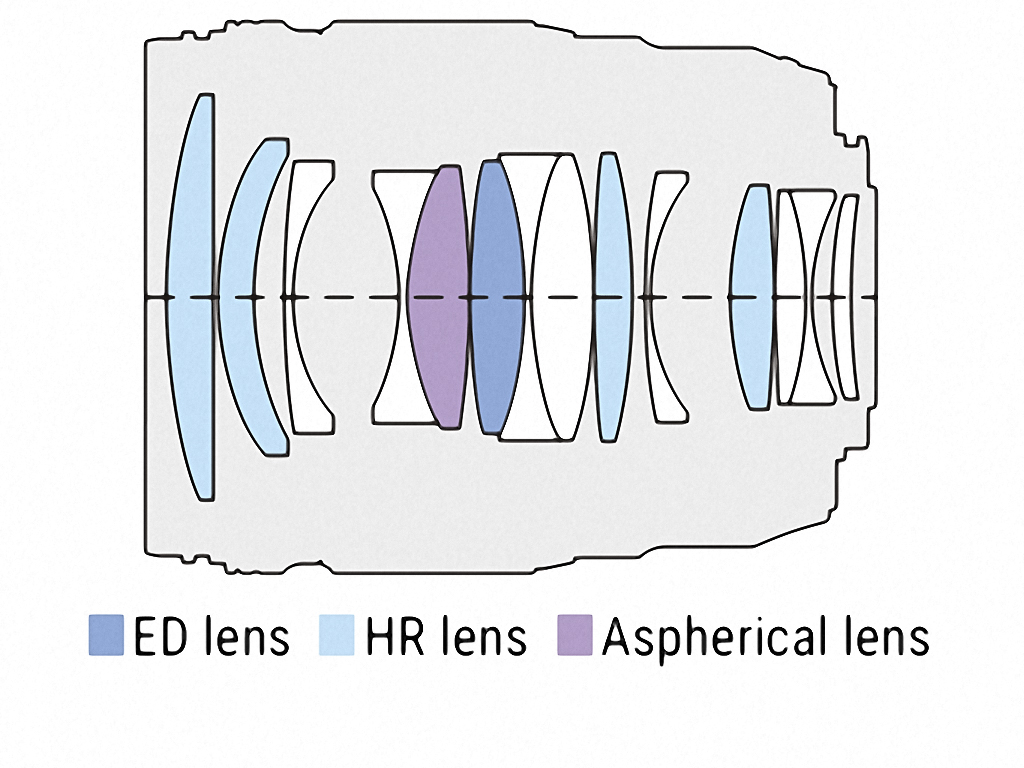
Olympus 45mm f1.2 lens has 14 elements in 10 groups with one ED element, four HR element, and one aspherical element.
Focal Length
45mm (90mm in full frame equvalence)
Angle of view
27º
Minimum focusing distance
50cm
Maximum magnification
0.1 X
Lens construction
14 elements in 10 groups with one ED element, four HR element, and one aspherical element
Maximum aperture
F1.2
Minimum aperture
f16
Diaphragm
9 curved blades
Focusing
Auto focus – yes, MSC mechanism making fast and silent AF possible in video mode.
Manual focusing – the focusing ring can be pulled back to engage a clutch mechanism with hard stops at each end.
Filter size
62mm
Dimensions
85mm (h) x 70mm ⌀
Weight
410g
Other features
Hermetic sealing making the lens dust proof, splash proof, and freeze proof. 60529 IPX1 IP rating.
The lens mount of the Olympus 45mm f1.2 lens. The mount has an ‘o’ ring that contributes to its 60529 IPX1 IP rating.
To see how this differs from an older classic design lets compare it to Olympus OM Zuiko 50mm f1.4 which was first produced in 1971 and remained in production until 1984.
Olympus OM Zuiko MC 50mm f1.4
Focal length
50mm
Angle of view
On 35mm 43º, on micro four thirds 21º
Minimum focusing distance
45cm
Maximum magnification
0.15 X
Lens construction
7 elements in 6 groups
Maximum aperture
f1.4
Minimum aperture
f16
Diaphragm
8 curved blades
Focusing
Manual focus with a straight helicoid
Filter size
49mm
Dimensions
36mm (h) x 60mm ⌀
Weight
230g
The 45mm f1.2 dwarves the f1.8 version.
Comparing the Olympus 45mm f1.2 to the Canon EF 50mm f1.8. On their respective bodies they both offer a similar field of view.
The 45mm f1.2 mounted on an Olympus EM1 mk i compared to the Voigtänder 75mm f2.5 Color-Heliar mounted on a Sony A7r. Both a ideal focal lengths for portraiture.
Physically this is a large lens. It dwarfs my Olympus 50mm f1.4, my Canon EF 50mm f1.8 and my Sony FE 50mm f1.8. It is a smidge larger than the Olympus m.Zuiko 12-40 f2.8 Pro and 27g heavier. The 45mm f1.2 follows the look of the other lenses in the Pro line and it also has a L-Fn button which can be programmed to various functions on Olympus cameras. In the hand the lens is reassuringly solid, it has that dense feeling that quality optics have. The focusing ring is nice and large and has the same ribbing that all the other lenses have in the Pro line. Like the other Pro lenses the 45mm f1.2 enables manual focusing by pulling back the focusing ring to engage a clutch to give a nice smooth focus throw of about 110º that has hard stops at either end. Combined with focus peaking this makes for manual focusing nirvana. As to what the lens is made out of this is hard to say, the lens mount is chrome plated brass, parts of the lens barrel have a metallic feel, and other parts feel plastic. Is this a problem? I don’t think so. For certain applications metals can be a poor choice and high quality engineering plastics such as ABS make better sense. In fact Sigma makes a big deal out of the use of their Thermally Stable Composite (TSC) which is substantially stronger than conventional polycarbonates while having similar thermal expansion properties to aluminium. Bottom line the 45mm f1.2 feels nice in the hand and is easy on the eye.
Optical Performance
The Olympus m.Zuiko 45mm f1.2 PRO lens is sharp wide open.
Lens sharpness test at f1.2 and f4. Click on the image to see it larger.
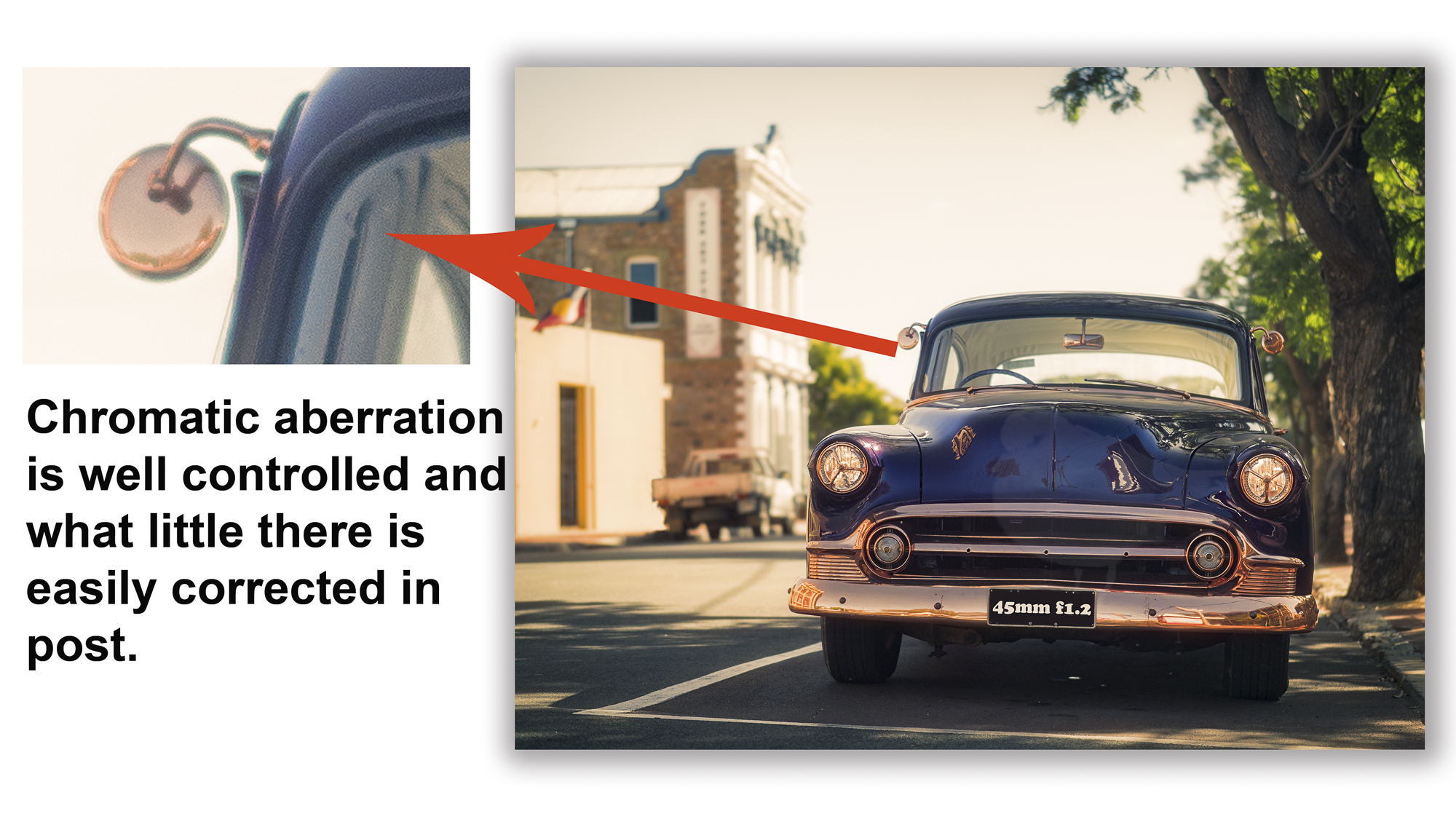
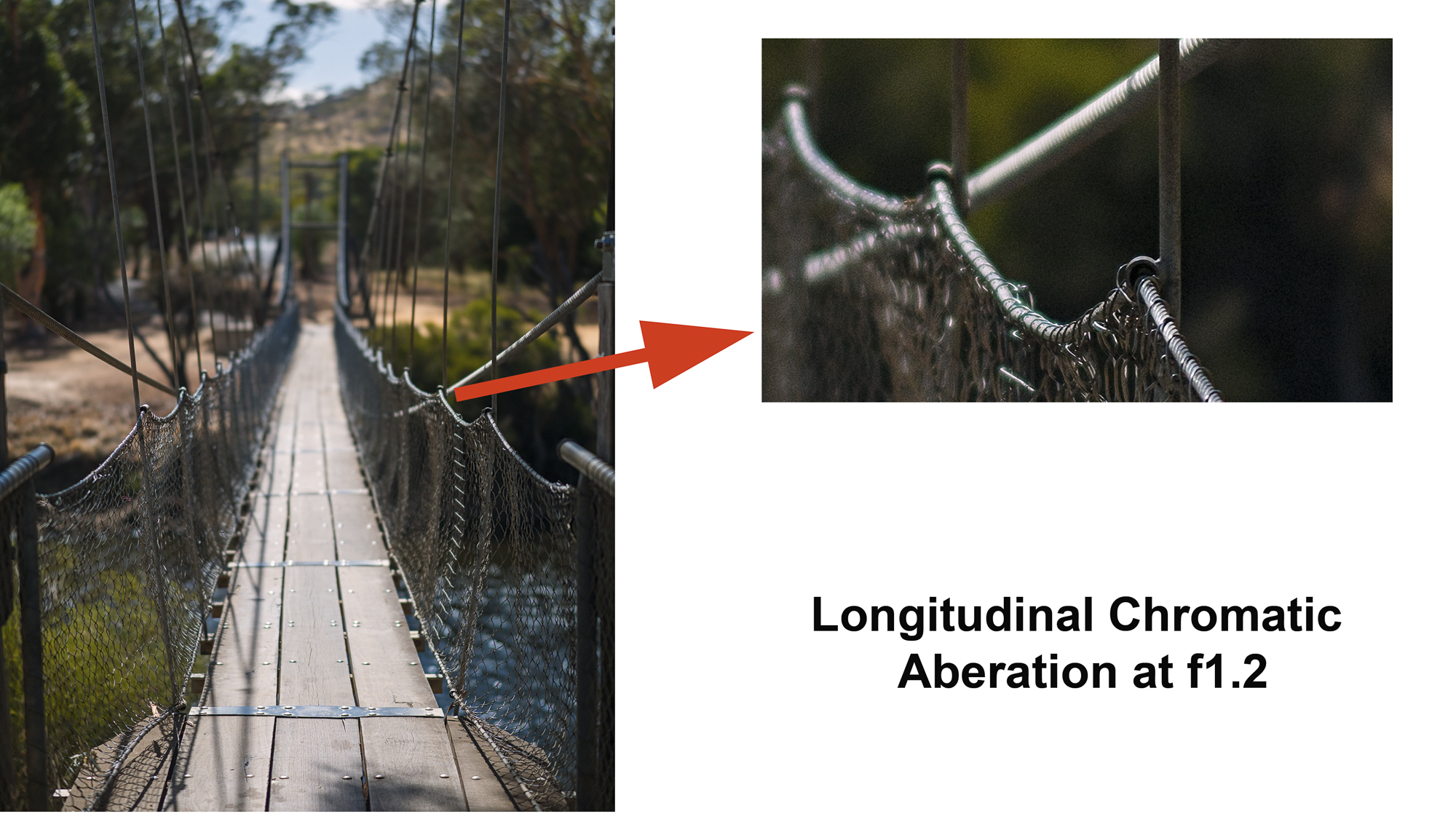
Image sharpness in the centre of the frame wide open is good and reaches its best at f4. The corners wide open are less sharp than the centre, however, by f2.8 the sharpness and contrast improves considerably and the lens reaches optimum sharpness at f4. By f8 the image starts to soften due to diffraction. Vignetting is also present wide open but this disappears at f4. There is a minute amount of pincushion distortion present, but unless you are shooting very demanding architectural work then it is largely unnoticeable. Chromatic aberration is present on high contrast edges, but it is very slight and easily removed in post. Longitudinal chromatic aberration is also present, but it too is very slight and not painfully obvious which is good as it is quite difficult to get rid of in post. All this is managed using firmware corrections. I like to turn these off using RAWTherapee to see how much correction is going on beneath the hood so to speak. The amount of vignetting is greater than the corrected images but it still clears up by f4. The pincushion distortion is also more evident. All in all the firmware corrections plus topnotch lens design make a lens that performs very well.
Chromatic aberration is well controlled and what little there is is easily fixed in post.
Longitudinal Chromatic aberration.
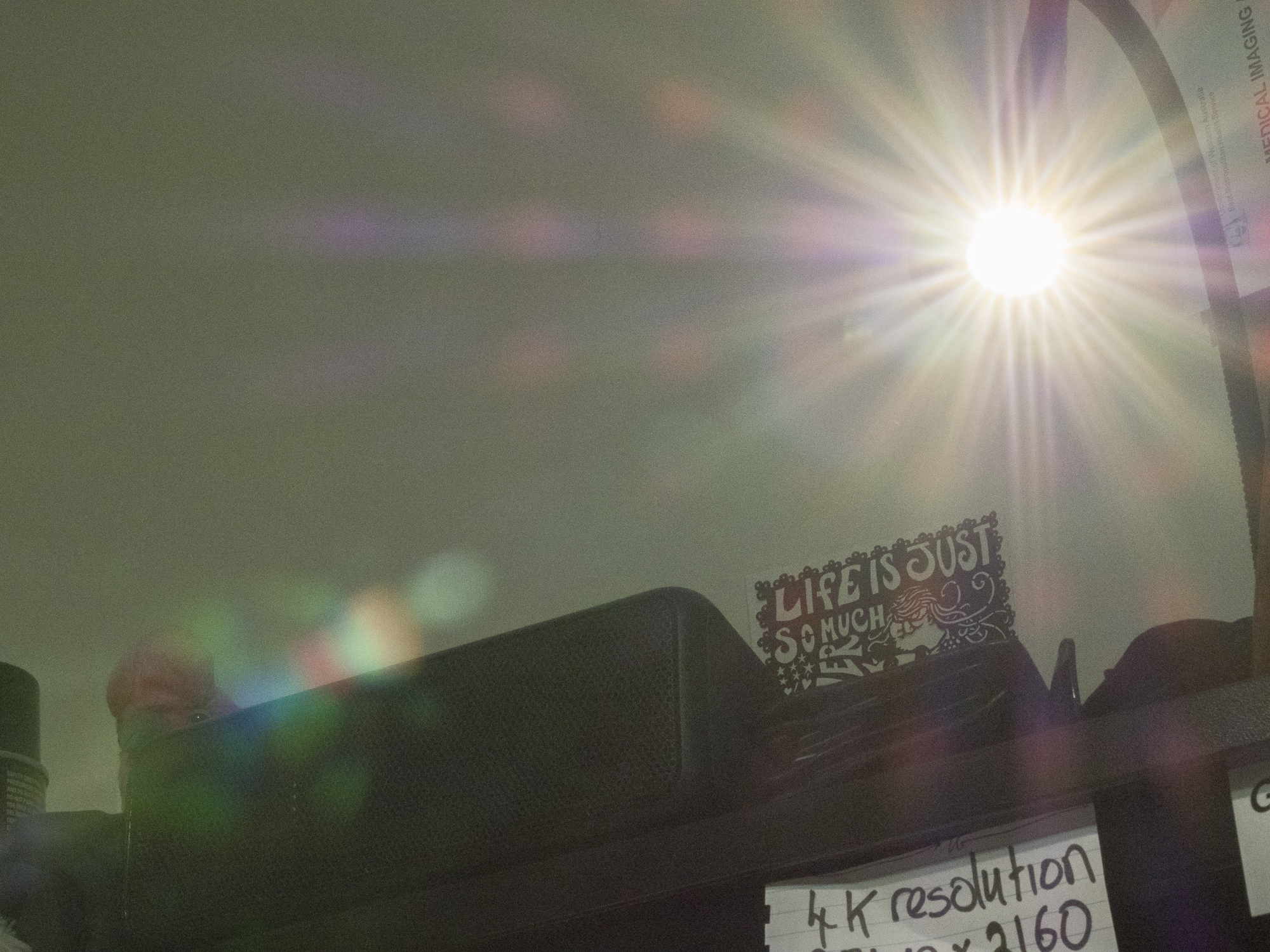
With regard to resistance to lens flare pointing the 45mm f1.2 at a very point light source shows it is quite prone to ghosting flare – images of the lens diaphragm as colourful bright spots. This is more evident on lenses with complex constructions with lots of lens elements. The red blobs in the photo are not lens defects. They are caused by light being reflectedoff of the sensor surface back onto the rear element. As each pixel is reflected it causes a grid pattern. Unfortunately the smaller lens flange distances on mirrorless cameras means this phenomena is more apparent than on a DSLR with their great lens flange distance.
The Olympus 45mm f1.2 is quite prone to flare so it is advisable to use the included lens hood.
The Olympus 45mm f1.2 is quite prone to flare so it is advisable to use the included lens hood. At f16 the sun stars are quite pronounced.
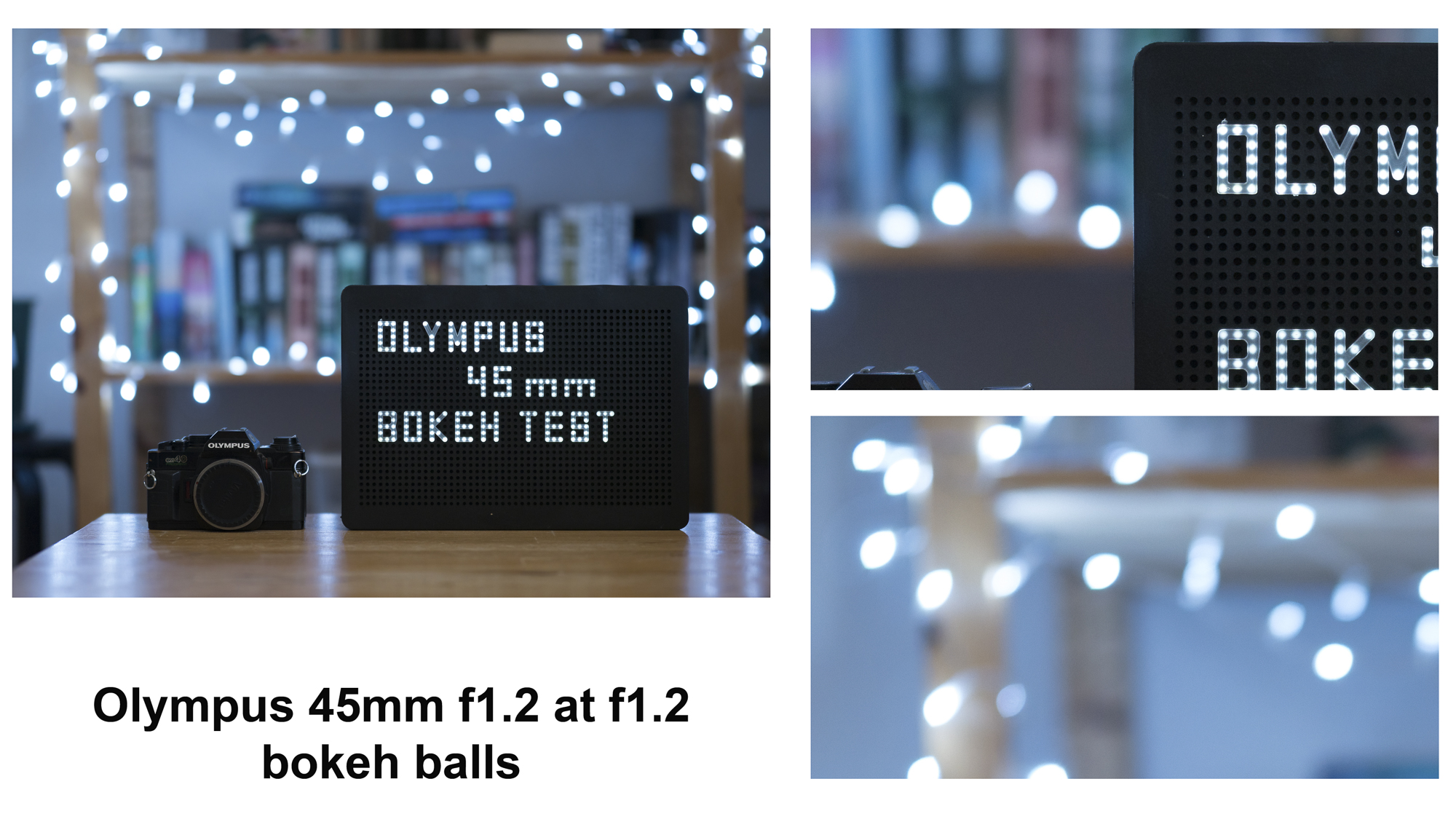
f1.2 bokeh balls test. In the centre of the frame nice round and smooth bokeh balls with no evidence of any onion rings. At the edgeges you can see cats eye shapped balls. Click on the image to see it larger.
Olympus make great claims about the bokeh, or more importantly the feathered bokeh of this lens. Up until the announcement of this line of lenses I’d never heard the term feather bokeh before and to be honest I’m not all that sure about what it is and how that you quantify it. I guess in simple terms Olympus means that edges of the bokeh balls are not harsh and to quantify how feathered they are we’ll have to make some comparisons. At f1.2 the centre of the frame has nice round bokeh balls with no evidence of any onion rings. Onion rings occur with the use of ground aspheric lens elements. Basically the grinding process leaves a series of ridges which can be seen with a defocused point source. The biggest problem with them is that for most people they go unseen, but once seen they can’t be unseen. At the edges of the frame there is cats eye shaped bokeh – this is caused by mechanical vignetting from the lens barrel.At f5.6 I was quite surprised to see star burst effects forming around specular highlights, I was expecting them to start appearing at the f11 mark. By f16 the bokeh balls in the corners have become spherical.
So the question is what to compare the Olympus 45mm f1.2 to? The most obvious contender is the 45mm f1.8. In their advertising blurb for the f1.2 Olympus compare the lens on an Old EM1 mk ii to a full frame DSLR with 85mm lens. Interestingly having made such a bid deal about the bokeh the only comparison is made with weight so I’ve decided to make the comparison using weight and bokeh quality with the Canon EF 50mm f1.8 on a Canon EOS550d. The 50mm lens has an equivalent focal length of 80mm in full frame terms. The nearest full frame equivalent I’ve got on hand is the Cosina Voigtländer 75mm f2.5 Color-Heliar on a Sony A7r2. Finally as I’ve already talked about the Olympus OM Zuiko 50mm f1.4 I’ll add it to the list with it mounted to the Olympus EM 1 mk ii. The older Olympus and the Canon and Voigtländer are also considered classic lens designs.
Olympus OMD EM1 mk ii with Olympus 45mm f1.2 Pro lens
984g
Olympus OMD EM1 mk ii with Olympus 45mm f1.8
737g
Canon EOS550d with Canon EF 50mm f1.8 mk ii
601g
Sony A7r2 with Voigtländer 75mm f2.5 Color-Heliar
932g
Olympus OMD EM1 mk ii with Olympus OM Zuiko 50mm f1.4
980g
So the Olympus 45mm f1.2 combo is the heaviest. Lets look at the bokeh. With the three Olympus lenses I’ll just compare the lenses at widest aperture of the slowest lens. With the other two I’m going take equivalency into account so 45mm f1.2 on the Olympus is roughly equivalent to 50mm f1.8 on the APSC sensor and the Olympus’ f1.2 is equivalent to f2.5 on the full frame sensor.
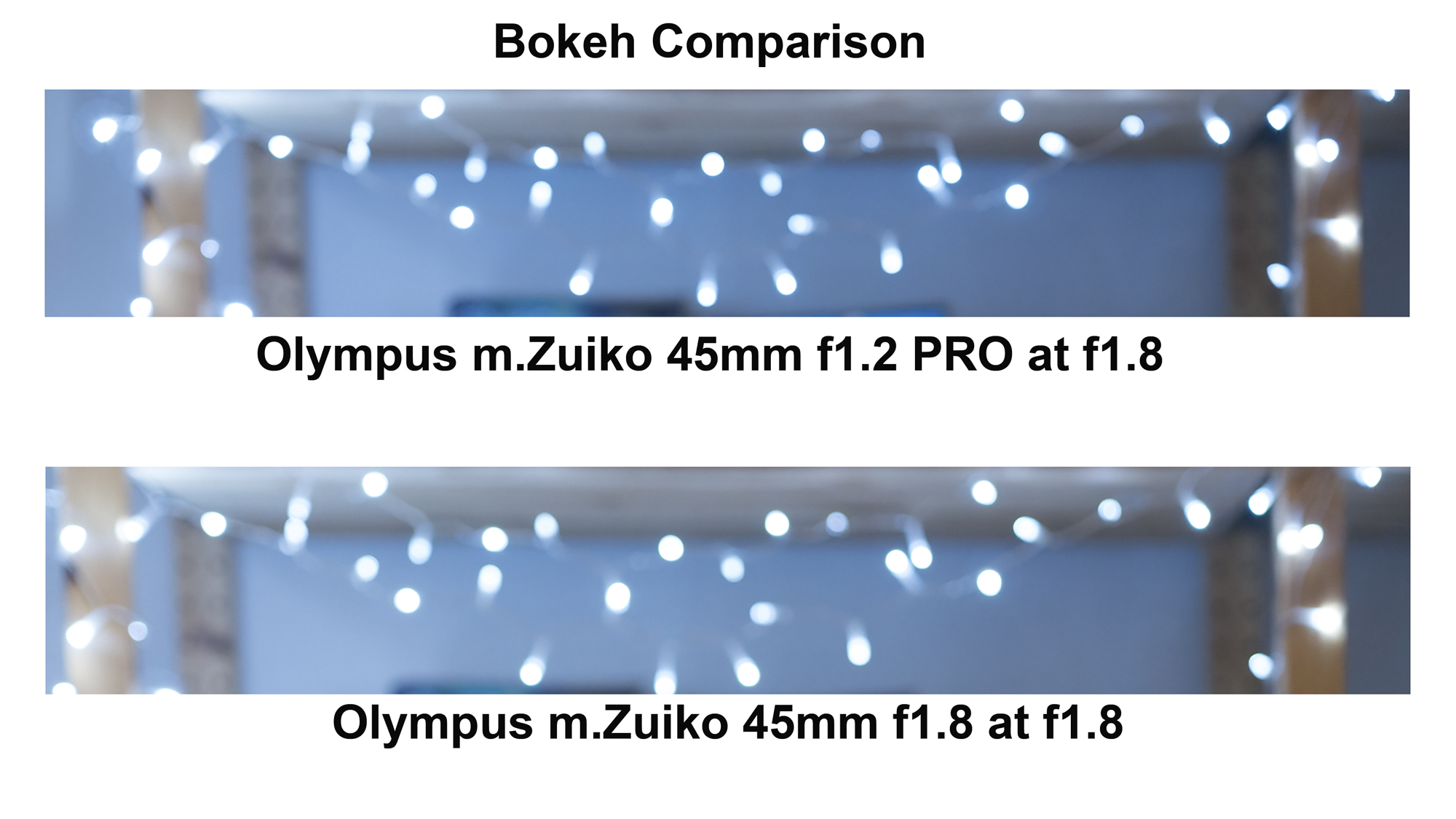
Bokeh comparison between Olympus 45mm f1.2 and the Olympus 45mm f1.8. Click on the image to see it larger.
First cab off the rank is the Olympus m.Zuiko 45mm f1.8 lens. It has an optical construction of 9 elements in 8 groups, weighs in at 116g and has a 37mm filter thread. This little lens is an absolute gem and I use it a lot to do both stills and video product shots. It currently retails for $1300 AUD less than the f1.2. Wide open at f1.8 there is vey little to distinguish it from the more expensive lens at f1.8. So I would have to say unless you absolutely need an aperture of f1.2 then save your money.
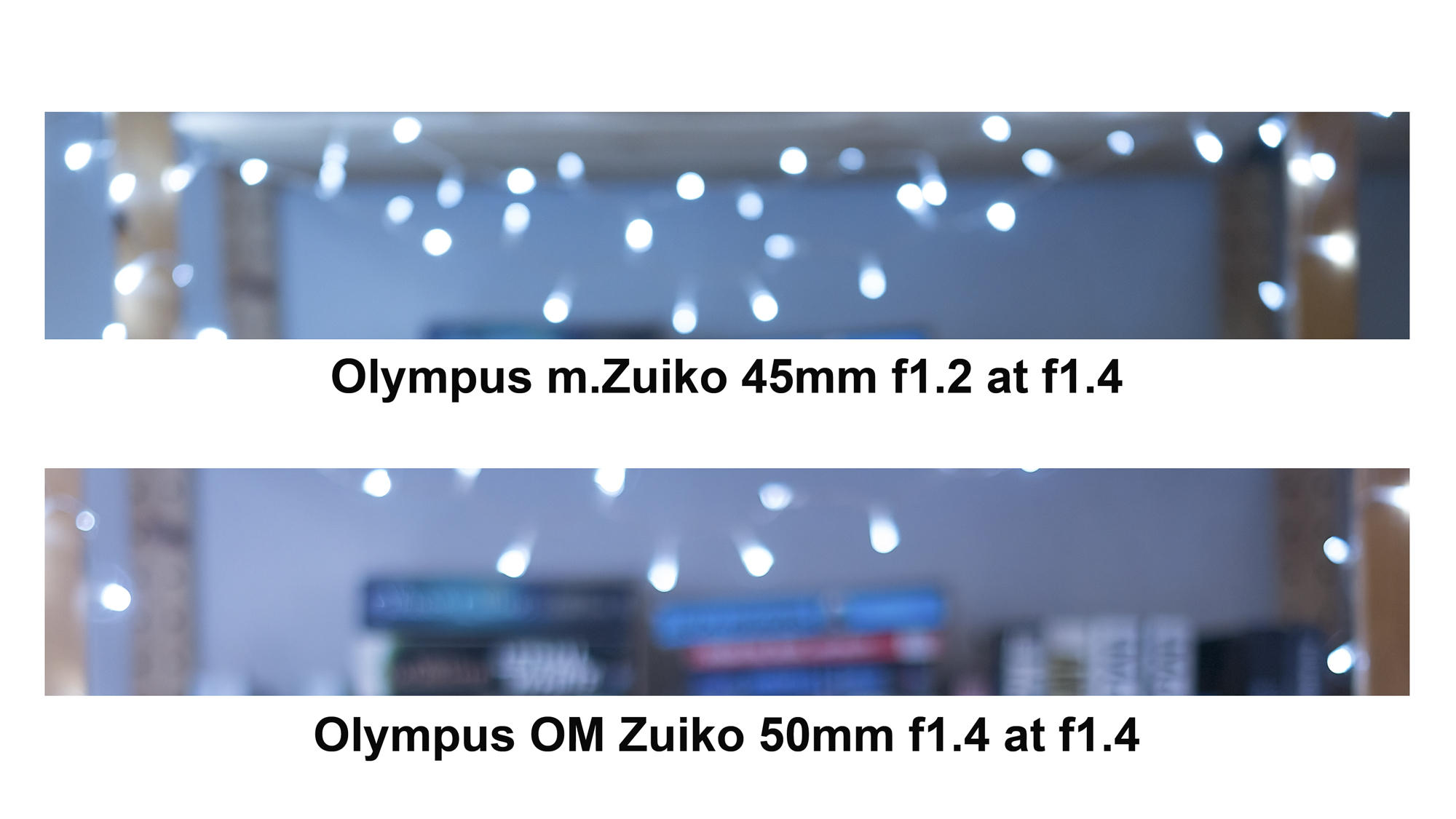
Bokeh comparison between the Olympus 45mm f1.2 and the Olympus OM 50mm f1.4 at f1.4. Click on the image to see it larger.
The Olympus OM Zuiko 50mm f1.4 was introduced way back in 1972 with the original OM1. The lens used here is the revamped version with improved coatings that came out in 1984.The lens construction is very simple with 7 elements in 6 groups and no fancy glass. Wide open it is not the sharpest lens and the bokeh balls are irregularly shaped, but stop it down to f2 and the bokeh is just as good as the 45mm f1.2 at f2. It’s possible to pick this lens up for about $100 on eBay and for $150 you can get it with a film SLR such as an OM1 or 2.
Bokeh comparison between the Olympus 45mm f1.2 at f1.2 and the Canon EF 50mm f1.8 at f1.8. Click on the image to see it larger.
When you put the Canon EF 50mm f1.8 on an APS-C camera such as my EOS550d it has a focal length that is equivalent to 80mm on full frame. It has a simple double-gauss design of 6 elements in 5 groups. This model is the mk ii version which was introduced in 1991 and is sometimes called the “plastic fantastic” because of its plastic body and lens mount. At the edges and in the corners of the frame the Canon has more pronounced cats eye bokeh, but at the centre it is nice and round. Thanks to only having a diaphragm consisting of 5 blades the bokeh becomes polygonal as it is stopped down. No longer in production it can be picked up for around $60 on eBay or you could really push the boat and buy the latest version which retails for $200 AUD.
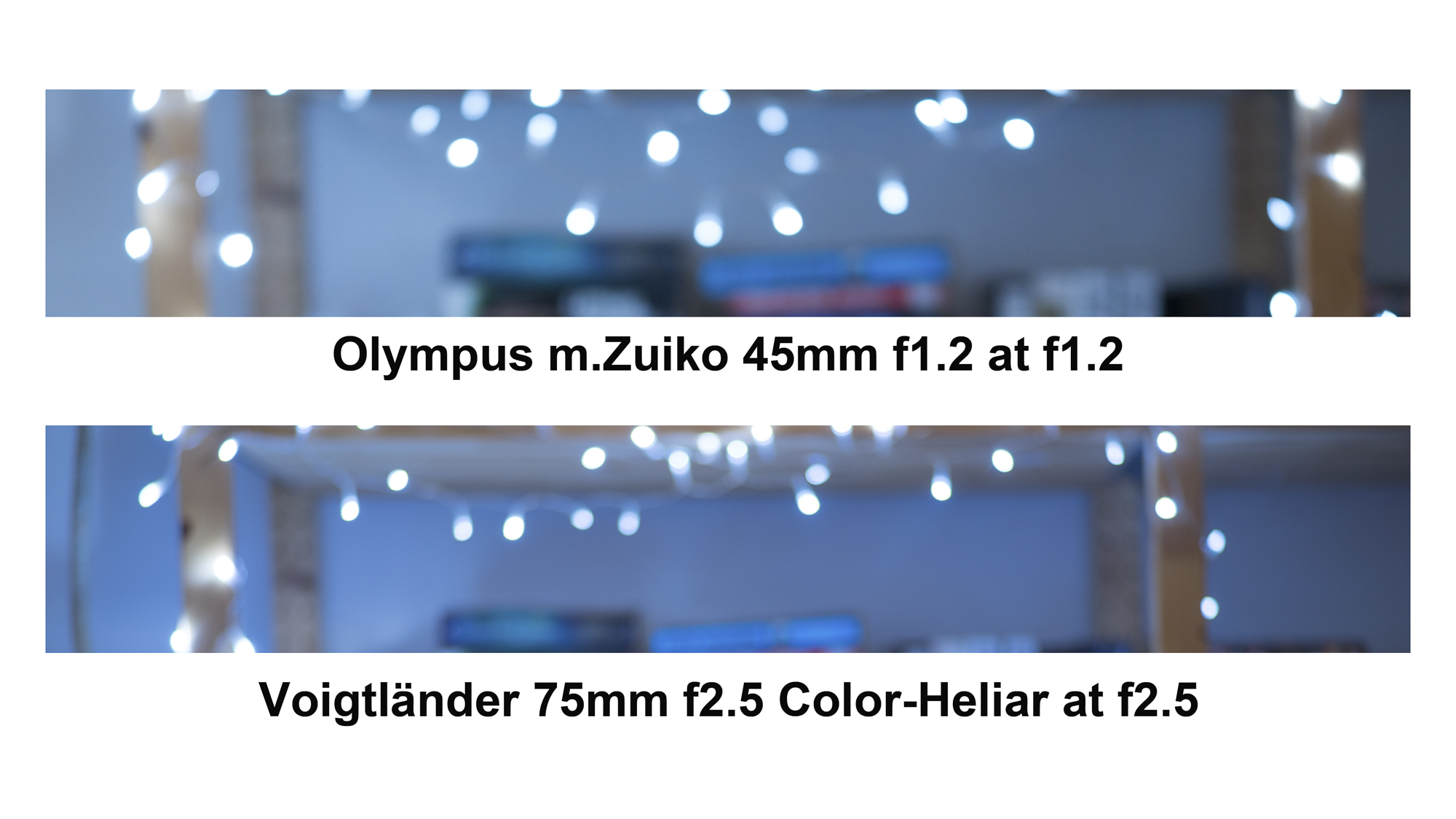
Bokeh comparison between the Olympus 45mm f1.2 at f1.2 and the Voigtländer 75mm f2.5 Color-Heliar at f2.5. Click on the image to see it larger.
The last lens is the Voigtländer 75mm f2.5 Color-Heliar mounted on a full frame body.The original Heliar design was developed in 1900 by Dr. Hans Harting as a symmetrical 5-element variant of the simple anastigmatic and well colour-corrected Cooke triplet. In 1902 the design was revised correcting astigmatism, curvature and coma better than the original design. That new design was asymmetrical six elements in five groups. In 1950 Dr. A.W. Tronnier refined the design even further to produce the Color-Heliar. When Cosina revitalised and relaunched the Voigtländer line they revived the Heliar concept with the 75mm f2.5 Color-Heliar. Cosina wanted to recreate the German optical aesthetic and engineering quality from the 1950s. The lens construction by modern standards is pretty basic with 6 elements in 5 groups and the 10 aperture blades bodes well for nice bokeh. Wide open at f2.5 it has the same depth of field characteristics as the Olympus at f1.2. It is not as sharp as the Olympus wide open but the tonal transitions are very smooth. The bokeh balls are nice and round at the centre, but at the edges and corners they take on the elliptical cats eye shape. This lens is longer in production and for a while it was possible to pick one up for around the $300 mark second hand, but the interest in adapting classic lens to mirrorless cameras has seen prices rise to almost $700.
Auto Focus Performance
the reluctant bull terrier test
Shooting stills the AF is very quick and accurate. Using the reluctant bull terrier test I shot a sequence of 25 frames using continuous autofocusat 10 frames per second with an EM1 mk i which does not have the latest iteration of Olympus’ on sensor phase detection AF. At f4 all the shots were in focus. Switching out the mk i for the mk ii with its better AF systemI shot a 71 frame sequence at f2 at 10 frames a second and only 6 frames were slightly soft.
Shooting video on the Olympus EM 1 mk ii using face tracking the camera and lens responds quickly and smoothly without hesitation. Many m4/3 users shoot video using Panasonics cameras so I put the 45mm f1.2 on my G85 and set it it use face tracking. The results were dismal. There was a lot of hunting, and if and when the camera acquired focus it would quickly drift off. Having had good success with the EM1 I can only put this down to Panasonic’s use of DFD contrast based autofocus and not the lens.
Conclusion
The fantastic little 45mm f1.8 is only $500 new and is just as sharp. The only place where it is found wanting is the maximum aperture.
There is no doubt that the Olympus m.Zuiko 45mm f1.2 PRO lens is a very good lens. It is well built and optically performs very well. The only thing that counts against it is its price when compared to other options. In the last quarter of 2020 Olympus ran a promotion in many parts of the world enabling purchasers of the EM1 to claim a free lens from the f1.2 trinity. If you were one of those and chose the 45mm then you got a great lens and I hope that you really enjoy it. If you are a committed Micro Four Thirds user and were wanting to purchase this lens today at the street price of $1800 I would suggest that your money could be better spent. The fantasticlittle 45mm f1.8 is only $500 new and is just as sharp. The only place where it is found wanting is the maximum aperture. If you are not so wedded to the idea of 45mm but just wanted a fast short telephoto then I’d seriously consider the Sigma 56mm f1.4 which at $750 is great value and a seriously good performer.
If you are just getting into photography and want a camera and lens combo that gives enormous creative control over depth of field then you’ve got to look at full frame cameras ($1800 will get you a new one less if second hand) and pick up an 85mm f1.8 where Canon, Sony and Nikon all have offerings between $600-900 new.
For video the 45mm f1.2 is a nice option as on the right camera it can autofocus extremely well and the the provision of a manual focus clutch that gives hard stops makes it very useful for manual focus pulls. If autofocus isn’t important to you then there are a huge number of older classic f1.2 and f1.4 lenses that can be picked up very cheaply.
Example Images
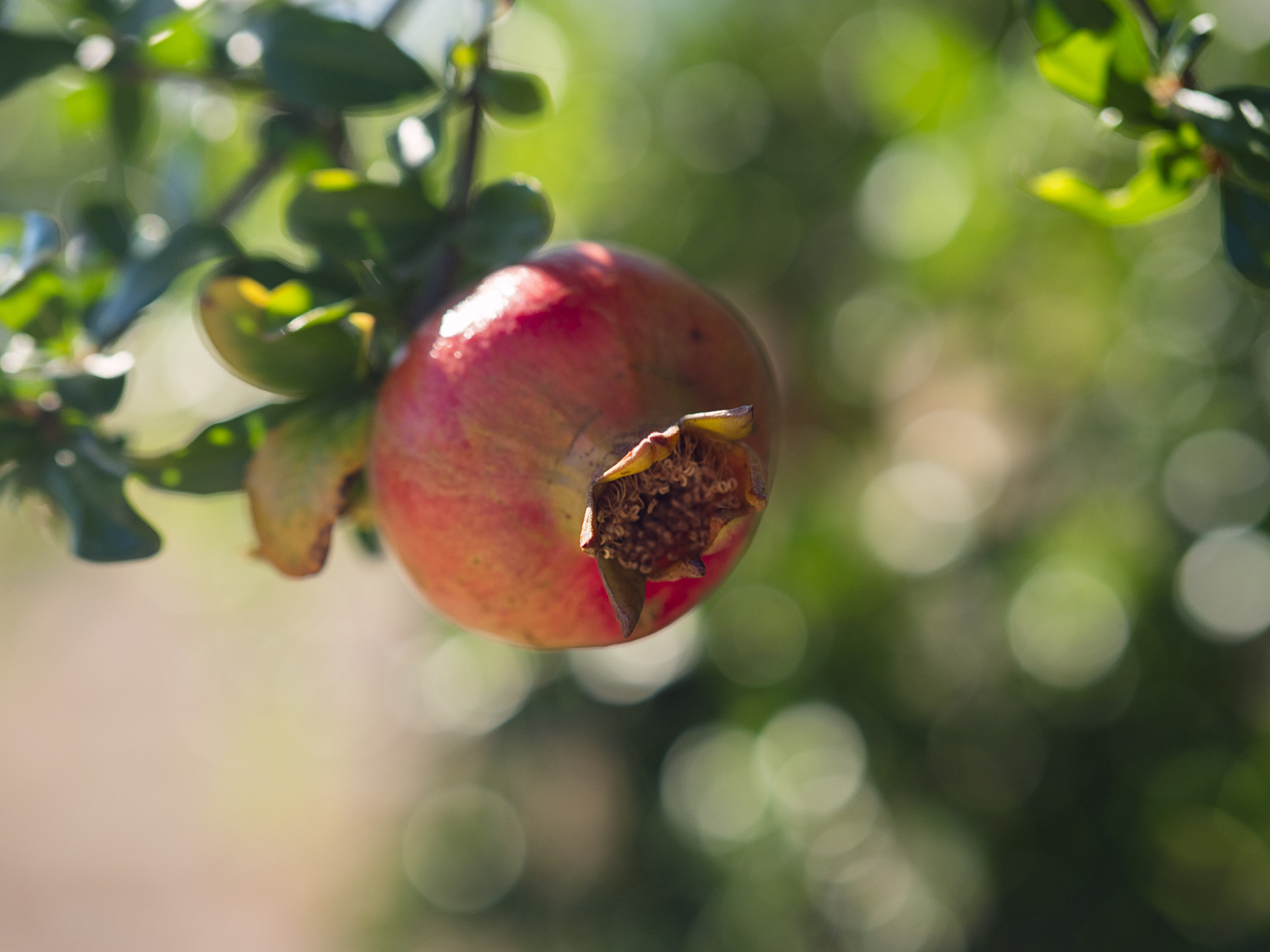
Wide open the Olympus m.Zuiko 45mm f1.2 PRO lens gives a nice please rendition with gentle tonal transitions.
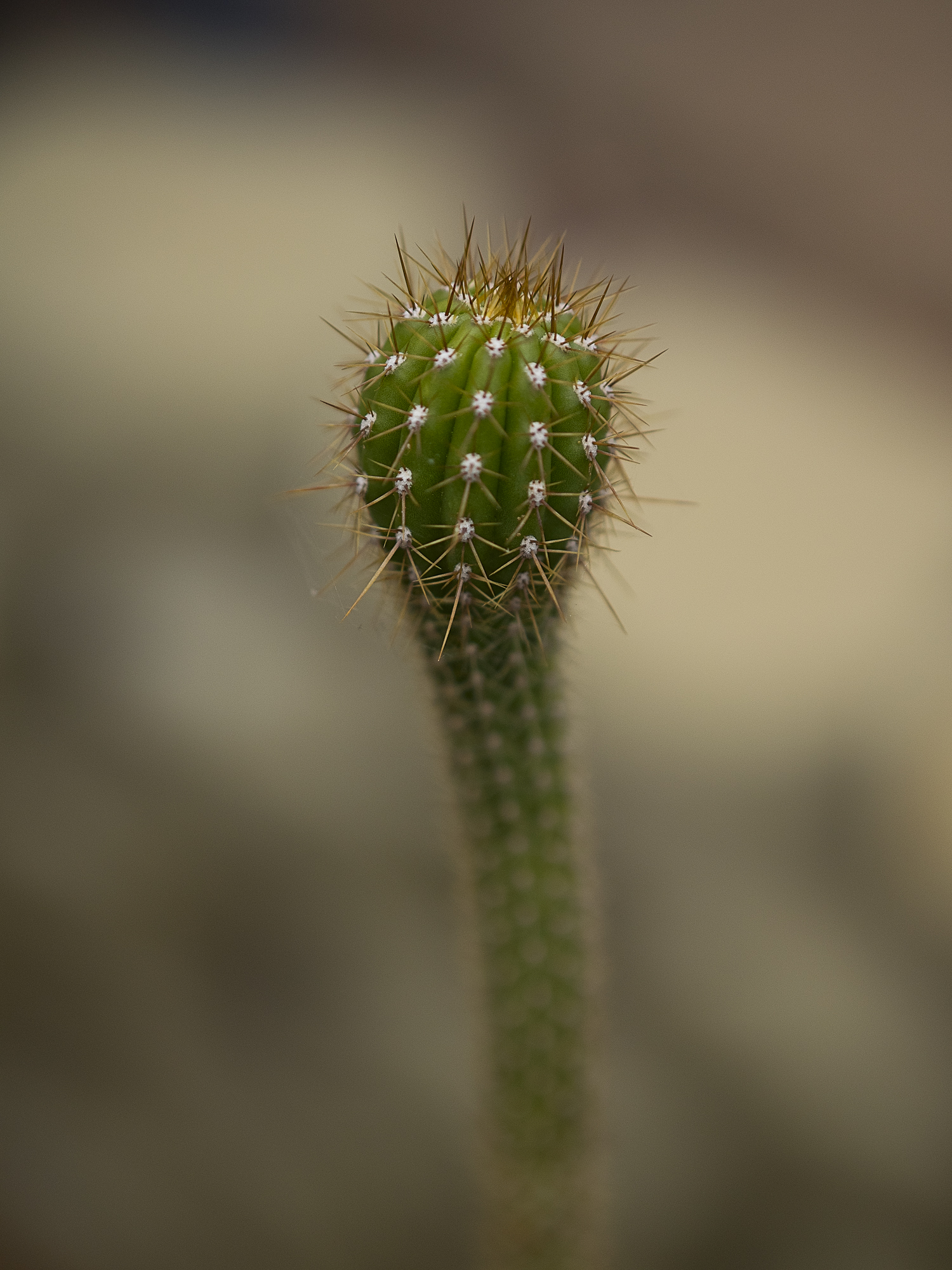
The close focusing capabilities of the Olympus 45mm f1.2 are impressive and couple this with pleasing bokeh it makes for a very nice lens with which to do product photography or still life.
The Olympus 45mm f1.2 also makes for a good lens for equine portraits.
Been left on my own for the weekend means it’s time for a curry extravaganza. Here we have Murgh musallam (baked chicken), Saag aloo (spinach with potatoes), Khili hui khichri (rice with yellow split peas) , popadoms and some ginger and mango chutney on the side. All this washed down by Ashai Dry.
Beloved Significant Other (BSO) has taken her sainted self off for the weekend to play croquet leaving yours truly and the dog at home. This can only mean one thing …CURRY NIGHT!!!!! And what’s more it’s not your usual blokey vindaloo. No here we have the height of Moghul culinary sophistication. There was Murgh musallam, Saag aloo, Khili hui khichri, accompanied by papadums, and ginger and mango chutney. It is next to impossible to get Kingfisher beer here so it was washed down with Asahai Dry. Three plus hours of cooking for a meal to be had on my own might seem a tad extravagant but I really enjoy cooking and I like to crank up the sound system and get stuck in. The recipes are not my own but were from Madhur Jaffrey’s eponymous book “Madhur Jaffrey’s Indian Cookery”. She is my cooking guru.
The photography was old school. I dug out the Canon EOS 5d – the original version – and the Canon EF 50mm f1.8 mike aka the nifty fifty and the plastic fantastic. Sure there is better on the market now but the Canon 5d was very special and had great colour science and beautiful tonality.
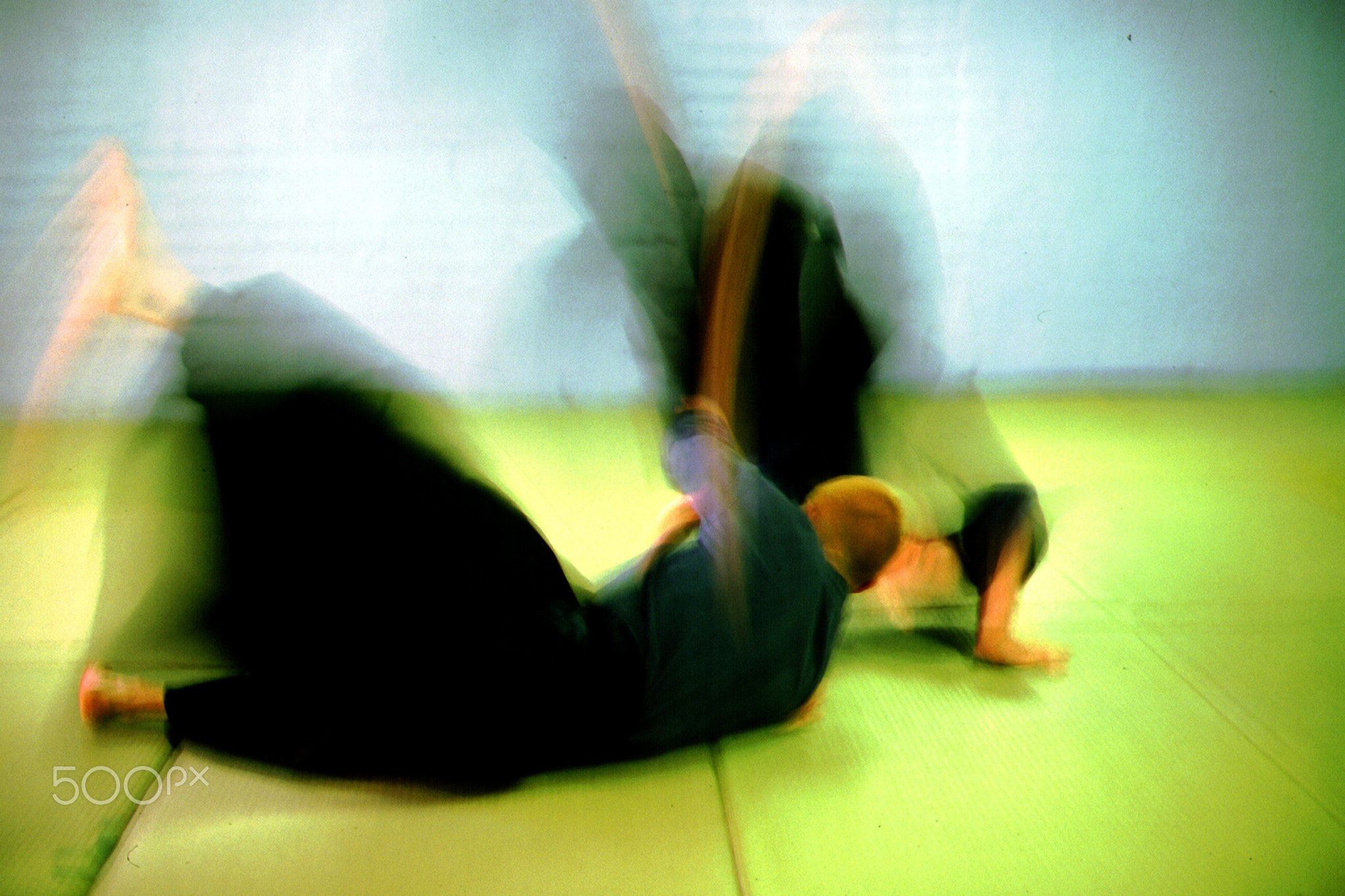
Sutemi waza from Yōseikan Aikido. Taken on Olympus C-720 Ultra Zoom with slow sync flash edited using Photoshop Elements 2 and Genuine Fractuals
Currently in photography there are several sacred cows and you’d think that from the amount of chatter these subjects generated that they were the be all and end all of photography. Thankfully for the actual art form of photography they are mostly irrelevant. These sacred cows are:
megapixels
dynamic range
sensor size
lens sharpness
My feeling is that these topics are so hotly debated is because now in this digital age it is easy to quantify these values numerically and the bigger the number the better. There is no doubt about it a great big spreadsheet of impressive looking numbers must be right after all. This is why the website http://www.dxomark.com has become a sacred text among the denizens of the internet fora and its proclamations and pronouncements can lift a camera or lens to photographic nirvana or condemn it to the lowest reaches of hell. Well having ruffled a few feathers with the piece on sensor size and depth of field this weeks entry is going to cause the DXO fundamentalists to really froth at the mouth in holy indignation.
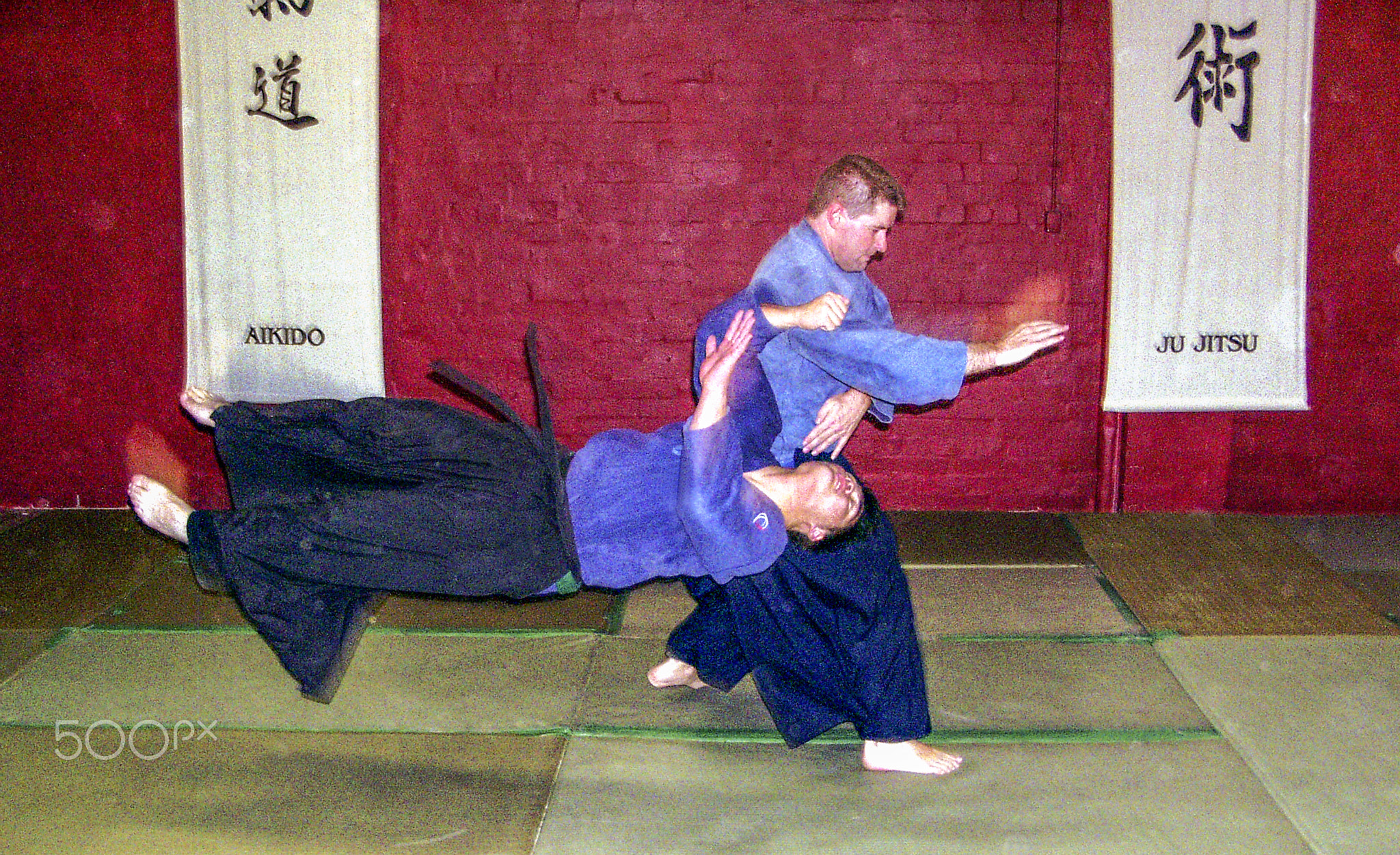
Ura Tai Otoshi from Yoseikan Aikido as taught by Shihan Jan de Jong. Shot using an Olympus C-720 Ultra using slow sync flash. Edited using Photoshop Elements 2 and Genuine Fractuals
Lens sharpness is something to be coveted. After all Leica, Zeiss, Schneider, Rodenstock, Canon and Nikon have made an art form of it. Those who worship at the high altar of lens sharpness are prepared to spend the equivalent of the GDP of a small African nation on the lenses that have the highest DXO score. The Carl Zeiss Distagon T* Otus 1.4/55 ZF.2 Nikon has a DXO score of 45 while the lowly Canon EF 50mm f/1.8 II only has a rating of 25. So the Otus is nearly twice as good as the plastic fantastic Canon. Phwoaaaaarrrrr forum domination and photographic greatness here I come, I’ll go out and buy one straight away. The Australian list price for the Zeiss is $4474 while the Canon is $135, so the Zeiss must be 33 times better. Er no. To quote DXO “The DxOMark Score shows the performance of a lens, mounted on a given camera body, for its optimal focal length/aperture combination and for defined exposure conditions.” So the lens has been mounted to a camera on an optical bench shooting a 2D lens chart at an aperture that is guaranteed to give the best results in carefully controlled lighting. So in other words it does not reflect real world usage unless your photographic interests lie in shooting charts or brick walls with a camera on a heavy tripod so you can orgasm over how sharp the image is at the edges. Shoot a complex 3D object in rapidly changing light conditions at sub optimal aperture settings and these ratings really don’t mean anything.
A sacrice throw from Yoseikan Aikido. Taken using an Olympus OM 4 with a Zuiko 35-105 lens on Fujichrome 400 pushed to 800 ISO. Scanned using an Olypus ES-10 scanner and edited using Adobe Photoshop Elements 2 and Genuine Fractuals.
There is no doubt that lenses have become a lot sharper over recent years, but I find it amusing to see that they have become so sharp that they are now unflattering for portraiture as they show every blemish and pore. So much so that photographers are now spending time and money on lessening the sharpness (blurring if you will) on portraits. Don’t you think that is ironic? I’ll spend a fortune on a very sharp lens that is so clinically sharp that no-one likes the results so I’ll spend some more money on a Photoshop plugin to blur it.
A famous quote and often mis-quoted as nobody can really tell you the context in which Cartier-Bresson said it. If we forget the Marxist definition of bourgeois and just concentrate on the dictionary definition we get:
“belonging to or characteristic of the middle class, typically with reference to its perceived materialistic values or conventional attitudes: a rich, bored, bourgeois family | these views will shock the bourgeois critics.”
I would hazard a guess that dear old Henri was stirring a bit when he said it and meant something along the lines that sharpness in a photograph is a very conventional and staid way of judging it and doesn’t look at its other qualities. How can I be sure, well I can’t but he also said:
“It is an illusion that photos are made with the camera, they are made with the eye, heart & head.” – Henri Cartier-Bresson
So I think it is more than likely to assume that Cartier-Bresson felt that there is a lot more to photography than technical perfection.
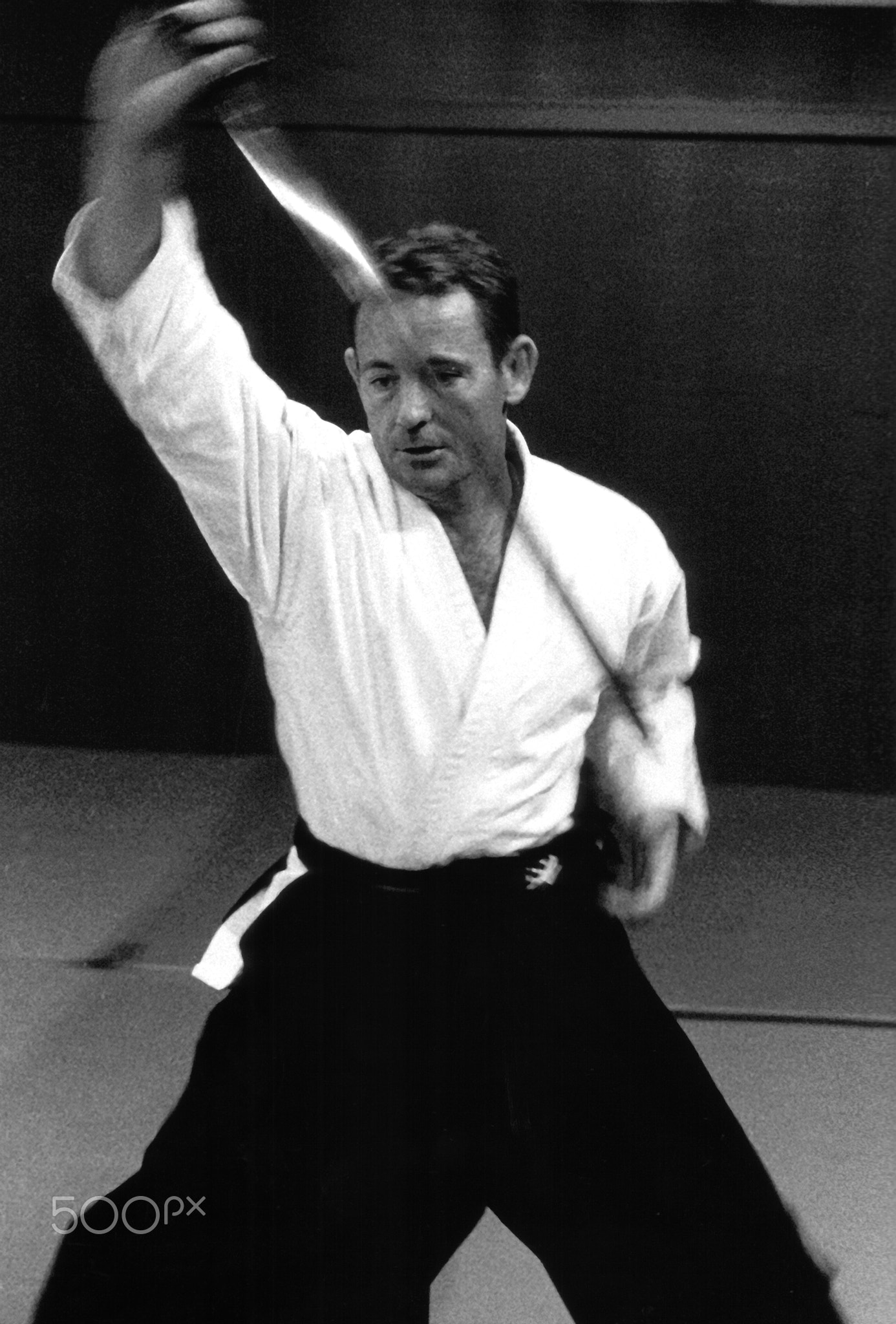
The Japanese art of sword drawing. Taken with an Olympus OM 4 with a Tamron 28 mm lens, using Ifford Delta 3200. Scanned using an Olypus ES-10 scanner and edited using Adobe Photoshop Elements 2 and Genuine Fractuals.
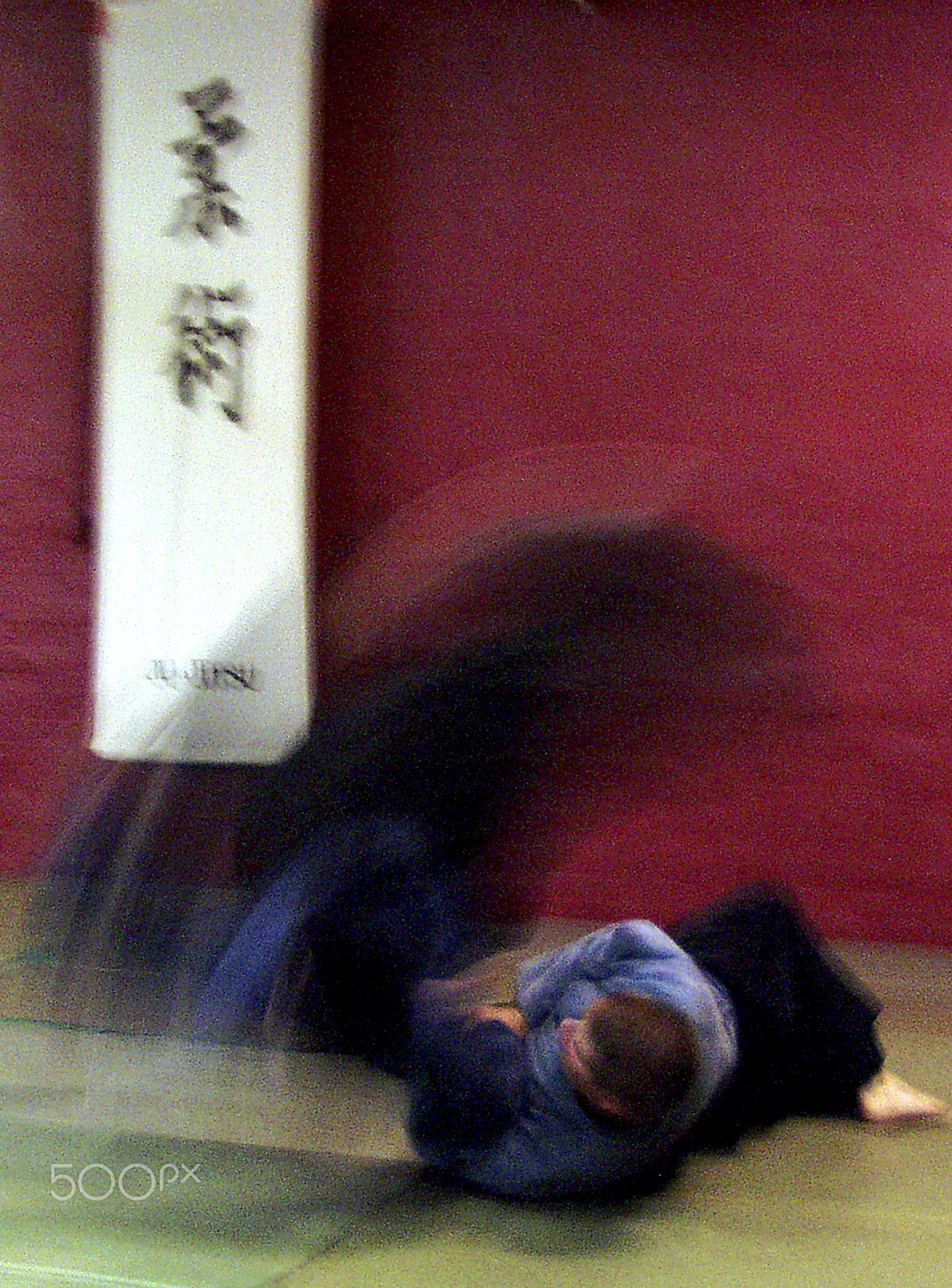
So by now you’ll have read this and seen some photos I made years ago of some people practicing Aikido and Iado, both Japanese martial arts. You’ll also have noticed that there is a lot of blurred movement and very little sharpness. The reason why is that I wanted to capture the beauty of the flowing energy that is involved in them and I felt that while static shots might capture the technical aspects of the techniques being demonstrated they don’t capture the nature of the philosophy behind them nor the dynamism. I like to feel that these are photos “made with the eye, heart & head” rather than the clinical gaze of the optically perfect lens. This is for me where the beauty of any art lies, not in technique but in the expression of ideas and emotions. None of the equipment used in the making of those photographs warrants a mention on DXOMark so I guess that gives them a score of zero. The equipment HCB used also isn’t on the DXO charts, and guess what quite a few of his pictures are blurred because he often relied on zone focusing and didn’t get it right, but I’d sooner have one of his pictures on my wall than a lens test chart any day.
















You must be logged in to post a comment.