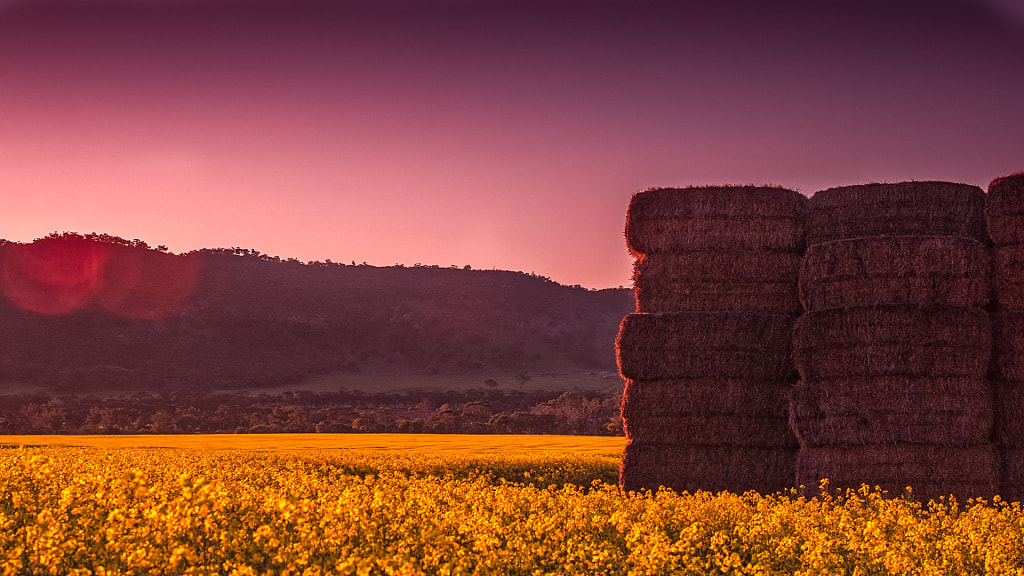
Golden hour light illuminates the canola. York, Western Australia.
It’s the time of year again when I post a gratuitous canola photograph. But the yellow of the canola and the blue of the sky are hard to resist. It’s really strange – York is a wildflower hot spot with an incredible number of spectacular species, yet I see more tourists pull up to photograph canola than the wildflowers.
I’ve thinking about variable neutral density filters a lot lately. When I started to get a bit more interested in video I decided to invest in a good Variable Neutral Density filter and as I’d always bought B+W filters I bought a B+W 77mm XS-Pro Digital ND Vario MRC-Nano Filter. It was beautifully made in Germany with a brass frame and hard stops. It didn’t offer anything spectacular in terms of range just 1 to 5 stops but it was very good. Unfortunately I was filming a waterfall and slipped on the rock and went into the river. I ended up with a week in hospital with septicaemia and the filter was smashed. I was unable to get a replacement so bought a Cokin NUANCES NDX 2-400 Filter which was considerably cheaper, not as well made but the images were good. Over time I decided I missed the hard stops and so as the B+W was still unavailable in Australia bought a Heliopan variable grey neutral density ND 0.3 – ND 1.8 filter which has served me very well.
Recently I decided that I wanted a new one in 95mm size. Normally I’d buy the best quality one and be done with it, but this time I was unprepared to spend that eye watering amount for what just amounts to an experiment. Looking online I saw there is a huge variation in prices and I couldn’t help but wonder whether paying more actually meant a better quality filter. So I’m looking at four filters and the price range goes from $24 AUD to $350 AUD. I’ll look at whether they impact image quality, whether they are prone to flare and whether they effect autofocus performance.
Testing Methodology
Colour casts produced by the filters at their minimum and maximum settings. Click on the image to see larger.
For all the tests the same camera and lens were used – a Sony A7r2 with Sony FE 50mm f1.8 lens. Although the filters are different sizes I used step up rings to fit the filters to the lens. To test for image sharpness and colour casts the camera was set on a tripod in front of a lens resolution chart so it filled the frame. The chart was lit with an LED light set to 5600K and then a custom white balance was set with no filter on the lens and an image was taken which was the control. Each filter was then tested at its minimum and maximum density.
The effects of the filters on image sharpness at their maximum and minimum settings. Click on the image to see larger.
For the video AF test the Sony A7r2 and 50mm lens were used again while with the stills AF test I was so surprised with the results that I also tested with the Olympus EM 1 mk ii and the the Olympus 25mm f1.8 just to make sure. I ran control tests for both camera and lens combinations to provide a baseline with which to compare. In the stills test both cameras without filters attained a 100% in focus rate.
The glare test was done with just the Sony A7r2 and the 50mm lens.
“Image quality may drop when focal length above 200mm. It may not be suitable for a wide-angle lens <24mm,35mm film format equivalent.”
The filter is made from an unspecified Japanese optical glass and there is no mention of any coatings. The frame is made out of aluminium and has a satin black finish. There are no hard stops but there is a scale indicating where the minimum and maximum effect occurs. The filters are made in China and come in a flimsy rectangular hard plastic case.
Certainly this filter has an effect on image sharpness it decreased sharpness and contrast of the tested 50mm lens the most. At the minimum density setting there was a definite reduction in contrast and sharpness which deteriorated even further at maximum density setting. It also had a pronounced colour cast.
The Fotga filter is the cheapest on test but the aluminium frame appears to be as well made as the filters from Cokin and Urth.
When testing the video autofocusing the Fotga produced the worst result – the AF was as snappy or confident and the image was decidedly soft. Shooting a burst of still images imagesthe Fotga filter only achieved an in focus rate of 67% and the images were all low in contrast, very soft and showed glare. Speaking of glare when testing for it specifically the Fotga produced the worst result exhibiting veiling and ghosting flare and strong halation around the light source.
The Urth Variable ND2-400 (1-8.65 Stop) Filter is the next cheapest filter costing $82 AUD for a 77mm filter. Urth state on their web site that the filter is not suitable for use on wide angle lenses stating:
“For wide-angle lenses, we recommend our Variable ND2-32, ND8-128, ND64-1000 or fixed ND filters.”
Urth also state that filter has eight layers of coatings to make it easier to clean but no mention of whether they improve optical quality. They also claim that there are no colour casts which unfortunately is not true, but on the positive side there was no impact on image sharpness at the minimum setting and a slight reduction in sharpness at the maximum setting.
The Urtth variable neutral density filter has an aluminium alloy frame and hard stops.
About the type of glass used the website says:
“Japanese AGC optical glass is coated with an 8-layer nano-coating “
The frame is aluminium and finished in matte black. There are hard stops at each end of the adjustment range with a scale marked showing maximum and minimum. Out of all the filters on test the Urth has the nicest presentation being supplied in a circular metal tin with a screw on lid and it was the only filter to be supplied with a lens cleaning cloth. To make you feel even better about your purchase Urth say they will plant 5 trees with every purchase. Urth are an Australian company but the filters are made in China.
When shooting video the Urth filter had no visible effect on the autofocus, but strangely enough did on the stills performance achieving an 80% hit rate. For the glare test it shared the best performance with the Cokin filter.
Cokin
Cokin NUANCES Variable Neutral Density 2-400 (1-8 Stops) Screw-in Camera Filter
The Cokin NUANCES NDX 2-400 – 77mm Filter comes in at $176 AUD for the 77mm size tested. Cokin put out a very helpful information sheet which clearly states that they do not recommend its use on lenses shorter that 24mm (full frame). Interestingly they specifically talk about the “Maltese Cross” phenomenon which occurs when you try to get the maximum density. This varies depending upon the focal length of the lens and limits the amount of density you can use. To get the full 8 2/3 stops lenses longer than 45mm should be used. A focal length of 35mm gives you 6 1/3 stops and 24mm gives 5 1/3 stops.
In terms of the optical construction the Cokin filter is made of “Schott Glass B270, renowned for its high transmittance and low reflection”. They state that the filter is coated but not with how many coats. The frame is made of aluminium with a matte black finish and it has a series of dot markings with min at one end and max at the other. The dots don’t correspond with any particular effect. The filter comes in a round hard plastic case that is hinged. It doesn’t feel particularly sturdy and I find it quite awkward to open. Although the packaging states it is designed in France there is no indication as to where the filter was made. As Cokin was acquired by Hoya in 2000, which is part of the Kenko Tokina group, which makes filters in both the Philippines and Japan it would be a fairly safe assumption that the Cokin filters would be.
Cokin NUANCES Variable Neutral Density 2-400 (1-8 Stops) Screw-in Camera Filter
Tested performance shows no effect on image sharpness at both the minimum and maximum settings and a very slight cast. The Cokin filter performed very strongly in the video autofocus test showing effect on performance or image quality. The stills performance was the second best at 82% and the results in the glare test were joint best.
“Depending on the focal length of the lens this filter is not recommended for use with very wide angle lenses.”
The Heliopan variable neutral density filter is the only one on test that has a brass frame. It is also one of only two that have hard stops to limit the amount of adjustment.
But having said that you shouldn’t be having too many problems as the filter has hard stops to prevent running into the “Maltese cross” phenomenon. They claim the use of Schott glass but make no mention of any coatings. The frame is made in Germany of brass with a matte black finish to avoid reflections and has hard stops at each end of the adjustment range plus a numerical scale marked from 1-12 but the numbers don’t correspond to any ND value. The filter comes in a square hard plastic case that is hinged and it is quite sturdy.
Heliopan Variable (1 to 6 Stops) ND Filter
The tested performance was similar to that of the Cokin a slight colour cast ( although different from the Cokin) and no effect on image sharpness.For the video AF there was no impact on the focus performance and no effect on the image quality.For the stills AF the heliopan was the best performer with a score of 86%. Interestingly it was not an equal performance across both cameras. On the Sony it achieved a score of 78% and the Olympus 94%. I’m really at a loss to explain why there is such as discrepancy with the results and I had to test several times to confirm it. The Heliopan didn’t do very well in the glare test exhibiting pronounced veiling and ghosting flare. It wasn’t as bad as the Fotga but it was significantly worse than the Urth and the Cokin.
Conclusion
For filters that don’t have hard stops, like this Cokin, if you apply too much filtration you get this cross pattern.
Before I started testing I definitely believed that you got what you paid for. I fully expected the Fotga filter to be the worst performer and the Heliopan the best leaving the Cokin and Urth filters to battle for second and third places. Well I only got part of it right. The Fotga was definitely the worst performing filter of the bunch. Its only redeeming feature is the price – it’s incredibly cheap. The real surprise was that the Heliopan while being marginally the best performer wasn’t delivering any significant improvement over the Cokin which cost half the amount. The Urth filter was a very solid performer. Their 77mm is half the price of the Cokin yet delivered a result that was only a fraction worse – probably undetectable in real world use. Yet the filter has hard stops and is more nicely made and presented. For a little more, $44 AUD to be precise, the Urth Filter Plus+ might be a very good buy having the benefit of the better Schott glass, but that is conjecture as I’ve not used one.
A key takeaway is that to get the best possible image quality you have to set your custom white white balance with the filter on. All the filters produce some degree of colour cast despite what the manufacturers claim. All the filters are prone to flare so I would recommend the use of a lens hood. Lens hoods and variable NDs are problematic as the filters prevent the use of the ones designed for the lens. I now use a matt box when shooting outside and it has made a surprising difference.
To sum up, well if I needed to start again I wouldn’t waste my money on the Heliopan. The Cokin would be my choice if I could live without hard stops and the Urth would be it if I couldn’t.
The Autumn burn off in the fields of the Western Australian Wheatbelt has left its distinctive stripes on the landscape.
Thought I’d put up a couple more pictures of the stripes fields we’ve got round our way. They won’t be around for much longer as we have had the first real rains and there will soon be a green flush that will change the colour of the landscape.
I must say it’s been quite nice to do some landscape photography again. I decided to go all retro and pull out the Cokin filters and a couple of older cameras. The top photo was taken with a Canon 6d and the Canon EF 70-200mm f2.8 IS L Mk I which completed the old school experience. The photo below was shot on the Olympus EM1 Mk i. They may not be the latest and greatest cameras and lenses but they still deliver
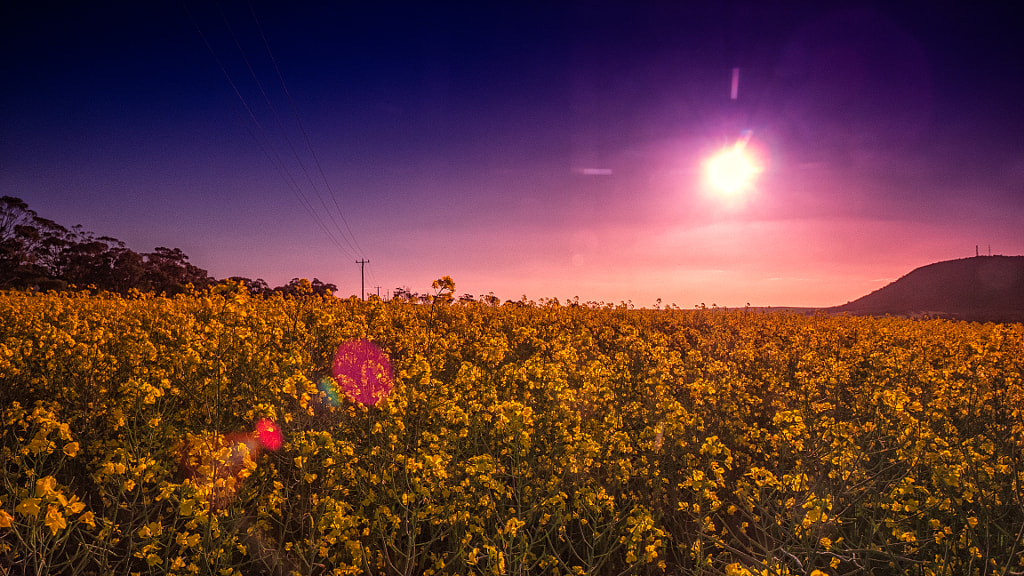
Rural Idyll. The sun sets on the canola by Mount Bakewell in York, Western Australia. Olympus OMD EM1 with Olympus 12-40mm f2.8 lens and Cokin 3 stop ND and 3 stop GND filters. Exposure: 1/13th sec, f8 ISO 200.
Photography and video are both media that allow the artist to play with the concept of time. Up until recently I primarily worked using still photography. With the advent of good quality video being added to most digital cameras I started playing tentatively with moving images and enjoying the whole idea of capturing movement in another way. Now I’m playing with time-lapse which is a way of using still photos to play with movement that the eye doesn’t normally perceive.
Sunset over the canola fields. York, Western Australia. Olympus OMD EM1 with Panasonic Leica 8-18/F2.8-4.0 lens a Cokin 3 stop ND and a 3 stop GND. Exposure: 1/50th sec, f8 at ISO 200.
The last couple of weeks have seen me shooting the canola fields around York. I’ve yet to do anything with the resulting video footage, but the pictures illustrating today’s post are still out takes. It is just a matter a shooting hundreds of shots of the same scene over a defined time period. My normal landscape gear and technique are used. I’m also experimenting with adding my own movement in the form of pans, tilts and slider moves. Thankfully my camera has an electronic shutter so I’m not burning through the shutter life.
Abandoned. An old colonial farmhouse amidst the canola. York, Western Australia. Olympus OMD EM1 with Olympus M.Zuiko Digital ED 75-300mm f/4.8-6.7 II lens and Cokin 3 stop GND. Exposure: 1/30th sec, f8 at ISO 200.
The thing with experiments is to allow ourselves to make mistakes. This can be difficult if you have, like I have, been practicing in a medium for many years because you tend to develop a certain competence/mastery (pick whichever is the most appropriate) and expect a certain result for your efforts. So when confronted with learning something new and seeing all the mistakes and failures it is tempting to run back to the security of our old established ways of working as it is more ego friendly. In our society the notion of mistakes and failure is seen as a negative, but they really should be embraced. We need to give ourselves freedom to explore and experiment in a nurturing environment so that we can learn and progress. At the moment I’ve got a couple of dozen time-lapse clips sitting on my hard drive, two of them are OK the rest suck big time. Looking at them objectively and looking at the work of people who are considered masters of this art form I can see where I have made my mistakes and so I can now work to avoid repeating them. Who knows in another couple of years I might actually get good at it.
Dead trees on a winters misty morning in Yenyenning Lake. Beverley, Western Australia. Sony A7r with Sony FE 28-70mm F3.5-5.6 OSS lens, and Cokin 3 stop graduated neutral density filter and a circular polarizing filter. Exposure: 0.3 sec, F16, ISO 100.
The town hall in the historic Western Australian town of York in pre-dawn light. Sony A7r with Olympus OM Zuiko 35mm f2 lens and Cokin 3 stop graduated neutral density filter. Exposure: 2.5 sec, f8 at ISO 100.
The other morning I got up at stupid O’clock to shoot a dawn time-lapse of the York Town Hall. So what do you do while you’re hanging around waiting for it to finish? Why take photos of course! So while the Leica D-Lux clicked away doing it’s time lapse thing I set up the Sony A7r and started taking snaps of the town hall. Good job I did as the time lapse wasn’t that crash hot.
The Faversham vintage van in Avon Terrace, York, Western Australia. Olympus OMD EM-1 with Olympus OM Zuiko 35-105mm f3.5-4.5 lens. Exposure: 1/200 sec, f5.6 ISO 400.
If you have slightly geeky bent, and to be honest if you are reading a photography blog it’s pretty much a given that you have, then Adobe’s Lightroom has several useful tools. One of the ones I’ve been looking at is the ability to look at your photographic work for a specific time frame, and in this case it’s for the year 2016. You can also look at the cameras and lenses you used for that period which enables you to see what patterns of equipment usage emerge. It might ultimately save you money i.e. if you have a hankering for an expensive lens you can look back on your past year to see if that focal length/s you used and whether the objective lens of your desires is one you’d actually use or not. This has actually happened to me – a while back I was working on my project Broncos and Bulls and I felt that the Canon EF 75-300 f4-5.6 IS was costing me shots as it wasn’t the fastest lens to focus and the images at the long end were pretty soft. I wanted a Canon 100-400 L IS but my then preferred local dealer didn’t have one in stock and after waiting nearly 3 months they informed they couldn’t get one. I allowed them to talk me into buying the Canon 70-200 f2.8 L IS with the Canon x2 converter which they had in stock. Their logic was that I’d end up using the 70-200 much more and would hardly use it combined with the teleconverter. Now looking back through my Lightroom library I can see that I’ve hardly used the 70-200 at all on its own and virtually all the times I have used it was in conjunction with the teleconverter. I should have stuck to my guns and gone to another dealer and that way I’d have a lens that met my needs gave and gave good image quality rather than put up with a convenient compromise.
Gotcha. Steer roping, Boddington Rodeo Western Australia. Canon EOS 5D with Canon 70-200 f2.8 IS L and x2 converter. Exposure: 1/800 s at f/5.6 ISO 200
So what have I deduced about my photography for 2016? Well I’ll start with commenting on 2015 – for that year over half my photographic output was shot with a DSLR (50:50 split between full frame and APS-C). In 2016 that dropped to 10% the other 90% was shot on mirrorless. The DSLR was only used for some macro work (radio controlled TTL flash), some architecture (a specialised lens) and one event where I had a crisis of confidence and didn’t think the mirrorless cameras would cope with high ISOs and low light focussing. When I look at lens usage it comes as a big surprise that one-quarter of the images were taken using adapted lenses and these with a focal range of between 15-135mm in full frame terms. Hmmm well I knew I preferred shorter lenses than
Aboriginal art at Quairading Railway Station, Western Australia. Sony A7r with Olympus OM Zuiko 24mm f2.8 lens. Exposure: 1/4000, f8 at ISO 400.
longer already, the main thing is that I enjoyed using legacy lenses and was more than happy with them in terms of image quality. I don’t have to use legacy lenses at all as I have 20 to 600mm covered by modern dedicated AF lenses. For work where it is appropriate I will use the legacy lenses because they give a certain aesthetic that I like which is a less digital and clinical look.
As you drive into York on the Great Southern Highway standing tall on your left is the historic York Flour Mill built in 1892, home to The York Mill. Sony A7r with Voigtlander 15mm f4.5 Super Wide – Heliar lens. Exposure: 1/25 sec, f16 at ISO 100.
Well what will 2017 bring. Well for 2016 I experimented with finding a certain look. For 2017 will be more project driven as I have found the style I wanted and now want to put it to practice. There will be at least one new book (work on that has already started) and there will be some multi media projects. So exciting times indeed.
Hillside Farmhouse was designed by Sir Talbot Hobbs, a leading architect and built in 1911 for Morris Edwards in the historic Wheatbelt town of York in Western Australia. Sony A7r with Olympus OM Zuiko 35-105mm f3.5-4.5 lens mounted via a Fotodiox adapter, Cokin circular polarizing filter and +3 stop graduated neutral density filter. Exposure 4 seconds, f16, ISO 50.
I hope for my readers that 2017 will be all that you hope and that you’ll be healthy and happy.
Everlastings on Mount Brown in York, WA. Sony A7r with Olympus OM Zuiko 135mm f2.8 lens. Exposure: aperture priority with +1 stop exposure compensation, 1/1000th sec, f2.8 at ISO 100.
Hillside Farmhouse was designed by Sir Talbot Hobbs, a leading architect and built in 1911 for Morris Edwards in the historic Wheatbelt town of York in Western Australia. Sony A7r with Olympus OM Zuiko 35-105mm f3.5-4.5 lens mounted via a Fotodiox adapter, Cokin circular polarizing filter and +3 stop graduated neutral density filter. Exposure 4 seconds, f16, ISO 50.
The Canon EOS5d – the first “affordable” dSLR with a 35mm sensor.
On 22 August 2015 the Canon EOS 5d turned ten years old – my own 5d turned 10 last week. Now they reckon dog years are seven for every human year. In terms of digital photography I reckon ten years equates to over a hundred human years as technology has advanced so fast. Despite that the original 5d, or if you want to really annoy the anally retentive Canon fan bois over on the DPReview forums the 5d Classic, is still more than a capable camera, in fact I would go onto say that if you don’t shoot video and don’t print any larger than A3+ you don’t need anything else. If all you do is post shots on Flickr and Facebook then I would say you’re over gunned and look for a Canon EOS 300d! Why was it so special – well it was the first “affordable” dSLR with a 35mm sized sensor. That meant a lot back in 2005 because a lot photo enthusiasts and pros had cut their teeth shooting 35mm film and had got used to a certain look with particular focal lengths. The advent of the cropped sized sensor (APS-C for Canon and DX for Nikon) meant that we couldn’t just look at a scene and say that calls for a 85mm lens, or a 24mm lens. No we had all these funny focal lengths and the other annoying thing was the camera and lens manufacturers didn’t populate their lens line ups with high quality cropped factor lenses – a fact that is still true today. So when the 5d was announced I thought at last I can get my favourite focal lengths back. I literally ran to my then favourite retailer PRA and placed my order. Since then my 5d has been in constant use, there are some 14,000 images in my Lightroom catalogue taken with that camera and it hasn’t missed a beat. It still gets used on a regular basis because those 12.8 Mp render an image beautifully. Many of the cameras detractors said that it had an atrocious auto focus system but I never had any problems with mine.
Gotcha!!! 2007 Boddington Rodeo, Boddington, WA. The 5d in full on action mode, something a lot of people said was impossible.
2005 Perth H2O Gravity Games
A lot of people complain that Canon sensors are crippled when it comes to dynamic range, again it has never been something that has caused me any problems.
Hot Air Balloons over the Avon River in Northam, Western Australia. Canon EOS 5D, Canon 75-300mm f/4-5.6 IS USM lens. Exposure 1/1000 s at f/5.6 ISO 400.
A walk down the lane at sunset. York, Western Australia. Canon EOS5d, Canon EF 28-135 f3.5-5.6 IS lens, Cokin 2 stop graduated neural density filter, Cokin circular polarizing filter. Exposure 20.0 s at f/22.0 ISO 100 in manual mode.
Long exposures such as the shot above and below didn’t cause any problems, just a little judicious use of noise reduction software in post.
York CBH Nocturne. Train been filled at the York CBH grain handling facility in York, Western Australia. Canon EOS 5D with Canon EF24mm f/2.8 lens. Exposure: manual mode 20.0 s at f/4.0 ISO 800.
As I said earlier I’m still happily using the camera after ten years and in that time quite a few other cameras have come and gone. I think the EOS5d deserves the appellation Classic because it helped a lot of photographers recover their preferred means of working with focal lengths, it quickly became a mainstay of a lot of working photographers, and it established the idea of the prosumer full frame sensor in camera market. Will it last another ten years? I don’t think so as a working camera. The problem is that the spares are no longer manufactured to keep the camera going. I’ll still continue to use mine until it fails but not as a mission critical camera.
Tessellated Pavement. Canon EOS5d with EF28-135mm f/3.5-5.6 IS USM lens. Cokin filters – 3 stop ND filter, 2 stop grad, and circular polarizing filter. Exposure: 1.6 s at f/11.0 ISO 100.
As always clicking on an image will take you through to my online gallery.





You must be logged in to post a comment.