Karak or Red-tailed Black Cockatoo (Calyptorhynchus banksii subs samueli) feeding on Cape Lilac AKA WhiteCedar (Melia azedarch). York, Western Australia.
The last couple of weeks I’ve been thrilled to see Red-Tailed Cockatoos (Calyptorhynchus banksii), called Karrak by the Nyoongar, feeding in the Cape Lilac trees of our neighbours.
Karak or Red-tailed Black Cockatoo (Calyptorhynchus banksii subs samueli) feeding on Cape Lilac AKA WhiteCedar (Melia azedarch). York, Western Australia.
There are four subspecies found in Western Australia – Cb. Naso (referred to as the Forest Red-tailed Black Cockatoo), Cb. Samueli (the Inland Red-tailed Black Cockatoo), Cb. macrorhynchus (sometimes referred to as the Great-billed Cockatoo, Banksian Black-Cockatoo, or Banks’ Black-Cockatoo), and the recently discovered Cb. Escondidusa. Now which species the ones in our neighbourhood are I couldn’t tell you – probably Inland or Forest Red-Tailed Black Cockatoos. All I know that is according to the experts we shouldn’t have any, but here they are.
The Nyoongar creation story for the Red-Tailed Black Cockatoo.
Ngoolyak or Carnaby’s Black-cockatoo (Calyptorhynchus latirostris). Yanchep National Park, Western Australia.
Dwert the Dingo
Djidi-djidi or Willie Wagtail (Rhipidura leucophrys). Avon Walk Trail, York, Western Australia.
Kwilom or purple swamp hen (Porphyrio porphyrio subsp bellus) picking over vegetation on shore of the lake. Lake Leschenaultia, Western Australia.
One day Ngoolyak the white-tailed black cockatoo saw a fight between Dwert the Dingo and Djidi-djidi the Willie Wagtail. Ngoolyak sided with Dwert and joined the fight. Kwilom the Purple Swamp Hen saw the commotion and tried to break them up. He picked some sedge and started beating Ngoolyak across his back to get him to back off. Ngoolyak started screaming and tried to fend off the blows by raising his tail. The sedge oozes red sap when it is cut and it left great red marks where it struck. As he screamed Ngoolyak’s voice became hoarse and he could no longer make his normal call of “wola” and the screeching sounded more like “Karrak!” instead, and that is how Ngoolyak the White-tailed Cockatoo became Karrak the Red-tailed Cockatoo.
Karak or Red-tailed Black Cockatoo (Calyptorhynchus banksii subs samueli) feeding on Cape Lilac AKA WhiteCedar (Melia azedarch). York, Western Australia.
Karak or Red-tailed Black Cockatoo (Calyptorhynchus banksii subs samueli) feeding on Cape Lilac AKA WhiteCedar (Melia azedarch). York, Western Australia.
It’s been a strange August. From my blog entries you’d think that it has been a very wet winter, but the reality is that it has been very little rain and the bush is very dry – almost crispy. It has has a tremendous impact on the wildflowers – there aren’t as many as the previous few years. This is causing problems for the tourist industry with some interstate and overseas tourists getting upset.
Dark banded greenhood, Pterostylis sanguinea.
Locally it has been very strange. Some species of orchid didn’t flower at all while some flowered 6-8 weeks earlier than normal as the winter as well as being dry has been warmer than normal. This last month I’ve been concentrating on the bush reserves around York and particularly those I’ve never been to. It’s quite boggling to think that after almost 20 years of living in the area I still haven’t visited all the reserves. The pictures accompanying this piece are some of the ones I’ve taken in August.
Lemon Scented Sun Orchid or vanilla orchid (Thelymitra antennifera).
One of the most disturbing things this year is the impact of orchid tourism. Usually the reserves around York receive a fraction of the visitors that other orchid hotspots do, but with high petrol prices more and more people are now restricting their days out to those areas an hours drive from Perth. Having more visitors isn’t bad in and of itself. What is bad is the deterioration in people’s behaviour. The amount of litter left in some spots is huge. Another thing is that people aren’t prepared to walk to sites and so drive off the tracks to look for flowers causing a lot of damage. The worst thing is that people are now digging up the orchids. On Friday 25th August I went out to photograph Curly Locks orchids in the Wandoo National Park. I found six in three separate clumps. The flowers hadn’t fully opened so I decided to go back in a couple of days time. The following Tuesday I went back and all three clumps had been dug up. I tried to report it but was told it was a kangaroo that did it, but in my experience kangaroos don’t dig perfectly square holes with spades, and nor do they smoke cigarettes while they do it and leave behind their water bottle.
Jug Orchid or Recurved Shell Orchid (Pterostylis recurva).
Orchid poaching is a big problem. Earlier this year Kings Park in Perth had nine hundred rare species of Western Australian orchids stolen. It seems that there people afflicted by orchidelirium a kind of flower-driven madness where people just have to own the rarest of the orchid species. It is a growing problem and only the other day I was approached by a man in his early 70’s claiming to be a friend of a noted Western Australian expert and that he was prepared to sell me orchid tubers for $40 a tuber. I told him in no uncertain terms where to go. The frustrating thing about this is that a lot of the orchid species are very specialised requiring certain other plants and pollinating insects to survive. Without these they die. In the case of the Curly Locks I know of only three sites where they can be found round York and at best there are only half a dozen flowering plants at each site per year. Wiping out one locations population like that means that is one less place where they can be found, which means extinction is even closer.
Bird Orchid, Pterostylis barbata
I’m sorry for the rant but the whole thing was a little upsetting and I’m not sure what was worse, the theft, the indifference of the authorities, or the brazenness of people trying to sell the orchids.
Clubbed Spider Orchid, Caladenia longiclavata.
Fringed Mantis Orchid or Green Spider Orchid (Caladenia falcata).
Caladenia roei goes by a number of common names which are Clown Orchid, Ant Orchid, Man Orchid, and Jack-in-the-box Orchid. Narrogin, Western Australia.
If you just look at the media you’d think that there’s not a lot of hope for the world. We’re in the middle of a global pandemic, there are bushfires raging on the west coast of America, eastern Australia was ravaged by bushfires earlier in the year, there’s a global recession – the list goes on and on. There seems very little hope left in the world. If you want to find some hope then you’re going to have to go looking for it.
Yoorn is the Nyoongar name for the bob tailed lizard (Tiliqua rugosa). Narrogin, Western Australia.
Every now and again I come across a place that gives me hope for the present and the future. They always take the form of a scrap of land that somebody has decided to regenerate. I’ve written about a couple of these places before – Lake Seppings and Lake Claremont.Both of these are examples of urban regeneration based around a lake. This month I’ve been out in the Wheatbelt exploring a reserve east of Narrogin. It’s a bush block in the middle of farm land that is being allowed to regenerate. To say it’s off the beaten track is an understatement. When you get there there is no access to it, no paths, no signs other than one telling you that it is a regeneration project. As you you make your way through the scrub you begin to notice something quite remarkable – there’s no evidence of any human visitation. No litter, no vehicle tracks, no foot prints. Nature is being left to itself and it is a wonderful sight. It’s not in anyway shape or form picturesque – just dense scrub fringing a granite outcrop.It’s hard country to move in as the scrub and the rocky uneven terrain make the going quite difficult in places, and then when you hit the rock it is quite steep and exposed.
The overly friendly echidna (tachyglossus aculeatus). Narrogin, Western Australia.. Narrogin, Western Australia.
Straight off the the things that were most noticeable were in the larger gaps between the trees where the sun hit the ground were amazing profusions of wildflowers – everlastings, orchids, all sorts. Then I started to stay still and just tune into the environment. The bird song was really loud and was made up the calls from lots of different species. Moving slowly I saw lots of different insects – spiders webs, butterflies, different types of beetles that I’d never seen before. There was a lot of evidence of digging on the ground. The small holes the size of a saucer and a couple of centimetres deep were signs that kangaroos were looking for moist roots and tubers. The larger holes had me puzzled until I found the culprit- these were made by echidnas looking for ants and termites. At one point I stopped to photograph some flowers and I was lying in the leaf litter to do so when I felt something touch my foot. Ever mindful of snakes I looked and found not a snake but an echidna. I was having a close encounter of the spiny kind. As I came to the rock the trees thinned out and there were bob tailed lizards basking in the sun. On the rock itself there were crested dragons (Ctenophorus cristatus), they are virtually impossible to photograph as they are so quick in dashing to the protection of an overhanging rock or crevice.
A pair of Australian Ground Shield Bugs meeting on a plant stem. Narrogin, Western Australia.
It would be tempting to over romanticise the place saying it was a return to the Garden of Eden or Paradise Regained. Looking at with a more down to each perspective it just illustrates how nature can recover if it is allowed to. There are no groups of volunteers here replanting and doing pest eradication as there was at Lakes Seppings and Claremont. It is just nature being allowed to do its thing and that is what gives me hope. So if you are feeling overwhelmed and hopeless with the current situation I can thoroughly recommend going to a nearby nature spot, or even your own garden, and thoroughly immersing yourself in it. Look up, look down, listen, even sniff. Just soak it all up and let it feed your soul.
Candy Orchid, Caladenia hirta subsp. hirta. Narrogin, Western Australia.
Three hooded dotterels or hooded plovers (Thinornis cucullatus). Lights Beach, Denmark, Western Australia
This week I read two articles that really made me stop and think not only about the looming climate crisis but my photography and what purpose it serves.
East Cove, Brunny Island.
Whether you believe in climate change or not, as Bob Dylan once sang “The Times Are A Changin’”. The first article I’ll reference was by the celebrated Australian author Richard Flanagan and he speaks of the joy he receives from observing birds around his home on Brunny Island in Tasmania. He also expresses the sorrow that the birds bring because of their diminishing numbers. For one reason or another bird populations are declining rapidlyand it’s not just in Tasmania, it is a global phenomena. In Perth, the capital of the state in which I live, the Swan Estuary is a highly important nesting and breeding site for migratory birds such as plovers, sandpipers, knots, stints, and curlews that travel from Siberia and North Asia. In the 1980’s it was estimated that 36 species and more than two million birds came to Australia each summer. The number of migrating waders on the Swan Estuary was around the ten thousand mark, but, by 2000 there were fewer than five hundred. The causes for this alarming decline are many and include feral foxes and cats preying on the birds, domestic dogs being walked through nesting sites, prawning parties , people digging on the mudflats for fishing bait. Here in York we had a sizeable colony of Rainbow Bee Eaters that migrate here from New Guinea and the tropical north of Australia to avoid the wet season there. They dig their burrows in banks above the Avon River and breed. Last summer the Shire of York Council put in gravel roads along the riverside to allow access for emergency vehicles. In the process of doing that they bulldozed the nesting sites killing the adults and the young they were rearing and then permanently destroyed the site by covering the area with rocks to make a retaining wall. It wasn’t malicious, it was pure ignorance as the council has no environmental protection policy and had not done any form of survey into the wildlife along the river. They were very apologetic when informed but the damage has been done. There should be a thriving colony of Rainbow Bee Eaters digging burrows and and rearing young at this time of year – I’ve just seen one solitary bird.
Rainbow Bee Eater, Merops ornatus. Avon Walk Trail, York, Western Australia.
The second article was also about Australia’s declining bird population and it talked about the phenomenaof ‘extinction of experience’ which is a phrase first coined by Robert M Pyle. Extinction experience has negative implications for people’s health and well being. The article referenced a research paper that basically says that if people are having less and less opportunities to interact with nature that will create an antipathy towards the natural world and consequently they will cease to care about it. So to get people to be more aware of environmental issues they must be encouraged to reconnect with nature. One of the reasons why I wrote my walking guide, and I articulate this in the introduction, is that I hope that the people who use it will develop a love for and an understanding of the environment.
Dead trees ring Lake Yenyenning
So what’s all this got to do with photography? Simple really. One of the main ways that I interact with the environment is through photography. It doesn’t matter whether it is close ups of plants, photos of birds or other wild animals or landscapes. It all equates to being out in the environment and experiencing it in a first hand way. Bushwalking, cycling, dog walking all do this as well and I feel so much better for it.
Denmark Nornalup Heritage Trail and Munda Bidi Trail loop ride. Denmark, Western Australia.
I started this post referencing Bob Dylan and I’d like to end with Cat Stevens or Yusuf Islam as he is now known. In his hit song “Morning Has Broken” the lyricist Eleanor Farjeon talks of the joy of walking through the Sussex village of Alfriston on a fresh morning. She talks of the joys of seeing the dawn, hearing blackbirds singing and experiencing the dew on the grass. Yesterday as I walked the dog along the river we were greeted by a territorial goshawk sitting on the branch of a dead tree. As we passed it swooped us while making plaintive calls. It was a totally sublime experience. Go out. Take pictures, walk, cycle, play. Enjoy the environment and revel in its beauty.
Penguin Island is home to a colony of approximately 1,200 little penguins, the largest population of the birds in Western Australia. The Penguin Discovery Centre is home to a small population of rescued birds which cannot be rehabilitated to the wild.
This week’s episode of Paul’s Pootles takes us to Penguin Island.
This is another walk from my book which is available from all good Australian book stores.
Stopped off at Tarraleah to admire the pipes and electricity pylons as they cross the valley.
There’s no doubt about it Australians love a dam. Build one and the accompanying recreation area will be full of happy Aussies burning sausages while commenting sagely on rainfall and water levels. On our recent jaunt around the Tasmanian North West we stopped at Tarraleah to admire the hydro and the Art Deco cottages that were built to house the workers when being constructed. They are now part of a swank resort where you can admire massive pipes and electricity pylons as they cross the valley.
Big Pipes
The building of the dams polarised the community and gave birth to Australian green politics and the conservation of the Tasmanian Wilderness. Sounds odd doesn’t it? Renewable energy is supposed to be good for the environment, but not when you destroy the wilderness and make entire species extinct in the process. The Hydro Electric Commission (HEC) was set up in 1914 to capitalise on Tasmania’s topography and high rainfall which made it eminently suitable for the generation of hydro-electricity. The whole thing progressed smoothly until the HEC wanted to build three dams on the Upper Gordon River with the aim of attracting industry to the State with the incentive of cheap energy. In December 1982, the Franklin River dam site was occupied by protesters, leading to widespread arrests and world-wide dismay and condemnation. The Hydro and the Tassie government were dismissive of any criticism and saw it as outsiders meddling in Tasmanian affairs. As happened in 1930’s America where the photographs of the High Sierras by Ansel Adams were paramount in changing public opinion and convincing politicians to do more to conserve the natural environment, the photographs of Peter Dombrovskis brought the spectacular Tassie wilderness to the attention of the wider public and they were used in a media campaign that helped bring down the government of Malcolm Fraser at the 1983 election. The new government, under Bob Hawke, had promised to stop the dam from being built. The resulting stoush between the Tasmanian State government and the Australian Federal government ended up going all the way to the High Court which ended up as landmark decision in favour of the federal government. The building of the dams gave birth to Australian green politics and the conservation of the the Tasmanian Wilderness.
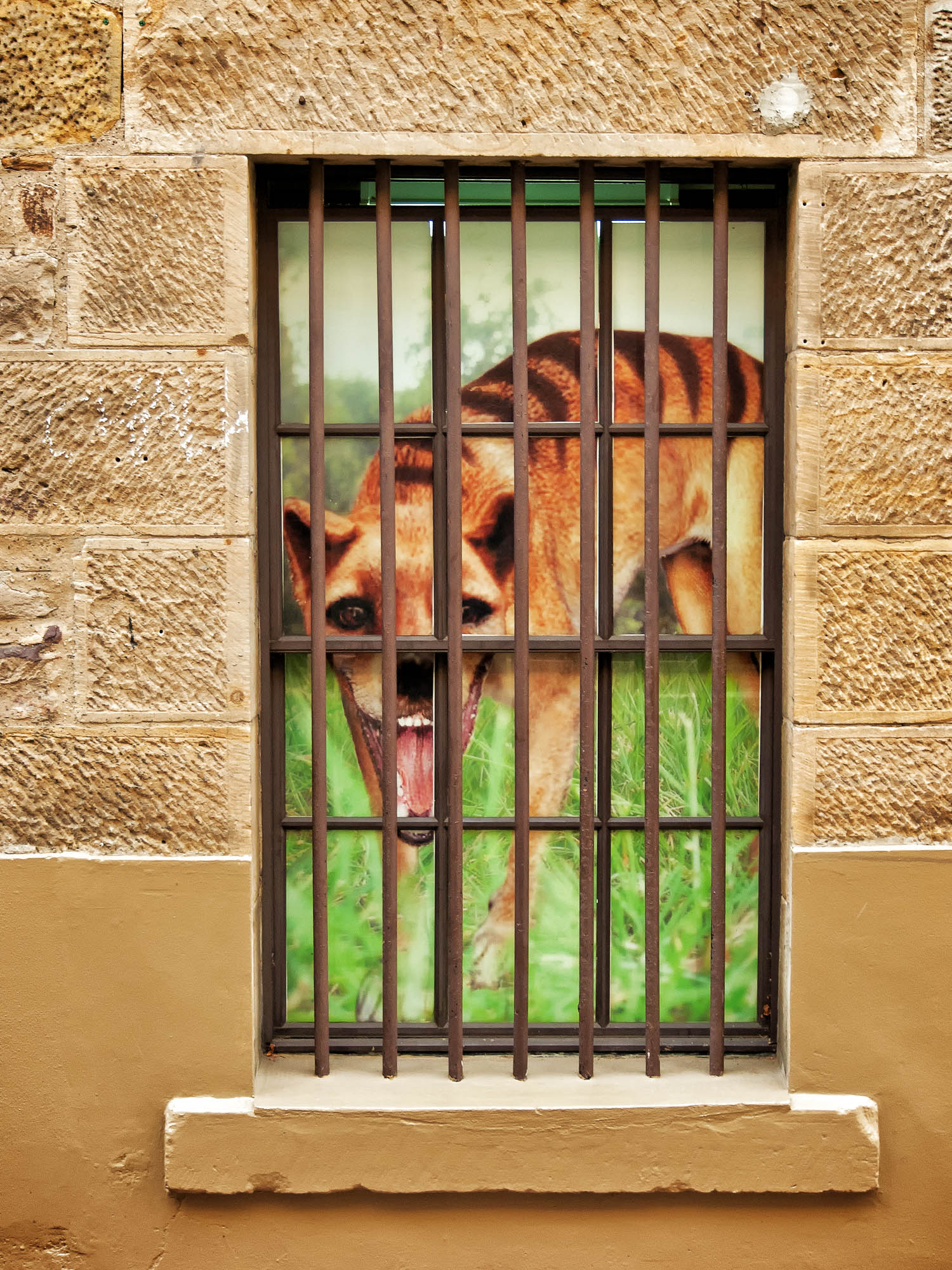
I went to the touristy olde world town of Richmond a little while ago and saw a Tasmanian Tiger or Thylacine. It had been turned into a garden ornament – “gnomified” if you like, just like the Buddha has been.
Tasmanian Tiger, aka the thylacine, spotted in a front garden in Tasmania’s historic town of Richmond.
Tasmanians have a very complicated relationship with the Tassie Tiger. Images of the thylacine can be seen everywhere, it’s on beer labels, the state coat of arms, the coat of arms for Launceston, the logo for Tourism Tasmania. In fact it is everywhere. You might, therefore, come to the conclusion that it is a much-loved animal. In a way it is, but the truth is it wasn’t.
The Tasmanian Tiger roams in Salamanca, Hobart, Tasmania.
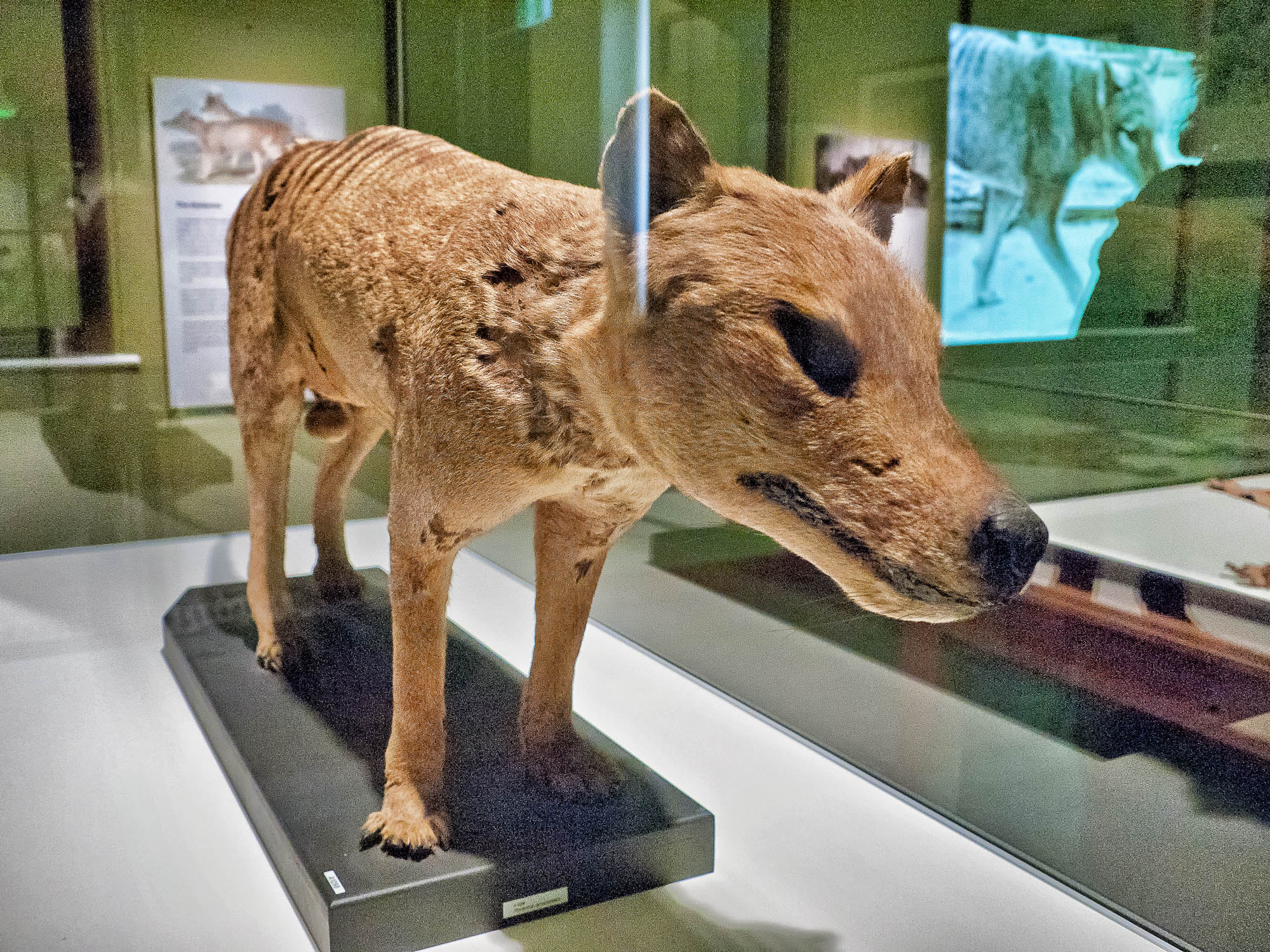
The Thylacine was a shy reclusive animal, the last of its kind – a carnivorous marsupial that was an apex predator and whose relatives went back into the mists of the mammalian era some 5 to 23 million years ago (the Miocene). Computer modelling has shown that the thylacine was not a very strong animal and would have been incapable of handling anything larger than 5Kg and it is now widely believed that they were ambush predators who preyed on small animals such as bandicoots and possums. When the first aboriginal people crossed to the Australian Continent via a land bridge some 40,000 years they brought with them the first dogs, the descendants of what we now call the dingo. The dog was simply a much better and more adaptable predator than the thylacine and by the time British colonisation started they were already extinct on the mainland. When the first settlers in Tasmania saw the thylacine they named it the Tasmanian Tiger or Tasmanian Wolf. There was an apocryphal tale appealing to Victorian gothic drama that can be traced back to just one source that the Thylacine was a blood drinker which preyed on sheep and poultry. That sealed its fate and a bounty was placed upon it and it was hunted vigorously.
A particularly moth eaten stuffed thylacine, or Tasmanian Tiger, in the Tasmanian state museum.
The bounty of £1 for a dead adult and 10 shillings for a dead pup meant that by the 1920’s it was rare to see a thylacine in the wild. In 1930 a farmer by the name of Wilf Batty shot the last wild one. This was bad enough but the tale takes a more tragic turn. In 1933 the Hobart Zoo acquired a thylacine, which was later referred to as Benjamin, which lived there for three years. Inevitably the animal died not of old age but because it was locked out of its shelter on a very cold Tasmanian night. In effect killed by neglect. The last of a species going back millions of years killed because somebody couldn’t be bothered to make sure it was sheltered safely for the night. So after 133 years of settlement, thirty years after a conservation movement was founded seeking its protection and just 59 days after the Tasmanian government signed a conservation order to protect it the last thylacine had died. Optimistically it remained on the endangered list until the 1980’s , but with no confirmed sightings for 50 years it was declared officially extinct.Every now and again there is some crack pot scheme to clone it from DNA harvested from remains in museums, or some millionaire will put a reward for the capture of a live one, but the reality is that the thylacine is long gone because of an indifference to its plight.
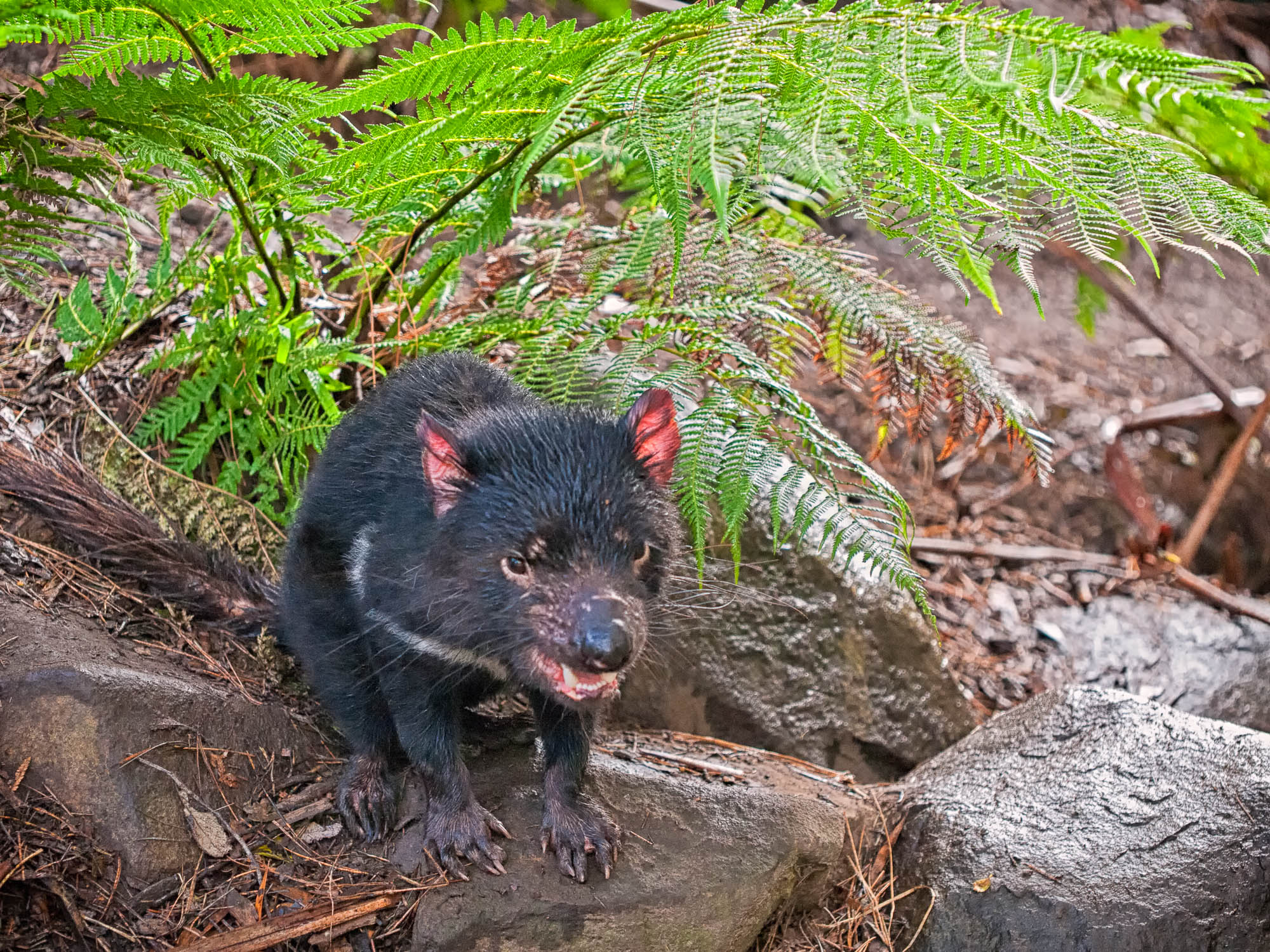
In the mid 1990’s a biologist by the name of Nick Mooney gave an interview to the Hobart Mercury newspaper. Mooney was concerned that the attention the thylacine was getting was diverting the attention away from Tasmania’s other iconic animal – the Tasmanian Devil. He argued that the Devil should be researched and protected. Many people thought that he was barmy as there were more Devils in Tasmania then than at the time of first settlement and farmers were claiming that they were at plague proportions and were a threat to livestock. Fast forward twenty years and the devil is now on the verge of extinction from a combination of devil facial tumour (a transmissible cancer), habitat destruction, traffic fatalities and environmental pollution caused by high levels of flame retardant chemicals found in consumer electronics. These chemicals are banned and were phased out in the 1980’s but their effects are still being felt and it is thought that they play a part in devil facial tumour disease. Because devil populations are declining the gene pool is also diminishing this had laid the Devils very vulnerable to disease.
The devil is an iconic symbol of Tasmania and many organisations, groups and products associated with the state use the animal in their logos. It is seen as an important attractor of tourists to Tasmania.
Today Tasmanians mourn the passing of the thylacine even though there are very few people who are left alive that actually saw one. All that remains are a few preserved specimens in museums, some black and white photos and some grainy film footage. Tourist operators say that the extinction of the devil will severely impact their industry and slowly people are starting to wake up to the fact that the devil is likely to go the same way if something is not done. There has been some research on the on devil facial tumour disease which is fantastic. So is devil saved? Well some scientists believe that the only way for the devil to survive is to quarantine healthy devils in captivity and let the wild population die out. Even if the wild population could survive the current Tasmanian state and Australian Federal governments are working to open up Tasmania’s national parks and world heritage areas to commercial logging. The federal government is also not prepared to fund research into Devil Facial Tumour Disease. So at present your best chance of seeing a Tasmanian devil is either at a zoo, animal sanctuary or dead beside a road. In another twenty years all we could be left with is some video footage and some memories. I would urge every Australian and prospective visitor to Tasmania to write to:
Matthew Groom the Tasmanian minister for the environment
and
Greg Hunt the federal minister for the environment
asking that more funding should be given to ensure the survival of the devil and to ask them not to open the Tasmanian national parks to logging.
They’re not the most loveable of creatures but the world would be a worse place without them.
I had been in Western Australia for 26 years, and to be honest although I hadn’t seen everything in WA things were starting to feel a little stale. Now I’m in Tasmania and everything is brand new. A change in the environment has suddenly got the creative juices flowing.
Yesterday I went unto Woodvine Reserve. It is a farm that has been held by one family since colonial times and has now been gifted to the Crown as a reserve. To me it is interesting to see how nature is reclaiming the land and gradually traces of human settlement are disappearing. The farm building are largely intact as they show the changes that occurred for the owners over the life of the farm. But the fields, the boundary fences, the farm tracks are all being over grown.
The comforting warning sign on the entrance to the reserve.
Woodvine Farm was gifted to the Crown on the condition that it was to be made a reserve in order to protect the animals that lived there. Prior to proclamation, the property had belonged to his family since it was first settled in 1861.
The back garden of the third house to be built on the farm.
Daffodils growing in what used to be the front garden of the second dwelling to be built at Woodvine.
The first building on the farm was this slab timber structure which provided the first home. When a new dwelling was built it was converted into a sheering shed.
Peat soils support wetlands, button grass moorland and fern fields. Woodvine Reserve.
Waxlip orchid (Glossodia major) found in Woodvine Reserve. Tasmania, Australia.
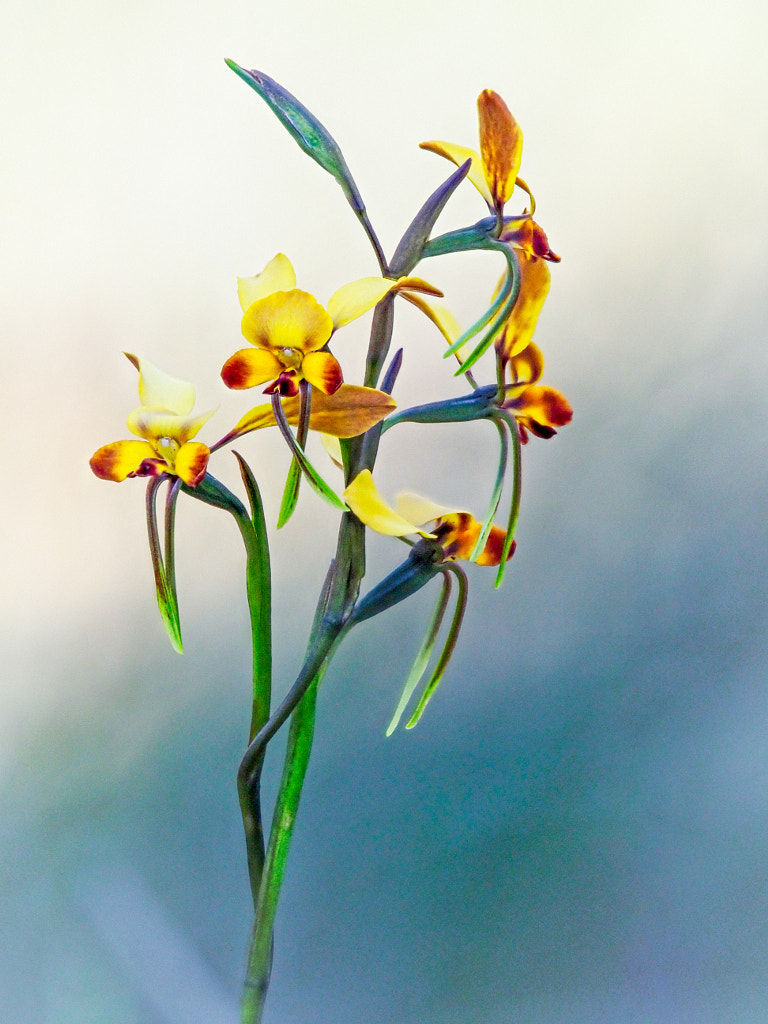
Small Duck Orchid or Paracaleana minor. Also called Caleana minor in some reference books. Woodvine Reserve, Tasmania.







You must be logged in to post a comment.