The Ascent of Mount Trio

Some places get all the attention and others are seldom mentioned. In the Sterling Range National Park everyone concentrates on climbing Bluff Knoll, but there is as I’ve said on previous occasions a lot more than Bluff Knoll. Believe it or not Bluff Knoll is one of the easier climbs in the park. Another one is Mount Trio. Climbing up Bluff Knoll is not a wilderness experience as there are far too many people. With Mount Trio if you see more than two other people its a very busy day.


Mount Trio by Paul Amyes on 500px.com
The sun sets behind Mount Trio in the Stirling Ranges of Western Australia.


The Ascent of Mount Trio by Paul Amyes on 500px.com
Helen at the start of the Mount Trio walking trail in Sterling Range National Park.


Mt Trio comprises three peaks and was once known by its Aboriginal name Warrungup, meaning “three become”. It is 3.7Km to the top and back with an ascent of 418m. The first third of the walk is very steep with irregularly spaced steps. Wildflowers, including the endemic mountain bells (Darwinia leiostyla), are a feature of this walk. Montane thicket on the upper levels of the peaks puts on a colourful display of wildflowers in spring and early summer although we didn’t see this as the area was still recovering from a devastating bushfire and was like walking through a landscape of charcoal sticks. 


The Ascent of Mount Trio by Paul Amyes on 500px.com
The first third of the walk trail is up a steep section with irregularly spaced steps which makes the going quite hard.


The Common Mountain Bell (Darwinia lejostyla) grows in the eastern and central Stirling Range, and can be readily seen on Bluff Knoll and Mount Trio.


Silky Blue Orchid by Paul Amyes on 500px.com
Silky Blue Orchid, Cyanicula sericea. Mount Trio, Western Australia.


The going gets easier once you hit the saddle between the east peak and the north peak. The saddle between the cols is covered in Drumsticks (Kingia australis). These grass trees were often called Black Gin trees, a derogatory racist term now not used. The Nyoongar name for them is Pulonok. The track then follows a more gentle slope to the highest (northern) point at 856 metres. At the summit there is a small cairn of stones which people add to on getting there. From the summit on a clear day you get views of Mt Toolbrunup the second highest peak in the range at 1052m. Then all it is a matter of retracing your footsteps back to the start.


The Ascent of Mount Trio by Paul Amyes on 500px.com
The saddle between the cols is covered in Drumsticks (Kingia australis). The Nyoongar name is Pulonok.


The Ascent of Mount Trio by Paul Amyes on 500px.com
A closer look at some Drumsticks (Kingia australis).


The Ascent of Mount Trio by Paul Amyes on 500px.com
Helen placing another stone on the cairn at the summit of Mount Trio.


The Ascent of Mount Trio by Paul Amyes on 500px.com
Looking out at Mt Toolbrunup from the summit of Mount Trio.


Climbing up was pretty taxing on the legs muscles – all those steps were like a sadistic form of step aerobics. Those steps were even more murderous on the way down. It was the muscles that were complaining this time it was my knee joints. At about 500m from the end my knees announced that they were going to divorce me on the basis of cruelty. Thankfully from this point we could clearly see the car in the car park below us and it spurred us on to one last final effort.

 

Tyger Tyger, burning bright…

Tyger Tyger, burning bright, 
In the forests of the night; 
What immortal hand or eye, 
Could frame thy fearful symmetry?
William Blake 1794 from “Songs of Experience“
Tasmania does not have a monopoly on the thylacine. Many people believe they can be seen in Western Australia’s Blackwood Valley. Nannup is the focus of Thylacine tourism in Western Australia.
William Blake when he wrote his famous poem was thinking of the Bengal Tiger. We have/had tigers in Australia. Well kind of – hmmmm  not really. The Tasmanian tiger or to give it its proper name the thylacine (Thylacinus cynocephalus) once roamed all over Australia. But by the time the island continent was colonised it was restricted to the rain forests of Tasmania. I wrote a blog post about them a while ago. The thylacine is a tourist draw card in Tassie and it has become an icon for the tourist industry, but they don’t have a monopoly on it. Down in the South West corner of Western Australia, in the Blackwood Valley is the sleepy town of Nannup. Many of the locals are convinced that the Thylacine roams the forests in the valley and consequently it is now part of Nannup’s tourism campaign.


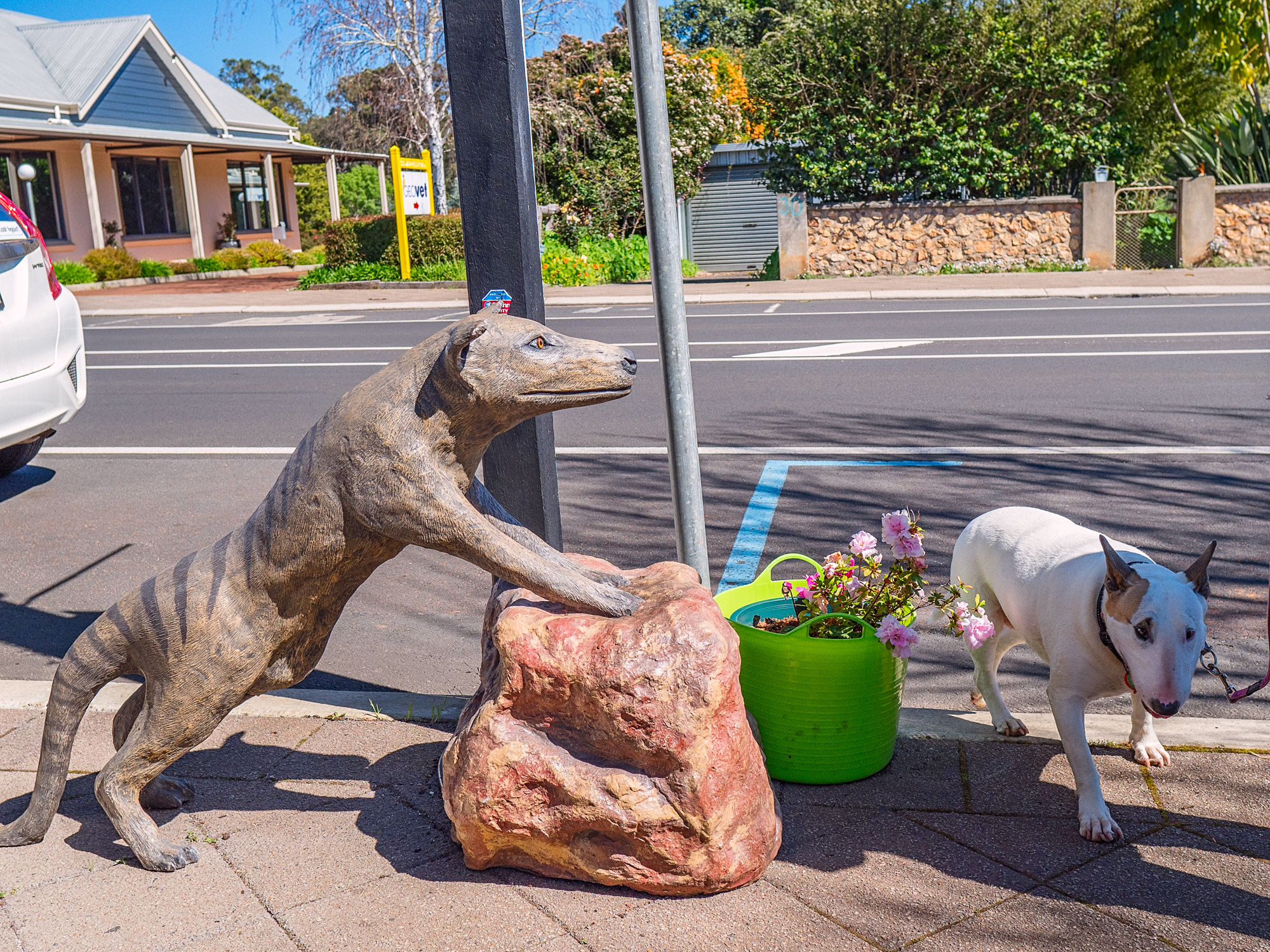
As it would happen we found ourselves in Nannup the other week. We weren’t looking for the tiger, but we certainly found them as we walked up and down the main street. Again like in Tassie the thylacine has been “gnomified” and can be found in front gardens all over the shop.


Frida was none too pleased with her thylacine encounter in Nannup.


It’s not the first time we’d visited the town, but we’d not been for a while and it had changed quite a bit. With the winding down of the forestry industry Nannup is seriously chasing the tourist dollar and the place has been titivated to reflect that. Once you were hard pushed to get a decent coffee now it seems that every other building is a cafe. It presents as a nice up beat place with a friendly vibe.


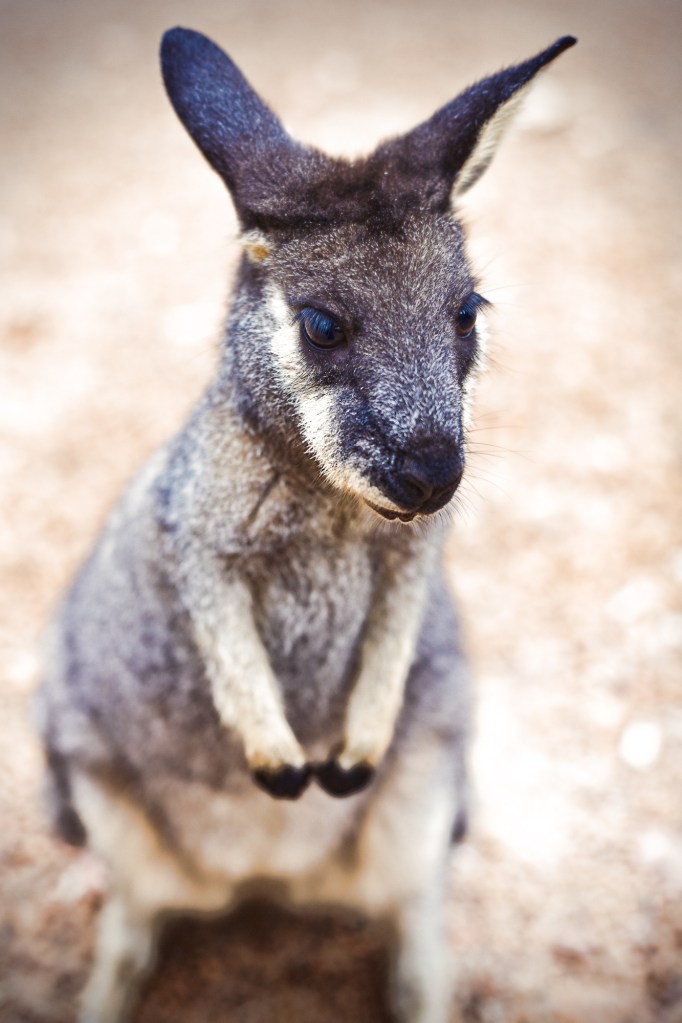
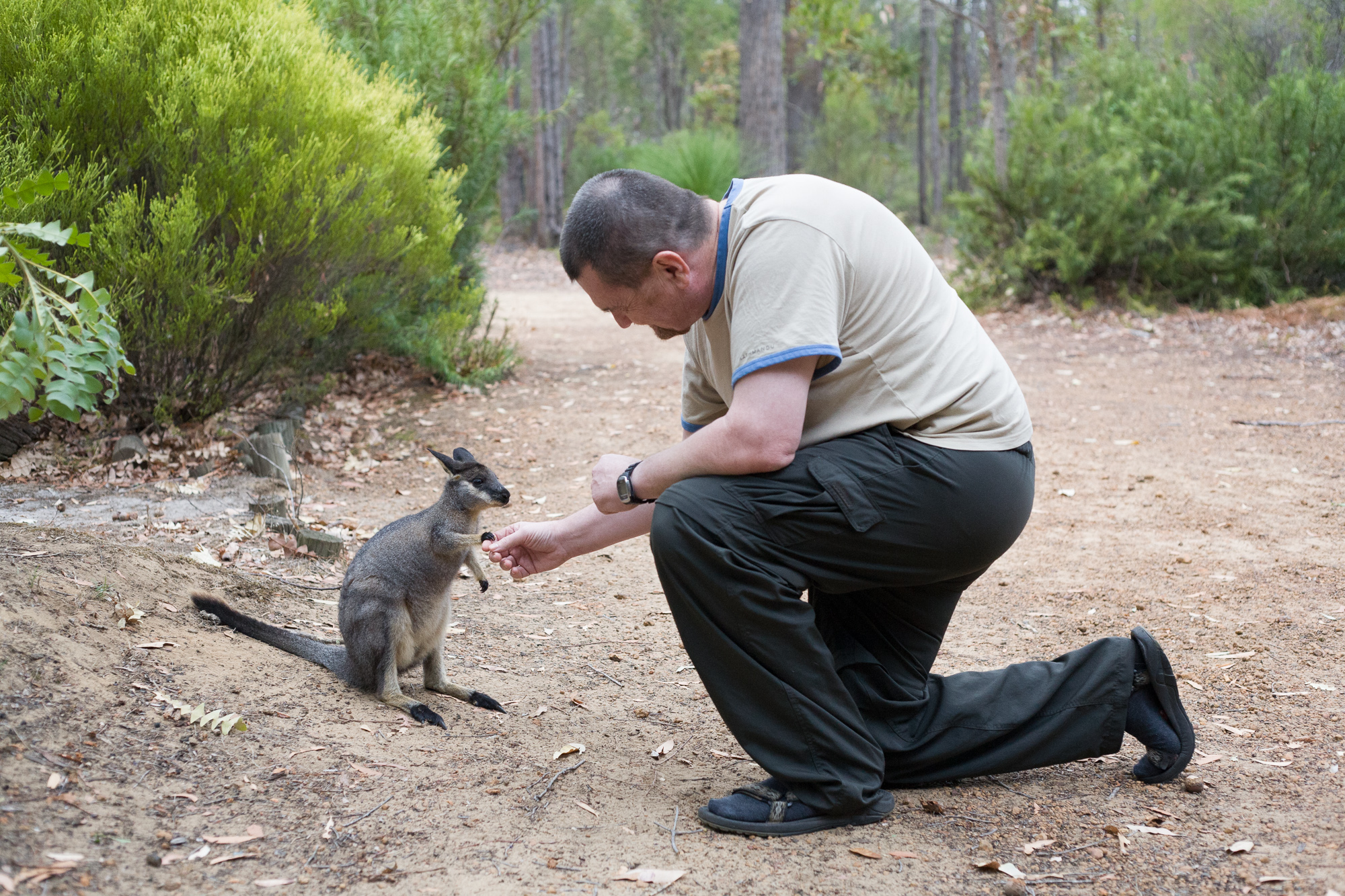
One of the Nannup locals, a Western Brush Wallaby (Macropus irma) also known as the black-gloved wallaby. Nannup, Western Australia.


… and they proved to be very friendly.

Our accommodation was ideally located in the forest and only a stone’s throw from Kondil Wildflower Park. The park consists of new growth forest which contains an incredible diversity of flora. There are three walking trails within the park and I walked two of them. The Woody Pear Walk which is a 1 Km easy walk trail and the the Wildflower Wander which according to the information board is 3.5 Km but according to my GPS is 4.9 Km – either way it’s an easy walk on well sign posted trails.


Below are some of the orchids I found while walking around.


Bird Orchid by Paul Amyes on 500px.com
Bird Orchid, Pterostylis barbata. Nannup, Western Australia. Olympus OMD EM 1 mk ii with Olympus m.Zuiko 60mm f2.8 macro lens. Exposure: 1/125 sec, f4 at ISO 1000.


Leaping Spider Orchid by Paul Amyes on 500px.com
Leaping spider orchid, Caladenia macrostylis. Nannup, Western Australia. Olympus OMD EM 1 mk ii with Olympus m.Zuiko 60mm macro lens. Exposure: 1/60 sec, f8, ISO 3200.


Albino Silky Blue Orchid by Paul Amyes on 500px.com
Albino Silky Blue Orchid, Cyanicula sericea. Nannup, Western Australia. Olympus OMD EM 1 mk ii with Olympus m.Zuiko 60mm macro lens. Exposure: 1/125 sec, f4 at ISO 200.


Silky Blue Orchid by Paul Amyes on 500px.com
Silky Blue Orchid, Cyanicula sericea. Nannup, Western Australia. Olympus OMD EM 1 mk ii with Olympus m.Zuiko 60mm f2.8 macro lens. Exposure: 1/100, f5.6 at ISO 1000.


Warty Hammer Orchid by Paul Amyes on 500px.com
Warty Hammer Orchid, Drakaea livida. Nannup, Western Australia. Olympus OMD EM 1 mk ii with m.Zuiko 60mm f2.8 macro lens. Exposure: 1/30 sec, f8 at ISO 64.