Sex, Lies, and Flowers


It seems like absolutely ages since I last made a post. The break came about because I moved house (yes again!) and as usual Telstra and iiNet cocked the whole re-location up resulting in me being without phone and internet for 6 weeks. Now I have signed up with Optus and I’m the proud owner of a fantastic broadband connection.

So in the last six weeks what have I been up to? Well I’ve definitely not been slacking off I can tell you!  I’m pleased to announce that for the whole of September I will be artist in residence at Beverley Station Arts and I’ll also be showing a body of work entitled “Sex, Lies, and Flowers”. Sex, Lies and Flowers is a project on the terrestrial orchids of the Wheatbelt of Western Australia. The word orchid comes from the Greek “orchis”, which literally means ‘testicle’ (with reference to the shape of its tuber). Orchids are distinguished from other flowers by their uniquely shaped column which is composed of the fused stamens and pistils. Often the petals are modified to mimic the shapes of insects to attract male insects to mate with the faux female and pollinate the flowers. Some of the forms they take also resembles human genitalia Hence the title “Sex, Lies and Flowers”. Over the last eight years I have travelled within the region photographing the plants on location. Instead of taking the standard approach of photographing the plant in its environment showing its full structure I’ve chosen to photograph them in a style more used in portraiture so as to bring out the distinguishing features and characteristics of the plants. The aim is not to produce an exhaustive catalogue of the plants but to produce a series of images that show case the beauty of the plants and raise awareness of them and how fragile they are. Hopefully some of you can pop in and see me and the work, if you are unable then the images from the exhibition and many more can be seen here.

Below is a video clip I made a while ago about photographing orchids in the Avon Valley of Western Australia.

Thanks for your patience everyone and regular programming should now resume.

It’s All New

I had been in Western Australia for 26 years, and to be honest although I hadn’t seen everything in WA things were starting to feel a little stale. Now I’m in Tasmania and everything is brand new. A change in the environment has suddenly got the creative juices flowing.

Yesterday I went unto Woodvine Reserve. It is a farm that has been held by one family since colonial times and has now been gifted to the Crown as a reserve. To me it is interesting to see how nature is reclaiming the land and gradually traces of human settlement are disappearing. The farm building are largely intact as they show the changes that occurred for the owners over the life of the farm. But the fields, the boundary fences, the farm tracks are all being over grown.


Woodvine Reserve
The comforting warning sign on the entrance to the reserve.


Woodvine Reserve
Woodvine Farm was gifted to the Crown on the condition that it was to be made a reserve in order to protect the animals that lived there. Prior to proclamation, the property had belonged to his family since it was first settled in 1861.


Woodvine Reserve
The back garden of the third house to be built on the farm.


Woodvine Reserve
Daffodils growing in what used to be the front garden of the second dwelling to be built at Woodvine.


Woodvine Reserve
The first building on the farm was this slab timber structure which provided the first home. When a new dwelling was built it was converted into a sheering shed.


Woodvine Reserve
Peat soils support wetlands, button grass moorland and fern fields. Woodvine Reserve.


Woodvine Reserve
Waxlip orchid (Glossodia major) found in Woodvine Reserve. Tasmania, Australia.


Small Duck Orchid
Small Duck Orchid or Paracaleana minor. Also called Caleana minor in some reference books. Woodvine Reserve, Tasmania.


Bee-utiful!

Apian Activity. Canon EOS 550d, Sigma 105 f2.8 macro, Canon 430EX Speedlite with Stofen Omni-bounce off camera. Exposure 1/200 s at f/8.0 ISO

This year has been a very busy one for the bees. Despite what the calendars say is the official start of spring in reality here in the Avon Valley it arrived four weeks early this year with everything kicking off. I said in a previous post that most of the orchids were out early, well where there are flowers there are bees and the early start has kept them very busy. Not only have they been very busy feeding and pollinating flowers they have been busy swarming. I’ve never seen so many swarms. In one week I saw four flying around as I took the dog out on her morning walks. One particularly memorable formed in Avon Terrace, which is Yorks main drag, and made its way up the street causing chaos as people tried to avoid it before it settled on a TV aerial on the back of a caravan.

Bee Swarm

The swarm in the picture above was on a blind corner on the river walk trail and I nearly walked into it. As it was I got stung several times on the face. Despite the drama of the swarms I’ve had a lot of fun this spring just photographing the bees in my garden and here are some of the shots that I’ve taken.

Bee gathering pollen on an apricot blossom. Canon EOS 550d Sigma 105mm f2.8 macro with Canon 430EX speedlite fitted with a Stofen Omni-bounce on a flash bracket. Exposure 1/50 s at f/5.6 ISO 200.
Pure Nectar. A bee feeding on the nectar from a bottle brush tree. York, Western Australia. Canon EOS5d, Sigma 105mm f2.8 macro lens, Canon Speedlite 550EX with Stofen Omnibounce on a flash bracket.
Cleared For Landing. Canon EOS5d Sigma 105mm f2.8 macro lens and Canon 550EX speedlite fitted with a Stofen Omni-bounce on a flash bracket. Exposure 1/125 s at f/11.0 ISO 200.

As far as photographic technique goes it is fairly simple. I shot these using a Canon EOS550d or an EOS5d with a Sigma 105mm f2.8 macro lens. I mounted my flash on Custom Brackets Mini-RC with a Stofen Omni-Bounce  as diffuser, and  I connected the flash to the camera via a TTL cable and shot in aperture priority setting -1 stop exposure compensation so that the flash light is the main source as light (or key) and the ambient is the fill.  The High Speed Sync function is also selected. I then select an aperture to give me sufficient depth of field – around f8 or f11. The ISO is set to give me a shutter speed of above 1/100th sec. I don’t worry about the speed of the bees when they move as the flash  freezes the motion with its very short duration. Easy peasy. At this point I should point out that when doing this you should keep your mouth shut as you don’t want to be stung on the tongue and if the bees start getting upset you should back off a bit to allow them to settle. Also if you are allergic to bee stings might I suggest butterflies it may be safer.

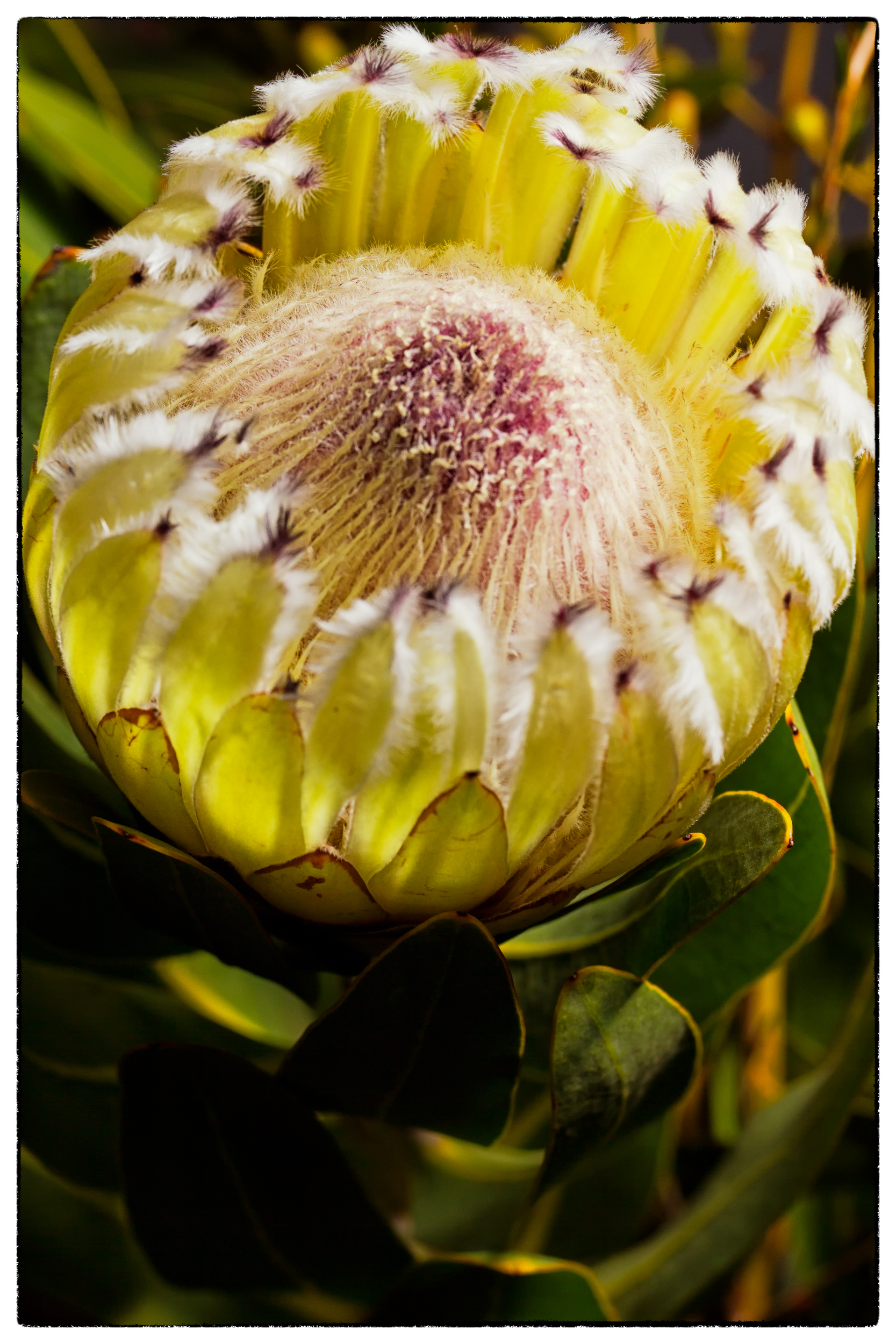
For Mother’s Day…

…a single protea.


A protea flower for Mother’s Day.


Canon EOS 550D, Sigma 105 f2.8 macro lens. 1x Canon 550EX speedlite firing through an umbrella as fill light positioned camera left. 1 x Canon 430EX speedlite firing through a Lumiquest soft box. Both flashes triggered by a Canon ST-E2 with E-TTL. Exposure: 1/200 s at f/8.0 ISO 100 in manual mode with -1 FEC. Lighting ratio 2:1.