Gone Fishing


One of the two bird hides at Samphire Cove Nature Reserve in Westerm Australia.


It’s no secret – summers in the Wheatbelt of Western Australia can be brutal. Most sensible people try to get at least a few days down on the coast as respite. We’re no different and we headed off to the Peel Inlet. Unfortunately the hot weather followed us there so on our first evening desperate to get some evening cool breeze I went looking for Eastern Ospreys at a known nesting site. With no Ospreys to be seen I carried on walking until I got to Samphire Cove Nature Reserve. Just as you go in there is a bird hide – now I’m not a great user of bird hides as I find them very uncomfortable. The observation windows are generally very low down and they have a fixed bench in front of them a bit to far away. This means I end up looking like a pretzel while trying to use them. As I walked closer to the hide to see if there was anything worth photographing I saw a Great Egret (Ardea alba) fishing just a couple of metres in front of the hide. This was going to be tricky – getting into the hide without frightening the bird away as the Great Egret is a very flighty bird. As the bird was quite engrossed in fishing I decided to move while it tried to catch a fish and remain still when it was looking around. It took ten minutes to cover the 25m to the hide. 


Great Egret by Paul Amyes on 500px.com
Missed! Great Egret, Ardea alba. Samphire Cove Nature Reserve, Westerm Australia.


Great Egret by Paul Amyes on 500px.com
Success!


This was the closest I’ve ever been to a Great Egret and it was presenting a problem because my lens was too long. It is very rare that this happens, normally you can’t have too long a lens. The fish were jumping a little further out so the Egret slowly walked out further into the water. I was quite surprised at how many fish the bird was eating. Slowly the sun began to set and just as the last rays of light were hitting the water the Great Egret took off in search of a roost. I’d been there an hour and I’d forgotten the heat and was totally oblivious to the discomfort of using the hide.  A magical experience.


Great Egret by Paul Amyes on 500px.com
Time to go home.


Great Egret by Paul Amyes on 500px.com
Up, up and away.


Golden Morning Light

Wayan by Paul Amyes on 500px.com
Wayan or White-faced Heron (Ardea novaehollandiae) taking in the suns rays. York, Western Australia.


As we approach winter it is now easier to get up before first light as it gets light so much later. On Thursday, which just happened to be my 60th birthday, I got up and head down to the river just getting there as the sun started to rise above the tree line. I was hoping to see some Nankeen Night Heron’s but couldn’t find them, but I did find a strangely cooperative White-faced Heron who was happy to sit on a branch and allow me to get close enough to photography. The bird was looking into the rising sun and the warm glow was reflected off his feathers. The heron looked very majestic just perched there. A wonderful start to the day.


Geat Egret by Paul Amyes on 500px.com
Geat Egret, Ardea alba. York, Western Australia.


Geat Egret by Paul Amyes on 500px.com
Put to flight.


Geat Egret by Paul Amyes on 500px.com
Feeling safer.


Walking up past Monger’s Weir I didn’t see anything more so I decided to head back and grab a coffee at the local bakery. As I was walking back I spied a Great Egret in one of the billabongs beside the main river. We’ve recently had a lot of rain so it was full and the egret was in the cooler shade of the trees while the golden light played on the foliage. Again another magical moment. Although Great Egrets are fairly common along the river it had been ages since I’d last photographed one. Again it was quite happy to let me sit quietly and take its picture. It knew I was there as occasionally it would stare at me as if to say “You still here?”. Eventually a boisterous dog burst through the undergrowth and put the bird to flight. It didn’t fly far – just 10 metres or so to the top of a dead sheaoak tree. By now the sun was well and truly up and we had the most brilliant blue sky so I quickly grabbed some shots of the egret against it.


Djakal-ngakal by Paul Amyes on 500px.com
Playing silly buggers in the trees. Djakal-ngakal or Galah (Cacatua roseicapilla). York, Western Australia


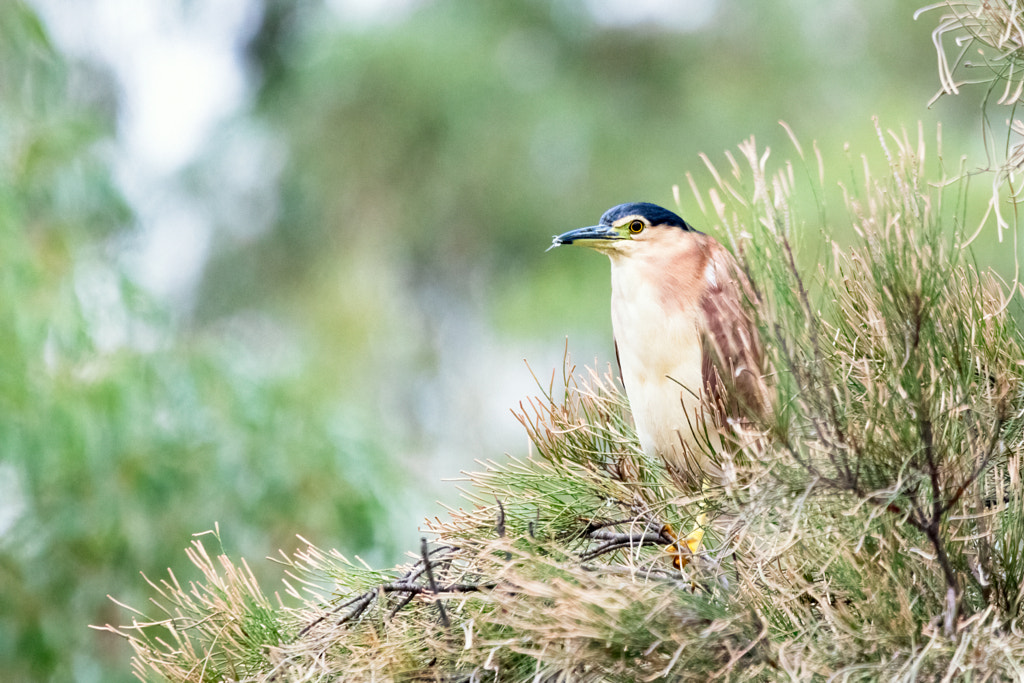
As I got near to the swing bridge to cross over into town some galas were playing around in the trees so I spent the next half hour photographing their antics. After a coffee I walked back to the car and saw four Nankeen Night Herons – three adults and a juvenile – so I grabbed a few shots  of them. A perfect end to a great photo session and a perfect start to a great day.


Ngalkaning by Paul Amyes on 500px.com

A juvenile Nankeen Night Heron, (Nycticorax caledonicus subsp mannillenis). York, Western Australia.


Ngalkaning by Paul Amyes on 500px.com

Ngalkaning or Nankeen Night Heron (Nycticorax caledonicus subsp mannillenis). York, Western Australia.


Ngalkaning by Paul Amyes on 500px.com

Ngalkaning or Nankeen Night Heron (Nycticorax caledonicus subsp mannillenis). York, Western Australia.

Matagarup

What do you do when you have to take your car into Perth to get it serviced but don’t want to hang around in the city and catch COVID? Go on a safari of course!!


My safari took me to Point Fraser and Heirisson Island. Heirisson Island is a small island of 285,600 sq. metres in the Swan River between East Perth and Victoria Park. Most people will know of it through crossing the Causeway which is the bridge over the river. It wasn’t always called Heirisson Island. Long before European explorers and colonists arrived there was a few smaller islands and some mudflats which was called Matagarup by the Beeloo Nyoongar. The name means one leg deep. The first known European visitors were led by Willem de Vlamingh in 1696. He and some of his crew rowed up the river and saw the black swans which led him to name the river the Swan River (Zwaanenrivier in Dutch). They got as far as the mudflats and island and could go no further. In 1801 Nicolas Baudin  from the French ship Le Naturaliste traveled up river and he named the island after his midshipman François-Antoine Boniface Heirisson. Since the early arrivals the river has been dredged and there has been a lot of land reclamation which has seen the mudflats disappear and the formation of the present island.


Yongka by Paul Amyes on 500px.com
Yongka or Western Grey Kangaroo, Macropus fuliginosus. Herrison Island, Western Australia.


There is a footpath round the island which is 2 Km in length which makes it perfect for an inner city safari. As far as the wildlife goes 92 different species of bird have been observed on the island and there is a resident population of Western Grey kangaroos which were introduced in 1998. Funnily enough I’ve walked round the island several times over the years and not seen a single kangaroo. Amazing considering that it’s a small island and they’re relatively large animals. But kangaroos are very good at making themselves scarce during daylight hours. This visit was different I saw three female kangaroos, two lazing around in the bushes and one grazing. In fact the one that was grazing was very curious and came right up to me – I think it was an attempted mugging because as soon as she realised I didn’t have anything worth stealing in the way of food she was off.


Yongka by Paul Amyes on 500px.com
This female checked me out to see what food offerings were available. I was a bit of a disappointment as I had nothing.


I must say it was a very pleasant way to pass the time and I’m looking forward to going again – hopefully to coincide with dawn or dusk.


Koonamit by Paul Amyes on 500px.com

These two welcome swallows were very obliging and let me take their photo.


Black and White by Paul Amyes on 500px.com

The Swan River Cormorants Club does not discriminate on the basis of colour or species – all are welcome.


Djidjinook by Paul Amyes on 500px.com

Not having any chips meant this silver gull just kept flying past.


Straw-necked Ibis by Paul Amyes on 500px.com

Straw-necked Ibis, Threskiornis spinicollis. Herrison Island, Western Australia.


Great Egret by Paul Amyes on 500px.com

Great Egret, Ardea alba modesta. Herrison Island, Western Australia.


Wyan by Paul Amyes on 500px.com

White-faced heron, Ardea novaehollandiae. Point Fraser, Western Australia.


Brown Jellyfish by Paul Amyes on 500px.com

No visit to the Swan River is complete without the ubiquitous Brown Jellyfish (Phyllorhiza punctata).

Mandurah Madness

The recent lock downs for the COVID 19 outbreak had a very strange effect. Living in York we don’t visit the coast very often, but as soon as the Western Australian government said we could leave our region all I wanted to do was go to the coast. I suppose it’s a bit like being on a diet and then spending all day obsessing over food. Well with the lockdown over we put the dog in kennels and headed down to Mandurah for a couple of days to get an oceanic fix.


Now the plan was to spend three days visiting some reserves around, but as Robert Burns once said “The best laid schemes o’ mice an’ men / Gang aft a-gley.”. The first spot we went out to was Lake McLarty, but there was no water in the lake and no birds to be seen. To cap it all the weather was grim – a storm front was closing in. So we decided to cut our losses and head in land to Pinjarra and walk along the Murray River and visit the Edenvale Heritage Tearoom. Well the tearooms were still shut because of COVID so we settled for a walk along the the river.


Eastern Osprey by Paul Amyes on 500px.com

Eastern osprey (Pandion cristatus subs leucocephalus) at Lake McLarty Nature Reserve near Mandurah in Western Australia. Olympus OMD EM1 mk ii with Panasonic Leica 100-400mm lens. Exposure: 1/500, f7.1 ISO 320.


Nankeen Night Heron by Paul Amyes on 500px.com

Nankeen Night Heron, Nycticorax caledonicus subsp mannillenis. Pinjara, Western Australia. Olympus OMD EM 1 mk ii with Panasonic Leica 100-400mm lens. Exposure: 1/500, f6.3, ISO 1600.


Australian Darter by Paul Amyes on 500px.com

A male Australian darter (Anhinga melanogaster subspecies novaehollandiae) aka as the snake bird. Pinjarra, Western Australia. Olympus OMD EM 1 mk ii with Panasonic Leica 100-400mm lens. Exposure: 1/500 sec, f6.3 at ISO 3200.


Paul Amyes taking it easy from the rigours of bird watching on a concrete sofa on the banks of the Murray River in Pinjarra, Western Australia. The sofa is part of the “Take Your Seat Art Project by Fremantle Arts Centre and Alcoa.


The next day the weather was grimmer than the previous day’s. We were wearing enough clothes to make Captain Scott of the Antarctic fame look severely underdressed. The morning’s activities were to be based at the Creery Wetlands Reserve which was only a short way from where we were staying. Although wet and bitterly cold we had more success than the previous day. It is amazing how much wildlife can be packed into a small area just minutes from a city centre. If you are in the area it is well worth visiting, don’t let the fact that the entrance makes it look like an off-shore detention camp put you off. As you cross the bridge you get the feeling a couple of Border Force goons could jump out of the bushes and indefinitely detain you. Once in side you can commune with nature to your hearts content.


Creery Wetlands Nature Reserve by Paul Amyes on 500px.com
The entrance to Creery Wetlands Nature Reserve in Western Australia.


Creery Wetlands Nature Reserve by Paul Amyes on 500px.com
One of the two bird hides at Creery Wetlands Nature Reserve in Western Australia.


Helen bird watching at the Creery Wetlands Nature Reserve, Mandurah, Western Australia.


Pacific Black Duck by Paul Amyes on 500px.com
Pacific black duck, Anas superciliosa. Creery Wetlands Nature Reserve, Western Australia.


Western Gerygone by Paul Amyes on 500px.com
Western Gerygone, Gerygone fusca. Creery Wetland Reserve, Western Australia.


Great Egret In Flight by Paul Amyes on 500px.com
A great egret (Ardea alba modesta) flying over the Creery Wetlands Nature Reserve in Western Australia.


Inland Thornbill by Paul Amyes on 500px.com
Inland Thornbill, Acanthiza apicalis. Creery Wetlands Nature Reserve, Western Australia.


Black Swans by Paul Amyes on 500px.com
Black swans (Cygnus atratus) feeding. Creery Wetlands Reserve, Western Australia.


1080 Poison Risk by Paul Amyes on 500px.com
An eastern osprey, Pandion cristatus subs leucocephalus, perched on a sign warning about 1080 baiting. Creery Wetalnds Nature Reserve, Mandurah, Western Australia.


Western Grey Kangaroo by Paul Amyes on 500px.com
Western Grey Kangaroo, Macropus fuliginosus. Creery Wetlands Nature Reserve, Western Australia.

Birding On The Avon


Like many people at this time I’ve had my movements curtailed. Where I live we are allowed out locally for exercise so I’ve been going out for walks along the river to photograph and video the birds that can be found there. This is the third time I’ve tried to video wildlife and it is very hard.I don’t work from a hide so I have to set up quickly and quietly and often the birds will move on before I can get filming. Shooting mainly just after dawn or just before sunset has meant using high ISOs and made focusing difficult. But, the more you do it the better you get. The purpose of the video was to make something, learn something new and help keep me thinking positive thoughts during this time.

Just out of interest I’ll put the stills up below. They were shot on either a Canon EOS6d with the Sigma 150-600mm f4.5-6.3 Contemporary lens or the Olympus OMD EM1 mk ii with the Panasonic Leica 100-400mm f4-6.3 lens. I wonder if you can tell the difference at web size without enlarging to 100% or checking the EXIF data?

Rufous Whistler by Paul Amyes on 500px.com
A male Rufous Whistler (Pachycephala rufiventris). York, Western Australia.


Laughing by Paul Amyes on 500px.com
Laughing kookaburra, dacelo novaeguineae. York, Western Australia


Yellow Rumped Thornbill by Paul Amyes on 500px.com
Yellow Rumped Thornbill, Acanthiza chrysorrhoa, York, Western Australia.


Yellow-billed Spoonbill by Paul Amyes on 500px.com
Yellow-billed Spoonbill (Platalea flavipes), Avon River, York, Western Australia.


Great Egret by Paul Amyes on 500px.com
Great egret, Ardea alba, feeding on the Avon River. York Western Australia


Tatty Robin by Paul Amyes on 500px.com
Tatty robin. Red-capped Robin (Petroica goodenovii), York, Western Australia.


Brown Honeyeater by Paul Amyes on 500px.com
Brown Honeyeater, Lichmera indistincta, York, Western Australia.


Yellow-billed Spoonbills by Paul Amyes on 500px.com
A pair of Yellow-billed Spoonbill (Platalea flavipes) feeding on the Avon River in York, Western Australia.


Dawn Hunt by Paul Amyes on 500px.com
A great egret (Ardea alba) and a white faced heron (Egretta novaeholladiae) hunting in the early morning light on the bank of the Avon River in York, Western Australia.


Great Egret by Paul Amyes on 500px.com
A great egret (Ardea alba) hunting in the early morning light on the bank of the Avon River in York, Western Australia.


Red-cap Dawn by Paul Amyes on 500px.com
Red-capped Robin (Petroica goodenovii), York, Western Australia.