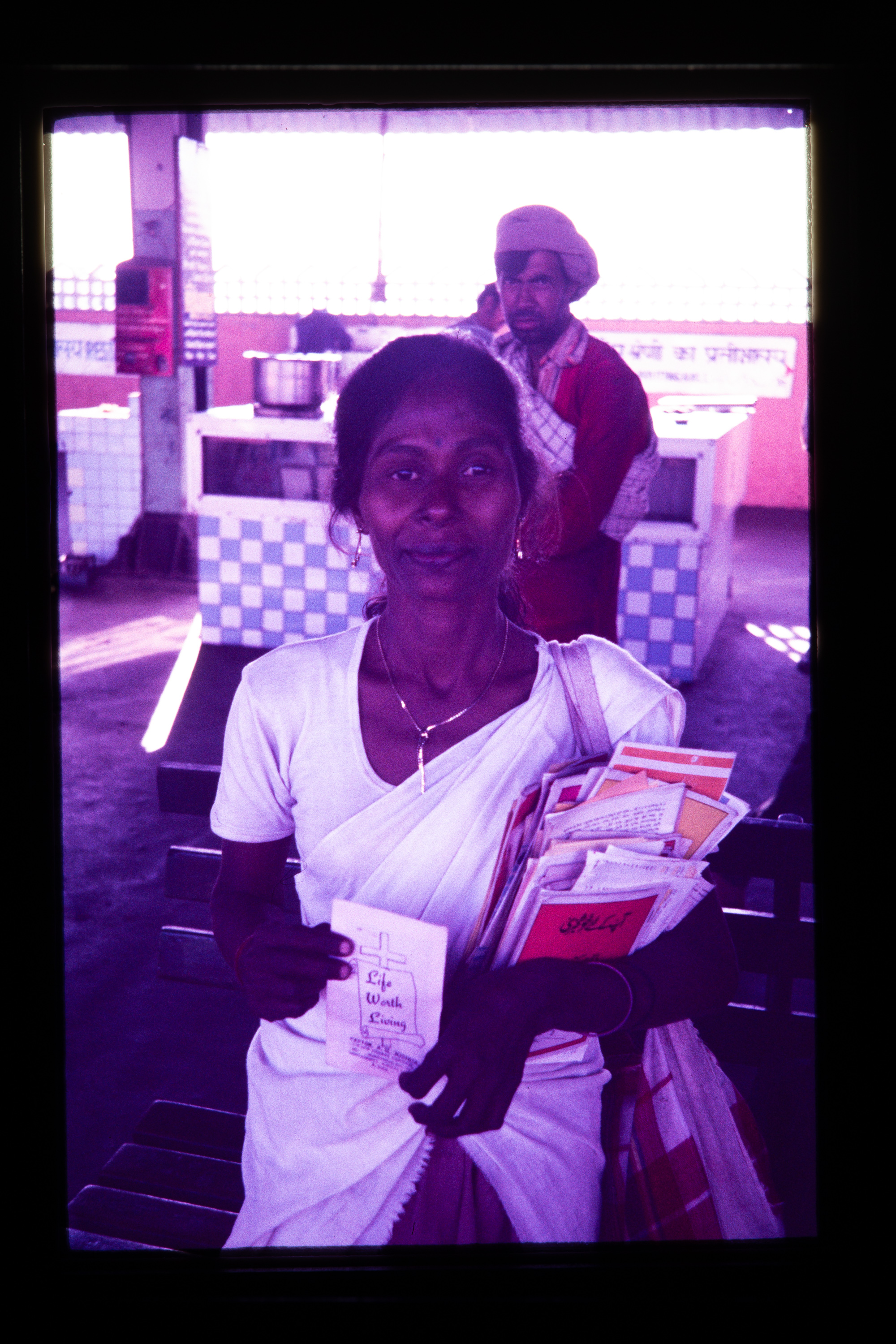
This lady lived on the railway platform at Jammu Railway Station and was a missionary to people using the station. Photo by/courtesy Helen Amyes.
This photo was taken in November 1987. We were travelling around India and Nepal before heading of to Australia to start a new life. If memory serves me correctly we had been staying on a house boat on Dal Lake in Srinagar and we were just leaving to head off to Kathmandu in Nepal. I was quite ill at this stage having gone down with amoebic dysentery and Helen wasn’t well either. We had a long journey ahead of us across the top of India from Srinagar to Jammu by bus and then Jammu to Gorakhpur by train and then finally catch a bus to the Nepali border where we would stay the night. The journey to Jammu Railway Station had left us absolutely wiped out and we were left with some time to kill before our train. While on the platform we met the lady in the photo above. She lived on the platform under a bit of a tarp and she saw herself as a missionary to the people travelling on the railway. We got talking, she was very excited to chat with us – I don’t think many westerns were coming through at the time because there was an ongoing armed insurgency with rebels demanding independence and several tourists had been killed. We’d been in India long enough to know that if you were a westerner you’d be approached for money. What this homeless lady did was offer to help us. She just had the clothes she stood in, a few religious pamphlets and her bedding. Finding out that we had “bad” stomachs she gave us cardamon pods to chew as it is considered to be an aid to digestion in India. The encounter did not last long, but, it has a long lasting effect on us both. We both think about her regularly and often wonder what happened to her.
This is another exercise in camera scanning – this time with colour transparency film. The original image was taken by Helen on her Olympus OM40 with the Olympus OM Zuiko 35-105mm f3.5-4.5 lens. The film stock was Kodak Ektachrome 100. Unfortunately over the last 37 years time has not been kind to the transparency and it has taken on a magenta colour shift and become very muddy. The scan cleaned up nicely in Lightroom with a couple of finishing touches done in Photoshop. This was all done manually. Trying to psych myself up for colour negatives next.
The original scan showing how in the 38 years since I had this film developed it had suffered a significant colour shift. E6 film uses dyes that are notoriously unstable.
Forrestdale Lake (originally Lake Jandakot, it was renamed in 1973) lies within the Forrestdale Lake Nature Reserve which is about 25 kilometres south of the Perth CBD on the southern fringes of the Perth metropolitan area. The lake is shallow and seasonal with a large area 220 to 245 hectares of open water when full. In June or July, Lake Forrestdale starts to fill, and about the end of September, it reaches its maximum depth which is somewhere between 200 and 500mm depending upon the winter rains and it usually dries out by mid-summer. That was not always the case as the lake used to hold a lot more water than it does now, and some years it did not dry up at all. Diminishing rainfall, and ground water extraction from government and private bores are some of the reasons for the lake’s decreasing water levels.
Before white fellas came Lake Forrestdale was a special place for the Whadjuk Nyoongar who camped around its shores and hunted long-necked turtles, waterfowl and their eggs; koonacs and gilgies, possums, kangaroos, quendas and many other animals that are now locally extinct. The first white settlers were William and Alfred Skeet in 1885 and they had a licence to fell and sell timber. Shortly after most of the land around the lake was cleared for farming and grazing despite that the lake continued to be a major breeding site, migration stop-over and semi-permanent drought refuge area for waterbirds so in 1957 the lake was gazetted as an “A” class nature reserve for the conservation of flora and fauna and to provide a location for recreational sailing. On 7 June 1990, along with Thomsons Lake 10 kilometres to the west, it designated under the Ramsar Convention as a wetland of international importance and both lakes form the Forrestdale and Thomsons Lakes Ramsar Site. It’s easy to see why. More than 20,000 waterbirds have been recorded on Forrestdale Lake. It regularly supports more than 1% of the national population of five shorebirds: red-capped plover (with up to 1,300 recorded at any one time), black-winged stilt (3,840), red-necked avocet (1,113), long-toed stint (up to 80), and curlew sandpiper (2,000). In some years it supports more than 10,000 ducks, including Australian shelduck (up to 1,650 counted), Pacific black duck (5,500), grey teal (9,000), Australasian shoveler (2,000), and hardhead (1,053). The lake is one of the few sites in Western Australia where little ringed plover and little stint have been recorded more than once, and it is the only location in the state where white-rumped sandpiper has been recorded. A comprehensive list of all the bird species seen at the reserve can be seen at eBird Australia.
The entyrance to the Forrestdale Lake Nature Reserve.
So when BSO (Beloved Significant Other) announced she was mounting a campaign to achieve croquet world domination I would use the opportunity of a weekend in Perth to have a gander at Forrestdale Lake Nature Reserve. So a quick peruse of the interwebs told me that the best place to start was was at the parking bay at the Skeet Memorial Park on Moore Street in Armadale. There I would find a comprehensive information board about the area and would also give me quick access to the bird observation platform. Having read all about all the different birds that use the lake I was expecting a birding nirvana. Unfortunately we’d had a dry winter and the water line was a good 600m from the platform which meant I had Buckley’s chance of seeing any water birds up close and personal.
The bird observation platform at Forrestdale Lake.
Fall back plan was to walk around the lake and just photograph what I found on the way. Once you leave the main entrance area there is little signage except for the keep out variety which is attached to the continuous fence designed to, funnily enough, keep people out. It was quite a frustrating experience – I could hear plenty of bird activity on the other side of the fence but I had no way of getting closer. For much of the walk you are in a narrow corridor of about 5 or 6 metres between two substantial fences with signs saying you are under surveillance – it’s hardly a nature experience. I’ve been to military bases which are more friendly. I feel this is a hugely wasted opportunity. Thomson’s Lake is much more accessible to visitors, and the Spectacles also makes much of it Aboriginal cultural significance. I’ve written previously that if people are having less and less opportunities to interact with nature that will create an antipathy towards the natural world and consequently they will cease to care about it. So to get people to be more aware of environmental issues they must be encouraged to reconnect with nature. There is very little opportunity for the casual visitor to interact with all that Forrestdale Lake offers so in many ways it defeats its stated purpose of raising public awareness about the importance of this chain of wetlands. Normally I am very positive about these types of reserves and have written about them in the past in glowing terms. I don’t like being negative or critical, but I really do feel that this is a waste of resources.
One of the many signs that warn you about unauthorised access.
The fence that rings the lake preventing unauthorised access.
Big brother is in full surveillance mode at Forrestdale Lake Nature Reserve.
Can I recommend the place as worth a visit? If you want a a bit of a walk with a nature experience then I would suggest that are better places and I’ve written about quite a few of them. If you are a die hard birder then I’d find out what the water levels are before visiting. There is little point in visiting if there is no water in the lake.
Red Wattlebird, Anthochaera carunculata subspecies woodwardi, at Forrestdale Lake Nature Reserve.
White-headed Stilt, Himantopus himantopus subsp. leucocephalus, Forrestdale Lake Nature Reserve.
Grey fantail, Rhipdiura albiscapa, Forrestdale Lake Nature Reserve.
Grey Butcherbird, Cracticus torquatus, Forrestdale Lake Nature Reserve.
Oh and BSO (Beloved Significant Other had a better time of it than I did and achieved world croquet domination – well she won the State Mixed Doubles for Golf Croquet.
2020 Croquetwest GC State Mixed Doubles. Forest Park Croquet Club, Mount Lawley, Western Australia.
2020 Croquetwest GC State Mixed Doubles. Forest Park Croquet Club, Mount Lawley, Western Australia.
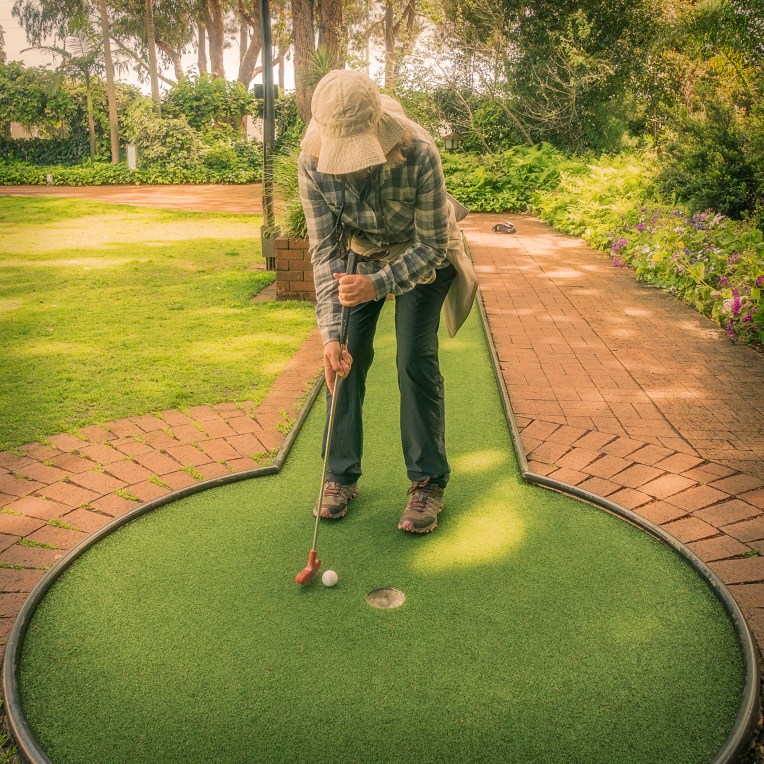
It’s not all beer and skittles at the huge multinational media empire that is Paul Amyes Photography (PAP), but it comes close when we get out to play crazy golf. Last week we managed to sneak off for a game at Wanneroo Botanic Gardens. The aim of the game is to have fun and I took along my Leica D-Lux Type 109 to record the proceedings. It was well suited being small and light and shooting 4K video meant I had some freedom to play around in the edit.
Beloved Significant Other collecting an armful of trophies from Emma Cole, mayor of the City of Vincent, at the recent Croqetwest awards presentation for 2018-9.
Well Beloved Significant Other (BSO) Helen Amyes had a stonker of a year on the croquet front and was invited to attend the Croquetwest 2018-9 trophy presentation. Yours truly was tagging along as the +1 with aim of taking just a couple of photos for her clubs Facebook page. The inevitable happened. Turn up with a camera, couple of lenses and a flash and suddenly you are the “official” photographer and taking the photos for the press and social media. As I’ve said before grip and grin is not my favourite form of photography. There wasn’t a lot of wriggle room for an alternative approach this time so it was pretty basic event photography. At least it was helped along in the form of a jolly jape where fake awards were interspersed with the real ones. Even the recipients were left wondering what they’d actually just won.
Brett McHardy and his partner Janine were winners of Golf Croquet Under Age Doubles. Brett is trying to work out what he’s just won.
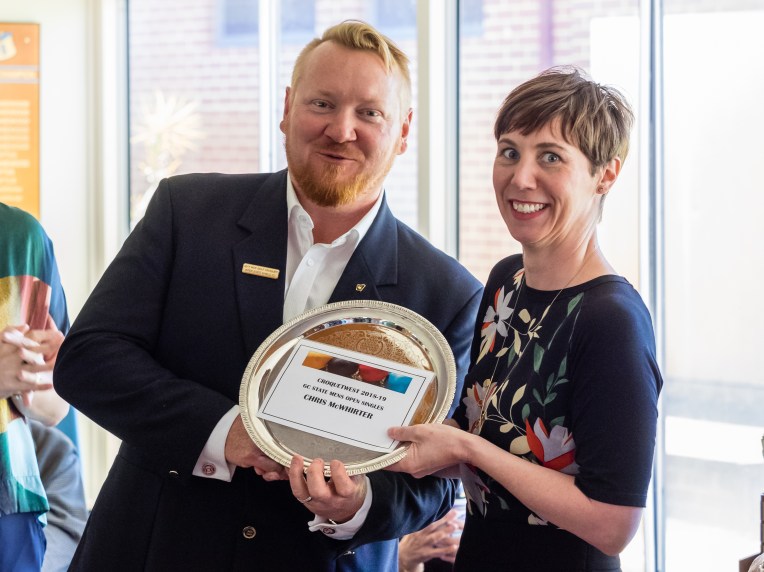
Chris McWhirtter receiving the prize for being the winner of the Golf Croquet open singles from Emma Cole.
Time to promote the achievements of Beloved Significant Other (BSO) via the wonderful medium of video. I didn’t intend to shoot a croquet video. No. I was enlisted as a logistical consultant (alright driver!) to take aforementioned personage and a friend to a croquet competition at the Cambridge Croquet Club. While the event was happening I was going bird watching at the nearby ornithological Mecca of Herdsman Lake with the hope of photographing nankeen herons. Alas the herons didn’t know that I was coming to see them and weren’t at home. Couple this with the fact that I was suffering from a deadly combination of Ebola, typhoid, bubonic plague and cholera (BSO says it was in fact a head cold) I went back to the croquet club to find a quiet corner in which I could drown in snot. Somehow news that BSO had made it to the finals penetrated my fever fuelled delirium and I leapt into action to record the event. I was not really equipped to do so as although I had the Panasonic G85 with me that shoots lovely 4K video I only had two lenses. The Panasonic Leica 100-400mm a great lens for birding but a bit long for court side croquet. The Sigma 16mm f1.4 which is another fantastic lens, but being a fixed focal length not as useful as standard zoom for the grip and grin at the presentations at the end of the tournament. All I can say is thank goodness for the magnificent stabilisation which enabled me to get good handheld footage, although it was defeated by my violent sneezing although it wasn’t as bad as that depicted below.
We decided to walk along the Bilya Walk Track on the banks of the Avon River in Toodyay ostensibly looking for birds. Although it was a fine winter’s day the ground was yes wet, flooded in places, and the river very high from the winter rains.
Helen and Frida out looking for birds along the Avon River.
Gratuitous shot of Frida
The track was flooded in places necessitating some paddling.
A bee pollinating Oxalis pes-caprae. Also known as Bermuda buttercup, African wood-sorrel, Bermuda sorrel, buttercup oxalis, Cape sorrel, English weed, goat’s-foot, sourgrass, soursob and soursop. It is a noxious weed introduced from South Africa to Australia. Toodyay, Western Australia.
Toodyay Stump #1 Tree stump, Toodyay, Western Australia.
Toodyay Stump #2
Knobbly Close up of a tree trunk. Toodyay, Western Australia.
Brown honeyeater, Lichmera indistincta, Toodyay, Western Australia.
Crested pigeon (Ocyphaps lophotes), Toodyay, Western Australia.
Weebill, , Australia’s smallest bird. Toodyay, Western Australia.
White-faced heron (Egretta novaehollandiae) and a western corella (Cacatua pastinator subsp. derbyi), Toodyay, Western Australia.
Next Sunday, the 18th October 2015 to be precise, my wife, Helen, and I are starting to sell fine art cards, prints and other items at Southern Beaches Markets which is held at Okines Community House in Dodges Ferry. The market is held on the third Sunday of every month for the next six months. We hope to see you there. Please feel free to stop by and have a chat.
All the art on sale will be predominantly about this part of Tasmania. More details about Helen’s art practice can be found here and here.
My partner, Helen, has taken up croquet. It is not a sport I know anything about, I had a few preconceptions about it namely that it was played by the pre-senile and involved eating cucumber sandwiches on the lawn and when that got boring you hit a ball around the garden with a large hammer.Well the other weekend the club Helen belongs to, York Croquet Club, had a tournament which attracted players from other parts of Western Australia and Helen entered. To show solidarity I went to watch one of the morning sessions, the promise of morning tea being the incentive, and like the complete camera bore I am I took my camera. This time instead of shooting stills I shot video. In fact this has become the first solely video project I have done.
Has my view of the sport changed. Well the club’s motto is “Old age and treachery will overcome youth and skill!” and watching them play it is very apt. If you do decide to play be warned, those genteel old ladies are merciless, prepare to be humiliated. If you are in the vicinity of York and want to turn up and have a go the club can be found at:
Glebe Street, York. WA 6302 and contacted at croquetyork@gmail.com .
For the technically minded the video was shot on a Canon EOS550d, a Sigma 17-50 f2.8 OS, Canon 70-200 f2.8 IS L, Rode Stereo Mic, and a Zoom H2N audio recorder. The edit was done in Apple’s iMovie.








You must be logged in to post a comment.