I came across a wonderful little piece in the Guardian the other about a photographer whom I’d never heard of before, but on looking at his work I was completely enthralled. The photographer is Raúl Cañibano from Cuba. His work falls into the categories of humanism and surrealism and follows in the traditions of Henri Cartier-Bresson, Elliot Erwitt, Walker Evans, Josef Koudelka and Sebastião Salgado. It is wonderful stuff and I would urge you to have a look at his work and maybe buy his books.
This genre of photography is one that for a number years I really wanted to practice without much success. There is this assumption that it is very easy – all you have to do is walk around and point your camera at everything you see and you’ll end up with “art”. It takes a great deal of dedication, patience and an eye that can spot “a significant moment in the continuous flux of life and captures it in a fraction of a second”. (p 104 Badger, G. 2007 “The Genius of Photography – how photography has changed our lives” Quadrille Publishing Ltd, London). Or to put it another way that nanosecond when all the individual elements of a photograph come together to create meaning. For years I have wanted to take a certain photograph that for me epitomises this ethos. I can see the image in my minds eye, but, I can never manage to make it happen. It is a simple concept but it has eluded me.
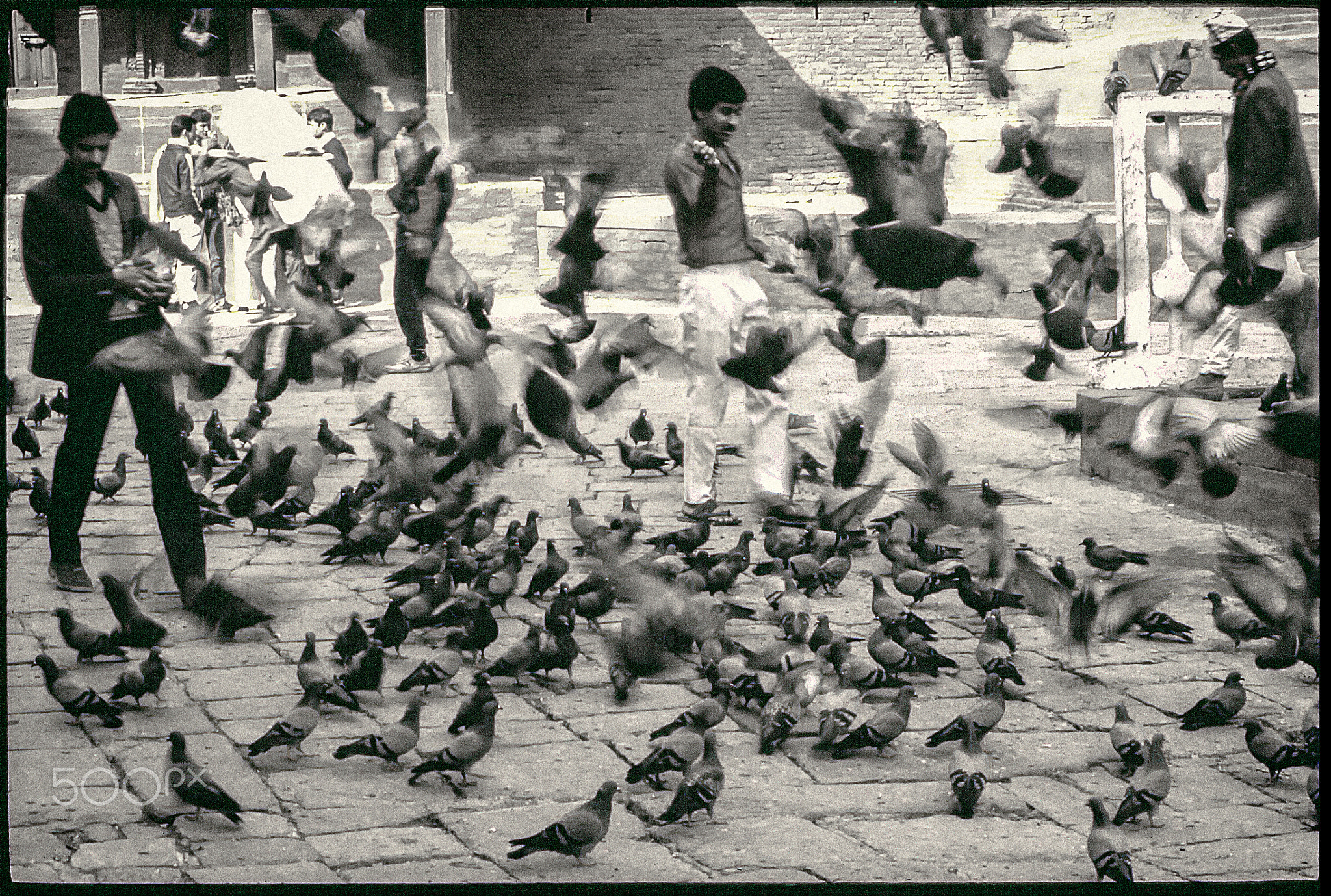
Walking through the feeding pidgeons in Durbar Square Kathmandu. Olympus OM4 with Sigma 75-210 lens, Kodak Ektachrome 100.
The idea is that a person walks into a large flock of pigeons that are feeding on the ground and as they do the birds take flight and we have a photo of a person surrounded by a swirling mass of birds.As I said it is a very simple concept and not original in any shape or form. The occurrence happens frequently yet I just can’t nail it. The best attempt so far is one that I took in Nepal in 1987 (yes it’s been going on that long!). It’s an OK shot on one level, but it is really too cluttered to work. Fast forward to Monday and I was in Perth walking through Forest Place where there was a flock of pigeons feeding on the ground. Suddenly alert to the possibilities I caught out of the corner of my eye a small boy running around in that state of hyper excitement that only small boys can have. I immediately thought that at last it is finally going to happen. So as the little lad approached the birds I quickly framed up and set an appropriate aperture and shutter speed and waited for the decisive moment of the child scattering the flock and them taking flight around him. I could just see the finished photograph. So what happened? Well the little lad did indeed run among the pigeons and they just didn’t react. The whole episode was a tremendous anticlimax. Maybe one day it will happen.
The Kid Among The Pigeons. Forest Place, Perth, Western Australia. Canon 5d with Canon EF 50mm f1.8 ii.
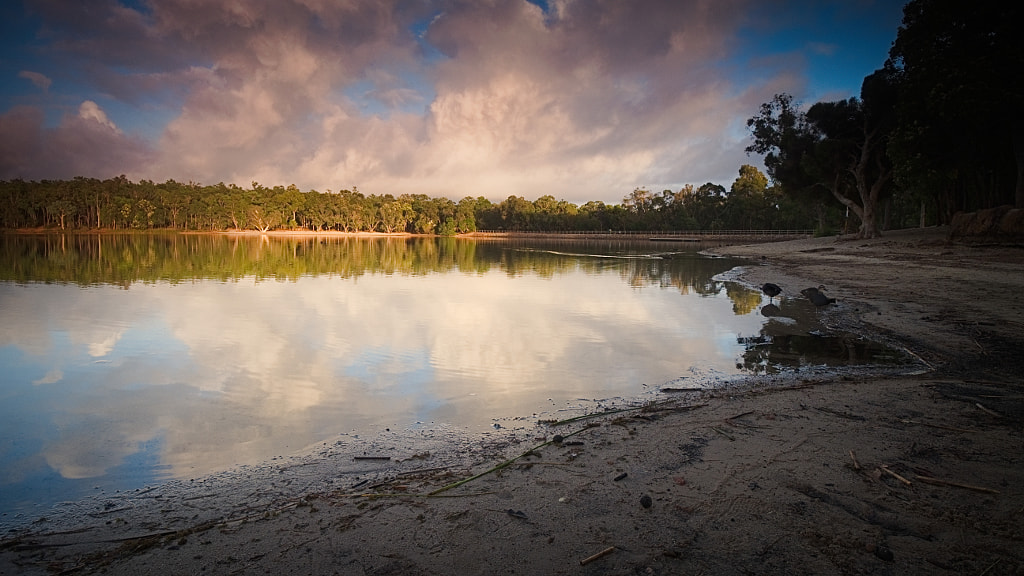
Lake Leschenaultia at sunrise. The glowing rising sun is refected in the trees on the opposite shore.
After the onslaught of the hottest summer ever, which I wrote about in the last post we’ve had a few days of respite with temperature dropping 15ºC to the more manageable mid twenties. All of a sudden it feels like my brain has kicked up a gear.
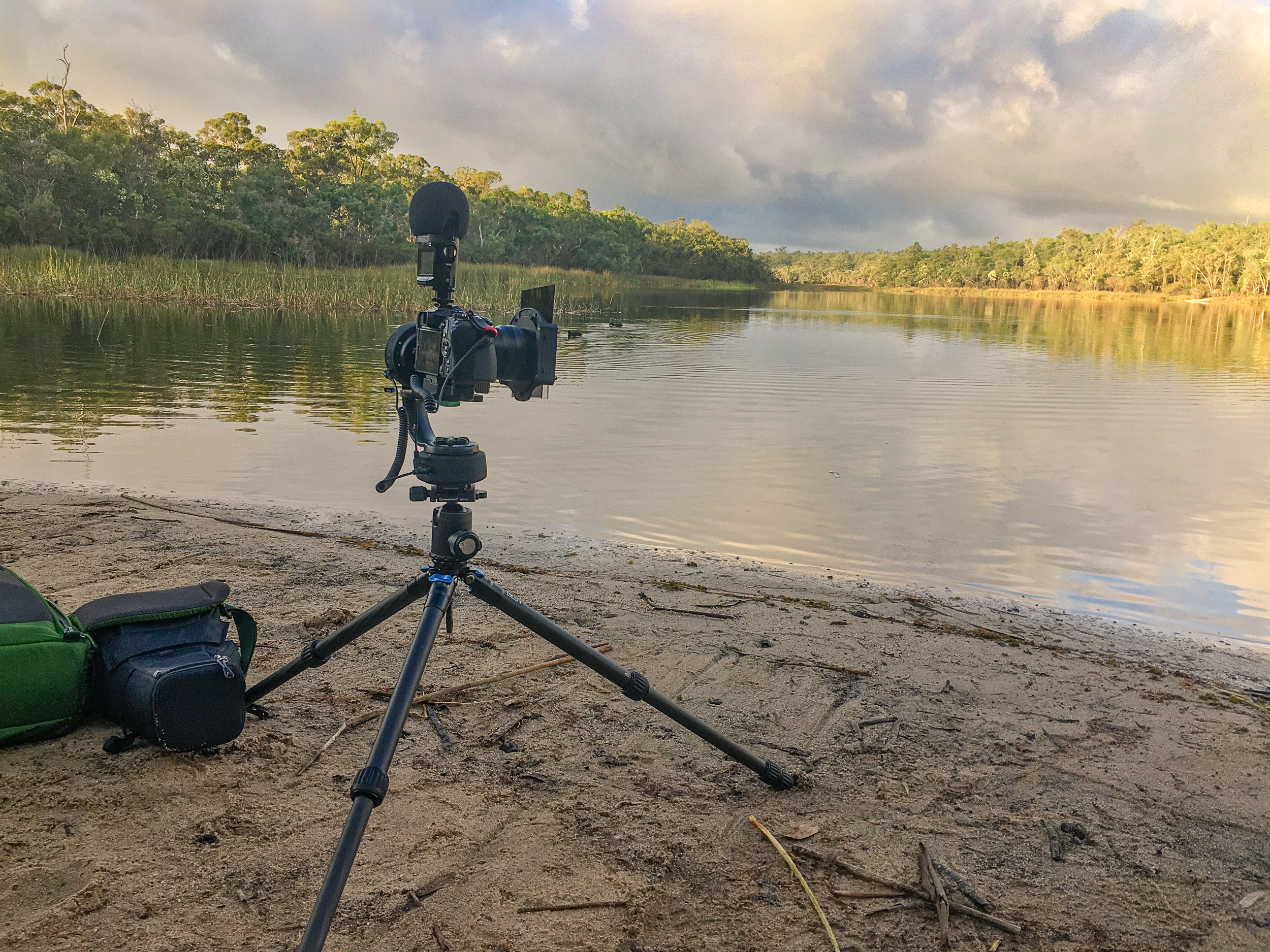
Time lapsing at Lake Leschenaultia in Western Australia.
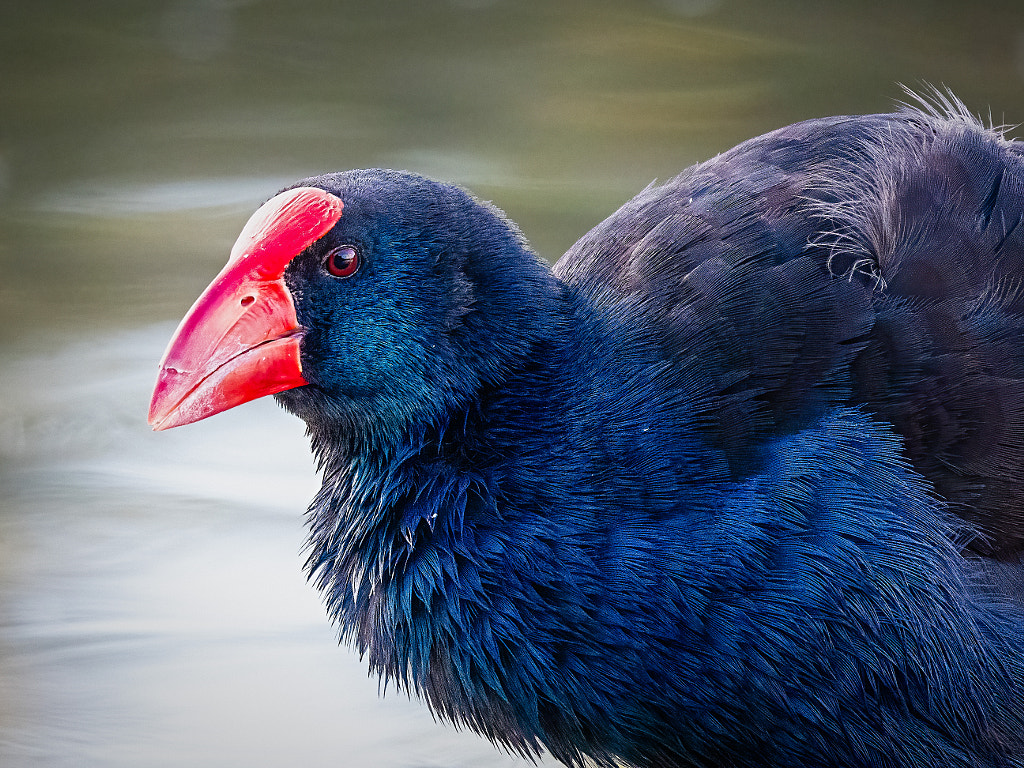
Kwilom or purple swamp hen (Porphyrio porphyrio subsp bellus). Lake Leschenaultia, Western Australia.
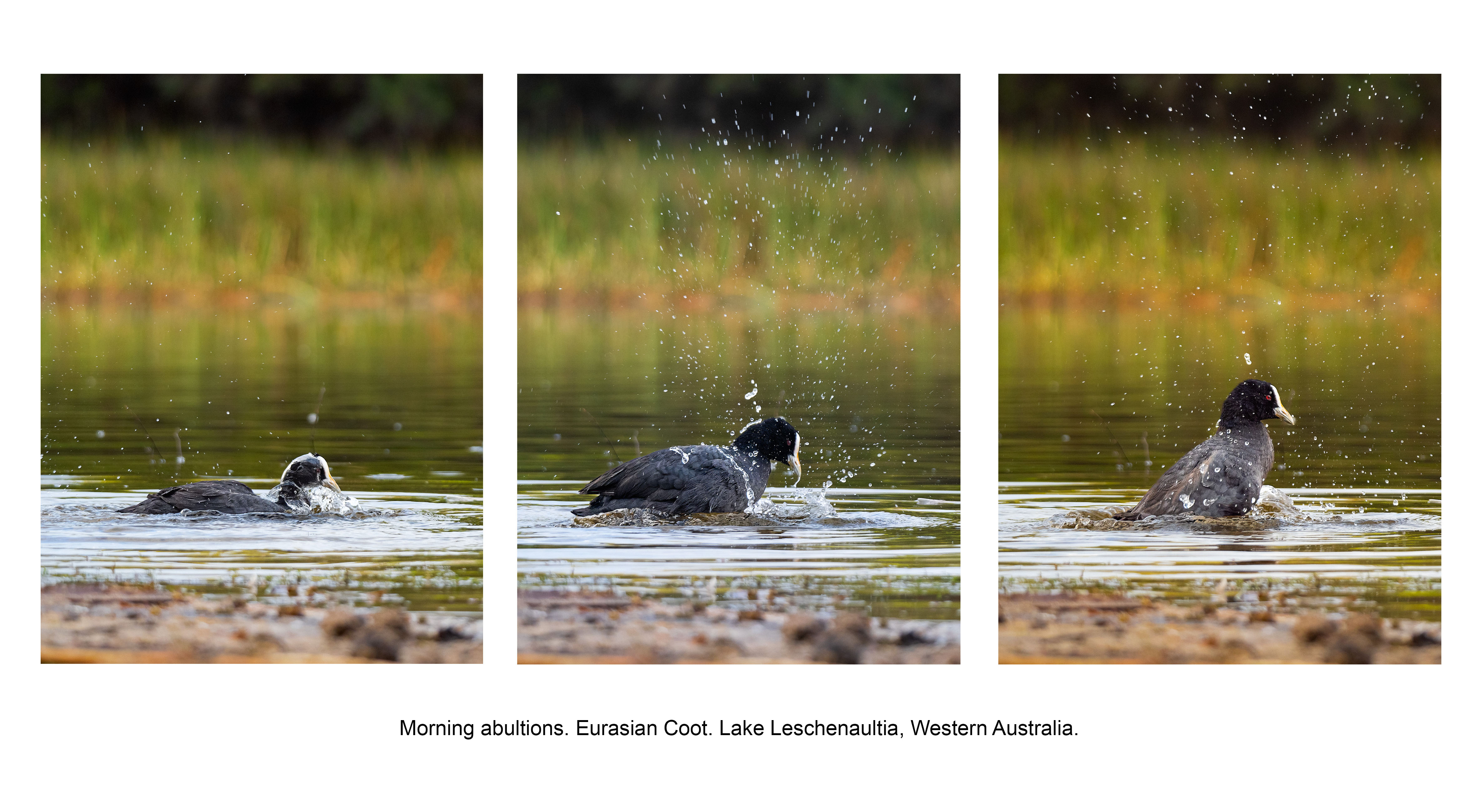
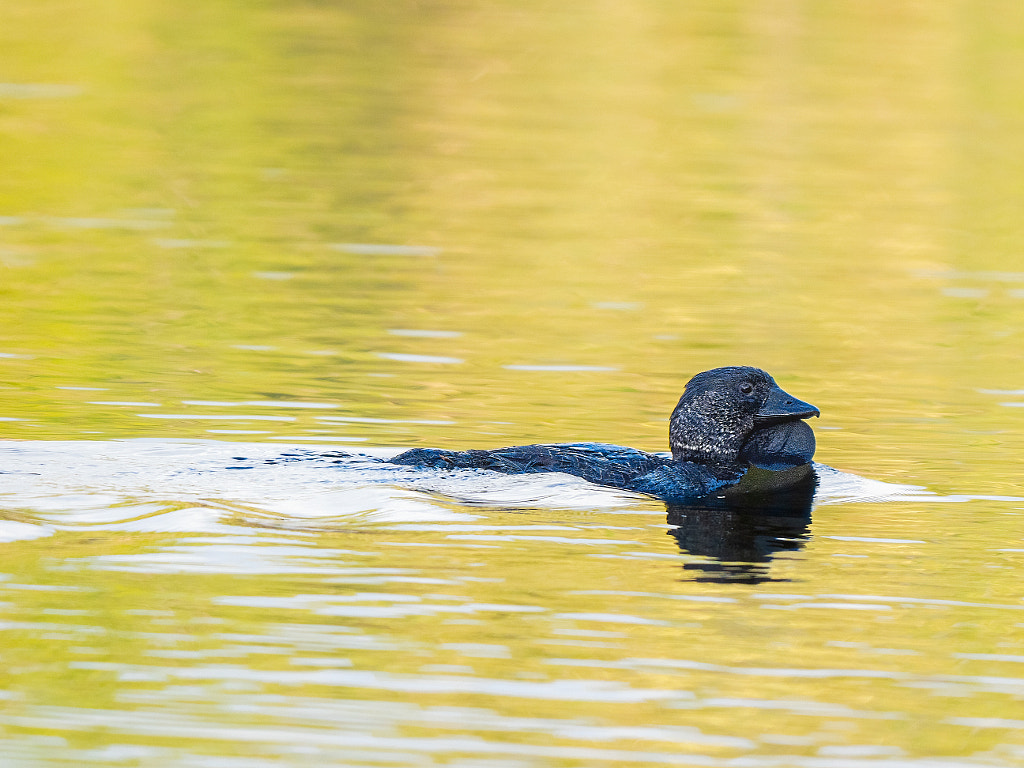
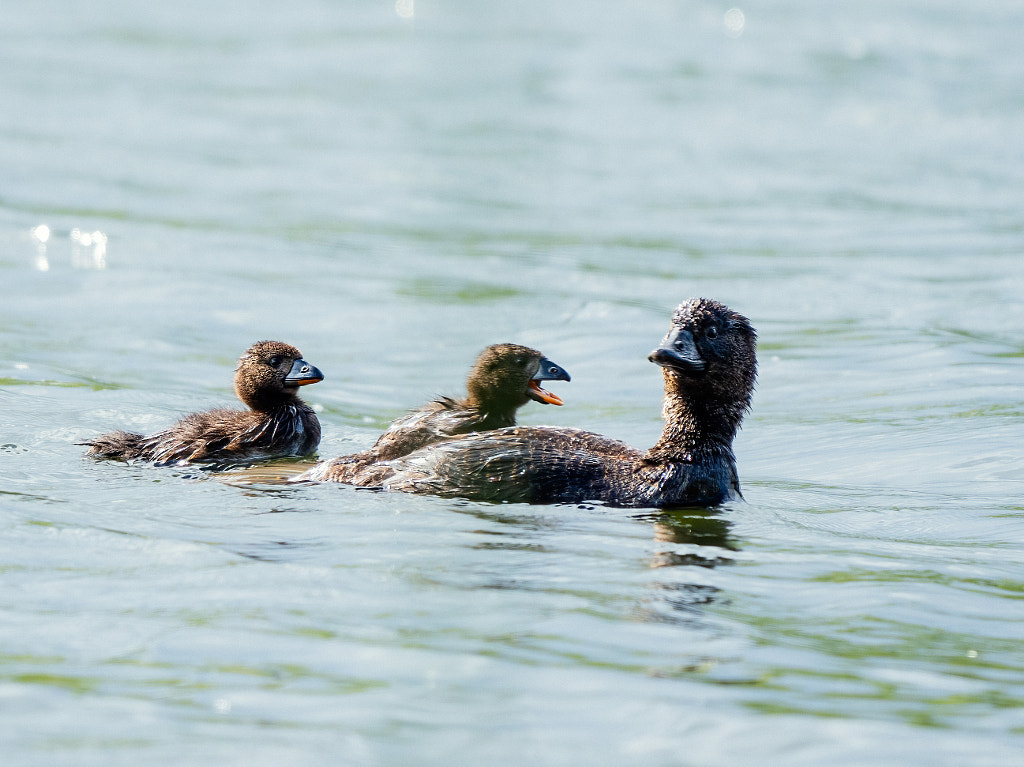
I went out to Lake Leschenaultia at sunrise to film a time lapse sequence for a video I’m working on. While there I decided to take a few pics of the birds I could see while I waited for the time lapse to finish. With the lower temperatures the birds were all a lot more active. When I visited last week a lot of the birds were just sleeping in the shade. The Eurasian Coots were putting on quite a show – preening, feeding, chasing each other. One of them was determined to explore the contents of my bag. The purple swamp hens weren’t very happy to see me on their bit of beach. One of them would walk backwards and forwards in front of me giving me the evil eye. The male musk duck I talked about in the last post came steaming out of the reeds. Man that is a fast duck. A few minutes later I was delighted when a female musk duck came out of the same reed bed with two ducklings in tow. That was a first for me.
A male Kodara or musk duck (Biziura lobata). Lake Leschenaultia, Western Australia.
A female Kodara or musk duck (Biziura lobata) with two ducklings. Lake Leschenaultia, Western Australia.
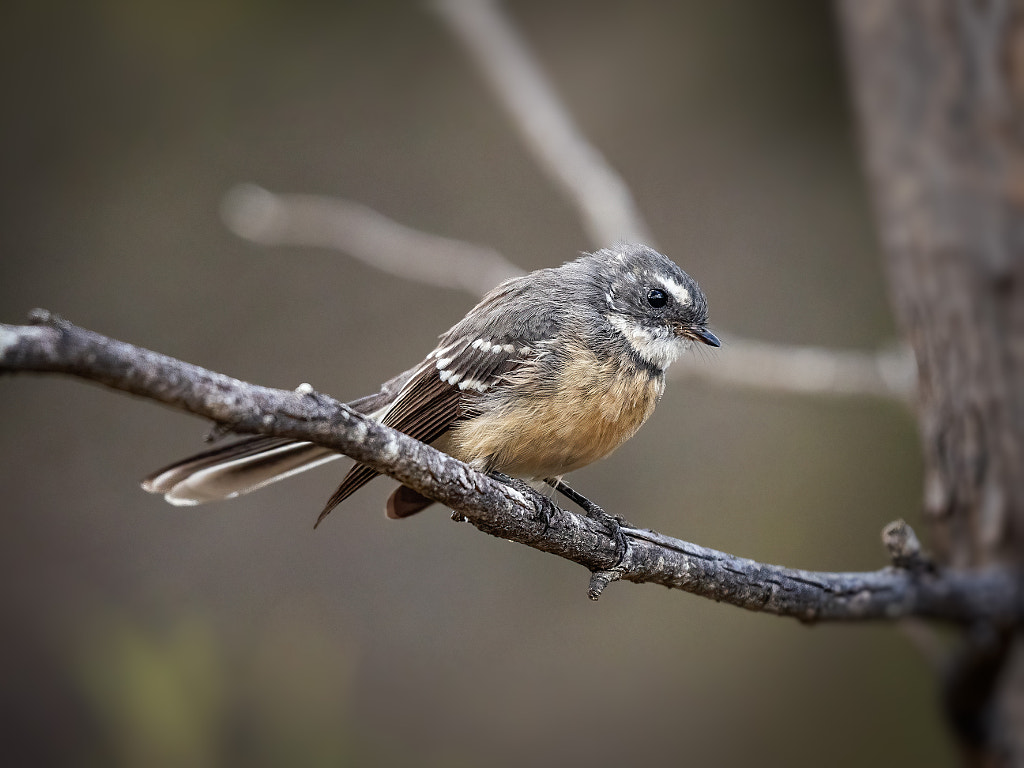
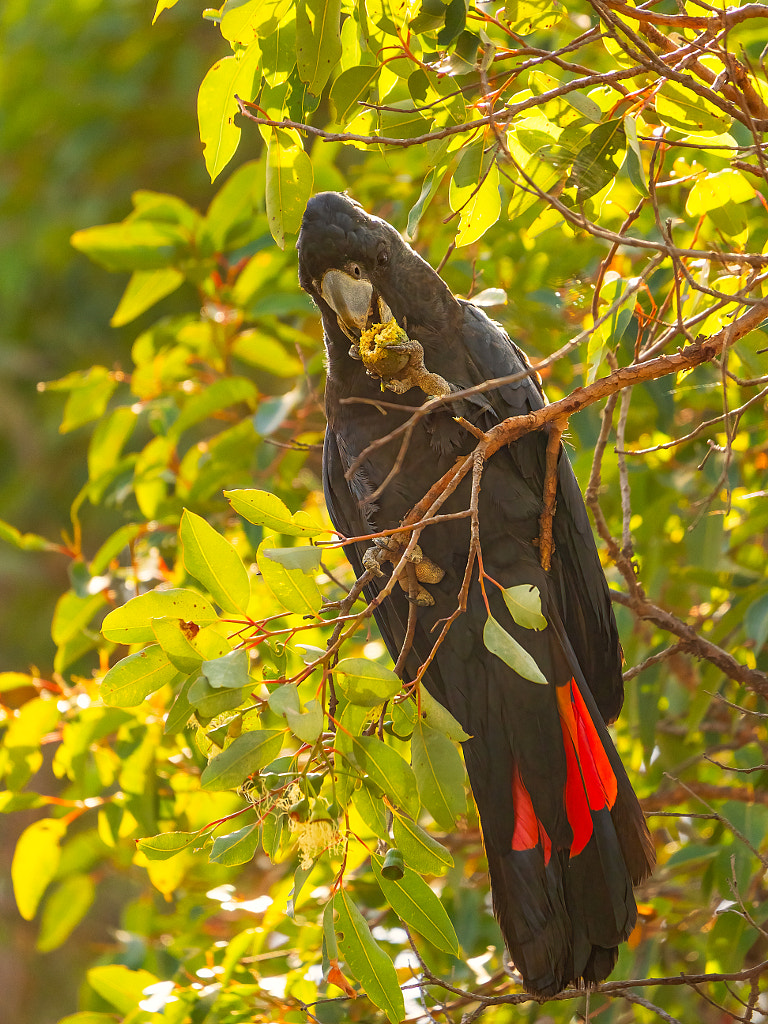
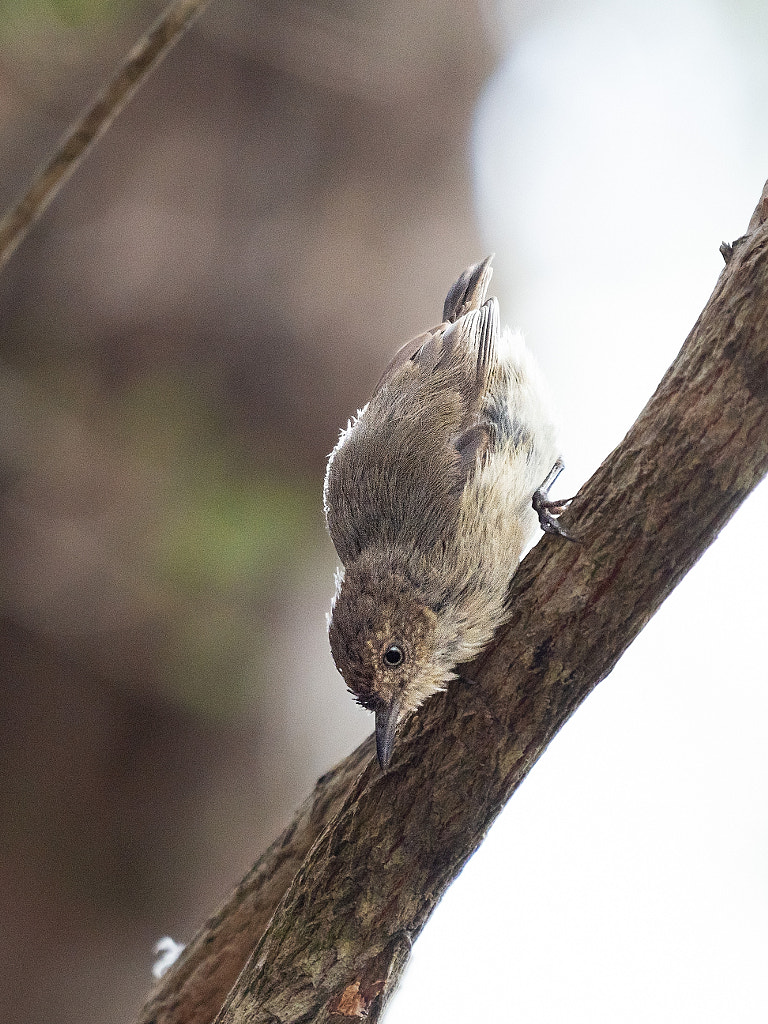
Away from the shoreline and in the trees the passerine birds were very busy looking for food. The grey fantails are a lot like their cousins the willie wagtail in that they just don’t give a stuff about people. They will perch on small branches and give you a good look over. That doesn’t mean they are easy to photograph as they have very short attention spans and don’t sit still for long. They are, however, quite territorial and will often come back to the same perch over and over so that increases your chances of getting a photo. The Western Thornbills are much more erratic and it can be difficult just to get a good look at as they move through the low lying scrub and shrubs. After a while I became aware of a large number of gum nuts dropping from two of the trees in front of me. Looking up I saw half a dozen Red-tailed Black Cockatoos feeding in true parrot fashion. Take a bite out of a fruit, drop it and then get another one. Repeat until you have stripped the tree bare or have had enough, whichever comes first. One of them gave me quite a long look and not for the first time I got the sense that there was a real intelligence behind those little black eyes.
Koodjinok. A juvenile Grey fantail (Rhipidura fuiginosa preissi). Lake Leschenaultia, Western Australia.
Karak or Red-tailed Black Cockatoo (Calyptorhynchus banksii subs samueli) feeding on gum nuts. Lake Leschenaultia, Western Australia.
While at the lake amongst all this wonderful nature it wasn’t hard to feel intensely grateful to have this experience but also a little guilty. Over the course of the last couple of years it seems as if the world has gone to hell in a handcart what with the climate crisis, COVID and now the Russian invasion of the Ukraine with Putin threatening global nuclear annihilation. So what gives me the right to have all this serenity and beauty when elsewhere people are suffering and dying? This sort of thinking isn’t new. Henri Cartier-Bresson the Godfather of socially concerned documentary photographers said of the American fine art photographers Ansel Adams and Edward Weston:
“The world is going to pieces and people like Adams and Weston are photographing rocks!”
(quoted by Adams, Oral History, Univ. of Calif., Berkeley, p. 498)
For Bresson a documentary photograph should deliver the truth and be an agent of social change making life better for all humanity. He felt that Adams’ love of the beauty of nature was sentimental, naive and wasted. So was my being at Lake Leschenaultia taking pretty pictures just self indulgent sentimentalism? Perhaps I should be doing something more useful to try and solve the climate crisis and stop the war in the Ukraine. I could take the defence that Ansel Adams took when he made the address “The Role Of The Artist In Conservation” where he said:
“I believe the approach of the artist and the approach of the environmentalist are fairly close in that both are, to a rather impressive degree, concerned with the ‘affirmation of life’….Response to natural beauty is one of the foundations of the environmental movement.”
I can say that I do through my books and photos hope that people will become more interested in the environmentand look to protect and conserve it. But I’m aware that what I do is very small. Adams had access to the presidents of the United Staes, millionaire philanthropists and captains of industry. So if I’m not influencing the opinions of the great and the good should I still be out taking pretty pictures?
Djoboldjobol or Western Thornbill (Acanthiza inornata). Lake Leschenaultia, Western Australia.
The last week or so I’ve been reading ‘Journeys In The Wild – the secret life of a camera man’ by Gavin Thurston. Thurston is a film cameraman and director of photography who has worked on many of the BBC’s David Attenborough documentaries amongst other things. An interesting read about what really happens behind the scenes when those programs are made. Thurston admits that even taking into account all the difficulties and the missing out on family life he has been extremely privileged to have seen what he has seen. He recounts of how he was filming for the ‘Trial of Life’ series during the civil unrest in Panama. After a particularly dangerous drive out to the rainforest where they could have easily been killed by Panamanian Defence Force he’s out filming stingless bees when he realises:
“Nature and its beauty and complexity is an easy diversion from the rigours of human turmoil.”
I find that being in nature is a way to re-establish calm in my life. So I could sit at home and become fearful and anxious about what is happening in the world, but what does that achieve? Going out to spend time in the natural world and allowing myself to be totally immersed in that world brings about calmness, joy and an appreciation of life. It recalibrates my thinking. So as an act of self care spending a morning watching the sunrise at Lake Leschenaultia and enjoying the antics of the animals around me was very important.
“I’m out of here”. Kidjibroon or Eurasian Coot (Fulica atra). Lake Leschenaultia, Western Australia.
“F8 and be there” is the old maxim of press photographers. It means basically turn up and get a picture. An aperture of f8 would be in the sweet spot of the lenses performance and would guarantee a sharp contrasty image if you found the focus. I’ve been thinking quite a bit about focusing and optimum sharpness of late.
A portrait of my BSO (Beloved Significant Other) not taken on the Sony A7 iv.
What is acceptable sharpness? What is an acceptable in focus hit rate with an autofocus camera? Why do some manufacturers have a reputation for excellent AF performance (Canon’s dual pixel technology) and some seem to be the bench mark for woeful autofocus (Panasonic’s DFD contrast based system)? I grew up with manual focus cameras and with them any failings were down to the operator. I remember getting my first AF camera – a Pentax SFX. The AF was slow really slow, glaciers move faster, and the noise of the motor made people stop and stare. I got rid of it quick smart and went back to using my manual focus Olympus SLRs up until 2004. It was the development of autofocus cameras in the 1980’s that saw photography as a hobby become more mainstream as out of focus photos were one of the things that put people off.
This thinking about autofocus came about becauseI’ve been reading and watching reviews about the Sony A7 iv *. There seems to be a vocal few criticising its auto focus performance in a very specific usage scenario. The users are using eye detect auto focus on a moving person with fast lenses such as the Sony 135mm f1.8 wide open at a distance of 2m or more. The complaint being that the camera only hits focus on the iris around 70% of the time and the rest of the time front focuses on the eye lashes. Let’s unpack this. The camera is ONLY achieving a 70% hit rate. Hells bells and buckets of blood! My Canon 5d and 6d couldn’t do that. When I use manual focus I couldn’t do that. I had enough trouble accurately focusing quickly with my Olympus OM Zuiko 135mm f2.8 wide open. Mind you those old 135mm f2.8 lenses were often a bit soft wide open. It is staggering to me that firstly you’ve got a 135mm f1.8 lens that is tack sharp wide open and then you can combine it with a camera that is able to focus on the iris of a moving person at 2m with a 70 % success rate. Let’s look at this problem from another direction. Now according to the DOF calculator on Cambridge in Colour the DOF with that combination is 2cm. That means 1cm in front of the eye and 1 cm behind. That would mean that the eye would be in focus but the nose and ears would be blurred. Even if you used an aperture of f4 which 2 1/3 stops more DOF you still only have 5cm DOF. An aperture of f8 would give a DOF of 11cm which is sufficient to render a human head acceptably sharp. Why would you want to take a portrait where only the iris is in focus? The craze for taking photos with razor this depth of field has been with up for about 20 years now and the only reason I can why it endures is that it signifies status – the photographer has the ability to own very fast and expensive lenses.
Wolf Lane in Perth, Western Australia.
Two of the Twentieth Century’s photographic titans had some things to say about sharpness. In 1998 at age 90 Henri Cartier-Bresson said to Helmut Newton: “sharpness is a bourgeois concept.”** For Bresson content and concept were everything and if you look at his images you can see some of them are a little soft. On the other side of the Atlantic in the United States Ansel Adams famously said “There is nothing worse than a sharp image of a fuzzy concept”. So for Adams who sought technical perfection on every level in his photographs saw that intention and content were more important. So focus and sharpness like many other facets of photography are secondary – they play a supportive role but are not the primary consideration.
The photos accompanying this piece were taken with a camera that does not have a lens. It is a 4×5 pinhole camera with a focal length of 150mm and an aperture of f256 which when using Ilford FP4 developed in Ilfosol 3 gives an amazing amount of detail and clarity considering that no lenses are involved. I like to think that it is my anti technology camera. No lens, no focusing, no shutter mechanism, no film advance, no metering, no viewfinder. A successful picture required a great deal of serendipity and that is part of its charm.
My 4×5 pinhole camera with a focal length of 150mm and an aperture of f256. I like to think that it is my anti technology camera.
* Not getting one and the reason has nothing to do with the autofocus issue and everything to do with the weight of bag with camera, 28-70mm f2.8, 105mm f2.8 macro, 35mm f2.8, 20mm f2.8, 150-600mm f5-6.3 and ring flash.
** I had a student who said that Bresson himself was a bourgeois concept.
I have a long and complicated relationship with street photography and I want to try and articulate that here. Wikipedia defines street photography as “photography conducted for art or enquiry that features unmediated chance encounters and random incidents within public spaces”. It does not have tohave people as the subject matter, but most of it does. The history of street photography is really tied to the technology of photography – once cameras and film became portable and quick to use then people started taking photos of the things that were happening around them. The genre really started in the inter war period, but it was the end of the Second World War that really kick started it. World War Two had seen death and destruction carried out on an enormous industrial scale – the methods of modern mass production lines had been used to exterminate millions of people. The American-Luxenbourgish photographer Edward Steichen, who at the time was the director of photography at the Museum of Modern Art (MOMA) in New York, decided to curate an exhibition based upon the universality of the human experience as a counter to the war. Dorothea Lange, a leading light in photographic reportage, assisted Steichen in his project and on January 16, 1953 she sent out a recruitment letter to photographers asking them to “show Man to Man across the world. Here we hope to reveal by visual images Man’s dreams and aspirations, his strength, his despair under evil. If photography can bring these things to life, this exhibition will be created in a spirit of passionate and devoted faith in Man.”. In all 273 photographers from 68 countries contributed 503 photos. The exhibition opened at MOMA on January 24 1955 and then went on to tour the world for eight years making stops in thirty-seven countries on six continents. More than 9 million people viewed the exhibit, which is still in excess of the largest audience for any photographic exhibition since. The book from the exhibition has never been out of print and has sold more than 4 million copies. The impact was colossal – it exposed people to the idea of looking at photos of people doing the things that make us human and encouraged them to make their own photos.
Studio 798 East meets west. Coke and tagging in Beijing.
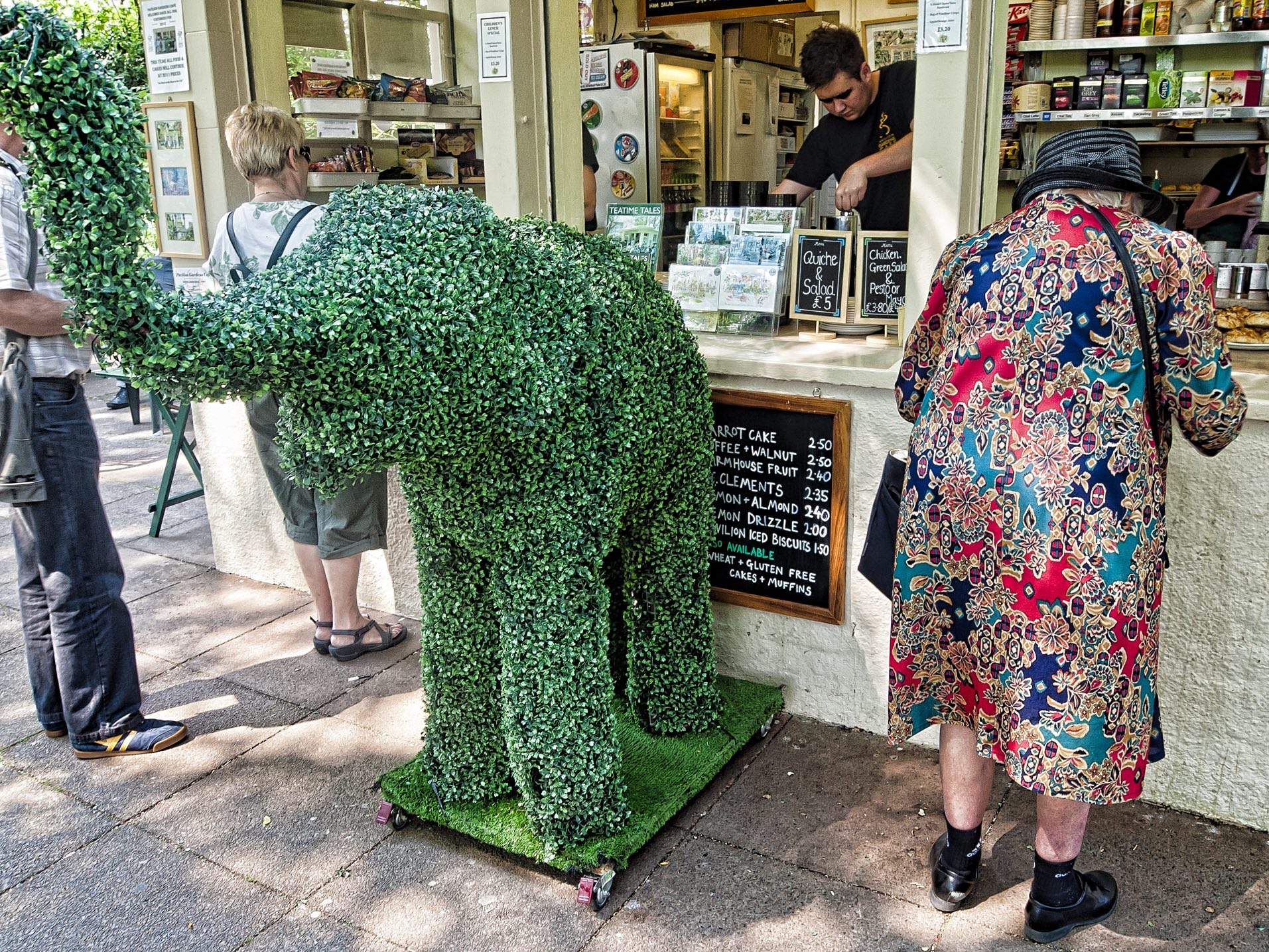
Topiary at the Pavillion Gardens Cafe, Brighton.
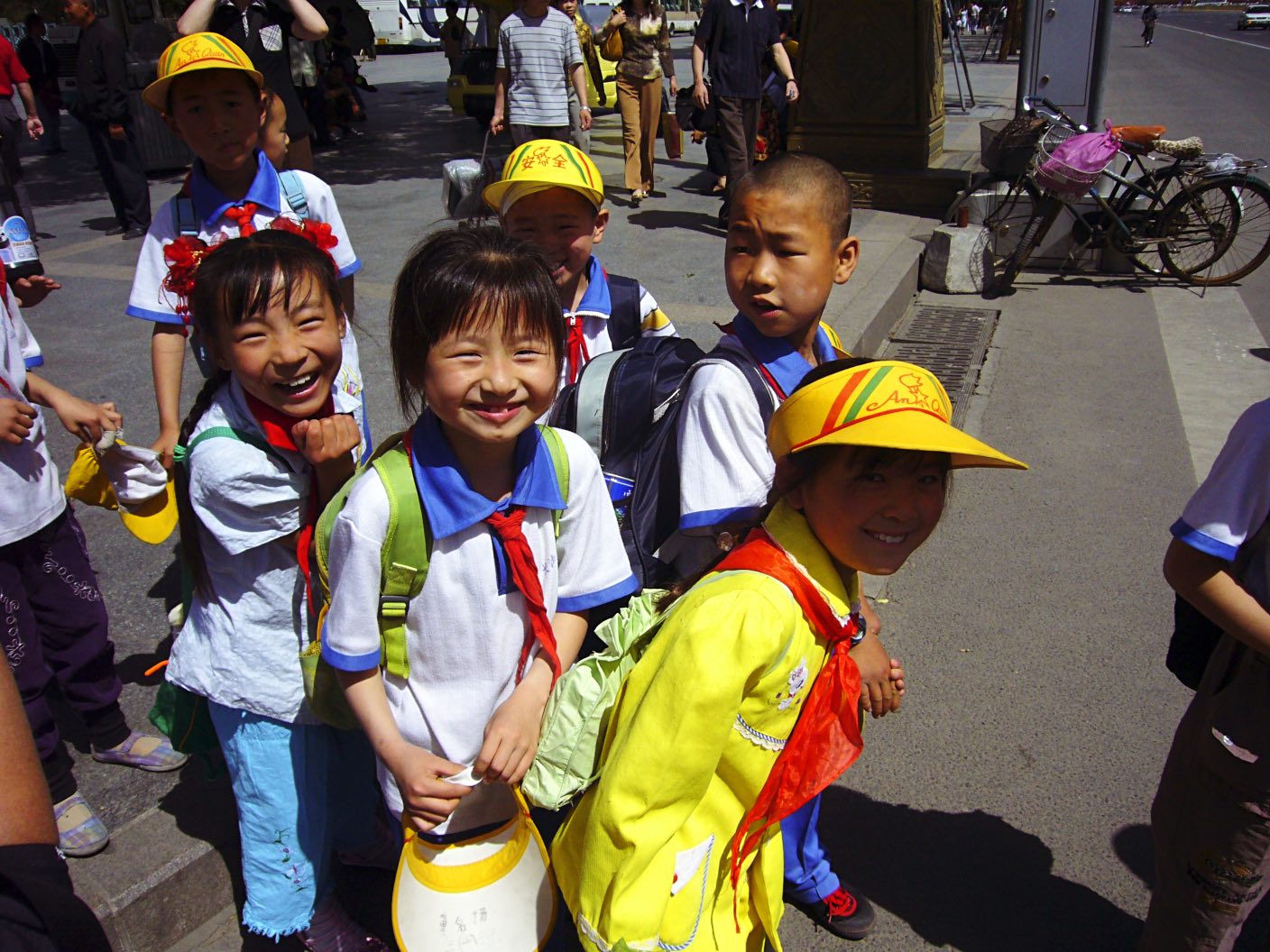
When I look at my bookshelves the bulk of them are of street photography. Ever since I saw the exhibition Another Country by Chris Killip and Graham Smith in 1985 I wanted to try and produce work that showed that ordinary people and things are important. So I started buying books by people such as Henri Cartier-Bresson, Robert Doisneau, Elliott Erwitt, and Robert Frank. At the same time I started loitering on streets with a camera trying to summon up the courage to take pictures of strangers. I’ve referred to this previously as having delusions of Bresson. In the 1980’s photography was expensive – every shot cost money – and this meant that I had to ration my picture taking to 2 or 3 rolls of film a month which meant that progression was a very slow process. Digital changed that and you could go out for the day and take hundreds of photos and get instant feedback on how they looked. It was a fantastic time to be a street photographer and the result is that there was another explosion of interest in the genre as millions of people world wide embraced it as a life style.
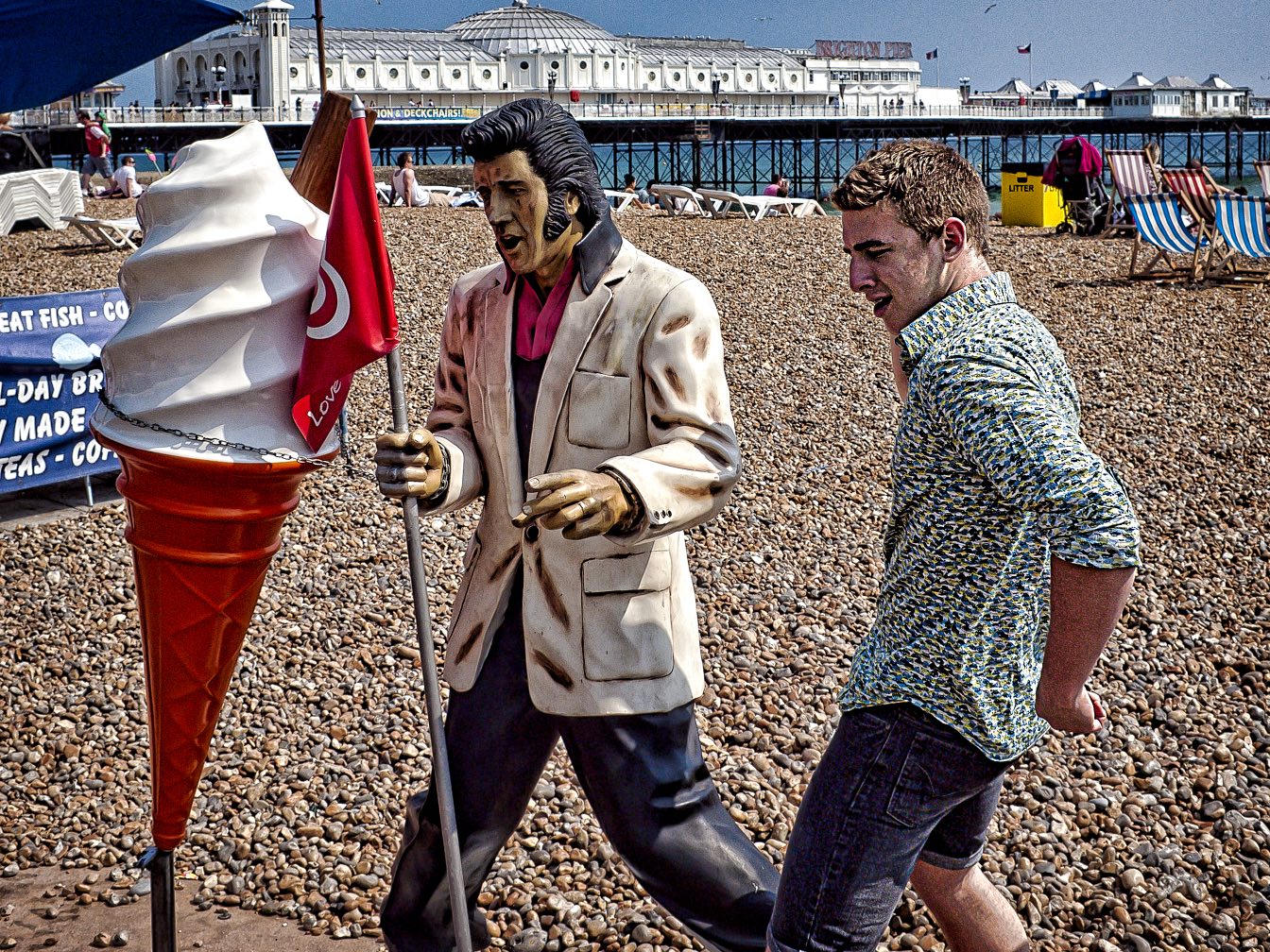
Getting in touch with his inner Elvis on Brighton Beach.
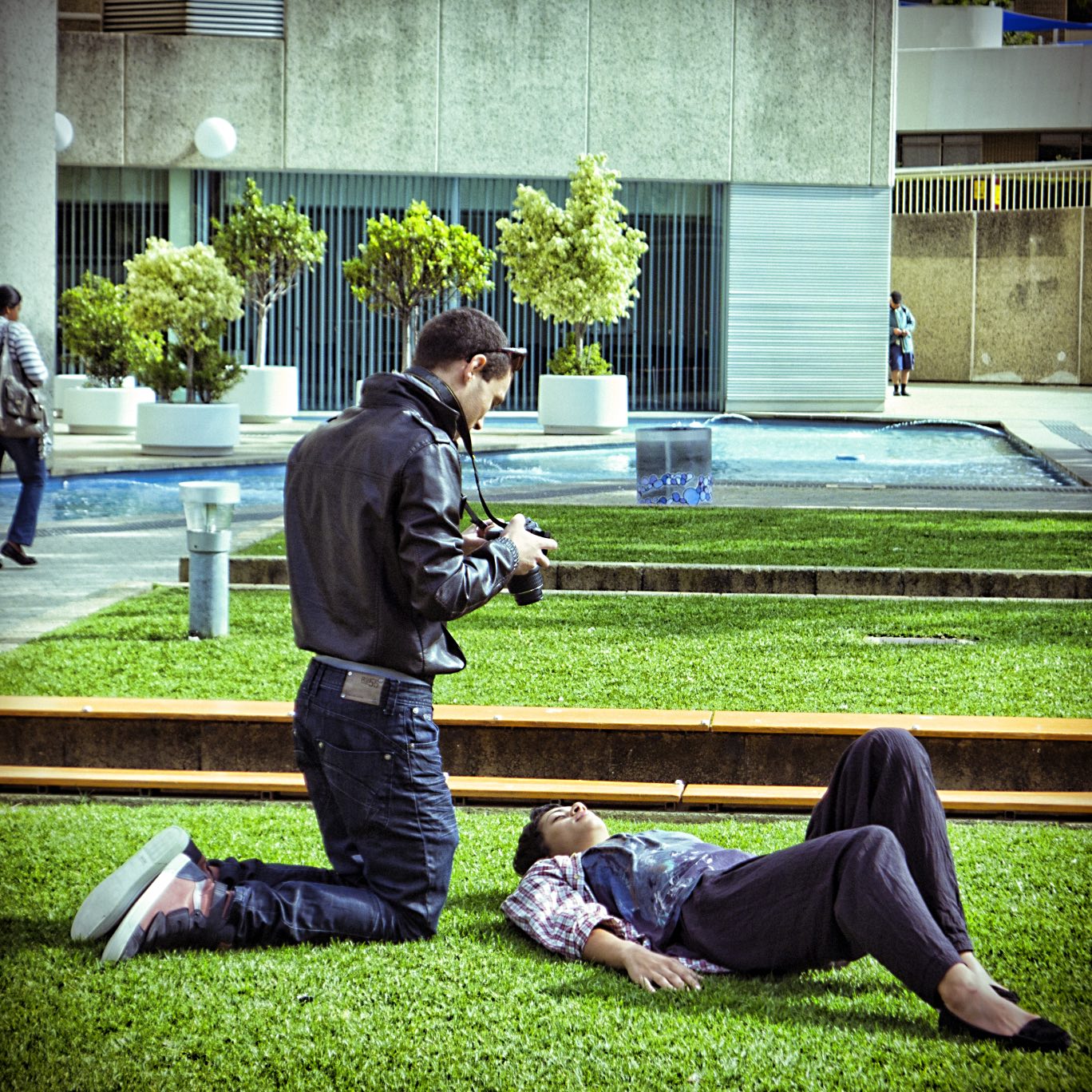
Goofing around with the camera in the Perth Cultural Precinct.
Things began to sour for me in 2007. After 9/11 the world was gripped with paranoia and virtually every country in the western world started bringing in counter terrorism legislation which meant every police officer and every security guard saw anyone carrying a camera as a potential terrorist. Some were OK and were polite and friendly. Some just over reached themselves and saw themselves as judge jury and executioner. In 2007 I went back to England as my father was dying. A few days after he died I wanted to go out and do something creative. Now the town we’re from attracts tourists from all over the world and so you’d think it would be safe to wander around taking photos. Well no and I had an extremely unpleasant encounter with a police officer who was convinced I was Osama Bin Laden scoping out the local shops for a potential suicide bombing. After threats of violence against my person he dragged me off to the police station and proceeded to threaten me some more for another couple of hours. It was only when I started asking the desk sergeant to see the Australian consul that things started to improve and I was eventually released and told to get on the next available plane. So that started to make me wary of taking photos out in public. The next year, 2008, Australia was gripped by the Bill Henson scandal and suddenly every photographer was not just a potential terrorist but also a paedophile. I attended the Earth From Above exhibition by Yann Arthus-Bertrand some of which was held outside in Perth’s Cultural Precinct. I took some photos of people interacting with the exhibits outside and while doing so I was accosted by a women who accused me of being a paedophile which led to an unpleasant encounter with the police. So with that I decided to hang up my rangefinder and 35mm lens and concentrate on subjects that weren’t people. But it wasn’t just the problems with the police it was also the fact that at this time I also felt that the world’s culture was beginning to change – it was becoming more homogeneous and it was difficult to see any difference in photos. The final straw was the ubiquity of the mobile phone. Everyone seems to walk around staring at this thing they carry. The little spontaneous connections and reactions have now disappeared as everyone just stares at the screen on their mobile phone. I’m not the only person who feels this way. Joel Meyerowitz the doyen of New York street photography said in an interview with the Guardian newspaper “In the 60s and 70s you could look at my street photographs and trace lines from the eyes of people connecting with other people’s eyes, setting up these force fields.” Of now he says “Nobody’s looking at each other. Everybody’s glued to their phones…The street has lost its savour.” Meyerowitz has now largely given up on it and concentrates on still life.
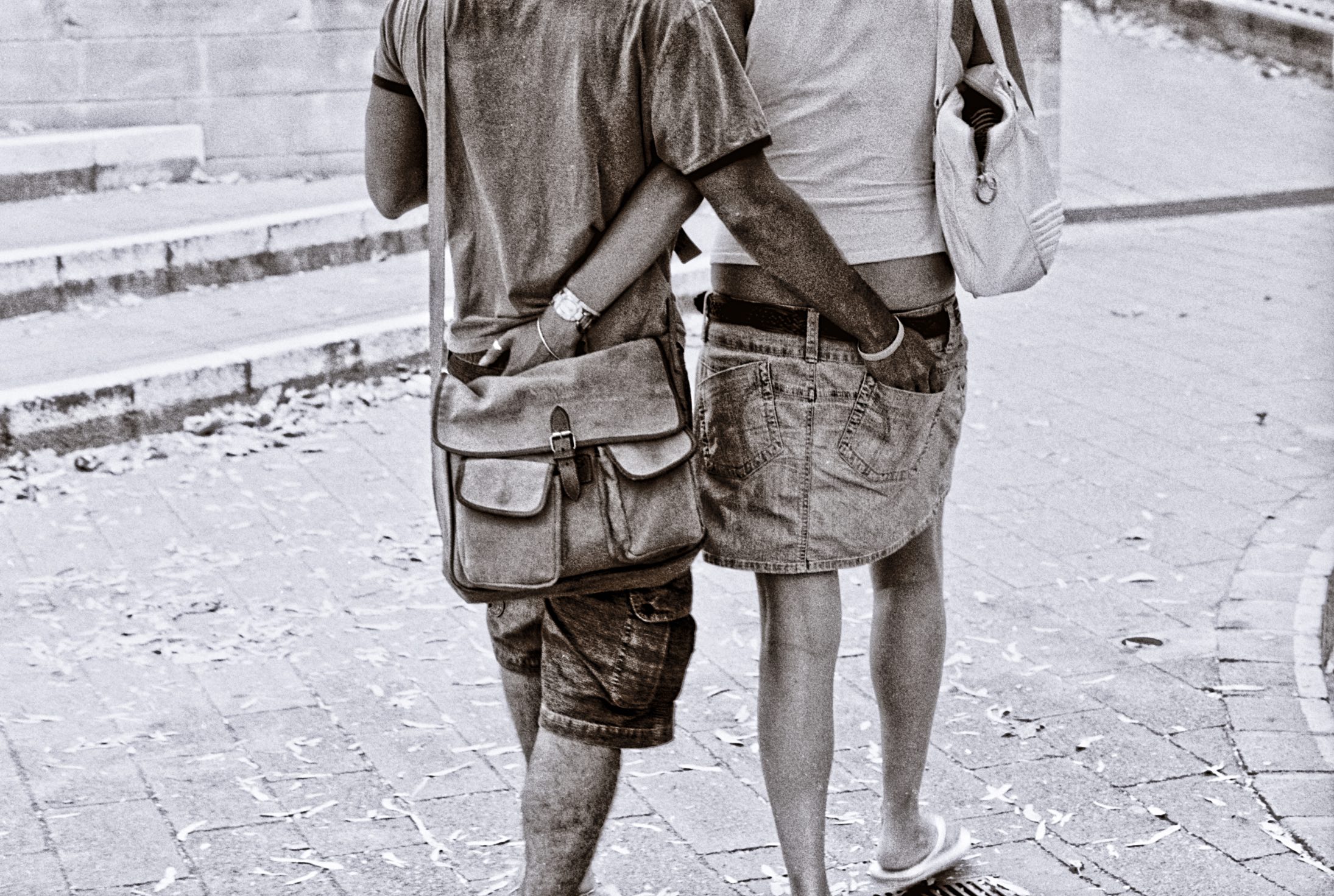
Young lovers walk arm in arm through Northbridge in Perth, Western Australia.
Palm Sunday walk for justice for refugees. Perth, Western Australia.
So what is my relationship with street photography now? Well I’m not buying the books or looking at other peoples work, but I am starting to re-engage. By any stretch of the imagination it is not my oeuvre anymore, but it is something I quite like to do when I’m in Perth and got a couple of hours to fill. I stay well clear of the police and make sure that no children are in the shot and I make sure I wander around looking like a tourist.
Busking in Elizabeth Street Mall, Hobart.
Water playground in Forest Place, Perth, Western Australia.
First Contact , Elizabeth Quay in Perth, is a five metre tall artwork by Nyoongar artist Laurel Nannup. The work depicts the arrival of European settlers to Perth. As the European boats arrived, the local Nyoongar people believed that these ships, were their past ancestors returning from the sea.
Sometimes you need help with taking your selfie.
Fortress England – smile you’re on CCTV. Chichester West Sussex.
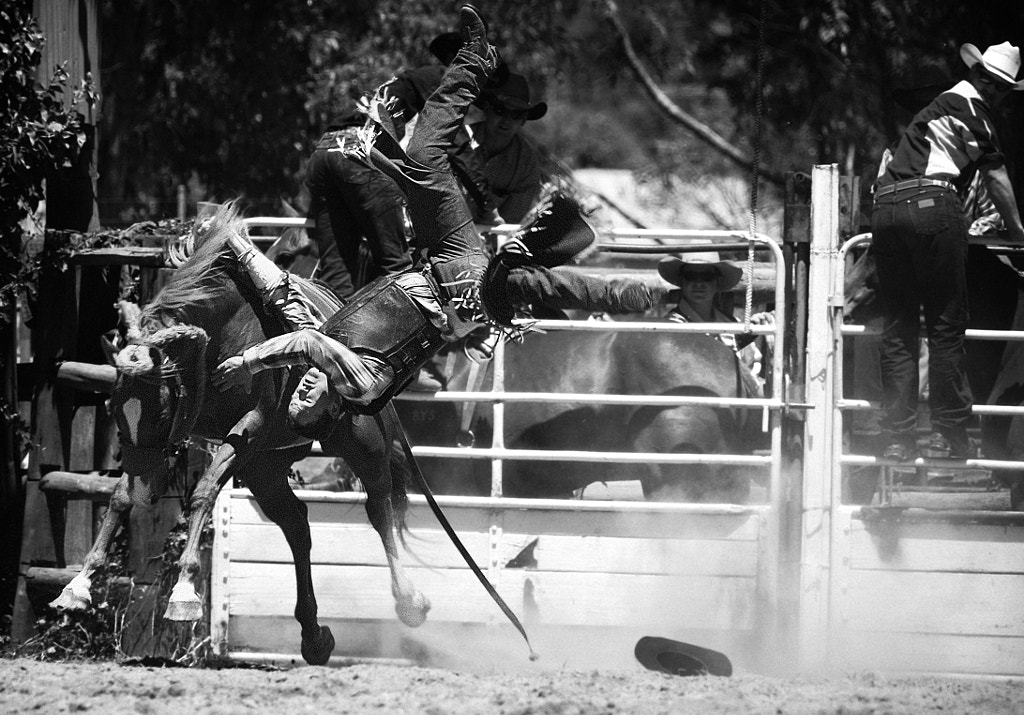
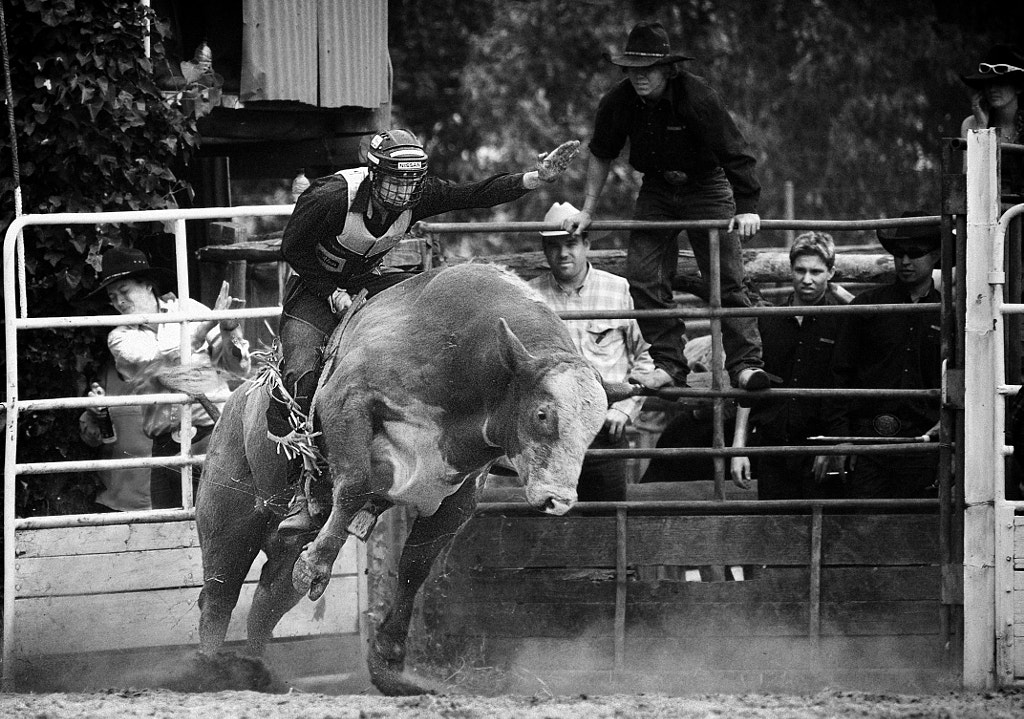
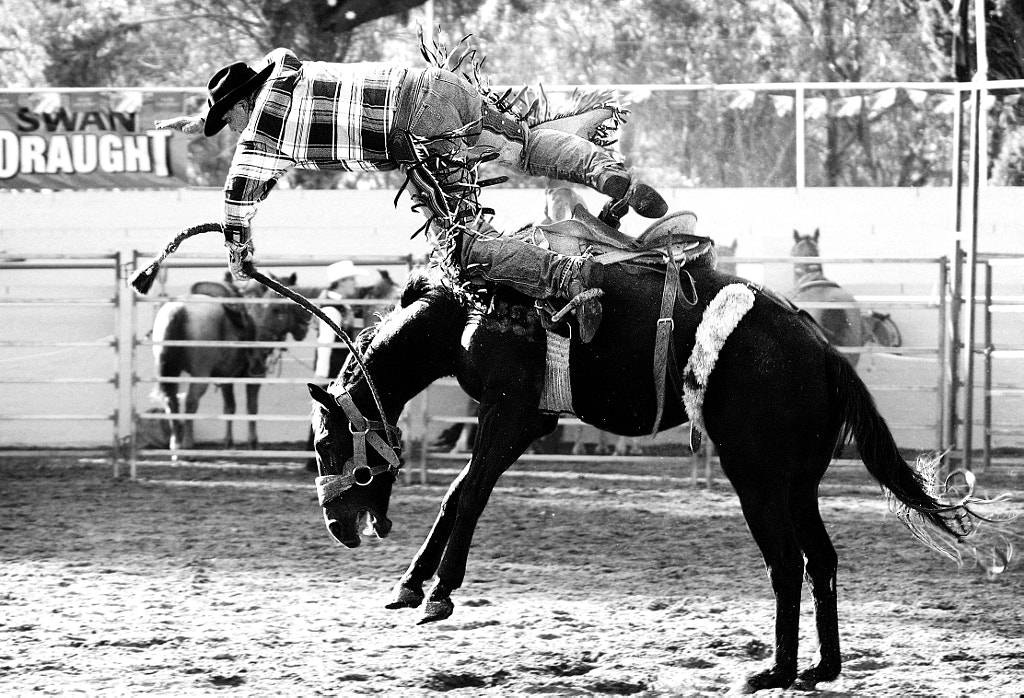
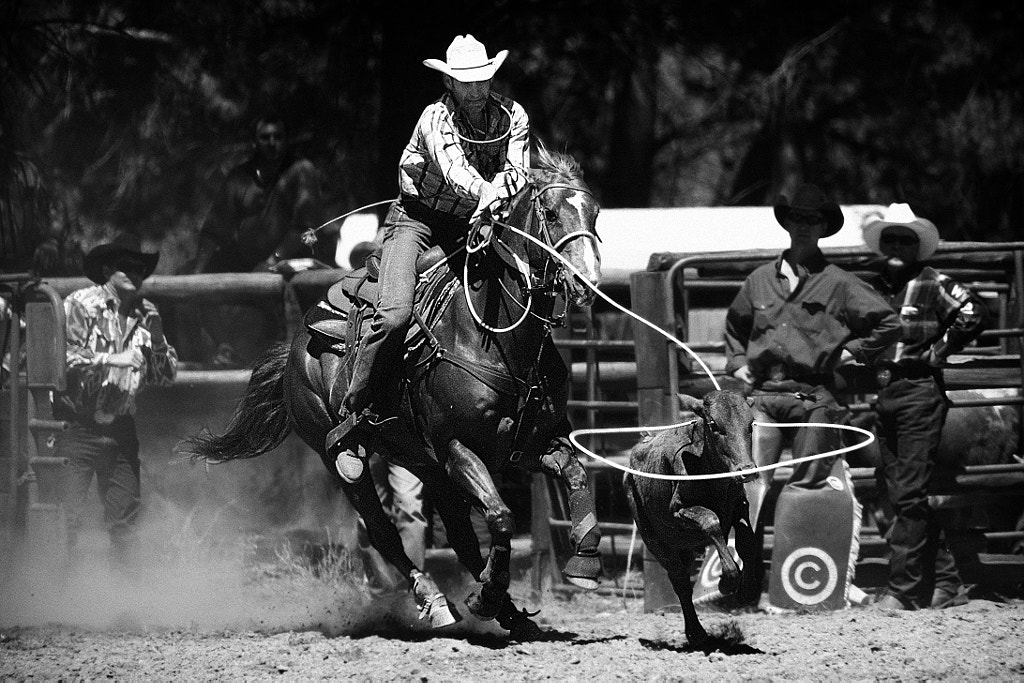
They say that Bronco riding is like holding on to the exterior door handle of a car doing 50 Km per hr. No wonder that 8 seconds seems such a long time.
Recently I put the above image up on my Instagram feed from a project I did back in 2004-8 called Broncos and Bulls. It elicited the following response:
“the rodeo is ALWAYS going to give you the opportunity of dramatic photos. …”
Initially I was going to put a short witty reply up, but then I started to think about it. “Will the rodeo always give the opportunity of dramatic photos?”.
In 1952 a French photographer by the name of Henri Cartier-Bresson is credited with coming up with the notion of the decisive moment. In fact it was the English title of his book of photographs. The original French title was “Images à la Sauvette” which is quite an awkwardphrase to translate into English. It has been variously translated as “images on the run”, “stolen images” and “images on the fly”. In the end it was Bresson’s American publisher who settled on the phrase the “decisive moment“. The book is hugely influential and Bresson has become one of the Titans of Twentieth Century photography and the phrase has come to define a whole genre of photography. Unfortunately it is misunderstood because it doesn’t just mean capturing the apex of action but rather it is “the instant when a prescient photographer anticipates a significant moment in the continuous flux of life and captures it in a fraction of a second”. (p 104 Badger, G. 2007 “The Genius of Photography – how photography has changed our lives” Quadrille Publishing Ltd, London). Or to put it another way when all the individual elements of a photograph come together to create meaning. Reams and reams of literature have been published by far cleverer people than I debating the whole notion and Bresson himself was only too aware that the whole concept could be corrupted.
Behind the Gare Saint-Lazare by Henri Cartier-Bresson. Considered by many to be one of the most influential photos of the Twentieth Century because it became the epitome of Cartier-Bresson’s “Decisive Moment”.
Jean Clair (Director of the Musée Picasso in Paris) in his essay that is included in the major retrospective book about Bresson ( pp47-55 Galassi, P; Delpire, R. et al, 2003, ‘Henri Cartier-Bresson – the man, the image, and the world’ Thames Hudson, London) likened the decisive moment to the ancient Greek word kairoswhich was used to describe how an archer using intuition would let an arrow fly to hit the right spot.This I feel is a flawed analogy because it reinforces the notion of the photographer as hunter stalking his prey with the one singular intention, but photography is not that simple. The American photographer Sam Abel in his 2008 book ‘The Life of a Photograph’ (National Geographic Society, Washington) states that are a whole series of acts which culminate in a photograph.Firstly the photographer has to pre-visualise the photo, then they have to seek out the opportunity and put themselves into the position when all the elements of lighting and composition come together, and then after the picture has been taken select the picture that most captures the intention. So rather than a singular point of time the photographer is looking at a series of decisive moments which have to evolve. After the photograph has been taken and published/viewed then the photograph takes on a whole new life and is imbued with new meaning by its viewers.
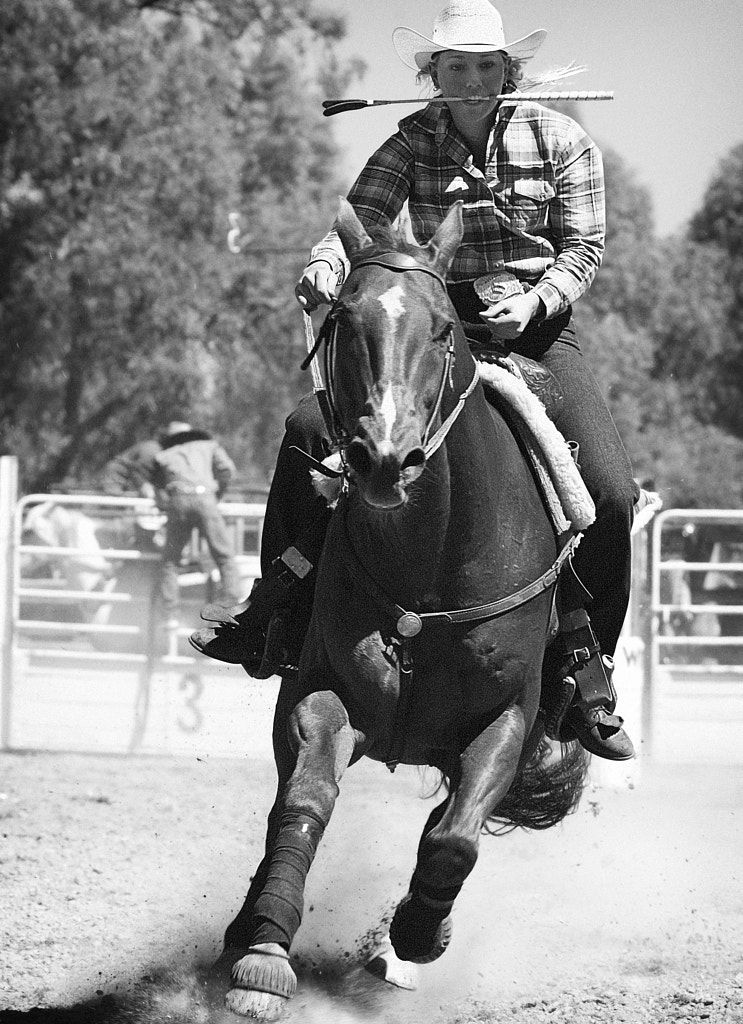
Barrel racing at Boddington Rodeo.
So getting back to the original statement “the rodeo is ALWAYS going to give you the opportunity of dramatic photos. …” the answer is yes and no. The event gives an opportunity it is up to the photographer to seize that opportunity through preparation, creative vision, and technical capability. Just turning up at a rodeo with a camera doesn’t mean that you’ll come away with a good photo. Just like going to MacDonalds won’t make you a hamburger.
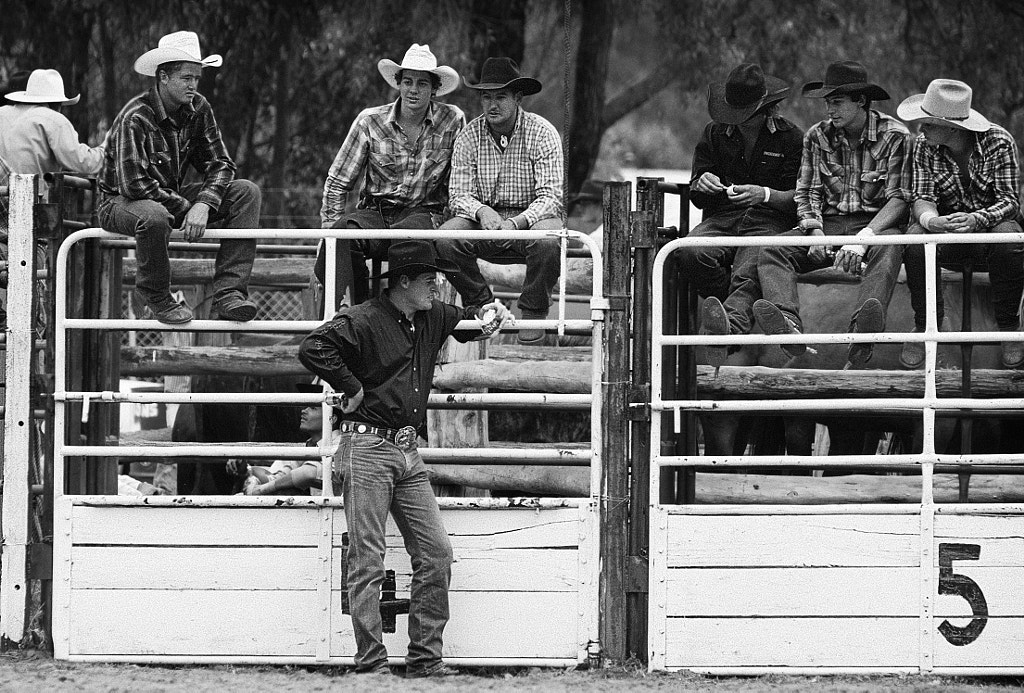
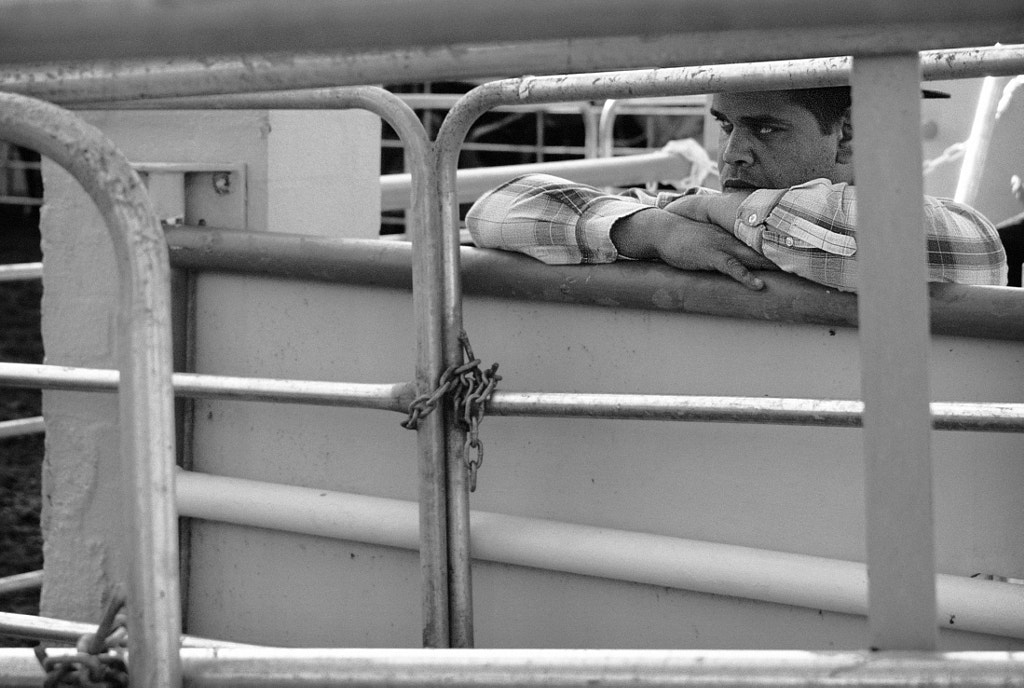
Waiting for the start.
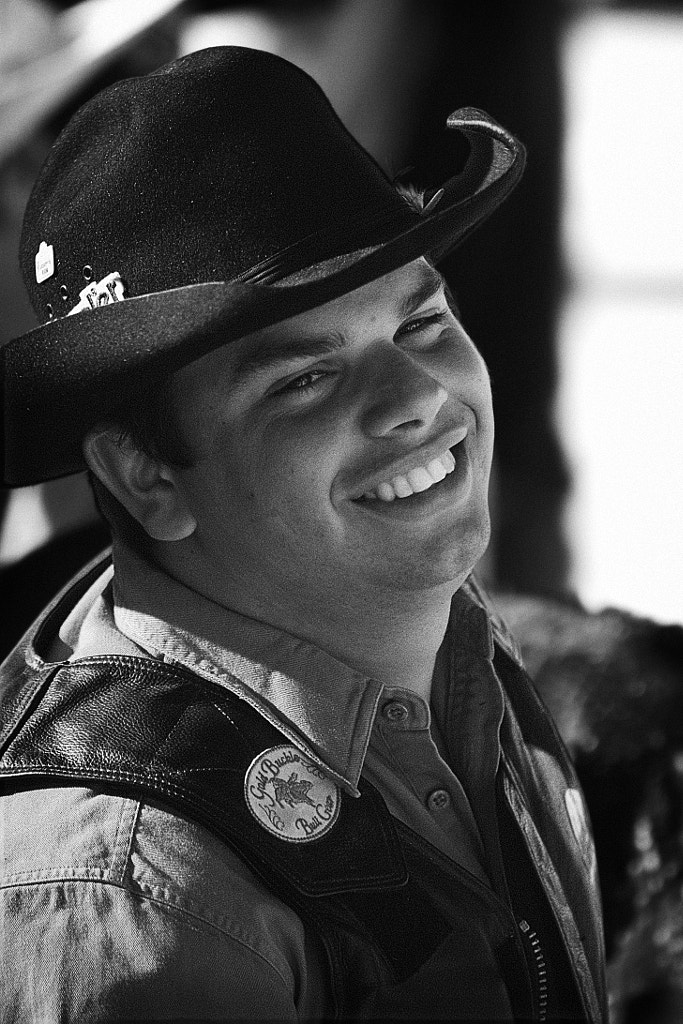
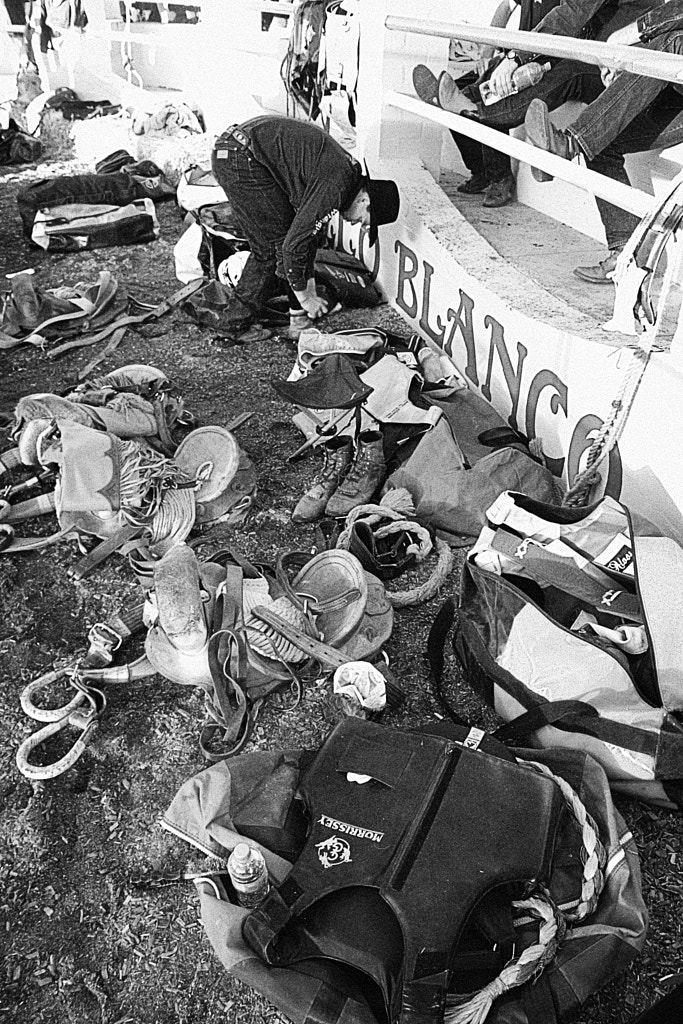
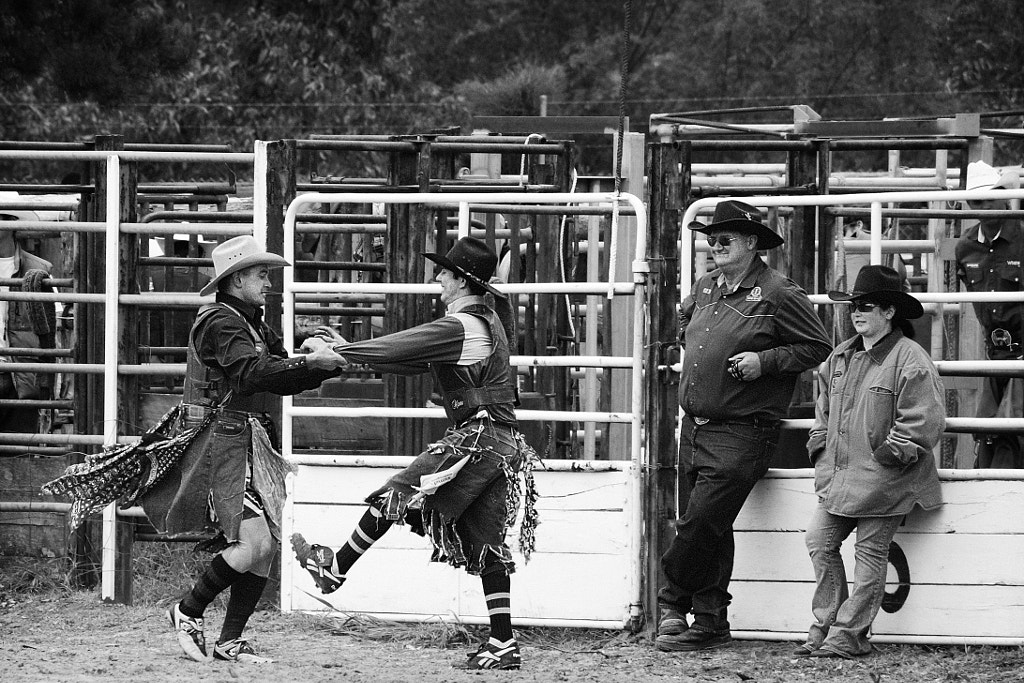
I’ve included the rest of the photos from the project Broncos and Bulls because the whole series was shot using the principle of the decisive moment to form a visual story. As I said previously this was done in 2004-8 and since then I have moved away from the subject and the style, but my current photographic interests are still based upon Bresson’s ideas.
The Next Generation. Rodeos are are big event in Western Australian country towns and attract an audience of all ages.
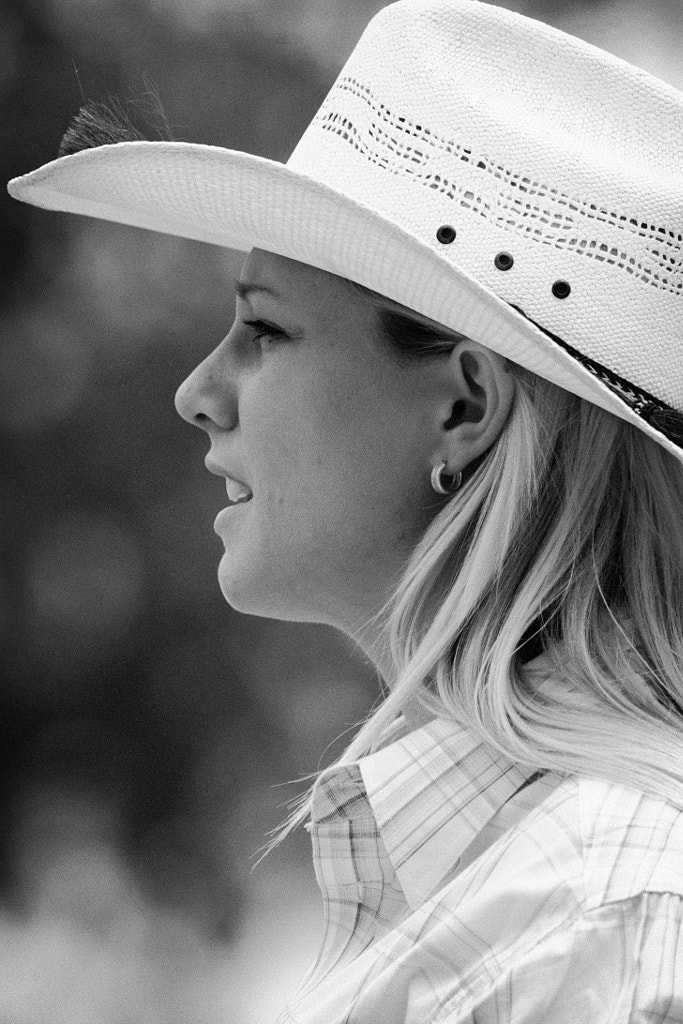
Nice Hat! Spectators dress for the occaision at the Boddington Rodeo.
Matt’s Free Fall. Matt, El Caballo’s Extreme Rodeo compere tries his hand at bronco riding with catastrophic results.
Damon Metcalf relaxes behind the chutes before the pro bull riding event.
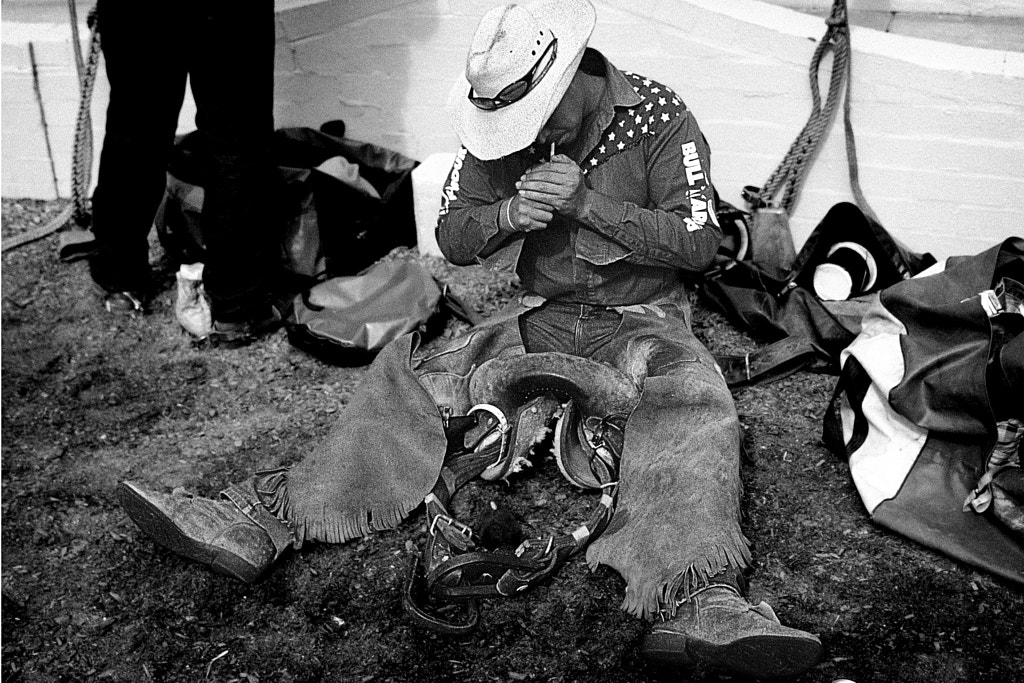
Preparation is the name of the game and the competitors at El Caballo Rodeo meticulously sort through their kit before competing.
The rodeo clowns had a ball.
Gotcha!!! Steer roping competition. Boddington Rodeo, Western Australia.
Having a quick smoko while getting ready. El Caballo.
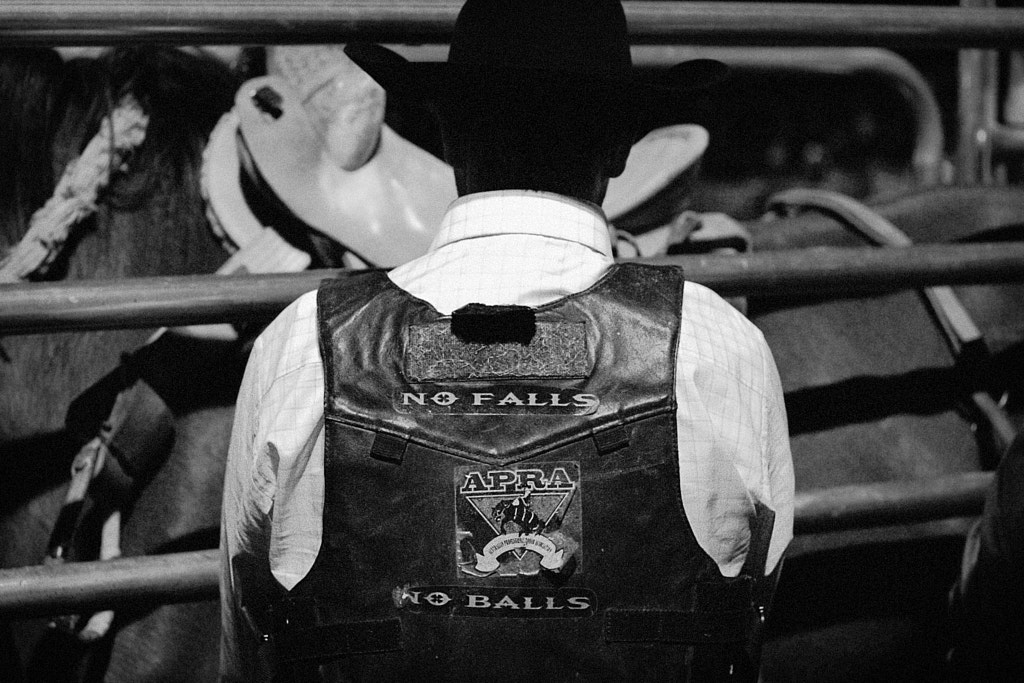
No Falls No Balls. Attitude is everything at the rodeo. El Caballo, Western Australia.
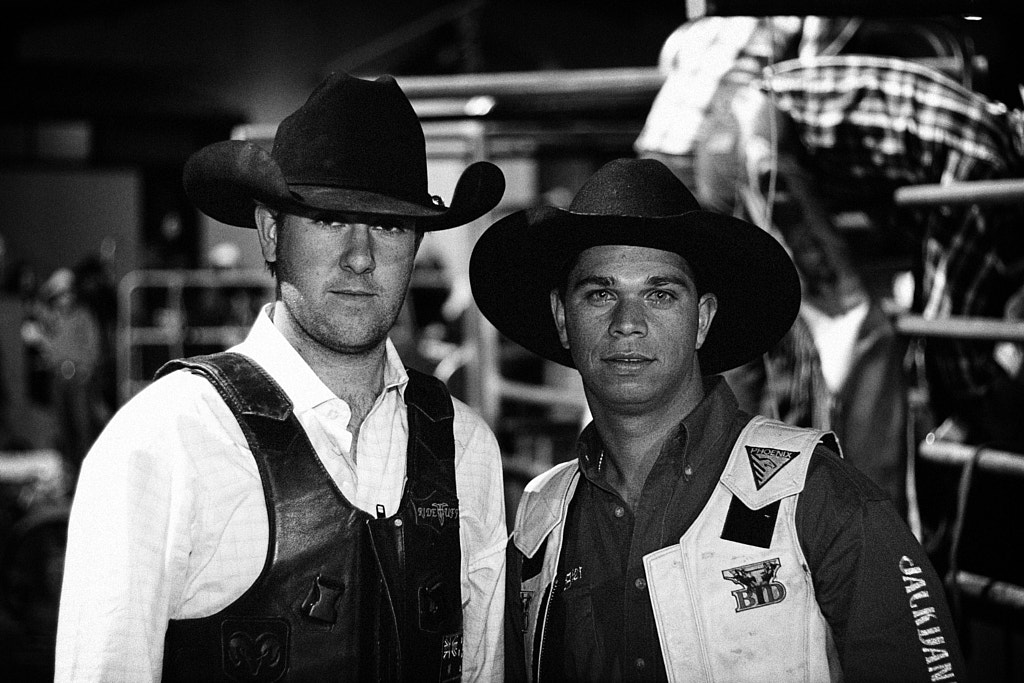
These two called themselves liquorice all sorts. El Caballo, Western Australia.
Waiting in the chutes. El Caballo, Western Australia, 2007
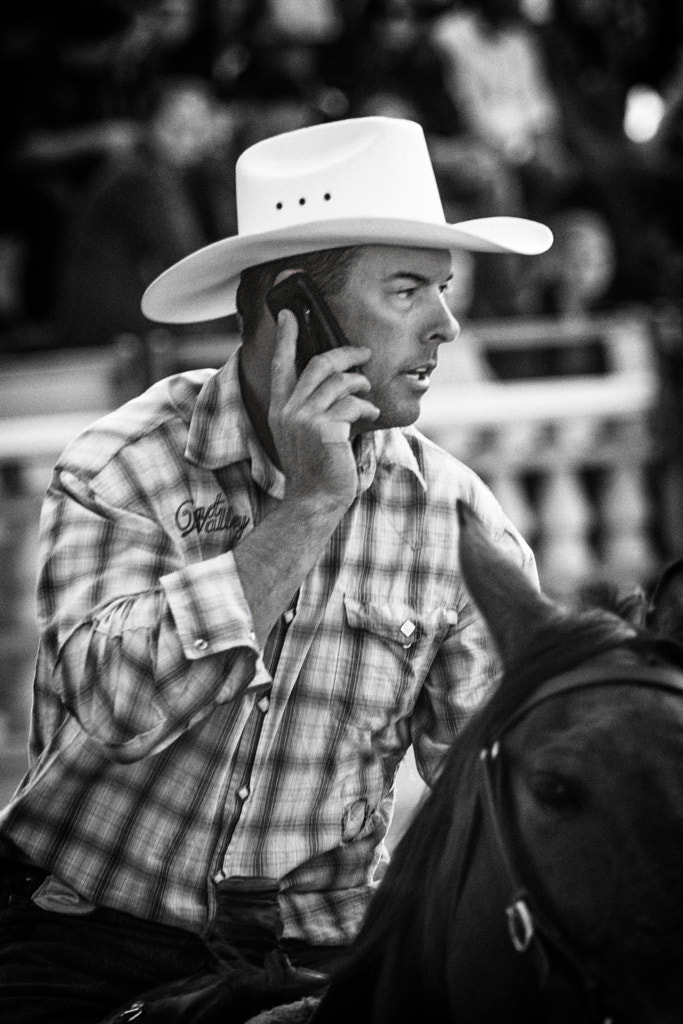
No Hands Free On A Horse. “Can you call back later – I’m kinda busy.”
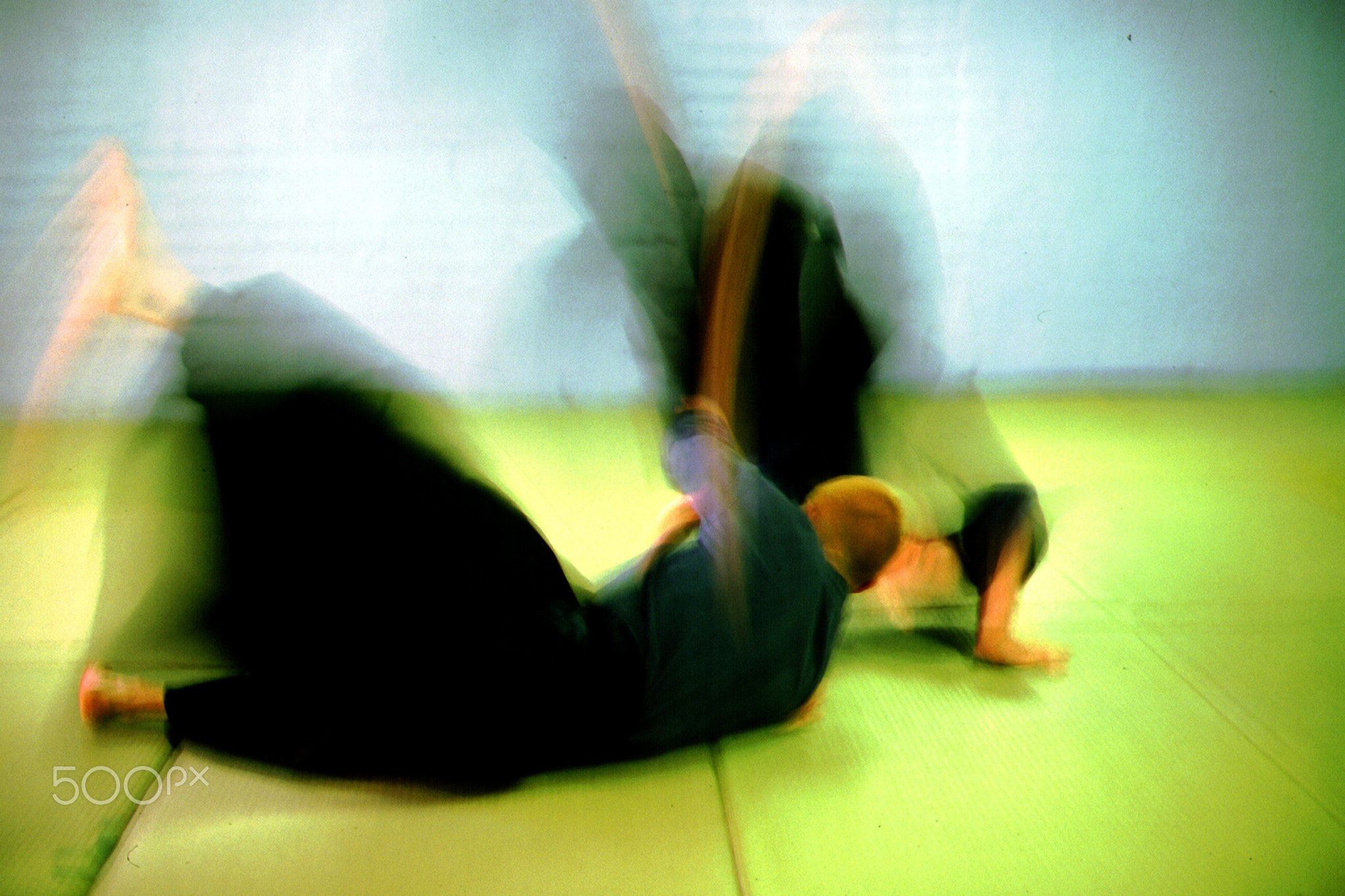
Sutemi waza from Yōseikan Aikido. Taken on Olympus C-720 Ultra Zoom with slow sync flash edited using Photoshop Elements 2 and Genuine Fractuals
Currently in photography there are several sacred cows and you’d think that from the amount of chatter these subjects generated that they were the be all and end all of photography. Thankfully for the actual art form of photography they are mostly irrelevant. These sacred cows are:
megapixels
dynamic range
sensor size
lens sharpness
My feeling is that these topics are so hotly debated is because now in this digital age it is easy to quantify these values numerically and the bigger the number the better. There is no doubt about it a great big spreadsheet of impressive looking numbers must be right after all. This is why the website http://www.dxomark.com has become a sacred text among the denizens of the internet fora and its proclamations and pronouncements can lift a camera or lens to photographic nirvana or condemn it to the lowest reaches of hell. Well having ruffled a few feathers with the piece on sensor size and depth of field this weeks entry is going to cause the DXO fundamentalists to really froth at the mouth in holy indignation.
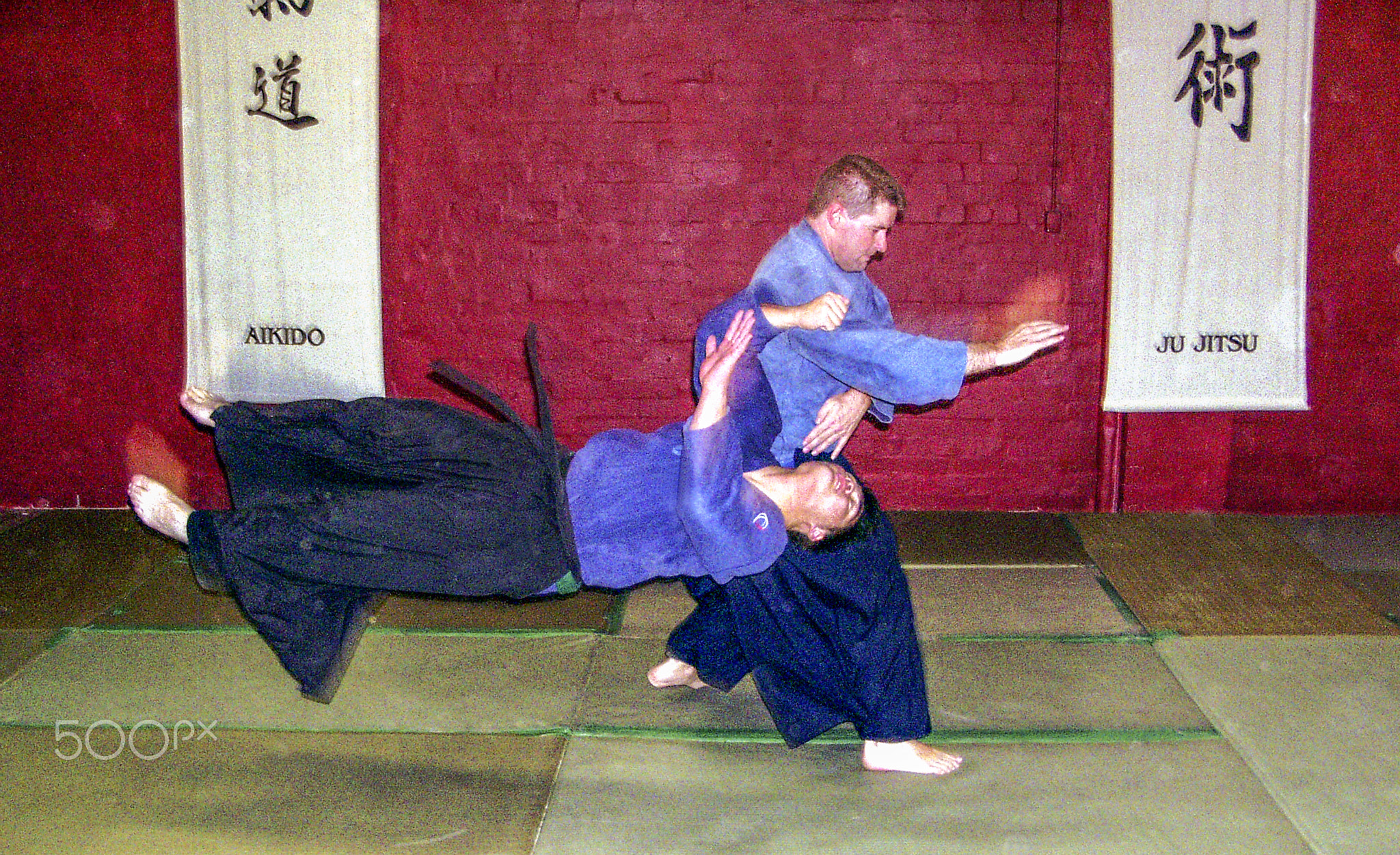
Ura Tai Otoshi from Yoseikan Aikido as taught by Shihan Jan de Jong. Shot using an Olympus C-720 Ultra using slow sync flash. Edited using Photoshop Elements 2 and Genuine Fractuals
Lens sharpness is something to be coveted. After all Leica, Zeiss, Schneider, Rodenstock, Canon and Nikon have made an art form of it. Those who worship at the high altar of lens sharpness are prepared to spend the equivalent of the GDP of a small African nation on the lenses that have the highest DXO score. The Carl Zeiss Distagon T* Otus 1.4/55 ZF.2 Nikon has a DXO score of 45 while the lowly Canon EF 50mm f/1.8 II only has a rating of 25. So the Otus is nearly twice as good as the plastic fantastic Canon. Phwoaaaaarrrrr forum domination and photographic greatness here I come, I’ll go out and buy one straight away. The Australian list price for the Zeiss is $4474 while the Canon is $135, so the Zeiss must be 33 times better. Er no. To quote DXO “The DxOMark Score shows the performance of a lens, mounted on a given camera body, for its optimal focal length/aperture combination and for defined exposure conditions.” So the lens has been mounted to a camera on an optical bench shooting a 2D lens chart at an aperture that is guaranteed to give the best results in carefully controlled lighting. So in other words it does not reflect real world usage unless your photographic interests lie in shooting charts or brick walls with a camera on a heavy tripod so you can orgasm over how sharp the image is at the edges. Shoot a complex 3D object in rapidly changing light conditions at sub optimal aperture settings and these ratings really don’t mean anything.
A sacrice throw from Yoseikan Aikido. Taken using an Olympus OM 4 with a Zuiko 35-105 lens on Fujichrome 400 pushed to 800 ISO. Scanned using an Olypus ES-10 scanner and edited using Adobe Photoshop Elements 2 and Genuine Fractuals.
There is no doubt that lenses have become a lot sharper over recent years, but I find it amusing to see that they have become so sharp that they are now unflattering for portraiture as they show every blemish and pore. So much so that photographers are now spending time and money on lessening the sharpness (blurring if you will) on portraits. Don’t you think that is ironic? I’ll spend a fortune on a very sharp lens that is so clinically sharp that no-one likes the results so I’ll spend some more money on a Photoshop plugin to blur it.
A famous quote and often mis-quoted as nobody can really tell you the context in which Cartier-Bresson said it. If we forget the Marxist definition of bourgeois and just concentrate on the dictionary definition we get:
“belonging to or characteristic of the middle class, typically with reference to its perceived materialistic values or conventional attitudes: a rich, bored, bourgeois family | these views will shock the bourgeois critics.”
I would hazard a guess that dear old Henri was stirring a bit when he said it and meant something along the lines that sharpness in a photograph is a very conventional and staid way of judging it and doesn’t look at its other qualities. How can I be sure, well I can’t but he also said:
“It is an illusion that photos are made with the camera, they are made with the eye, heart & head.” – Henri Cartier-Bresson
So I think it is more than likely to assume that Cartier-Bresson felt that there is a lot more to photography than technical perfection.
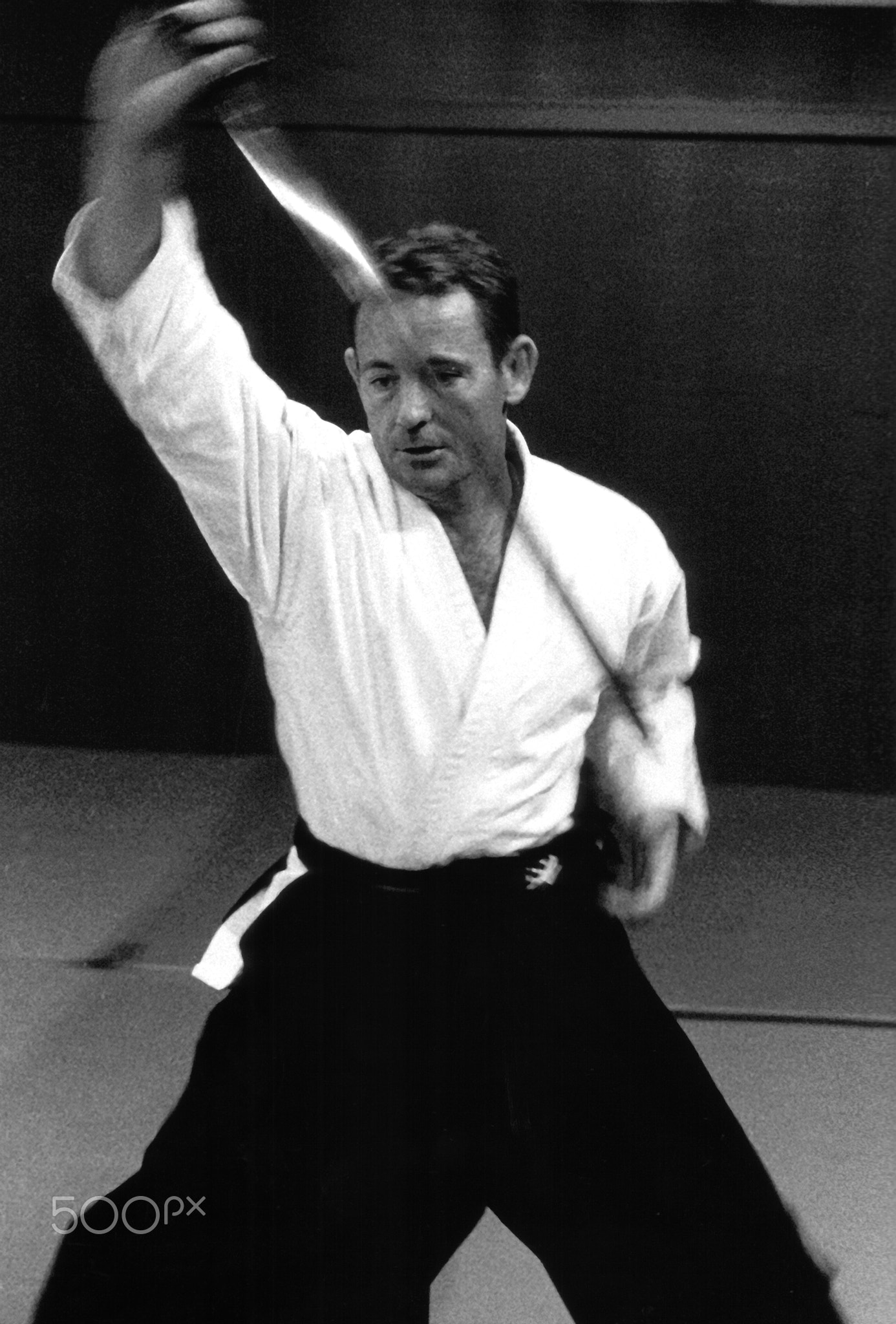
The Japanese art of sword drawing. Taken with an Olympus OM 4 with a Tamron 28 mm lens, using Ifford Delta 3200. Scanned using an Olypus ES-10 scanner and edited using Adobe Photoshop Elements 2 and Genuine Fractuals.
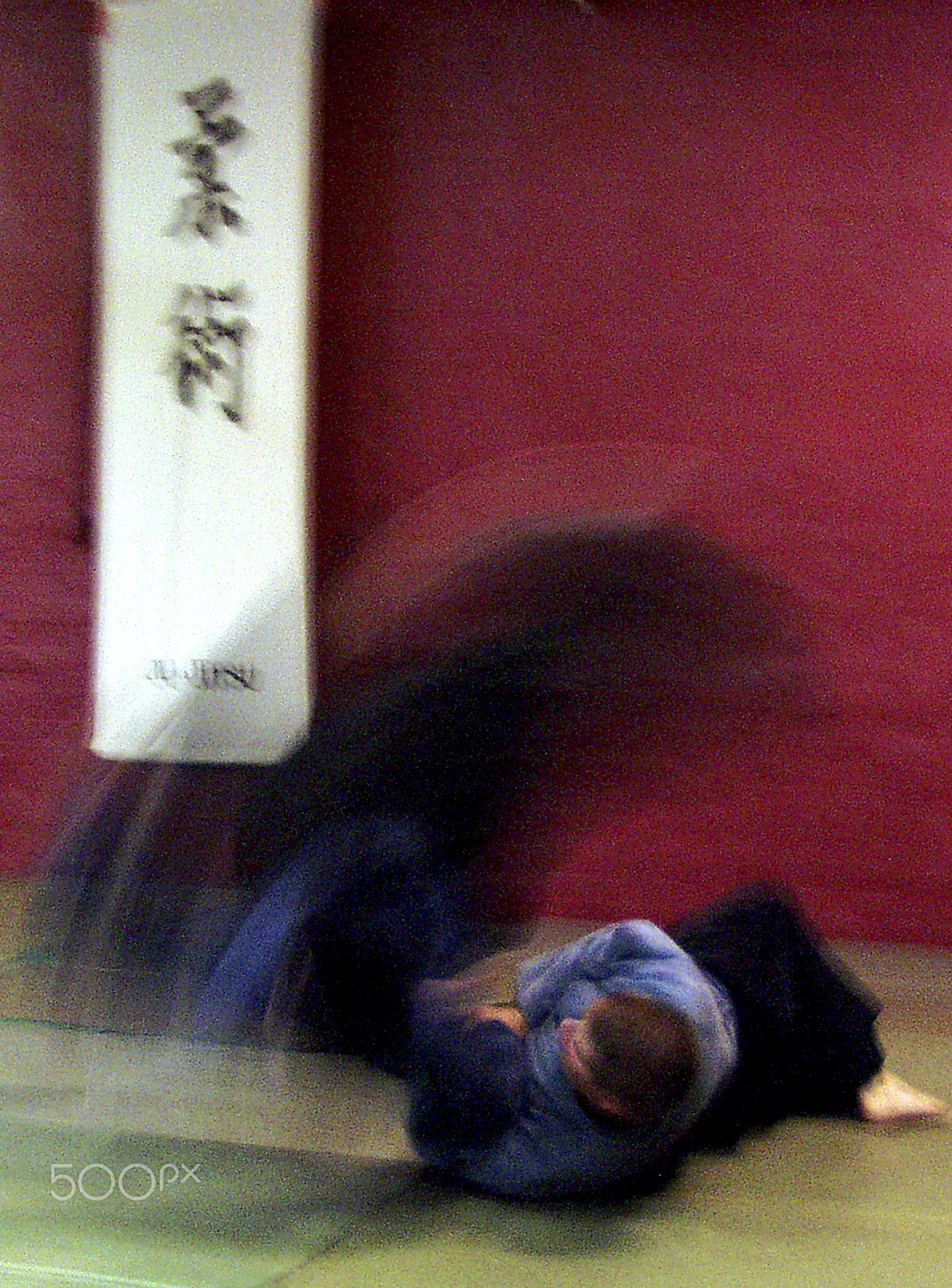
So by now you’ll have read this and seen some photos I made years ago of some people practicing Aikido and Iado, both Japanese martial arts. You’ll also have noticed that there is a lot of blurred movement and very little sharpness. The reason why is that I wanted to capture the beauty of the flowing energy that is involved in them and I felt that while static shots might capture the technical aspects of the techniques being demonstrated they don’t capture the nature of the philosophy behind them nor the dynamism. I like to feel that these are photos “made with the eye, heart & head” rather than the clinical gaze of the optically perfect lens. This is for me where the beauty of any art lies, not in technique but in the expression of ideas and emotions. None of the equipment used in the making of those photographs warrants a mention on DXOMark so I guess that gives them a score of zero. The equipment HCB used also isn’t on the DXO charts, and guess what quite a few of his pictures are blurred because he often relied on zone focusing and didn’t get it right, but I’d sooner have one of his pictures on my wall than a lens test chart any day.












You must be logged in to post a comment.