Second Time’s A Charm…


… or is it?

OM System 100-400mm f5-6.3 II IS lens Review


20250829-OMSystem100-400-0236-Edit


This has been very difficult to write and has become a very long and drawn out affair and it shouldn’t have been.

I have, as regular visitors to the site may recall, been using the Panasonic Leica DG Vario-Elmar 100-400mm f4-6.3 lens for my wildlife photography since September 2018. I bought it because it was the only affordable quality long lens available in Micro Four Thirds at the time. Largely I have been very, very happy with it. The major nitpick I have is that although both Panasonic and Olympus/OM System are part of the Micro Four Thirds consortium and conform to certain protocols such as lens mounts, flash system standards, and autofocus compatibility some features are not cross brand compatible. Now when I got the lens I was primarily using a Panasonic Lumix G85 with which it mates up perfectly and an Olympus EM1 mk 1 which was close enough. But as I progressed with Olympus cameras some of the features such as Synch IS, autofocus while using Pro Capture, focus stacking and high resolution functions required complete compatibility and I was wanting to use them on a regular basis. When Olympus introduced the mk 1 version of the 100-400mm lens in 2020 it seemed weird as it wasn’t compatible with those features so I saw no need to change. So with the announcement in February 2025 OM System announced the OM System 100-400mm f5-6.3 II IS lens and that they had fixed some those issues I became very interested and bought it after watching and reading many, many positive reviews.


20250829-OMSystem100-400-0234-Edit


One of the things that has made this so difficult is because I keep making comparisons to the Panasonic 100-400mm mk I which I also own. In fact, it is probably more a comparison review than anything else, which is unfortunate as I wanted to make it a stand alone look at the OM System 100-400mm.


Panasonic Leica 100-400mm Lens
Comparisons with the Panasonic Leica DG Vario-Elmar 100-400mm f4-6.3 are inevitable considering they both share the same focal range and lens mount.


The Controversy 

When the original Olympus 100-400mm came out a lot people jumped on the fact that it was simply a rebadged SIGMA 100-400MM F/5-6.3 DG DN OS Contemporary Lens. The criticism mainly centred on the fact that it was firstly a lens designed for full frame cameras rather than specifically for Micro Four Thirds which meant some how that it was too large and heavy and undermined the original m4/3 ethos of being small and light. The second complaint was that the original Sigma lens sells for around half the price of the Olympus/OM System version so, therefore, customers were being ripped off by Olympus/OM System. When the  OM System 100-400mm f5-6.3 II IS lens was launched these same complaints were again raised. Well the truth is somewhat different. 


M.ZUIKODIGITALED100-400mm -Edit
Optical construction of the OM System 100-400mm lens.


Sigma100-400_2
The optical construction of the Sigma 100-400mm lens. Looking at this and the OM System one you can see the differences.


While both lenses may have been built by Sigma (and there is no definitive proof that the Olympus/OM System lens has been) there are some key differences. While they share the same focal length, aperture range, and thermally stable composite body the filter size of the Sigma is 67mm compared to 72mm of the OM System lens. The Sigma lens has a lens construction comprising of 22 elements in 16 groups with four FLD elements and one SLD element. The OM System 100-400mm lens has 21 elements in 15 groups with four ED elements, two HR elements and two Super HR elements. The OM System lens diaphragm has 9 circular blades while the Sigma has 7. The OM System lens has IPX1-rated weather-sealing and there is no rating for the Sigma. The OM System lens’ front element has a ZERO Coating which is a form of fluorine coating that repels water and smears keeping it clean.  The Sigma’s image stabilisation is four stops while the OM System’s is 5 on its own and it fully integrates with their cameras IBIS to give 7 stops of image stabilisation. 

At this point I think it is fair to say that the OM System lens is not a simple case of badge engineering, there are too many differences. Now I’m not saying that OM System didn’t contract Sigma to build the lens using their existing  SIGMA 100-400MM F/5-6.3 DG DN OS Contemporary Lens as a framework. What I am saying is that are sufficient differences in the specifications and they should be treated as entirely separate entities.

Vital Statistics

Focal Length  100-400mm (35mm equivalent 200-800mm)
Mount Micro Four Thirds
Lens Construction 21 elements in 15 groups with four ED elements, two HR elements and two Super HR elements
Lens Coating ZERO Coating
Angle of View 12° (wide) – 3.1° (tele)
Number of Diaphragm Blades 9 rounded blades
Maximum Aperture f/5.0 (wide) – f/6.3 (tele)
Minimum Aperture  F22
Minimum Focusing Distance 1.3m
Maximum Magnification Ratio 0.09x (wide) – 0.29x (tele)
Filter Size 72mm
Dimensions 86.4mm ⌀ × 205.6mm h
Weight 1,125g
Supplied Accessories lens hood
Weatherproof IPX1-rated weather-sealing – Dust-proof, Freeze-proof, Splash-proof
Lens Sync IS 5-Axis


20250829-OMSystem100-400-0224-Edit
The OM System 100-400mm is not part of the top tier PRO line of m.Zuiko lenses, but rather one of their consumer grade ones. Consequently it does not have the metal body nor MF Clutch / Snapshot Ring but rather a nondescript composite body that is strictly utilitarian. The zoom is of the external variety in that the lens barrel extends as you zoom through the focal range, but the focusing is internal and the front element does not rotate as the lens focuses. The mechanism feels sturdy with no hint of any flex or wobble. At the mount end there is a chromium plated brass mount which is surrounded by an “o” ring which provides a seal between the lens and camera body. Be aware that OM Systems OM1 mk i & ii, OM3 and OM5 mk i & ii have an IPX rating of 53 which means that they are protected against low pressure water streams from any angle and while not completely dust proof any ingress that does occur will not interfere with the operation of the camera. The lens is IPX1 rated which means that there is no information available about resistance to dust ingress and it is resistant to vertically dripping water equivalent to 1 mm rainfall per minute. So the camera body has more resistance than the lens. 


20250829-OMSystem100-400-0231-Edit
The chromium plated brass lens mount and the rubber “o” ring that provides some weather sealing.


The lens is quite a chunky beast and it also has considerable weight. It is when you compare it to the PanaLeica 100-400mm that this becomes really apparent. The PanaLeica is 34.1 mm shorter, 3mm in diameter smaller and 140g lighter while having a much more premium metal body that just exudes class. In comparison the OM System lens comes off as feeling lumpen and a little tacky.


20250830-OMSystem100-400-0237-Edit
The OM System lens extends as you zoom in. Fitted with the included lens hood it is quite a large lens.


When it comes to controls both lenses are pretty the same. A zoom ring, focus ring, zoom lock and switches for the AF function, focus limiter and image stabilisation. The OM System lens scores well here as the PanaLeica is plagued with an incredibly stiff zoom ring, but overall the PanaLeica gives to my mind a much better user experience.


20250829-OMSystem100-400-0242-Edit
The much lauded new tripod collar. I see it as a solution to a problem that never existed.


On launch there was a lot of fanfare about the new tripod collar. Yes it’s different from the one on the original version but you’d hardly call it innovative. I see it as a solution to a problem that never existed. I’m amazed that so many of the internet reviews went on and on about this giving scant attention to things like autofocus and optical performance. If you want to see a truly innovative approach to tripod collar design look at how Panasonic implemented theirs on the PanaLeica 100-400mm.


20250830-OMSystem100-400-0233-Edit
At its minimum focal length with the lens hood attached.


The OM System 100-400 includes a bayonet type lens hood in the box while the PanaLeica has a a two piece lens hood (a mini hood permanently attached to the body of the lens and a separate extension that attaches to it) and also throws in a lens pouch. To be honest I’ve never used it, but, it’s nice they’ve taken the effort to include it.

Performance


Sharpness


20250901-OMS100-400mmmk2-0293
The new you beaut lens chart.


At 100mm wide open at f5 the performance is even across the frame – a little soft and lacking contrast. At f5.6 the contrast improves a little but the sharpness remains the same. At f8 there is no improvement. At f11 the lens reaches it’s best performance and at f16 softness in the form of diffraction re-appears.


lenschart400wideopen


Best results from the lens came at 200mm, with the best results at f11.

At 400mm wide open at f6.3 at the centre of the image the lens is soft and lacking contrast and the corners match this. The results follow the progress of the shorter end with best performance at f11.


lenschart400f8


This is very disappointing as the lens is not capable of resolving fine feather detail wide open unless you stop down to f11 which makes the lens really unsuitable for low light or birds in flight as you’ll have to use very high ISOs to get high shutter speeds and that kills image quality.


lenschart400f11


Flare resistence


20250924-OMSystem100-400-0247-Edit


Over all flare resistance is very good – the lens coatings are working well to minimise veiling flare. There is some ghosting present – polygonal shapes and light streaks – and it starts to become intrusive at f8. The diffraction spikes are not pretty at all, but then you don’t buy a lens like this for the diffraction spikes.

Chromatic aberration

Transverse or lateral chromatic aberration is present, but it is very, very slight and you really have to pixel peep to find it or turn off the lens profile in your image editing software.

Axial chromatic aberration, also known as longitudinal chromatic aberration is virtually nonexistent, but that is to be expected with such a small maximum aperture.

Autofocus

If you think this has been a pretty damming review so far well all I can say is brace yourself as we haven’t dealt with the lens’s major short comings. Now before any of you complain about me having a faulty camera I tested the lens on an Olympus EM1, two different EM 1 mk 2s, and an EM 1x and got the same result. The lens and the cameras all had the latest firmware installed. 


20250901-OMS100-400mmmk2-0378
The bird on the slider test. The slider was set so that it travelled the 20cm of the slider in 20 seconds on a continuous loop.


At best using continuous autofocus on a slow moving target – me walking – I got 56% of the images in focus. Putting a stuffed toy bird on a slider and having it move back and forth 40% of the photos were in focus. At this point I contacted OM Systems Australia and sent the lens into them for recalibration. On getting it back the performance was actually worse with only 20% of photos in focus. The problem is that it seems to take ages for the lens to acquire focus and if it does it will momentarily grab focus for a couple of frames before drifting off again. The number of times where I’ve had a bird sitting just 5-10m away from me with a clear background and the camera and lens refuses to lock on to it. Frustration just doesn’t begin to express what I feel when that happens. Switch the lens over to the PanaLeica and there is no problem. Even the much cheaper OM System 75-300mm MKII lens performs better than the OM System 100-400 despite being a quarter of the price.


20250924-OMSystem100-400-0229
No matter what I tried the camera and lens combination would not focus on the bird. This Reed Warbler got fed up with waiting and took off.


When shooting video the situation is worse. It struggles to find focus and then will inexplicably drift off.

At the time of writing the lens is with OM System Australia for “evaluation”.

Image Stabilisation 


imagestabilisation


This is an area where the 100-400 excels. OM System claims that the optical stabilisation of the lens combines with the the in body image stabilisation of the camera body to give 5 axis stabilisation of 7 stops. Back in the days of yore when 35mm film SLRs were the norm there was the old adage of the minimum shutter speed you can hold is the reciprocal of the the focal length. So with the micro four thirds crop factor a focal length of 400mm is the full frame equivalent of 800mm and it would need a shutter speed of 1/800 sec to avoid camera shake. Now seven stops would take us down to a shutter speed of 1/6 sec and with my shake hands I could only get 1/13 or 6 stops and get a sharp image. Pretty impressive by anyone’s standards. The practical application of this is that for taking photos of birds I don’t often go below 1/500 sec so it seems overkill, but for video that is another matter entirely and it makes it possible to shoot handheld with this lens.

Minimum Focusing and Maximum Magnification Ratio


OM System 100-400mm f5-6.3 mkII lens
The minimum focusing distance of 1.3m at all focal lengths makes the OM System 100-400mm a very capable close up lens.


OM System 100-400mm f5-6.3 mkII lens
The minimum focusing distance of 1.3m at 400mm gives a Maximum Magnification Ratio of 0.29X.


Conclusion

Thomas Eisl in his review:

“When working with the 100 to 400 Mark  II in practice, one of the first things you will notice is the exceptional focusing performance…It is therefore highly suitable not just for wildlife photography, but also for professional wildlife film making.”

“The exceptional autofocus performance stems from full compatibility with the latest OM system autofocus technologies. This lens is swift enough for the speediest of all subjects and is definitely on par with OM system pro lenses in that regard.”

“Now to conclude the optical performance analysis, it is fair to state that the 100 to 400 M Ii delivers where it matters most and compromises, if existent at all, are very minimal. Overall, a lens capable of professional results, even under demanding conditions. No wonder that this is my most used super telephoto lens at the moment.”

“The OMS 100 to 400 F5 to F6.3 M II stands as a highly capable super telephoto zoom. Its robust yet portable construction, impressive image stabilization and swift autofocus cement its position as a reliable tool for demanding applications like sports and wildlife.”

“This lens delivers a performance that feels almost too good to be true both on paper and in the field.”

Mike Lane states that there is very little difference between the $2200 OM System 100-400mm f5-6.3 II IS lens and the $12,000 150-400mm F4.5 TC1.25X IS PRO.

Espen Helland says “I’m really impressed with the sharpness of the new lens, my photos at 400mm are tack sharp.” and “Though the 100-400mm chases with autofocus a little bit more than my 150-400mm f/4.5 it still performs really well.”

So with these glowing reviews I reflect on my own experience with supposedly the same lens. As it stands, I think that based upon my experience that the OM System 100-400 mk ii is actually unsuited to wildlife photography. The autofocus is incredibly poor and will just frustrate the hell out of you – well it certainly did me. When it does find focus at 400mm, which is where most bird photographers will use it, it is incapable of resolving any fine feather detail. Now it maybe that I just have higher standards than the other reviewers, but I highly doubt that. It maybe that camera and lens manufacturers make sure they send out perfect examples for review. Possible. I know that if I were sending out a product for critical evaluation I would definitely send the best of the best. More likely I just got a lemon. Now if that’s the case then why aren’t OM System looking to rectify the problem. At the time of writing their official line is no refund, no replacement and we’ll begrudgingly look at the lens , but won’t necessarily do anything. That leaves a very sour taste in my mouth and makes me want to change brand. Now OM System doesn’t have a very large market share, they are really struggling to break even (at the end of 2024 they were ¥1.2 billion or $120,000,000 AUD in the red) so alienating existing users seems like economic suicide.

Can I recommend the lens? In short no.

If you’re an Olympus/OM System camera user and not fussed about synch IS, the computational functions and the need for teleconverters then buy the PanaLeica 100-400 it is the much better lens in every way. If those functions and the use of teleconverters are important then I’d skip this lens and sell some body parts and get either the OM System 300mm or 150-400mm. Don’t waste your money on this lens.


190321-PanaLeica100-400-0224-Edit
Just buy the PanaLeica 100-400mm as it is the better lens.

Baby, You So Nice…

…I’d like to do the same thing twice, yeah!

Baby, you so nice

I’d like to do the same thing twice

I love you so much, so-o-o

Bob & Rita Marley 1978


A review of the Sigma 16mm f/1.4 DC DN lens for Sony E mount


Sigma 16mm 1.4 for Sony E
The Sigma 16mm f1.4 DC DN lens mounted on a Sony A6500.


Have you ever bought something so wonderful that you’d wished you done it twice? Back in March 2020 I wrote about my experiences with the excellent Sigma 16mm f/1.4 DC DN lens for m4/3. It’s become the mainstay of my video work and is more or less permanently attached to my Panasonic G85. At the beginning of this year I got a Sony A6500 second hand for wildlife photography, but I couldn’t really gel with it using it like that, but I have come to like the 4K video out of it so I thought I’d look for a secondhand Sigma 16mm f1.4 to put on it. Now the astute among you may see a flaw with my thinking here, which is that on a m4/3 camera the Sigma 16mm lens has a 68.1º angle of view which equates to focal length of 32mm on 35mm full frame. Put the lens on the APSC A6500 and the angle of view becomes 83.2° or the equivalent of a 24mm lens on a full frame camera which is considerably wider. I knew that when I purchased it and I quite like the 24mm focal length for general photography and it’s a good focal length for “talking head” videos.

When I wrote about the micro four thirds version I wrote:

“So how come this lens is so lardy I hear you all ask. Well this lens wasn’t designed for micro four thirds, it was initially designed for the Sony 6000 series cameras with an APS sized sensor where it equates to being a 24mm in full frame terms. To get a wide angle lens that’s fast and a good optical performance means lots of glass and glass is heavy, and this lens is large and heavy for APS format cameras.”

Well having got the lens on my A6500 it’s still a big heavy lens, but, (spoiler alert) it’s bloody brilliant at what it does and worth the size and weight penalty.


Sigma 16mm 1.4 for Sony E
The Sigma 16mm f1.4 compared to the Sony 50mm f1.8 and the Sony 28mm f2.


Vital Statistics

Diagonal angle of view 83.2º
Optical construction 16 elements in 13 groups
Diaphragm 9 rounded blades
Minimum aperture F1.4
Maximum aperture F16
Minimum focusing distance 25cm
maximum magnification ratio 0.07X
Filter diameter 67mm
Dimensions ⌀ 72.2mm x 92.3mm (H)
Weight 405g
Internal focusing Yes


Sigma 16mm 1.4 for Sony E
The lens mount is made of chrome plated brass and there is an ‘O’ ring to provide sealing when mounted on the camera


In the hand the Sigma 16mm feels very dense and substantial. The lens body is made out of what Sigma calls a Thermally Stable Composite (TSC) which is substantially stronger than conventional polycarbonates while having similar thermal expansion properties to aluminium. The lens mount is made of chromium plated brass which should ensure a long life. The Sigma 16mm is advertised as being dust and splash proof but on closer reading of Sigma’s spec sheet there is only one seal and that is at the lens mount. The lens comes with a bayonet mount petal lens hood which has a ribbed grip to make attaching and detaching easier. There is a ribbed rubber focus ring of the fly by wire type – while it feels smooth and easy to use there no hard stops at the minimum and maximum focusing distances. There are no other controls or switches which means if you want to switch between AF and manual focus you will have to use the camera controls for that.


20200106-Sigma16mm-0224


The Sigma 16mm has an optical construction of 16 elements in 13 groups with 3 FLD (“F” Low Dispersion) glass elements, which offers performance equivalent to fluorite which exhibits less chromatic aberration than those utilising a traditional flint glass. There are 2 SLD (Special Low Dispersion) glass elements which also help to minimise chromatic aberration and 2 ASPH moulded glass aspherical elements which work to reduce optical aberrations. According to Sigma’s website the ASPH elements are polished with a tolerance of under 10 nanometers or 0.000001 millimetres which according to Sigma reduces onion ring bokeh. 


Optical Performance 


Sigma 16mm 1.4 for Sony E
Diffraction spikes, veiling flare and ghosting.


The optical performance of the Sony lens is a little different to that of the M4/3 version and the simple reason is that the M4/3 sensor crops the image circle that the lens produces more than the APSC sensor so it can avoid the dodgy areas. But the reality is that those “dodgy” areas are still pretty good. In the centre of the frame wide open at f1.4 the images lacks contrast and appears a little soft. Stop down to f2 and the contrast and sharpness improve and at f4 you get the best results. In the corners at f1.4 the image is rendered a little softer than the centre but by f4 the corners match the centre of the frame. Diffraction starts to set in at f11 and is really noticeable at f16.


Sigma 16mm 1.4 for Sony E
With lens corrections turned off there is quite prominent barrel distortion and some vignetting.


Without lens profiles applied there is severe barrel distortion and vignetting. Once the profile is applied all is good at the expense of a little corner sharpness. There is some axial or longitudinal chromatic aberration when the lens is wide open at f1.4. The fringing clears up when you stop the lens down. When it comes to transverse or lateral chromatic aberration you  have to look really hard to find it and what little there is is easily corrected in post. Lens flare is well controlled with only a hint of veiling flare and some mild ghosting. A lens hood is included to help prevent this. Diffraction spikes or “sunstars” are not good, not bad, just OK.


Sigma 16mm 1.4 for Sony E


In terms of bokeh the 9 aperture blades create nice round balls in the centre of the frame, they become slightly elliptical towards the edges. Onion rings are present within the balls and there is a soap bubble effect at the edges of the balls. Looking at the focus transitions they are nice and smooth.


20231224-York-0224-2


Autofocus Performance

For stills shooting wide open at f1.4 at 11 fps with continuous autofocus with lock on focus and balanced priory shutter release the best result out of a sequence of 40 frames was only 9 were critically in focus. Switching to 3 fps with lock on focus set to AF priority a sequence of 20 frames had all of them in perfectly in focus. The inference is that the Sigma 16mm is quick to focus providing you have the right menu settings.


20231221-Sigma16sony-0243-2-Edit
3 fps with lock on focus set to AF priority a sequence of 20 frames had all of them in perfectly in focus


Sigma 16mm 1.4 for Sony E
Dancing Jesus on a slider. 10fps for 5 seconds with continuous AF with lock on tracking with lens at f1.4. There was a 98% hit rate.


For video the auto focus worked really well – it was responsive, smooth and accurate. Really tracking a person walking around presented no difficulties. To make things harder I tried mounting a stuffed toy to a slider at the minimum focusing distance having it move fairly rapidly and it managed this very well. I tried a smaller subject, this time Dancing Jesus, which also wobbled as it moved and again the autofocus did a good job of tracking the subject.

Talking of video I tested for focus breathing and there is only a slight amount which should make the video crowd very happy.


Verdict


Sigma 16mm 1.4 for Sony E


I absolutely love the micro four thirds version and use it constantly. I approached this review with a little trepidation because I thought that putting it in front of a larger APSC sensor would reveal  the Sigma 16mm’s flaws. I needn’t have worried. This is an excellent lens and I would have been happy paying the full retail price for it, but having bought it second hand for just over half the full retail price and I’m over the moon. If you’re on a budget and want a wide angle lens for Sony E mount, Canon M, Fujifilm X, Nikon Z and the L Mount Alliance then you should definitely consider this lens especially if you can find one secondhand.


Tamron 20mm f2.8 Di III Lens Review

The Tamron 20mm f2.8 lens for Sony E mount cameras was announced back in November 2019 as part of a trio of prime lenses which share the same exterior design, construction, size, filter diameter and f stop. The other lens being the 24 and 35 mm. I reviewed the 35mm f2.8 back in June 2021 and was quite impressed with it.


TLDR


Vital Statistics


Focal Length 20mm
Maximum Aperture F2.8
Angle of View (diagonal) 94º30’
Optical Construction 10 elements in 9 groups with 3 low dispersion lens elements and 1moulded glass aspherical element.
Minimum Object Distance 11cm or 4.3 inches
Magnification Ratio 1:2
Filter Size 67mm
Dimensions (h) 64mm (2.5 inches) x ⌀ 73mm ( 2.9 inches)
Weight 220g (7.8 oz)
Number of Diaphragm Blades 7 curved blades
Accessories included lens hood
Available Mounts Sony E

Build Quality

The Tamron 20mm is pretty much the same design and build quality as the 24 and 35. They are all the same length and diameter. They all have the same filter diameter of 67mm. Weight wise the 20mm is the heaviest at 220g and the 35mm is the lightest at 210g. All three have the same magnification ratio of 1:2. So Tamron has worked very hard to ensure that uniformity is carried throughout this line of lenses. It will be interesting to see if they introduce longer lenses like an 85mm how they carry that out. When compared to my Canon EF 20mm f2.8  the Tamron is only a smidge smaller and lighter which is quite surprising as the Canon is a retrofocus design built to accommodate the larger lens flange distance of 44mm compared to the 18mm of the Sony. 

The body is made out of some form of engineering plastic and the lens mount appears to be chrome plated brass which is nice. There is an “o” ring which provides some semblance of sealing from the elements at the mount. There is no other weather sealing and no indication as to the level of sealing and Tamron on their website just say that it has a “Moisture-Resistant Construction”. Tamron also claim that the front lens element has a fluorine coating which is dirt resistant. The only control on the lens is the ribbed focus ring which is of the fly-by-wire type and it has no hard stops or any form of tactile feedback when turning it. Bad news if you want to do manual video focus pulls. The lens comes with a petal shaped lens hood that bayonets into place.


Optical Performance

Tamron on their website say “The expert arrangement of the LD and GM specialised glass elements greatly controls aberrations, including chromatic aberrations. Tamron’s proprietary BBAR (Broad-Band Anti-Reflection) Coating reduces ghosting and flare, which can otherwise occur when taking a photo against the sun.” When shooting with the camera’s lens correction function enabled “it delivers, throughout the frame, high resolution performance that maximises the benefits of the latest high-megapixel cameras”. So let’s see how those claims stack up to real world usage.

With no lens profile applied there is massive barrel distortion on the Tamron 20mm f2.8 Di III at f5.6.

Let’s deal with the whopping great elephant in the room. This lens has very profound barrel distortion, but for jpg shooters an inbuilt lens profile minimises the effect. For RAW shooters Adobe has made a lens profile available for Lightroom and Camera RAW.

When we look at the uncorrected image and look at the rulers on the bottom and the side we can see that it is 47.4 cm in width and 29.5 cm in height. Compare that to the corrected image which is 43.7cm by 28.3cm. So in percentage terms that is a 7.2% reduction in width and a 4.2% reduction in height. This means that with the lens profile applied the lens effectively becomes a 22mm. But if you shoot video with electronic stabilisation the image is cropped again and it will give an angle of view similar to that of a 24mm lens. So if video is important to you and you want an angle of view given by a 20mm lens then you either get a lens that doesn’t suffer from as much distortion or you get a wider lens  – somewhere around 16-18mm.

So in real terms how bad is the distortion? Well comparing the Tamron, which is a very modern design to the Olympus OM Zuiko 21mm f3.5 released in 1984 and the Canon EF 20mm f2.8 USM from 1992 we can see that the Tamron has considerably worse distortion. This is very surprising as the two older lenses are retrofocus designs. SLRs have a big flippy flappy mirror between the lens and the film/sensor and this meant in the early days of SLR photography making wide angle lenses impossible  because the rear lens element would foul the mirror. The breakthrough came  in 1950 when Pierre Angénieux invented the retrofocus lens which is a  kind of “reverse” telephoto design where the lens elements closest to the film plane have a negative effect making the image smaller. The downsides are more glass elements which means more air to glass surfaces which means more refraction which means more potential chromatic aberration and distortion. So the fact that the Canon and Olympus lenses have a better performance with their compromised design is saying something.

Slight barrel distortion on the Olympus OM Zuiko 21mm f3.5 lens at f5.6.


Slight barrel distortion on the Canon EF 20mm f2.8 lens at f5.6.

In terms of lateral chromatic aberration the Tamron 20mm shows mild CA in the corners and edges which is very slight when uncorrected and virtually invisible when the profile is applied. Wide open there is longitudinal chromatic aberration present – cyan and magenta fringing on the out of focus edges – but this is easily fixed by stopping down. Vignetting is quite apparent without the lens profile, but when it is applied it is a non issue.

Specular light sources in the frame or just outside it can cause ghosting and flare.


Using the supplied lens hood reduces the incidence of len flare.

When it comes to flare resistance, well extreme wide angles lenses are very prone to the effects of flare and don’t necessarily have to have a specular light source in the frame to cause it. The Tamron handles it reasonably well but is prone to veiling and ghosting flare. The lens comes with a lens hood and it would be wise to use all the time and it does a reasonably good job of reducing the incidence of flare. The seven aperture blades produce sunstars or diffraction spikes that are a bit messy and not very pleasant – although this is a matter of personal taste.

The sunstars or diffraction spikes are a little on the messy side.


The bokeh balls produced by the Tamron 20mm f2.8 Di III lens wide open at f2.8.


A close up of the bokeh balls showing the shape deformity and the onion ring artefacts.


The bokeh produces nice tonal transitions in the out of focus areas.

The bokeh balls aren’t very attractive, they have a very pronounced onion ring effect and even the balls at the centre of the image have a slightly elliptical shape and this gets more apparent towards the edge of the image. While you don’t necessarily buy a 20mm lens for its bokeh it is important on this lens because of its close focusing capabilities. When we look at real world examples we can see the tonal transitions in the out of focus areas are nice and smooth.

Sharpness. Wide open at the centre the lens is a little soft and lacking contrast. Things improve as you stop down and the best sharpness is attained at f5.6. At the edges at f2.8 the corners are slightly worse than the centre. It is not until f8 when the corner performance equals that of the centre.


The pergola in the middle of Tomato Lake in Kewdale.

Autofocus 


For stills photography the Tamron 20mm is very positive in acquiring focus if just a bit slow. There’s no hesitancy and no hunting. In a sequence of shots of me walking backwards and forwards the camera and lens combo achieved an 88% hit rate. I would expect that to be better with the third and fourth generation A7 bodies.

Video is a different story. There is some hesitancy in focusing and a bit of wobble even with static shots. Performance is at its best at closer distances.


Usage Scenarios

For landscape and architectural work this would be quite a nice choice, particularly if you are travelling and want to keep the weight of your kit down. The fact that the lens doesn’t reach peak optical performance across the frame until f8 would not be a problem. Just remember to keep for your verticals vertical when shooting buildings.

The minimum focus distance and high magnification ratio means that you can fill the frame with small objects.


To achieve the magnification ratio of 1:2 you have to be very very close to your subject


The close up capabilities of this lens are what sets it apart from other extreme wide angle lenses. This lens will reproduce an object at half size at its minimum focusing distance of 11cm. Now remember that that distance isn’t measured from the front lens element but from the sensor plane. This means to achieve the magnification ratio of 1:2 you have to be very very close to your subject. So close that you may have to remove the lens hood as it casts shadow over your subject. I bought the lens for nature photography, particularly close ups of flowers. Wide angle close up shots allow you to show the detail of the subject and its context. That gives a more unusual look to the more standard viewpoint of a short telephoto macro lens such as 100mm. For this the Tamron works very well.

Cowslip Orchid, Caladenia flava subs. flava. Christmas Rock, Western Australia.

Astro – I don’t do this type of photography but from what I’ve read I think that you’d be better off getting one of the faster 20mm lenses from Sony or Sigma. F2.8 is borderline too slow an aperture and the lack of edge sharpness at wide apertures further handicaps the lens for this particular usage.

Video usage. This is where the lens is like the curate’s egg – “good in parts”. The autofocus is a bit of a let down and the manual focusing makes repeatable focus pulls difficult. The light weight is a boon for gimbal usage as is the fact that the lens doesn’t extend when focusing. If vlogging is your thing then the angle of view is just about perfect – giving your viewers more of the background rather than just having a large talking head – plus the light weight means the lens and camera combo is easier to hold at arms length.


Conclusion


Rainwater captured on Christmas Rock in natural forming crack, depressions and gullies.


A suprising number of plants grow on Christmas Rock.


Jug orchid or recurved shell orchid (Pterostylis recurva). Woottating, Western Australia.


Cycling along the Beenyup Swamp Boardwalk in Yellagonga Regional Park.

I bought this lens to compliment the 35mm f2.8 which I really like and use a lot. I find that the 20mm is somewhat underwhelming. I feel that the optical performance isn’t as good as it could be. The lens distortion is quite severe and the lens profile just blurs the detail in the corners. Couple this with the autofocus performance and I’m left feeling that it would be better to save more money and buy a better lens. In fact if it wasn’t for the close focusing capabilities I would be parting company with this lens. 

A New Standard


If you are a regular reader of this blog then you’ll be aware that I’m trying to transition from my full frame Canon DSLR to a full frame Sony mirrorless system without spending a fortune. Initially the idea was to buy a second hand A7r ii body and use second hand lens adapters (the Sigma MC-11 and the Metabones V Smart Adapter) to enable me to use my existing Canon EF lenses. The experience went relatively well until I tried to use the kit for covering a couple of events. It was my experience of using the Canon 24-70mm f4 IS L lens mounted via the Metabones V Smart Adapter that made me start to reconsider the whole idea of adapting Canon EF lenses to Sony FE bodies. I’d already been using a Sony 28-70mm f3.5-5.6 OSS lens and while the AF and the stabilisation were good points I wanted a brighter lens and a constant aperture as it makes life easier when doing flash photography. My options in this focal range were:

  • Sony Zeiss FE 24-70mm f/4 ZA OSS Lens
  • Sony FE 24-70mm f/2.8 G Master Lens
  • Tamron 28-75mm F/2.8 Di III VXD G2 Lens 
  • Sigma 28-70mm f2.8 DG DN Lens

The Sony Zeiss 24-70 f4 doesn’t have a very good reputation as there is a lot sample variation and it would appear that good copies are few and far between. Sony’s f2.8 GM, well at just under $3000 AUD was out of the running on price alone. With the Tamron 28-75mm well the original version is permanently out of stock here in Australia so goodness knows when the mk ii version will be available. So the Sigma won the day.

Sigma 28-70mm f2.8 DG DN Lens available in both Sony FE mount and L mount.

TLDR


Specifications 

Focal length 28-70mm
Angle of view 75.4~34.3°
Maximum aperture f2.8
Minimum aperture f22
Filter Size 67mm
Stabilisation  no
Maximun magnification  At 28mm 1: 3.3

At 70mm 1: 4.6

Minimum focusing distance Ay 28mm 19cm

At 70mm 38cm

Focusing modes AF and manual
Optical construction 12 groups, 16 elements

Including 2 FLD elements, 2 SLD elements, and 3 aspherical elements

Aperture blades 9 rounded blades
Weather sealing dust and splash-proof
Weight  470g
Dimensions φ72.2mm × 103.5mm
Mount Sony FE and L-mount Alliance

Build Quality

Sigma 28-70mm f2.8 DG DN Lens available in both Sony FE mount and L mount.

The 28-70mm DG DN is part of Sigma’s “Contemporary” line which up to recently was seen to be their line which had good optical performance while cutting costs in the materials and finish. Recent releases such as the 90mm f2.8 have muddied this somewhat as they spare no expense seemingly in their construction and performance. Anyway back to the 28-70 it has a more utilitarian approach to its design – it has a rather plain matte black appearance and is made out of Sigma’s Thermally Stable Composite which is a kind of engineering grade plastic that has similar thermal expansion properties as aluminium. The lens is compact and relatively light when compared to other standard zooms with a f2.8 constant aperture. When you pick it up it doesn’t feel cheap or flimsy, but rather it feels reassuringly dense and solid. Nothing creaks or flexes and there are no mould seams – Tamron I’m looking at you! The lens mount is chrome plated brass and there is an ‘o’ ring to prevent the ingress of moisture and dust.

The chrome plated brass mount and the “o” ring that surrounds it.

Compared to other lenses there is a paucity of controls – just a focus ring, a zoom ring and a focus mode selector switch. Both rings have a nice ribbed rubber texture to facilitate a good grip. The zoom ring has a smooth 90º which has just the right amount of resistance – not too sloppy or too tight. The lens barrel extends as you zoom to 70mm by 27mm. The focus ring is of the fly by wire variety with no hard stops. Again it is not too loose or tight and I found it quite pleasant to use.

The controls on the lens are few and far between. A focus ring, an AF mode switch and the zoom ring.

The lens comes with a plastic lens hood that bayonets into place securely. A nice touch is that the interior is ribbed to prevent reflections. The filter size is 67mm which is a modest size and keeps the cost of filters down. The first standard zoom I got had a filter thread of 55mm. Subsequent standard lenses went increased to 77mm and then 82mm so it’s good to see sizes slipping back.

The lens barrel extends by 27mm when zoomed out to 70mm. The lens comes with a petal shaped lens hood.

In terms of size and weight, well my Sigma 16mm f1.4 and Olympus 45mm f1.2 are almost as big and as heavy as the 28-70 DG DN and they were made for the micro four thirds system. It’s a little larger than the the Sony 28-70mm f3.5-5.6 OSS lens and while the same length as the Canon 24-70mm f4 IS L the Sigma is 135g lighter.

The Sigma 28-70mm f2.8 DG DN lens is only fractionally bigger and heavier than the Sigma 16mm f1.4 and Olympus 45mm f1.2 prime lenses for the micro four thirds system.

Optical Performance

To see any of the images larger just click on them.


OK lets get down to the nitty gritty. At 28mm wide open the centre of the image is sharp and contrasty. The edges are softer and there is a very, and I mean very, small amount of green fringing. Switching off the lens correction we can see that there is vignetting and barrel distortion. At f8 the edges catch up with the centre sharpness. By f16 the effects of diffraction are noticeable.

At 70mm f2.8 the centre performance is not as good as the wide end being slightly soft and lacking contrast in the centre and with corners a little worse. Stop down to f4 and the centre improves considerably and by f8 the corners are as good as the centre. Again by f16 diffraction is apparent. Without the lens profile there is vignetting and pincushion distortion.


.

When it comes to chromatic aberration well axial (or longitudinal) CA can be observed when shooting wide open especially at the minimum focusing distance. This is easily dealt with by stopping down. It is more pronounced at 70mm than 28mm. Transverse (lateral) CA is very well controlled and images need to be forensically examined at 200% to spot it. Very impressive.

Ghosting flare, sensor flare and diffraction spikes. 28mm at f22. I you look carefully you can see a small amount of ghosting flare and some sensor flare.

Looking at the diffraction spikes (sun stars) for this lens the nine bladed diaphragm produces 18 points and stopping down to f22 produces the best effect. Diffraction blurs them a little but I quite like them.

Flare resistance is very good. There is little to no veiling flare and just a little ghosting flare. What is apparent is sensor flare aka red dot flare.  This is caused by reflections from the micro lenses on the sensor hitting the rear lens element and the being reflected back onto the sensor. Unfortunately it seems that mirrorless cameras seem more prone to this due to the shorter lens flange distance.

Looking at the bokeh at 28mm wide open at f2.8 the balls don’t have a round shape – they are a bit misshapen and have visible onion rings. The tonal transitions are smooth. By f8 the balls take on a polygonal shape. At 70mm wide open the balls in the centre of the frame are nice and round with some onion rings. At the edge of the frame they have an elliptical cats eye shape. The tonal transitions  in out of focus areas are again nice and smooth. Stopping down to f4 the balls become tighter and the onion rings not so prominent. Interestingly the bokeh balls keep their round shape all the way down to f22.


Bokeh at 70mm f2.8


Auto Focus Performance

Auto focus test for stills at 28mm.

Shooting stills wide open at 28mm the autofocus is very snappy and sticky in daylight with lots of contrast. I shot several sequences of me walking towards the camera and achieved a 100% hit rate. At 70mm f2.8 the results weren’t as impressive but I averaged out with a hit rate of 81%. The problem seemed to occur when I got very close to the camera and the lens would struggle to keep up. It would focus for a couple of frames, loose focus for a frame and then re-acquire. Using the 28-70 DG DN with my Sony A7 r ii at a grip and grin I found that the AF wasn’t as confident in the low light and contrast setting. It wasn’t terrible but I found it wasn’t as quick as I’d of liked and a couple of times I lost a spontaneous moment because the combination hadn’t acquired focus quick enough.

Auto focus test for stills at 70mm.

When shooting the video test I mounted the camera on my slider with a repeating 20cm movement and then filmed myself walking back and forth. At 28mm wide open the lens did very well with just a couple of moments where it was hesitant. Overall a very good performance. At 70mm the AF wasn’t as confident and prone to loose focus and then not quickly re-acquire. I decided to re-test but not using the slider this time and everything was a lot better at both focal lengths so from that I can assume that the movement from the slider was stressing the autofocus too much.

Checking for focus breathing I found that it was very minimal which should keep the video crowd. Normally I don’t bother checking where a lens is parfocal or not, but, as the lens had so far done so well I thought I’d give it a go. And the Sigma 28-70 f2.8 is indeed parfocal.


Conclusion

Sigma 28-70mm f2.8 DG DN Lens mounted on a Sony A7r ii.

There have been a few criticisms about the Sigma 28-70 DG DN. People moan about the distortion present when you don’t use the lens profile. I would argue that using corrections like that enables manufacturers to make compact, lightweight and affordable lenses. Other have been very vocal about the reduced performance at the 70mm end, but it is not unusual for a zoom lens to be better optically at the wide end. Better performance would again mean bigger, heavier and more expensive lenses. The main criticism is that at 28mm it’s just not wide enough and that it really should be a 24-70mm f2.8. Well Sigma does make one and its $600 AUD more expensive and it is bigger. Sony’s GM 24-70mm f2.8 is $1300 AUD more expensive, 371g heavier, 33mm longer and 14mm wider. So if you want a small compact f2.8 constant aperture standard zoom some compromise has to be made and I think Sigma has made the right choices.


The focusing and zoom rings have a nice ribbed rubber grip.


I really like standard zooms – I have one for each of my camera systems (Canon EF, M4/3, and now Sony FE). I find they fit in with my way of working with just one camera and one lens. This lens with its useful close focus ability makes it ideal for shooting small subjects, food, and products. Its constant f2.8 aperture is good for low light, flash photography and video. While 70mm at the long end makes it a bit on the short side for some types of portrait photography the focal range is great for environmental portraiture. Overall this lens is perfectly suited to being used as an everyday carry or part of a lightweight travel kit. Occasionally I wished for something a little wider, so what I ended up doing was carrying my Tamron 20mm f2.8 and then everything was just dandy.


Sigma 28-70mm f2.8 DG DN Lens available in both Sony FE mount and L mount.


I really enjoyed using this lens. While it’s not perfect by any means it is a very solid and workman like performer that lets you get on and take photos.


Sample Images

A selection of images taken with the Sigma 28-70mm f2.8 DG DN lens.

A glass of bubbles to celebrate.


York Town Hall as the sun begins to set.


The Tourist Wheel on the Esplanade Park in Fremantle.


The point that tghe Wagyl (Dreamtrime Rainbow Serpent) leaves the Swan River and swims out to sea. Fremantle, Western Australia.


Greg James Sculpture Studio Gallery at the J Shed in Fremantle.


South Metroploitain TAFE Fremantle.


The pusher/tug Svitzer Nana berthed at Fremantle Harbour.


WA Maritime Museum at Fremantle Harbour.


The cargo ship William entering Fremantle Docks.


The cranes at the dry dock that houses HMAS Ovens at the WA Maritime Museum at Fremantle Harbour.


HMAS Ovens in dry dock at the WA Maritime Museum at Fremantle Harbour.


One of the cranes at the dry dock that houses HMAS Ovens at the WA Maritime Museum at Fremantle Harbour.


Part of the HMAS Ovens display at the WA Maritime Museum at Fremantle Harbour.


That Was Then This Is Now

The Sigma 105mm f2.8 EX macro compared to its newer variant the Sigma 105mm f2.8 DG DN macro lens. Both lenses have their lens hoods attached.

Back in the annals of time, well 1999 to be precise, Sigma released the Sigma 105mm f2.8 EX Macro lens. Twenty one years later they released the Sigma 105mm f2.8 DG DN Art Macro lens. So let’s see what has changed in macro lens design.

As always click on the images to see them larger.


TLDR

.


Physical Attributes

Sigma 105mm f2.8 EX Macro

The Sigma 105mm f2.8 EX macro lens in Canon EF mount. The lens has no weather sealing.


As I said above this lens was introduced back in 1999 and it was well received by reviewers and users alike. In fact it cemented Sigma’s reputation for producing excellent macro lenses. One of my photography lecturers reckoned that this was one of the best lenses he’d used so I bought the lens new in 2003 to use with my then Canon EOS 3 and 30 and it remained in regular use until 2016. I’ve used it for macro, product shots, still life, portraits, fine art reproduction and copywork and of course close ups of flowers.

The lens was designed with film use in mind and was made available in the following mounts:

  • Canon EF
  • Minolta A
  • Nikon F
  • Pentax K
  • Sigma SA

Pick up the lens and it feels very well made. It is light by modern standards but it has a nice heft to it. The lens barrel is metal – none of your plastic composites here – and the lens mount is a chrome plated brass affair. The front lens element is recessed 25mm into the lens barrel and it is ribbed to prevent reflections and acts as shallow lens hood. Combine it with the included metal lens hood and it is virtually impossible  to induce flare. The lens hood screws firmly into place on the lens’ front filter thread and is threaded to take 77mm filters which is a neat idea as it makes it possible to quickly attach filters without having to take the lens hood off.

The finish is the peculiar matt black finish that Sigma had for all their EX range of lenses with a gold ring at the end of the focus ring and the text done in a mixture of white and gold. The focusing ring is 35mm wide and has ribbed rubber to aid grip. In autofocus mode the ring spins freely, but pull that ring back and flip the AF switch and it has a nice smooth 270º throw taking you from infinity to 31cm. The lens barrel extends as you focus closer by 50mm and there are magnification scales marked on the barrel extension for both manual and auto focusing. This means you can quickly set the lens to a desired magnification ratio. It is to my mind still one of the best implementations of manual focus on an autofocus macro lens. The lens motor makes quite a bit of noise and it can’t be called quick by any stretch of the imagination, however, macro lenses are not noted for their speed of use.


The Sigma 105mm f2.8 EX macro lens at full extension to give 1:1 magnification. Note the magnification ratios marked on the lens barrel. This makes manual setting of the lens for specific ratios a breeze.


Behind the focusing ring is a clear panel over a focusing scale in both feet and metres. There are two switches on the right side of the lens. The first is a focus limiter which speeds up auto focus by preventing the lens racking back and forth through the whole focus range. The second switch is the previously mentioned focus mode switch. Both are very positive in their action.

Sigma 105mm f2.8 DG DN Art Macro Lens

Sigma’s 105mm f2.8 DG DN macro lens attached a Sony A7Rii.


Announced in September 2020 the DG DN is available in Sony FE and Panasonic/Leica/Sigma L mounts. It is part of Sigma’s Art series and so shares the same gloss black finish with understated white graphics and lettering. No 1990’s gold bling here, just a minimalist workman like appearance. The body is a combination of metal and Sigma’s Thermally Stable Composite a kind of plastic with thermal expansion properties the same as aluminium. There are a number of ribbed panels to facilitate a secure grip. It’s great to see that Sigma has not abandoned the chrome plated brass  lens mount – it’s a proven method and lasts a long time. Pick the lens up and the first thing you notice is the weight. It is very heavy for its size. The 17 lens elements really make their presence felt when compared to the EX’s 10.


Both lenses are focused at their minimum focusing distance to give a maximum magnification ratio of 1:1. The DG DN focus internally and remains the same length while the EX’s barrel extends.


So weight and appearance aside how else does the DG DN differ from its distant ancestor the EX? Well the DG DN is 40mm longer, but it is important to remember that it is made for mirrorless cameras with a shorter lens flange distance than DSLRs. Put a Sigma MC-11 on the EX and they are virtually the same length. Another difference is that the new DG DN focuses internally – there’s no extending barrel and this will help with the weather sealing. The large ribbed focusing ring is of the fly-by-wire type, there’s no pulling it back to engage a manual focus mechanism. Consequently there are no hard stops and you get no feedback as you focus other than the image in the EVF or on the back panel. Macro photography is an area where you do use manual focus a lot and using it on the DG DN is not a very pleasant or positive experience to my mind. 


The controls on the Sigma 105mm f2.8 DG DN macro lens include an AF/MF switch, a reprogrammable focus lock button, a focus limiter switch and a switch to de-click the aperture ring.


There are a lot more controls on the newer lens:-

  • an AF MF switch
  • a focus lock button that can be reprogrammed
  • a focus limiter switch with 3 settings – 0.295 to 0.5m, 0.5m to infinity, full range.
  • a switch for de-clicking the aperture ring
  • an aperture ring
  • a locking switch for the aperture ring


The aperture ring on the Sigma 105mm f2.8 DG DN macro lens. Not only can it be de-clicked it can also be locked in the auto position for those who would prefer to chasnge aperture using camera dials.


The focus limiter switch has three settings. 0.295-0.5m macro, 0.5m to infinity normal range, and a full range option.


So let’s have a quick gander at the specs for both lenses.


Sigma 105mm f2.8 EX Macro lens Sigma 105mm f2.8 DG DN Art Macro lens
Focal length 105mm 105mm
Angle of view 24º (on full frame) 23.3º
Maximum aperture f2.8 f2.8
Miniumum aperture f45 for Canon, Sigma, and Minolta

f32 for Nikon and Pentax

f22
Filter size 58mm on the lens body

77mm on the lens hood

62mm
Stabilisation No No
Maximum magnification 1:1 1:1
Minimum focusing distance 31cm from the film plane 29.5cm (from the sensor plane)
Focusing modes Auto and manual Auto and manual
Optical construction 10 elements in 9 groups with 3 special low dispersion elements 17 elements in 12 groups with 1  special low dispersion element
Aperture blades 8 9 (rounded)
Weather sealing No “Dust and splash proof construction”
Weight 456g (Canon EF mount) 710g
Dimensions 95mm (h) x 74mm ⌀ 135.6mm (h) x 74mm ⌀

Optical Performance

Sharpness

A comparison between the 1999 Sigma 105mm f2.8 EX macro lens and the 2021 Sigma 105mm f2.8 DG DN macro lens. Aperture: f 2.8

This is where we really start to what has changed in terms of lens design over the years. Wide open at f2.8 the DGDN is sharper and more contrasty in the centre of the frame. The corners are sharp but the contrast is lower. The EX on the other hand is softer and has less contrast in the centre and the corners are not only softer but display prominent chromatic aberration and have a warm tinted vignetting. Older Sigma lenses were known for having a warmer look than other brands and it is clearly visible.


A comparison between the 1999 Sigma 105mm f2.8 EX macro lens and the 2021 Sigma 105mm f2.8 DG DN macro lens. Aperture: f 4


A comparison between the 1999 Sigma 105mm f2.8 EX macro lens and the 2021 Sigma 105mm f2.8 DG DN macro lens. Aperture: f 5.6

By f5.6 the corners of the DGDN have improved considerably and the centre is even sharper. The centre of the frame for the EX has improved but not to the same extent as that of the DGDN. The corners of the EX are still quite soft and still exhibit vignetting.


A comparison between the 1999 Sigma 105mm f2.8 EX macro lens and the 2021 Sigma 105mm f2.8 DG DN macro lens. Aperture: f 8


At f8 the DGDN really hits its stride and produces its best optical performance with both the centre and the corners having excellent sharpness and contrast. The EX has reached its best centre performance but it is still not as good as its younger sibling. The corners have improved slightly but vignetting is still present.

At the aperture of f11 the DGDN’s performance remains the same as it was at f8 in both the centre and the corners of the frame. The EX now turns in its best performance but some vignetting remains.


A comparison between the 1999 Sigma 105mm f2.8 EX macro lens and the 2021 Sigma 105mm f2.8 DG DN macro lens. Aperture: f 32

At f16 diffraction is taking effect on both lenses. Interestingly the EX will stop down to f45 but you wouldn’t want to use it as it looks like someone has smeared vaseline over the front lens element.

Chromatic Aberration 

Chromatic aberration is the failure of a lens to focus all colours at the same point and there are two types:-

  1. Axial or longitudinal chromatic aberration – this where different wave lengths of light are focused at different distances from the lens. Generally it can be reduced by stopping down thereby increasing the depth of field so that all the wavelengths fall with acceptable focus. This is very hard to remove in post processing.
  2. Transverse or lateral chromatic aberration – different wavelengths of light are focused at different positions in the focal plane. It does not occur in the centre of an image and increases as you move out to the edges. It is not effected by stopping down, but can be removed in post.

The DGDN is exceptional well controlled for both kinds of chromatic aberration and even at magnifications of 200% I could not observe any. The EX is really showing its age here as both types can be seen. The transverse chromatic aberration is very prominent.

Flare


The Sigma 105mm DGDN shows good resistance to flare. In this extreme case we can see some evidence of veiled flasre and a little reflection.


The EX despite having that recessed front element that acts as a de facto lens hood suffers badly from halation, veiling flare, and reflections when specular light sources were in the frame. The DGDN has better lens coatings which means that the halation and reflected glare is minimal and there is no halation. This means that there’s little loss of contrast.

Bokeh

Sigma 105mm f2.8 DGDN Macro lens bokeh test.


Both lenses at f2.8 have nice round bokeh balls in the centre of the frame and at the edges exhibit that elliptical cats eye effect. The tonal transitions are nice and smooth, there is no busyness or swirly effect. At f4 the EX is starting to develop polygonal balls while those of the DGDN are still nice and round. At f11 the bokeh balls in the corners of the DGDN are starting to develop into sun stars and the effect on the EX is more profound. The 9 rounded aperture blades are producing much more pleasing bokeh effects than the 8 straight ones of the EX.


Autofocus

Continuous autofocus with the Sigma 105mm f2.8 mounted on a Canon EOS 6d.


Autofocus is where there has been an enormous improvement in performance over the last 22 years. The EX when mounted on the Sony A7r ii with either the Metabones V Smart Adapter or the Sigma MC-11 just won’t autofocus. When you switch the camera on the lens racks through its entire focus range (depending on where the limiter is set) and then does nothing. So to test the AF performance I had to mount it on a Canon EOS6d which wasn’t known for its blistering AF speed. I shot several sequences with the focus limiter on at f2.8 of me walking slowly towards the camera with it set Continuous AF and obtained a nit rate of between 70-75%. Video AF was a non starter and it just would not find focus. To be fair the CAF of the 6d in video mode is pretty lacklustre. With the DGDN mounted on the Sony A7r ii the stills burst rate for AF averaged out at 94% which is pretty impressive. The DGDN handled the video AF test with aplomb, it was smooth and positive keeping up with me moving about in the frame. The AF was noisy and was picked up by the shotgun microphone mounted in the camera hot-shoe. Speaking of noise the EX was incredibly noisy.


Continuous auto focus using the Sigma 105mm f2.8 DG DN macro lens on a Sony A7rii.


Conclusion

Both lenses mounted on Sony bodies. The EX is mounted via the Sigma MC-11 lens adapter.


This should really come as no surprise, time has marched on and the advances in lens design are easily apparent.The Sigma 105mm f2.8 EX macro was considered a very good lens in its day, and even now it is remembered fondly on photographic forums. The DGDN is just at another level of performance both in terms of optics and auto focusing. The EX while being optically suited to a number of tasks its AF performance let it down when it came to anything that moved quickly or erratically. The DGDN on the other hand can be confidently used as a general purpose short telephoto with a wide variety of subjects as well as being a dedicated macro lens. The only area in which the EX is superior to the DGDN is in the handling department. The manual focusing experience and the ability to pre-set specific magnification ratios makes the lens a joy to use manually. The DGDN is clearly aimed at the autofocus only photographer. A great shame.

So if you have a Sony FE or one of the  offerings from the “L mount alliance” then the lens is worth a look at. Well it is your only option in L mount. It is also a worthy competitor to the Sony 90mm f2.8 FE macro OSS G at a cheaper price.


Sample Images


Looking through the Olympus OM Zuiko 135mm f2.8 lens at an Olympus OM 40.


Lime slice oozing juice.


Cream runs down over a strawberry.


Where there’s smoke there’s fire.


Australian one and two dollar coins.


Sigma 105mm f2.8 DG DN Macro lens auto focus test. Auto focus tracking a subject walking towards the camera while the lens is wide open at f2.8.


Darth Vader divided by the light.


Bee feeding on lavender flowers.


A bee feeding on a daisy.


A ladybird looking for aphids.


Clubbed Spider Orchid, Caladenia longiclavata. Mount Observation, Western Australia.


Custard Orchid, Thelymitra villosa. Mount Observation, Western Australia.


Known by a variety of names the dancing spider orchid (Caladenia discoidea) is also known as the antelope orchid and sometimes the bee orchid. St. Ronan’s Nature Reserve, Western Australia.

Tamron 35mm f2.8 Di III Lens

After all that talk the other day about street photography lets talk about a focal length that is synonymous with the street photography genre – the 35mm. In particular the Tamron 35mm f2.8 Di III lens.

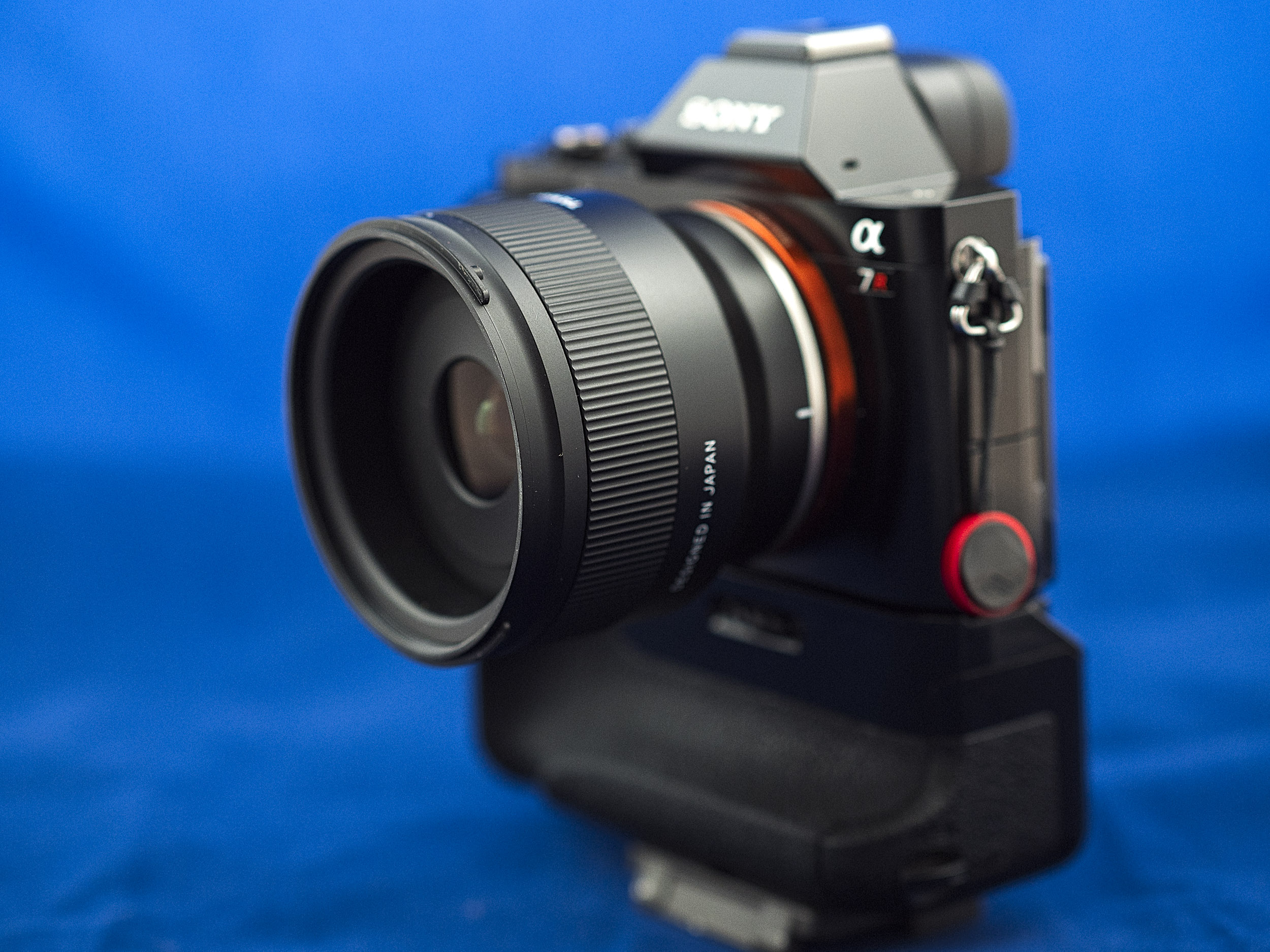
Tamron 35mm f2.8 Di III lens mounted to a Sony A7r.

TLDR


Introduction


The Tamron 35mm f2.8 lens for Sony E mount cameras was announced back in November 2019 as part of a trio of prime lenses which share the same exterior design, construction, size, filter diameter and f stop. The other lens being the 24 and 20 mm. As lenses are becoming ever faster and even larger with price tags to match it is nice to see Tamron do something significantly different. The modest apertures and price tags may put off lens snobs, but they have enabled Tamron to give good optical performance at very reasonable price of $450 AUD. To many f2.8 may be disappointing, but honestly apart from bragging rights about shallow DOF we do not honestly need ultra fast lenses as todays cameras have absolutely astounding high ISO performance. When I started photography you needed fast lenses because film speeds were slow. I regularly shot ISO 25, 50 and 64 film emulsions and I wanted to do it handheld not on a tripod. Now shooting full frame digital at ISO 6400 gives the same image quality as as shooting ISO 64 film stock.


Specifications

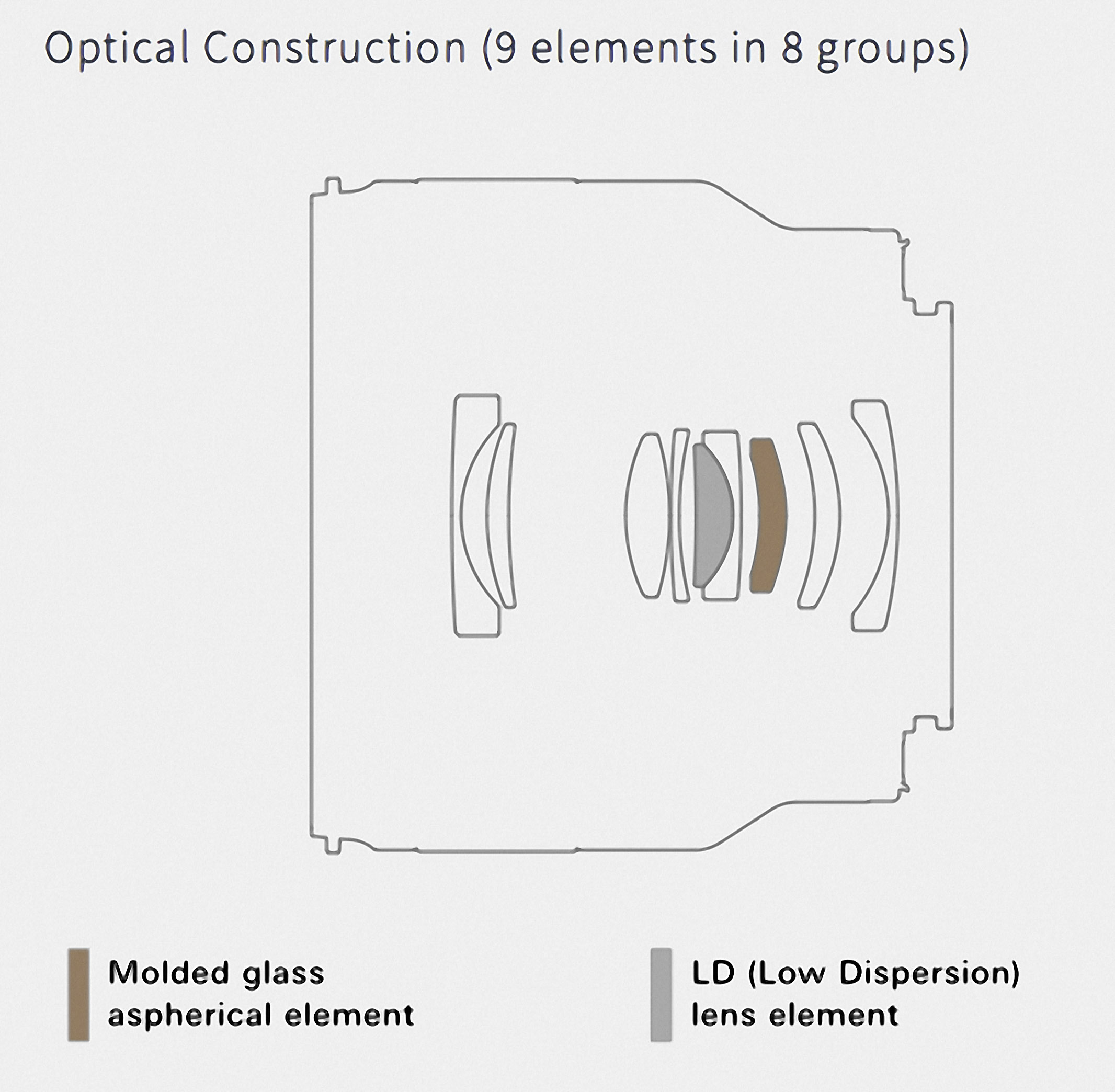
A schematic of the lens construction.


Focal Length 35mm
Maximum Aperture F/2.8
Angle of View (diagonal) 63° 26′ (for full-frame mirrorless format)
Optical Construction 9 elements in 8 groups with 1 low dispersion element and 1 moulded glass aspherical element
Minimum Object Distance 0.15m (5.9 in)
Maximum Magnification Ratio 1:2
Filter Size Φ67mm
Maximum Diameter Φ73mm
Length* 64mm (2.5 in)
Weight 210g (7.4 oz)
Diaphragm Blade Number 7 (circular diaphragm) The circular diaphragm stays almost perfectly circular up to two stops down from maximum aperture.
Minimum Aperture F/22
Standard Accessories Flower-shaped hood, Lens caps
Compatible Mounts Sony E-mount


Golden Orb-Weaving Spider, Nephila edulis. Despite its size and their massive webs they are harmless to humans. Yellagonga Regional Park, Western Australia. The 1:2 magnification of the Tamron 35mm f2.8 makes this sort of photography a breeze.


For me the interesting aspect of this lens and indeed of its siblings is the cminimum focusing distance and it’s ability to shoot half life size. For me this makes them very suitable to creative macro and close up work. It’s not what you’d use to photography small critters as the lens has to be very close to the subject and will scare them off. For product shots, still life and another form of table shot photography it is a very interesting choice.

With a close focusing distance of just 15cm and a magnification ratio of 1:2 the Tamron 35mm f2.8 Di III is very suited to product photography.

Build Quality

In terms of build quality the Tamron 35mm the internet has largely been critical of it. The body is made out of some form of engineering plastic which you’d think had been manufactured by Tupperware judging by a lot of the reactions. Comparing this to recent Sigma lenses and Canon L lenses there is very little to distinguish the Tamron from the others. The only difference I can find without some sort of destructive testing is that the Tamron has a slightly more “satin” finish than the more “mat” of the Canons and Sigmas. The lens mount appears to be chrome plated brass which is nice, and there is an “o” ring which provides some semblance of sealing from the elements at the mount. There is no other weather sealing so I would say the lens isn’t really weather sealed at all despite Tamron’s claims. Tamron isn’t alone in this and I think it is high time the industry took a leaf out of Olympus’s book and actually stated to what level their products are sealed and give an IPX rating. Anything else is just weasley marketing BS as the majority of the camera and lens manufacturers state their products are weather sealed but won’t cover water water ingress under their warranties.  

The metal lens mount as a gasket to provide some weather sealing.

The lens is larger than other 35mm lenses of similar specifications and feels quite light in the hand, but it doesn’t feel cheap. It feels quite sturdy and well made. On the lens barrel there is only a ribbed focusing ring which is of the focus by wire type which means there is little chance of getting repeatable focus pulls using it.A the front of the lens the front lens element is well recessed and while the lens doesn’t focus internally it extends within that recess so it does not protrude beyond the front of the lens barrel. Like all Tamron’s mirrorless range so far the 35mm f2.8 has a 67mm filter thread. Tamron thoughtfully include a lens hood with the lens. Other manufacturers please take note – if Tamron can include a lens hood with its budget lenses there no reason why you can’t. I’m looking at Olympus and Canon here. The lens hood warrants some discussion here as it is quite an interesting design. It is not the conventional bucket or petal shape. Instead it is like a plastic blank that has had a rectangular hole cut in the front and it is very effective at preventing flare and would also provide a degree of protection for the front element. The hood is threaded to take 67mm filters which means that you don’t have to remove it if you want to use a polarising filter. Somebody at Tamron has been doing some thinking. The hood bayonets into place.

The front lens element is well recessed.

Optical Performance

The Tamron 35mm f2.8 has built in lens profiles that are applied to jpgs and RAW files if so selected in the camera’s menu. I’ve opened the files in both Lightroom with the profiles switched on and then in RawTherapee with no profiles. 

Click on the chart to see larger.

In terms of sharpness well at f2.8 at the centre of the image the lens is nicely sharp and contrasty. At f4 the it reaches its best performance and stays there to f11. At the edges wide open it isn’t quite as sharp as the centre, but by f5.6 the edges are as good as the centre. The old adage of stoping down two stops from wide open to achieve optimum performance certainly holds true of this lens. By f16 the image starts to soften as diffraction rears its ugly head.

In terms of optical aberrations well once the lens profile is switched off there is very slight evidence of pincushion distortion and vignetting. At f5.6 the vignetting disappears. A small amount of lateral chromatic aberration can be seen, but it is so slight I had to magnify the images to 300% to see them. Easily fixed in Lightroom. With a maximum aperture of f2.8 longitudinal chromatic aberration is not a problem. It is really fast apertures of f1.2 and f1.4 that really cause problems with this.

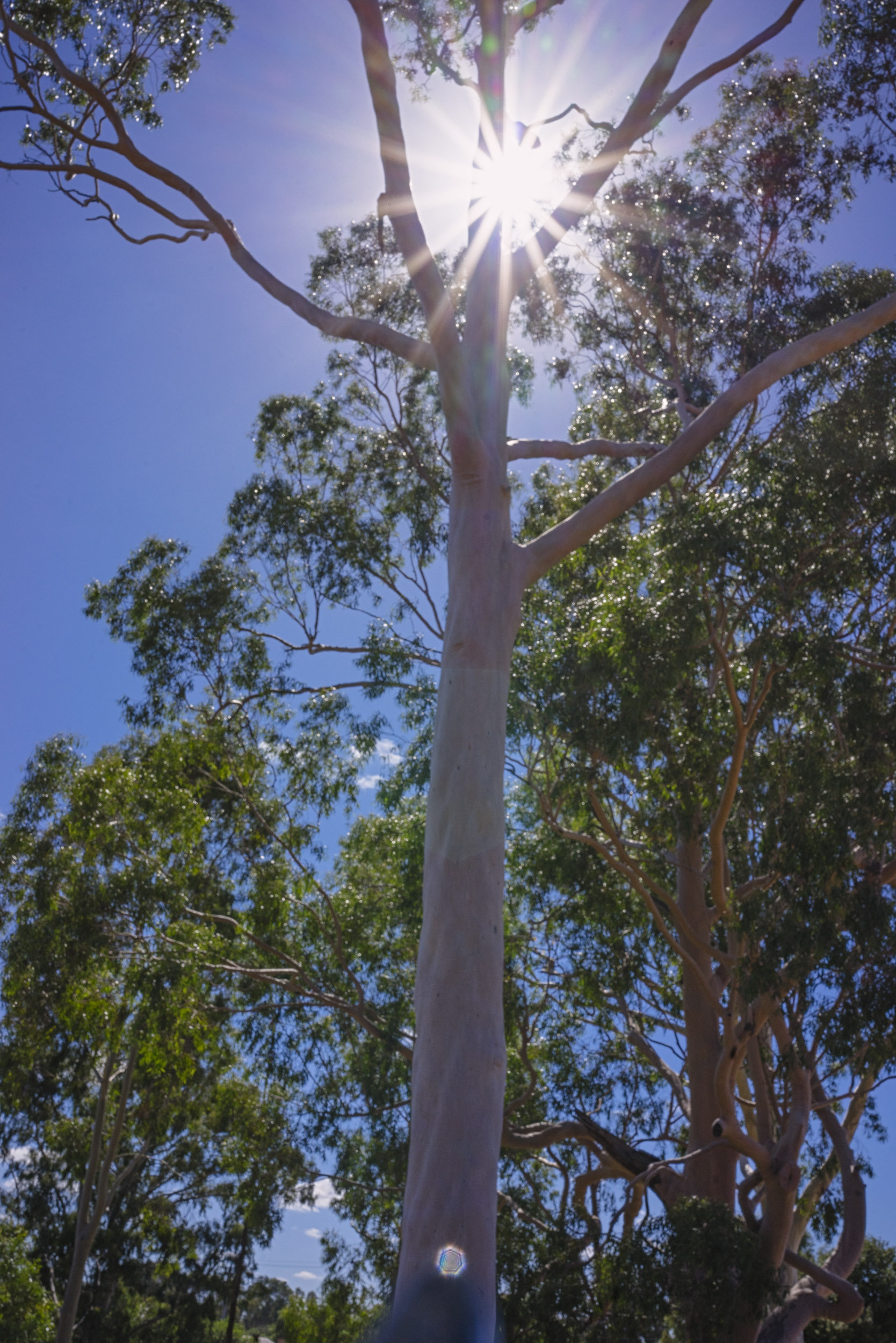
Without a lenshood the lens exhibits quite pronounced ghosting flare. Note the discolourateion on the tree trunk halfway down and the polygonal shape on the trunk at the bottom of the frame. At f22 the sunstars are pronounced, but aren’t that well defined.

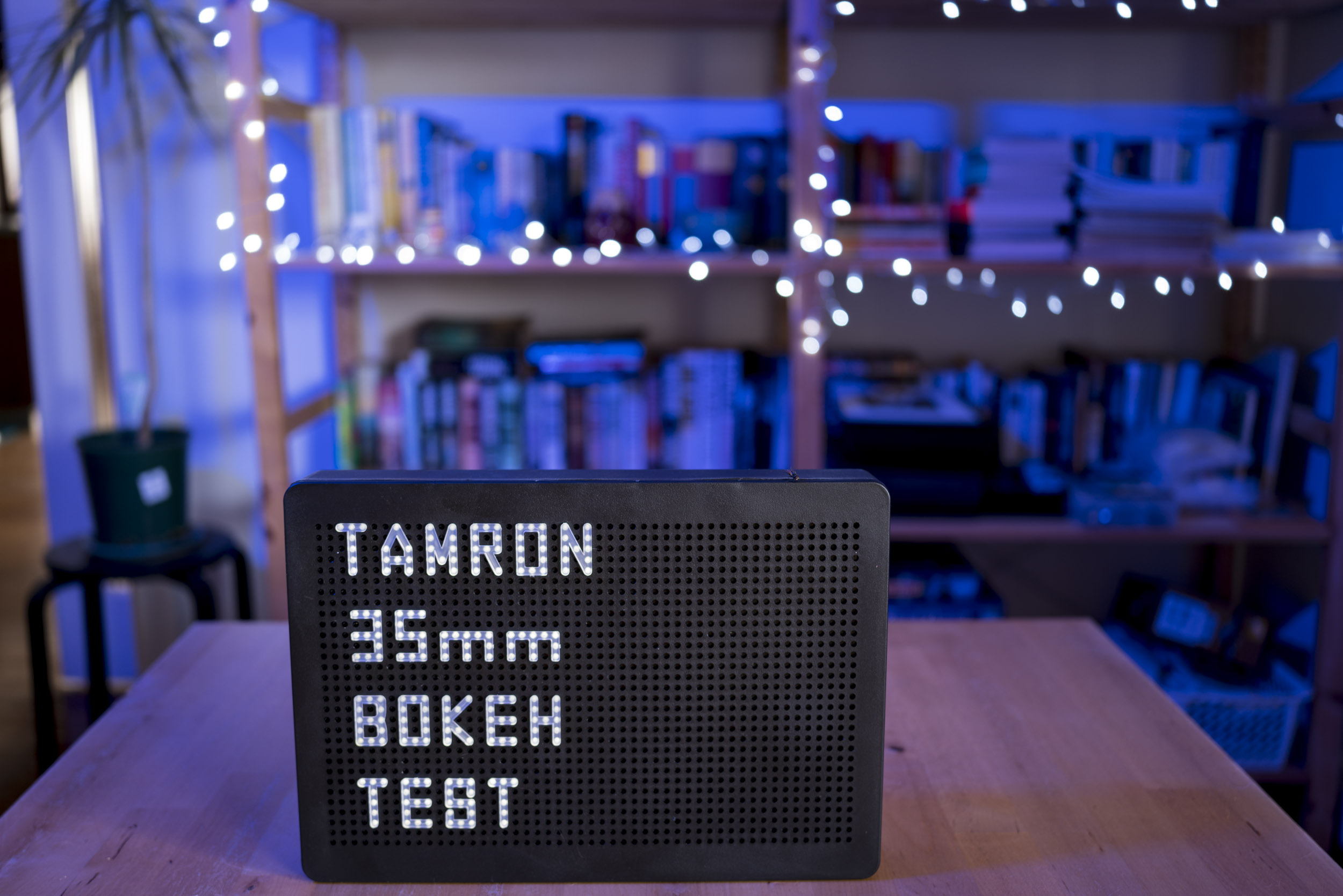
Flare resistance is a bit on the pedestrian side without the lens-hood with ghosting visible. The lens-hood is included in the box for a reason so use it. The seven bladed iris produces what to me are quite attractive sun-stars. Speaking of how the lens handles specular highlights the bokeh is not what I would call thrilling but it is not offensive either.  Wide open in the centre there are round balls with faint onion rings present from moulded aspherical element. I suppose the final polishing wasn’t as smooth as that on more expensive lenses as a cost cutting measure. The edges of the balls are not smooth, they have a fuzzy appearance as the light bleeds into the darker areas which is a form of halation. At the edges of the image the bokeh balls take on that elliptical cats eye shape. By f8 the bokeh balls take on a definite polygonal shape.

In the bokeh test we can see quite nice round balls in the centre of the image wide open, but on closer inspection onion rings are present and the edges have a fuzzy appearence to them. At the edge of the frame the balls have a definite cats eye shape. As the lens stops down the bokeh balls take on a polygonal shape which is really apparent from f8 and beyond.


Click on the image to see larger.

Comparison 

The Olympus OM Zuiko 35mm f2 mounted on a Sony A7r.

Is a cheap auto focusing lens worth getting over a classic manual focusing version? Well to find out I’m comparing the Tamron 35mm f2.8 lens to the Olympus OM Zuiko 35mm f2 lens. Forty five years separate the two optical designs and a lot has changed. There are several different version of the Olympus lens. It had a long production run from 1974 to 2002. I’m using a later multi-coated version. This MC version is 43mm in length, 240g in weight and has a filter thread of 55mm. It has an optical construction of eight lens elements in 7 groups and a minimum focusing distance of 0.3m. When it’s performance is studied we can see there is slight barrel distortion evident in the test image. CA is present when wide open and clears up on stopping down Wide open the lens is quite soft and lacking in contrast both in the centre and at the edges. Both sharpness and contrast improve in the centre when stopped down to f8. The edges show some signs of improvement but not as much as the centre. 

Our test subject for the comparison.

Comparing the two lenses in an actual real world shooting scenario we can see that with both lenses set to an aperture of f2.8 in the centre of the frame there is virtually no difference between them and I’d say they they are equal. In the corners, however, it is a very different story. The Tamron has a good level of sharpness while the Olympus is very soft. Stopping down to their respective minimum apertures – f22 for the Tamron and f16 for the Olympus -we see again in the centre that there is just a very marginal difference. In the corner the Tamron is better by a gnat’s whisker. Just remember that the Olympus was given an advantage. The Tamron shot wide open at f2.8 while the Olympus was stopped down at to f2.8 allowing an improvement in optical performance. At f16 the Olympus didn’t suffer the amount of diffraction the Tamron did at f22.

A comparison between the Tamron 35mm and the Olympus 35mm at f2.8. Click on the image to see it larger.


The same again but at f22.

Conclusion

When Sony launched the original A7 and A7r in 2014 critics poured scorn over the nascent system by saying there were no lenses. Early adopters divided into the system and tried their hand at adapting lenses they did have to fill the gaps in the line up. Fast forward to 2021 and Sony have done a tremendous job at fleshing out their line up. But the most significant thing is that Sony allowed third parties to access the lens mount protocols and this has meant that are lenses that range in price from decidedly wallet friendly all the way to those that would make a trust fund baby wince. At the time of testing the Tamron lens is selling for $350 AUD (which is the equivalent of being given away with a McDonalds Happy Meal in the USA). Looking on EBay the Olympus is selling for between $300 to $700 AUD depending upon condition and version. The version I have would count as a mint late model which would place it in the upper range. So the question is whether having a new autofocus  lens is worth more to you than having a potentially more expensive 20-40 year old lens. Well I had the Olympus lens left over from OM film days (along with quite a few others) and I actually got a secondhand Sony A7r camera so I could use the Olympus lenses. I was very happy with that arrangement. The Tamron registered on my radar because of its macro capabilities.

So you want to go full frame mirrorless with a 35mm prime lens  but don’t want f1.2 lenses or can’t afford them then buy the Tamron. Don’t want want to carry around a lens that is capable of blocking the Suez Canal buy the Tamron. It is nowhere near a perfect lens. It is a modest lens, with a modest price and with a better than modest performance. So with what it costs and with what it can do it is a great buy.

What A Whopper!

The Sigma 150-600mm f5-6.3 DG OS Contemporary lens is part of Sigma’s Global Vision line of lenses. It offers an inexpensive way of getting into wildlife photography.


Not so long ago I looked at the the Panasonic Leica DG Vario-Elmar 100-400 f4-6.3 ASPH Power OIS lens for micro four thirds, well today I’m looking at an alternative lens for APS and full frame cameras – the Sigma 150-600mm f5-6.3 DG OS Contemporary lens. Now confusingly Sigma make two versions of the 150-600 and they are labelled the Sport and Contemporary. The-Digital-Picture.com has put up a good article explaining the difference between the two. The main ones are price and weight with the Contemporary being a 1Kg lighter and $1200 AUD cheaper. This is quite a significant difference and I for one prefer a lighter lens and a heavier wallet. The Contemporary is part of Sigma’s Global Vision line of lenses and is thus compatible with the Sigma TC-1401 1.4x Teleconverter which allows auto focus to work to a maximum of f8 while wide open if your camera supports this feature. This is an interesting option as it allows a reach of 860mm on full frame and a humongous 1376mm on an APSC sensor which is impressive reach for a lens and converter costing less than $2000 AUD. I didn’t happen to look at this option because none of my Canon DSLRs allow f8 auto focusing. shuttermuse.com has an article on f8 focusing with extenders or teleconverters and a list of compatible Canon DSLRs. This does not apply to the mirrorless R and RP which have f11 auto focusing.


Lens mounts available Canon EF

Nikon F

Sigma SA

Focal length 150-600mm
Angle of view 4.1° – 16.4°
Aperture range f5/6.3 to f22/27
Filter size 95mm
Minimum focusing distance 2.8 metres
Maximum magnification 1:4.9
Focusing Silent HSM with internal focusing and manual override
Aperture blades 9
Lens construction 20 elements in 14 groups with 1 FLD and 3 SLD elements
Image stabilisation Yes – 3 stops equivalent
Length 26cm
Diameter 10.5cm
Weight 1.93Kg without lens hood and tripod collar.


Fully extended to the 600mm focal length the lens is a beast. There is no sign of any wobble in the zoom extension.

Physically this is a large lens, it stands head and shoulders above my Canon 70-200mm f2.8 IS L lens which in itself quite a large lens. The 150-600 is also 500g heavier. At 2.1 Kg with lens hood and tripod collar attached it definitely has heft to it. Interestingly Sigma refer to it as a lightweight lens, I suppose it’s all a matter of perspective as the Panasonic Leica 100-400 is 0.985 Kg so the Sigma feels gargantuan compared to it while the Canon EF 600 mm f4L IS is over 3Kg so the Sigma then seems svelte and compact. The lens body is made out of what Sigma calls a Thermally Stable Composite (TSC) which is substantially stronger than conventional polycarbonates while having similar thermal expansion properties to aluminium. The lens mount is made of chromium plated brass which should ensure a long life. All in all it feels a well made and rugged lens, it may feel like plastic but the TSC body feels substantial and gives the impression of being very durable with no creaking or flexing. The Sigma 150-600 is advertised as being dust and splash proof but on closer reading of Sigma’s spec sheet there is only one seal and that is at the lens mount. If you want better then you’ll have to spring for the Sports version.


The Canon EF lens mount is made of chromium plated brass.

When looking at the lens from the front there is a large ribbed rubber zoom ring that has a long throw of about 160º. The action is smooth and feels not too tight nor too loose. As you rotate the zoom ring the lens barrel extends by 8cm. The extension feels secure with no slop or wobble. Just behind the zoom ring on the lefthand side is a zoom lock switch which can lock the zoom ring at the 150mm focal length to prevent zoom creep while carrying the lens. The focusing ring is narrow ribbed rubber and allows you to manually adjust focus while the lens is in the autofocus mode. There are no hard stops which might concern you if you were to use the lens for video. Behind the focusing ring is a panel of four switches and they are:

  • An AF switch allowing to choose between AF, MF and MO (Manual Override)
  • A focus limiter switch allowing a choice of full range, 10m to ∞, and 2.8 to 10m.
  • An optical stabilisation switch that gives a choice of off, on and a panning mode.
  • A custom switch that allows you to select two custom modes that can be programmed using the Sigma FD-11 USB Dock


There are three switches on the lens barrel. One fotr focus modes, the second a focus limiter and the third is for the optical stabilisation.


The focus distance scale is behind a window just below the the focus ring.

Above the switches is a window showing the focusing scale and then behind that is the lens collar. The lens collar allows you to turn the camera from horizontal to vertical while mounted on a tripod, but, unfortunately there are no detents to allow you to do this while looking through the viewfinder of the camera, you have to align the marks on the collar with those on the lens body. The tripod collar can be detached and thoughtfully Sigma provide a cosmetic rubber ring to slide over the lugs that hold the collar in place. The lens comes with a large plastic lens hood the size of a flower pot, it seems sturdy enough and bayonets into place and a nice touch  is that is ribbed internally to prevent reflections. The 150-600 has a 95mm filter thread which means filters will be expensive and potentially hard to get. In terms of accessories Sigma provide a nice well padded lens case, a shoulder strap for it and a Sigma branded camera strap. Like all Sigma lenses you get a lot for the money you spend. Nice one Sigma!

The 150-600 has a 95mm filter thread which means filters will be the size of dinner plates, be expensive and potentially hard to get.

I tested the lens on a Canon EOS 6d and an EOS 550d to see how it would perform on both crop and full frame cameras. In terms of AF performance as neither of those cameras have what can be considered state of the art AF systems, in fact it is over twelve years old, the lens did very well. The single point AF using the centre point was fast and precise and well capable of fixing on small birds amongst foliage. In terms of continuous AF on the EOS 550d the camera was the limitation being only able to shoot 6 frame bursts in RAW, but out of my six shots when tracking my dog trotting five of the six would be in focus. The 6d is able to shoot 4.5 frames per second for 15 frames and on the trotting bull terrier test it managed 12 frames in focus.


This slideshow requires JavaScript.

When it came to BIF (birds in flight not fisticuffs) the AF was more than capable of focusing on and tracking medium to large birds. It really struggled with small birds especially swallows. Put it on a better camera and I’m sure you’d get better results.


Australian White Ibis, by Paul Amyes on 500px.com
Australian white ibis, Threskiornis molucca, Herdsman Lake, Western Australia.


My primary use for a lens like this is handheld bird photography, and as such I didn’t really give the image stabilisation a workout as I seldom use a shutter speed below 1/500 sec. But messing around at home in the house and garden I figured it was good for three stops. Mind you I do have steady hands so your experience may differ from mine.


The optical construction of the lens is twenty elements in fourteen groups with 1 FLD and 3 SLD elements. The FLD (“F” Low Dispersion) glass element, which offers performance equivalent to fluorite.  Canon and other manufacturers have used synthetically grown crystals of calcium fluoride components in lenses to aid apochromatic design, and to reduce light dispersion so lenses made from it exhibit less chromatic aberration. What Sigma has done is use newer glasses and computer-aided design to render the use of fluorite crystals unnecessary. Sigma claim that the FLD element is “highly transparent, its refractive index and dispersion are extremely low as compared to conventional types of glass. It offers characteristics very similar to those of fluorite, which is valued for its anomalous dispersion. These characteristics minimize residual chromatic aberration (secondary spectrum), which cannot be corrected by ordinary optical glass, while helping to produce sharp, high-contrast images.” (https://sigmaphoto.com.au). The three SLD (Special Low Dispersion) glass elements also help to minimize chromatic aberration. To help achieve attractive out of focus transitions there are nine rounded aperture blades which should help achieve nice round bokeh balls when shooting specular highlights.


In terms of optical performance well I’ll deal with full frame and crop separately. First up using the lens on the crop framed 550d. At 150mm the centre of the lens wide open was sharp and contrasty and stayed A as such until f22 when it softened due to the effects of diffraction. At the edges the peak performance was attained at f11 and remained until f22 when it softened again. At 600mm the centre wide open was a little soft and lacking in contrast. This improved by f8 and then deteriorated at f22. The edges weren’t so good – wide open they were soft and lacking contrast and remained so until f22 when they got worse. As for vignetting well at the short end wide open it was apparent, about 1/2 to 1 stop and this disappeared by f8. It was the same story at the long end. Throughout the focal range there is slight pin cushion distortion and some chromatic aberration can also be seen. Open the files up in Lightroom and apply the lens profile and things improve nicely. On the full frame 6d the story is the same except for the vignetting which is naturally worse at around 1-1 1/2 stops which is totally understandable as you are using the whole frame rather than just the central part of the lens coverage.


100 % crop from the centre of a New Holland Honeyeater to show how detail is rendered by the Sigma 150-600mm f5-6.3 Contemporary lens.


What’s all this mean in real life. Well if we look at the image for the New Holland Honeyeater which I took at a distance of around 3.5 to 4 metres and then enlarge the section around the head you can see that there is nice feather detail and that the eye is sharper than a very sharp thing. To get much better you’d have to spend an awful lot of money and if we look at the Canon 600mm f4 lens I mentioned earlier that has an eye watering price of $18,500 AUD which is over 11 times the cost of the Sigma. Personally I know that if I plonked $18 K down on a lens I’d be heading for the divorce court which would make the Canon a doubly expensive lens. So for what it costs the Sigma is amazing value.

Below are some examples of bird photography shot with the lens on both a Canon EOS 6d and 550d.


Welcome Swallow by Paul Amyes on 500px.com
Welcome Swallow, Hirundo neoxxena, Herdsman Lake, Western Australia. Canon 6d with Sigma 150-600mm Contemporary. Exposure: 1/500 sec, f7.1 at ISO 250.


Red Capped Robin, by Paul Amyes on 500px.com
Red capped robin, Petroica goodenovi, Avon Walk Trail, York, Western Australia. Canon 550d with Sigma 150-600mm Contemporary lens. Exposure: 1/500, f6.3 at ISO 160.


Chestnut-rumped Thornbill by Paul Amyes on 500px.com
Chestnut-rumped Thornbill (Acanthiza uropygialis), York, Western Australia. canon 550d with Sigma 150-600mm Contemporary lens. Exposure: 1/1000 sec, f6.3 at ISO 320.


Mistletoebird, by Paul Amyes on 500px.com
Mistletoebird, Dicaeum hirundinaceum. The Nyoongar name is Minnijit. York, Western Australia. Canon 6d with Sigma 150-600mm Contemporary lens. Exposure: 1/1000 sec, f8 at ISO 1600.

So would I recommend the lens? Yes without hesitation. It performs very well and is sold at a very good price and you can’t argue with that.

A Small Surprise

The Olympus 25mm f1.8 standard lens. Small but beautifully formed. Olympus even give you a lenshood!

The other day I was sitting at my desk just idly surfing the net when a courier van pulls up and leaves a small box. Once unwrapped it revealed an even smaller box containing  the Olympus m.Zuiko Digital 25mm f1.8 lens. Now for a long time I’ve always believed that every photographer should own a fastish standard lens. In fact I also believe that if should ever find yourself in the photographic doldrums then just committing to use a standard lens for a period of 12 months will see your photography improve no end. I had one for my OM film system (and still have and use it) and I have one for my Canon EOS digital kit, but a little while back I had a dalliance with film range finder cameras and I eschewed the fast 50mm in favour of a pancake 35mm moderate wide-angle. In fact I was so smitten with the focal length that when I adopted the m4/3 system the Olympus 17mm f2.8 pancake was a must have, and if I look through my Lightroom catalogue over half the picture I’ve taken with my Pen and OMD have been with that lens. So now I’m in possession of a fast standard again.

No obvious lens distortion.

My initial impressions are that although it has a plastic body it is well made, although not as well made as say the 60mm f2.8 macro. It continues with the clean modern lines that Olympus adopted with the launch of the EM-5 and it feels well-balanced on both my EP-2 and EM-10. The other small thing that makes feel very positive about the lens is that Olympus have finally stopped being tight and are including lens hoods. The hood is hard plastic and bayonets securely on to the lens after the front cosmetic rim of the lens has been removed. Nice – a good lens should have a lens hood to get the best out of it. After a couple of days of shooting stills out and about I found that the focal length took a little adjusting to, it is a bit narrow for my tastes, but I quickly adapted and started looking for subjects that would play into its strengths.

DOF comparison 1 Olympus Zuiko 25mm f1.8 lens wide open at f1.8
DOF comparison 2 Olympus Zuiko 25mm f1.8 lens at f8
DOF comparison 3 Olympus Zuiko 25mm f1.8 lens at f22

So optically how did it fare? Very well. There is no distortion worth talking about and although shooting wide open there is some slight chromatic aberration but this disappears very quickly and by f4 it is gone. Sharpness is good with the centre of the lens performing very well wide open with some softening towards the corners again things improve quickly as you stop down, but get down past f11 and things start to soften up again as diffraction rears its ugly head. Diffraction isn’t a fault of the lens it is a problem with the size of the sensor, and all sensor and film sizes suffer from it. The lens isn’t what I would call “clinically” sharp in the way a lot of modern lenses are, it renders nicely and has a nice fall off from sharp edges to the out of focus areas. I’m not by any means a bokeh slut but this lens does render out of focus specular highlights in a very pleasing way. It made me want to go out and look for images that would give me those velvety smooth transitions.

Decentering test on the Olympus 25mm f1.8 at f1.8.
Decentering test on the Olympus 25mm f1.8 at f5.6.
Beachside Bully Run. The autofocus is quick and accurate and was able to track my dog running erratically on the beach.

The lens focuses insanely quickly on the EM-10, which is as it should be on the latest generation of m4/3 cameras and is no slouch on my first generation EP-2. The worrier of DPReview now obsess over centring and on the micro four thirds forum the hysteria regarding the Olympus 25mm is something to behold. A few people there are expecting lens perfection from this lens and unfortunately no lens is perfect. Does the lens suffer excessively from being de-centred – well according my exhaustive testing of just one sample lens the answer is no. The lens is well within acceptable and I have seen much worse on lenses that cost ten times the amount this one does. My advice is that if you spend all day shooting pictures of brick walls and sheets of newspaper right way up and upside down then blow the resulting shots up to 3 or 400 % and then worry continually that you have a bad copy, or your rate of return rate of “faulty” products is so high that the customer service people know who is on the line just from the sound of your voice then you need a new hobby, therapy or both. Life is short, hobbies are supposed to bring enjoyment and fulfilment not create endless gear angst.

White flowers with bokeh balls. Dodges Ferry, Tasmania.
Tea Strainers
Banoffee pie Banjo’s Bakery, Hobart, Tasmania.
Liberal Party Hobart, Tasmania.
Coffee Lovers Hobart, Tasmania.
On location filming at the Bellerive Yacht Club with the Olympus EM-10 and 25mm f1.8 lens.

For video the lens is a very good choice. I shot the video clip below to test the lens’ resistance to flare, how it coped with continuous focus in video, close focusing and bokeh rendition.

Now there are some lenses which are so good that people buy into the system just to have a copy of that lens. Is the Olympus 25mm one of those? The short answer is no, but that is a disservice to this lens. It is a very capable performer and I think it should be given serious consideration by anyone who is already invested in the micro four thirds system. I really must say I was pleasantly surprised at how well the 25mm performed. It’s not the fastest lens, it’s not the most expensive, nor is it the cheapest. There are other m4/3 lens that are optically superlative and there are those whose performance is less than stellar to put it mildly. The Olympus m.Zuiko Digital 25mm f1.8 lens is a “Goldilocks” lens – just right.

Ouch! Don’t headbutt the buildings – it hurts.
Blowing in the Wind Bellerive Yacht Club, Tasmania.
The SS Kosciusko part of the facade of the Waterfront Hotel in Bellerive.
Looking out over the marina at Bellerive Yacht Club.
Stool Samples Hobart, Tasmania.