Optical Antithesis


A review of the Sigma 16mm f/1.4 DC DN lens for m4/3


The Sigma 16mm f1.4 shown mounted to an Oympus OMD EM1 mk 1 which is one of the larger m4/3 cameras.


I’ve said many times on this blog that my favourite focal length is 35mm (35mm equivalent) which give a diagonal angle of view of 63.4º To me it is a relaxing normal view, I find 50mm a bit too tight and 28mm a bit too “loose”. So when I migrated from so-called full frame to micro four thirds in 2010 one of the first lenses I bought was the Olympus m.Zuiko 17mm f2.8 pancake lens. Actually at the time there were only three lenses in the system the 17mm, a 14-42mm kit lens and the 40-150 telephoto kit zoom and I ended up getting them all.


Olympus m.Zuiko 17mm f2.8 shown on an EP5. The lens was the first prime introduced for the Olympus’ m4/3 system.


The 17mm was equivalent to 34mm in in full frame terms and has a diagonal angle of view of 65º, so close enough as not to make any real difference. It wasn’t a well received lens despite being what initial advocates of the micro four thirds said they wanted – pancake lenses. It’s slow maximum aperture of f2.8, slow and noisey auto focus combined with less than stellar optical performance put many people off and they went for the much more expensive Panasonic 20mm f1.7 which had the virtues of being optically better, and having a faster maximum aperture. It still wasn’t great in the AF department though. But hey these were the early days of mirrorless technology and AF systems were not very quick and accurate then. But anyways I got the Olympus in a kit with my Olympus EP2 and I actually loved it. I could slip it mounted to the EP2 in my pocket which made it a great stealth camera combination and I used it to shoot my TransPerth-Transhumance project. I still use the lens today, mainly on my EP5. The area where I felt it was absolutely hopeless was video. The AF was too slow, too noisy (think angry wasp stuck in a jar) and I wanted a bit more subject isolation than the f2.8 aperture could give.


The Sigma 16mm f1.4 compared to the Olympus 17mm f2.8, 25mm f.1.8 and the 45mm f1.9.


The Sigma 16mm f1.4 is a physically large lens. Here it is shown with the Olympus 12-40mm f2.8 and 75-300 f4-6.3 zoom lenses.


So fast forward a few years and I’m shooting more and more video and I decide to get myself a better 17mm lens. In the intervening years Olympus had produced the very favourably received 17mm f1.8 and the eye-wateringly expensive f1.2 version. Panasonic had also come to the party with their Panasonic Leica Summilux 15mm f/1.7 lens. In fact I went to my local (if you can call 110Km away local) camera dealer to buy this lens and it was always out of stock which made me want it even more. But in the end I went for an outlier in the form of the Sigma 16mm f/1.4 DC DN lens. The reasons being that f1.4 is faster than f1.9, it was cheaper than the f1.2 and the difference between f1.2 and f1.4 is slight, and my dealer had it in stock. So what makes it and outlier? Well to put it bluntly it’s bloody huge. It has a 67mm ⌀ filter thread which compares to 37mm for the Olympus 17mm f2.8. It is bigger than the Olympus 12-40mm f2.8 and the Panasonic Leica 8-18mm f2.8-4 while being only a little shorter than the Olympus 75-300mm f4.8-6.7. The 16mm focal length equates to 32mm on full frame with a diagonal angle of view 68.1º so is a bit wider, but when used with the Panasonic G85 for 4K video this isn’t much of a problem as the camera crops in slightly. So how come this lens is so lardy I hear you all ask. Well this lens wasn’t designed for micro four thirds, it was initially designed for the Sony 6000 series cameras with an APS sized sensor where it equates to being a 24mm in full frame terms. To get a wide angle lens that’s fast and a good optical performance means lots of glass and glass is heavy, and this lens is large and heavy for APS format cameras. To get some additional return on their investment Sigma decided to offer the lens in micro four thirds mount hence it seeming a funny focal length and being bigger than necessary.


Vital Statistics

Olympus 17mm f2.8

Sigma 16mm f1.4

Diagonal angle of view 65º 68.1º
Optical construction 6 elements in 4 groups 16 elements in 13 groups
Diaphragm 5 rounded blades 9 rounded blades
Minimum aperture f2.8 F1.4
Maximum aperture F22 F16
Minimum focusing distance 20cm 25cm
maximum magnification ratio 0.11x 0.07X
Filter diameter 37mm 67mm
Dimensions ⌀ 57mm x 22mm (H) ⌀ 72.2mm x 92.3mm (H)
Weight 71g 405g
Internal focusing No Yes


In the hand the Sigma 16mm feels very dense and substantial. The lens body is made out of what Sigma calls a Thermally Stable Composite (TSC) which is substantially stronger than conventional polycarbonates while having similar thermal expansion properties to aluminium. The lens mount is made of chromium plated brass which should ensure a long life. The Sigma 16mm is advertised as being dust and splash proof but on closer reading of Sigma’s spec sheet there is only one seal and that is at the lens mount. The lens comes with a bayonet mount petal lens hood which has a ribbed grip to make attaching and detaching easier. While it is good that the lens comes with a hood it’s not the best implementation and feels quite insubstantial and can be fiddly to attach as it can foul and not lock home. There is a ribbed rubber focus ring of the fly by wire type – it feels smooth and easy to use. There are no other controls or switches which means if you want to switch between AF and manual focus you will have to use the camera controls for that.


The Sigma 16mm has an optical construction of 16 elements in 13 groups with 3 FLD (“F” Low Dispersion) glass elements, which offers performance equivalent to fluorite which exhibits less chromatic aberration than those utilising a traditional flint glass. There are 2 SLD (Special Low Dispersion) glass elements which also help to minimise chromatic aberration and 2 ASPH moulded glass aspherical elements which work to reduce optical aberrations. According to Sigma’s website the ASPH elements are polished with a tolerance of under 10 nanometers or 0.000001 millimetres which according to Sigma reduces onion ring bokeh.


Performance

100 % crops showing lens performance wide open and then at the best performing aperture.


In terms of autofocus the stepping motor is fast and accurate and very smooth when shooting video. I tested the lens on the OMD EM1 mk ii which has on sensor phase detect AF and on the Panasonic G85 which uses DFD technology – a variant of contrast detect auto focus that requires the lens to provide a profile to the camera to ensure fast and accurate AF. The Sigma does not have such a profile as these are limited at present to only Panasonic’s own lenses. Despite that there were no problems and I could detect no discernible difference between the Olympus and the Panasonic. The only downside in the AF department is that I can’t use the Pro Capture Low setting which gives up to 18 fps with auto exposure and AF tracking. This is no fault of Sigma’s as the option is only available with Olympus lenses.


Optically – well straight from the get go the Sigma is impressively sharp wide open corner to corner. The performance improves slightly (and it is only visible on my 4K screen at 300%) as you stop down. Diffraction sets in at f16 and this does soften the image. In terms of chromatic aberration, well wide open in high contrast situations it is apparent albeit slight and it is easy to correct in post. The lens is reasonably resistant to flare – but if you have a specular light source in the frame you will experience some veiled flare and ghosting. If you turn off the built in lens profile you can observe a slight barrel distortion, but switch on the profile and it is not visible. The bokeh balls this lens produces are more or less round when shooting wide open even at the edges of the frame and the transitions are nice and smooth. There is some onion ring bokeh which is the result of using moulded aspherical lens.Vignetting is not a problem and is very slight in the region of 1/2 stop.


Chromatic aberration is quite apparent on this lens. It is also quite prone to flare even when using the included lens hood.


Verdict

This slideshow requires JavaScript.


Being designed to have an image circle much larger than micro four thirds requires means that you are using the best performing part of the lens and this really shows. Just for giggles I compared the Sigma with my old Olympus. The Olympus is noticeably soft in the corners at all apertures and just average in the centre. It suffers badly from chromatic aberration. Vignetting is very apparent, in excess of 1 stop in the corners with the lens profile switched on and getting on for 2 stops when switched off. Physically, optically and figuratively the Sigma stands head and shoulders above the little Olympus. The only area where the Olympus wins out is its small size and that is why I’ll continue to use it when I want something small and compact. For every other occasion I’m reaching for the Sigma. The knock on effect is that I’m seriously wondering about replacing my Olympus 45mm f1.8 with the Sigma 56mm f1.4.

Broadening My Horizons…


… with the Panasonic Leica DG Vario-Elmarit 8-18mm f2.8-4 micro four thirds lens which will be referred to hence forth as the 8-18 for brevity’s sake. For those who prefer video there is a video review at the bottom of the page.

The 8-18 was introduced as part of Panasonic’s Leica branded f2.8-4 lens range in April 2017. I was immediately interested as I wanted a wide-angle zoom in m4/3. I had discounted the existing Panasonic 7-14mm f4 and the Olympus 7-14mm f2.8 because they wouldn’t accept screw in filters and the Olympus 9-18mm f4-5.6 because the collapsible design means the lens is prone to failure due to the internal ribbon cables breaking. The new 8-18 presented itself with a high quality metal construction that was splash proof and a modest 67mm filter thread. I wanted to use the lens for video work and so the ability to take a variable neutral density filter was a must. So when the lens became available here in Australia I plonked my cash down and got one.


My first impression on opening the box was that it is a quality bit of kit – it feels nice in the hand with a cool metallic feel and satisfying density. The bulbous front element is well recessed and combined with the excellent locking lens hood means that it is protected from stray light and from being physically damaged. The lens barrel has two ring controls – the front being for focus and the rear for zoom – and a switch for selecting auto or manual focus.The focusing ring is of the fly-by-wire type that twiddles endlessly – I wish that Panasonic would follow Olympus’s lead and have the pull back clutch type focusing rings with hard stops. The zoom ring is nicely damped and travels in a smooth 90º rotation. Another gripe is that both Panasonic and Olympus are members of the m4/3 consortium so why oh why can’t they agree on which way the zoom ring turns? Both zoom and focus are internal which is nice as it does not affect the centre of balance while using a gimbal. The lens body is finished in a smooth black satin with the engravings done in the Leica font and colours. The lens mount is metal and looks to be chrome plated brass. So full marks to Panasonic for presentation.

Vital Statistics

lens mount m4/3
focal length 8-18mm (16-36mm 35mm full frame equivalent)
angle of view 62º – 107º
maximum aperture f2.8-4
minimum aperture f22
filter size 67mm
optical stabilisation no
internal focusing yes
internal zoom yes
minimum focusing distance 23cm
maximum magnification 0.12 x
number of lens elements 15
number of lens groups 10
weight 315g
length 88mm
diameter 73.4mm


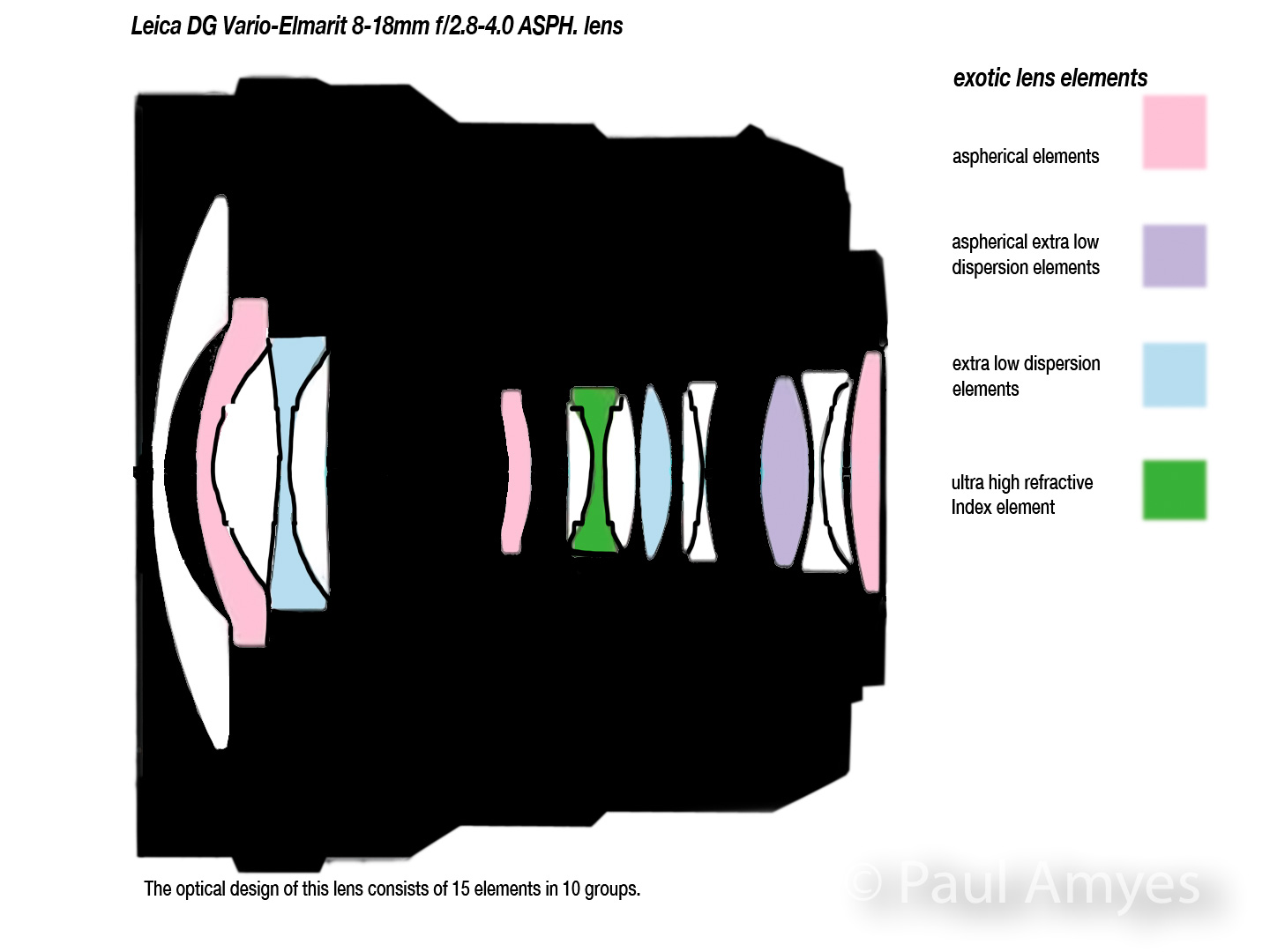
The lens construction is 15 elements in 10 groups with 1 aspherical extra low dispersion element, 2 extra low dispersion elements and 1 ultra high refractive index element. Combined with the nano coatings they should reduce internal flare, distortion and chromatic aberration. Control of distortion and chromatic aberration is also aided by an internal software profile that is baked into the image file. A lot of people don’t like this approach as they feel corrections should be made optically. The main criticism is that there is too much of an image quality hit in the corners with this approach. Hasselblad was the manufacturer to take this approach with their H3 camera and when that was introduced there were few complaints about image quality. The reality is that using lens profiles means lenses can be cheaper, smaller, and lighter than their optically optimised brethren.

The 8-18 has a variable aperture and unfortunately it quickly steps down as you zoom in as can be seen by the chart below.

8mm f2.8
9mm f3.1
10mm f3.2
12mm f3.4
14mm f3.6
18mm f4

Test Results

I’ve done my standard tests to look for distortion, chromatic aberration, and sharpness at 8mm, 12mm and 18mm to give an indication of how the lens does throughout its zoom range. I have just for interest sake posted images with no profile correction to give an idea of what the lens is actually doing. Click on the images to see them at full size.


8mm at f2.8 no lens profile applied


8mm at f2.8 with internal profile applied.

At 8mm without any inbuilt lens profile applied there is very obvious barrel distortion and vignetting at f2.8. With the profile applied there is still a very slight barrel distortion and the vignetting remains until f5.6. In terms of sharpness well at f2.8 the centre of the image is nicely sharp and contrasty and remain so until f16 when diffraction kicks in and softens the image. In the corners the story is different, at f2.8 the corners are significantly softer and less contrasty than the centre, they improve a little as you stop down reaching best performance at f5.6 and then get worse at f16 with diffraction. A small amount of chromatic aberration is present throughout the aperture range and is easily corrected in post.


12mm at f3.4 no lens profile applied


12mm at f3.4 with profile applied.

At 12mm we can see no distortion when the lens profile is applied and the vignetting is about 1/2 stop and is barely discernible. Wide open at f3.4 the centre of the image is sharp and contrasty and the best performance is at f5.6. In the corners the image is softer and has less contrast than the centre. The best performance is at f8. Diffraction starts to set in at f11.


18mm at f4 no lens profile


18mm at f4 with internal profile applied.

At 18mm there is some pincushion distortion in the profile corrected image. There is also a tiny bit of vignetting at f4 but this clears up at f5.6. Sharpness at f4 is very, very good in the centre throughout the aperture range only deteriorating at f16 due to diffraction.The corners are remarkably sharp at f4 but have slightly less contrast than the centre. Peak performance sets in at f5.6 and then again diffraction rears its ugly head at f16 and spoils the party. Chromatic aberration is very well controlled across the whole range and is very, very slight.

Like most ultra wide-angle zooms Panasonic’s 8-18mm f2.8-4 is prone to flare. The recessed front element and tulip lens hood do minimise this, but with the sun in the frame you will see veiling flare. When stopped down you can achieve nice sun stars.

Like most wide-angle zooms the 8-18 is prone to flare. In order to reduce this the engineers recessed the front lens element and then provided a decent lens hood. The Panasonic 7-14mm f4 caused purple blobs on Olympus cameras when there was a specular light source in the frame. Some people pointed the finger at the difference in UV coatings between Panasonic and Olympus cameras. Others said the thickness of the Olympus sensor stack caused the problem. Anyway the 8-18 is thankfully free of those artefacts. Shooting into the sun there is some veiling flare and ghosting.

Auto focus is done via a stepping motor and it is designed to work with Panasonic’s Depth From Defocus technology that is basically a contrast based auto focus system that is enhanced by software profiles for each Panasonic lens. Single point autofocus in single shot drive mode is incredibly fast and accurate. I decided to check the Continuous Auto Focus by continuous shooting at medium speed wide open on the Panasonic G85 with a person walking slowly towards the camera at focal lengths of 8mm and 18mm. All the shots were in focus. Then I tried to see how the lens would perform on a camera without DFD – in this case an Olympus OMD EM1 mk i. At 8mm and f2.8 all the images were in focus. At 18mm shooting a burst of 10 images the camera lost focus on the last 2 images of the burst. So this very limited test shows that the autofocus of the lens does perform better on Panasonic cameras with DFD.

Conclusions

The Panasonic Leica DG Vario-Elmarit 8-18mm f2.8-4 lens with Cokin P system wide-angle lens filter holder attached.

Ok I’ve had the lens a year now and I’ve used it for stills, time lapses and video shooting on the afore-mentioned EM1 and G85 along with an EP5 and EM10 so what can I say. The in camera lens profiles make a huge difference in terms of distortion, but most people won’t see this as they’ll see the corrected images. I did expect this to have some impact on sharpness in the corners but was pleasantly surprised to find that not the case at all. Most zooms perform best at the short end and become softer at the long end. With my copy of the 8-18 this lens is very good at the long end and it is a little softer at the short end. The ability to use filters is a boon for landscape photography and video. The 67mm filter size does not make filter purchases onerous and with the wide-angle filter holder you can use the Cokin P filter system with rectangular filter with an 85mm width. It is really nice not to use filters the size of dinner plates with this lens. I’ve been caught in a couple of downpours while using the 8-18 and have had no problems. I have found the lens immensely satisfying to use and have put it to more uses than I originally thought I would. In all I feel it is a very good lens if you can live without a fixed aperture. I would definitely recommend it.


This slideshow requires JavaScript.


Voigtländer 15mm f4.5 Super wide-Heliar

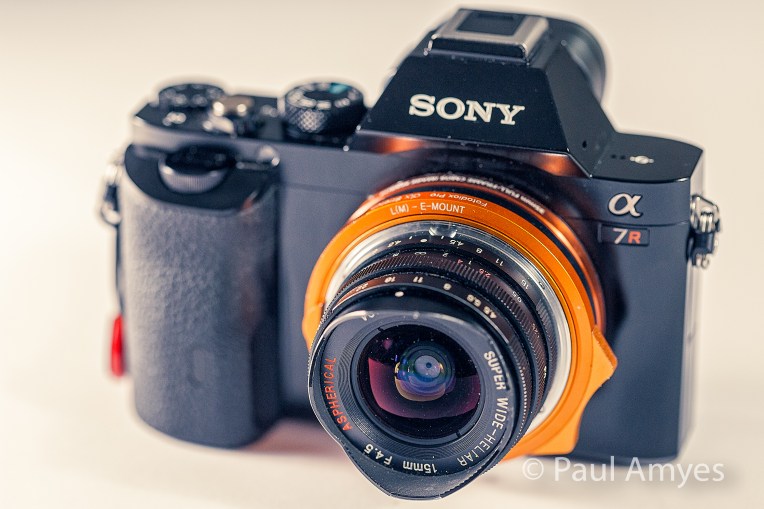
Cosina Voigtlander 15mm f4.5 Super Wide-Heliar lens mounted to a Sony A7r via a Voigtlander VM Adapter II. and Voigtlander L39 to M mount adapter.

I’ve been meaning to write a review of this lens for a long time – well over a year in fact – and it has proven difficult for a number of reasons which will become apparent as we proceed. In an ideal world all lenses would be wonderful for every possible use we put them to, and to be fair with modern lens their computer aided design makes this happen for the most part. Things get sketchy when we are dealing with older designs on modern digital cameras. High resolution digital imaging has placed a great deal of strain on lenses. With film only a few people had the time, ability, resources and inclination to examine the optical performance of lenses. This was largely the province of a few magazines (remember them?) and they would accompany a review with a couple of graphs which would reference the resolving capabilities with fine grains low ISO black and white films developed in special developers designed to minimise grain and maximise acutance. Now anyone can open up an image in Photoshop and zoom into 200% and see a lenses faults. This is why Canon, Nikon and independents such as Sigma are going through their catalogue of lenses and updating them, and this need for optical improvements explains why lenses are getting bigger, heavier and more expensive. Back to the matter at hand. The video below is the short version.


Cosina Voigtlander 15mm f4.5 Super Wide-Heliar Lens.

The Voigtländer 15mm f4.5 Aspherical Super wide-Heliar to give its full name is really the antithesis of modern lens design. It is small, light, affordable and not heavily optically corrected. But having said that this is the lens that really put Cosina’s re-launch of the Voigtländer brand on the radar of photographers. I can remember when this lens first came out a friend of mine borrowed one and ran around madly shooting roll after roll of film with a silly look on his face enthusing about it wildly. Up until then the widest lens in Leica M mount was the Zeiss 15mm f8 Hologon of which only 225 were made and currently change hands for around the $10,000 USD for one in mint condition.

The Voigtländer 15mm f4.5 is now discontinued but can be obtained as new old stock for approximately $600 USD, or second-hand on Ebay for around the $400 USD mark at the time of writing.


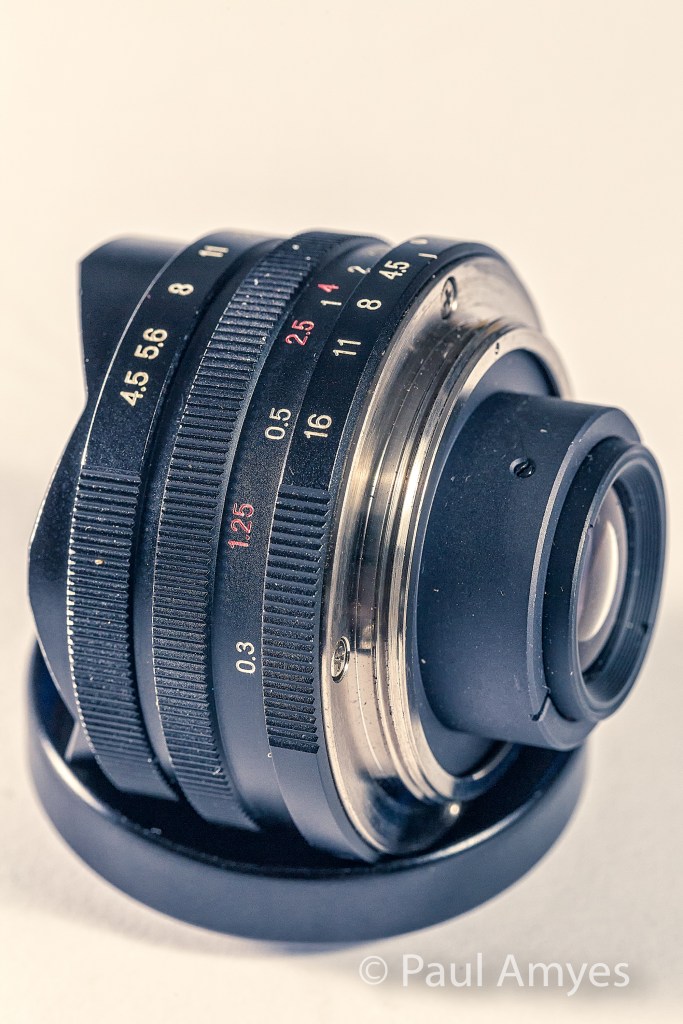
Cosina Voigtlander 15mm f4.5 Super Wide-Heliar lens showing the Leica L39 screw mount.


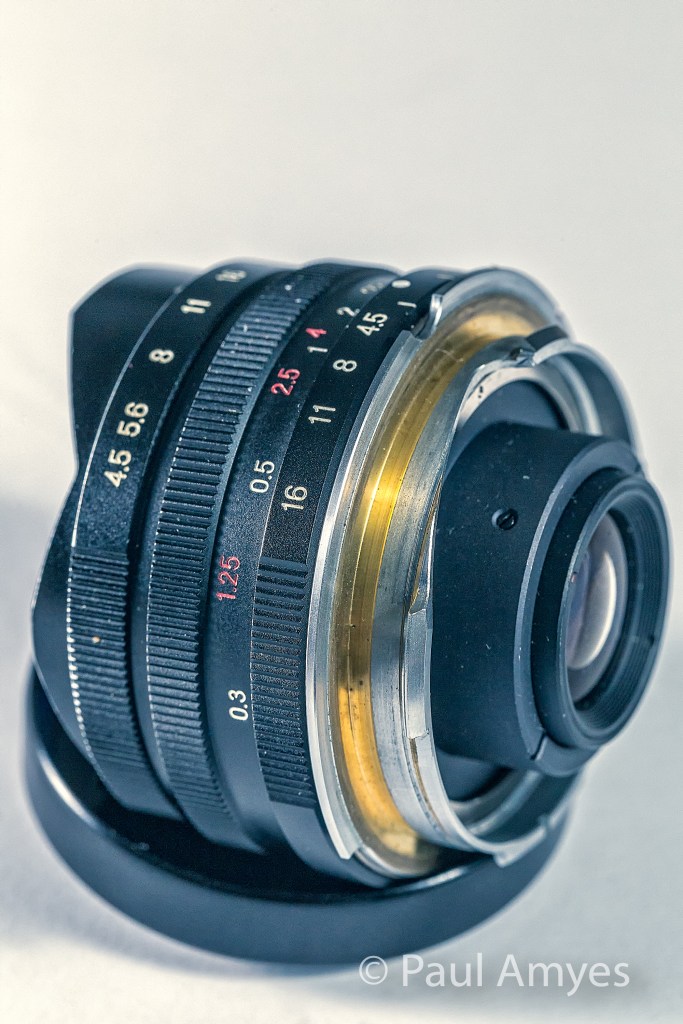
Cosina Voigtlander 15mm f4.5 Super Wide-Heliar lens showing the Voigtlander L39 to M mount adapter.


Cosina Voigtlander 15mm f4.5 Super Wide-Heliar lens showing the Voigtlander VM adapter II Sony E mount adapter.


Specifications

Mount – Leica thread or L39
Angle of view – 110º
Lens construction – 8 elements in 6 groups with one aspherical element
Number of aperture blades – 10
Aperture range f4.5 – f22 in half click stops
Minimum focusing distance – 29.85cm or 11.75 inches
Weight – 113g or 4oz
Diameter 49.6mm or 1.94 inches
Length – 30.7mm or 1.2 inches
Filter thread – N/A
Lens hood – built in tulip style
Rangefinder coupling – no

The lens is very well made – up to Cosina’s very high standards and it has, despite its diminutive size a solid feel and satisfying heft. The aperture ring is at the front of the lens, as is usual with rangefinder lenses, and turns nicely with satisfying half stop click indents. The focusing action is very smooth and has an approximate 100º throw. I found that I tended to use hyper focal distances to zone focus the lens in use as the short focal length means that the DOF is immense. The lens has a very clearly marked scale to make this easy. An aperture of f8 means that everything from 0.5m to infinity is in focus. Conversely lovers of shallow depth of field should really be looking elsewhere.


Test Results

Cosina Voigtlander 15mm f4.5 Super Wide-Heliar lens mounted to a Sony A7r via a Voigtlander VM Adapter II.


Cosina Voigtlander 15mm f4.5 Super Wide-Heliar lens mounted to a Sony A7r via a Voigtlander VM Adapter II.


Years ago Clint Eastwood made a film called “The “Good, The Bad, The Ugly” (a movie which had the coolest theme tune ever, actually that is an exaggeration as everyone knows Shaft had the coolest, but it’s a close run thing) well this lens is all three. Good, bad and ugly. The good comes when you use the lens as intended on a film rangefinder body. The bad when you mount it on a digital m4/3s body and the ugly when you put in from of the A7r’s 36Mp sensor. This lens is one of the worst I’ve ever had on a digital camera – the worst was a $20 25 mm f/8 Holga lens in m4/3s mount which I tried using on my Olympus EP2 several years ago, but that is, as they say, another story. My friend who I mentioned earlier abused Kodak Tri-X by pushing it, developing in Rodinal and then lith printed the results. He wouldn’t have noticed what I’m about to describe. So this is how it was on the Sony A7r.Right from the get go there is obvious barrel distortion. Wide open there is considerable vignetting which has a very obvious magenta cast. No matter how far you stop down this does not go away (kind of like Mormon missionaries on your doorstep). Wide open the centre sharpness is quite good and remains so until f22 when diffraction rears its ugly head. The corners are smeared and out of focus, things improve a little by f11 but they never get to the level of sharpness of the centre of the lens. Chromatic aberration is also present throughout the aperture range. Flare for such a wide lens is remarkably well controlled and lovers of sunstars should be happy as the 10 aperture blades produce nice results.


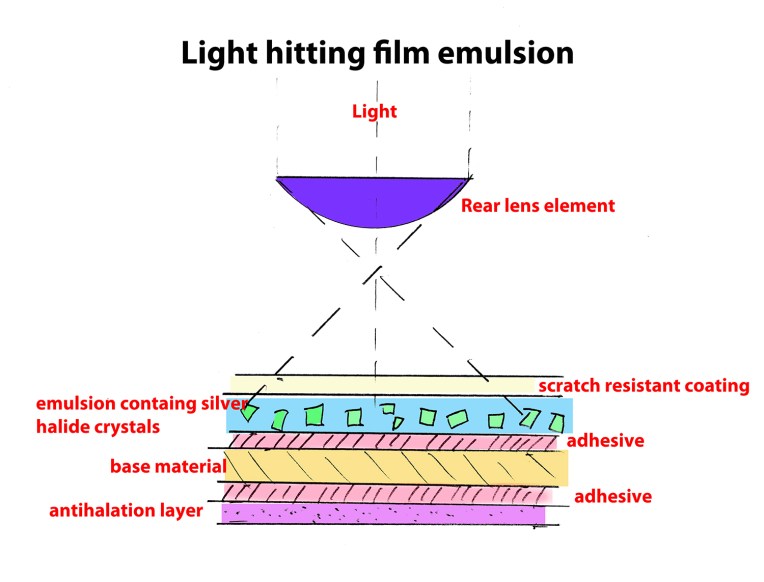
With film the light-sensitive silver halide crystals don’t care at which angle light hits them.

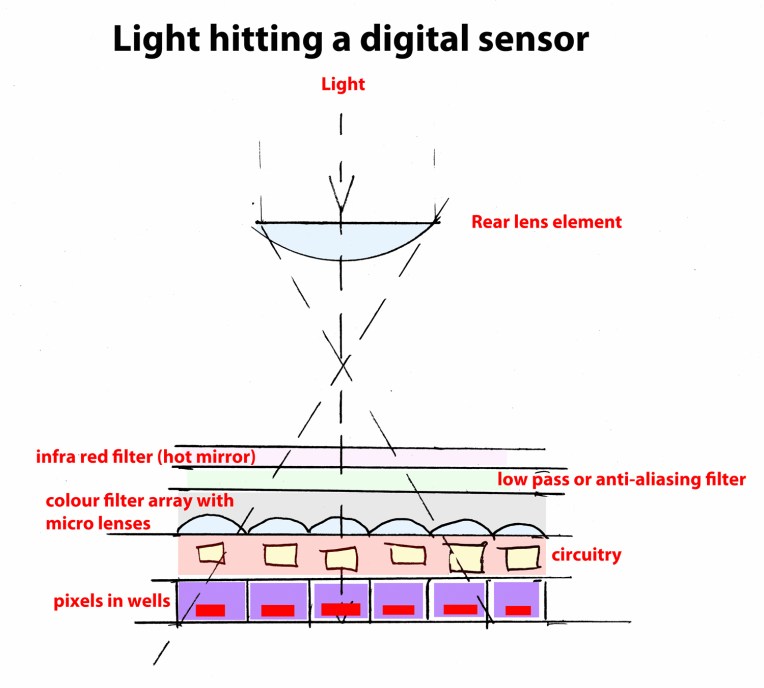
The reasons for this are that Voigtländer 15mm was designed for use with film and the silver halide crystals in the film emulsion did not care at what angle lights hits them to provide the necessary reaction to form the latent image. But with a digital sensor it is a whole different ball game because the sensor is no longer just a gelatine substrate coated with an emulsion containing silver halide crystals it is a complex sandwich of filters, lenses and electronic componentry as the schematics  show. For best performance the light needs to enter micro lenses at 90º, when the incidence of the light is severely off perpendicular then not all of it reaches the pixel at the bottom of its well this can cause vignetting, smearing with loss of detail, and severe colour fringing. This is what stopped Leica initially developing a digital range finder. Kodak developed a special sensor with offset micro lenses for Leica to help overcome this along with in camera software correction the digital M became a reality.

For light to hit the pixel in its well it needs to travel as near to perpendicular to the sensor plane as possible.

In Use

For stills photography the 15mm f4.5 could be a consideration if you don’t have the current fixation of razor sharpness corner to corner i.e. if the hero of your shot is central to the frame and you don’t mind loss of sharpness at the edges. Working in monochrome would help get rid of the magenta cast of the edges as well. Have said that the magenta cast and vignetting are removable in post, the accompanying video shows how this can be done in Lightroom. In the gallery of example pictures below I’ve left the magenta cast in some of the photos so you can see what it looks like. If you’d like to see the photos larger they can be seen here.

This slideshow requires JavaScript.

Video is another matter. Ideally this lens should be perfect for vlogging on a Sony A7 but the smearing, colour cast and vignetting make it quite unsuitable. Also it has no filter threads so it is impossible to use a variable neutral density filter which further adds to its unsuitability.

Conclusion


To be completely fair we are demonstrating uses for this lens that it was never designed for. With film and optical/chemical printing it is an amazing lens at very cheap price. When looking at it from a digital imaging point of view, whether stills or video, it really can’t be recommended unless you already own it and are prepared to put up with its short comings. If you are looking for an ultra wide the are better options available such as the Laowa 15mm f/2 Zero-D Lens.