
A Reconciliation…

…of sorts. I wrote recently about my attempt to abandon my Olympus cameras and move to Sony and how it was an unhappy experience. Well last weekend I went out orchid hunting in Wandoo National Park and I took my Olympus kit with me and it made for a far happier experience.


Pink Enamel Orchid, by Paul Amyes on 500px.com
Pink Enamel Orchid, Elythranthera emarginata. Wandoo National Park, Western Australia.


Pink Enamel Orchid, by Paul Amyes on 500px.com
Close up of a pink enamel orchid.


The main reason was weight. Looking for orchids in the Wandoo National Park is a matter of walking lots. It is a big park – 463.68 square Km – and while you can drive in on numerous gravel roads and 4WD tracks it only gets you so far and then you have to walk over quite varied terrain to find anything. Humping heavy photographic equipment, water, food, extra layers, first aid kit etc gets old really fast. So anything that can reduce the load is most welcome.


Little Laughing Leek Orchid, by Paul Amyes on 500px.com
Little Laughing Leek Orchid, Prasophyllum gracile. Wandoo National Park, Western Australia.


Pouched Leek Orchid by Paul Amyes on 500px.com
Pouched Leek Orchid, Prasophyllum cyphochilum. Wandoo National Park, Western Australia.


The second reason was the rear LCD panel. Having one I could actually see in bright sunlight again was in a word fantastic. Add to that it was of the flippy flappy variety which meant I could twist it to see it irrespective of the camera position meant that I didn’t have to contort myself into impossible positions. It’s amazing how such small things can make life so much easier and more pleasurable.


Custard Orchid by Paul Amyes on 500px.com
Custard Orchid, Thelymitra villosa. Wandoo National Park, Western Australia.


Custard Orchid by Paul Amyes on 500px.com
Close up of a custard orchid.


The orchids were scarce this year. Where there would be literally a carpet of custard orchids there were just one or two specimens. But, although the numbers were down there were plenty of different species to look at and photograph. I went primarily to photograph leopard orchids and I only found them after about 5 hours of looking. It was like the day’s grande finale.


Leopard Orchid, by Paul Amyes on 500px.com
Leopard Orchid, Thelymitra benthamiana. Wandoo National Park, Western Australia.


All in all I was a very happy boy when I got home.


Purple Enamel Orchid by Paul Amyes on 500px.com

Purple Enamel Orchid, Elythranthera brunonis. Wandoo National Park, Western Australia.
Big Cats and Flowers

My last wander about the local Wandoo forest didn’t yield anything much. The only plants worth getting the camera out for were some Leopard Orchids. So I did my usual full length portrait using my 40-150mm f2.8 plus MC-14 teleconverter with focus stacking. Then a tighter “head and shoulders” shot with the 60mm f2.8 macro and flash. I finished up with really tight detail shot at close to 1:1 again with the 60mm macro.


Leopard Orchid by Paul Amyes on 500px.com
Leopard Orchid, Thelymitra benthamiana. A 10 shot focus stack using the Olympus EM1 mk ii, Olympus 40-150mm f28 lens and the the Olympus MC-14 teleconverter. File assembled in Photoshop.


Leopard Orchid by Paul Amyes on 500px.com
If you look closely at the main flower there is a spider peeping out and the fly on the edge of plant is caught in its web. Leopard Orchid, Thelymitra benthamiana.


In the past I’ve used OM Workspace to do the focus stacks, but after it’s latest update it has become so slow – glaciers move quicker. So I decided to to do the stack using Adobe Lightroom and Photoshop. To say it was much faster would be a massive understatement, but the final result was a lot better as well. For the life of me I can’t work out why camera manufacturers software is so bad. It should be better as they know all the features of the cameras and how to get the best out of them. This isn’t just a whinge directed at OM Systems. Canon’s DPP is absolutely appalling as well. Adobe would’t have such a stranglehold on the market if the camera manufacturers could develop good software.

Prodigious Display

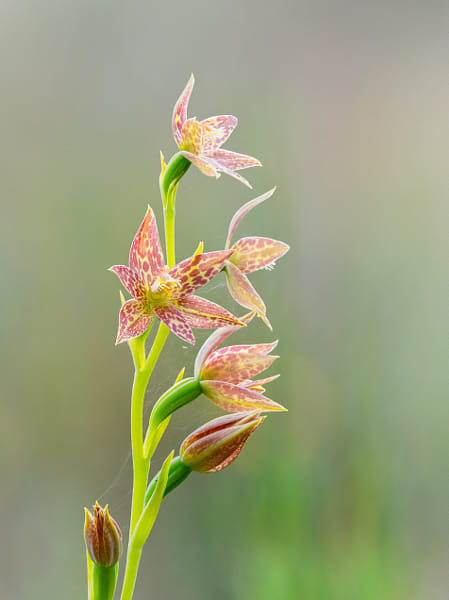
Up until this time last year I had only ever seen one leopard orchid (Thelymitra benthamiana). It is not that they are rare or hard to find, it’s just been that I’ve never been in the right place at the right time. The one I saw wasn’t at its best, but it made me very happy to see it. I went back to the same place last week and I was amazed to find not not one, not 10, but over a hundred of them. It was quite a spectacle. I’ve been saying how unseasonably warm it has been and dry the bush is, but obviously it suits leopard orchids. I was spoilt for choice as I wandered around looking for a good specimen with a good background that was sheltered from the wind.


Leopard Orchid by Paul Amyes on 500px.com

Leopard Orchid, Thelymitra benthamiana. Wandoo National Park, Western Australia.
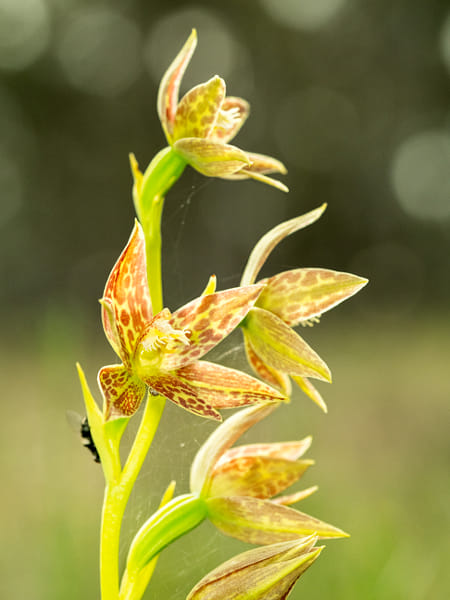
 

Leopard Orchid by Paul Amyes on 500px.com

Leopard Orchid

Shelter From The Storm*

Shelter From The Storm
A mosquito shelters from the wind and rain on a leopard orchid. Dodges Ferry, Tasmania. Olympus EM-10 with OLYMPUS M.60mm F2.8 Macro lens and Metz 44-AF1 flash. Exposure: Manual mode 1/180 s at f/8.0 ISO 200.

I first got my Olympus 60mm macro in May 2013 and wrote about it here. It is an amazing lens, but I was using it initially on an Olympus Pen EP-2 with the less than stellar 12Mp sensor I really wasn’t seeing what the lens was capable of. The picture of the mosquito on the Leopard orchid above was taken with the same lens but now mounted to an OMD EM-10 with the latest iteration of the 16Mp sensor. Tripod mounted and using flash I can now see how much detail the lens is able to resolve – you can see the hairs on the leg of the mosquito. Up until this morning when I processed the shot I never knew that mosquitos have hairy legs.

Lepopard Orchid
Leopard orchid (Diuris pardina), Dodges Ferry, Tasmania. Olympus EM-10 with OLYMPUS M.60mm F2.8 Macro and Metz 44-AF1 flash. Exposure: manual mode 1/180 s at f/8.0 ISO 200.

The other thing that I’m really taken with is the Olympus flash system. When I migrated from Canon I was particularly concerned about the flash capabilities and it was one of the reasons why I held onto my Canon kit. Now I have two dedicated speedlites for my Olympus kit, a Metz 44-AF1 (which I really do like) and a newer Olympus FL-600R (which I’m still getting to grips with and will be the subject of a separate blog entry a little later on). Like most things Olympus when you initially use the flash system the choices offered are quite daunting, but once you’ve set everything up it really is quite easy to use. The remote control for off camera flash is very sophisticated and make it very easy to get good results. Its only down fall is that it is radio controlled and there are no reliable third-party TTL radio controlled flash triggers. The day they arrive the Canon equipment will go.

Trip The Light Fantastic
My Olympus EM-10 tricked out for macro flash using a Custom Brackets Mini-RC, a Metz 44-AF! flash, an Aputure TTL sync cable and a cheap Chinese no name flash modifier.

The above shot shows how I had my camera set up to take the shots of the leopard orchids. The flash and the camera are mounted to a Custom Brackets Mini-RC via Manfotto quick release plates which makes setting things up a quick and easy affair. The TTL cable is by Aputure and was only $30 and the flash modifier is a cheap Chinese no name knock off of a Rogue FlashBender that I got off eBay for $5 including postage. What I like about it is that it is easy to use either handheld or tripod mounted.

As usual clicking on a photo will take you through to my online gallery.

* Apologies to Bob Dylan

SHELTER FROM THE STORM BOB DYLAN from Rita Giuliana on Vimeo.