As summer draws to a close dawn comes round a little later meaning that I don’t need to get up early. It gives an opportunity to enjoy a leisurely cup of that all important morning coffee and head out.
Wayan or White-faced Heron (Egretta novaehollandiae) greets the new morning. York, Western Australia.
Once down at the river I’m met with sight of the sun just peaking through the clouds and it was a joy to behold. Then the moment is shattered as several hundred Little Corellas take to the air in a whirling squawking mass. Successive waves of birds fly over me each one noisier than the one that preceded it. It was an incredibly intense experience. Eventually the birds all decided to settle in the gum trees along this section of the river bank. Physically they may have settled but their incessant squawking didn’t stop. I was transfixed. I didn’t bother continuing along the river bank I just stayed and watched and photographed.
As the sunrises the Manatj or Little Corellas (Cacatua sanguinea) start to become active.
Then as the sun rises over the horizon the Little Corellas take to the air en masse.
Manatj or Little Corella (Cacatua sanguinea). York Western Australia.
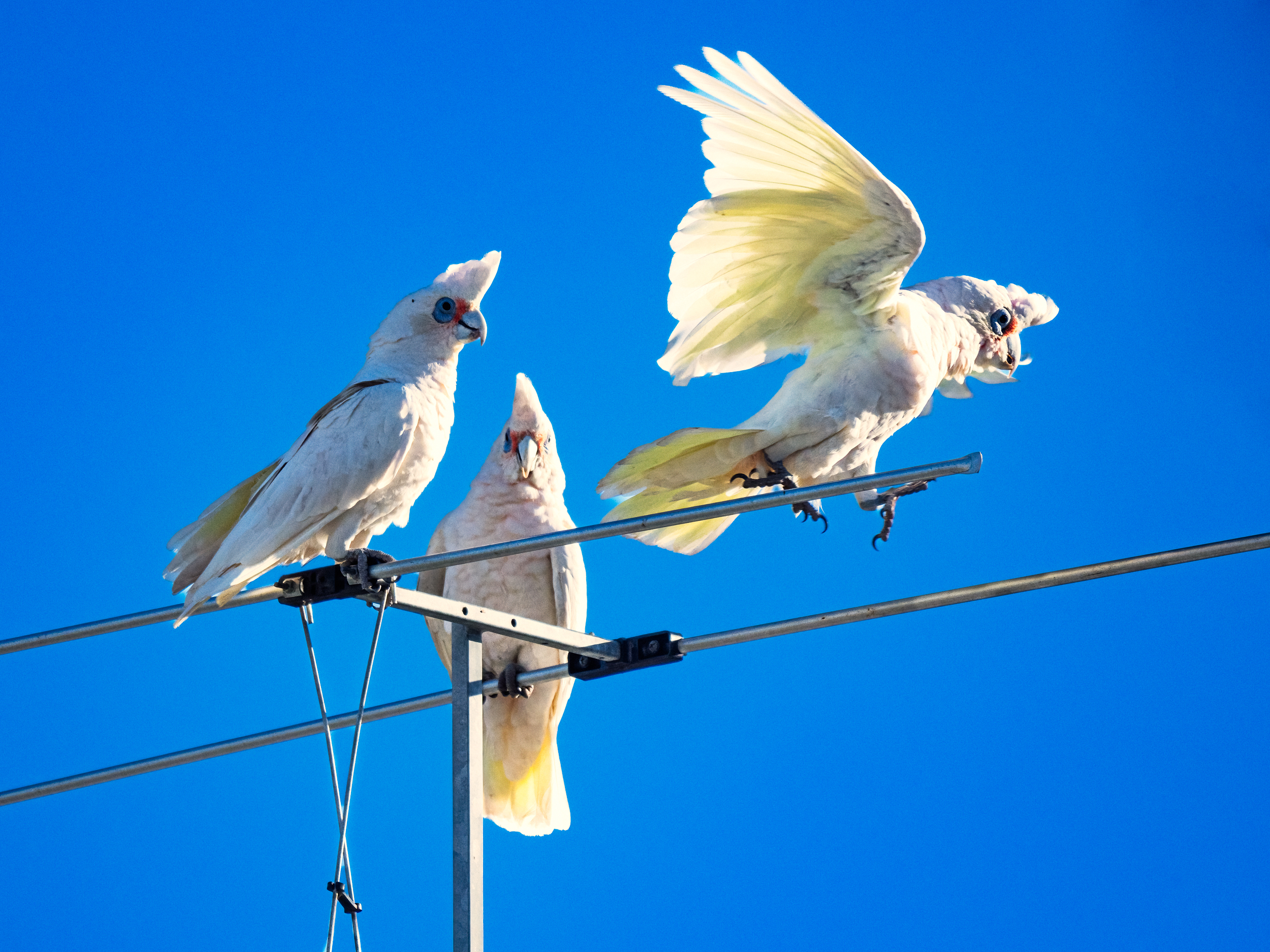
It’s got nothing to do with the Ukrainian situation. Nothing to do with Taiwan, China or submarines. No this is a crisis which threatens the very fabric of the Australian way of life. It is Western Australia’s corella problem. Huge flocks of corellas are causing havoc. They dig up lawns, dance around on TV aerials causing havoc with the reception, they make a noise early in the morning meaning the great Sunday lie in is disturbed. Locals are so incensed that they have taken to calling them flying cane toads and want to blast them out of the skies with shotguns. The Western Australian government sensing a potential vote winning platform for the next election has set up a new task force headed up by a former police commissioner to deal with the corella plague. This probably means they’ll spend a fortune on cars, helicopters, four wheel drives, a snazzy para military looking uniform, and lots of media releases. It will probably go massively over budget long before it gets round to tackling the feathered little blighters.
Flocks of vociferous Little Corellas are disturbing the peace.
It’s not the fault of the corellas. They’re just doing what they have to do to survive. Originally found in great numbers further inland, but climate change and lessening rainfall means they are moving to more populous areas where people have provided an environment that they thrive in. We get them here in York because there is water in the Avon River and there is plenty to eat in the form of grain spilt while being transported to the grain bins. People water their gardens which means there are succulent roots to be dug up and there are a lot of tall eucalypts for roosting.
The corellas cause all sorts of mischief – digging up lawns, stripping the insulation off electrical cables, and chewing TV aerials are just a few of their crimes against humanity.
Having said all that I actually like the flocks of corellas. To me the sound of summer isn’t the thwack of a leather ball on a willow bat, it’s not the sound of surf breaking on a beach. It is the sound of the corellas. When me moved to Tasmania we really missed it.
You can’t watch the cricket when you’ve got a corella dance party on your TV aerial.
Just as a final note – the last time a war was declared against an avian foe was in 1932 with the “Great Emu War”. The Royal Australian Artillery was sent into bat against the wily emus armed with machine guns. It wasn’t pretty. After a month and only 50 emus killed the army withdrew conceding that the emus guerrilla tactics and high speed manoeuvrability meant that it wasn’t a fair fight.
The rainbow lorikeet (Trichoglossus haematodus) is a feral bird in Perth that commonly nests on the platforms at the base of palm fronds. Olympus Pen EP-5 with OLYMPUS M.45mm F1.8 lens. Exposure: 1/25 sec, f5.8 at ISO 200.
Warning this blog entry contains avian themes!
The other day I had to take the car into be serviced in Victoria Park near the Causeway. This meant I had time to kill so I decided to take a walk along the northern bank of the Swan River Foreshore. I hadn’t been along there for ages and there has been some recent redevelopment of the area so I decided to have a sticky beak. These are a few of the pictures I took as I wandered around.
Little Corellas (Cacatua sanguinea) Swan River foreshore, Perth, Western Australia. Olympus Pen EP-5 with OLYMPUS M.45mm F1.8 lens. Exposure: 1/800 sec, f4 at ISO 200.
Australian darter (Anhinga novaehollandiae) on the Swan River foreshore, Perth, Western Australia. Olympus Pen EP-5 with OLYMPUS M.45mm F1.8 lens. Exposure: 1/2000 sec, f4 at ISO 200.
Little Dove. The Duyfken (Little Dove in English) replica moored at Elizabeth Quay on the Swan River, Perth, Western Australia. Olympus Pen EP-5 with OLYMPUS M.17mm F2.8 lens. Exposure: 1/125 sec, f8 at ISO 200.
First Contact , Elizabeth Quay in Perth, is a five metre tall artwork by Nyoongar artist Laurel Nannup. The work depicts the arrival of European settlers to Perth. As the European boats arrived, the local Nyoongar people believed that these ships, were their past ancestors returning from the sea. Olympus Pen EP5 with OLYMPUS M.17mm F2.8 lens. Exposure: 1/400 sec, f8 at ISO 200.
The 20-metre high suspension bridge is an iconic architectural feature of Elizabeth Quay. The bridge forms part of the popular ‘bridges’ recreational route along the Swan River and provides a link between the promenades, the island and Barrack Street Jetty. Olympus Pen EP5 with OLYMPUS M.17mm F2.8 lens. Exposure: 1/500 sec, f8 at ISO 200.
*Swanning around and swanning about mean to move about aimlessly, irresponsibly and in a carefree manner. Related terms are swan around or about, swans around or about, swanned around or about. When the terms swanning around and swanning about first appeared in the late nineteenth century, they simply described the process of swimming like a swan. Today’s meaning of the term swanning about has its origins in World War II, interestingly. At that time, swanning around and swanning about described the movements of tanks in battle, in seemingly aimless maneuvers. The term made its way into mainstream English to mean anyone moving about in an irresponsibly carefree or aimless pattern. Swanning around and swanning about are primarily British terms, they are rarely seen in the United States.





You must be logged in to post a comment.