I’ve been enjoying watching the Rainbow Bee-eaters. This year it appears that only one breeding pair have returned to York. This is the lowest number I’ve seen in York in the last twenty years. Despite that the pair we have make for delightful watching.
The female Rainbow Bee-eater playing with her food (a bee naturally) the male isn’t impressed.
The male leaves her to get on with it.
A couple of minutes later he returns with his own bee.
This week I made the annual pilgrimage to Lake Gwellup reserve to photograph Birinbirin or Rainbow Bee-eaters (Merops ornatus). This is a bit early for me and when I got there I could see that the breeding pairs were still digging their burrows. This meant that both female and males were out and about catching insects, working on their burrows and taking frequent rests on a suitable perch.
A quick bite to eat for breakfast.
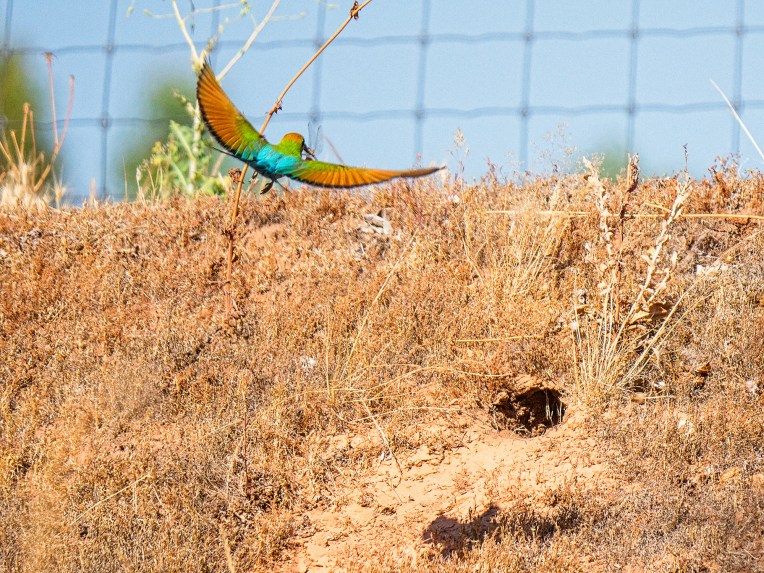
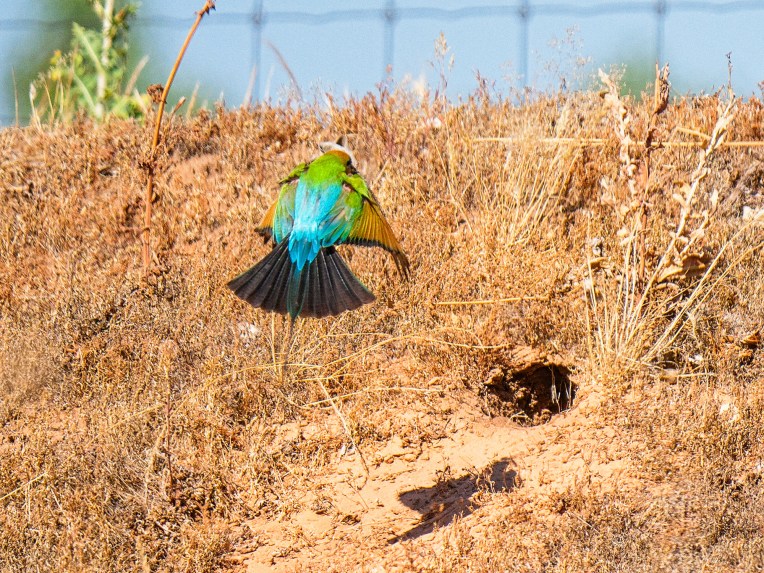
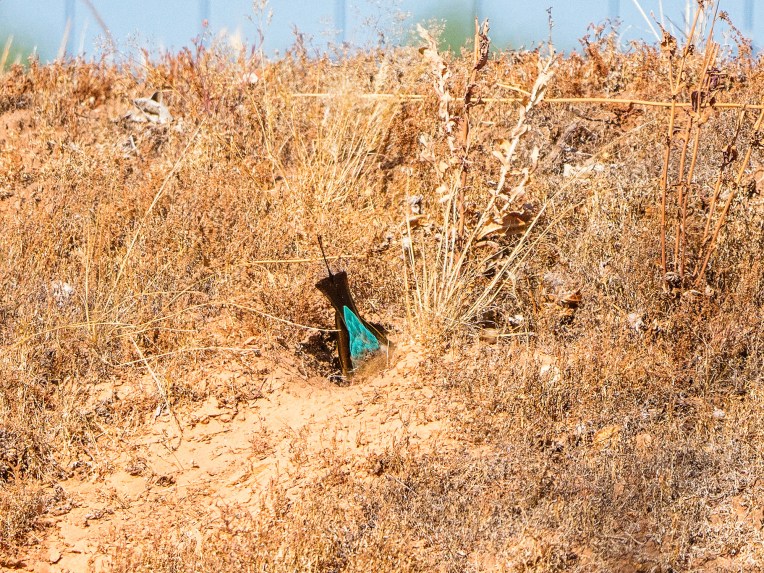
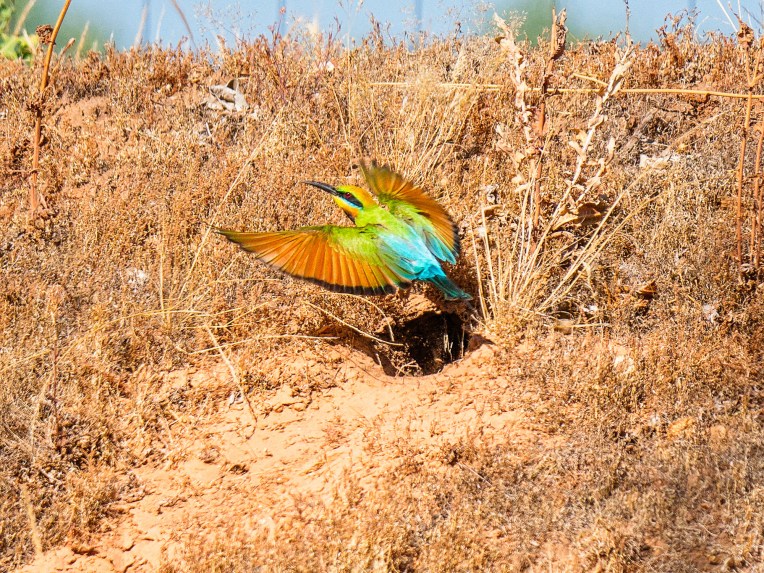
Photographically I tried something new. The Olympus EM1x has a feature called “Pro Capture”. On a half press of the shutter the camera buffers frames and when you fully depress the shutter saves them to the memory card. This way in theory you don’t miss a shot. There are two variations of this, a low speed one that allows autofocus with bird tracking and a high speed one that just has single AF on the press of the shutter. To use the low speed pro capture you need to use one of Olympus’ high end ‘Pro’ lenses which I have in shorter focal lengths but not as my birding lens. So I had to make do on this occasion with single AF high speed pro capture. I’ve never bothered with this feature before as I’ve felt that it wouldn’t really suit the conditions I normally work in. But, this time I envisioned taking a shot of a Rainbow Bee-eater taking off from its perch. I could set the camera up on a tripod, focus on the same place on the perch as the birds kept going back to the same spot over and over again. I set the camera to manual and selected a a shutter speed of 1/4000 to freeze the movement and an aperture of f8 to give a bit more depth of field. Then it was a case of just waiting and photographing the birds as they came and went. The down side to this method was that you go through batteries very quickly and the high speed pro capture shoots 60 fps so memory cards are filled up quickly meaning a lot of work at the editing stage. But I was happy with how it went for a first effort.
Coming into land.
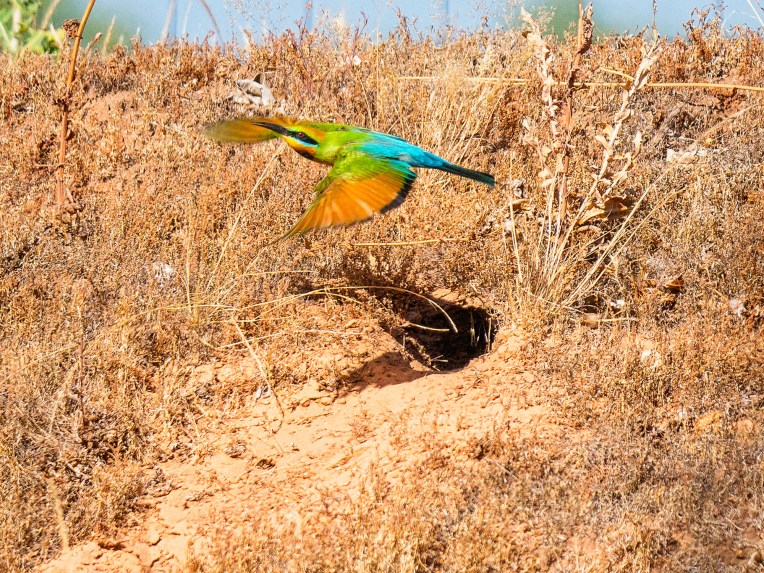
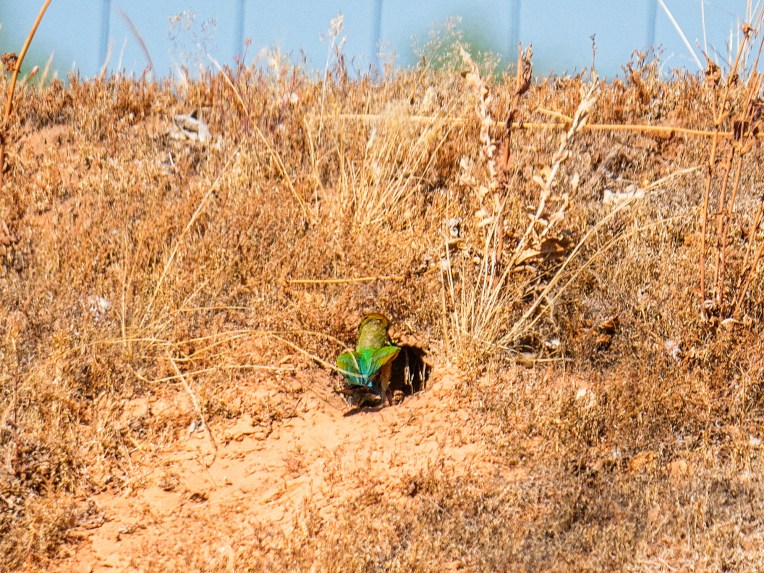
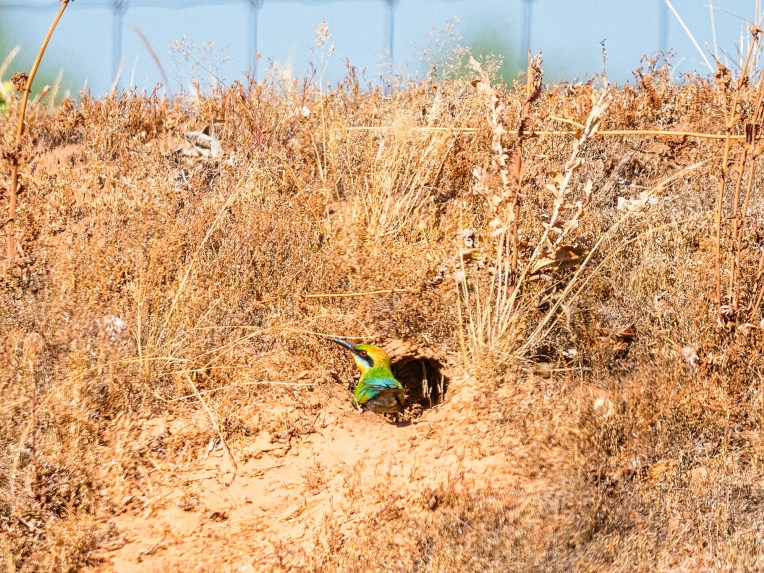
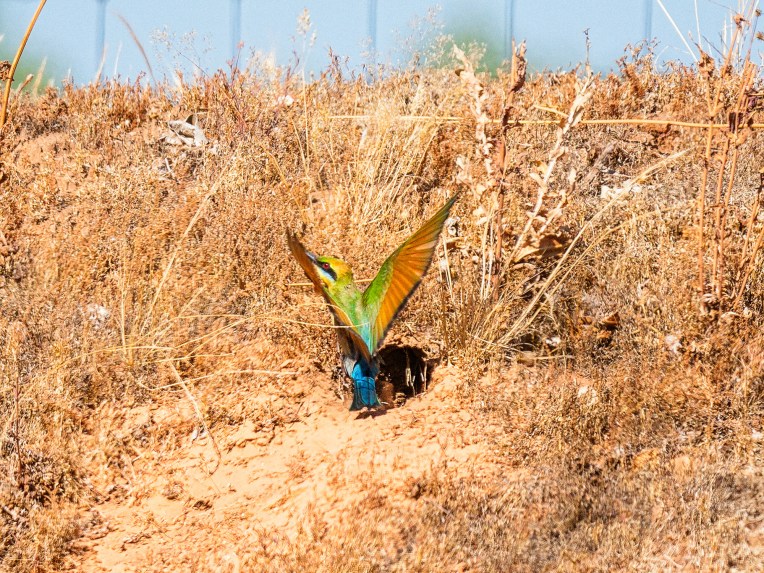
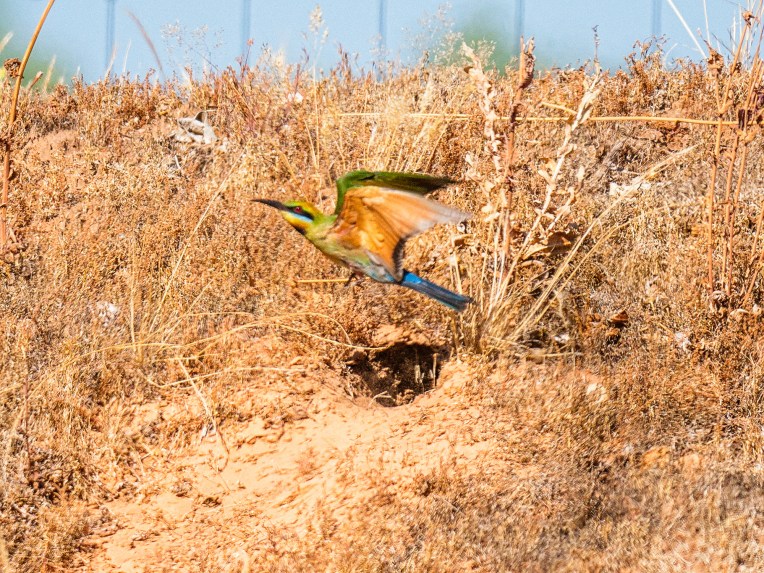
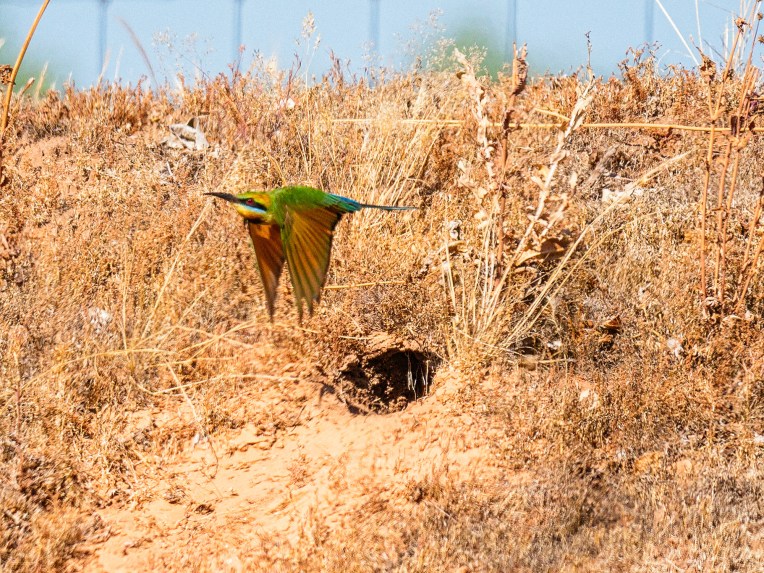
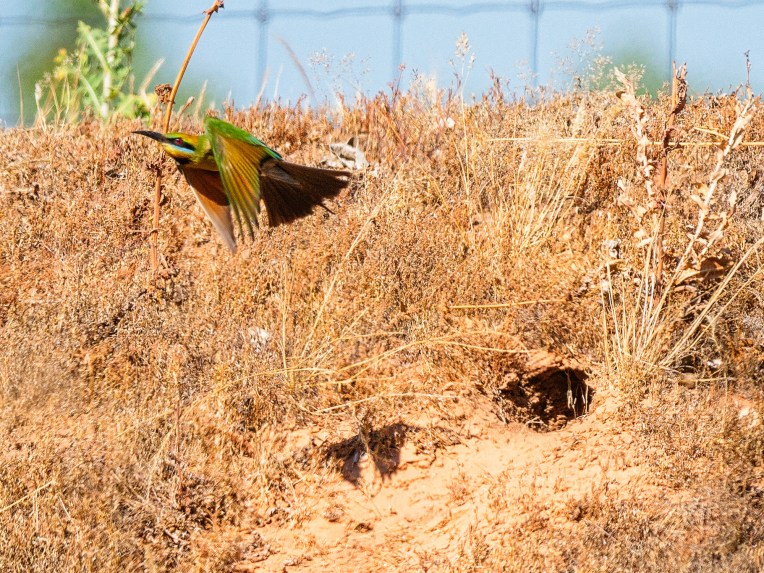
Leaving the burrow.
On getting home I fired up Lightroom and looked at the memory cards. I’d taken 1261 photos. Just glancing at them enabled me to winnow them down to 110 photos which I imported into Lightroom. Looking at the imported photos carefully to check critical focus at 100% I was able to select 36. Another look through looking a composition and I further reduced the selected photos down to 21. I then processed the photos and then looked at them carefully. They were then graded on a scale of 1 to 5 stars. Anything higher than 4 stars was selected and that gave me 8 final photos of which 4 are shown here.
Birin-birin or Rainbow Bee Eater (Merops ornatus). Avon Walk Trail, York, Western Australia.
So after their long flight from Far North Australia and Papua New Guinea the rainbow bee eaters have returned. Not the best photograph of a rainbow bee eater, but it makes me happy that they’ve returned to the banks of River Avon. They’ve dug their burrows and we’re now waiting for the eggs to hatch because this will mean a huge amount of activity from both parents as they catch enough food for the chicks.
I was also happy to see a red-backed kingfisher as they’re not very common in these parts. From a distance I thought it was a one of its cousins – a laughing Kookaburra as they share a similar profile. I don’t know the Nyoongar name for the red-backed kingfisher so if anyone out there does know I’d much appreciate you telling me.
Red-backed Kingfisher, Todiramphus pyrrhopygius. Avon Walk Trail, York, Western Australia.
Kaa-kaa, Laughing Kookaburra (dacelo novaeguineae). Avon Walk Trail, York, Western Australia.
Rainbow Bee Eaters (Merops ornatus) catching insects and taking them to their chicks in their burrows.
Walking down by the Avon this morning there was a lot of commotion. A steady “prrrp-prrrp” sound followed by a flash of bright colour. Scanning the trees I found what I was looking for in the branches of a big old dead gum tree. A male rainbow bee eater bashing a large insect on the branch till it was dead so it could take it to its young brood. On further inspection I noticed that there was a holding pattern going on with mum and dad taking it in turns to take food to their ever demanding young.
Mum taking off to make the delivery while dad waits patiently to be cleared for take off.
A further shufti and I find the burrow and settle myself in to watch the parents fly in the food supplies. It was non stop, no let up at all. First off we see dad make a trip.
Rainbow Bee Eaters (Merops ornatus) catching insects and taking them to their chicks in their burrows.
Rainbow Bee Eaters (Merops ornatus) catching insects and taking them to their chicks in their burrows.
Rainbow Bee Eaters (Merops ornatus) catching insects and taking them to their chicks in their burrows.
Rainbow Bee Eaters (Merops ornatus) catching insects and taking them to their chicks in their burrows.
Rainbow Bee Eaters (Merops ornatus) catching insects and taking them to their chicks in their burrows.
Rainbow Bee Eaters (Merops ornatus) catching insects and taking them to their chicks in their burrows.
Rainbow Bee Eaters (Merops ornatus) catching insects and taking them to their chicks in their burrows.
As soon as he is clear it’s mum turn.
Rainbow Bee Eaters (Merops ornatus) catching insects and taking them to their chicks in their burrows.
Rainbow Bee Eaters (Merops ornatus) catching insects and taking them to their chicks in their burrows.
Rainbow Bee Eaters (Merops ornatus) catching insects and taking them to their chicks in their burrows.
Rainbow Bee Eaters (Merops ornatus) catching insects and taking them to their chicks in their burrows.
Rainbow Bee Eaters (Merops ornatus) catching insects and taking them to their chicks in their burrows.
Rainbow Bee Eaters (Merops ornatus) catching insects and taking them to their chicks in their burrows.
Rainbow Bee Eaters (Merops ornatus) catching insects and taking them to their chicks in their burrows.
All pictures taken with a Panasonic Lumix G85 with Panasonic Leica Vario Elmar 100-400mm f4-6.3 lens.
Below is a short video clip containing footage of the birds and some more stills.
Rainbow Bee Eater, Merops ornatus. Avon Walk Trail, York, Western Australia. Panasonic Lumix G85 with Panasonic Leica 100-400mm f4-6.3. Exposure: 1/1000, f6.3 at ISO 250.
There are quite a number of them along the Avon River here in York. They migrate from Indonesia, New Guinea and northern Australia to avoid the cyclone season and come to breed during our summer. They nest in burrows which they dig and I discovered them quite by chance. While walking the dog I noticed these brightly coloured birds literally nose diving into the ground. At first I thought that the bird must have been hurt and went over to look for it, but I found nothing. Over the next few weeks I watched several others repeat the behaviour so looking carefully at the embankment I found several holes which turned out to be their burrows. So ever since I’ve been trying to photograph them.
Rainbow Bee Eater, Merops ornatus. Avon Walk Trail, York, Western Australia. Panasonic Lumix G85 with Panasonic Leica 100-400mm f4-6.3. Exposure: 1/1000, f6.3 at ISO 320.
So far I’ve only managed to photograph them when they perch. They feed on flying insects and their acrobatic manoeuvring while chasing their prey are beyond my photographic abilities. Luckily I’ve noticed that they tend to favour a particular tree de jour as a lookout and they repeatedly return between sorties so it has just been a case of walking along the river finding that day’s favoured tree and waiting.
Rainbow Bee Eater, Merops ornatus. Avon Walk Trail, York, Western Australia. Panasonic Lumix G85 with Panasonic Leica 100-400mm f4-6.3. Exposure: 1/1000, f6.3 at ISO 250.
Just before Christmas my wife and I decided to mount a mission early one morning to observe them bringing food to the chicks that have hatched. We must have been a strange sight for any passers-by – my wife in her camp chair with binoculars aimed at an earth bank and me loitering in the foliage under a tree with a camera and very long lens. We spent a couple of delightful hours watching and photographing before heading off for morning tea.
Rainbow Bee Eater, Merops ornatus. Avon Walk Trail, York, Western Australia. Panasonic Lumix G85 with Panasonic Leica 100-400mm f4-6.3. Exposure: 1/1000, f6.3 at ISO 250.








You must be logged in to post a comment.