
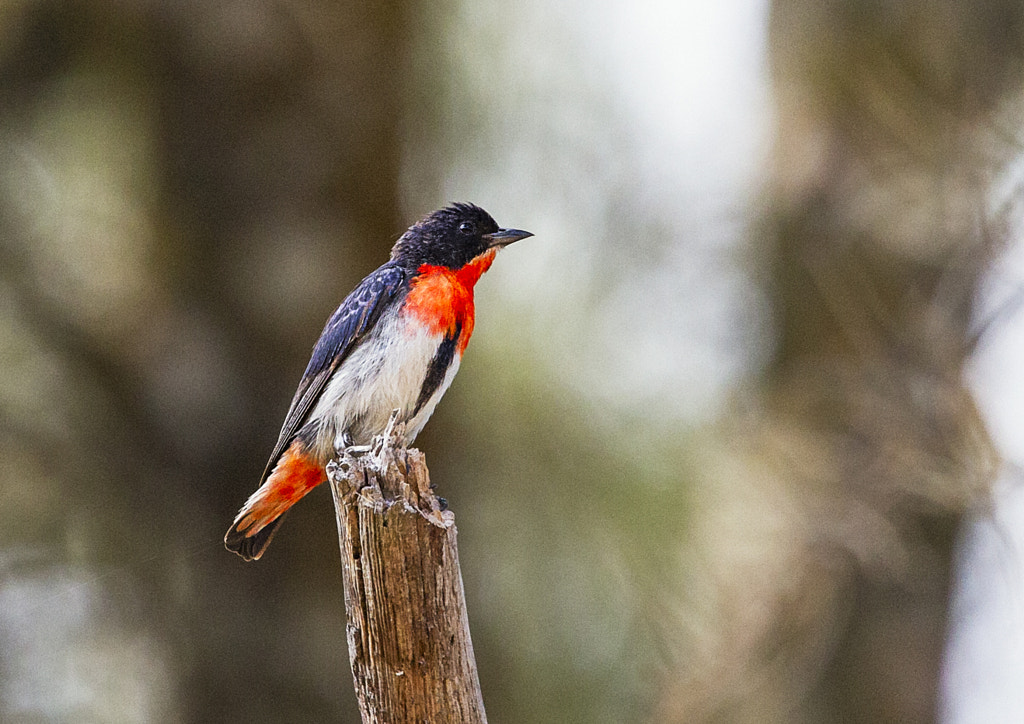
We’ve had a new family move in and they have been delighting us with their behaviour. The family in question are Mistletoebirds. There is a male, a female both mature adults and at least one juvenile male. They are a very striking looking bird. When you first see the male you could be mistaken for thinking it is a Robbin, but they are a distinct species that have evolved a symbiotic relationship with mistletoe – hence the name. The birds only eat the fruit of the mistletoe and they spread the seeds to other trees. We don’t have any mistletoe in our garden but we do put out water and that is what attracts them.

Minnijit or Mistletoebird, Dicaeum hirundinaceum. This is an adult male. York, Western Australia.

Female adult Mistletoebird, Dicaeum hirundinaceum. York, Western Australia.

Juvenile male Mistletoebird, Dicaeum hirundinaceum. York, Western Australia.
Now most people associate mistletoe being a northern hemisphere thing where you end up kissing people under bunches of it at Christmas, but, Australia is the land of mistletoe and has over 90 species. There is a belief that mistletoe kills the host tree, but that is a bit like saying fleas kill dogs. The tree only suffers harm if there is something else wrong with it – usually isolated in a paddock and suffering from heat stress. These beliefs persist among farmers who see the only solution as hunting mistletoebirds and so they are frequently shot. One farmer in Australia in the 1930s claimed to have killed over 1200 mistletoebirds in a 6-year period. Unfortunately this has the exact opposite effect for which it is intended as the presence of the bird and the plant in the eucalyptus forest encourages a rich biodiversity and in a recent study in southern Australia, 217 species of Australian arboreal birds were reported nesting in mistletoe, including the mistletoebird.
We’re happy that the birds come to our garden and hope that they remain a feature.
You must be logged in to post a comment.