We had some very co-operative visitors this week in the form of 6 Carnaby’s Cockatoos. They arrived in the garden while I was out with young Bertie our puppy. Normally when I dash back to the house and get a camera the birds disappear before I get back. This little group were very relaxed and hung around for ages letting me get quite close to take their picture. When I went to process the photos I thought the black and white birds would benefit from a monochrome treatment.
Carnaby’s Black-cockatoo, (Zanda latirostris). York, Western Australia.
The weather has finally broken and we’ve had some decent rain. Around Easter time York shifts into gear by acting as the host for numerous weekend events. The York Motorcycle Festival being the first one this year. Now to be perfectly honest motor vehicles have no allure for me at all – to be totally frank they bore the faecal matter out of me – but, I often attend the festival just for the photographic opportunities and this year was no different. What was different was that I used two cameras, one a Sony A6500 with Sigma 23mm f1.4 lens and the other a Canon EOS 30 with a Canon EF 24-70mm f4 lens loaded with Ilford FP4+ . I’m not going to say which was which because that’s not the point. I didn’t come away with anything breathtaking but it was fun couple of hours walking up and down taking photos.
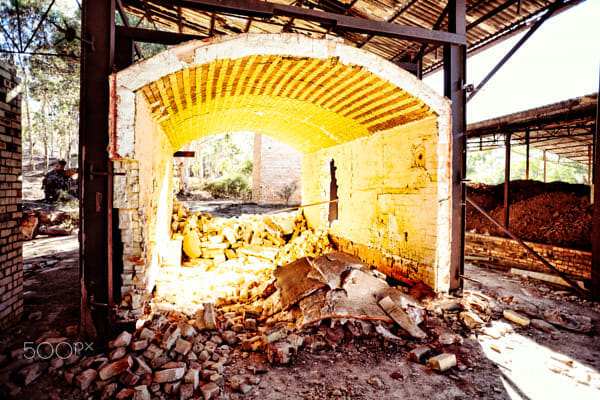
Like most things in Australia the Clackline Refractory came into being more by luck than planning. In 1898 Western Australia was undergoing a gold rush and two blokes by the names of John Ford and James Murray were prospecting in the eastern end of the Darling Range. About 80Km east of Perth they decided to sink an exploratory shaft and instead of finding gold they found fire-clay. Disappointed they moved on. Fast forward a couple of years and it must of dawned upon them that they had stumbled upon a valuable commodity as they decided to extract the clay from what on closer inspection was a limitless supply. Why was the clay so valuable? Well fire-clay is used to make bricks for furnaces and kilns. It is used in the manufacture of crucibles for smelting. Before this discovery Australia was having to import bricks made of fire-clay from Britain at some considerable cost. The refractory was built to produce the bricks and it was found they were more durable than the imported ones. You’d think that having a ready made monopoly would have meant that Messrs Ford and Murray would be laughing all the way to bank. Well no and the refractory changed hands several times before being completely shut down in 1992.
The suns rays reflected on the white walls of a derelict brick kiln at the Clackline Refractory.
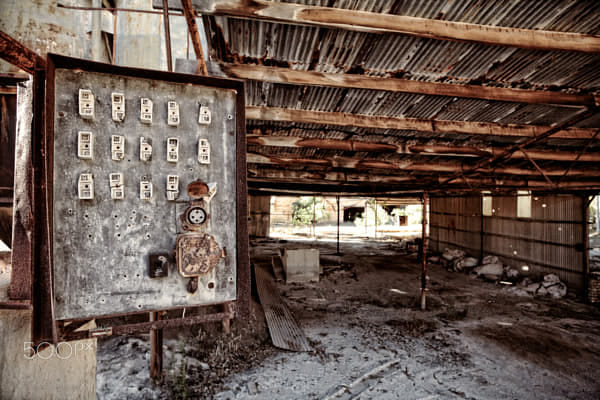
The remains of an electrical control panel at the Clackline Refractory.
I discovered the Refractory completely by accident. I was cycling along the Kep Track and as I was approaching Clackline I saw an enormous brick chimney rising out of the trees. It was definitely industrial looking so I decided to have a shufty and found this huge post industrial site. It had only been shut for a couple of years at that stage and everything looked pretty intact. I went back a few days later and photographed the place early in the morning and the sunlight shining through the huge kilns was magical. On further research I wasn’t surprised to learn that it had been given a heritage listing.
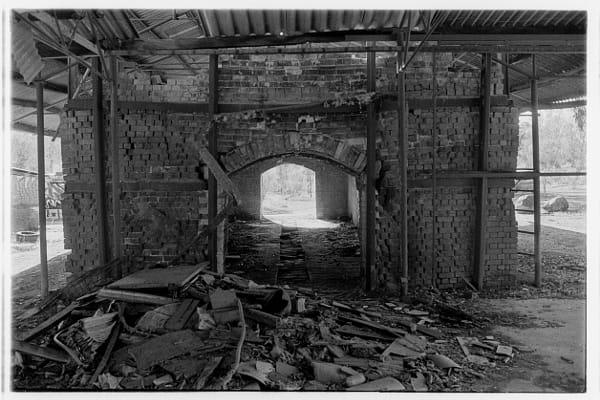
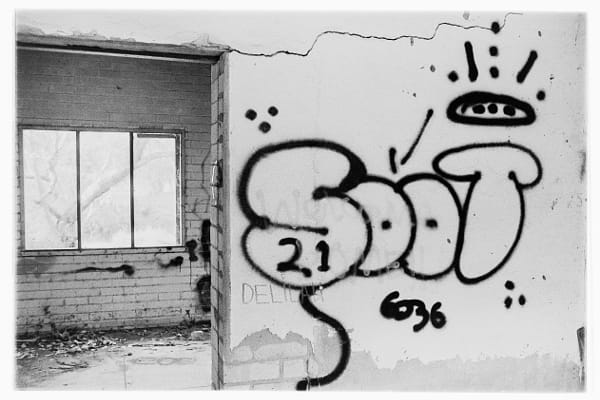
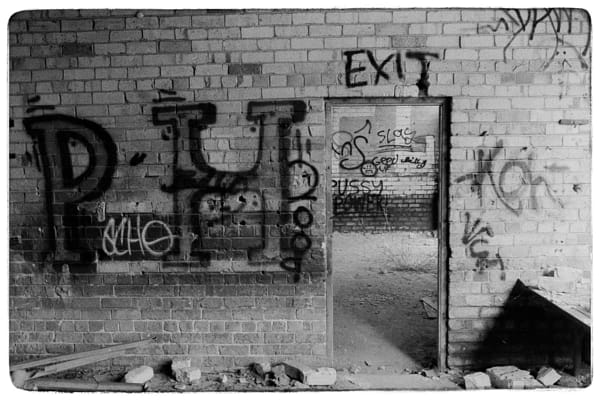
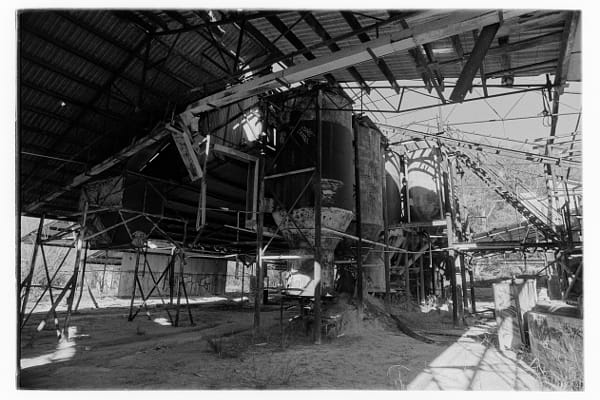
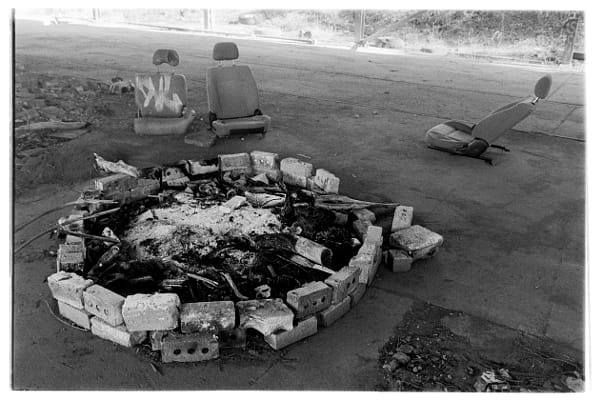
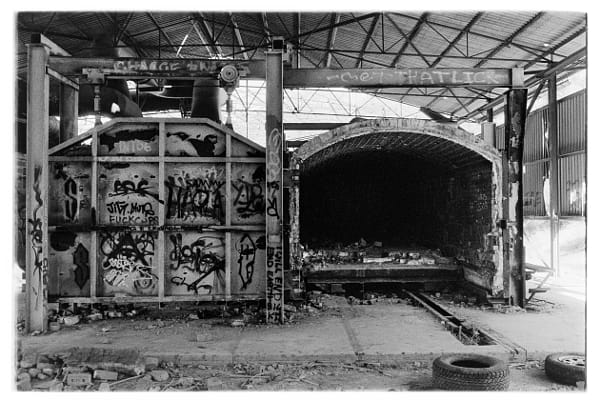
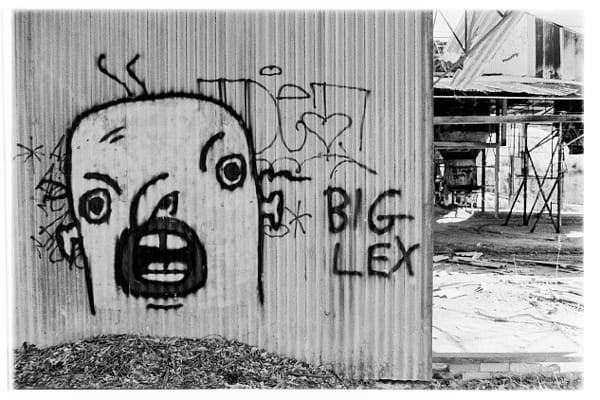
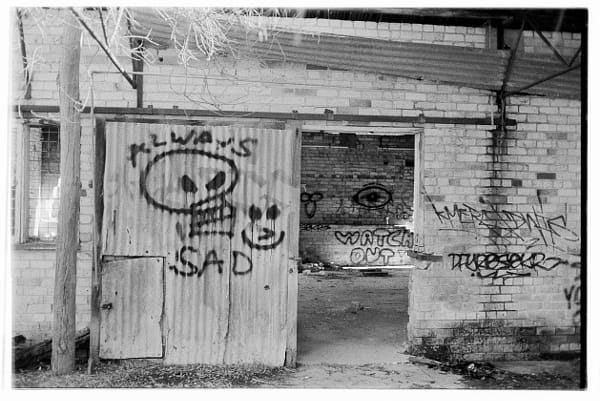
I didn’t think about the refractory again until a couple of months ago. I just purchased a new to me secondhand camera and I wanted to put a roll of film through it to see if it was working OK. My partner wanted to visit Clackline to get some material for a project she’s working on so I decided that the refractory was where I’d test the new camera. When we got there I wasn’t prepared for how much the site had changed. Everything of value had been stripped out, the buildings were in a dreadful state, there was graffiti everywhere along with drug paraphernalia. To add to the sombre mood we met a family there who were visiting to see where a relative had died just a couple of days previously. You couldn’t more get a more gothic atmosphere if you tried and this suited the black white film perfectly. All in all it was quite a strange experience and we moved on after I had shot the roll.
One of the old kilns at Clackline Refractory.
SOOT. Clackline Refractory.
Exit. Clackline Refractory.
Where the clay was mixed prior to being moulded and then fired.
Dead trees on a winters misty morning in Yenyenning Lake. Beverley, Western Australia. Sony A7r with Sony FE 28-70mm F3.5-5.6 OSS lens, and Cokin 3 stop graduated neutral density filter and a circular polarizing filter. Exposure: 0.3 sec, F16, ISO 100.
Pie Melons or Citrullus lanatus (Thunb.) Matsum. & Nakai are an introduced pest in Western Australia. Sony A7r with Voigtlander 75mm f2.5 Color-Heliar lens. Exposure: 1/640th sec, f2.8, ISO 100.
Much is written about “Tasmanian Gothic” – a dark soberness that has its roots in the landscape and the colonial history. Personally I’m not a fan as I feel it colours much of modern-day Tasmania and restricts progress. But, there is no doubt that the weather and the landscape do particularly suit black and white or monochrome photography.
Wooden tender beached at Pirates Bay, Tasmania. Canon EOS 5D with Canon EF20mm f/2.8 USM lens. Exposure: 1/30 s at f/16.0 ISO 100
When I worked with film I loved the whole process for black and white photography. Picking a film and developer combination, then choosing a paper and then finally whether to tone the image or not. The whole process was magical and working in the darkroom, whether it was a commandeered bathroom or a purpose-built one was like a going back to the womb to create something wonderful. Admittedly an awful lot of the time I seemed to turn out a lot of dross, but it was an enjoyable process. To misquote Kilgore’s eulogy in the Coppola classic film Apocalypse Now“I love the smell of fixer in the morning,”.
Kite surfing off Park Beach in Tasmania. Olympus E-M10 and OLYMPUS M.75-300mm F4.8-6.7 II lens. Exposure: 1/1600 s at f/6.3 ISO 200.
I would love to work with black and white film again – but living with a rainwater tank for our supply and with a septic tank for waste water management means that I cannot develop film at home and there are no labs in Tasmania that develop the film. So for now it is the digital option, which is not as magical and mystical as the darkroom, is in its own way just as satisfying. No longer following the Zone Systemlaid down by St Ansel, I now expose to the right (ETTR) to get the maximum amount of tonal information in my RAW file and then process in Lightroom. The final black and white conversion is done in NikSoft’s Silver Efx Pro 2, which is always done the same way and mimics what I used to get with Ilford Delta 400 developed in Rodinol and then printed on Ilford FB Warmtone Multigrade paper. My Canon Pixma Pro9000 does a fantastic job of monochrome printing on Harman Gloss Baryta Warmtone. I’ve done two exhibitions using this combination and been delighted with the results.
Yachts moored on King George Bay Murdunna, Tasmania. Canon EOS 5D with Canon EF28-135mm f/3.5-5.6 IS USM lens. Exposure: 1/640 s at f/11.0 ISO 800.
Thankfully working digitally means that we can work in both colour and black and white at once, just making the decision of which way to go at the time of processing. It is a great time to be a photographer.
As always clicking on an image will take you through to my online gallery.
Sometimes when I read the photography forums I wonder how we managed to make pictures in the past. No auto focus, shooting film so there was no instant feedback on exposure and content, being limited to 36 exposure rolls of film rather than 128Gb memory cards, frame rates of only 3 fps rather than 11. But make photos we certainly did. Going through my Lightroom catalogue the other day I looked at this short series I shot. The assignment was to make a short photo essay of six photos using black and white film and produce six prints. The equipment used was fairly basic by todays comparison, an Olympus OM4 fitted with an autowinder, an Olympus 35-105mm lens, an Olympus 65-200mm lens, and four rolls of Ilford HP5. The film was developed in D76 and the prints were made on Ilford Multigrade RC. The images below were from scans of the actual prints.
The steward walking the dogs out to the start line. Greyhound racing at Cannington in Western Australia.
Preparing the dogs at the starting gates. Greyhound racing at Cannington in Western Australia.
They’re off chasing the electric hare. Greyhound racing at Cannington in Western Australia.
Into the final straight. Greyhound racing at Cannington in Western Australia.
The winners on the podium being photographed. Greyhound racing at Cannington in Western Australia.
The punters watch the action on screens in side the bar. Greyhound racing at Cannington in Western Australia.
I won’t say any more because I feel I’m in danger of becoming the photographic equivalent of:
We all love a bargain and what better bargain is there when it is absolutely free? There’s no doubt about it – photography can be an incredibly expensive pastime. The cost of a pro body, the so-called holy trinity of 2.8 zooms, and some fast primes could pay for you to do a degree or buy a good car. The real kicker is that as soon as the latest models come out your kit is “made” redundant and stops taking good photos so you have to do it all over again. Insane isn’t it? Well I have the answer for you and it won’t cost a single penny. Actually I have to confess that I didn’t devise this myself, a clever Hungarian bloke by the name of André Friedman is responsible for it and it goes like this:
“If your pictures aren’t good enough, you’re not close enough.”
Mrs Friedman’s little boy changed his name to Robert Capa because he felt having an American sounding name would earn him more money (it did), he went on to found the famous photo agency Magnum (so named after the size of champagne bottle he was fond of buying), one of the most famous and highly regarded conflict photographers in the world, and one that is arguably the most controversial as many believe that his most famous works are fakes. Chris Boot in his excellent book “Magnum Stories” (and I would recommend any serious photographer to at least read this book or better still buy it) wrote:
“Capa’s photography is all about being there, close. His art lay in risking where to be and when, in how he built and conducted the relationships that enabled him to be there, and in how he shaped and presented the narrative of events he witnessed.”
Boot, Chris; Magnum Stories p.66. Phaidon, New York 2004.
So does it mean that we all have to pack our bags and head for the nearest God forsaken war zone just to get some decent photos? Have no fear gentle reader we at Paul Amyes Photography (PAP) know that pain hurts and death can be fatal and so prefer to find our photographic subjects in safer environments. So what was Capa on about? Well firstly you should be in close proximity to your subject so that it fills the frame. There are times when the subject (i.e. wildlife or sports) may dictate that you use a long lens, but the principle still holds true position yourself so you can fill the frame. Generally the most drama can be had by using wide angled lenses and filling the frame. It gives impact and intimacy. While speaking of intimacy get to know your subject really well and look to capture a side of it that isn’t so well-known. It may be necessary to find people who can help you gain access to a subject and that these relationships may need to be cultivated over a period of time so you can build trust. For quite a while I followed the rodeo circuit around in Western Australia. I just didn’t want the standard pictures of the participants in the ring, I wanted to get behind the chutes to where the contestants got ready. I wanted to experience and so record the emotions that they felt – the tension, the elation, the sense of relief, and the disappointment. It took a lot of emails, phone calls, and offers of photos for publicity to get there, but it was so worth it. Some photographers choose to live like their subjects in order to get that closeness. Magnum photographer Antoine d’Agata is one such photographer. He photographs people on the margins of society such as sex workers and drug addicts and he participates fully in their world.
“It’s not how a photographer looks at the world that is important. It’s their intimate relationship with it. ”
Antoine d’Agata
Magnum photographer Antoine d’Agata giving a floor talk at the opening of his exhibition Until The World No Longer Exists at the Moores Building.
His work is confronting to say the least and his approach may and subject matter may not be to everyone’s taste but the images are arresting and powerful.
So improving your photography considerably won’t require you to spend a penny on equipment, but it will cost you in terms of time, commitment, and perhaps a bit of courage.
As a middle-aged bloke taking pictures of kids in public is fraught with difficulties, but in situations such as this you just have to summon up the courage and ask the parent.
This young cowboy is nervously waiting behind the chutes for his turn in the bull riding competition. Forming relationships with the organisers of the rodeos was the only way I was going to get access to these moments.





You must be logged in to post a comment.