Silvereye, Zosterops lateralis. York, Western Australia.
We’re still getting visitors to the garden. Lately we’ve been getting half a dozen or so Silvereyes visit at around 4-5pm. They’re tricky things to photograph because they are so small (about 10cm beak to tail) and they move so erratically- think manic clockwork toy on speed and you’ll be in the ball park. Just before sundown we get a female rufous whistler pick over the mulch in the garden beds. I can hear the male in the peppercorn tree but I’ve not seen him.
A female rufous whistler visits the garden.
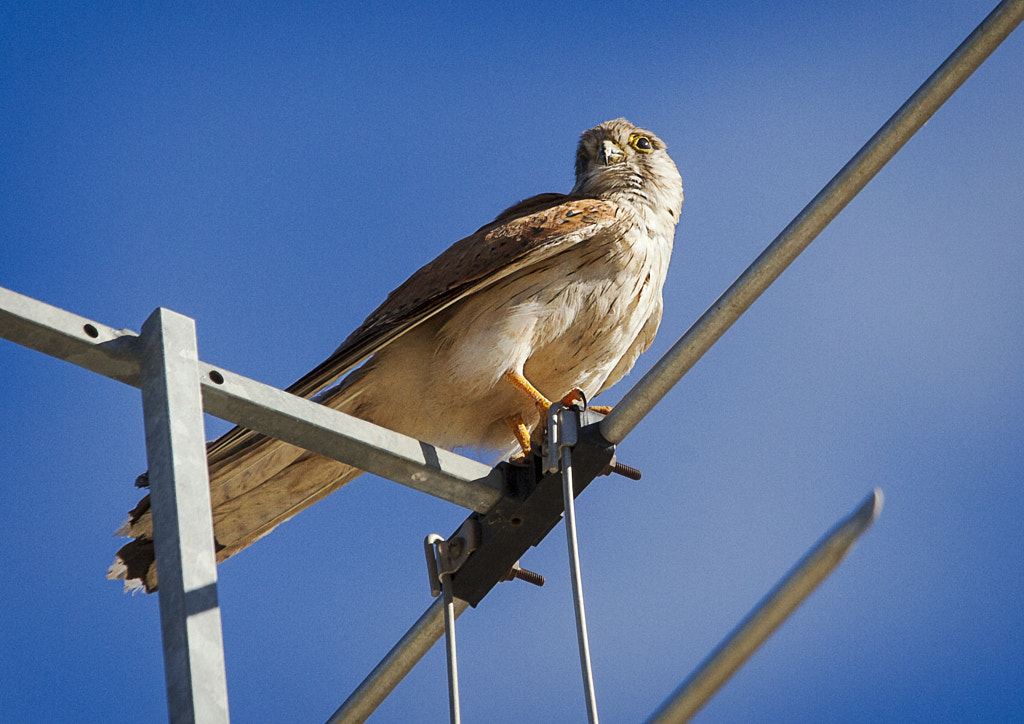
The Nankeen Kestrels have been spending a lot of time on out TV aerial and the power pole on the street. They largely just sit and watch the paddock opposite. Occasionally they are digesting a recent meal. Every now and again we are treated to display of aerial acrobatics where the kestrel will hover over a spot and watch it carefully before diving at great speed to take its prey.
Nankeen kestrel (Falco cenchroides cenchroides), York, Western Australia.
Prey sighted now dive! Nankeen kestrel (Falco cenchroides cenchroides), York, Western Australia.
It seems ages since I last posted. Things have been a bit quiet because of the cold wet weather and I’ve missed a few opportunities which have all contributed to making me feel a bit blah.
We went to Bickley looking for these Red-eared Firetaisl (Stagonopleura oculata).
We went to the New Victoria Dam at Bickley in search of Red-eared Firetails but all we found were lots of butterflies. It’s amazing that a lot of Western Australia’s butterfly species can be found all year round. Even on a freezing winters day.
What we found were Australian painted lady butterflies, Vanessa kershawi. New Victoria Dam, Bickley, Western Australia.
We also saw a lot of these. Monarch butterfly, Danaus plexippus.
On the home front we had a new visitor to the garden in the form of an Australian Hobby. It also looks like a pair of Nankeen Kestrels have nested in a tall tree on the land opposite us. They can be regularly seen hunting over the fields and gardens and they use our TV aerial as an observation platform. Hopefully, if I can swing it with the landowner, I’ll get some photos of them rearing chicks over the next few months.
Australian hobby(Falco longipennis) perched on our TV aerial.
Nankeen kestra (Falco cenchroides cenchroides), York, Western Australia.
Nankeen kestra (Falco cenchroides cenchroides), York, Western Australia.
Well the garden has sprung into action like a very springy thing. The bees are busy with all the flowers, butterflies are flitting from bloom to bloom. The birds are getting really active. The usual inhabitants, the White Browed Babblers and the New Holland Honeyeaters are in a frenzy of nest building/repairs and generally chasing each other round the garden. We’ve got a new family moved in. A pair of Rufous Whistlers have built a nest in our peppercorn tree and can be regularly seen foraging for insects in the garden beds. The other day there was a commotion – all the small birds were squawking loudly. At first I thought it was the neighbours cat, but when I went outside to have a look I saw this blur descend out of the skies, level off just before hitting the ground and dash back up onto the TV aerial. It was a Nankeen Kestrel feeding off of small skinks and geckos that were foolish enough to sun themselves. The kestrel spent about 30 minutes repeating the behaviour until it flew off. Who needs to go on a wildlife safari with all this happening.
Although considered a pest the cabbage white butterfly (Pieris rapae) is the most conspicuous butterfly in Western Australia and is a sure sign that spring has arrived.
The eponymous New Holland Honeyeaters can be seen feeding off the Geraldton Wax and grevilleas. They are quite territorial and aggressive and they chase each other around incessantly.
One of ever increasing number of White Browed Babblers eating grubs.
The rufous whistlers have made a nest in our peppercorn tree and can be regularly seen foraging in the garden for insects.
A Nankeen Kestrel (Falco cenchroides cenchroides) perching on our TV aerial watching for prey. York, Western Australia.
A Buchanan’s Snake-eyed Skink (Cryptoblepharus buchananii) sunning itself on the trellis of our patio.
* today’s blog title is a quote from the 1975 film Royal Flash which I went and saw on release at the Chichester fleapit I mean Granada Cinema. It was a spectacularly bad film and its only redeeming feature was that it gave work to some actors who would have otherwise been unemployed. The Observer’s review of it said “leaves one breathless not so much with enchantment as with boredom”. It shows how bad it is in that it has never been resurrected as a cult classic that only connoisseurs could enjoy. That I can quote lines from the film is testimony to the fact that I grew up in a town where there was very little in the way of entertainment for young people.
Welllllllll…not strictly true. This Nankeen Kestrel was on the power pole on the nature strip in front of our house. Another metre and it would have been in the front garden so I’m claiming it. They often perch there in the cooler months to either observe the field opposite for small animals or to eat the small animal they’ve just caught. This one was running an observation post.
A nankeen kestral (Falco cenchroides) uses the power pole on our nature strip to watch for prey in the field oppersite. Canon EOS 6d with Sigma 150-600mm f5-6.3 lens. Exposure: 1/500 sec, f7.1 at ISO 100.
Nankeen Kestrel with prey at Marwick’s Barn in York, Western Australia. Canon EOS 550d with Sigma 150-600mm f4-6.3 OS. Exposure: 1/1000 sec, f6.3 at ISO 320.
The other day I’d been up on Mount Brown (which is a grand name for a moderately sized hill) looking for interesting birds to photograph. The conditions were great, but the birds uncooperative so I gave up and started driving home. At the bottom of the hill I caught out of the corner of my eye a nankeen kestrel hunting on an empty block. It swooped down into the long grass and quickly took off again obviously holding something. So I did something I’d never thought that I’d do. I’ve just been really getting into this bird photography malarkey and have been watching YouTube videos for tips. Mostly British videos, but the occasional American one. I’d noticed that quite a few of the American ones had the photographers driving around looking for birds and photographing then from the car. Well I started to follow this bird in the car. It didn’t go far. It landed on the power lines outside of Marwick’s Barn obviously to catch its breath. It obviously decided that the power lines was no place to deal with the kicking and struggling mouse so it moved to the top of a nearby power pole. So I pulled up on to the dirt shoulder and hanging out of the driver’s side window I photographed madly.
Nankeen Kestrel with prey at Marwick’s Barn in York, Western Australia.
There were no niceties, the kestrel didn’t even both to dispatch its prey before eating – it just pulled the mouse apart. I continued snapping frantically. When everything was finished the kestrel noticed the sound of the camera and gave me a hard stare. Rumbled! With a look of disdain it flew off.
Nankeen Kestrel with prey at Marwick’s Barn in York, Western Australia.
Marwick’s Shed also called Marwick’s Barn. Constructed from 1876. Was used for transporting supplies to the goldfields prior to the completion of the Perth-Coolgardie railway line. Olympus OMD EM10 mk I with Olympus 17mm f2.8 lens. Exposure: 1/400, f8 at ISO 200.
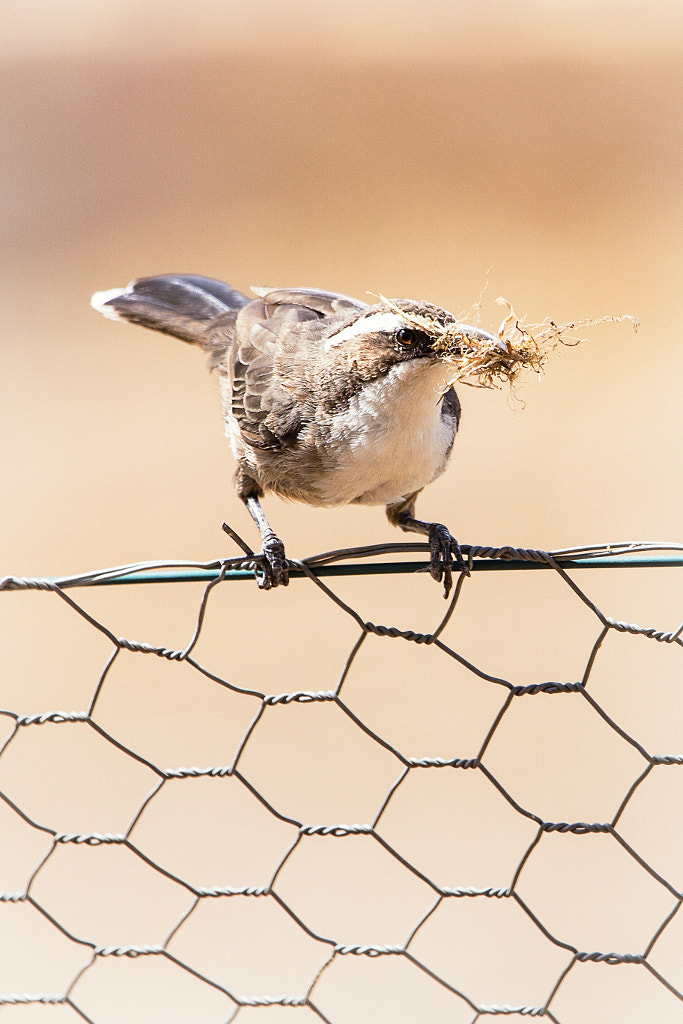
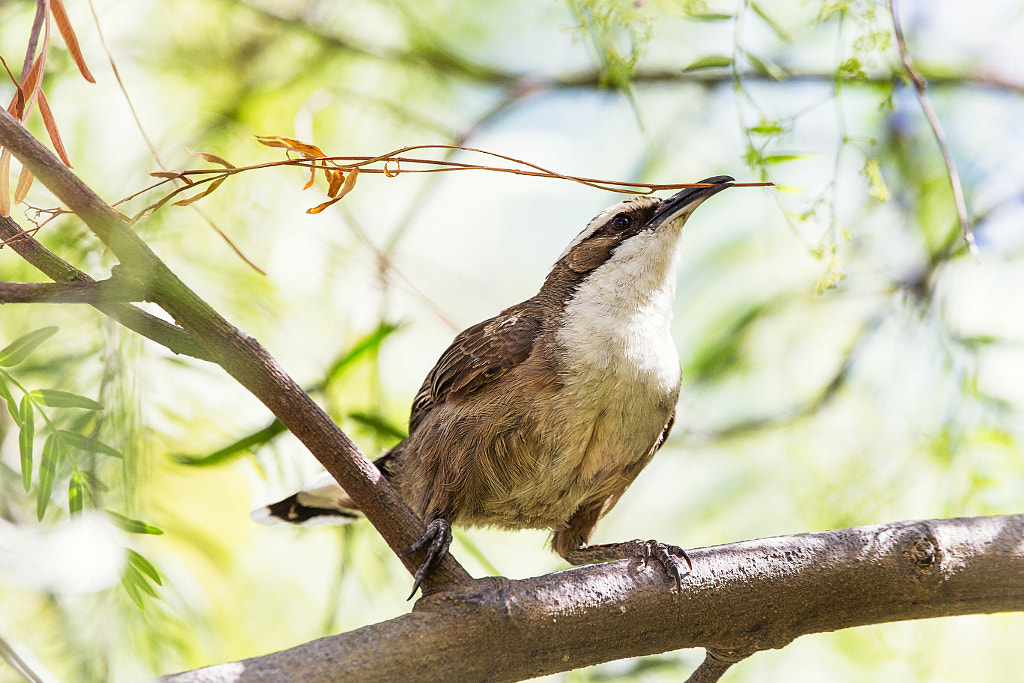
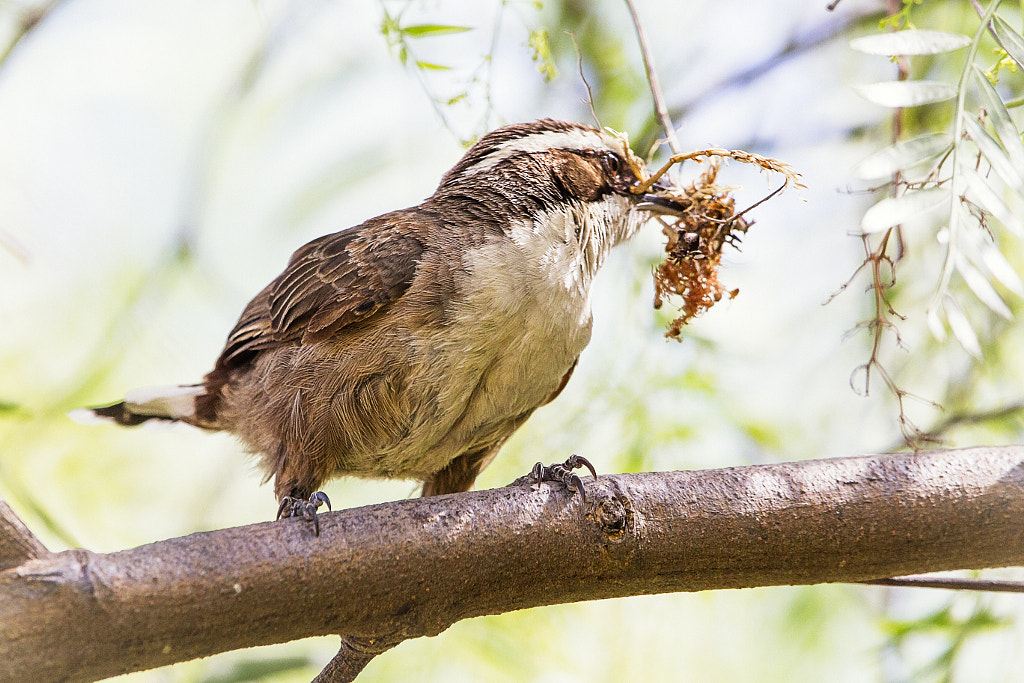
Back in September I wrote about the various birds nesting in the garden. Well autumn is now here and I thought I’d write an update. The white browed babblers have successfully hatched all their eggs which means there has been a population explosion. They are quite curious birds as they live in communal nests and have separate nursery nests as well which they all take turns in raising the chicks. Well now they are embarking on a building program to make a new communal sleeping nest for all the new adults. As a result these funny little grumpy birds are flying in building materials at a great rate of knots.
A delivery of nest material from next door. White browed babbler, Pomatostomus superciliosus. York, Western Australia. Canon 6d with Sigma 150-600mm f/5-6.3 DG OS HSM Contemporary lens. Exposure: 1/640 sec, f6.5 at ISO 500.
Queuing on the landing branch waiting to unload. White browed babbler, Pomatostomus superciliosus. York, Western Australia. Canon EOS6d with Sigma 150-600mm f/5-6.3 DG OS HSM Contemporary lens. Exposure: 1/640 sec, f6.3 ISO 320.
Waiting to enter the building site. White browed babbler, Pomatostomus superciliosus. York, Western Australia. Canon EOS6d with Sigma 150-600mm f/5-6.3 DG OS HSM Contemporary lens. Exposure: 1/640 sec, f6.3 at ISO 640.
We were also quite delighted to have a visitor. While we were talking one afternoon I spotted a Nankeen Kestrel hunting in the field opposite. It didn’t catch anything and left empty-handed. I thought that was that when I heard a bump from the TV aerial so we both ran outside to look, me with my camera and Helen with her binoculars. Sure enough the kestrel had decided our aerial would make a very good observation perch. It remained there quite unfazed for quite a while. It was only when I tried to get closer for a better photo that it decided to leave.
Nankeen kestrel, Falco cenchroides cenchroides. York, Western Australia. Canon EOS 6d with Sigma 150-600mm f/5-6.3 DG OS HSM Contemporary lens. Exposure: 1/1000 sec, f8 at ISO 320.
Nankeen Kestrel (Falco cenchroides cenchroides) sitting on the street lamp outside our house. Canon EOS550d with 70-200mm f2.8 IS L + x2 extender. Exposure: 1/4000, f8, ISO 1600.
Wave Rock at sunset. Hyden, Western Australia. Olympus OMD EM1 mki with Olympus m.Zuiko 12-40 f2.8 lens. Exposure: 1/160 th sec, f5.6, ISO 200.
Every day tour buses stop over in York on their way to Wave Rock near Hyden. The Northern Territory has Uluru (formerly known as Ayres Rock) and Western Australia’s tourism industry markets Wave Rock as our equivalent. I often feel sorry for the tourists, particularly the Chinese and Japanese ones, as they drive out from Perth to the middle of nowhere to see a large rock that looks like an enormous ocean wave frozen for posterity. I wonder what they think when they get there.
A week or so ago we went out to Hyden to visit Wave Rock. It’s not the first time we’ve visited, we first went in 2008. I find it very hard to be enthusiastic about it – it is just a curved rock face. My over all feeling is that Wave Rock is more marketing than substance. What I find more interesting is the way people interact with it. The majority of people just pull up in the car park and jump out to quickly take a selfie with their phone or a couple of seconds of video on a GoPro on one of those annoying sticks that they nearly poke someones eye out with as they are too busy on making strange faces for the camera. They then jump back into their cars and race off to the next destination on their itinerary. The next group of people are harried parents herding their bored looking children around and eventually persuading them to have their photo taken while they pretend to surf the perfect stone wave. The best was a young Chinese couple – he was shooting “glamour” photos of her while she was standing halfway up the curve in skimpy attire and the most incredible high heels – the sort that you need a ladder to get into and induce vertigo. My immediate reaction was not to perv the girl, but one of how the hell did she get up their dressed like that. The answer was obvious – when he finished taking photos he threw a bag up to her and she changed into a pair of track pants, a t-shirt and trainers and slid down on her backside.
Mulka’s Cave in the Humps Nature Reserve is a site of special significance to the Nyoongar people. Apart from being the subject of local folklore it also has the largest collection of rock paintings in the south of Western Australia. Olympus OMD EM1 mki with Olympus m.Zuiko 12-40 f2.8 lens. Exposure: 1/30 sec, f5.6, ISO 3200.
Sixteen Kilometres north-east of Wave Rocks is The Humps Nature Reserve. It’s not a very appealing name and probably doesn’t help with marketing to the tourist hordes. The Humps are a massive granite outcrop some 2 km x 1.5 km in area and rises to 80 m above the surrounding plain which was and is of huge cultural significance to the Nyoongar people. Mulka’s Cave is a gallery for 452 motifs which makes it the largest collection in southern Western Australia.It is thought that the paintings were produced over the last two or three thousand years and it feels like the people who made them are reaching out from the past to the present day. It really reinforces the impression of spirit of place and of belonging to the land. To me this is what makes The Humps more special than Wave Rock, it engenders a feeling to that felt at Uluru or Ubirr. Powerful stuff. Mulka’s Cave is named after one of its inhabitants about which there is a gruesome Dreamtime story.
‘Mulka was the illegitimate son of a woman who fell in love with a man to whom marriage was forbidden. As a result, Mulka was born with crossed eyes. Even though he grew up to be an outstandingly strong man of colossal height, his crossed eyes prevented him from aiming a spear accurately and becoming a successful hunter. Out of frustration, Mulka turned to catching and eating human children, and he became the terror of the district. He lived in Mulka’s Cave where the impressions of his hands can still be seen much higher than those of an ordinary man. His mother became increasingly concerned with Mulka and when she scolded him for his anti-social behaviour, he turned on his own mother and killed her. This disgraced him even more and he fled the cave, heading south. Aboriginal people were outraged by Mulka’s behaviour and set out to track down the man who had flouted all the rules. They finally caught him near Dumbleyung 156 km south-west of Hyden, where they speared him. Because he did not deserve a proper ritual burial, they left his body for the ants – a grim warning to those who break the law.’
R.G.Gunn, Mulka’s Cave Aboriginal rock art site: its context and content, Records of the Western Australian Museum 23: 19-41 (2006).
Nyoongar hand prints reach out from the past in Mulka’s Cave. Hyden, Western Australia. Olympus OMD EM1 mki with Olympus m.Zuiko 12-40mm f2.8 lens. Exposure: 1/100 sec, f4, ISO 1600.
There are a couple of walks in the reserve – The Gamma Trail a 1.2km interpretative walk explains the significance of the area to the local Nyoongar people, and the Kalari Trail, a 1.6 Km trail climbs to the summit. The early morning walk to the summit was fantastic. There were kangaroos amongst clumps silver princess trees (Eucalyptus caesia), nankeen kestrels were riding the thermal currents looking for prey and there were hosts of wrens bathing in the shallow pools of water on the rock surface. You get the feeling that this is a place where everything has been stripped back to the elemental essentials. Time was standing still. Of course the moment was lost as the multitudes of tourists pulled up in the car park jumped out to grab a selfie in the cave and use the toilet, their chattering voices carrying up to the summit shattering the tranquility. For a brief couple of hours on top of the humps I was somewhere else quite magical.
Rock pool on the Humps. The Humps are a large granite outcrop to the north-east of Hyden, Western Australia. Olympus OMD EM1 mki with Olympus m.Zuiko 12-40mm f2.8 lens. Exposure: 1/640, f8 at ISO 200.
A nankeen kestral soaring the summit of the Humps. Hyden, Western Australia. Olympus OMD EM1 mki with Olympus m.Zuiko 12-40mm f2.8 lens. Exposure: 1/500, f9, ISO 200.







You must be logged in to post a comment.