Cack-handed Day

Newly mobile, I had such high hopes for this trip to Bernard Park in the Wheatbelt metropolis of Northam. I walked the dog through the park the day before and saw plenty of bird activity. Everything was checked and packed carefully the night before and the car had a full tank of petrol. What could go wrong? I pulled up in the carpark just after dawn and the conditions were looking perfect. I could see and hear plenty of birds. Then I found out what could go wrong. Me! I just couldn’t do anything right. It was as if I’d never picked up a camera before. Forty years of photographic knowledge and experience had evaporated. A lot of the birds got so bored sitting around waiting for me to get my act together that they took off in search of a better photographer. I missed lots of sitters because I was just so slow in sorting out focus, exposure and composition. After an hour and a half of abject failure I threw in the towel  and called it a day.

I’ve put the two best photos below and they are quite frankly very, very pedestrian.


Three Little Birds. Kanamit or Welcome Swallows (Hirundo neoxxena). Bernard Park, Northam, Western Australia.


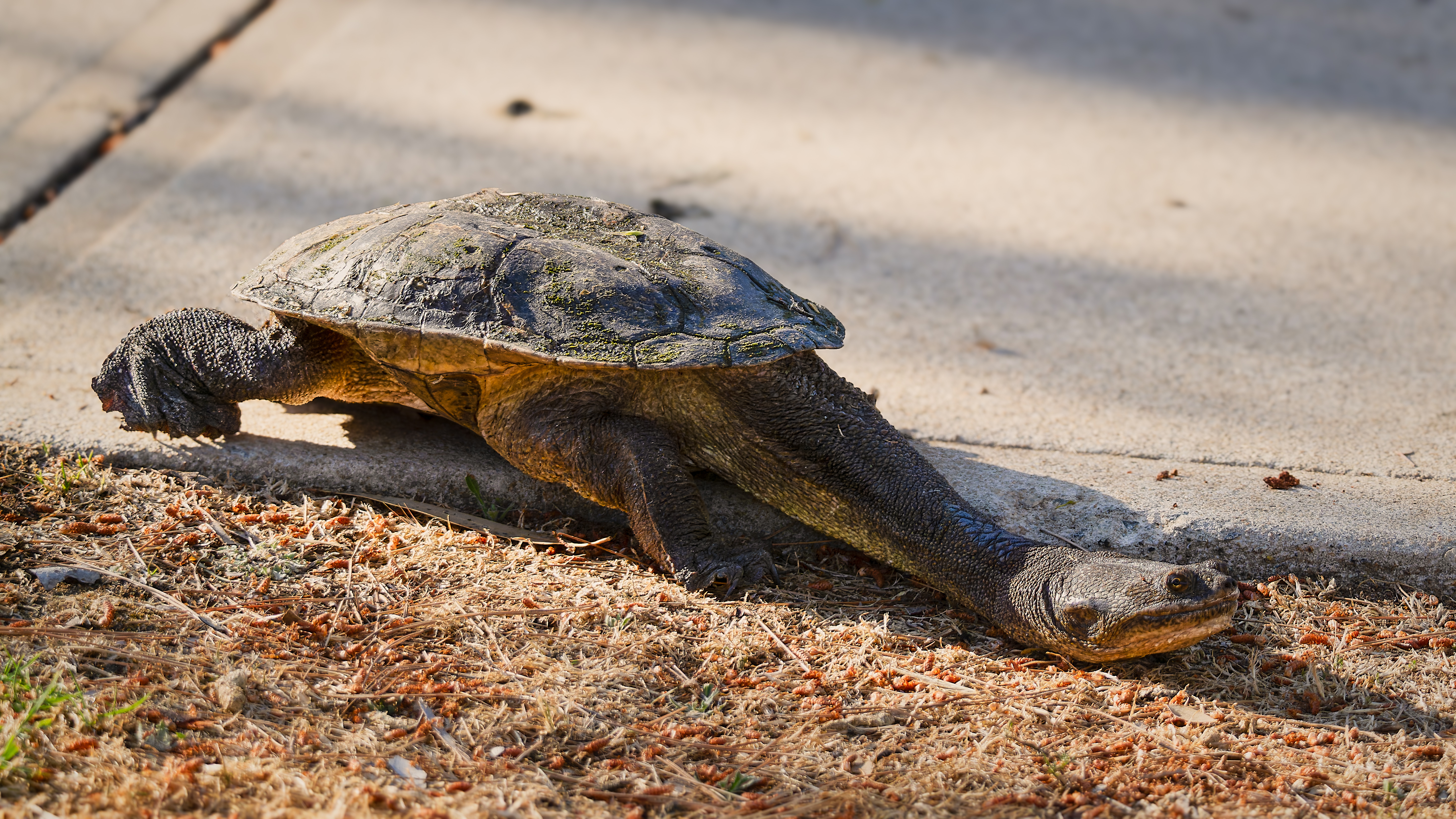
A female Choonya or Long-necked turtle aka oblong turtle (Chelodina oblonga) having laid its eggs slowly makes its way back to the safety of the river. Bernard park, Northam, Western Australia.


The only upside to the day was that I saw two of the Long-necked Turtles. It’s egg laying season for them and they come up from the river – no mean feet as the bank is very high and steep at this point – and lay their eggs. They will have hatched out at this spot and every year they will lay their eggs there. Their offspring will do the same. Thirty years ago I used to see turtles quite regularly, but now they are very rare so to see 2 within five minutes of each other was something rather special. This time of year sees the turtles try to cross busy roads to get to their nesting sites, so if you live in these areas please be careful as you drive. A word to the wise. If you ever feel the need to help one not get run over by picking it up and moving it to a safe location  a word of caution. Make sure that the rear end is pointing away from your body. Long-necked Turtles void as a defence mechanism – it is an incredibly foul smelling mess that is very difficult to wash off yourself and out of your clothes. Once smelt never forgotten.


The issues regarding my blog that I spoke about a couple of weeks ago have not resolved. I still can’t link images from my account at 500px to my pages here at WordPress. I had extensive communications with both companies and each is blaming the other and I’m the meat in the sandwich. I hope in another couple of weeks to find a permanent solution.

One Of Those Days

The other day was was one of those days. Not the sort where everything goes mammaries up and you wish you hadn’t got out of bed. No it was one of those days when everything goes stupendously well – like unbelievably well. The other day was just one of those.


Bulland by Paul Amyes on 500px.com
Bulland or Little Egret (Egretta garzetta subsp. nigripes)


Bulland by Paul Amyes on 500px.com
Bulland or Little Egret (Egretta garzetta subsp. nigripes) are quite rare up in the Avon Valley although they are common elsewhere.


I was walking along the River Avon in Northam and it was proving to be a fruitful morning. Black-fronted Dotterels, Black-winged Stilts, Dusky Moorhens, and even a rare (well rare in these parts) Little Egret. After a couple of hours of sheer bliss I decided to call it a day and walk back to the car. As I was walking I thought to myself “You know what would cap off a perfect day? A Sacred Kingfisher.” And lo and behold within seconds of thinking that thought one appeared on a branch right in front of me. The best part was it could clearly see me and didn’t give a stuff. I was in raptures! It was hunting for large insects in the grass and every few minutes it would swoop down catch one and return to the branch and eat it. This kept going on for twenty minutes or so. In the end I called it quits after taking hundreds of photos and it stayed there. A brilliant finale to a brilliant day.


Nidoolyorong by Paul Amyes on 500px.com
A gratuitous shot of a Nidoolyorong or Black-fronted Dotterel (Elseyornis melanops).


Djandjarak by Paul Amyes on 500px.com
This Djandjarak or Black-winged Stilt (Himantopus himantopus) was too busy looking for food to bother about me.


Kanyinak by Paul Amyes on 500px.com
The icing on the proverbial cake. Kanyinak or Sacred Kingfisher (Todiramphus sanctus). Isn’t he magnificent?


Kanyinak by Paul Amyes on 500px.com
Having a bug for breakfast.


Kanyinak by Paul Amyes on 500px.com
Having a laugh.

The last few of weeks I’ve been observing some very interesting bird behaviour (well interesting to me) and I’ve found trying to record it just using photographs wasn’t capturing what was happening. So I’ve decided to shoot more video footage. Up until now I’ve found doing both photography and video very difficult. That’s because I was taught in order to shoot video well you had to have your camera on a tripod, limit your shutter speed to twice that of the frames per second which means faffing around with neutral density filters, use manual focus, take an accurate colour temperature reading and set the camera accordingly, and record good sound. All that takes the spontaneity out of it. If an animal pops up suddenly I like to be able to react in an instant and with stills photography you do that. Video requires (or so I thought) so much preparation that the animal has been and gone. So I came to the conclusion that I only do this for my entertainment so it doesn’t matter if I break “the rules”. So I set my camera up to shoot in programme mode, set auto white balance, auto ISO, I use the camera’s built in microphone for sound, and auto focus. I’m not carrying a tripod so I’m shooting handheld. If I see something interesting I snap off a few photos and then press the video record button. This approach has added a new dimension to my photography and I’ve been very happy with the results so far. Below are a few clips from my brilliant day in Northam. 


Has anyone else added video to their photography?

Settling Down

Spring is now almost over and most of the wildlife has now settled down to domestic duties – having and raising young.

A recent visit to Bernard Park in the Wheatbelt metropolis of Northam showed this to be true. The Australian Reed Warblers were still building nests and it won’t be long before the serious business of egg laying starts.


Koordji-koordji by Paul Amyes on 500px.com
Koordji-koordji or Australian Reed Warbler (Acrocephalus australis subspecies gouldi) gathering nesting material. Northam, Western Australia.
Koordji-koordji by Paul Amyes on 500px.com


Koordji-koordji by Paul Amyes on 500px.com


The Welcome Swallows were mostly content to hang out together between hunting forays, but we did see a couple which did seem to be in the middle of a domestic alternately screeching at each other. Do birds separate and divorce? No idea. Perhaps I anthropomorphising them too much, but it is hard not to project human feelings into animal interactions.


Kanamit by Paul Amyes on 500px.com
A contented pair of Kanamit or Welcome Swallows (Hirundo neoxxena) taking a breather under the Peel Terrace Bridge. Northam, Western Australia


Kanamit by Paul Amyes on 500px.com
These two seemed to be in some sort of domestic dispute.


Kanamit by Paul Amyes on 500px.com
It wasn’t one sided either. Both were carrying on like pork chops in a frying pan. Perhaps a referral to Relationships Australia is in order?

Purple and Yellow

In spring some of the fields round here can erupt with a mass of purple and yellow flowers. The purple one is called Patterson’s Curse (Echium plantagineum) and the other yellow flower is called Capeweed (Arctotheca calendula). Unfortunately the plants are feral weeds and not at all welcomed by the local farmers. Patterson’s Curse is very toxic to non-ruminants causing liver failure. It is also a skin irritant for humans.  Despite that it can be spectacular to see fields covered in them.

The scene below was just a snap shot taken while returning home from the Wheatbelt metropolis of Northam.


Grazing by Paul Amyes on 500px.com
Two horses grazing amongst Patterson’s Curse (Echium plantagineum) and Capeweed (Arctotheca calendula). Northam, Western Australia.


I Cry And Sing The Blues*

This little boy was belting his heart out.


Djer-djer by Paul Amyes on 500px.com
“OOOH! Got an audience.” Djer-djer or Splendid Fairy-wren (Malarus splendens subsp splendens). Northam, Western Australia.


Djer-djer by Paul Amyes on 500px.com
“This is for all my ladies”.


Djer-djer by Paul Amyes on 500px.com
Hitting the top note.


Djer-djer by Paul Amyes on 500px.com
Big finish.


Djer-djer by Paul Amyes on 500px.com
“Thank you very much. Did you like it?”
  • Today’s title comes from the album and track by the amazing blues legend Buddy Guy.


A Clear And Crisp Morning

At last a morning with no rain or mist. It was definitely on the chilly side, but the most important thing was the sun was out. What a difference the sun makes. Everything looked new and clean.

The morning saw us walking along the river bank in the Wheatbelt Metropolis of Northam. There was definitely a hint of spring being around the corner. Lots of birds gathering material for nests. Birds calling out to each other and pairing up. So much activity. It was just wonderful to see.


20250807-Northam-0228-Edit by Paul Amyes on 500px.com
The rail bridge over the Avon River in Northam. The water levels bode well for the forth coming Avon Descent White Water Race.


Bandiny by Paul Amyes on 500px.com
Bandiny or New Holland Honeyeater (Phylidonyris novaehollandiae) collecting nesting material from the reeds. Northam, Western Australia.


Djeringkara by Paul Amyes on 500px.com
This Djeringkara or Silver Gull (Larus novaehollanddiae) was also collecting nesting material. Northam, Western Australia.


The Proud Parents by Paul Amyes on 500px.com
Forget building nests. This pair of Marangana or Australian Wood Ducks (Chenonetta jubata) were walking around with their newly hatched clutch of 10 ducklings


Bambon by Paul Amyes on 500px.com
Just past the weir the trees were full of Bambon or Rufous Whistlers (Pachycephala rufiventris) noisily calling out to each other trying to attract a mate. Northam, Western Australia.


Reciprocity

The Exposure Triange. All values have a reciprocal relationship.


Reciprocity in photography is where if you make one change to the exposure triangle – shutter speed, ISO, aperture – then you have to change one of the others by a corresponding amount to compensate for it. So if I have an exposure value of 1/125 sec, f4, ISO 400 and I want a shutter speed of 1/1000 then I’d either have to open the aperture to f1 or increase the ISO to 6400 or a combination of the two. The problem with wildlife photography is that it is often done in low light and has a need to use fast shutter speeds as the critters won’t sit still for very long. It is surprising to see how much a bird moves while sitting on a stick. This was my problem the other day when I returned to Northam to have another go at getting a photos of an Australian Spotted Crake (Porzana fluminea) . 


Common Sandpiper by Paul Amyes on 500px.com
Common Sandpiper, Actitis hypoleucos. Northam, Western Australia. Exposure: 1/200 sec, f6.3 ISO 10000. Topaz DeNoise AI saved the day!


As regular readers may remember in a previous post I said that I didn’t have a long enough lens for my usual Micro Four Thirds camera – the Olympus EM1x. My lens is a 100-400mm which gives me a reach of 800mm in 35mmm full frame terms. The lens won’t take a teleconverter and even if it did that would entail a further loss of light and image quality. So after some thought I decided to use my Canon 80d and Sigma 150-600mm lens which would give a reach equivalent to 960mm. Not a lot more but sometimes you’ve got to take all you can get. So with that we headed off to Northam and I sat on the river bank waiting for that elusive little spotty bird to make an appearance. My big problem was light – well to be more precise the lack of it. I warmed up with shots of a Common Sandpiper with an exposure value of 1/200, f6.3, ISO 10,000. I was lucky as the Sandpiper was content to sit still. When I did finally get a glimpse of the Australian Spotted Crake it was in deep shade so I had to drop the shutter speed to 1/60. I couldn’t open the lens up any more as I was wide open and I couldn’t use a higher ISO as I’d reached the limit. I shot several bursts in the hope I’d get at least one sharp image. A quick look at the rear LCD panel gave me a bit of hope for a result. By now the bird had taken itself back into the undergrowth not to emerge again. After waiting for a while we continued walking down the river to see if anything else was about.


Wayan by Paul Amyes on 500px.com
Wayan or White-faced Heron (Ardea novaehollandiae). Northam, Western Australia. Even in the open 1/250 sec, f6.3, ISO 5000.


Djandjarak by Paul Amyes on 500px.com
Djandjarak or Black-winged Stilt (Himantopus himantopus). Northam, Western Australia. Exposure: 1/160 sec, f6.3, ISO 3200.


Nidoolyorong by Paul Amyes on 500px.com
Nidoolyorong or Black-fronted Dotterel (Elseyornis melanops). Northam, Western Australia. Now we’re talking, light levels are starting to improve. Exposure: 1/500 sec, f7.1, ISO 2000.


Bambon by Paul Amyes on 500px.com
Bambon or Rufous Whistler (Pachycephala rufiventris). Northam, Western Australia. Exposure: 1/500 sec, f6.3, ISO 200.


Ngalkaning by Paul Amyes on 500px.com
Ngalkaning or Nankeen Night Heron AKA Rufous Night Heron (Nycticorax caledonicus subsp mannillenis). Northam, Western Australia. A bit on the dark side under the bridge so 1/250, f6.3, ISO 8000.


Getting home and looking at the photos none of the images of the Spotted Crake were sharp, there was motion blur and grain the size of golfballs. I tried every trick I know to try and rescue the images. But, as my dad used to say “No matter how hard you polish a turd it will always be a turd”. That flipping bird has become my nemesis. On the positive side I did get the nicest images of a Sacred Kingfisher that I’ve ever taken.


 Kanyinak by Paul Amyes on 500px.com
Kanyinak or Sacred Kingfisher (Todiramphus sanctus). Northam, Western Australia. Exposure: 1/1000 sec, f6.3, ISO 1250.


 Kanyinak by Paul Amyes on 500px.com
Exposure: 1/1000 sec, f6.3, ISO 3200.


Just When You Thought You’d Seen Everything

Wayan by Paul Amyes on 500px.com
Wayan or White-faced Heron (Egretta novaehollandiae). Northam, Western Australia.


 Kaaka-baaka by Paul Amyes on 500px.com
Kaaka-baaka or Yellow-billed Spoonbill (Platalea flavipes). Northam, Western Australia.


I’ve been writing about visiting the great Wheatbelt Metropolis of Northam for birding several times this year and I thought I’d got a good handle on what there was to be found along the Avon River there. But this last visit I was genuinely surprised. We’d parked the car at Enright Park with the intention of walking along one bank towards the weir and the Peel Terrace traffic bridge, cross the river and walk back on the other side. The light wasn’t particularly nice – in fact it was quite overcast and dark. There wasn’t much to see – a couple of White-faced Herons (Egretta novaehollandiae), Yellow-billed Spoonbills (Platalea flavipes) and a few Silver Gulls (Larus pacificus).  At that point I was a bit bored and my mind was drifting off with thoughts of coffee and cake at the bakery. Then as we crossed the traffic bridge I noticed a tiny little blob bouncing around on the island in the middle of the river. As I walked to get a better look I saw that it was an Australian Spotted Crake. Well that was a first. I was, I have to admit pretty excited after that. As we crossed the weir I saw Common Sandpipers (Actitis hypoleucos), Black-winged Stilts (Himantopus himantopus) and Black-fronted Dotterels. By then I was fully engaged and all thoughts of leaving had evaporated. Northam – you never know what you may find.


Australian Spotted Crake by Paul Amyes on 500px.com

Australian Spotted Crake (Porzana fluminea). Northam, Western Australia.


Djandjarak by Paul Amyes on 500px.com
Djandjarak or Black-winged Stilt (Himantopus himantopus). Northam, Western Australia.


Common Sandpiper by Paul Amyes on 500px.com
Common Sandpiper (Actitis hypoleucos). Northam, Western Australia.


Nidoolyorong and Common Sandpiper by Paul Amyes on 500px.com
Common Sandpiper (Actitis hypoleucos) and Nidoolyorong or Black-fronted Dotterel (Elseyornis melanops). Northam, Western Australia.


Nidoolyorong by Paul Amyes on 500px.com
Nidoolyorong or Black-fronted Dotterel (Elseyornis melanops). Northam, Western Australia.


Burlong Pool

Burlong Pool is about 4.5 Km south west of the Wheatbelt Metropolis of Northam and is one of the termini of the Dorntj Koorliny or Walking Together Track. The Ballardong Nyoongar  believe that it is a significant place for the Dreamtime Wagyl or Rainbow Serpent. The Wagyl created the landscape of the South West of Western Australia, looks after the fresh water and also helps bring the rains. Burlong pool was/is the Wagyl’s summer resting place and is regarded as a sacred site.

We’ve been visiting the site for years as we often take the dog with us to Northam when we go shopping (not in summer) and we use it as a walk place for her and to stretch our legs. Every time we went we’d see a lot of wildlife and I always came away thinking I must go and take some photos. Well that time came and we headed out early one morning. On getting there we were met with raucous calling from an enormous flock of corellas. We stayed for a bit watching them and the other birds and then we started walking the Dorntj Koorliny Track towards Northam. Even though the weather was very warm it was an enjoyable walk and we saw heaps.


Kadjinak by Paul Amyes on 500px.com
Kadjinak or Grey Fantail (Rhipidura albiscapa). Dorntj Koorliny, Burlong Park, Northam, Western Australia.


Grass Seeds by Paul Amyes on 500px.com
Dorntj Koorliny, Burlong Park, Northam, Western Australia.


Nidoolyorong by Paul Amyes on 500px.com
Nidoolyorong or Black-fronted Dotterel (Elseyornis melanops). Dorntj Koorliny, Burlong Park, Northam, Western Australia.


Djindjokoor by Paul Amyes on 500px.com
Djindjokoor or Brown Honeyeater (Lichmera indistincta). Dorntj Koorliny, Burlong Park, Northam, Western Australia.


Kakak by Paul Amyes on 500px.com
Kakak or Little Pied Cormorant (Phalacrocorax melanoleucos). Dorntj Koorliny, Burlong Park, Northam, Western Australia.


Koordjokit by Paul Amyes on 500px.com
Koordjokit or Little Black Cormorant (Phalacrocorax sulcirostris). Dorntj Koorliny, Burlong Park, Northam, Western Australia.