I had to take the car for a service in Perth the other day and as I set off the mist was really thick. At one point on the Great Southern Highway I couldn’t see more than 5m in front of me. With such poor visibility I didn’t fancy my chances taking photos on Heirisson Island, but by the time I got there the mist was starting to burn off. I spent a pleasant couple of hours wandering around taking photos.
Looking out from Heirisson Island to Perth and the mist obscures the view.
Despite the misty conditions the Galahs (Cacatua roseicapilla) were very busy.
Eventually the warm light of the sun started to break through the mist.
This female Western Grey Kangaroo came over to check me out. Once she realised that I had no food she hopped off.
The obligatory bird on a stick photo. Noolarko or Black-faced Cuckoo-shrike (Coracina novaehollandiae).
And another, this time a Kanamit or Welcome Swallow (Hirundo neoxxena).
Mimal or Australian Darter (Anhinga melanogaster subspecies novaehollandiae) drying out in the warm winter sun.
Walking off the island gave me a chance to see and use the new Boorloo Bridge the new Pedestrian and Cyclist bridge connecting the Perth Foreshore with South Perth foreshore via Heirisson Island.
The other week I had the privilege of being asked to judge one of Mundaring Camera Club’s monthly competitions. It was a great experience and I really enjoyed looking at all the wonderful photos that had been entered. At one point when looking a shot of a flower I made my oft said statement shoot photos of flowers like they are a portrait of a person. So what do I actually mean by that? After a couple of weeks thought – I’m not the quickest! – I’ve decided to actually write it down.
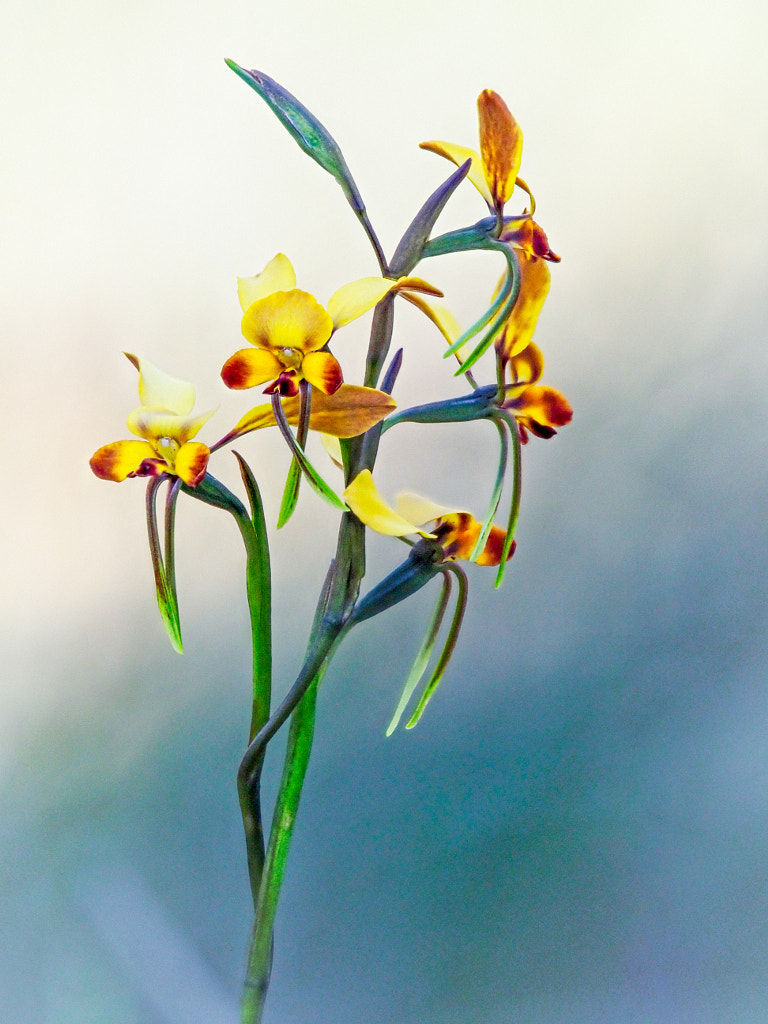
The following four shots are all photos of the same Winter Donkey Orchid – it’s nothing special it’s just a plant I found the other day. But they do illustrate how I approach each subject.
Winter donkey orchid, Diuris brumalis. Woottating, Western Australia.
The first is the establishing shot, an environmental portrait. It shows the plant in situ and how it relates to bush around it.
The first of the mid length portraits.
The second mid length shot done with the macro lens and flash. It creates a very different looking picture when compared with first one.
The next two are mid length shots. Two different techniques are used to try and produce the same effect. One is a single shot taken with a macro lens and flash, the other is done with a long telephoto lens as a focus stack. The aim is produce a shot with a nice clean back ground.
The tight “head” shot.
The fourth shot is a close up portrait – a head and shoulders if you like – to reveal some of the characteristics of the flower.
It is how I work the subject. Unlike Austin Powers I’m not asking the flower to be a tiger, but, what I am doing is taking a series of photos from different angles to bring out the best in the subject.
As an aside the clip of Austin Powers is its self a parody of another famous screen photographer – the protagonist of Michelangelo Antonioni’s masterpiece ‘Blowup’. I certainly don’t behave like David Hemmings’ character did when photographing Veruschka von Lehndorff in the film. That would be a bit strange.
The plan was simple walk the 7.9km Mt Matilda Walk Trail is located in the Wongan Hills Nature Reserve which is 12 km from Wongan Hill’s townsite. Beloved Significant Other (BSO) had a long cherished dream of doing the walk and with nothing on the agenda we set out to fulfil it. Now at this stage I’ll be completely honest and say my intentions were not only of the walking kind. I was hoping to slope off and get some orchid photography in at another nearby reserve. The BSO doesn’t like hanging about while I take photos – she would sooner watch paint dry.
Helen at the Lake Hinds Lookout on Mount Matilda.
How things turned out was another matter. As Rabbie Burns the Scottish poet wrote in his 1785 poem To a Mouse“The best-laid schemes o’ mice an’ men Gang aft agley”or for those nonScotslanguage speakers “The best-laid schemes of mice and men Go oft awry”.
Looking down from the Lake Hinds Lookout at the patterns in the neighbouring farmland.
Paul celebrates reaching the summit of Mount Matilda.
The summit of Mount Matilda. The sign marking the summit has seen better days. Lake Hinds can be seen in the distance.
Well we did climb to the summit of Mount Matilda, which at only at 411m isn’t really saying much, but a combination of a dodgy back, grumbling knees and a long drive meant that we didn’t do the full walk. We decided to walk out to the summit and then back track to the turn off for the 4.8 km Wildflower Loop and I’m glad we did because we saw something really special – something we’d only waited 36 years to see. There on the side of the track was a Thorny Devil. We could scarcely believe it. Now Australia is full of weird animals – egg laying mammals, strange birds, bizarre looking insects, but the Thorny Devil is one of the strangest looking I’ve ever seen. Its defence seems to based on the idea that you’ll not want to harm it because it’s covered on big thorns as it made no attempt to move away from us.
Thorny Devil, Moloch horridus. Mount Matilda, Western Australia.
Weird eh? Thorny Devil, Moloch horridus. Mount Matilda, Western Australia.
On completion of the walk we had a nice picnic lunch at the shelter at the start of the walk trail while watching a bunch of blokes head to run the trail. I didn’t slope off to do any orchid photography as I couldn’t be fagged. The walk had been enough.
Helen standing next to a Spreading Coneflower.
Spreading Coneflower(Isopogon divergens) is found in Wongan Hills.
Helen walking through a stretch of trail called “A Country Garden” on Mt Matilda.
Pink Pokers (Grevillea petrophiloides) found all over Mount Matilda.
As I sit and write this SBO has announced we’ll have to go back and do the whole walk.
Time lapsing at Lake Leschenaultia in Western Australia.
The last few weeks I’ve been spending a day at Lake Leschenaultia. I’ve photographed there often but this time I thought I’d try making a video about some of the wildlife there. In the process I’ve discovered three things:
The animals don’t play ball. Quite a few times I went and they didn’t show up.
It’s harder than it looks. We’re accustomed to seeing the David Attenborough docos on the TV and they spoil us because trying to get anything halfway decent takes an enormous amount of time, dedication and skill.
All the cameramen and directors of photography I know of all complain of having wrecked backs. Having carted the equipment round for a few weeks I now know why – it’s bloody heavy!
Having said that it has been great fun and while I’m not particularly happy with the resulting video I enjoyed the whole experience immensely.
Now for a shameless plug. Autumn, Winter and Spring are the best times to go walking in Western Australia and the walk around Lake Leschenaultia is one of forty two that are in my book Perths Best Bush, Coast and City Walks which can be bought through the link given. Further more if you use the code PAULA15 you get a discount of 15%.
The wildflowers in their beauty, the mountain ranges tall, the billabongs and rivers, and friendly birds that call…
by
Brian Black
Zebra Orchid, Caladenia cairnsiana. Stirling Range National Park, Western Australia. Olympus OMD EM1 mk ii with Olympus 60mm f2.8 macro lens. Exposure: 1/250 sec, f8 at ISO 200.
Prisoner Orchid – a hybrid between Josephs Spider Orchid (Caladenia polychroma )and the Zebra Orchid (Caladenia carnsiana). Hybridisation occurs due to cross pollination of parent plants by a feral pollinator the European honeybee (Apis mellifera).Olympus OMD EM 1 mk ii with Olympus 60mm f2.8 macro lens. Exposure: 1/250 sec, f8 at ISO 200.
Joseph’s Spider Orchid, Caladenia polychroma. Stirling Range National Park, Western Australia. Olympus OMD EM1 mk ii with Olympus 60mm f2.8 macro lens. Exposure: 1/250 sec, f5.6 at ISO 200.
Looking out at Mt Toolbrunup from the summit of Mount Trio. Olympus OMD EM 1 mk ii with Olympus 12-40mm f2.8 lens. Exposure: 1/400 sec, f8 at ISO 200.
Wookonga or Regent Parrot (Polytelis anthopeplus). Stirling Range Retreat, Western Australia. OlympusOMD EM1 mk ii with Panasonic Leica 100-400mm f4-6.3 lens. Exposure: 1/500 sec, f6.3 at ISO 250.
Yellow-plumed Honeyeater (Lichenostomus ornatus) called Miamit by the Nyoongar of Southwest Western Australia. Stirling Range Retreat, Western Australia. Olympus OMD EM 1 mk ii with Panasonic Leica 100-400 f4-6.3 lens. Exposure: 1/500 sec, f6.3 at ISO 800.
Djoondalkoron or Crested Shrike-tit (Falcunculus frontatus). Stirling Range Retreat, Western Australia. Olympus OMD EM 1 mk ii with Panasonic Leica 100-400mm f4-6.3 lens. Exposure: 1/500 sec, f6.3 at ISO 800.
Some places get all the attention and others are seldom mentioned. In the Sterling Range National Park everyone concentrates on climbing Bluff Knoll, but there is as I’ve said on previous occasions a lot more than Bluff Knoll. Believe it or not Bluff Knoll is one of the easier climbs in the park. Another one is Mount Trio. Climbing up Bluff Knoll is not a wilderness experience as there are far too many people. With Mount Trio if you see more than two other people its a very busy day.
The sun sets behind Mount Trio in the Stirling Ranges of Western Australia.
Helen at the start of the Mount Trio walking trail in Sterling Range National Park.
Mt Trio comprises three peaks and was once known by its Aboriginal name Warrungup, meaning “three become”. It is 3.7Km to the top and back with an ascent of 418m. The first third of the walk is very steep with irregularly spaced steps. Wildflowers, including the endemic mountain bells (Darwinia leiostyla), are a feature of this walk. Montane thicket on the upper levels of the peaks puts on a colourful display of wildflowers in spring and early summer although we didn’t see this as the area was still recovering from a devastating bushfire and was like walking through a landscape of charcoal sticks.
The first third of the walk trail is up a steep section with irregularly spaced steps which makes the going quite hard.
The Common Mountain Bell (Darwinia lejostyla) grows in the eastern and central Stirling Range, and can be readily seen on Bluff Knoll and Mount Trio.
Silky Blue Orchid, Cyanicula sericea. Mount Trio, Western Australia.
The going gets easier once you hit the saddle between the east peak and the north peak. The saddle between the cols is covered in Drumsticks (Kingia australis). These grass trees were often called Black Gin trees, a derogatory racist term now not used. The Nyoongar name for them is Pulonok. The track then follows a more gentle slope to the highest (northern) point at 856 metres. At the summit there is a small cairn of stones which people add to on getting there. From the summit on a clear day you get views of Mt Toolbrunup the second highest peak in the range at 1052m. Then all it is a matter of retracing your footsteps back to the start.
The saddle between the cols is covered in Drumsticks (Kingia australis). The Nyoongar name is Pulonok.
A closer look at some Drumsticks (Kingia australis).
Helen placing another stone on the cairn at the summit of Mount Trio.
Looking out at Mt Toolbrunup from the summit of Mount Trio.
Climbing up was pretty taxing on the legs muscles – all those steps were like a sadistic form of step aerobics. Those steps were even more murderous on the way down. It was the muscles that were complaining this time it was my knee joints. At about 500m from the end my knees announced that they were going to divorce me on the basis of cruelty. Thankfully from this point we could clearly see the car in the car park below us and it spurred us on to one last final effort.
I’ve got a confession to make. I’ve lived in and around Perth since 1988 and the first time I went to Riverside Gardens in Bayswater was in 2017 when I was making a video about that year’s Avon Descent – it is the finishing line. I didn’t pay much attention to the surroundings as I was concentrating on the event. Recently I went again, but this time I was using the garden’s carpark as a jumping off point to explore the Eric Singleton Bird Sanctuary.
The entrance to the Eric Singleton Bird Sanctuary in Bayswater, Western Australia.
Eric Singleton was an avid bird watcher from Embleton. In the 1970’s he observed over 70 species of bird in the area and his efforts led to the City of Bayswater deciding to preserve the wetlands in 1977. After a few wobbly patches the council and the Department of Parks and Wildlife in 2014 embarked upon a $3 million project to increase the biodiversity and improve the the water quality in the sanctuary and consequently the Swan River. Apparently it prevents a staggering 40 tonnes of sediment and rubbish, 1.35 tonnes of nitrogen, and 200 Kg of phosphorus from reaching the river each year. It does this by diverting water from the Bayswater Brook and directing it through a series of marsheswhich filter the pollutants out. So while you may think that you are looking a bird sanctuary comprised of a series of marshland and pools what you are actually looking at is a cunningly disguised water treatment facility. The system works well and the wetland has seen a huge upswing in the amount of wildlife species that use it. One hundred and four bird species have been sighted there. All of this in an urban setting is quite remarkable. Some of the animals you can expect to see are:
Purple swamp hen
Little pied cormorant
White-faced heron
Black fronted dotterel
Australian white ibis
Dusky moorhen
Grey fantail
motorbike frog
Dwarf skink
Oblong turtle
Great Egret (Ardea alba modesta). Eric Singleton Bird Sanctuary.
Yellow billed spoonbill, Platalea flavipes. Eric Singleton Bird Sanctuary, Western Australia.
Little Pied Cormorant (Microcarbo melanoleucos) called kokoko by the original Nyoongar inhabitants.
Mimal or Australian Darter (Anhinga melanogaster subspecies novaehollandiae). Eric Singleton Bird Sanctuary, Western Australia.
I visited on a Saturday and I was not prepared for what I saw. It was absolutely chockers. There were dog walkers galore, cyclists, picnickers, kids playing, kayakers on the river. The car park was used by a huge variety of food trucks doing a roaring trade selling to the hungry masses. There were even stalls selling dog treats. Once I got clear of the gardens and into the bird sanctuary proper it was a totally different story. I was the only person there. Just me and the birds. You could still hear the noise from the gardens and the surrounding suburbs, but you still had the feeling of getting away. I think to get the most out of the location in terms of seeing wildlife you’d be looking at visiting at dawn or dusk during the week. After a leisurely walk back to the car park I enjoyed a very nice Bánh mì from the Vietnamese food truck for lunch.
Riverside Gardens in Bayswater is a popular paddle sport venue and clubs such as the Bayswater Paddle-sports Club maintain facilities there.
On the weekends visitors can enjoy the numerous food trucks at the Riverside Gardens in Bayswater.
* Todays musical reference is to the Afro-American spiritual “Down by the Riverside” (also known as “Ain’t Gonna Study War No More” and “Gonna lay down my burden”). The song originates from the American Civil War (1861-1865) but wasn’t published until 1918. It’s pacifist imagery has seen it used as an anti-war protest song and included in collections of socialist and labour songs. Over the years it has been recorded by hundreds of different artists but my current favourite version is this one by Ben and Micah Hester as part of the “Southern Gospel Revival”.
The south east bank of Lake Gwelup in Western Australia.
The bird observation platform that forms part of the Lake Gwelup Reserve Broadwalk on the south eastern shore of Lake Gwelup.
Lake Gwelup and the reserve that surrounds it is one of the few areas of wetland that is still relatively intact. This means that it is home to a wide variety of flora and fauna which is all the more surprising considering it is just 12 Km north of Perth’s CBD in the City of Stirling which with a population of 210,000 (2016 Census) is the largest local government area by population in Western Australia. The bush around the lake is comprised of Marri, Jarrah, Flooded Gum, Tuart (, Swamp Paperbark and several species of Banksia. The bush and the lake provided a habitat for birds (according to eBird Australia 110 species of bird have been sighted there), frogs (notably Moaning Frogs), and reptile species (e.g. dugites, skinks and long necked turtles). One of the strange facts that has prevented the land from being developed is that the peaty soils around the lake if disturbed release arsenic and iron sulphates. In the areas nearby that have been drained and reclaimed they have the highest concentrations of dissolved arsenic in the world – some 25000 ug/L (some 400 times higher than that identified as safe levels for drinking water).
Bees feeding on the flowers of the Swamp Paperbark (Melaleuca rhaphiophylla). Lake Gwelup Reserve, Western Australia.
A male Blue-billed Duck (Oxyura australis) on Lake Gwelup in Western Australia.
So what is there to see and do? Well there is a networks of paths around the lake and through the surrounding bushland and you can bring your best canine friend with you. There are BBQ’s and picnic shelters, public bathrooms, sail-shaded playground, sporting grounds and cricket nets for those who don’t feel the need to connect with nature. For those wanting a nature fix on the southern side is a broad walk and viewing platform that allows you to get up lose and personal with the wildlife. An interesting development is that the bush northwest of the lake is a breeding ground for Rainbow Bee-eaters. These migratory birds come from Papua New Guinea and Tropical Australia and build their nesting burrows in our summer time.The City of Stirling has taken measures to protect the nesting sites and at the same time promote them as a feature of the reserve encouraging people to come and see them. Something that the City of Armadale could learn from with their management of Forrestdale Lake. Conservation and protection doesn’t mean you have to fence people out. So when I went the other week I put together a 3.75 Km walk around the lake that also took in the Rainbow Bee-eater nesting site. It was a loverly walk and it was great to see people out enjoying the sunshine in such beautiful surroundings.
The breeding colony of Rainbow Bee-eaters (Merops ornatus) is quite a feature of the Lake Gwelup Reserve in Western Australia.
The City of Stirling, who administer Lake Gwelup Reserve, place signage up warning people of the presence of Rainbow Bee-eaters’ underground nests.





You must be logged in to post a comment.