I had to take the car for a service in Perth the other day and as I set off the mist was really thick. At one point on the Great Southern Highway I couldn’t see more than 5m in front of me. With such poor visibility I didn’t fancy my chances taking photos on Heirisson Island, but by the time I got there the mist was starting to burn off. I spent a pleasant couple of hours wandering around taking photos.
Looking out from Heirisson Island to Perth and the mist obscures the view.
Despite the misty conditions the Galahs (Cacatua roseicapilla) were very busy.
Eventually the warm light of the sun started to break through the mist.
This female Western Grey Kangaroo came over to check me out. Once she realised that I had no food she hopped off.
The obligatory bird on a stick photo. Noolarko or Black-faced Cuckoo-shrike (Coracina novaehollandiae).
And another, this time a Kanamit or Welcome Swallow (Hirundo neoxxena).
Mimal or Australian Darter (Anhinga melanogaster subspecies novaehollandiae) drying out in the warm winter sun.
Walking off the island gave me a chance to see and use the new Boorloo Bridge the new Pedestrian and Cyclist bridge connecting the Perth Foreshore with South Perth foreshore via Heirisson Island.
It has been a difficult week. I walked along the local river bed looking for wildlife and struck very lucky with what I saw. My problems came when it came to identifying the species of damselfly I had photographed. Now in this part of Western Australia there are only ten species so you’d think it should be relatively straight forward. But, no it is not. For quite a few of the species counting the number of abdominal segments is a key feature. Now that’s not a huge problem because I can do that at home when looking at the photo. The problem I had was when you have to look at the “anal appendages” according to The Complete Field Guide to Dragonflies of Australia (Theischinger, Hawking and Orr). Now it’s hard enough to get a damselfly to sit still long enough for a photo, but getting one to remain still for a proctological examination – well good luck with that! I wonder if David Attenborough has a whole team of assistants who do this for him?
No problems identifying this wee beastie. Inland Ringtail, Austrolestes aridus. Avon Walk Trail, York, Western Australia.
Now this little chap presented nicely on this dried grass but he wouldn’t consent to having a rectal examination. Avon Walk Trail, York, Western Australia.
Flippin’ heck has it been warm here lately. I got up early a few days ago to photograph birds just after sunrise and it was 27ºC and a lot of the birds had already taken shelter in the deep shade. Yesterday it was 41ºC and the garden was a crispy brown and what vegetations there is was wilted. So this morning the garden sprinkler was put on. I was sent out to move the sprinkler in the back garden when I spotted some Yellow-rumped Thornbills playing in the water trying to keep cool.
A Yellow-rumped Thornbill taking up position to get maximum benefit from the garden sprinkler.
Adjusting the position so the feathers don’t repel the water.
The other week I had the privilege of being asked to judge one of Mundaring Camera Club’s monthly competitions. It was a great experience and I really enjoyed looking at all the wonderful photos that had been entered. At one point when looking a shot of a flower I made my oft said statement shoot photos of flowers like they are a portrait of a person. So what do I actually mean by that? After a couple of weeks thought – I’m not the quickest! – I’ve decided to actually write it down.
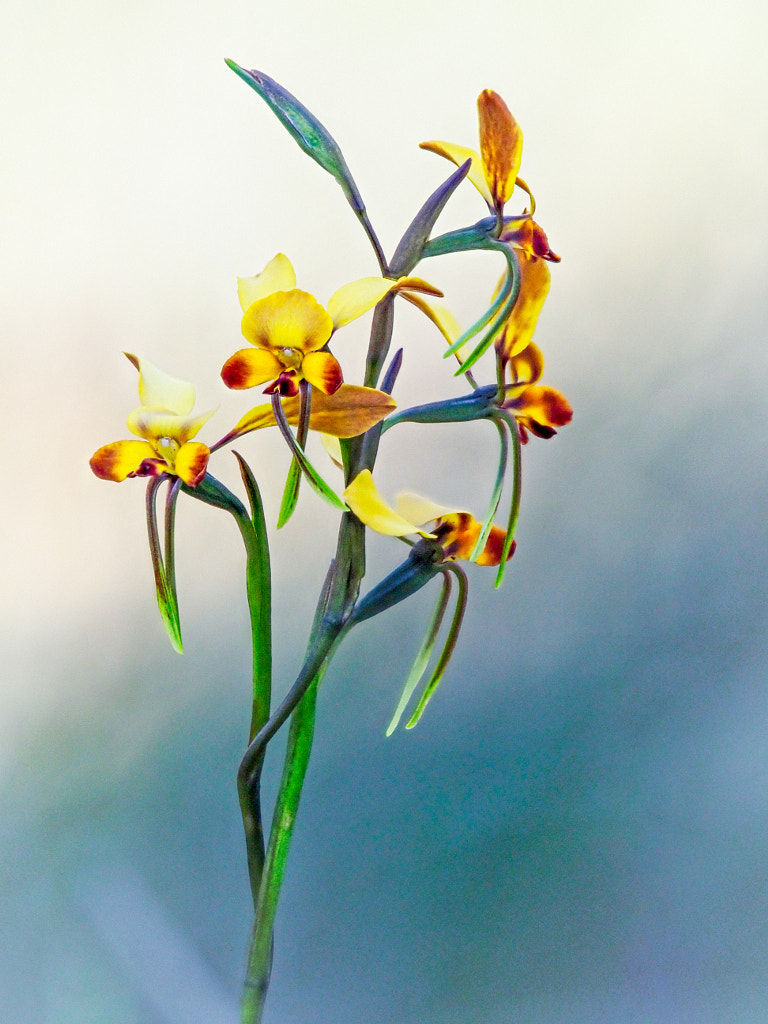
The following four shots are all photos of the same Winter Donkey Orchid – it’s nothing special it’s just a plant I found the other day. But they do illustrate how I approach each subject.
Winter donkey orchid, Diuris brumalis. Woottating, Western Australia.
The first is the establishing shot, an environmental portrait. It shows the plant in situ and how it relates to bush around it.
The first of the mid length portraits.
The second mid length shot done with the macro lens and flash. It creates a very different looking picture when compared with first one.
The next two are mid length shots. Two different techniques are used to try and produce the same effect. One is a single shot taken with a macro lens and flash, the other is done with a long telephoto lens as a focus stack. The aim is produce a shot with a nice clean back ground.
The tight “head” shot.
The fourth shot is a close up portrait – a head and shoulders if you like – to reveal some of the characteristics of the flower.
It is how I work the subject. Unlike Austin Powers I’m not asking the flower to be a tiger, but, what I am doing is taking a series of photos from different angles to bring out the best in the subject.
As an aside the clip of Austin Powers is its self a parody of another famous screen photographer – the protagonist of Michelangelo Antonioni’s masterpiece ‘Blowup’. I certainly don’t behave like David Hemmings’ character did when photographing Veruschka von Lehndorff in the film. That would be a bit strange.
Wayan or White-faced Heron (Ardea novaehollandiae) shrouded in the mist on the banks of the Avon River. York, Western Australia.
Early mornings along the River Avon have taken on a decidedly misty appearance. Going down to Monger’s Crossing at first light and I’ve been hard pushed to see across the river. The upside of this is that by carefully walking and crawling I can get quite close to the herons and spoonbills there. The spoonbills seem a bit more stoic than the herons. They just get on with the normal morning routine of foraging in the shallows for food. In contrast the heron looked decidedly unimpressed with the weather just standing in the long grass with its shoulder hunched up and looking forlornly at the water coming down from the weir.
Kaaka-baaka or Yellow-billed Spoonbill (Platalea flavipes) foraging on a misty morning.
Ngalkaning or Nankeen Night Heron (Nycticorax caledonicus subsp mannillenis) in the early morning mist.
Looking up the Avon River with Mount Bakewell shrouded in the early morning mist. York, Western Australia.
After an hour or so the sun gradually started burn off the mist and the golden light gave a radiance to everything. The sun’s warmth began to take effect and the birds became a lot more active and I was able to get some photos of birds flying, which is always a thrill. The still and quietness of the mist was gone and replaced by the raucous noise of the corellas and the honking of the herons as they flew overhead. By 9 o’cock it was all over. The birds had settled and no activity could be seen.
Golden Orb-weaving Spider’s web lit by the golden dawn light.
Wayan or White-faced Heron (Ardea novaehollandiae) flying in the warm light of dawn.
Manatj or Western Corellas (Cacatua pastinator) flying over the Avon River in York Western Australia.
Last week I focused on the water birds this last week I’ve been walking the Avon Walk Trail looking at arboreal birds. There are more Laughing Kookaburras along the river than I can ever recall. They are not native to Western Australia and were introduced in 1912 in the hope that they’d significantly reduce the snake population. The scheme was a failure and the impact on the native bird species was huge. They have the ability to sit motionless in trees for very long periods of time watching for prey. They watch for smaller passerine birds repeatedly returning to nests and then take the chicks. They also ambush unsuspecting picnickers and will often steal sausages from a BBQ hot plate or sandwiches out of the hand of unwary. We had relatives from the UK over and were having a picnic with them when a large kookaburra relieved one of them of a piece of fruit cake. Although they are now considered a pest they are one of the iconic birds of the Australian bush and I do derive a lot of pleasure from seeing them.
Kaa-kaa or laughing kookaburra (dacelo novaeguineae). Avon Walk Trail, York, Western Australia.
For me one of the highlights of summer is the return of the Rainbow Bee Eaters. Their numbers in York were severely depleted a few years ago when the council obliterated their nesting area with a bull dozer. They nest underground in burrows and while they are here they breed. The work was done while they were raising their young so killed off two generations of birds. Last year we had a solitary female return and she looked a very sorry sight on her own crying out for a mate. This year we’ve had two breeding pairs who’ve hatched out chicks who have fledged – so hopefully we’ll have them back in larger numbers next summer. This morning I went down to where they nest and their burrows were empty and there were no birds flying around so they must have set off on their long journey north.
Birin-birin or Rainbow Bee Eater (Merops ornatus). Avon Walk Trail, York, Western Australia.
Another bird I have a soft spot for is the Black-faced Cuckoo Shrike. We have quite a few nesting at then of our street so they’re no particularly uncommon, but I prefer to photograph them sitting in trees as opposed to sitting on a power line. I think they are a rather handsome looking bird with their black face and grey body. It’s just as well they’re good looking as it makes up for their terrible call which sounds like cat that smokes 60 a day.
Noolarko or Black-faced cuckoo shrike (Coracina novaehollandiae) .Avon Walk Trail, York, Western Australia.
The last couple of shots are of the small boring birds people don’t take any notice of. In fact they are known as SBB or small brown birds by most bird watchers. I like watching them flit about in the tree canopy. The Western Thornbills follow clouds of insects and feed off of them. They can be seen in small groups or as part of a flock with other small birds. They’ll suddenly descend upon an area feeding in the low shrubs and then as quickly as they arrived they’ll leave.
Djobool-djobool or Western Thornbill (Acanthiza inornata). Avon Walk Trail, York, Western Australia.
The last bird is the Brown Honeyeater. Despite its plain looks and small size it is easily one of the best singers in the Western Australian bush. The volume produced is amazing considering it size.
Djindjokoor or Brown Honeyeater (Lichmera indistincta) . Avon Walk Trail, York, Western Australia.





You must be logged in to post a comment.