I first went to Gnomesville in January 2018. It was a fun experience and I used it to experiment with mounting some of my vintage (that makes me feel very old as I bought these lenses new) Olympus OM Zuiko lenses on a Sony A7r2. Well just recently we were in Balingup which isn’t far away and my partner expressed a desire to visit as she had never been. So we duly went.
This time round I was still taking the same OM Zuiko lenses, but they were being used with an Olympus OM40 film camera. The film stock I was using was the new to me Ilford Ilfocolor 400+ Vintage Tone colour negative. I must say I didn’t really understand what I was letting myself in for with this film. It has a very distinct look – muted tones with the reds boosted. More by chance than judgement the film suited the gnomes. Whether I continue to use the film stock is another question. The problem being is that the look is baked in and it doesn’t suit all subjects.
Not The Wild West Show, but the York Show. We’ve lived in York for nearly twenty years and this was the first time I’d been. The York Show is your typical Australian country town agricultural fair. There are displays of livestock, trade stands for agricultural machinery, arts and crafts exhibitions and awards, and most importantly for the kids a bit of a fun fair with a fireworks display in the evening. I didn’t really know what to expect, so I took my Olympus OM40 and two lenses – a 35 and a 135. I loaded up with Ilford XP2 and decided to photograph anything that took my fancy. The show was held in September and it’s taken me this long to get the film developed and scanned. The following are just a few of my favourites from the day.
The York Agricultural Society presents the 2024 York Show.
Laughing clowns sideshow attraction at the York Agricultural Show.
Getting Crazy On The Waltzers. Enjoying the thrills of a fairground ride.
Be-ewe-tiful!
Queuing for a coffee at the York Agricultural Show.
Contestants try their luck on the fairground shooting gallery,
Everyone stopped to admire the ponies. York Agricultural Show.
The queue at the entrance to recreation grounds where the York Agricultural Show is held.
“Now which one shall I have?”. The Plushy Wall at the York Agricultural Show.
Start Them Young. Trying out the latest John Deer. York Agricultural Show.
Like most things in Australia the Clackline Refractory came into being more by luck than planning. In 1898 Western Australia was undergoing a gold rush and two blokes by the names of John Ford and James Murray were prospecting in the eastern end of the Darling Range. About 80Km east of Perth they decided to sink an exploratory shaft and instead of finding gold they found fire-clay. Disappointed they moved on. Fast forward a couple of years and it must of dawned upon them that they had stumbled upon a valuable commodity as they decided to extract the clay from what on closer inspection was a limitless supply. Why was the clay so valuable? Well fire-clay is used to make bricks for furnaces and kilns. It is used in the manufacture of crucibles for smelting. Before this discovery Australia was having to import bricks made of fire-clay from Britain at some considerable cost. The refractory was built to produce the bricks and it was found they were more durable than the imported ones. You’d think that having a ready made monopoly would have meant that Messrs Ford and Murray would be laughing all the way to bank. Well no and the refractory changed hands several times before being completely shut down in 1992.
The suns rays reflected on the white walls of a derelict brick kiln at the Clackline Refractory.
The remains of an electrical control panel at the Clackline Refractory.
I discovered the Refractory completely by accident. I was cycling along the Kep Track and as I was approaching Clackline I saw an enormous brick chimney rising out of the trees. It was definitely industrial looking so I decided to have a shufty and found this huge post industrial site. It had only been shut for a couple of years at that stage and everything looked pretty intact. I went back a few days later and photographed the place early in the morning and the sunlight shining through the huge kilns was magical. On further research I wasn’t surprised to learn that it had been given a heritage listing.
I didn’t think about the refractory again until a couple of months ago. I just purchased a new to me secondhand camera and I wanted to put a roll of film through it to see if it was working OK. My partner wanted to visit Clackline to get some material for a project she’s working on so I decided that the refractory was where I’d test the new camera. When we got there I wasn’t prepared for how much the site had changed. Everything of value had been stripped out, the buildings were in a dreadful state, there was graffiti everywhere along with drug paraphernalia. To add to the sombre mood we met a family there who were visiting to see where a relative had died just a couple of days previously. You couldn’t more get a more gothic atmosphere if you tried and this suited the black white film perfectly. All in all it was quite a strange experience and we moved on after I had shot the roll.
One of the old kilns at Clackline Refractory.
SOOT. Clackline Refractory.
Exit. Clackline Refractory.
Where the clay was mixed prior to being moulded and then fired.
State Route 120 is perhaps better known as the Great Southern Highway. It is the road that takes you to York once you leave Perth via the Great Eastern Highway. I always breathe a sigh of relief once we turn onto it because it means we’re leaving the madness of Perth and returning to our quiet country existence. I love driving down it watching the forest change gradually from Jarrah to Wandoo.The other thing I look forward to is the art work you see. For the last twenty or so years people have been decorating some of the trees. It maybe a complete paint job of a long dead tree or it maybe a small painting on board or sheet metal that has been attached to a tree.Every now and again a new piece turns up and its always a pleasant surprise.
Dave Minion. Great Southern Highway, Western Australia.
Australian Easter Stump. Great Southern Highway, Western Australia.
Startled stump. Gret Southern Highway, Western Australia.
Mary has seen better days. Great Southern Highway, Western Australia.
Tipper is not what he used to be – his ears have been broken off. Great Southern Highway, Western australia.
Happy to see you. Great Southern Highway, Western Australia.
Lucky The York Tree. Great Southern Highway, Western Australia.
I was feeling a bit of a loose end. The weather has been unpleasant and I didn’t feel like going out to photograph wildlife or wildflowers. I suddenly had the bright idea of documenting the art along the Great Southern Highway. To make it more interesting I decided to use some of my old classic film era Olympus lenses – specifically the OM Zuiko 21mm f3.5, the OM Zuiko 35mm f2, and the OM Zuiko 135mm f2.8 – on my Sony A7r. The whole process of framing up, setting up a tripod and manually focusing the cameras and carefully making the exposure is the complete antithesis of photographing birds and it made a nice change.
After all that talk the other day about street photography lets talk about a focal length that is synonymous with the street photography genre – the 35mm. In particular the Tamron 35mm f2.8 Di III lens.
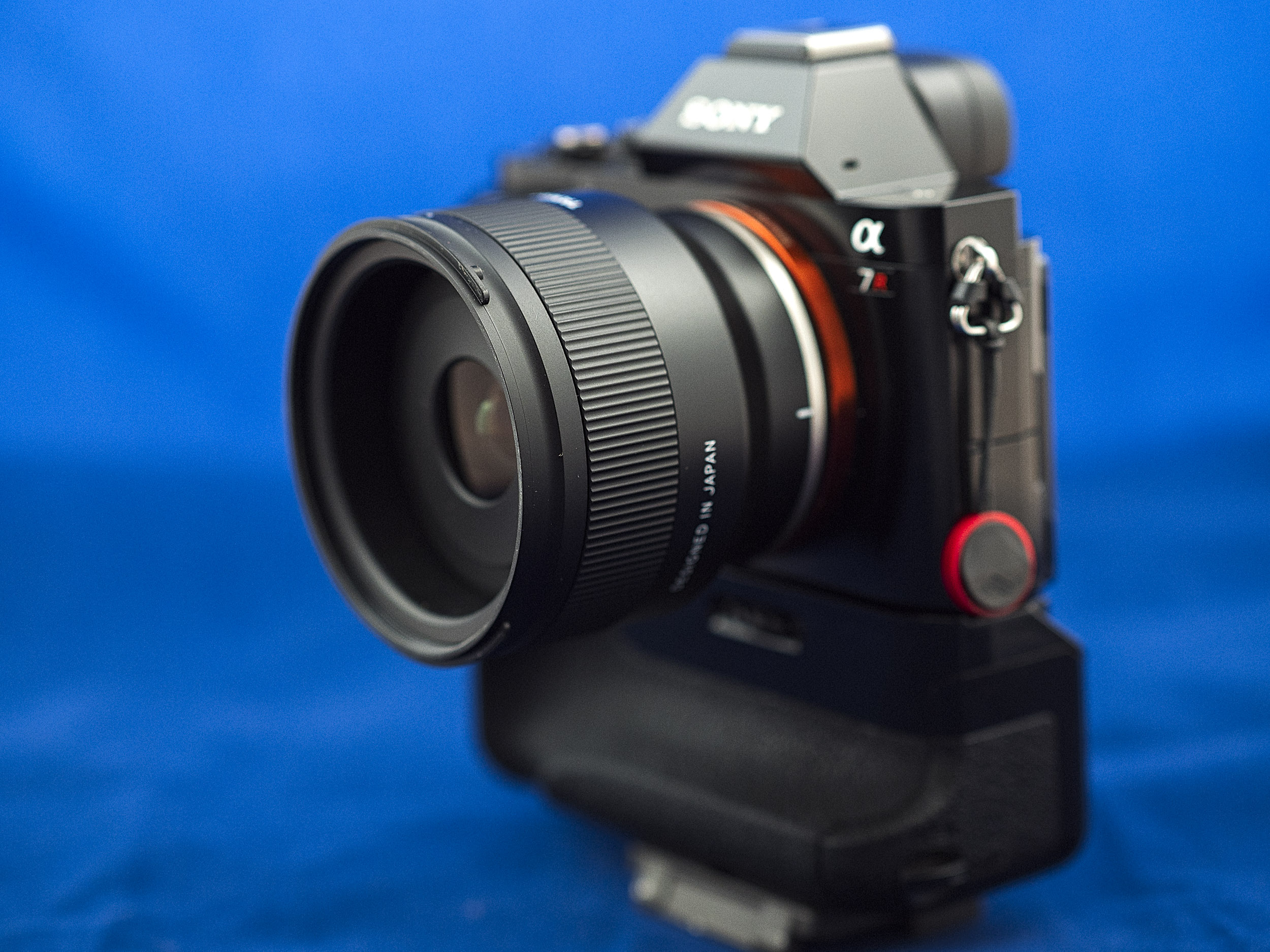
Tamron 35mm f2.8 Di III lens mounted to a Sony A7r.
TLDR
Introduction
The Tamron 35mm f2.8 lens for Sony E mount cameras was announced back in November 2019 as part of a trio of prime lenses which share the same exterior design, construction, size, filter diameter and f stop. The other lens being the 24 and 20 mm. As lenses are becoming ever faster and even larger with price tags to match it is nice to see Tamron do something significantly different. The modest apertures and price tags may put off lens snobs, but they have enabled Tamron to give good optical performance at very reasonable price of $450 AUD. To many f2.8 may be disappointing, but honestly apart from bragging rights about shallow DOF we do not honestly need ultra fast lenses as todays cameras have absolutely astounding high ISO performance. When I started photography you needed fast lenses because film speeds were slow. I regularly shot ISO 25, 50 and 64 film emulsions and I wanted to do it handheld not on a tripod. Now shooting full frame digital at ISO 6400 gives the same image quality as as shooting ISO 64 film stock.
Specifications
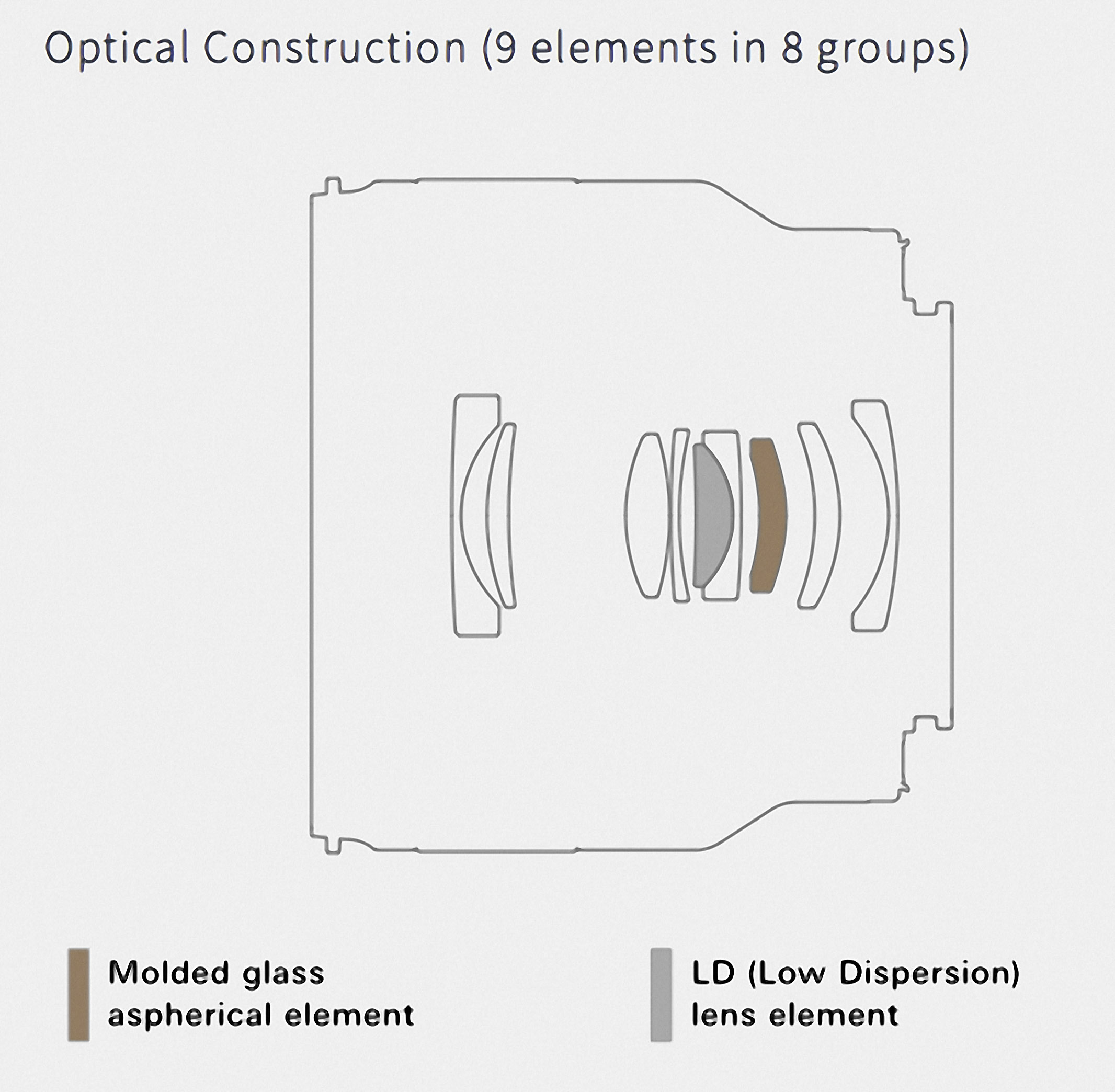
A schematic of the lens construction.
Focal Length
35mm
Maximum Aperture
F/2.8
Angle of View (diagonal)
63° 26′ (for full-frame mirrorless format)
Optical Construction
9 elements in 8 groups with 1 low dispersion element and 1 moulded glass aspherical element
Minimum Object Distance
0.15m (5.9 in)
Maximum Magnification Ratio
1:2
Filter Size
Φ67mm
Maximum Diameter
Φ73mm
Length*
64mm (2.5 in)
Weight
210g (7.4 oz)
Diaphragm Blade Number
7 (circular diaphragm) The circular diaphragm stays almost perfectly circular up to two stops down from maximum aperture.
Minimum Aperture
F/22
Standard Accessories
Flower-shaped hood, Lens caps
Compatible Mounts
Sony E-mount
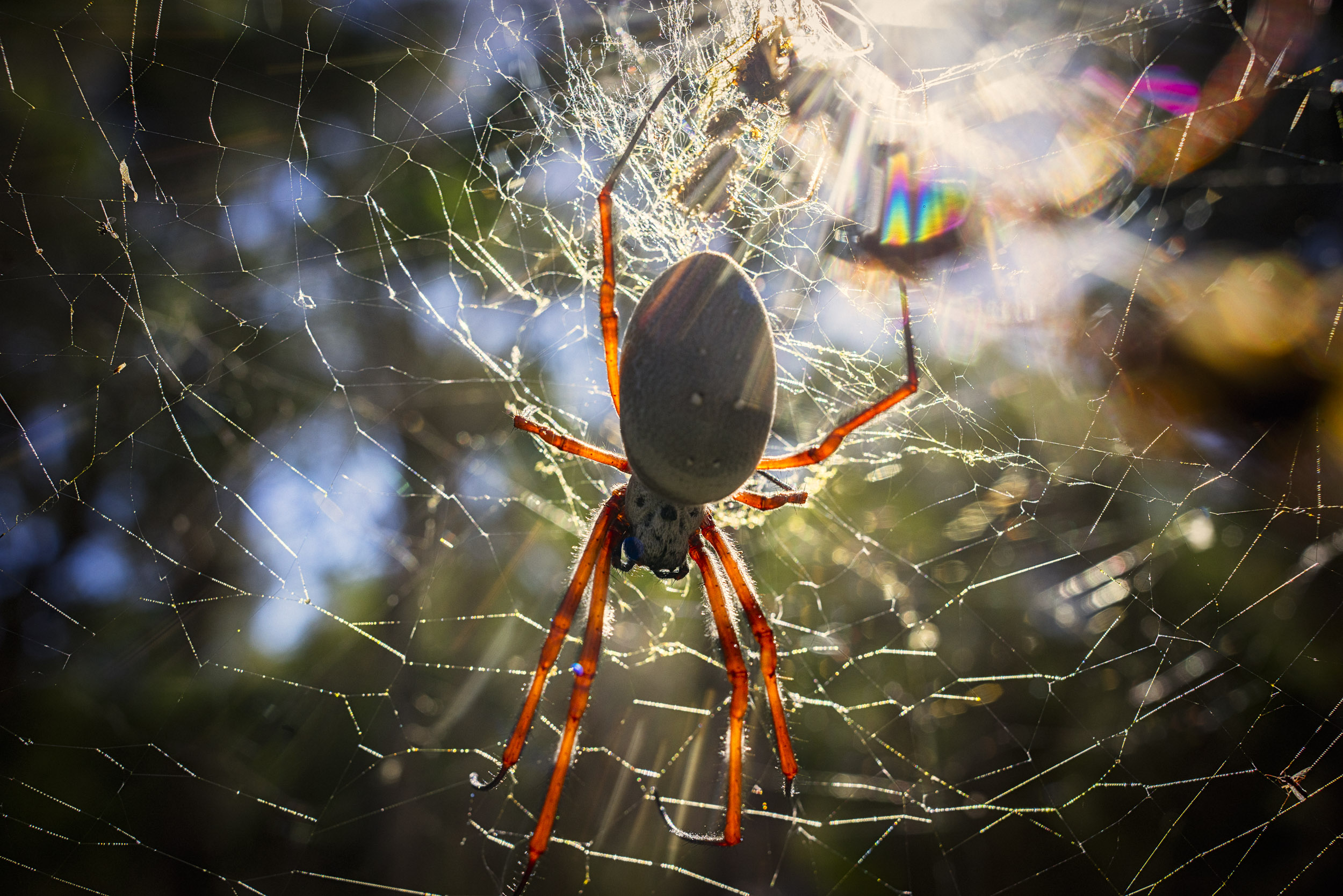
Golden Orb-Weaving Spider, Nephila edulis. Despite its size and their massive webs they are harmless to humans. Yellagonga Regional Park, Western Australia. The 1:2 magnification of the Tamron 35mm f2.8 makes this sort of photography a breeze.
For me the interesting aspect of this lens and indeed of its siblings is the cminimum focusing distance and it’s ability to shoot half life size. For me this makes them very suitable to creative macro and close up work. It’s not what you’d use to photography small critters as the lens has to be very close to the subject and will scare them off. For product shots, still life and another form of table shot photography it is a very interesting choice.
With a close focusing distance of just 15cm and a magnification ratio of 1:2 the Tamron 35mm f2.8 Di III is very suited to product photography.
Build Quality
In terms of build quality the Tamron 35mm the internet has largely been critical of it. The body is made out of some form of engineering plastic which you’d think had been manufactured by Tupperware judging by a lot of the reactions. Comparing this to recent Sigma lenses and Canon L lenses there is very little to distinguish the Tamron from the others. The only difference I can find without some sort of destructive testing is that the Tamron has a slightly more “satin” finish than the more “mat” of the Canons and Sigmas. The lens mount appears to be chrome plated brass which is nice, and there is an “o” ring which provides some semblance of sealing from the elements at the mount. There is no other weather sealing so I would say the lens isn’t really weather sealed at all despite Tamron’s claims. Tamron isn’t alone in this and I think it is high time the industry took a leaf out of Olympus’s book and actually stated to what level their products are sealed and give an IPX rating. Anything else is just weasley marketing BS as the majority of the camera and lens manufacturers state their products are weather sealed but won’t cover water water ingress under their warranties.
The metal lens mount as a gasket to provide some weather sealing.
The lens is larger than other 35mm lenses of similar specifications and feels quite light in the hand, but it doesn’t feel cheap. It feels quite sturdy and well made. On the lens barrel there is only a ribbed focusing ring which is of the focus by wire type which means there is little chance of getting repeatable focus pulls using it.A the front of the lens the front lens element is well recessed and while the lens doesn’t focus internally it extends within that recess so it does not protrude beyond the front of the lens barrel. Like all Tamron’s mirrorless range so far the 35mm f2.8 has a 67mm filter thread. Tamron thoughtfully include a lens hood with the lens. Other manufacturers please take note – if Tamron can include a lens hood with its budget lenses there no reason why you can’t. I’m looking at Olympus and Canon here. The lens hood warrants some discussion here as it is quite an interesting design. It is not the conventional bucket or petal shape. Instead it is like a plastic blank that has had a rectangular hole cut in the front and it is very effective at preventing flare and would also provide a degree of protection for the front element. The hood is threaded to take 67mm filters which means that you don’t have to remove it if you want to use a polarising filter. Somebody at Tamron has been doing some thinking. The hood bayonets into place.
The front lens element is well recessed.
Optical Performance
The Tamron 35mm f2.8 has built in lens profiles that are applied to jpgs and RAW files if so selected in the camera’s menu. I’ve opened the files in both Lightroom with the profiles switched on and then in RawTherapee with no profiles.
Click on the chart to see larger.
In terms of sharpness well at f2.8 at the centre of the image the lens is nicely sharp and contrasty. At f4 the it reaches its best performance and stays there to f11. At the edges wide open it isn’t quite as sharp as the centre, but by f5.6 the edges are as good as the centre. The old adage of stoping down two stops from wide open to achieve optimum performance certainly holds true of this lens. By f16 the image starts to soften as diffraction rears its ugly head.
In terms of optical aberrations well once the lens profile is switched off there is very slight evidence of pincushion distortion and vignetting. At f5.6 the vignetting disappears. A small amount of lateral chromatic aberration can be seen, but it is so slight I had to magnify the images to 300% to see them. Easily fixed in Lightroom. With a maximum aperture of f2.8 longitudinal chromatic aberration is not a problem. It is really fast apertures of f1.2 and f1.4 that really cause problems with this.
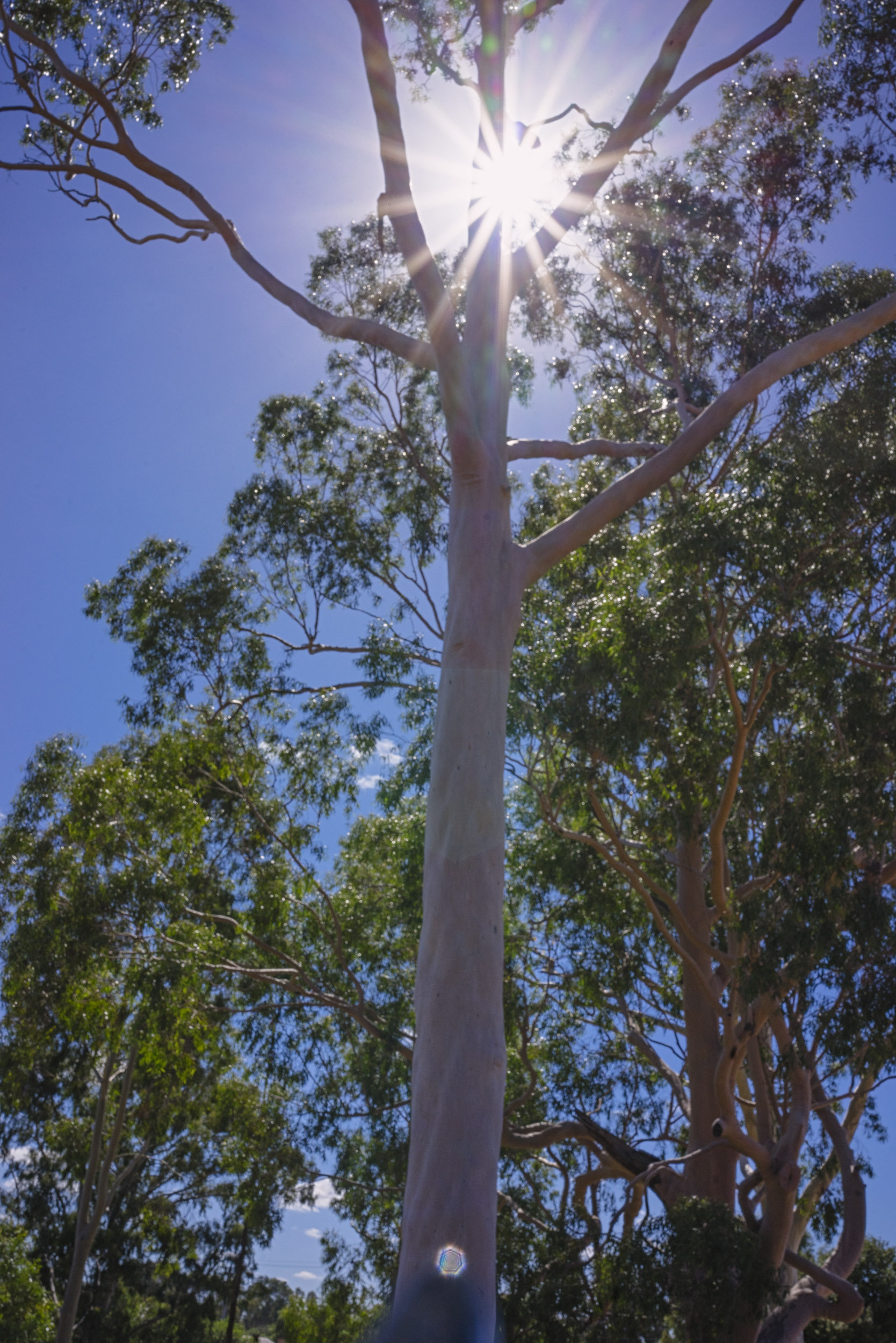
Without a lenshood the lens exhibits quite pronounced ghosting flare. Note the discolourateion on the tree trunk halfway down and the polygonal shape on the trunk at the bottom of the frame. At f22 the sunstars are pronounced, but aren’t that well defined.
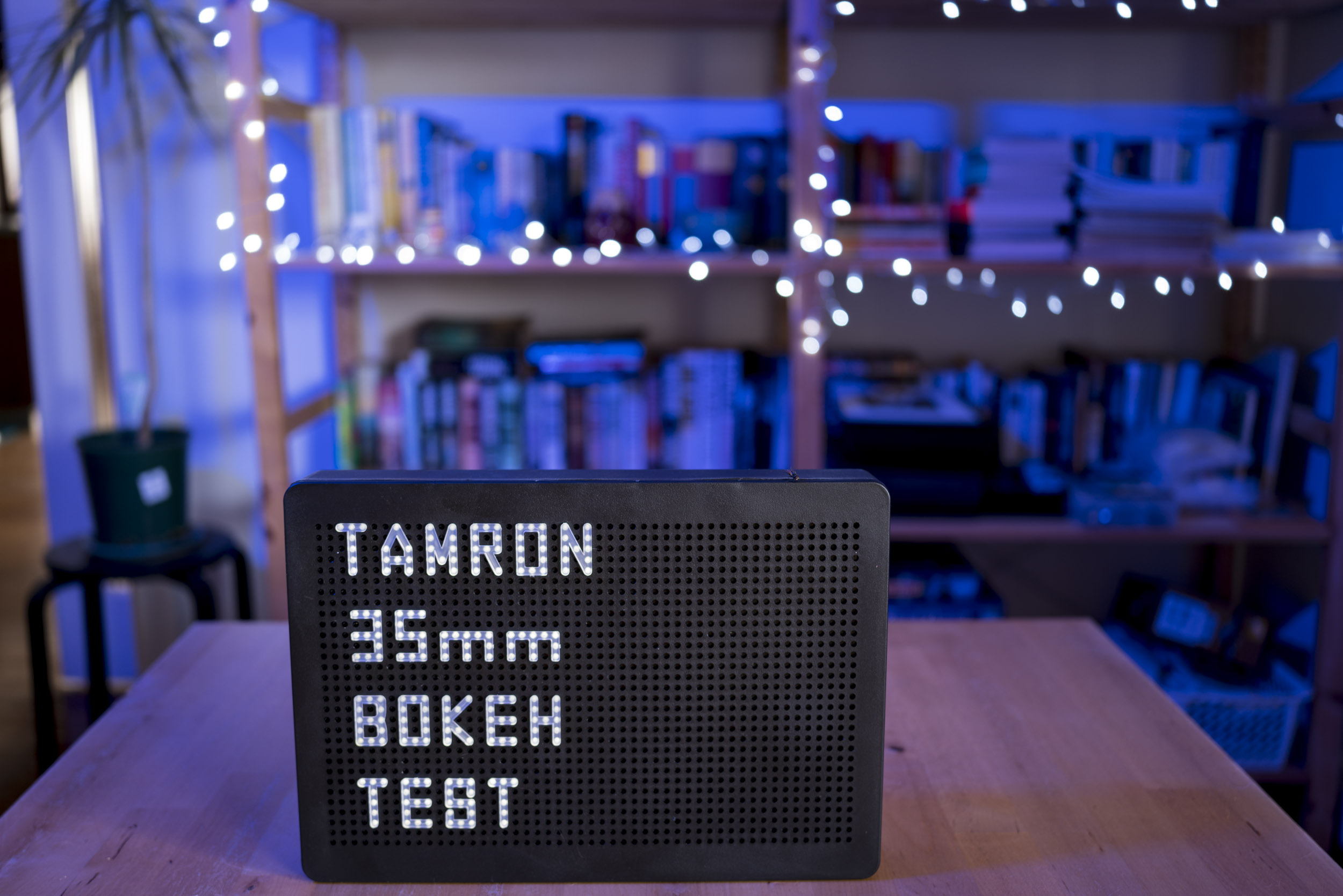
Flare resistance is a bit on the pedestrian side without the lens-hood with ghosting visible. The lens-hood is included in the box for a reason so use it. The seven bladed iris produces what to me are quite attractive sun-stars. Speaking of how the lens handles specular highlights the bokeh is not what I would call thrilling but it is not offensive either.Wide open in the centre there are round balls with faint onion rings present from moulded aspherical element. I suppose the final polishing wasn’t as smooth as that on more expensive lenses as a cost cutting measure. The edges of the balls are not smooth, they have a fuzzy appearance as the light bleeds into the darker areas which is a form of halation. At the edges of the image the bokeh balls take on that elliptical cats eye shape. By f8 the bokeh balls take on a definite polygonal shape.
In the bokeh test we can see quite nice round balls in the centre of the image wide open, but on closer inspection onion rings are present and the edges have a fuzzy appearence to them. At the edge of the frame the balls have a definite cats eye shape. As the lens stops down the bokeh balls take on a polygonal shape which is really apparent from f8 and beyond.
Click on the image to see larger.
Comparison
The Olympus OM Zuiko 35mm f2 mounted on a Sony A7r.
Is a cheap auto focusing lens worth getting over a classic manual focusing version? Well to find out I’m comparing the Tamron 35mm f2.8 lens to the Olympus OM Zuiko 35mm f2 lens. Forty five years separate the two optical designs and a lot has changed. There are several different version of the Olympus lens. It had a long production run from 1974 to 2002. I’m using a later multi-coated version. This MC version is 43mm in length, 240g in weight and has a filter thread of 55mm. It has an optical construction of eight lens elements in 7 groups and a minimum focusing distance of 0.3m. When it’s performance is studied we can see there is slight barrel distortion evident in the test image. CA is present when wide open and clears up on stopping down Wide open the lens is quite soft and lacking in contrast both in the centre and at the edges. Both sharpness and contrast improve in the centre when stopped down to f8. The edges show some signs of improvement but not as much as the centre.
Our test subject for the comparison.
Comparing the two lenses in an actual real world shooting scenario we can see that with both lenses set to an aperture of f2.8 in the centre of the frame there is virtually no difference between them and I’d say they they are equal. In the corners, however, it is a very different story. The Tamron has a good level of sharpness while the Olympus is very soft. Stopping down to their respective minimum apertures – f22 for the Tamron and f16 for the Olympus -we see again in the centre that there is just a very marginal difference. In the corner the Tamron is better by a gnat’s whisker. Just remember that the Olympus was given an advantage. The Tamron shot wide open at f2.8 while the Olympus was stopped down at to f2.8 allowing an improvement in optical performance. At f16 the Olympus didn’t suffer the amount of diffraction the Tamron did at f22.
A comparison between the Tamron 35mm and the Olympus 35mm at f2.8. Click on the image to see it larger.
The same again but at f22.
Conclusion
When Sony launched the original A7 and A7r in 2014 critics poured scorn over the nascent system by saying there were no lenses. Early adopters divided into the system and tried their hand at adapting lenses they did have to fill the gaps in the line up. Fast forward to 2021 and Sony have done a tremendous job at fleshing out their line up. But the most significant thing is that Sony allowed third parties to access the lens mount protocols and this has meant that are lenses that range in price from decidedly wallet friendly all the way to those that would make a trust fund baby wince. At the time of testing the Tamron lens is selling for $350 AUD (which is the equivalent of being given away with a McDonalds Happy Meal in the USA). Looking on EBay the Olympus is selling for between $300 to $700 AUD depending upon condition and version. The version I have would count as a mint late model which would place it in the upper range. So the question is whether having a new autofocuslens is worth more to you than having a potentially more expensive 20-40 year old lens. Well I had the Olympus lens left over from OM film days (along with quite a few others) and I actually got a secondhand Sony A7r camera so I could use the Olympus lenses. I was very happy with that arrangement. The Tamron registered on my radar because of its macro capabilities.
So you want to go full frame mirrorless with a 35mm prime lensbut don’t want f1.2 lenses or can’t afford them then buy the Tamron. Don’t want want to carry around a lens that is capable of blocking the Suez Canal buy the Tamron. It is nowhere near a perfect lens. It is a modest lens, with a modest price and with a better than modest performance. So with what it costs and with what it can do it is a great buy.
Not the dreadful film, but the camera company. On the 24th June 2020 Olympus announced that they were in talks with Japan Industrial Partners to divest themselves of their camera business after three continuous years of losses despite numerous restructuring attempts. I’ve got no idea what all this means from a practical point of view, but from an emotional point of view it is quite a sad day. I’ve always considered myself to brand agnostic and have used over the years Praktika, Pentax, Minolta, Canon, Leica, Voigtländer, Sony, Panasonic and of course Olympus. But I’ve got to say that over the last 38 years I’ve always had at least one Olympus camera. More than just a few key moments in my life have been documented by an Olympus camera.
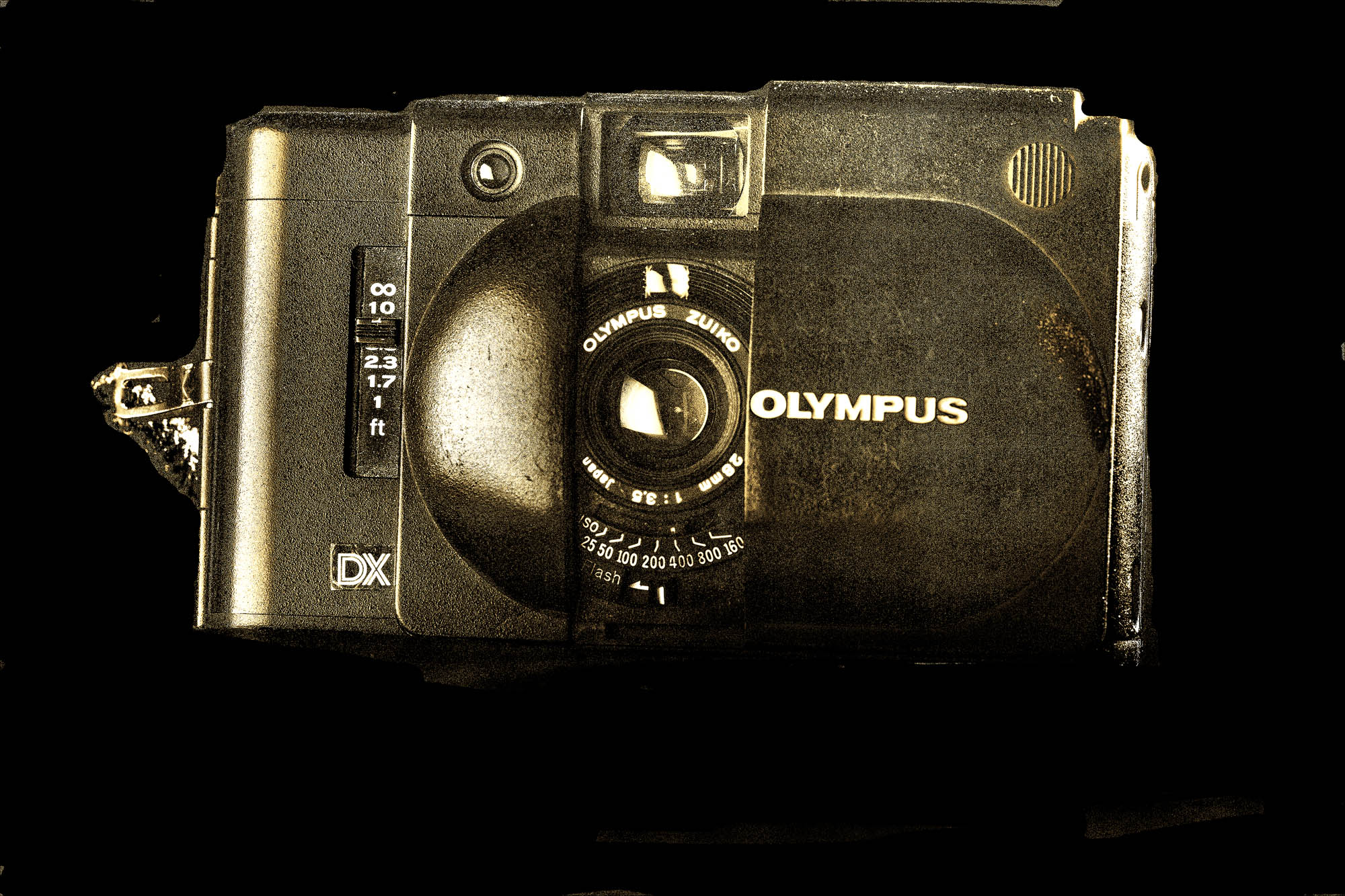
My first Olympus camera was an XA2. This is the XA4 I bought later to replace it, they look very similar, the major difference being that XA2 had a 35mm lens while the XA4 had a 28mm macro lens.
Portrait of me in Majorca taken in March 1986 by my father in law, Brooke Spencer. Probably taken with a Leica R4 with a Leica 135/2.8 Elmarit-R on Kodak colour negative film. I’m holding my OM1n with 35-105 lens.
I bought my first Olympus camera in 1982 after returning back home from an extended stay in Israel where I got into taking photos. Previously I had a Kodak 110 cartridge camera and when I got the films back from the processors I was dismayed with how crap they looked. I was determined that on the next trip I would take a much better camera. So after a trip to the newly opened Whibys camera shopping Chichester and a long and informative chat with the owner Derek Whitby I left with an Olympus XA2 – a unique 35mm clam shell compact camera. I kept going to Whitby’s until 1988 which was when I migrated to Australia. In that time Derek went on to sell me an OM20, OM1n, OM2n, OM4 and my partner an OM40. Along with those cameras was wheelbarrow load of lenses, some very specie flashguns for the time and a shed load of film. I’m glad their business is still going although Derek and his wife Jacqui no longer run it. The cameras kept marching on and were perfect for my travels being small, durable and highly featured for their time. The lenses were also compact and gave great image quality. I’ve still got most of the lenses and still use them, and I’ve written about them on this blog ( 21mm f3.5, 24mm f2.8, 35mm f2, 50mm f1.4,135mm f2.8, and 35-105mm f3.5-4.5).
Believe it or not that’s me in Red Square, Moscow in January 1987. The temperatures were -40ºC. You can just about see my camera bag slung over my shoulder. In it is an OM1n, an OM2n, a 35-105mm, a 50mm f1.4, a 200mm f4 lens a T32 flash and a T20 flash. We went to document the plight of Russians in Moscow and Leningrad (now St Petersberg for a human rights campaign that was to be launched later that year at the House of Commons in London). The cameras worked flawlessly in the cold. The photo was taken by my wife on an Olympus AF1.
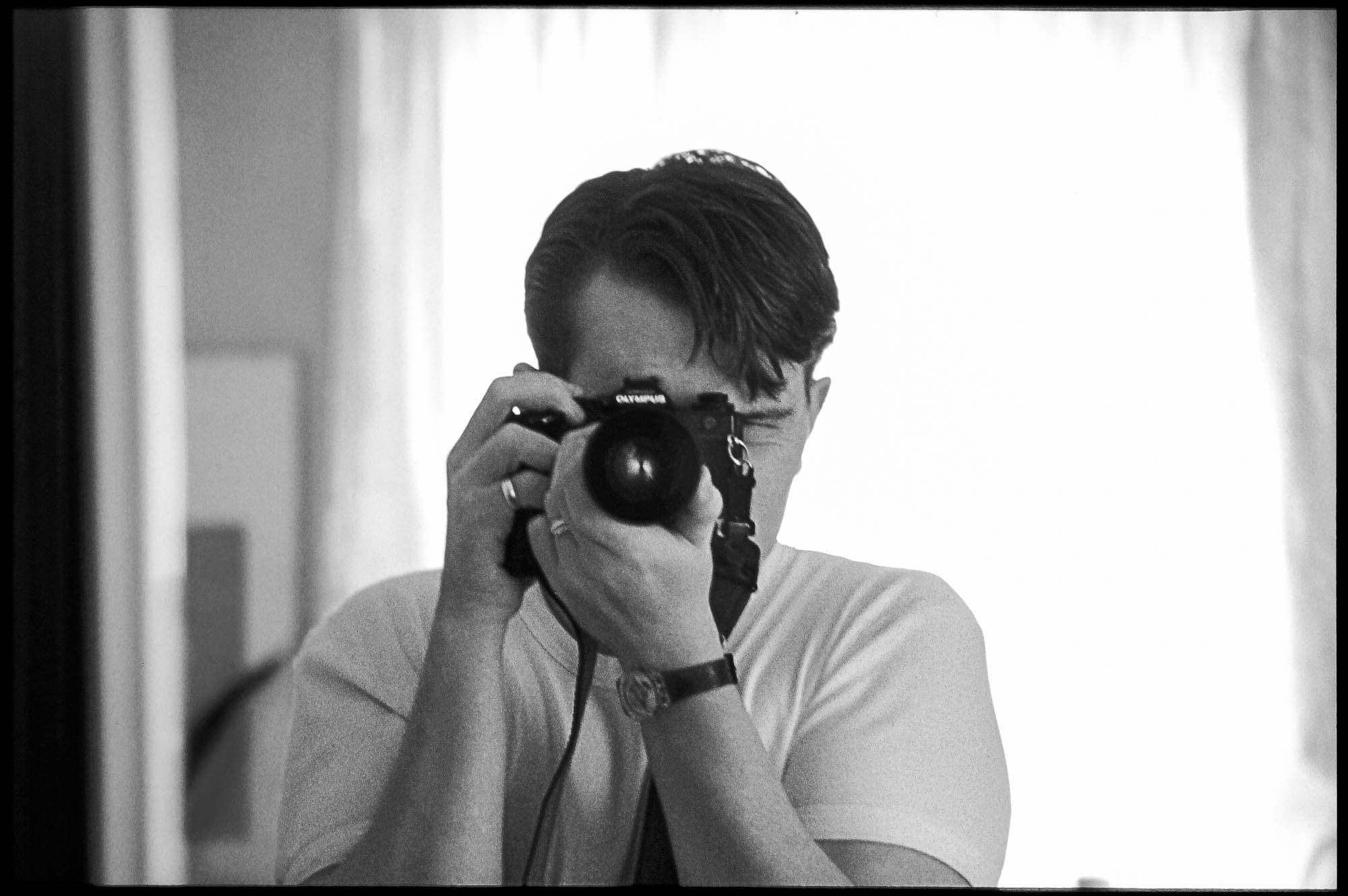
My earliest selfie – taken in September 1987 while I was staying with my in-laws just prior to departing for India and Nepal. The camera is an Olympus OM4 with an Olympus OM Zuiko 35-105mm lens. Originally shot on Ektachrome 200 but converted to black and white because of fading.
Yours truly on a house boat on Lake Dal in Srinagar, Kashmir, India. I’m wearing a Camera Care Systems pouch with my Olympus OM4 in it. Taken by my partner with her OM40 and 35-105 lens.
In 2003 I shot a couple of weddings and my OM4s developed problems, one the shutter failed and the other the film advance jammed. I took them to the local camera whisperer but he broke the bad news to me – there were no new spare parts. He said I could by up some old models and use them as donor cameras but there was no guarantee as to the condition of the parts and how long they would last. To say I was gutted would be an understatement. This came a a particularly bad time for me, I was recovering after a bad accident and was pretty broke. I had enrolled at college to study photography as a form of therapy and now I was pretty well camera less. My late father-in-law (Brooke Spencer) in an act of supreme kindness stepped into the breach. He had just bought a Canon EOS D60 digital SLR and he sent me his old EOS3 film SLR and a couple of lenses. I now had a camera to complete college with and had inadvertently changed system. I went digital with Canon but I wasn’t really happy with it. I found the Canon EOS system to be large, heavy and cumbersome. About this time I fell into writing about and photographing outdoor activities and then was commissioned to write a walking guide. Well after a year lugging a Canon 5d and three lenses on over 1000Km of walks I knew I needed something lighter.
The Canon EOS system full monty. Three bodies, seven lenses, two flashes, flash meter, filters, cables, flash triggers, and reflectors. It is a hernia inducing load.
This is the camera kit I used on my first walking guide book. Less hernia inducing than the Full Monty, but still coming in at 7Kg including filters and batteries.
When I saw the Olympus Pen EP1 in 2009 I was smitten, but it didn’t have a viewfinder so I held off buying one. Less than a year later Olympus introduced the EP2 and I got one. The next guide book was done with an outfit based around that camera and a a few lenses and I was much happier.
Coming in at under 2Kg complete with batteries, filters, microphone and assorted cables for video. This kit still gives me coverage from 24emm to 300emm with 1:1 macro and a smallish prime. All that’s missing is flash.
Here I am pausing to take a photo with EP2 while walking up Frenchman Peak in Cape Le Grand National Park, Western Australia.
Over the last ten years I’ve heard a lot reasons from keyboard warriors on various photographic forums why the micro four thirds format that Olympus and Panasonic used was inferior to full frame sensors and that you couldn’t get work published if you used it. Well after three books, two exhibitions and loads of print sales no one has ever said the image quality was not up to snuff. Unfortunately photography is an activity dominated by very conservative men who see a small camera, no matter how capable, as being an affront to their masculinity. So Olympus was sandwiched by the small minded conservatives that wanted big cameras and at the other end the onslaught of the do anything mobile phones which now have very good photo and video capabilities.
The Canon EOS6d with Sigma 150-600mm lens compared to the Panasonic G85, which uses the same sensor format and lens mount as Olympus, with the Panasonic Leica 100-400mm lens. The Panasonic has great reach, better video, the same number of megapixels, weighs less and costs less.
The Canon EOS 6d camera with 100mm f2.8 macro lens that I used to use for photographing orchids alongside the Olympus EM 1 mk ii with 60mm f2.8 macro lens that I use now. Both produce amazing images, but the Olympus is a lot nicer to carry through the bush all day.
As I said at the beginning of this piece I have no way of knowing what will happen. Maybe JIP will turn the company around and make it it profitable and innovative. Maybe they’ll just asset strip and close it down. The company does both. I hope it is the former, but if it is the later I guess that this a eulogy for Olympus. But whatever may happen my current Olympus cameras have plenty of mileage left in them and if I can get another 10 years out of them, and at this stage I don’t see why not, then I’ll be very happy.
I’m always pleasantly surprised by the things I find while pootling along the back roads of Western Australia. Last weekend was a case in point. I was driving along the bucolic Ferguson Valley in the south-west of the state when I came across something that just expressed a sense of spontaneous anarchistic fun. That something was Gnomesville. We’ve all seen garden gnomes haven’t we? You know those kitsch garden ornaments usually made out of plaster and sometimes out of cement that can be found in gardens all over the world. Usually they are seen singly, occasionally in twos or threes. Sometimes you come across a garden that has maybe a couple of dozen and that is regarded as a bit OTT. So imagine a place with thousands of gnomes. That’s right thousands. The exact number is not known, but some reckon the figure could be as high as 5000. They are not in a garden, it’s not some commercial tourist attraction. Gnomesville is found on the verge by a roundabout in a very rural setting.
Welcome to Gnomesville. A small gathering of the inhabitants. Western Australia. Sony A7r with Olympus OM Zuiko 35mm f2 lens. Exposure: 1/60th sec, f8 at ISO 320.
The whole thing is absolutely bonkers. So how did it start? Well there is the legend of Gnomesville which is as follows:
“A long, long time ago, a Gnome was travelling on an Australian country road. It was at night and far from anywhere. All around was leafy and green. A pleasant place.
By and by, he came to a fork in the road. He followed the road, which seemed to go around and around.
Now, being a little person, he could not see over the curb. If he did, the story would have ended here.
He walked all night with the feeling he was going nowhere. Roads branched off every so often. By the morning, he was exhausted. Then it was clear. He had come across a ROUNDABOUT—a circular intersection in the middle of (almost) nowhere.
This was something he had never seen as a country traveller.
But it was a nice place and reminded him of home. There was a bubbling brook and shady trees. So he stayed a while. And another while. Other Gnomes passed and visited, and many stayed. Word passed around.
Gnomes from far and wide left their gardens and came to visit. But they stayed. This was something new for the mostly solitary Gnomes. There was something irresistible about the place. It was as if the ROUNDABOUT was casting a spell.
Peak hour in Gnomesville. Western Australia. Sony A7r with Sony FE 28-70mm f/3.5-5.6 OSS. Exposure: 1/200th sec, f4 at ISO 200.
For people who need the real actual true story well Kevin and Vicki Campbell were a local couple who played a large part in the creation of Gnomesville. The local shire had annexed some land from a neighbour to create a T junction at the bottom of a hill. The local residents weren’t too keen as they felt that it would be unsafe. So after a public meeting and some toing and froing it was decided that a roundabout would be built instead. Not long after a gnome appeared in a hollow tree by the roundabout. It was in fact the very spot where Vicki used to leave her bicycle when she caught the school bus as a child. It was the start of a gnome sit in protest. Soon there were twenty gnomes all showing solidarity. And so Gnomesville was born. I prefer the legend. Now people come from quite literally all over the world to leave a gnome. When I was there a young couple with their son had come all the way from Malaysia to leave a gnome. There are Dutch gnomes, gnomes from Japan, even from Finland. Gnomesville is a very cosmopolitan place.
Gnomesville attracts gnomes from all over the world. This is the Japanese contingent. Gnomesville, Western Australia. Sony A7r with Cosina Voigtlander 15mm f4.5 Super Wide-Heliar lens. Exposure: 1/60th sec, f8 at ISO 400.
So if you are in the vicinity of Bunbury and are kicking your heels wondering what to do take a drive out to the Ferguson Valley and enjoy the sights of Gnomesville. You could even stop off and buy a gnome to leave there.
Warning – gnomes crossing. Gnomesville, Western Australia. Sony A7r with Olympus OM Zuiko 35mm f2.0 lens. Exposure: 1/160th sec, f2.8 at ISO 200.
*apologies to Wally Johnson and Bob Brown for corrupting the title to their all time Aussie favourite song “Home Among The Gum Trees”
The town hall in the historic Western Australian town of York in pre-dawn light. Sony A7r with Olympus OM Zuiko 35mm f2 lens and Cokin 3 stop graduated neutral density filter. Exposure: 2.5 sec, f8 at ISO 100.
The other morning I got up at stupid O’clock to shoot a dawn time-lapse of the York Town Hall. So what do you do while you’re hanging around waiting for it to finish? Why take photos of course! So while the Leica D-Lux clicked away doing it’s time lapse thing I set up the Sony A7r and started taking snaps of the town hall. Good job I did as the time lapse wasn’t that crash hot.
Some years ago I was going through a phase I called “delusions of Bresson“. It involved hanging around on the street corners of Perth with a range finder camera fitted with a 35mm lens. It enabled me get close enough to my subjects but not ground them. In modern terms 35mm is not considered a wide-angle lens – in fact quite a few photographers brought up in the digital age think that wide angles start at 20mm (35mm full frame equivalent) – 35mm is seen more as a widish standard lens. Either way it is how I have come to see the world and I consider a 35mm prime (or its equivalent angle of view depending on format size) to be an essential item in my camera bag and this brings me to the Olympus Zuiko 35mm f2 lens.
Olympus OM Zuiko MC 35mm f2 lens.
Olympus OM Zuiko MC 35mm f2 lens.
There are again multiple versions of this lens. The first silver nosed single coated version was 42mm in length, 230g in weight and had a filter thread of 49mm. This MC version is 43mm in length, 240g in weight and has a filter thread of 55mm. It has an optical construction of eight lens elements in 7 groups and a minimum focusing distance of 0.3m.
Olympus OM Zuiko MC 35mm f2 lens
There is slight barrel distortion evident in the test image. CA is present when wide open and clears up on stopping down Wide open the lens is quite soft and lacking in contrast both in the centre and at the edges. Both sharpness and contrast improve in the centre when stopped down to f8. The edges show some signs of improvement but not as much as the centre. Wide open there is some vignetting but that quickly disappears as you stop down. The lens is quite prone to flare, especially ghosting flare, when there is a point light source in the frame. The solution is to use a lens hood or you can do as I sometimes do and use my cap as a French flag. The alternative approach is to embrace the flare and use it creatively in your photos and videos.
York Cemetry, Mount Brown, Western Australia. Olympus OM Zuiko 35mm f2
York Cemetry, Mount Brown, Western Australia. Olympus OM Zuiko 35mm f2
York Cemetry, Mount Brown, Western Australia. Olympus OM Zuiko 35mm f2.
Canola and Patterson’s Curse at sunset. Mount Brown, York, Western Australia. Olympus OM Zuiko 35mm f2
If you can find a good clean copy of the multi-coated version of this lens at a good price then I recommend you pounce on it. It is a wonderful characterful lens that makes its modern counterparts look sterile and boring.
The Olympus OM Zuiko 35mm f2 lens mounted onto a Sony A7r via a Fotodiox adapter.














You must be logged in to post a comment.