The other day was was one of those days. Not the sort where everything goes mammaries up and you wish you hadn’t got out of bed. No it was one of those days when everything goes stupendously well – like unbelievably well. The other day was just one of those.
Bulland or Little Egret (Egretta garzetta subsp. nigripes)
Bulland or Little Egret (Egretta garzetta subsp. nigripes) are quite rare up in the Avon Valley although they are common elsewhere.
I was walking along the River Avon in Northam and it was proving to be a fruitful morning. Black-fronted Dotterels, Black-winged Stilts, Dusky Moorhens, and even a rare (well rare in these parts) Little Egret. After a couple of hours of sheer bliss I decided to call it a day and walk back to the car. As I was walking I thought to myself “You know what would cap off a perfect day? A Sacred Kingfisher.” And lo and behold within seconds of thinking that thought one appeared on a branch right in front of me. The best part was it could clearly see me and didn’t give a stuff. I was in raptures! It was hunting for large insects in the grass and every few minutes it would swoop down catch one and return to the branch and eat it. This kept going on for twenty minutes or so. In the end I called it quits after taking hundreds of photos and it stayed there. A brilliant finale to a brilliant day.
A gratuitous shot of a Nidoolyorong or Black-fronted Dotterel (Elseyornis melanops).
This Djandjarak or Black-winged Stilt (Himantopus himantopus) was too busy looking for food to bother about me.
The icing on the proverbial cake. Kanyinak or Sacred Kingfisher (Todiramphus sanctus). Isn’t he magnificent?
Having a bug for breakfast.
Having a laugh.
The last few of weeks I’ve been observing some very interesting bird behaviour (well interesting to me) and I’ve found trying to record it just using photographs wasn’t capturing what was happening. So I’ve decided to shoot more video footage. Up until now I’ve found doing both photography and video very difficult. That’s because I was taught in order to shoot video well you had to have your camera on a tripod, limit your shutter speed to twice that of the frames per second which means faffing around with neutral density filters, use manual focus, take an accurate colour temperature reading and set the camera accordingly, and record good sound. All that takes the spontaneity out of it. If an animal pops up suddenly I like to be able to react in an instant and with stills photography you do that. Video requires (or so I thought) so much preparation that the animal has been and gone. So I came to the conclusion that I only do this for my entertainment so it doesn’t matter if I break “the rules”. So I set my camera up to shoot in programme mode, set auto white balance, auto ISO, I use the camera’s built in microphone for sound, and auto focus. I’m not carrying a tripod so I’m shooting handheld. If I see something interesting I snap off a few photos and then press the video record button. This approach has added a new dimension to my photography and I’ve been very happy with the results so far. Below are a few clips from my brilliant day in Northam.
At this stage in summer most of the birds are busy feeding their young, with the majority about to fledge soon. The constant foraging for food and hunting must be exhausting for the parents especially in the 40ºC + days we’ve been having lately. Over the last couple of weeks I’ve stumbled across a few nests with demanding offspring and I’ve observed a range of different behaviours designed to get food from a parent.
Hungry Kanamit or Welcome Swallow (Hirundo neoxxena) chicks demanding to be fed. Avon Terrace, York, Western Australia.
The food arrives.
The two larger chicks get fed while the little one at the end misses out.
On Avon Terrace, the main drag in York, a lot of the shop fronts have Welcome Swallow nests tucked away in the shade of the verandas. Most people walk along the street under them not even aware of what is happening above them. I spent an hour watching this particular nest. The adults returned every five minutes or so with food for the three chicks. Two chicks got the bulk of the food as is often the case in birds. I don’t know if the little runt of the brood managed to survive until fledging or not.
Kaaka-baaka or Yellow-billed Spoonbill (Platalea flavipes) adolescent demanding food from its parent.
Click to play the video clip.
In Northam, on the banks of the River Avon, I witnessed something I’d never seen before. There were two Yellow-billed Spoonbills in a tree, one a mature adult and the other an adolescent. The adolescent was trying hard to get the parent to regurgitate some food and it did this by first bobbing its head vigorously while flapping its wings. After a while of this it would then start rubbing the parent on the side of its head. The photos don’t do it justice, the video is better.
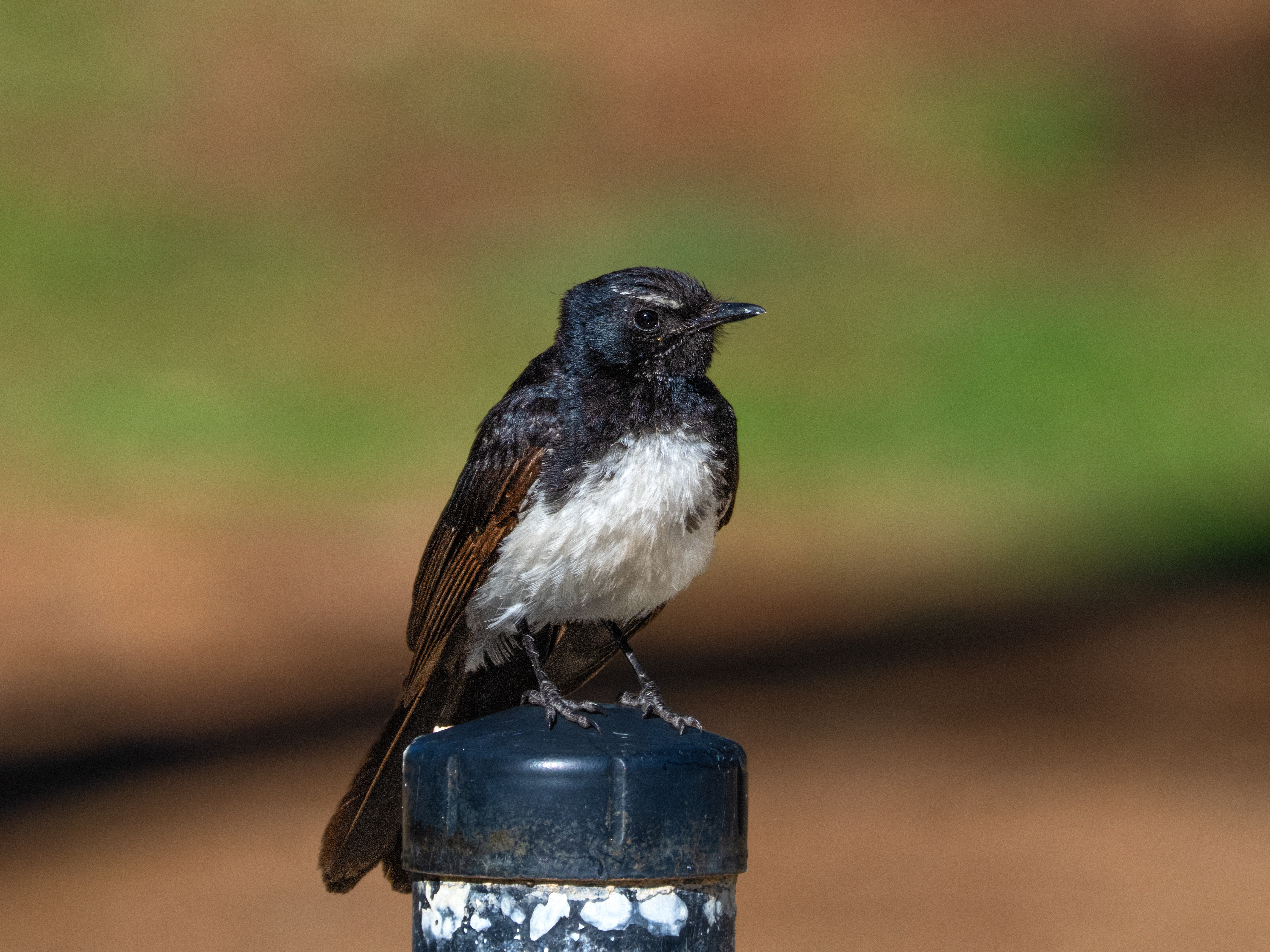
Djidi-djidi or Willie Wagtail (Rhipidura leucophrys) chicks that have out grown their nest.
The unusually placid Djidi-djidi or Willie Wagtail (Rhipidura leucophrys) parent.
Willie Wagtails make incredibly tiny nests – smaller than a tea cup. The typical clutch of eggs is 2-4 which is fine until they hatch and then overcrowding sets in. I spotted this nest while walking back to the car. It looked quite a comical situation – 2 adolescent Willie Wagtails just about ready to fledge crowding round this tiny nest with one in it. All three looked incredible grumpy – it’s the eyebrow and the down turned mouth that gives that impression. One of the parents was sat on a fence post just 5m away closely watching. I was very surprised it didn’t try to chase me off as Willie Wagtails are incredibly aggressive and territorial. Perhaps it was too knocked form taking care of the chicks.
This has been very difficult to write and has become a very long and drawn out affair and it shouldn’t have been.
I have, as regular visitors to the site may recall, been using the Panasonic Leica DG Vario-Elmar 100-400mm f4-6.3 lens for my wildlife photography since September 2018. I bought it because it was the only affordable quality long lens available in Micro Four Thirds at the time. Largely I have been very, very happy with it. The major nitpick I have is that although both Panasonic and Olympus/OM System are part of the Micro Four Thirds consortium and conform to certain protocols such as lens mounts, flash system standards, and autofocus compatibility some features are not cross brand compatible. Now when I got the lens I was primarily using a Panasonic Lumix G85 with which it mates up perfectly and an Olympus EM1 mk 1 which was close enough. But as I progressed with Olympus cameras some of the features such as Synch IS, autofocus while using Pro Capture, focus stacking and high resolution functions required complete compatibility and I was wanting to use them on a regular basis. When Olympus introduced the mk 1 version of the 100-400mm lens in 2020 it seemed weird as it wasn’t compatible with those features so I saw no need to change. So with the announcement in February 2025 OM System announced the OM System 100-400mm f5-6.3 II IS lens and that they had fixed some those issues I became very interested and bought it after watching and reading many, many positive reviews.
One of the things that has made this so difficult is because I keep making comparisons to the Panasonic 100-400mm mk I which I also own. In fact, it is probably more a comparison review than anything else, which is unfortunate as I wanted to make it a stand alone look at the OM System 100-400mm.
Comparisons with the Panasonic Leica DG Vario-Elmar 100-400mm f4-6.3 are inevitable considering they both share the same focal range and lens mount.
The Controversy
When the original Olympus 100-400mm came out a lot people jumped on the fact that it was simply a rebadged SIGMA 100-400MM F/5-6.3 DG DN OS Contemporary Lens. The criticism mainly centred on the fact that it was firstly a lens designed for full frame cameras rather than specifically for Micro Four Thirds which meant some how that it was too large and heavy and undermined the original m4/3 ethos of being small and light. The second complaint was that the original Sigma lens sells for around half the price of the Olympus/OM System version so, therefore, customers were being ripped off by Olympus/OM System. When theOM System 100-400mm f5-6.3 II IS lens was launched these same complaints were again raised. Well the truth is somewhat different.
Optical construction of the OM System 100-400mm lens.
The optical construction of the Sigma 100-400mm lens. Looking at this and the OM System one you can see the differences.
While both lenses may have been built by Sigma (and there is no definitive proof that the Olympus/OM System lens has been) there are some key differences. While they share the same focal length, aperture range, and thermally stable composite body the filter size of the Sigma is 67mm compared to 72mm of the OM System lens. The Sigma lens has a lens construction comprising of 22 elements in 16 groups with four FLD elements and one SLD element. The OM System 100-400mm lens has 21 elements in 15 groups with four ED elements, two HR elements and two Super HR elements. The OM System lens diaphragm has 9 circular blades while the Sigma has 7. The OM System lens has IPX1-rated weather-sealing and there is no rating for the Sigma. The OM System lens’ front element has a ZERO Coating which is a form of fluorine coating that repels water and smears keeping it clean.The Sigma’s image stabilisation is four stops while the OM System’s is 5 on its own and it fully integrates with their cameras IBIS to give 7 stops of image stabilisation.
At this point I think it is fair to say that the OM System lens is not a simple case of badge engineering, there are too many differences. Now I’m not saying that OM System didn’t contract Sigma to build the lens using their existingSIGMA 100-400MM F/5-6.3 DG DN OS Contemporary Lens as a framework. What I am saying is that are sufficient differences in the specifications and they should be treated as entirely separate entities.
Vital Statistics
Focal Length
100-400mm (35mm equivalent 200-800mm)
Mount
Micro Four Thirds
Lens Construction
21 elements in 15 groups with four ED elements, two HR elements and two Super HR elements
The OM System 100-400mm is not part of the top tier PRO line of m.Zuiko lenses, but rather one of their consumer grade ones. Consequently it does not have the metal body nor MF Clutch / Snapshot Ring but rather a nondescript composite body that is strictly utilitarian. The zoom is of the external variety in that the lens barrel extends as you zoom through the focal range, but the focusing is internal and the front element does not rotate as the lens focuses. The mechanism feels sturdy with no hint of any flex or wobble. At the mount end there is a chromium plated brass mount which is surrounded by an “o” ring which provides a seal between the lens and camera body. Be aware that OM Systems OM1 mk i & ii, OM3 and OM5 mk i & ii have an IPX rating of 53 which means that they are protected against low pressure water streams from any angle and while not completely dust proof any ingress that does occur will not interfere with the operation of the camera. The lens is IPX1 rated which means that there is no information available about resistance to dust ingress and it is resistant to vertically dripping water equivalent to 1 mm rainfall per minute. So the camera body has more resistance than the lens.
The chromium plated brass lens mount and the rubber “o” ring that provides some weather sealing.
The lens is quite a chunky beast and it also has considerable weight. It is when you compare it to the PanaLeica 100-400mm that this becomes really apparent. The PanaLeica is 34.1 mm shorter, 3mm in diameter smaller and 140g lighter while having a much more premium metal body that just exudes class. In comparison the OM System lens comes off as feeling lumpen and a little tacky.
The OM System lens extends as you zoom in. Fitted with the included lens hood it is quite a large lens.
When it comes to controls both lenses are pretty the same. A zoom ring, focus ring, zoom lock and switches for the AF function, focus limiter and image stabilisation. The OM System lens scores well here as the PanaLeica is plagued with an incredibly stiff zoom ring, but overall the PanaLeica gives to my mind a much better user experience.
The much lauded new tripod collar. I see it as a solution to a problem that never existed.
On launch there was a lot of fanfare about the new tripod collar. Yes it’s different from the one on the original version but you’d hardly call it innovative. I see it as a solution to a problem that never existed. I’m amazed that so many of the internet reviews went on and on about this giving scant attention to things like autofocus and optical performance. If you want to see a truly innovative approach to tripod collar design look at how Panasonic implemented theirs on the PanaLeica 100-400mm.
At its minimum focal length with the lens hood attached.
The OM System 100-400 includes a bayonet type lens hood in the box while the PanaLeica has a a two piece lens hood (a mini hood permanently attached to the body of the lens and a separate extension that attaches to it) and also throws in a lens pouch. To be honest I’ve never used it, but, it’s nice they’ve taken the effort to include it.
Performance
Sharpness
The new you beaut lens chart.
At 100mm wide open at f5 the performance is even across the frame – a little soft and lacking contrast. At f5.6 the contrast improves a little but the sharpness remains the same. At f8 there is no improvement. At f11 the lens reaches it’s best performance and at f16 softness in the form of diffraction re-appears.
Best results from the lens came at 200mm, with the best results at f11.
At 400mm wide open at f6.3 at the centre of the image the lens is soft and lacking contrast and the corners match this. The results follow the progress of the shorter end with best performance at f11.
This is very disappointing as the lens is not capable of resolving fine feather detail wide open unless you stop down to f11 which makes the lens really unsuitable for low light or birds in flight as you’ll have to use very high ISOs to get high shutter speeds and that kills image quality.
Flare resistence
Over all flare resistance is very good – the lens coatings are working well to minimise veiling flare. There is some ghosting present – polygonal shapes and light streaks – and it starts to become intrusive at f8. The diffraction spikes are not pretty at all, but then you don’t buy a lens like this for the diffraction spikes.
Chromatic aberration
Transverse or lateral chromatic aberration is present, but it is very, very slight and you really have to pixel peep to find it or turn off the lens profile in your image editing software.
Axial chromatic aberration, also known as longitudinal chromatic aberration is virtually nonexistent, but that is to be expected with such a small maximum aperture.
Autofocus
If you think this has been a pretty damming review so far well all I can say is brace yourself as we haven’t dealt with the lens’s major short comings. Now before any of you complain about me having a faulty camera I tested the lens on an Olympus EM1, two different EM 1 mk 2s, and an EM 1x and got the same result. The lens and the cameras all had the latest firmware installed.
The bird on the slider test. The slider was set so that it travelled the 20cm of the slider in 20 seconds on a continuous loop.
At best using continuous autofocus on a slow moving target – me walking – I got 56% of the images in focus. Putting a stuffed toy bird on a slider and having it move back and forth 40% of the photos were in focus. At this point I contacted OM Systems Australia and sent the lens into them for recalibration. On getting it back the performance was actually worse with only 20% of photos in focus. The problem is that it seems to take ages for the lens to acquire focus and if it does it will momentarily grab focus for a couple of frames before drifting off again. The number of times where I’ve had a bird sitting just 5-10m away from me with a clear background and the camera and lens refuses to lock on to it. Frustration just doesn’t begin to express what I feel when that happens. Switch the lens over to the PanaLeica and there is no problem. Even the much cheaper OM System 75-300mm MKII lens performs better than the OM System 100-400 despite being a quarter of the price.
No matter what I tried the camera and lens combination would not focus on the bird. This Reed Warbler got fed up with waiting and took off.
When shooting video the situation is worse. It struggles to find focus and then will inexplicably drift off.
At the time of writing the lens is with OM System Australia for “evaluation”.
Image Stabilisation
This is an area where the 100-400 excels. OM System claims that the optical stabilisation of the lens combines with the the in body image stabilisation of the camera body to give 5 axis stabilisation of 7 stops. Back in the days of yore when 35mm film SLRs were the norm there was the old adage of the minimum shutter speed you can hold is the reciprocal of the the focal length. So with the micro four thirds crop factor a focal length of 400mm is the full frame equivalent of 800mm and it would need a shutter speed of 1/800 sec to avoid camera shake. Now seven stops would take us down to a shutter speed of 1/6 sec and with my shake hands I could only get 1/13 or 6 stops and get a sharp image. Pretty impressive by anyone’s standards. The practical application of this is that for taking photos of birds I don’t often go below 1/500 sec so it seems overkill, but for video that is another matter entirely and it makes it possible to shoot handheld with this lens.
Minimum Focusing and Maximum Magnification Ratio
The minimum focusing distance of 1.3m at all focal lengths makes the OM System 100-400mm a very capable close up lens.
The minimum focusing distance of 1.3m at 400mm gives a Maximum Magnification Ratio of 0.29X.
“When working with the 100 to 400 MarkII in practice, one of the first things you will notice is the exceptional focusing performance…It is therefore highly suitable not just for wildlife photography, but also for professional wildlife film making.”
“The exceptional autofocus performance stems from full compatibility with the latest OM system autofocus technologies. This lens is swift enough for the speediest of all subjects and is definitely on par with OM system pro lenses in that regard.”
“Now to conclude the optical performance analysis, it is fair to state that the 100 to 400 M Ii delivers where it matters most and compromises, if existent at all, are very minimal. Overall, a lens capable of professional results, even under demanding conditions. No wonder that this is my most used super telephoto lens at the moment.”
“The OMS 100 to 400 F5 to F6.3 M II stands as a highly capable super telephoto zoom. Its robust yet portable construction, impressive image stabilization and swift autofocus cement its position as a reliable tool for demanding applications like sports and wildlife.”
“This lens delivers a performance that feels almost too good to be true both on paper and in the field.”
Mike Lane states that there is very little difference between the $2200 OM System 100-400mm f5-6.3 II IS lens and the $12,000 150-400mm F4.5 TC1.25X IS PRO.
Espen Helland says “I’m really impressed with the sharpness of the new lens, my photos at 400mm are tack sharp.” and “Though the 100-400mm chases with autofocus a little bit more than my 150-400mm f/4.5 it still performs really well.”
So with these glowing reviews I reflect on my own experience with supposedly the same lens. As it stands, I think that based upon my experience that the OM System 100-400 mk ii is actually unsuited to wildlife photography. The autofocus is incredibly poor and will just frustrate the hell out of you – well it certainly did me. When it does find focus at 400mm, which is where most bird photographers will use it, it is incapable of resolving any fine feather detail. Now it maybe that I just have higher standards than the other reviewers, but I highly doubt that. It maybe that camera and lens manufacturers make sure they send out perfect examples for review. Possible. I know that if I were sending out a product for critical evaluation I would definitely send the best of the best. More likely I just got a lemon. Now if that’s the case then why aren’t OM System looking to rectify the problem. At the time of writing their official line is no refund, no replacement and we’ll begrudgingly look at the lens , but won’t necessarily do anything. That leaves a very sour taste in my mouth and makes me want to change brand. Now OM System doesn’t have a very large market share, they are really struggling to break even (at the end of 2024 they were ¥1.2 billion or $120,000,000 AUD in the red) so alienating existing users seems like economic suicide.
Can I recommend the lens? In short no.
If you’re an Olympus/OM System camera user and not fussed about synch IS, the computational functions and the need for teleconverters then buy the PanaLeica 100-400 it is the much better lens in every way. If those functions and the use of teleconverters are important then I’d skip this lens and sell some body parts and get either the OM System 300mm or 150-400mm. Don’t waste your money on this lens.
Just buy the PanaLeica 100-400mm as it is the better lens.
The other morning as I was walking around Lake Leschenaultia I spotted a couple of male Australian Reed Warblers marking out their territories while trying to attract a mate. When both of them were singing the sound was so loud that it almost made my ears hurt. It’s amazing that something so small can produce such a volume of sound. Normally you tend to hear them rather than see them, but this morning the two of them were perched on the very tips of the reeds. It was quite an amazing experience.
Koordji-koordji or Australian Reed Warbler (Acrocephalus australis subspecies gouldi). Lake Leschenaultia, Western Australia.
This week’s walk along the River Avon looking for birds was very odd. It was a magnificent morning. There was loads of birdsong, but no birds out in the open. Everything was hidden in the high tree canopy – even the ducks. By the time I’d reached Avon Park I’d only managed a couple of photos and I felt like I should have stayed in bed. So while sitting on a park bench pondering my options I noticed that there were lots of Welcome Swallows flying very low over the grass – like 30-50cm above the ground.
At this point it should be said that when comes to Bird In Flight photography (often abbreviated to BIF on forums) I am absolutely useless. For some reason I just can’t get it going. It may be partly due to the environment I go birding in – mainly forest – and this throws off the autofocus system. For a while I thought it was due to the fact that I didn’t have a camera with bird detect autofocus, but now I do and I still haven’t improved. So the idea of photographing a very fast erratic small bird seemed somewhat implausible. But, I had made the effort of getting up early and I was in the park and there were loads of Welcome Swallows so I thought why not? In all I spent the next hour trying to photograph the little buggers. Man alive are they quick. Up to 60 kmph or 25m per second! Just when you think you’ve lined one up perfectly they suddenly alter course and you’ve lost it. Despite all that I really enjoyed myself. I didn’t look at any of the images I’d taken as I feared that would have been too discouraging. In that hour I ended up taking nearly 3,000 photos. Now in the online wildlife forums people regularly brag they have a 90% hit rate of perfectly in focus shots of birds flying. So I’m a little ashamed to admit that out of those 3,000 photos I only got four photos where the bird was in focus and one of those was of a Welcome Swallow perching on a park bench. Now either I’m spectacularly inept or there is great deal of bovine excrement flying around. Whatever! I had a thoroughly enjoyable morning and that is all that counts.
Banking to begin fly past. Kanamit or Welcome Swallow (Hirundo neoxxena). York, Western Australia.
Coming in fast and low.
It’s a lot easier to photograph them when they sit still.
It’s quite hard to believe that flowering canola can be a tourist attraction, but judging from the number of people taking selfies of themselves in front of fields of it certainly confirms it. So here are my gratuitous canola themed photos.
Djandjarak or Black-winged Stilt (Himantopus himantopus) with canola reflections.
We’ve had a lot of cold, dank, foggy mornings along the Avon River lately. It must be cold as most of the duck population has taken to perching in trees while waiting for the day to warm up.
The weak winter sun tries to burn off the thick winter mist in the Avon Valley.
The mornings dew on a spider’s web. Avon Walk Trail, Western Australia.
Marangana or Australian Wood Duck (Chenonetta jubata).
Ngowonan or Pacific Black Duck (Anas superciliosa).
Wayan or White Faced Heron (Ardea novaehollandiae) hunkered down against the cold.
This pair of Kaaka-baaka or Yellow-billed Spoonbills (Platalea flavipes) braved the cold and were wading in the river looking for food.
“Time I was off”. Ngowonan or Pacific Black Duck (Anas superciliosa).
Overall I was actually quite impressed that my Olympus EM1x could find focus in these dark low contrast situations.
I had an appointment in Glen Forest, about an hours drive away, late in the morning and to make the most of the petrol I decided to stop en route at Lake Leschenaultia at dawn. The weather was quite bleak when I got there – cold and damp with thick fog and virtually zero visibility. Knowing I wasn’t going to get anything to blog I decided to experiment and shoot some video.
A few hours later while walking back to the car a young woman walked past me at speed and commented on the seriousness of my camera. A few steps on she stopped and asked whether I’d seen and photographed the little duck. Always seeking local knowledge I asked which little duck in particular as there are quite a few species that call the lake home. She tried to explain that it was a very unusual little duck, completely different from anything she’d seen before. Oooh I thought – something new and unusual. She went onto say that she’d taken a photo with her phone and Googled it and found out that it was the Madagascan Duck. Now I was a bit sceptical as although ducks do migrate with the change of seasons it does tend to transcontinental as opposed to crossing large expanses of open sea. They also do it in large flocks, so if there is one there are probably hundreds. It would seem very unlikely that a single duck would have wandered so far off course as their navigation is pretty impressive. While trying to be helpful and say it was probably one of last summers fledglings she saw I was answered with I still have the photo on my phone. With that she quickly locates it and shows me the photo. It wasn’t a duck. It was an Australasian Grebe (Tachybaptus novaehollandiae). She seemed absolutely delighted with this information said goodbye and walked off.
Definitely not a Madagascan Duck but rather Ngoonan or Australasian grebes (Tachybaptus novaehollandiae). Lake Leschenaultia, Western Australia.
On getting home I was a little bemused by the event and decided to Google the Madagascan Duck myself. It threw up the Madagascan pochard (Aythya innotata) which is an incredibly rare species of diving duck which was thought to have gone extinct in the late 1990’s. Some breeding pairs were later discovered and as a result of a captive breeding program there now is a small population of 25 individuals located on two small volcanic lakes in the far north of Madagascar. Whenever I see an Australasian Grebe I shall always think of the Madagascan Duck.
I had to take the car for a service in Perth the other day and as I set off the mist was really thick. At one point on the Great Southern Highway I couldn’t see more than 5m in front of me. With such poor visibility I didn’t fancy my chances taking photos on Heirisson Island, but by the time I got there the mist was starting to burn off. I spent a pleasant couple of hours wandering around taking photos.
Looking out from Heirisson Island to Perth and the mist obscures the view.
Despite the misty conditions the Galahs (Cacatua roseicapilla) were very busy.
Eventually the warm light of the sun started to break through the mist.
This female Western Grey Kangaroo came over to check me out. Once she realised that I had no food she hopped off.
The obligatory bird on a stick photo. Noolarko or Black-faced Cuckoo-shrike (Coracina novaehollandiae).
And another, this time a Kanamit or Welcome Swallow (Hirundo neoxxena).
Mimal or Australian Darter (Anhinga melanogaster subspecies novaehollandiae) drying out in the warm winter sun.
Walking off the island gave me a chance to see and use the new Boorloo Bridge the new Pedestrian and Cyclist bridge connecting the Perth Foreshore with South Perth foreshore via Heirisson Island.





You must be logged in to post a comment.