
Panasonic 100-400mm lens
Welcome Swallows
The Welcome Swallow (Hirundo neoxena subs. carteri and called Kanamit by the Nyoongar of Western Australia) is a small bird approximately 14cm long and weighing up to 20g. They are an attractive looking bird with a glossy blue-black body and crown, dark brown wings, and a rusty red face, neck and upper breast. They have a forked dark grey tail which forms two streamers when flying. They are very fast and acrobatic in flight swooping on their insect prey and they often drink water while flying over bodies of water.

When Europeans first colonised Western Australia Welcome Swallows were confined to coastal areas. As land clearing progressed they spread further inland and northwards. They differ from their Eastern State cousins in that they are not migratory. They have readily adapted to human habitation and can be easily found in urban areas. To thrive they require substantial insect populations and large flocks can be commonly found near water. They are often seen perching on fences and overhead power lines. They nest in a cup shaped structure made by both parents from mud and grass and is lined with feathers and fur. This typically takes between 8 and 23 days to make. The nests are often attached to walls, rafters, cranes, bridges, rock faces, and dead trees.The monogamous pairs will re-use their old nest. A warming climate has meant that Swallows in Western Australia are having 2-3 broods per year and lay a clutch of up to 5 eggs. The female incubates the eggs for around 3 weeks and when they hatch they are fed by both parents. The young fledge after a further 3 weeks and become independent after 35 days.


A juvenile Kanamit or Welcome Swallow (Hirundo neoxxena) demanding to be fed by it’s parent.

A Little Reserved
Forrestdale Lake (originally Lake Jandakot, it was renamed in 1973) lies within the Forrestdale Lake Nature Reserve which is about 25 kilometres south of the Perth CBD on the southern fringes of the Perth metropolitan area. The lake is shallow and seasonal with a large area 220 to 245 hectares of open water when full. In June or July, Lake Forrestdale starts to fill, and about the end of September, it reaches its maximum depth which is somewhere between 200 and 500mm depending upon the winter rains and it usually dries out by mid-summer. That was not always the case as the lake used to hold a lot more water than it does now, and some years it did not dry up at all. Diminishing rainfall, and ground water extraction from government and private bores are some of the reasons for the lake’s decreasing water levels.
Before white fellas came Lake Forrestdale was a special place for the Whadjuk Nyoongar who camped around its shores and hunted long-necked turtles, waterfowl and their eggs; koonacs and gilgies, possums, kangaroos, quendas and many other animals that are now locally extinct. The first white settlers were William and Alfred Skeet in 1885 and they had a licence to fell and sell timber. Shortly after most of the land around the lake was cleared for farming and grazing despite that the lake continued to be a major breeding site, migration stop-over and semi-permanent drought refuge area for waterbirds so in 1957 the lake was gazetted as an “A” class nature reserve for the conservation of flora and fauna and to provide a location for recreational sailing. On 7 June 1990, along with Thomsons Lake 10 kilometres to the west, it designated under the Ramsar Convention as a wetland of international importance and both lakes form the Forrestdale and Thomsons Lakes Ramsar Site. It’s easy to see why. More than 20,000 waterbirds have been recorded on Forrestdale Lake. It regularly supports more than 1% of the national population of five shorebirds: red-capped plover (with up to 1,300 recorded at any one time), black-winged stilt (3,840), red-necked avocet (1,113), long-toed stint (up to 80), and curlew sandpiper (2,000). In some years it supports more than 10,000 ducks, including Australian shelduck (up to 1,650 counted), Pacific black duck (5,500), grey teal (9,000), Australasian shoveler (2,000), and hardhead (1,053). The lake is one of the few sites in Western Australia where little ringed plover and little stint have been recorded more than once, and it is the only location in the state where white-rumped sandpiper has been recorded. A comprehensive list of all the bird species seen at the reserve can be seen at eBird Australia.
 The entyrance to the Forrestdale Lake Nature Reserve.
So when BSO (Beloved Significant Other) announced she was mounting a campaign to achieve croquet world domination I would use the opportunity of a weekend in Perth to have a gander at Forrestdale Lake Nature Reserve. So a quick peruse of the interwebs told me that the best place to start was was at the parking bay at the Skeet Memorial Park on Moore Street in Armadale. There I would find a comprehensive information board about the area and would also give me quick access to the bird observation platform. Having read all about all the different birds that use the lake I was expecting a birding nirvana. Unfortunately we’d had a dry winter and the water line was a good 600m from the platform which meant I had Buckley’s chance of seeing any water birds up close and personal.
 The bird observation platform at Forrestdale Lake.
Fall back plan was to walk around the lake and just photograph what I found on the way. Once you leave the main entrance area there is little signage except for the keep out variety which is attached to the continuous fence designed to, funnily enough, keep people out. It was quite a frustrating experience – I could hear plenty of bird activity on the other side of the fence but I had no way of getting closer. For much of the walk you are in a narrow corridor of about 5 or 6 metres between two substantial fences with signs saying you are under surveillance – it’s hardly a nature experience. I’ve been to military bases which are more friendly. I feel this is a hugely wasted opportunity. Thomson’s Lake is much more accessible to visitors, and the Spectacles also makes much of it Aboriginal cultural significance. I’ve written previously that if people are having less and less opportunities to interact with nature that will create an antipathy towards the natural world and consequently they will cease to care about it. So to get people to be more aware of environmental issues they must be encouraged to reconnect with nature. There is very little opportunity for the casual visitor to interact with all that Forrestdale Lake offers so in many ways it defeats its stated purpose of raising public awareness about the importance of this chain of wetlands. Normally I am very positive about these types of reserves and have written about them in the past in glowing terms. I don’t like being negative or critical, but I really do feel that this is a waste of resources.
 One of the many signs that warn you about unauthorised access.
 The fence that rings the lake preventing unauthorised access.
 Big brother is in full surveillance mode at Forrestdale Lake Nature Reserve.
Can I recommend the place as worth a visit? If you want a a bit of a walk with a nature experience then I would suggest that are better places and I’ve written about quite a few of them. If you are a die hard birder then I’d find out what the water levels are before visiting. There is little point in visiting if there is no water in the lake.
 Red Wattlebird, Anthochaera carunculata subspecies woodwardi, at Forrestdale Lake Nature Reserve.
 White-headed Stilt, Himantopus himantopus subsp. leucocephalus, Forrestdale Lake Nature Reserve.
 Grey fantail, Rhipdiura albiscapa, Forrestdale Lake Nature Reserve.
 Grey Butcherbird, Cracticus torquatus, Forrestdale Lake Nature Reserve.
Oh and BSO (Beloved Significant Other had a better time of it than I did and achieved world croquet domination – well she won the State Mixed Doubles for Golf Croquet.
 2020 Croquetwest GC State Mixed Doubles. Forest Park Croquet Club, Mount Lawley, Western Australia.
 2020 Croquetwest GC State Mixed Doubles. Forest Park Croquet Club, Mount Lawley, Western Australia.
Birding On The Avon
Like many people at this time I’ve had my movements curtailed. Where I live we are allowed out locally for exercise so I’ve been going out for walks along the river to photograph and video the birds that can be found there. This is the third time I’ve tried to video wildlife and it is very hard.I don’t work from a hide so I have to set up quickly and quietly and often the birds will move on before I can get filming. Shooting mainly just after dawn or just before sunset has meant using high ISOs and made focusing difficult. But, the more you do it the better you get. The purpose of the video was to make something, learn something new and help keep me thinking positive thoughts during this time.
Just out of interest I’ll put the stills up below. They were shot on either a Canon EOS6d with the Sigma 150-600mm f4.5-6.3 Contemporary lens or the Olympus OMD EM1 mk ii with the Panasonic Leica 100-400mm f4-6.3 lens. I wonder if you can tell the difference at web size without enlarging to 100% or checking the EXIF data?


New Victoria Dam

Over the last few days my FaceBook feed has been seeing some seriously tasty bird photos from one of the groups that I belong to. The photos all come from one area – New Victoria Dam which is 30Km east of Perth on the Darling Range in Korung National Park. So when the Beloved Significant Other (BSO) announced she was competing in a croquet competition at a location just 20 minutes drive away I immediately volunteered myself as driver.
There are two starting points to the walk and which you choose will largely depend upon when you visit. If you visit outside of office hours Monday to Friday or anytime at the weekend then y ou have to use the upper carpark as your start point as the access road is shut. During office hours you can drive down to the lower carpark keeping in mind that if stay till after 5pm then you won’t be able to drive out. I started at the upper carpark which only adds 800m each way to the walk. The walk consists of a 7Km round trip down past the New Victoria Dam to the Old Victoria dam wall and the garden and picnic area. There used to be a path through the trees at the edge of the road but it has become quite overgrown and indistinct so you are best walking along the access road. As you walk down the road on your left is the gravesite of Francis Weston who died in 1876 aged two days, his parents lived in the timber workers settlement at Bickley. When you get to the lower carpark walk through it and then follow the trail markers. After walking through the forest you come to New Victoria Dam. Walk down the steps and at the bottom turn right onto the road and walk down to the remains of the Old Victoria Dam.


The original dam was built in 1891 and pumped water via pipelines to Kings Park and a reservoir there on Mount Eliza. The dam became the first permanent water source for Perth and was operated by the private City of Perth Waterworks Company. As the water catchment area took in agricultural land and timber settlements there were fears that it would be polluted by raw sewage and excrement from livestock. Between 1895 and 1900 typhoid broke out in Perth and 425 people died. The water was tested and found to be contaminated so the government took control and made changes to prevent re-occurrence. By 1988 the concrete structure was beginning to degrade to such an extent it could no longer be repaired so in 1990 work on the new dam commenced and because of the use of roller compacted concrete it was completed by the following year. It can hold 9.5 million kilo-litres and is used to supply drinking water to Kalamunda and Lesmurdie.

In the lee of the old dam there is a grassed picnic area and toilets. Thickets of ti-tree and one-sided bottlebrush or claw flower have been planted and the thick vegetation along the creek line provides dense cover for a number of bird species. On this trip I used the picnic gazebo as an impromptu bird hide and spent a couple of hours watching the various birds feed and drink. I saw red-eared firetails, mistletoe birds, splendid fairy wrens, western spinebills, new holland honeyeaters, white faced herons and rosellas. The dam spillway feeds water to the pond and creek that provides a year round water supply which means that the birds are always active all here. If you are there at dawn or dusk then kangaroos can be seen feeding on the grass. It is a great little spot and doesn’t require too much effort to get there.


Anastasis

Anastasis – from Ancient Greek ἀνάστασις (anástasis, “resurrection”).
A funny name for a blog post about Lake Seppings in Albany, Western Australia, but it does describe what happened.

Way back in the Nyittiny (creation times) the spirit Djrat walked on the earth and created south coast of Western Australia and as he walked he left a footprint which filled with water and created a freshwater lake 1.1 Km long and 400m wide. The Minang group of the Nyoongar called this place Tjuirtgellong or “place of the long necked turtle” which was an important food source for them in the summer months. The lake was surrounded by a variety of vegetation. Fringing the lake are bullrushes, sedges, and reeds reeds. Further back were Western Australian peppermint trees, spearwoods, paperbarks, native willows, wattles, banksias and melaleuca. All this provided habitat for over 100 different bird species including Australian white ibis, yellow-billed spoonbil, white-faced heron, blue-billed duck, musk duck, black swan, hoary-headed grebe, Australian pelican, Eurasian coot, spotless crake, masked lapwing, dusky moorhen, purple swamphen and buff-banded rail.


All was fine and dandy until 1790 when the British explorer George Vancouver arrived. While he was mapping King George Sound he didn’t see any Minang but saw plenty of evidence that they were around and he later wrote that he found a ‘native village; fresh food remains near a well-constructed hut; a kangaroo that had apparently been killed with a blow to the head; a fish weir across what is now called the Kalgan River; and what appeared to be systematic firing of the land.’ (R. Appleyard. ‘ Vancouver’s Discovery and Exploration of King George’s Sound’ in Early Days, Journal and Proceedings of the Western Australian Historical Society, 1986, pp.86-97). That was the start of colonial settlement. As far as the lake is concerned well initially the settlers tried to do the right thing and in 1887 the Albany Municipal Council applied to the state government for permission to make the Lake and some of its surrounding bushland a botanical park. This lasted up until 1900 when it became a rubbish dump for the city of Albany. This sad state continued until 1972 when it was decided by the department of fisheries and fauna to turn the lake into a water fowl reserve. Very quickly the community got on board with initially a bird-walk being established by the Apex club of Albany in 1980. By 2004 a walk around the lake had been completed and the lake was given protected status. In 2018 there was a ‘community planting’ of some 22,000 trees and understory plants to provide a ‘biodiversity corridor’ and habitat for endangered wildlife such as the western ring tailed possum.

Every time we go to Albany I always visit Lake Seppings. I love walking around the edge of the lake and observing all the wildlife. I see it in many ways as a beacon of hope. The local community came together and have made a serious and worthwhile attempt to restore the lake to what it once was it still has a long way to go before it reaches its former status but it is a very good start. For the Nyoongar I hope that the recent claim for compensation for the loss of their traditional lands succeeds and can bring them some way of moving forward.


Yoondoordo

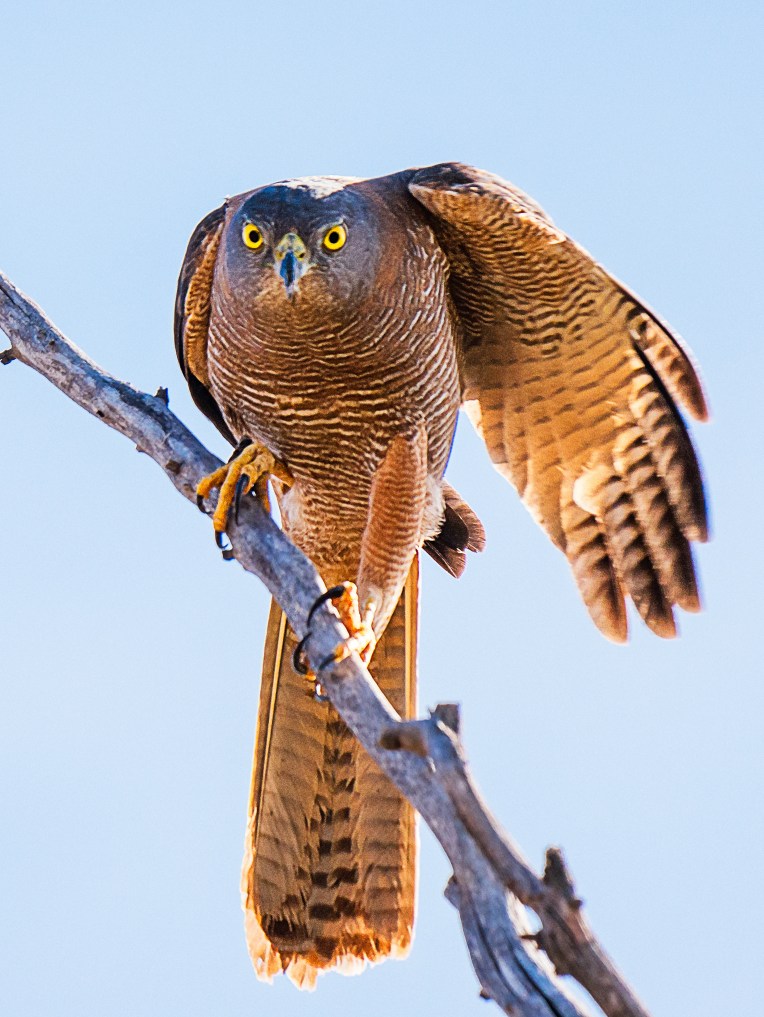
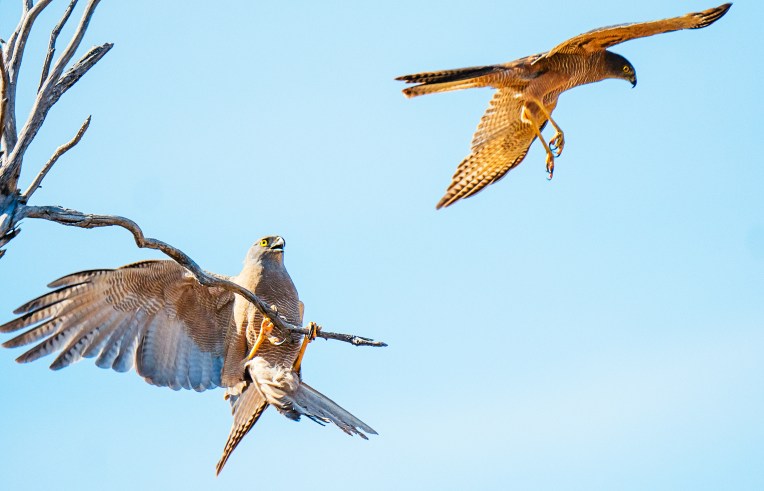
I’ve got to say of the bird types raptors, or birds of prey, are my favourite. The way they hover above the landscape looking for prey or ride the thermals brings a quickening to my heart. Probably a corny thing to say but I really enthralled by their power and majesty – they are the epitome of an apex predator. It’s not just the large raptors like wedge tailed eagles that do this but the smaller species such as falcons and kites as well. I’m lucky that where I live I often see birds of prey hunting and I’ve shared some photos on the blog of collared sparrowhawks, nankeen kestrels, and brown goshawks over the years.

When we started making plans to spend Christmas in Albany I was excited because it would mean that I’d be able to photograph Eastern Ospreys at a nest site near where we staying. So when we set out I made sure I had the necessary kit to take advantage of the opportunity. I spent a very happy Christmas Day filming these wonderful animals.
Angry Birds

The last few mornings dog walks have been spiced up by some very territorial brown goshawks. As we walk along the river and then down onto the river bed we can hear them calling and chattering. It then goes quiet for a second or so and then there is a loud whoosh as you are buzzed from behind. As the bird passes overhead you can feel the air current generated by its wings. At first I thought the birds were objecting to the dog but I and this pattern persisted for about a week. But then something happened that disabused me of that notion – my hat suddenly became the victim of a bird of prey. The last time it happened they managed to knock it off my head. I’m beginning to think my bicycle helmet may be more appropriate headwear.

Spring Is Springing

Tomorrow here in Western Australia is the first day of spring. I don’t think Mother Nature got the memo as the bush around York sprung into life a couple of weeks ago. Flowers are bursting into bloom and the birds are in a frenzy of nest building and dancing around trying to attract mates. This means that I have also sprung into action trying to document as much of thais activity as possible. The cameras are working over time.


You must be logged in to post a comment.