Zoomin’ Heck


On 7th October 2018 I put a video up of me unwrapping the Panasonic Leica DG Vario-Elmar 100-400 f4-6.3 ASPH Power OIS and my initial impressions of it. Well after six months of use this is my opinion of the lens. I don’t know if it has won the title for having the longest model name, but if not it should be a contender. For brevities sake I’ll just refer to it hence forth as the PanaLeica 100-400.  At the outset I’ll say that this is my lens bought with my money and I’ve only used the one copy of it


First off let’s set things straight – this is a very specialist bit of kit that you either have a need for or you don’t. I’ll also say that there is a very good argument to adopt the micro four thirds system just for this lens alone. No I’ve not stopped taking my meds, this lens should be a contender for anyone who shoots wildlife, particularly birds, and travels a lot. A long time ago someone said to me, and I’m not entirely sure who it was, but I’ll attribute it to Hugh Graham who’d been a Fleet Street photographer, that you should choose your camera system on the basis of the lenses you’ll use. I think Panasonic were very smart when they designed this lens because this leverages all the benefits of the m4/3 system. It uses the two times crop factor and small size to produce a lens that is just not available in the 35mm full frame world ie a compact lightweight 200-800mm zoom lens. Recently a muppet on YouTube pronounced that micro four thirds is dead but this lens proves that the system is very viable indeed. Lets compare the PanaLeica 100-400 to some of its rivals. 

Comparing the Canon EOS6d with Sigma 150-600mm lens to the Panasonic G85 and PanaLeica 100-400 lens. Remember folks the Panasonic combination has more reach.


Lens Weight Cost
PanaLeica 100-400 0.985 Kg $1900 AUD
Canon EF 800mm f/5.6L IS USM Lens 4.5 Kg $17000 AUD
Sigma 800mm f/5.6 APO EX DG HSM Lens 4.9 Kg $8400 AUD
Sigma 300-800mm f/5.6 APO EX DG HSM Lens 5.8 Kg $8000 AUD
Nikon AF-S 800mm f/5.6E FL ED VR Lens 4.5 Kg $23000 AUD


Or lets look at it another way. My Panasonic G85 with battery grip, two batteries, a memory card and the PanaLeica 100-400 weighs in at 1.829 Kg. A Canon EOS 550d with a Sigma 150-600mm F5-6.3 DG OS HSM Lens which has the same equivalent angle of view is 2.958 Kg and my Canon 6d with the same Sigma lens is 3.345 Kg and doesn’t have the same range. To get the same zoom range the 6d would need to be paired up with the Sigma 300-800mm f/5.6 APO EX DG HSM Lens and the combination would weigh 7.1 Kg. Now if you sit in a bird hide all day with your camera on a tripod then you might be prepared to sacrifice weight, expense and portability to get high image quality. But if like me you walk around anything up to 20 Km in a day looking for birds and are willing to work around the issue of the smaller sensor and it’s inherent poorer performance at ISOs over 6400 (and coming from the days of shooting slide film at ISOs between 50 and 400 I can’t believe that I see 6400 as a problem) then you will be very happy. The argument about image quality is very spurious if you only look at your images on an iPad or phone. So you can see why I think that this lens is enough to persuade people to adopt the m4/3 system – it has enormous reach, is lightweight and is very affordable.


Tech Specs


Focal Length 100-400mm (200-800 35mm equivalent)
Aperture range f4-6.3 to f22
Construction 20 elements in 13 groups
Diaphragm 9 circular blades
Focus drive Ultra sonic stepper motor
Close focus distance 1.3 m
Maximum magnification x 0.25
Length collapsed 17.15 cm
Diameter 8.3 cm
Filter size 72 mm
Weight 985 g

The Leica designation denotes that Leica had input into the design but the lens is made by Panasonic at their Yamagata lens factory in Japan. The PanaLeica 100-400 retains the same design cues as Leica’s own lenses and the other Panasonic lenses in this series such as the 8-18mm f2.8-4 ie it uses the same fonts and the same ribbing for the focus and zoom rings. It features an all metal body construction and is listed as being weather proof. However, there is no rating as to the extent of the weather resistance. It is a very attractive lens to look at and has a satisfying heft to it which reinforces the fact that this a quality bit of kit. In November 2015 I blogged about the Olympus m.Zuiko 75-300mm f4.8-6.7 mk ii which I bought when I first started dabbling in wildlife photography, with its plastic construction it makes the PanaLeica 100-400 look like a luxury item.


The PanaLeica 100-400mm mounted on Olympus OMD EM1 with lens zoomed out to 400mm.


With regards to the physical controls on the lens body working backwards from the built in mini lens hood (a separate full-sized one can attach to this but I have never used it) there is a narrow focus ring. As per usual with Panasonic this a fly by wire ring with no direct physical coupling to the lens heliocord. Behind the focusing ring is ring which locks and unlocks the lens mechanism to prevent zoom creep. This can be applied at any point in the focal range. The zoom ring is nice a broad enabling a good grip and is quite smooth with a little resistance to movement. It has a ninety degree throw and works very nicely when shooting video. The lens body extends outwards as you progress through the lens range. The front lens element, however, does not rotate which is good news for users of polarizing and variable neutral density filters. The tripod foot and collar is really a rather clever piece of design. There is no collar as such, the rear part of the lens rotates 90 degrees to allow users to change from horizontal to vertical orientation. The foot screws into the lens and can be completely detached. In another nice touch you don’t need the foot to attach a tripod plate as you can attach it directly to the lens body which reduces the profile of the lens considerably. Just before the lens mount there are three physical switches. The first is a focus limiter which offers two positions, full focus range and 5m to infinity. Below that is a switch for AF or manual focus, and below that a switch for the optical image stabilisation system. The lens mount is metal and there is an o ring that provides some sealing against water and dust ingress.


Without a doubt the PanaLeica 100-400 is a very complex lens with 20 elements in 13 groups, 1 ultra low dispersion element, 2 extra low dispersion elements and 1 aspheric extra low dispersion element. From this we can see that it is corrected against chromatic aberration and optimised to produce high contrast, high-resolution images whilst maintaining a compact form factor. Although each group is positioned precisely within the lens barrel it is impossible to do this perfectly so the three lens groups that are most acutely effected by tilt and centring defects and therefore impact most upon image quality are the only ones that are adjustable. This has meant that repair or adjustment of the lens is very difficult and only Panasonic’s Yamagata factory is able to do this which means warranty repairs are sent back to Japan for assessment and then are usually replaced. If your lens fails outside of the warranty period customers are offered a refurbished lens at a discount rather than a repair. To further complicate the issue Panasonic in most countries contracts out its customer service and it is very difficult to access and there have been quite a few accounts of poor service on various camera forums. So my best advice would be to buy this lens from a bricks and mortar store with a good returns policy and then thoroughly test the lens, because if you have a problem it could be quite difficult to resolve.


The image quality is very good from 100-300 and just gets a little softer towards 400. This is not unusual for zoom lenses. At all focal lengths the edges of the frame are a little softer wide open but sharpen up nicely as you stop down. Diffraction becomes apparent at f16. There is next to no chromatic aberration, and the only times that I did observe it a simple click in Lightroom fixed it. Flare is remarkably well controlled on a lens with so many glass elements. I have shot a lot of frames into the light and have found that I don’t need to use the full-sized screw on lens hood, I just use the mini sliding hood that is built into the lens. Filter users be aware that this lens is very fussy about filters as many long lenses are. I’ve had no problem with multi-coated B+W and Heliopan filters. For giggles I tried an uncoated Fotga variable neutral density filter and using a combination of the lens on both a G85 and an EM1 could not get focus. This is not a fault of the lens but shows the effect that using cheap uncoated filters can have on lenses. My Canon 70-200mm f2.8 IS L does exactly the same with the Fotga filter. I’ve never understood why people will spend $2K on a lens and then slap a cheap $10 filter on it. If you are going to use filters use good ones.


Australasian Grebe by Paul Amyes on 500px.com
Australasian Grebe, Tachybaptus novaehollandiae. Lake Monger, Western Australia. Olympus OMD EM1 with PanaLeica 100-400mm. Exposure: 1/1000s, f6.3, ISO 400.


Rainbow Lorikeet by Paul Amyes on 500px.com
Rainbow Lorikeet, Trichoglossus moluccanus. Lake Monger, Western Australia. Olympus OMD EM1 with PanaLeica 100-400mm lens. Exposure: 1/1000s, f5.1 at ISO 6400.


Laughing Kookaburra by Paul Amyes on 500px.com
Laughing Kookaburra, Dacelo novaeguineae. Avon Walk Trail, York, Western Australia. Panasonic Lumix G85 with PanaLeica 100-400mm lens. Exposure: 1/1000s, f6.3 at ISO 250.


White Faced Herron by Paul Amyes on 500px.com
White faced heron, Egretta novaehollandiae, Wilson Inlet, Denmark, Western Australia. Olympus OMD EM1 with PanaLeica 100-400mm lens. Exposure: 1/800s, f6.3 at ISO 320.


In Use


After six months of use and a few thousand exposures I think I’ve got a good handle on this lens. The inbuilt optical stabilisation combines with Panasonic’s Dual IS bodies (at the time of writing the GH5, G9, G95, G85, GX85, and GX9) to give impressive results, around 5-6 stops. When shooting 4K video with the G85 it is very impressive being able to shoot handheld with such a long lens. The video below has footage using the lens on both the G85 and EM1 as well as more stills examples. Unfortunately the OIS does not combine with the IBIS on Olympus bodies so it’s a case of either or. I have my EM1 set up with the IBIS permanently on and have selected Lens IS Priority in the custom functions. This means that when a lens with inbuilt stabilisation is detected the camera switches IBIS off. The reason for this is with shorter lenses IBIS is more effective, but with longer telephoto lenses lens based stabilization works best. The OIS works well enough to get fairly good handheld 1080 video with the EM1, but it’s obviously not as smooth as the G85. The hybrid AF system in the EM1 (a combination of contrast detect and on sensor phase detect) is more confident than the DFD (depth from defocus) of the Panasonic. With small subjects against busy backgrounds I’ve found that the G85 and the PanaLeica just hesitates that little bit as it tries to acquire focus and with small birds that slight hesitation is difference between getting a shot or not. The EM1 is very quick to acquire focus and that is why I’ve ended up favouring it more for bird photography. Now I’m perfectly happy to accept that this just might be a shortcoming of the AF system in the G85 and having read the Lumix GH5/Gh5s/G9 AF Guide Book things might improve significantly if I were to use one of those bodies. But for now I have the quandary of superb image stabilisation versus better AF and I’d sooner have better AF and use faster shutter speeds.


Conclusion


Lakesided Walk - Thomsons Lake by Paul Amyes on 500px.com
Good close focusing and fairly decent maximum magnification of 0.25 means that the PanaLeica 100-400 is very good when photographing larger insects such as butterflies, moths, dragon flies and damsel flies. Australian painted lady (Vanessa kershawi). Thomsons Lake, Western Australia. Olympus OMD EM1 with PanaLeica 100-400mm lens. Exposure: 1/1000s, f6.3 at ISO 640.


If you are already invested in the m4/3 ecosystem and are interested in photographing birds then this is a no brainer. The PanaLeica 100-400 is streets ahead of the Olympus 75-300 and I would imagine the similarly priced Panasonic 100-300mm. It’s absolutely the muts nuts for walking around in the bush photographing birds and larger insects. Now if you’re interested in wildlife and nature and either don’t have a camera or have another brand I’d really recommend giving this lens and a micro four thirds camera some serious consideration. The image quality is very good as long as you’re not a pixel peeper and are honest with your self on what you’ll do with the image. It is very liberating to walk through the bush unencumbered by heavy camera kit that cost the equivalent of the annual GDP of a small Pacific Island nation. My only wish is that there were more compatibility within the micro four thirds system so that the image stabilisation worked across brands, the zoom rings turn in the same direction and that Panasonic adopt the clutch mechanism on their lenses for manual focus with hard stops.


Sacred Kingfisher by Paul Amyes on 500px.com
Sacred Kingfisher, Todiramphus sanctus, the Knoll, Walpole, Western Australia. Olympus OMD EM1 with PanaLeica 100-400 lens. Exposure: 1/1000s, f5.7 at ISO 800.


Bash For Cash


Time to promote the achievements of Beloved Significant Other (BSO) via the wonderful medium of video. I didn’t intend to shoot a croquet video. No. I was enlisted as a logistical consultant (alright driver!) to take aforementioned personage and a friend to a croquet competition at the Cambridge Croquet Club. While the event was happening I was going bird watching at the nearby ornithological Mecca of Herdsman Lake with the hope of photographing nankeen herons. Alas the herons didn’t know that I was coming to see them and weren’t at home. Couple this with the fact that I was suffering from a deadly combination of Ebola, typhoid, bubonic plague and cholera (BSO says it was in fact a head cold) I went back to the croquet club to find a quiet corner in which I could drown in snot. Somehow news that BSO had made it to the finals penetrated my fever fuelled delirium and I leapt into action to record the event. I was not really equipped to do so as although I had the Panasonic G85 with me that shoots lovely 4K video I only had two lenses. The Panasonic Leica 100-400mm a great lens for birding but a bit long for court side croquet. The Sigma 16mm f1.4 which is another fantastic lens, but being a fixed focal length not as useful as standard zoom for the grip and grin at the presentations at the end of the tournament. All I can say is thank goodness for the magnificent stabilisation which enabled me to get good handheld footage, although it was defeated by my violent sneezing although it wasn’t as bad as that depicted below.


Dry River Bed

Australian summers are hot and dry, and while we are not in a drought cycle like the Eastern States, it does get very warm here in York. 45º C is not unheard of. The hot weather and the lack of rain means that the Avon River largely dries up with the exception of a few deep pools, and so I often go walking along the dry river bed with Frida my faithful canine companion as it allows me to view quite a variety of wildlife that congregates around the pools.

Western Whistler by Paul Amyes on 500px.com
Female Western Whistler, sometimes called the Western Golden Whistler, (Pachycephala occidentalis). York, Western Australia. Olympus OMD EM10 with Olympus M.Zuiko Digital ED 75-300mm f/4.8-6.7 II lens. Exposure: 1/1000sec, f7.1 at ISO 500.


Southern Scrub Robin by Paul Amyes on 500px.com
A Southern Scrub Robin, Drymodes brunneopygia, achives vertical take off. The Nyoongar name is Djibot. York, Western Australia. Olympus OMD EM10 with Olympus M.Zuiko Digital ED 75-300mm f/4.8-6.7 II lens. Exposure: 1/1000 sec, f7.1 at ISO 500.


White-faced Heron by Paul Amyes on 500px.com
White-faced Heron (Egretta novaehollandiae). York, Western Australia. Panasonic Lumix G85 with LEICA DG 100-400/F4.0-6.3 lens. Exposure: 1/1000 sec, f6.3 at ISO 250.


Brown Honeyeater by Paul Amyes on 500px.com
Brown Honeyeater, Lichmera indistincta.The Nyoongar name is Djindjoko. York, Western Australia. Panasonic Lumix G85 with Panasonic LEICA DG 100-400/F4.0-6.3 lens. Exposure: 1/1000 sec, f6.3 at ISO 3200.


Sacred Kingfisher by Paul Amyes on 500px.com
Sacred Kingfisher, Todiramphus sanctus. Known by the Nyoongar as Koonyenok. Avon River, York, Western Australia. Canon EOS 550d with a Sigma 150-600mm f/5-6.3 DG OS HSM Contemporary lens. Exposure: 1/1000 sec, f6.3 at ISO 250.

It’s not just birds we see, there are small fish in the ponds (difficult to photograph) and masses of different insects like this damselfly below.

Blue Ringtail Damselfly by Paul Amyes on 500px.com
Blue ringtail damselfly (Austrolestes annulosus,) at rest on the Avon River, York, Western Australia. Canon EOS 550d with a Sigma 150-600mm f/5-6.3 DG OS HSM Contemporary lens. Exposure: 1/1000 sec, f6.3 at ISO 1250.


Frida usually takes my photographic hijacking of her morning walks with good grace. She usually waits for me either in some convenient shade or as shown below standing in some water. She’s not as daft as she looks!

Keeping Cool by Paul Amyes on 500px.com
Frida waiting patiently in the cool of a water pool.

The other morning we were quite surprised to have a fox pop out of the long grass on the river bank and on to river bed. Initially it took off, but when it saw that Frida wasn’t in hot pursuit slowed down and turned back. The fox and Frida then played a mad game of chase up and down taking it in turns to be the chaser and the the chasee. Quite delightful to watch. It was like the canine equivalent of Kevin Costner’s film Dances With Wolves. Unfortunately by this time the battery in the camera had run flat so I was unable to take any photos of this rather special occurrence. Although this being a predominantly farming community most round here would not regard it as such as they belong to the “only good fox is a dead fox” brigade. A couple of days later we went back to see if the event could be repeated and I had a pocket full of batteries to ensure that I got some photos. We did find the fox in the same location but this time both it and Frida were indifferent to each other and the fox disappeared into the undergrowth on the opposite bank. Again I stuffed up the photography and all I got was the slightly blurred image below. Perhaps we’ll try again.


Red fox (Vulpes vulpes) on the Avon River river bed. York, Western Australia.

The soundtrack for summer in the Western Australian bush is provided by Broome based band the Pigram Brothers and their track Dry River Bed provided the title and inspiration for this blog entry.


When your drifting on the ocean
and the sea is a perfect blue
But those storm clouds on the horizon
are keeping you true to who are you
So take me away ‘cross the spinifex plains
where the true mirage never ends
And the smell of the rain is a long way away
lay me down on my dry river bed
Don’t have no white picket fence,
don’t have no green english lawn
Just got heat waves dancing for me,
on the red dirt where I was born
Feel the heart of my country,
beating to them lonely blues
Gotta get back there, gotta get back there,
I’ll be back there real soon
Pigram Brothers – Dry River Bed
Music and Words: ( S Pigram/A, D, G, P, S Pigram, P Mamid)

Seeing Red

Red-capped Robin by Paul Amyes on 500px.com
Red-capped Robin,Wei. Avon Walk Trail, York, Western Australia. Panasonic Lumix G85 with Panasonic Leica 100-400mm F4.0-6.3 lens. Exposure: 1/1000 sec, f6.3 at ISO 640.


Being originally from England I automatically associate Christmas with cold weather, and by association Robins as they are part of iconography of the festive season. So when walking along the Avon River on a 40º C day seeing these Red-capped Robins seems a little incongruous. For such a small bird they are as bold as brass and will let you approach quite closely. The other confusing thing about Australian robins is that they don’t just come in red.


Lake Leschenaultia Lakeside Walk by Paul Amyes on 500px.com
The Western Yellow Robin (Eopsaltria griseogularis). Lake Leschenaultia, Western Australia. Olympus OMD EM1 with Olympus M.Zuiko Digital ED 75-300mm f/4.8-6.7 II lens. Exposure: 1/400 sec, f8 at ISO 800.


When we were in Tasmania we had proper winters with snow, and that meant we had robins in their proper setting, but not at Christmas. Oh it’s all very confusing!


Pink Robin at Silver Falls by Paul Amyes on 500px.com
A pink robin (pink) at Silver Falls, Mount Wellington in Tasmania. Olympus OM-D E-M10 with Olympus M.Zuiko Digital ED 40-150mm f/4-5.6 R lens. Exposure: 1/160 sec, f5.6 at ISO 200.


Chasing Rainbows

That is Rainbow Bee Eaters


Rainbow Bee-eaters by Paul Amyes on 500px.com
Rainbow Bee Eater, Merops ornatus. Avon Walk Trail, York, Western Australia. Panasonic Lumix G85 with Panasonic Leica 100-400mm f4-6.3. Exposure: 1/1000, f6.3 at ISO 250.


There are quite a number of them along the Avon River here in York. They migrate from Indonesia, New Guinea and northern Australia to avoid the cyclone season and come to breed during our summer. They nest in burrows which they dig and I discovered them quite by chance. While walking the dog I noticed these brightly coloured birds literally nose diving into the ground. At first I thought that the bird must have been hurt and went over to look for it, but I found nothing. Over the next few weeks I watched several others repeat the behaviour so looking carefully at the embankment I found several holes which turned out to be their burrows. So ever since I’ve been trying to photograph them.


Rainbow Bee-eaters by Paul Amyes on 500px.com
Rainbow Bee Eater, Merops ornatus. Avon Walk Trail, York, Western Australia. Panasonic Lumix G85 with Panasonic Leica 100-400mm f4-6.3. Exposure: 1/1000, f6.3 at ISO 320.


So far I’ve only managed to photograph them when they perch. They feed on flying insects and their acrobatic manoeuvring while chasing their prey are beyond my photographic abilities. Luckily I’ve noticed that they tend to favour a particular tree de jour as a lookout and they repeatedly return between sorties so it has just been a case of walking along the river finding that day’s favoured tree and waiting.


Rainbow Bee-eaters by Paul Amyes on 500px.com
Rainbow Bee Eater, Merops ornatus. Avon Walk Trail, York, Western Australia. Panasonic Lumix G85 with Panasonic Leica 100-400mm f4-6.3. Exposure: 1/1000, f6.3 at ISO 250.


Just before Christmas my wife and I decided to mount a mission early one morning to observe them bringing food to the chicks that have hatched. We must have been a strange sight for any passers-by – my wife in her camp chair with binoculars aimed at an earth bank and me loitering in the foliage under a tree with a camera and very long lens. We spent a couple of delightful hours watching and photographing before heading off for morning tea.


Rainbow Bee-eaters by Paul Amyes on 500px.com
Rainbow Bee Eater, Merops ornatus. Avon Walk Trail, York, Western Australia. Panasonic Lumix G85 with Panasonic Leica 100-400mm f4-6.3. Exposure: 1/1000, f6.3 at ISO 250.


Now we are waiting for the chicks to fledge.

Get A Grip

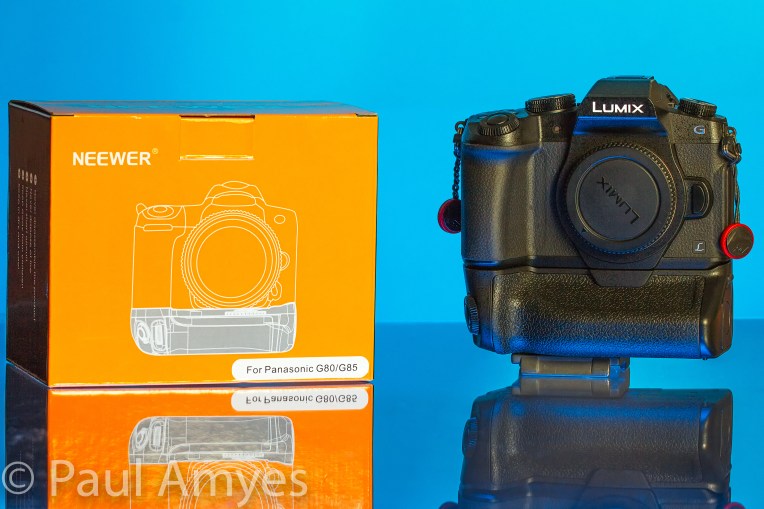
The Neewer DMW-BGG1 battery grip for the Panasonic Lumix G85.


There’s no doubt about it that micro four thirds cameras offer superb performance in a compact body. My favourite cameras have been the EM10 Mki and the EP-5 equipped with one of the excellent prime lenses such as the 25mm f1.8 or the 45mm f1.8. Trouble arises when you slap a bigger lens on such as the truly excellent Olympus M.Zuiko 40-150mm f2.8. It’s possible to use them but it feels unwieldy and uncomfortable for long periods. So the solution was to buy a bigger bodied camera such as the EM1 Mki. I was lucky that I managed to blag a good deal and it included HLD-7 battery grip. In day-to-day usage that grip has never left the camera. When I got the Panasonic Leica 100-400 I started using it primarily on the EM1 and it felt well-balanced, but I wasn’t getting the use of the 5 axis dual image stabilisation. So I thought I’d slap it on front of the G85 that I bought for video. Problem solved for the image stabilisation, but then I felt I needed a bit more real estate for the hands. 


The Neewer DMW-BGG1 battery grip for the Panasonic Lumix G85.


Looking online I saw the Panasonic BGG1 Battery Grip was $362 AUD. Now I don’t know about you but lately I think the camera manufacturers have been having a lend of us with camera grips. The new Canon EOS R’s grip retails for $599 AUD and the Fuji X-H1’s is $499 AUD. This is why there is a thriving market in cheap Chinese knock offs, but these tend to be for the best-selling cameras from Canon and Nikon. A lot of people regard these as crap, but back in 2010 I’d bought a Canon 550d and wanted a grip and I ended up buying one by Aputure from eBay for a whopping $40. It is still going strong, in fact it is in better nick than the camera body which I’ve had to superglue together on a couple of occasions. So I was definitely open to the idea of an after market grip, but I was under the impression that there wouldn’t be one as Panasonic don’t command a big enough market share. The other week I was trawling the internet looking for some batteries for my G85 and I found on Amazon Australia for the grand price of $61 AUD the battery grip DMW-BGG1 Battery Grip. So I took the plunge.


The Neewer DMW-BGG1 battery grip for the Panasonic Lumix G85.


The Neewer DMW-BGG1 battery grip for the Panasonic Lumix G85.


Ok first impressions. It’s made of plastic, but so is the body of the G85. It seems to be a pretty faithful copy of the Panasonic version right down to the recessed area for holding the rubber cover for the electrical contacts from the camera. The buttons and dials don’t feel as nice as those on the camera but they work well. The only downsides are that the tripod mount is not under the axis of the lens and it is obviously not weather sealed. For me these weren’t a big deal. In use the grip is comfortable and fits the contours of the camera body well. It helps provide a nice comfy grip, especially in the portrait orientation and the extra battery is a welcome addition when shooting video.I’ve been using it for a couple of months and it has been great. A good buy. 


The Neewer DMW-BGG1 battery grip for the Panasonic Lumix G85.


The Neewer DMW-BGG1 battery grip for the Panasonic Lumix G85.

Out Of Step

Blackadder Lake by Paul Amyes on 500px.com
Juvenile pied stilts (Himantopus leuccocephalus) at Blackadder Lake, Vivash, Western Australia. Panasonic Lumix G85 with a Panasonic LEICA DG 100-400/F4.0-6.3 lens. Exposure 1/1250, f6.3, ISO 800.


The other day we were down at Blackadder Lake in Vivash. We had gone to photograph Sacred Kingfishers, but the only glimpse we got of them was as we got out of the car. When we got to the lake we became entranced by the antics of a pair of juvenile pied stilts. They moved across the lake shallows in perfect synchronised formation, until the need for a tasty morsel became too much.

Blackadder Lake by Paul Amyes on 500px.com
Juvenile pied stilts (Himantopus leuccocephalus) at Blackadder Lake, Vivash, Western Australia. Panasonic Lumix G85 with a Panasonic LEICA DG 100-400/F4.0-6.3 lens. Exposure 1/1250, f6.3, ISO 800.


Blackadder Lake by Paul Amyes on 500px.com
Juvenile pied stilts (Himantopus leuccocephalus) at Blackadder Lake, Vivash, Western Australia. Panasonic Lumix G85 with a Panasonic LEICA DG 100-400/F4.0-6.3 lens. Exposure 1/1250, f6.3, ISO 800.


Broadening My Horizons…


… with the Panasonic Leica DG Vario-Elmarit 8-18mm f2.8-4 micro four thirds lens which will be referred to hence forth as the 8-18 for brevity’s sake. For those who prefer video there is a video review at the bottom of the page.

The 8-18 was introduced as part of Panasonic’s Leica branded f2.8-4 lens range in April 2017. I was immediately interested as I wanted a wide-angle zoom in m4/3. I had discounted the existing Panasonic 7-14mm f4 and the Olympus 7-14mm f2.8 because they wouldn’t accept screw in filters and the Olympus 9-18mm f4-5.6 because the collapsible design means the lens is prone to failure due to the internal ribbon cables breaking. The new 8-18 presented itself with a high quality metal construction that was splash proof and a modest 67mm filter thread. I wanted to use the lens for video work and so the ability to take a variable neutral density filter was a must. So when the lens became available here in Australia I plonked my cash down and got one.


My first impression on opening the box was that it is a quality bit of kit – it feels nice in the hand with a cool metallic feel and satisfying density. The bulbous front element is well recessed and combined with the excellent locking lens hood means that it is protected from stray light and from being physically damaged. The lens barrel has two ring controls – the front being for focus and the rear for zoom – and a switch for selecting auto or manual focus.The focusing ring is of the fly-by-wire type that twiddles endlessly – I wish that Panasonic would follow Olympus’s lead and have the pull back clutch type focusing rings with hard stops. The zoom ring is nicely damped and travels in a smooth 90º rotation. Another gripe is that both Panasonic and Olympus are members of the m4/3 consortium so why oh why can’t they agree on which way the zoom ring turns? Both zoom and focus are internal which is nice as it does not affect the centre of balance while using a gimbal. The lens body is finished in a smooth black satin with the engravings done in the Leica font and colours. The lens mount is metal and looks to be chrome plated brass. So full marks to Panasonic for presentation.

Vital Statistics

lens mount m4/3
focal length 8-18mm (16-36mm 35mm full frame equivalent)
angle of view 62º – 107º
maximum aperture f2.8-4
minimum aperture f22
filter size 67mm
optical stabilisation no
internal focusing yes
internal zoom yes
minimum focusing distance 23cm
maximum magnification 0.12 x
number of lens elements 15
number of lens groups 10
weight 315g
length 88mm
diameter 73.4mm


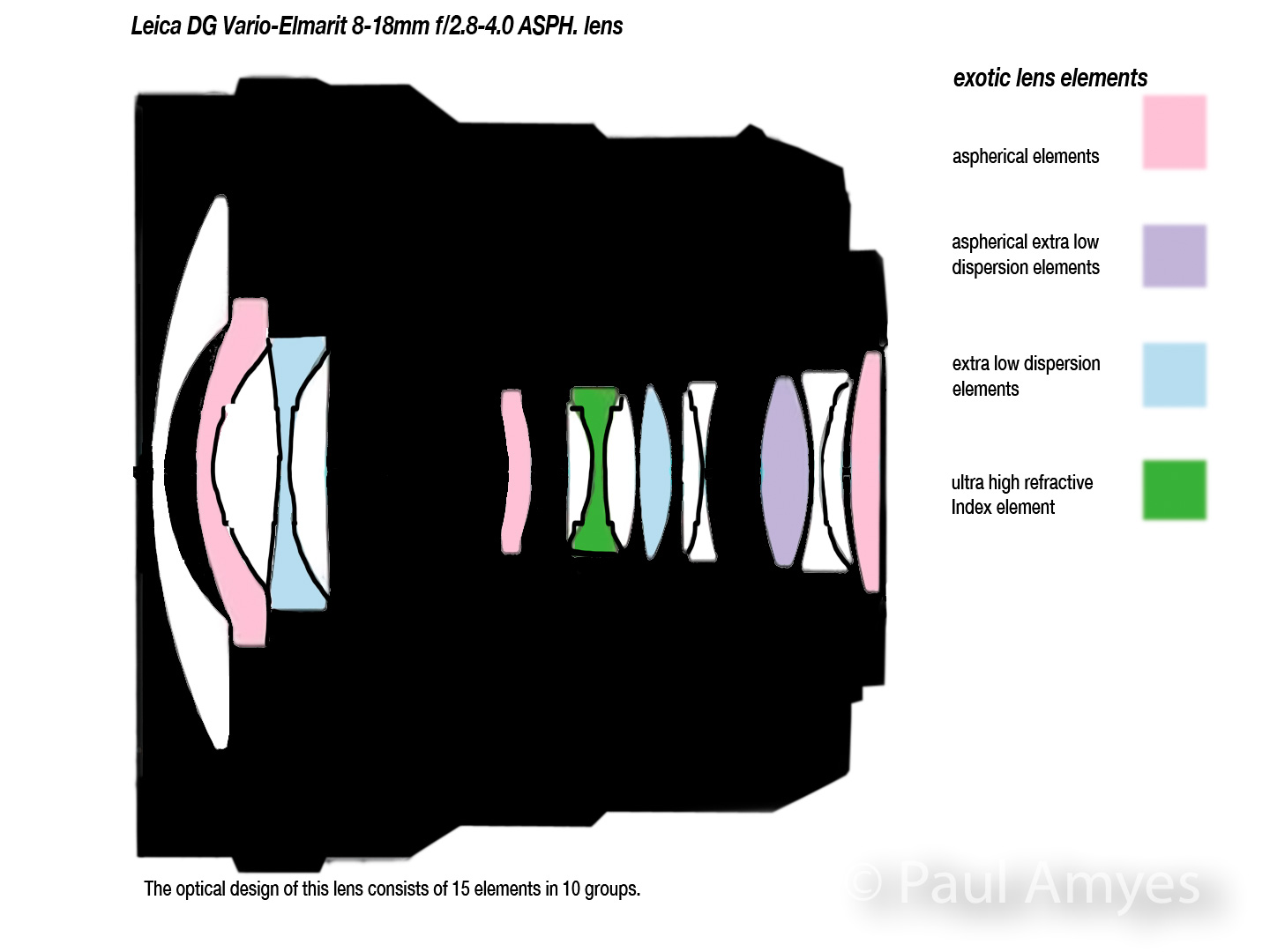
The lens construction is 15 elements in 10 groups with 1 aspherical extra low dispersion element, 2 extra low dispersion elements and 1 ultra high refractive index element. Combined with the nano coatings they should reduce internal flare, distortion and chromatic aberration. Control of distortion and chromatic aberration is also aided by an internal software profile that is baked into the image file. A lot of people don’t like this approach as they feel corrections should be made optically. The main criticism is that there is too much of an image quality hit in the corners with this approach. Hasselblad was the manufacturer to take this approach with their H3 camera and when that was introduced there were few complaints about image quality. The reality is that using lens profiles means lenses can be cheaper, smaller, and lighter than their optically optimised brethren.

The 8-18 has a variable aperture and unfortunately it quickly steps down as you zoom in as can be seen by the chart below.

8mm f2.8
9mm f3.1
10mm f3.2
12mm f3.4
14mm f3.6
18mm f4

Test Results

I’ve done my standard tests to look for distortion, chromatic aberration, and sharpness at 8mm, 12mm and 18mm to give an indication of how the lens does throughout its zoom range. I have just for interest sake posted images with no profile correction to give an idea of what the lens is actually doing. Click on the images to see them at full size.


8mm at f2.8 no lens profile applied


8mm at f2.8 with internal profile applied.

At 8mm without any inbuilt lens profile applied there is very obvious barrel distortion and vignetting at f2.8. With the profile applied there is still a very slight barrel distortion and the vignetting remains until f5.6. In terms of sharpness well at f2.8 the centre of the image is nicely sharp and contrasty and remain so until f16 when diffraction kicks in and softens the image. In the corners the story is different, at f2.8 the corners are significantly softer and less contrasty than the centre, they improve a little as you stop down reaching best performance at f5.6 and then get worse at f16 with diffraction. A small amount of chromatic aberration is present throughout the aperture range and is easily corrected in post.


12mm at f3.4 no lens profile applied


12mm at f3.4 with profile applied.

At 12mm we can see no distortion when the lens profile is applied and the vignetting is about 1/2 stop and is barely discernible. Wide open at f3.4 the centre of the image is sharp and contrasty and the best performance is at f5.6. In the corners the image is softer and has less contrast than the centre. The best performance is at f8. Diffraction starts to set in at f11.


18mm at f4 no lens profile


18mm at f4 with internal profile applied.

At 18mm there is some pincushion distortion in the profile corrected image. There is also a tiny bit of vignetting at f4 but this clears up at f5.6. Sharpness at f4 is very, very good in the centre throughout the aperture range only deteriorating at f16 due to diffraction.The corners are remarkably sharp at f4 but have slightly less contrast than the centre. Peak performance sets in at f5.6 and then again diffraction rears its ugly head at f16 and spoils the party. Chromatic aberration is very well controlled across the whole range and is very, very slight.

Like most ultra wide-angle zooms Panasonic’s 8-18mm f2.8-4 is prone to flare. The recessed front element and tulip lens hood do minimise this, but with the sun in the frame you will see veiling flare. When stopped down you can achieve nice sun stars.

Like most wide-angle zooms the 8-18 is prone to flare. In order to reduce this the engineers recessed the front lens element and then provided a decent lens hood. The Panasonic 7-14mm f4 caused purple blobs on Olympus cameras when there was a specular light source in the frame. Some people pointed the finger at the difference in UV coatings between Panasonic and Olympus cameras. Others said the thickness of the Olympus sensor stack caused the problem. Anyway the 8-18 is thankfully free of those artefacts. Shooting into the sun there is some veiling flare and ghosting.

Auto focus is done via a stepping motor and it is designed to work with Panasonic’s Depth From Defocus technology that is basically a contrast based auto focus system that is enhanced by software profiles for each Panasonic lens. Single point autofocus in single shot drive mode is incredibly fast and accurate. I decided to check the Continuous Auto Focus by continuous shooting at medium speed wide open on the Panasonic G85 with a person walking slowly towards the camera at focal lengths of 8mm and 18mm. All the shots were in focus. Then I tried to see how the lens would perform on a camera without DFD – in this case an Olympus OMD EM1 mk i. At 8mm and f2.8 all the images were in focus. At 18mm shooting a burst of 10 images the camera lost focus on the last 2 images of the burst. So this very limited test shows that the autofocus of the lens does perform better on Panasonic cameras with DFD.

Conclusions

The Panasonic Leica DG Vario-Elmarit 8-18mm f2.8-4 lens with Cokin P system wide-angle lens filter holder attached.

Ok I’ve had the lens a year now and I’ve used it for stills, time lapses and video shooting on the afore-mentioned EM1 and G85 along with an EP5 and EM10 so what can I say. The in camera lens profiles make a huge difference in terms of distortion, but most people won’t see this as they’ll see the corrected images. I did expect this to have some impact on sharpness in the corners but was pleasantly surprised to find that not the case at all. Most zooms perform best at the short end and become softer at the long end. With my copy of the 8-18 this lens is very good at the long end and it is a little softer at the short end. The ability to use filters is a boon for landscape photography and video. The 67mm filter size does not make filter purchases onerous and with the wide-angle filter holder you can use the Cokin P filter system with rectangular filter with an 85mm width. It is really nice not to use filters the size of dinner plates with this lens. I’ve been caught in a couple of downpours while using the 8-18 and have had no problems. I have found the lens immensely satisfying to use and have put it to more uses than I originally thought I would. In all I feel it is a very good lens if you can live without a fixed aperture. I would definitely recommend it.


This slideshow requires JavaScript.