Oh Happy Day!!!!!

Bit of an odd morning today. It was a distinctly grey day and I wasn’t intending to take any photos. While getting set to take the dog out for a walk along the river at Blandstown the Beloved Significant Other said she was taking her binoculars to look for birds. I thought about taking mine but when I saw that they were in a pouch with my camera I just grabbed the whole shebang.

When we got there I wasn’t sure whether Frida – our dog – would walk. She is very old now and has to all intents and purposes given up on walking. She loves a ride in the car, but you can’t guarantee that she’ll get get out for a walk. With a bit of assistance she got out and was quite happy to head towards the river. When she was young long grass would send her silly and she would madly runabout causing mayhem. At 13 with arthritis in one of her back legs and kidney problems it doesn’t happen very often anymore but all that long grass along the river and she was off!


A hairy wrecking ball with four legs. Frida mid bully run when she was a lot younger.


While trying to avoid being bowled over by a deranged bull terrier the Beloved Significant Other said she thought she could see a Rainbow Bee-eater. Oh how I scoffed. “Impossible” said I. “They don’t arrive back from Northern Australia and Papua New Guinea until November.” I added being all ‘knowledgeable’. But when I raised the camera up and looked there was a female Rainbow Bee-eater, and listening very carefully I could just make out the chirping call of another. Never had I seen one this early in York before. I’d read that in some areas of southern Australia the winters are becoming much milder and some of the birds aren’t migrating north in autumn. Whether that applied to these birds I don’t know.


Birin-birin by Paul Amyes on 500px.com
Birin-birin or Rainbow Bee-eater (Merops ornatus). York, Western Australia.


Birin-birin by Paul Amyes on 500px.com


So as we headed home I couldn’t work out what had made me the happier. The fact that Frida had just had a bully run or that I’d seen the Rainbow Bee-eater. Probably both. Oh! I did photograph some other birds. Here they are below.


Chestnut-rumped Thornbill by Paul Amyes on 500px.com
Chestnut-rumped Thornbill, Acanthiza uropygialis. York, Western Australia.


Djindjokoor by Paul Amyes on 500px.com
Juvenile Djindjokoor or Brown Honeyeater (Lichmera indistincta). York, Western Australia.


The Happy Couple

I’ve been enjoying watching the Rainbow Bee-eaters. This year it appears that only one breeding pair have returned to York. This is the lowest number I’ve seen in York in the last twenty years. Despite that the pair we have make for delightful watching.


Birin-birin by Paul Amyes on 500px.com
The female Rainbow Bee-eater playing with her food (a bee naturally) the male isn’t impressed.


Birin-birin by Paul Amyes on 500px.com
The male leaves her to get on with it.


Birin-birin by Paul Amyes on 500px.com
A couple of minutes later he returns with his own bee.


Birin-birin by Paul Amyes on 500px.com
His turn to enjoy a meal.


The Annual Pilgrimage

This week I made the annual pilgrimage to Lake Gwellup reserve to photograph Birinbirin or Rainbow Bee-eaters (Merops ornatus). This is a bit early for me and when I got there I could see that the breeding pairs were still digging their burrows. This meant that both female and males were out and about catching insects, working on their burrows and taking frequent rests on a suitable perch.


Birinbirin by Paul Amyes on 500px.com
A quick bite to eat for breakfast.


Photographically I tried something new. The Olympus EM1x has a feature called “Pro Capture”. On a half press of the shutter the camera buffers frames and when you fully depress the shutter saves them to the memory card. This way in theory you don’t miss a shot. There are two variations of this, a low speed one that allows autofocus with bird tracking and a high speed one that just has single AF on the press of the shutter. To use the low speed pro capture you need to use one of Olympus’ high end ‘Pro’ lenses which I have in shorter focal lengths but not as my birding lens. So I had to make do on this occasion with single AF high speed pro capture. I’ve never bothered with this feature before as I’ve felt that it wouldn’t really suit the conditions I normally work in. But, this time I envisioned taking a shot of a Rainbow Bee-eater taking off from its perch. I could set the camera up on a tripod, focus on the same place on the perch as the birds kept going back to the same spot over and over again. I set the camera to manual and selected a a shutter speed of 1/4000 to freeze the movement and an aperture of f8 to give a bit more depth of field. Then it was a case of just waiting and photographing the birds as they came and went. The down side to this method was that you go through batteries very quickly and the high speed pro capture shoots 60 fps so memory cards are filled up quickly meaning a lot of work at the editing stage. But I was happy with how it went for a first effort.


Birinbirin by Paul Amyes on 500px.com
Coming into land.


Birinbirin by Paul Amyes on 500px.com
Leaving the burrow.


On getting home I fired up Lightroom and looked at the memory cards. I’d taken 1261 photos. Just glancing at them enabled me to winnow them down to 110 photos which I imported into Lightroom.  Looking at the imported photos carefully to check critical focus at 100% I was able to select 36. Another look through looking a composition and I further reduced the selected photos down to 21. I then processed the photos and then looked at them carefully. They were then graded on a scale of 1 to 5 stars. Anything higher than 4 stars was selected and that gave me 8 final photos of which 4 are shown here.


Birinbirin by Paul Amyes on 500px.com
The happy couple.


Up With The Lark


Bandin
Up at dawn to catch the early bird. Bandin or White-cheeked honeyeater (Phylidonyris nigra). York, Western Australia.


It’s a well established wisdom that to photograph most wildlife you have to be in the field at sunrise or just before. I have to say that this is quite pleasurable in summer as it is the coolest part of the day. In fact the last few days it has almost felt cold at just 20ºC. I’ve been heading out looking for black shouldered kites and rainbow bee-eaters. I’ve done my homework found the trees that the kites nest in and the burrows that the rainbow bee-eaters are currently using. I’ve also found out which trees that they like to perch in. Sounds like  it is done and dusted, but photographing wildlife is seldom straight forward.


Birds in Flight
The only photos of Black Shouldered Kites (Elanus axillaris) I’ve got are a sequence of one hunting but I was too far away to get a good photos and this is a heavy crop. The photo does show the distinctive pose of the black shouldered kite when hunting.


The black shouldered kites are incredibly skittish. The closest I’ve ever got to one was while walking the dog. Needless to say I didn’t have a camera with me. So far my efforts have come to naught – the closest I’ve managed to get with a camera is 30 metres. It’s a work in progress.


Birin-birin
Birin-birin or Rainbow Bee Eater (Merops ornatus). York, Western Australia.


The Rainbow bee-eaters are in full swing with raising chicks so both parents will be out hunting and returning to the nest with food roughly every 15 minutes. So all that was necessary was to get into position as the sun’s rising and wait for them to appear. Except they didn’t. Seems like I picked the morning when they decided to have a lie in. After an hour an a half I decided to move to “Plan B” which was to cross the river and go to another site I’ve been watching. Here the birds were early risers and were already full swing into the routine for the day. Photographing them in York is more difficult than at Lake Gwelup where they have been habituated to a human presence and perching posts have been put at lower heights – approximately 1-1.5 metres above the ground. The open terrain means that capturing them flying and hunting is easier. Here in York they favour larger trees, but occasionally will perch lower.  This particular morning I came across a male bird perched in the top of a dead tree. He wasn’t exhibiting the usual behaviour – in fact he looked downright uncomfortable. After a while it became apparent what was causing his discomfort. He had indigestion. His last meal wasn’t going down smoothly at all and was trying to escape! When they catch something like a dragonfly they take it to their favoured perching spot and then beat it against the branch to kill it. Obviously this bird hadn’t thumped the hapless insect hard enough. Eventually the bird sorted the problem out and flew off looking more comfortable. This was the sort of digestion problem that wouldn’t be fixed with a bit of Mylanta.


Birin-birin
“I feel a bit funny. I think something I’ve eaten is disagreeing with me.”


Birin-birin
“Buuuurrrrrrrrrp!”


Birin-birin
“Better out than in.”


They’re Back!!!

Birin-birin by Paul Amyes on 500px.com
Birin-birin or Rainbow Bee Eater (Merops ornatus). Avon Walk Trail, York, Western Australia.


So after their long flight from Far North Australia and Papua New Guinea the rainbow bee eaters have returned. Not the best photograph of a rainbow bee eater, but it makes me happy that they’ve returned to the banks of River Avon. They’ve dug their burrows and we’re now waiting for the eggs to hatch because this will mean a huge amount of activity from both parents as they catch enough food for the chicks.


I was also happy to see a red-backed kingfisher as they’re not very common in these parts. From a distance I thought it was a one of its cousins – a laughing Kookaburra as they share a similar profile. I don’t know the Nyoongar name for the red-backed kingfisher so if anyone out there does know I’d much appreciate you telling me.

Red-backed Kingfisher by Paul Amyes on 500px.com
Red-backed Kingfisher, Todiramphus pyrrhopygius. Avon Walk Trail, York, Western Australia.


Kaa-kaa by Paul Amyes on 500px.com

Kaa-kaa, Laughing Kookaburra (dacelo novaeguineae). Avon Walk Trail, York, Western Australia.

It’s Hot! Dam Hot!


It’s safe to say this summer has been hotter than a very hot thing that is feeling hot. The knock on effect of all that heat is that motivation evaporates – literally. It is very hard to get out and about when temperatures are above 40ºC (104ºF). The UV index is so high that if you’ve been outside for longer than 5 minutes you need to see a dermatologist to have skin cancers removed.


Frida trying to trying to escape the summer heat in what’s left of the Avon River


So summer days are spent dreaming up ways to keep cool. You can go for the psychological approach like my Beloved Significant Other (BSO) – she is reading Scandi noir books set in  chilly sub Arctic nordic climes hoping that she can convince her body that it is cold. I’ve tried watching a few films along those lines but my body is not easily fooled. Next is the physical approach. The BSO has also taken to spending as much time as possible at the swimming pool. I don’t go as when I get into the pool the water gets out. More seriously the pool isn’t heated in any way and the cold water has me shrieking like a teenage girl at a Beatles concert. So I’ve given up on that idea. I’ve taken to hanging around the freezer cabinet in the local super market along with the rest of the town. The competition for the best spots can be brutal. The little old ladies are the worst – they’ve got sharp pointy elbows that they use to great effect to secure prime position and maximum coolness. The best place to go is the bottle shop’s (liquor store or off-licence for non Aussies) coolroom. Absolutely blissful. Unfortunately I was banned after I tried to smuggle in a chair and a TV. The best strategy is to get up early and try and do everything before it gets too hot. Then you retreat back to the sanctity of home and crank up the air con. This is why I’ve been printing photos lately.


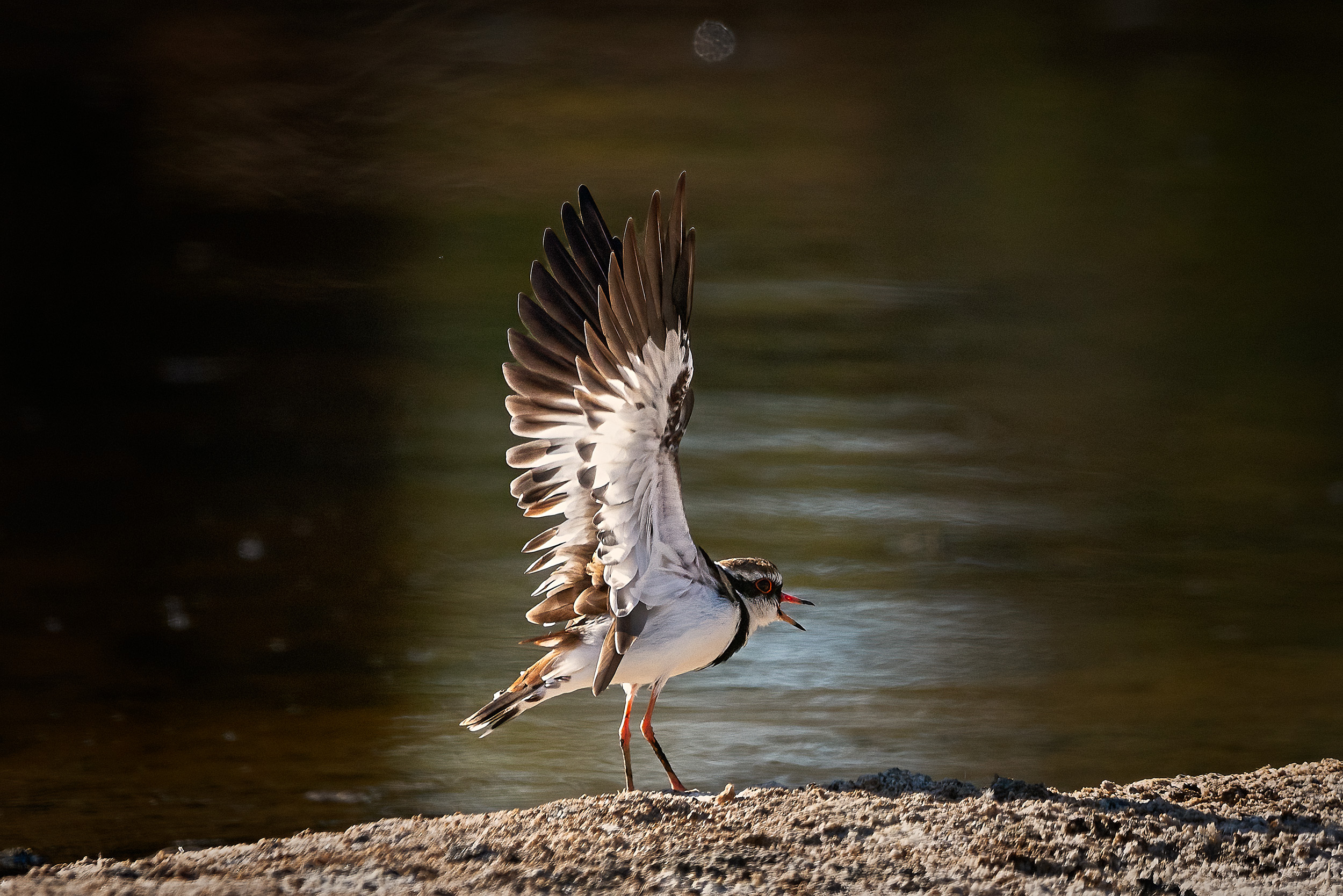
Nidoolyorong or Black-fronted Dotterel (Elseyornis melanops). York, Western Australia.


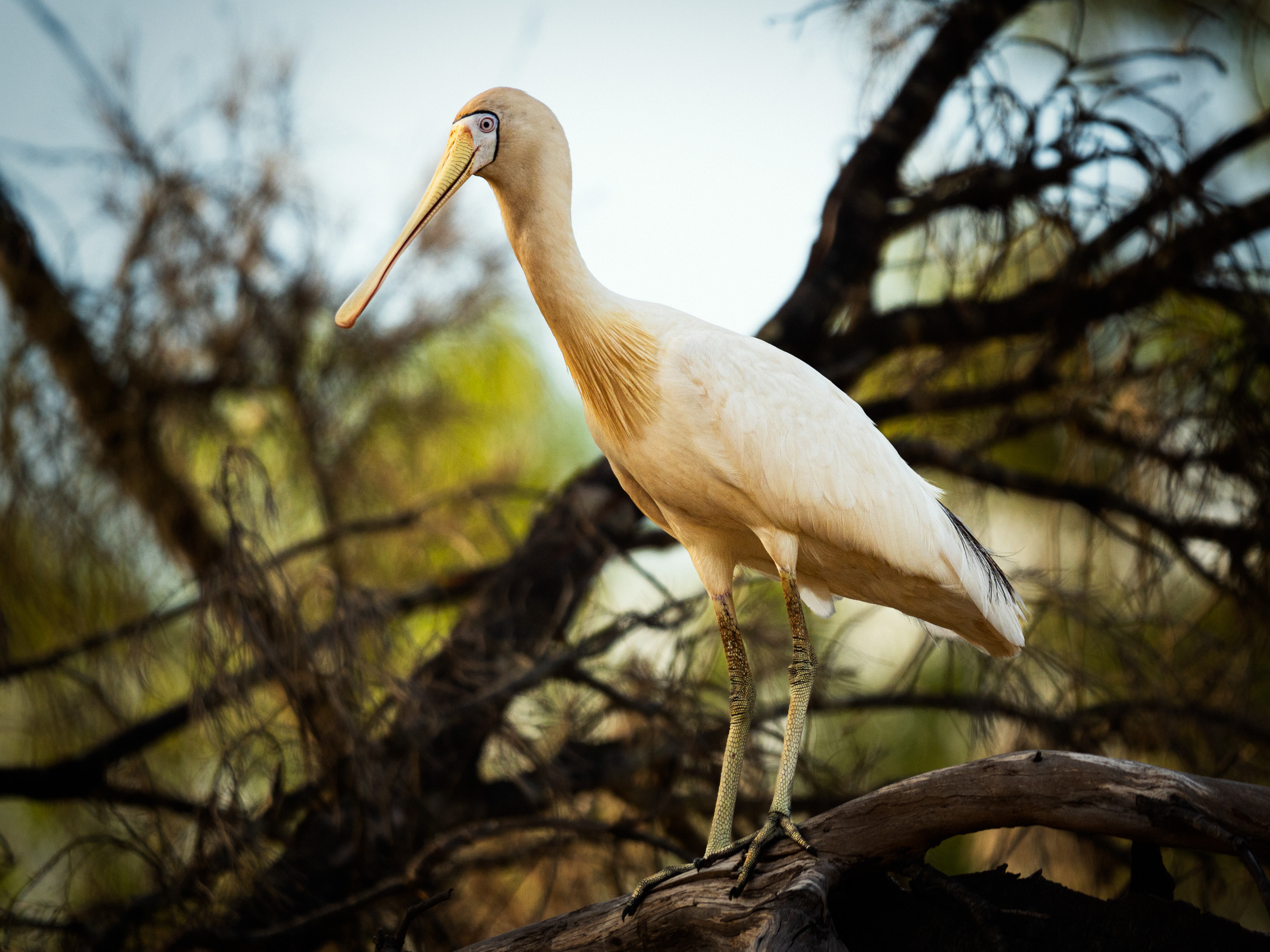
Yellow billed Spoonbill, Platalea flavipes. York, Western Australia.


A Willie Wagtail wondering if the Rainbow Bee Eater is going to share its dragon fly.

The impact of all this hot weather on the local wildlife has been considerable. The numbers of birds around is quite low. Lack of food and water. Even along the river, which now no longer resembles a river but a series of small fetid murky pools, there seems to be less activity. It has been a bumper year for dragon flies. I guess they must like it a little on the warm side. Once a week I’ve been going out to a large freshwater lake about 50Km from here to work on a new project. There’s been a bit more activity there but not much. Early in the mornings there is no vehicular access so you have to walk in through the bush and a couple of times I’ve come across a mob of kangaroos sparked out in the shade under the trees. They’re so hot and lethargic they can’t summon up the energy to move and they just lazily watch as I walk past. The only real activity at the lake has come in the form of a randy male musk duck desperately swimming up and down looking for a victim – err I mean prospective breeding partner. That duck can certainly move fast. Funnily enough I’ve not yet spotted a female musk duck – I guess they must be too hot and bothered and are avoiding him by hiding in the reed beds.

Musk Duck by Paul Amyes on 500px.com
A male musk duck – not the randy one mentioned above.

Thankfully it is the end of February. That means we’ve only got to survive March and the the weather will start to cool in April. Can’t wait!!


It’s A Knockout!!!

In the red corner we have…


the Rainbow Bee-eaters aka Merops ornatus


In the blue corner we have …


The Blue Skimmer aka Orthetrum caledonicum


Well the Blue Skimmer walked into that one!


The Blue Skimmer is caught in a half Nelson


This is getting ugly fast!


The Rainbow Bee-eater gets the first fall.


Looks like the Rainbow Bee-eater is going for the pile driver!


That’s got to hurt!


I don’t think there’s any way back from that move for the Blue Skimmer.


It’s all over folks!


It’s a knockout!!

Lake Gwelup


Lake Gwelup by Paul Amyes on 500px.com
The south east bank of Lake Gwelup in Western Australia.


Lake Gwelup by Paul Amyes on 500px.com
The bird observation platform that forms part of the Lake Gwelup Reserve Broadwalk on the south eastern shore of Lake Gwelup.


Lake Gwelup and the reserve that surrounds it is one of the few areas of wetland that is still relatively intact. This means that it is home to a wide variety of flora and fauna which is all the more surprising considering it is just 12 Km north of Perth’s CBD in the City of Stirling which with a population of 210,000 (2016 Census) is the largest local government area by population in Western Australia. The bush around the lake is comprised of Marri, Jarrah, Flooded Gum, Tuart (, Swamp Paperbark and several species of Banksia. The bush and the lake provided a habitat for birds (according to eBird Australia 110 species of bird have been sighted there), frogs (notably Moaning Frogs), and reptile species (e.g. dugites, skinks and long necked turtles). One of the strange facts that has prevented the land from being developed is that the peaty soils around the lake if disturbed release arsenic and iron sulphates. In the areas nearby that have been drained and reclaimed they have the highest concentrations of dissolved arsenic in the world – some 25000 ug/L (some 400 times higher than that identified as safe levels for drinking water).


Swamp Paperbark Flowers by Paul Amyes on 500px.com
Bees feeding on the flowers of the Swamp Paperbark (Melaleuca rhaphiophylla). Lake Gwelup Reserve, Western Australia.


Blue-billed Duck by Paul Amyes on 500px.com
A male Blue-billed Duck (Oxyura australis) on Lake Gwelup in Western Australia.


So what is there to see and do? Well there is a networks of paths around the lake and through the surrounding bushland and you can bring your best canine friend with you. There are BBQ’s and picnic shelters, public bathrooms, sail-shaded playground, sporting grounds and cricket nets for those who don’t feel the need to connect with nature. For those wanting a nature fix on the southern side is a broad walk and viewing platform that allows you to get up lose and personal with the wildlife. An interesting development is that the bush northwest of the lake is a breeding ground for Rainbow Bee-eaters. These migratory birds come from Papua New Guinea and Tropical Australia and build their nesting burrows in our summer time.  The City of Stirling has taken measures to protect the nesting sites and at the same time promote them as a feature of the reserve encouraging people to come and see them. Something that the City of Armadale could learn from with their management of Forrestdale Lake. Conservation and protection doesn’t mean you have to fence people out. So when I went the other week I put together a 3.75 Km walk around the lake that also took in the Rainbow Bee-eater nesting site. It was a loverly walk and it was great to see people out enjoying the sunshine in such beautiful surroundings.


Rainbow Bee-eater by Paul Amyes on 500px.com

The breeding colony of Rainbow Bee-eaters (Merops ornatus) is quite a feature of the Lake Gwelup Reserve in Western Australia.


Rainbow Bee-eater by Paul Amyes on 500px.com
The City of Stirling, who administer Lake Gwelup Reserve, place signage up warning people of the presence of Rainbow Bee-eaters’ underground nests.


Birding by Paul Amyes on 500px.com