Second Time’s A Charm…


… or is it?

OM System 100-400mm f5-6.3 II IS lens Review


20250829-OMSystem100-400-0236-Edit


This has been very difficult to write and has become a very long and drawn out affair and it shouldn’t have been.

I have, as regular visitors to the site may recall, been using the Panasonic Leica DG Vario-Elmar 100-400mm f4-6.3 lens for my wildlife photography since September 2018. I bought it because it was the only affordable quality long lens available in Micro Four Thirds at the time. Largely I have been very, very happy with it. The major nitpick I have is that although both Panasonic and Olympus/OM System are part of the Micro Four Thirds consortium and conform to certain protocols such as lens mounts, flash system standards, and autofocus compatibility some features are not cross brand compatible. Now when I got the lens I was primarily using a Panasonic Lumix G85 with which it mates up perfectly and an Olympus EM1 mk 1 which was close enough. But as I progressed with Olympus cameras some of the features such as Synch IS, autofocus while using Pro Capture, focus stacking and high resolution functions required complete compatibility and I was wanting to use them on a regular basis. When Olympus introduced the mk 1 version of the 100-400mm lens in 2020 it seemed weird as it wasn’t compatible with those features so I saw no need to change. So with the announcement in February 2025 OM System announced the OM System 100-400mm f5-6.3 II IS lens and that they had fixed some those issues I became very interested and bought it after watching and reading many, many positive reviews.


20250829-OMSystem100-400-0234-Edit


One of the things that has made this so difficult is because I keep making comparisons to the Panasonic 100-400mm mk I which I also own. In fact, it is probably more a comparison review than anything else, which is unfortunate as I wanted to make it a stand alone look at the OM System 100-400mm.


Panasonic Leica 100-400mm Lens
Comparisons with the Panasonic Leica DG Vario-Elmar 100-400mm f4-6.3 are inevitable considering they both share the same focal range and lens mount.


The Controversy 

When the original Olympus 100-400mm came out a lot people jumped on the fact that it was simply a rebadged SIGMA 100-400MM F/5-6.3 DG DN OS Contemporary Lens. The criticism mainly centred on the fact that it was firstly a lens designed for full frame cameras rather than specifically for Micro Four Thirds which meant some how that it was too large and heavy and undermined the original m4/3 ethos of being small and light. The second complaint was that the original Sigma lens sells for around half the price of the Olympus/OM System version so, therefore, customers were being ripped off by Olympus/OM System. When the  OM System 100-400mm f5-6.3 II IS lens was launched these same complaints were again raised. Well the truth is somewhat different. 


M.ZUIKODIGITALED100-400mm -Edit
Optical construction of the OM System 100-400mm lens.


Sigma100-400_2
The optical construction of the Sigma 100-400mm lens. Looking at this and the OM System one you can see the differences.


While both lenses may have been built by Sigma (and there is no definitive proof that the Olympus/OM System lens has been) there are some key differences. While they share the same focal length, aperture range, and thermally stable composite body the filter size of the Sigma is 67mm compared to 72mm of the OM System lens. The Sigma lens has a lens construction comprising of 22 elements in 16 groups with four FLD elements and one SLD element. The OM System 100-400mm lens has 21 elements in 15 groups with four ED elements, two HR elements and two Super HR elements. The OM System lens diaphragm has 9 circular blades while the Sigma has 7. The OM System lens has IPX1-rated weather-sealing and there is no rating for the Sigma. The OM System lens’ front element has a ZERO Coating which is a form of fluorine coating that repels water and smears keeping it clean.  The Sigma’s image stabilisation is four stops while the OM System’s is 5 on its own and it fully integrates with their cameras IBIS to give 7 stops of image stabilisation. 

At this point I think it is fair to say that the OM System lens is not a simple case of badge engineering, there are too many differences. Now I’m not saying that OM System didn’t contract Sigma to build the lens using their existing  SIGMA 100-400MM F/5-6.3 DG DN OS Contemporary Lens as a framework. What I am saying is that are sufficient differences in the specifications and they should be treated as entirely separate entities.

Vital Statistics

Focal Length  100-400mm (35mm equivalent 200-800mm)
Mount Micro Four Thirds
Lens Construction 21 elements in 15 groups with four ED elements, two HR elements and two Super HR elements
Lens Coating ZERO Coating
Angle of View 12° (wide) – 3.1° (tele)
Number of Diaphragm Blades 9 rounded blades
Maximum Aperture f/5.0 (wide) – f/6.3 (tele)
Minimum Aperture  F22
Minimum Focusing Distance 1.3m
Maximum Magnification Ratio 0.09x (wide) – 0.29x (tele)
Filter Size 72mm
Dimensions 86.4mm ⌀ × 205.6mm h
Weight 1,125g
Supplied Accessories lens hood
Weatherproof IPX1-rated weather-sealing – Dust-proof, Freeze-proof, Splash-proof
Lens Sync IS 5-Axis


20250829-OMSystem100-400-0224-Edit
The OM System 100-400mm is not part of the top tier PRO line of m.Zuiko lenses, but rather one of their consumer grade ones. Consequently it does not have the metal body nor MF Clutch / Snapshot Ring but rather a nondescript composite body that is strictly utilitarian. The zoom is of the external variety in that the lens barrel extends as you zoom through the focal range, but the focusing is internal and the front element does not rotate as the lens focuses. The mechanism feels sturdy with no hint of any flex or wobble. At the mount end there is a chromium plated brass mount which is surrounded by an “o” ring which provides a seal between the lens and camera body. Be aware that OM Systems OM1 mk i & ii, OM3 and OM5 mk i & ii have an IPX rating of 53 which means that they are protected against low pressure water streams from any angle and while not completely dust proof any ingress that does occur will not interfere with the operation of the camera. The lens is IPX1 rated which means that there is no information available about resistance to dust ingress and it is resistant to vertically dripping water equivalent to 1 mm rainfall per minute. So the camera body has more resistance than the lens. 


20250829-OMSystem100-400-0231-Edit
The chromium plated brass lens mount and the rubber “o” ring that provides some weather sealing.


The lens is quite a chunky beast and it also has considerable weight. It is when you compare it to the PanaLeica 100-400mm that this becomes really apparent. The PanaLeica is 34.1 mm shorter, 3mm in diameter smaller and 140g lighter while having a much more premium metal body that just exudes class. In comparison the OM System lens comes off as feeling lumpen and a little tacky.


20250830-OMSystem100-400-0237-Edit
The OM System lens extends as you zoom in. Fitted with the included lens hood it is quite a large lens.


When it comes to controls both lenses are pretty the same. A zoom ring, focus ring, zoom lock and switches for the AF function, focus limiter and image stabilisation. The OM System lens scores well here as the PanaLeica is plagued with an incredibly stiff zoom ring, but overall the PanaLeica gives to my mind a much better user experience.


20250829-OMSystem100-400-0242-Edit
The much lauded new tripod collar. I see it as a solution to a problem that never existed.


On launch there was a lot of fanfare about the new tripod collar. Yes it’s different from the one on the original version but you’d hardly call it innovative. I see it as a solution to a problem that never existed. I’m amazed that so many of the internet reviews went on and on about this giving scant attention to things like autofocus and optical performance. If you want to see a truly innovative approach to tripod collar design look at how Panasonic implemented theirs on the PanaLeica 100-400mm.


20250830-OMSystem100-400-0233-Edit
At its minimum focal length with the lens hood attached.


The OM System 100-400 includes a bayonet type lens hood in the box while the PanaLeica has a a two piece lens hood (a mini hood permanently attached to the body of the lens and a separate extension that attaches to it) and also throws in a lens pouch. To be honest I’ve never used it, but, it’s nice they’ve taken the effort to include it.

Performance


Sharpness


20250901-OMS100-400mmmk2-0293
The new you beaut lens chart.


At 100mm wide open at f5 the performance is even across the frame – a little soft and lacking contrast. At f5.6 the contrast improves a little but the sharpness remains the same. At f8 there is no improvement. At f11 the lens reaches it’s best performance and at f16 softness in the form of diffraction re-appears.


lenschart400wideopen


Best results from the lens came at 200mm, with the best results at f11.

At 400mm wide open at f6.3 at the centre of the image the lens is soft and lacking contrast and the corners match this. The results follow the progress of the shorter end with best performance at f11.


lenschart400f8


This is very disappointing as the lens is not capable of resolving fine feather detail wide open unless you stop down to f11 which makes the lens really unsuitable for low light or birds in flight as you’ll have to use very high ISOs to get high shutter speeds and that kills image quality.


lenschart400f11


Flare resistence


20250924-OMSystem100-400-0247-Edit


Over all flare resistance is very good – the lens coatings are working well to minimise veiling flare. There is some ghosting present – polygonal shapes and light streaks – and it starts to become intrusive at f8. The diffraction spikes are not pretty at all, but then you don’t buy a lens like this for the diffraction spikes.

Chromatic aberration

Transverse or lateral chromatic aberration is present, but it is very, very slight and you really have to pixel peep to find it or turn off the lens profile in your image editing software.

Axial chromatic aberration, also known as longitudinal chromatic aberration is virtually nonexistent, but that is to be expected with such a small maximum aperture.

Autofocus

If you think this has been a pretty damming review so far well all I can say is brace yourself as we haven’t dealt with the lens’s major short comings. Now before any of you complain about me having a faulty camera I tested the lens on an Olympus EM1, two different EM 1 mk 2s, and an EM 1x and got the same result. The lens and the cameras all had the latest firmware installed. 


20250901-OMS100-400mmmk2-0378
The bird on the slider test. The slider was set so that it travelled the 20cm of the slider in 20 seconds on a continuous loop.


At best using continuous autofocus on a slow moving target – me walking – I got 56% of the images in focus. Putting a stuffed toy bird on a slider and having it move back and forth 40% of the photos were in focus. At this point I contacted OM Systems Australia and sent the lens into them for recalibration. On getting it back the performance was actually worse with only 20% of photos in focus. The problem is that it seems to take ages for the lens to acquire focus and if it does it will momentarily grab focus for a couple of frames before drifting off again. The number of times where I’ve had a bird sitting just 5-10m away from me with a clear background and the camera and lens refuses to lock on to it. Frustration just doesn’t begin to express what I feel when that happens. Switch the lens over to the PanaLeica and there is no problem. Even the much cheaper OM System 75-300mm MKII lens performs better than the OM System 100-400 despite being a quarter of the price.


20250924-OMSystem100-400-0229
No matter what I tried the camera and lens combination would not focus on the bird. This Reed Warbler got fed up with waiting and took off.


When shooting video the situation is worse. It struggles to find focus and then will inexplicably drift off.

At the time of writing the lens is with OM System Australia for “evaluation”.

Image Stabilisation 


imagestabilisation


This is an area where the 100-400 excels. OM System claims that the optical stabilisation of the lens combines with the the in body image stabilisation of the camera body to give 5 axis stabilisation of 7 stops. Back in the days of yore when 35mm film SLRs were the norm there was the old adage of the minimum shutter speed you can hold is the reciprocal of the the focal length. So with the micro four thirds crop factor a focal length of 400mm is the full frame equivalent of 800mm and it would need a shutter speed of 1/800 sec to avoid camera shake. Now seven stops would take us down to a shutter speed of 1/6 sec and with my shake hands I could only get 1/13 or 6 stops and get a sharp image. Pretty impressive by anyone’s standards. The practical application of this is that for taking photos of birds I don’t often go below 1/500 sec so it seems overkill, but for video that is another matter entirely and it makes it possible to shoot handheld with this lens.

Minimum Focusing and Maximum Magnification Ratio


OM System 100-400mm f5-6.3 mkII lens
The minimum focusing distance of 1.3m at all focal lengths makes the OM System 100-400mm a very capable close up lens.


OM System 100-400mm f5-6.3 mkII lens
The minimum focusing distance of 1.3m at 400mm gives a Maximum Magnification Ratio of 0.29X.


Conclusion

Thomas Eisl in his review:

“When working with the 100 to 400 Mark  II in practice, one of the first things you will notice is the exceptional focusing performance…It is therefore highly suitable not just for wildlife photography, but also for professional wildlife film making.”

“The exceptional autofocus performance stems from full compatibility with the latest OM system autofocus technologies. This lens is swift enough for the speediest of all subjects and is definitely on par with OM system pro lenses in that regard.”

“Now to conclude the optical performance analysis, it is fair to state that the 100 to 400 M Ii delivers where it matters most and compromises, if existent at all, are very minimal. Overall, a lens capable of professional results, even under demanding conditions. No wonder that this is my most used super telephoto lens at the moment.”

“The OMS 100 to 400 F5 to F6.3 M II stands as a highly capable super telephoto zoom. Its robust yet portable construction, impressive image stabilization and swift autofocus cement its position as a reliable tool for demanding applications like sports and wildlife.”

“This lens delivers a performance that feels almost too good to be true both on paper and in the field.”

Mike Lane states that there is very little difference between the $2200 OM System 100-400mm f5-6.3 II IS lens and the $12,000 150-400mm F4.5 TC1.25X IS PRO.

Espen Helland says “I’m really impressed with the sharpness of the new lens, my photos at 400mm are tack sharp.” and “Though the 100-400mm chases with autofocus a little bit more than my 150-400mm f/4.5 it still performs really well.”

So with these glowing reviews I reflect on my own experience with supposedly the same lens. As it stands, I think that based upon my experience that the OM System 100-400 mk ii is actually unsuited to wildlife photography. The autofocus is incredibly poor and will just frustrate the hell out of you – well it certainly did me. When it does find focus at 400mm, which is where most bird photographers will use it, it is incapable of resolving any fine feather detail. Now it maybe that I just have higher standards than the other reviewers, but I highly doubt that. It maybe that camera and lens manufacturers make sure they send out perfect examples for review. Possible. I know that if I were sending out a product for critical evaluation I would definitely send the best of the best. More likely I just got a lemon. Now if that’s the case then why aren’t OM System looking to rectify the problem. At the time of writing their official line is no refund, no replacement and we’ll begrudgingly look at the lens , but won’t necessarily do anything. That leaves a very sour taste in my mouth and makes me want to change brand. Now OM System doesn’t have a very large market share, they are really struggling to break even (at the end of 2024 they were ¥1.2 billion or $120,000,000 AUD in the red) so alienating existing users seems like economic suicide.

Can I recommend the lens? In short no.

If you’re an Olympus/OM System camera user and not fussed about synch IS, the computational functions and the need for teleconverters then buy the PanaLeica 100-400 it is the much better lens in every way. If those functions and the use of teleconverters are important then I’d skip this lens and sell some body parts and get either the OM System 300mm or 150-400mm. Don’t waste your money on this lens.


190321-PanaLeica100-400-0224-Edit
Just buy the PanaLeica 100-400mm as it is the better lens.

Optical Antithesis


A review of the Sigma 16mm f/1.4 DC DN lens for m4/3


The Sigma 16mm f1.4 shown mounted to an Oympus OMD EM1 mk 1 which is one of the larger m4/3 cameras.


I’ve said many times on this blog that my favourite focal length is 35mm (35mm equivalent) which give a diagonal angle of view of 63.4º To me it is a relaxing normal view, I find 50mm a bit too tight and 28mm a bit too “loose”. So when I migrated from so-called full frame to micro four thirds in 2010 one of the first lenses I bought was the Olympus m.Zuiko 17mm f2.8 pancake lens. Actually at the time there were only three lenses in the system the 17mm, a 14-42mm kit lens and the 40-150 telephoto kit zoom and I ended up getting them all.


Olympus m.Zuiko 17mm f2.8 shown on an EP5. The lens was the first prime introduced for the Olympus’ m4/3 system.


The 17mm was equivalent to 34mm in in full frame terms and has a diagonal angle of view of 65º, so close enough as not to make any real difference. It wasn’t a well received lens despite being what initial advocates of the micro four thirds said they wanted – pancake lenses. It’s slow maximum aperture of f2.8, slow and noisey auto focus combined with less than stellar optical performance put many people off and they went for the much more expensive Panasonic 20mm f1.7 which had the virtues of being optically better, and having a faster maximum aperture. It still wasn’t great in the AF department though. But hey these were the early days of mirrorless technology and AF systems were not very quick and accurate then. But anyways I got the Olympus in a kit with my Olympus EP2 and I actually loved it. I could slip it mounted to the EP2 in my pocket which made it a great stealth camera combination and I used it to shoot my TransPerth-Transhumance project. I still use the lens today, mainly on my EP5. The area where I felt it was absolutely hopeless was video. The AF was too slow, too noisy (think angry wasp stuck in a jar) and I wanted a bit more subject isolation than the f2.8 aperture could give.


The Sigma 16mm f1.4 compared to the Olympus 17mm f2.8, 25mm f.1.8 and the 45mm f1.9.


The Sigma 16mm f1.4 is a physically large lens. Here it is shown with the Olympus 12-40mm f2.8 and 75-300 f4-6.3 zoom lenses.


So fast forward a few years and I’m shooting more and more video and I decide to get myself a better 17mm lens. In the intervening years Olympus had produced the very favourably received 17mm f1.8 and the eye-wateringly expensive f1.2 version. Panasonic had also come to the party with their Panasonic Leica Summilux 15mm f/1.7 lens. In fact I went to my local (if you can call 110Km away local) camera dealer to buy this lens and it was always out of stock which made me want it even more. But in the end I went for an outlier in the form of the Sigma 16mm f/1.4 DC DN lens. The reasons being that f1.4 is faster than f1.9, it was cheaper than the f1.2 and the difference between f1.2 and f1.4 is slight, and my dealer had it in stock. So what makes it and outlier? Well to put it bluntly it’s bloody huge. It has a 67mm ⌀ filter thread which compares to 37mm for the Olympus 17mm f2.8. It is bigger than the Olympus 12-40mm f2.8 and the Panasonic Leica 8-18mm f2.8-4 while being only a little shorter than the Olympus 75-300mm f4.8-6.7. The 16mm focal length equates to 32mm on full frame with a diagonal angle of view 68.1º so is a bit wider, but when used with the Panasonic G85 for 4K video this isn’t much of a problem as the camera crops in slightly. So how come this lens is so lardy I hear you all ask. Well this lens wasn’t designed for micro four thirds, it was initially designed for the Sony 6000 series cameras with an APS sized sensor where it equates to being a 24mm in full frame terms. To get a wide angle lens that’s fast and a good optical performance means lots of glass and glass is heavy, and this lens is large and heavy for APS format cameras. To get some additional return on their investment Sigma decided to offer the lens in micro four thirds mount hence it seeming a funny focal length and being bigger than necessary.


Vital Statistics

Olympus 17mm f2.8

Sigma 16mm f1.4

Diagonal angle of view 65º 68.1º
Optical construction 6 elements in 4 groups 16 elements in 13 groups
Diaphragm 5 rounded blades 9 rounded blades
Minimum aperture f2.8 F1.4
Maximum aperture F22 F16
Minimum focusing distance 20cm 25cm
maximum magnification ratio 0.11x 0.07X
Filter diameter 37mm 67mm
Dimensions ⌀ 57mm x 22mm (H) ⌀ 72.2mm x 92.3mm (H)
Weight 71g 405g
Internal focusing No Yes


In the hand the Sigma 16mm feels very dense and substantial. The lens body is made out of what Sigma calls a Thermally Stable Composite (TSC) which is substantially stronger than conventional polycarbonates while having similar thermal expansion properties to aluminium. The lens mount is made of chromium plated brass which should ensure a long life. The Sigma 16mm is advertised as being dust and splash proof but on closer reading of Sigma’s spec sheet there is only one seal and that is at the lens mount. The lens comes with a bayonet mount petal lens hood which has a ribbed grip to make attaching and detaching easier. While it is good that the lens comes with a hood it’s not the best implementation and feels quite insubstantial and can be fiddly to attach as it can foul and not lock home. There is a ribbed rubber focus ring of the fly by wire type – it feels smooth and easy to use. There are no other controls or switches which means if you want to switch between AF and manual focus you will have to use the camera controls for that.


The Sigma 16mm has an optical construction of 16 elements in 13 groups with 3 FLD (“F” Low Dispersion) glass elements, which offers performance equivalent to fluorite which exhibits less chromatic aberration than those utilising a traditional flint glass. There are 2 SLD (Special Low Dispersion) glass elements which also help to minimise chromatic aberration and 2 ASPH moulded glass aspherical elements which work to reduce optical aberrations. According to Sigma’s website the ASPH elements are polished with a tolerance of under 10 nanometers or 0.000001 millimetres which according to Sigma reduces onion ring bokeh.


Performance

100 % crops showing lens performance wide open and then at the best performing aperture.


In terms of autofocus the stepping motor is fast and accurate and very smooth when shooting video. I tested the lens on the OMD EM1 mk ii which has on sensor phase detect AF and on the Panasonic G85 which uses DFD technology – a variant of contrast detect auto focus that requires the lens to provide a profile to the camera to ensure fast and accurate AF. The Sigma does not have such a profile as these are limited at present to only Panasonic’s own lenses. Despite that there were no problems and I could detect no discernible difference between the Olympus and the Panasonic. The only downside in the AF department is that I can’t use the Pro Capture Low setting which gives up to 18 fps with auto exposure and AF tracking. This is no fault of Sigma’s as the option is only available with Olympus lenses.


Optically – well straight from the get go the Sigma is impressively sharp wide open corner to corner. The performance improves slightly (and it is only visible on my 4K screen at 300%) as you stop down. Diffraction sets in at f16 and this does soften the image. In terms of chromatic aberration, well wide open in high contrast situations it is apparent albeit slight and it is easy to correct in post. The lens is reasonably resistant to flare – but if you have a specular light source in the frame you will experience some veiled flare and ghosting. If you turn off the built in lens profile you can observe a slight barrel distortion, but switch on the profile and it is not visible. The bokeh balls this lens produces are more or less round when shooting wide open even at the edges of the frame and the transitions are nice and smooth. There is some onion ring bokeh which is the result of using moulded aspherical lens.Vignetting is not a problem and is very slight in the region of 1/2 stop.


Chromatic aberration is quite apparent on this lens. It is also quite prone to flare even when using the included lens hood.


Verdict

This slideshow requires JavaScript.


Being designed to have an image circle much larger than micro four thirds requires means that you are using the best performing part of the lens and this really shows. Just for giggles I compared the Sigma with my old Olympus. The Olympus is noticeably soft in the corners at all apertures and just average in the centre. It suffers badly from chromatic aberration. Vignetting is very apparent, in excess of 1 stop in the corners with the lens profile switched on and getting on for 2 stops when switched off. Physically, optically and figuratively the Sigma stands head and shoulders above the little Olympus. The only area where the Olympus wins out is its small size and that is why I’ll continue to use it when I want something small and compact. For every other occasion I’m reaching for the Sigma. The knock on effect is that I’m seriously wondering about replacing my Olympus 45mm f1.8 with the Sigma 56mm f1.4.

Get A Grip

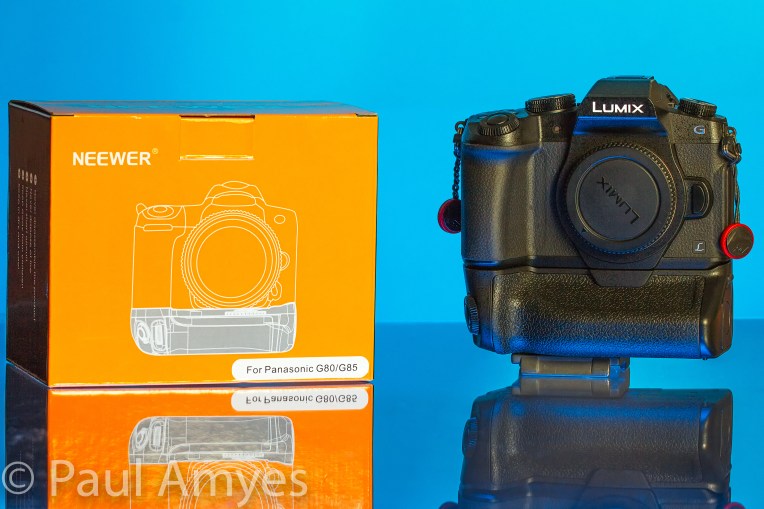
The Neewer DMW-BGG1 battery grip for the Panasonic Lumix G85.


There’s no doubt about it that micro four thirds cameras offer superb performance in a compact body. My favourite cameras have been the EM10 Mki and the EP-5 equipped with one of the excellent prime lenses such as the 25mm f1.8 or the 45mm f1.8. Trouble arises when you slap a bigger lens on such as the truly excellent Olympus M.Zuiko 40-150mm f2.8. It’s possible to use them but it feels unwieldy and uncomfortable for long periods. So the solution was to buy a bigger bodied camera such as the EM1 Mki. I was lucky that I managed to blag a good deal and it included HLD-7 battery grip. In day-to-day usage that grip has never left the camera. When I got the Panasonic Leica 100-400 I started using it primarily on the EM1 and it felt well-balanced, but I wasn’t getting the use of the 5 axis dual image stabilisation. So I thought I’d slap it on front of the G85 that I bought for video. Problem solved for the image stabilisation, but then I felt I needed a bit more real estate for the hands. 


The Neewer DMW-BGG1 battery grip for the Panasonic Lumix G85.


Looking online I saw the Panasonic BGG1 Battery Grip was $362 AUD. Now I don’t know about you but lately I think the camera manufacturers have been having a lend of us with camera grips. The new Canon EOS R’s grip retails for $599 AUD and the Fuji X-H1’s is $499 AUD. This is why there is a thriving market in cheap Chinese knock offs, but these tend to be for the best-selling cameras from Canon and Nikon. A lot of people regard these as crap, but back in 2010 I’d bought a Canon 550d and wanted a grip and I ended up buying one by Aputure from eBay for a whopping $40. It is still going strong, in fact it is in better nick than the camera body which I’ve had to superglue together on a couple of occasions. So I was definitely open to the idea of an after market grip, but I was under the impression that there wouldn’t be one as Panasonic don’t command a big enough market share. The other week I was trawling the internet looking for some batteries for my G85 and I found on Amazon Australia for the grand price of $61 AUD the battery grip DMW-BGG1 Battery Grip. So I took the plunge.


The Neewer DMW-BGG1 battery grip for the Panasonic Lumix G85.


The Neewer DMW-BGG1 battery grip for the Panasonic Lumix G85.


Ok first impressions. It’s made of plastic, but so is the body of the G85. It seems to be a pretty faithful copy of the Panasonic version right down to the recessed area for holding the rubber cover for the electrical contacts from the camera. The buttons and dials don’t feel as nice as those on the camera but they work well. The only downsides are that the tripod mount is not under the axis of the lens and it is obviously not weather sealed. For me these weren’t a big deal. In use the grip is comfortable and fits the contours of the camera body well. It helps provide a nice comfy grip, especially in the portrait orientation and the extra battery is a welcome addition when shooting video.I’ve been using it for a couple of months and it has been great. A good buy. 


The Neewer DMW-BGG1 battery grip for the Panasonic Lumix G85.


The Neewer DMW-BGG1 battery grip for the Panasonic Lumix G85.

Slide Thing*

Video/film relies on movement to make it interesting. That movement can be provided by the subject or it can be by moving the camera itself. Now big budget productions will use all sorts of clever and expensive gizmos to achieve this, but for the budget conscious amateur what can you do. Well you can use your tripod and using panning, but you can only do that so many times before it looks old. You can I suppose use a zoom lens and zoom in and out. Now some people do this, but most people in the “know” regard it as offence worthy of crucifixion if you ask about it on and forum dedicated to film making. But one of the easiest and most effective ways to bring movement is a slider. Prices can go from a few thousand for motorised versions to around one hundred bucks. Or you can go for the cheap skate route and make one in your shed for a few dollars and there are plenty of tutorials on You Tube showing you how. As I was playing truant when the handyman gene was dished out and I am fiscally challenged I looked at the budget end of the market and settled on the catchily named Kamerar S-23 Video Camera Slider.

In summary, for the money it is an absolute bargain and PNC are selling them for $130 USD from their website. I got my copy from Photo-Shop-Studio here in Australia for the amazing price of $120 AUD.

* Apologies to the late great Stevie Ray Vaughn. Slide Thing is a track on the debut album In The Beginning which was recorded live in 1980.

Olympus EM-10 Redux


It's Wet
It’s been raining – a lot! Most unusual for the Wheatbelt.


Well here I am back with another look at the EM-10 now I’ve had it in my possession for a month. First I’d like to thank reader Mike Hendren who set me straight about the bracketing feature. Thanks to him I’ve found that if you go into the HDR function then you can find lots of bracketing features. The camera is capable of in camera HDR and it processes the images as a jpg. The camera shoots a burst of four shots each with a different exposure and you have a choice of two settings for the output – one is more “dramatic” than the other.


Marwick's Barn
Marwick’s Barn, a large stone and timber structure with a high-pitched iron roof was built in the 1870s. Single exposure with just a little sharpening in Lightroom.


Marwick's Barn
In camera HDR from Olympus EM-10 using the “dramatic” setting.

Not a lot of difference really, just a flatter image. Scrolling past the in camera processing you can choose to bracket your exposures and then process the images on your computer. You have a choice of 3, 5 or 7 frames at -/+ 2 stops,  3 and 5 frames at -/+ 3 stops.  The picture below was 3 5 frames at -/+ stops and processed in Lightroom and HDR Efex Pro 2.


Marwick's Barn
Using the HDR bracketing function of the EM-10 to make 5 exposures -/+2 stops and then process in Google’s HDR Efex Pro.

If HDR is your bag then I think you have a definite idea of how you want your photos to look and will choose to blend the images in software on your computer. However, the function could be just the ticket if you’re a confirmed jpg shooter. Speaking of bracketing and jpgs,  then the Art Filter bracketing may prove to be a boon if you ever feel a little indecisive about how you want an image to look. You can choose as many of the filters as you like, but bear in mind that you will need a bit of patience while you wait for the buffer to be cleared.


This slideshow requires JavaScript.

I must say that I’m pretty impressed with the robustness of the files the EM-10 produces, they hold up to post processing very well.

Albion
Detail of a vintage car radiator grill. Avon Tce, York, Western Australia. ORF processed in Lightroom and then in the desktop version of Snapseed.
Curly
Curly wire on a fence post. Focusing the Color-Heliar 75mm f2.5 wide open using focus peaking.Raw file processed using Lightroom and Snapseed.
Two's Company
Two horses kept on a property on the banks of the Avon River in York, Western Australia. Shooting with a 35mm Color-Skopar lens wide at f4 with focus peaking. Raw file processed using Lightroom and Snapseed.


Ceramic Flock
Sheep garden ornaments. Color-Heliar 75mm f2.5 wide open focused with focus peaking on the new Olympus EM-10. Raw file processed using Lightroom and Viveza 2.

Noise, both colour and luminance, seem very well controlled as this shot Diego my cockatiel shows.

Diego
High ISO noise test. Diego my cockatiel at ISO 6400. No noise reduction applied.
Diego's beak
High ISO noise test. Diego my cockatiel at ISO 6400. Close up of Diego’s beak to show noise.


Olympus has always had a good track record when it came to metering systems. The OM 3 and 4 introduced multi-spot reading with shadow and highlight priority, which made them very popular with adherents of the Zone System pioneered by Ansel Adams. The Om 40 saw the introduction of ESP metering which meters from several areas of the image and it is a more sophisticated version of this using 324 areas is present in the EM-10. Spot metering,  high light and shadow spot metering are also present, but multi-spot metering is not present. The metering is very accurate and backlit subjects don’t fool it into under exposing.

Razor Sharp
The ESP multizone metering handled this well with good detail being maintained in both the shadows and the highlights. Straight out of camera jpg.

A few readers asked questions about the capabilities of the camera. Several wanted to know whether the EM-10 was suited to BIF. Sorry the only biff I know about is jujitsu and aikido. Seriously I don’t have a lens long enough to attempt birds in flight, and when I try with my 40-150 they certainly take flight but can only be seen as tiny specks. I do have a sequence of Frida, my English Bull Terrier, doing a “bully run” .


Bully Run
Twelve frame sequence on low continuous shooting of my dog running towards me using the 40-150mm zoom. On some of the frames the focus tracking lost focus but then quickly reacquired.

I mentioned in the previous part of the review that I had used the EM-10’s pop up flash to act as a controller for off camera flash and several people asked how I did this. Well the video below should answer that question.

Another reader asked about using the inbuilt WiFi function. This is the first camera I have used with this function and I have to say I think it is really great. I used my iPad and it was brilliant to use it as a gigantic screen to aid with composition and focusing. The only downsides are that it uses up the camera battery real quick and you can’t use to in movie mode.


So, as I’ve got to know the camera have my feelings changed? Well I have to say when I first picked it up I felt that the camera felt unnecessarily complicated and frustrating to use. Four weeks on I have to say that we’re starting to establish a relationship, I’ve largely set the camera up so I don’t have to do much menu diving which means I can just get on and shoot. The metering is reliable and the files are great, so for still photography I think the EM-10 has the makings of good camera. As for video, well I’m still out to lunch on that one. As I said at the beginning of this entry it has been very wet here and so I’ve not had enough time to get out and shoot anything. I’m hoping to get out in the next week or two and shoot a small project with it, so when that is ready I’ll post my thoughts about it. Stay tuned for the next thrilling instalment.