“F8 and be there” is the old maxim of press photographers. It means basically turn up and get a picture. An aperture of f8 would be in the sweet spot of the lenses performance and would guarantee a sharp contrasty image if you found the focus. I’ve been thinking quite a bit about focusing and optimum sharpness of late.
A portrait of my BSO (Beloved Significant Other) not taken on the Sony A7 iv.
What is acceptable sharpness? What is an acceptable in focus hit rate with an autofocus camera? Why do some manufacturers have a reputation for excellent AF performance (Canon’s dual pixel technology) and some seem to be the bench mark for woeful autofocus (Panasonic’s DFD contrast based system)? I grew up with manual focus cameras and with them any failings were down to the operator. I remember getting my first AF camera – a Pentax SFX. The AF was slow really slow, glaciers move faster, and the noise of the motor made people stop and stare. I got rid of it quick smart and went back to using my manual focus Olympus SLRs up until 2004. It was the development of autofocus cameras in the 1980’s that saw photography as a hobby become more mainstream as out of focus photos were one of the things that put people off.
This thinking about autofocus came about becauseI’ve been reading and watching reviews about the Sony A7 iv *. There seems to be a vocal few criticising its auto focus performance in a very specific usage scenario. The users are using eye detect auto focus on a moving person with fast lenses such as the Sony 135mm f1.8 wide open at a distance of 2m or more. The complaint being that the camera only hits focus on the iris around 70% of the time and the rest of the time front focuses on the eye lashes. Let’s unpack this. The camera is ONLY achieving a 70% hit rate. Hells bells and buckets of blood! My Canon 5d and 6d couldn’t do that. When I use manual focus I couldn’t do that. I had enough trouble accurately focusing quickly with my Olympus OM Zuiko 135mm f2.8 wide open. Mind you those old 135mm f2.8 lenses were often a bit soft wide open. It is staggering to me that firstly you’ve got a 135mm f1.8 lens that is tack sharp wide open and then you can combine it with a camera that is able to focus on the iris of a moving person at 2m with a 70 % success rate. Let’s look at this problem from another direction. Now according to the DOF calculator on Cambridge in Colour the DOF with that combination is 2cm. That means 1cm in front of the eye and 1 cm behind. That would mean that the eye would be in focus but the nose and ears would be blurred. Even if you used an aperture of f4 which 2 1/3 stops more DOF you still only have 5cm DOF. An aperture of f8 would give a DOF of 11cm which is sufficient to render a human head acceptably sharp. Why would you want to take a portrait where only the iris is in focus? The craze for taking photos with razor this depth of field has been with up for about 20 years now and the only reason I can why it endures is that it signifies status – the photographer has the ability to own very fast and expensive lenses.
Wolf Lane in Perth, Western Australia.
Two of the Twentieth Century’s photographic titans had some things to say about sharpness. In 1998 at age 90 Henri Cartier-Bresson said to Helmut Newton: “sharpness is a bourgeois concept.”** For Bresson content and concept were everything and if you look at his images you can see some of them are a little soft. On the other side of the Atlantic in the United States Ansel Adams famously said “There is nothing worse than a sharp image of a fuzzy concept”. So for Adams who sought technical perfection on every level in his photographs saw that intention and content were more important. So focus and sharpness like many other facets of photography are secondary – they play a supportive role but are not the primary consideration.
The photos accompanying this piece were taken with a camera that does not have a lens. It is a 4×5 pinhole camera with a focal length of 150mm and an aperture of f256 which when using Ilford FP4 developed in Ilfosol 3 gives an amazing amount of detail and clarity considering that no lenses are involved. I like to think that it is my anti technology camera. No lens, no focusing, no shutter mechanism, no film advance, no metering, no viewfinder. A successful picture required a great deal of serendipity and that is part of its charm.
My 4×5 pinhole camera with a focal length of 150mm and an aperture of f256. I like to think that it is my anti technology camera.
* Not getting one and the reason has nothing to do with the autofocus issue and everything to do with the weight of bag with camera, 28-70mm f2.8, 105mm f2.8 macro, 35mm f2.8, 20mm f2.8, 150-600mm f5-6.3 and ring flash.
** I had a student who said that Bresson himself was a bourgeois concept.
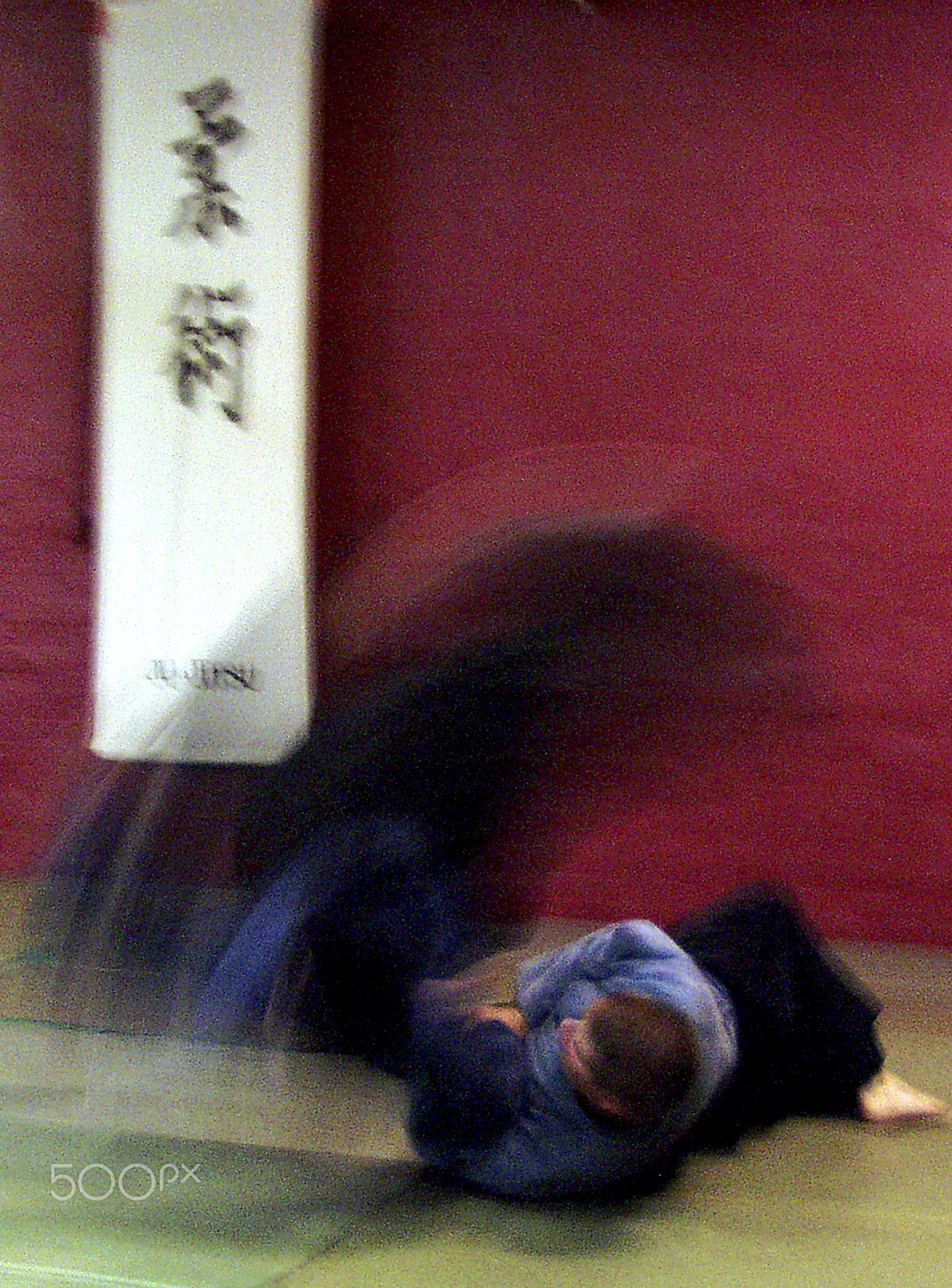
Sutemi waza from Yōseikan Aikido. Taken on Olympus C-720 Ultra Zoom with slow sync flash edited using Photoshop Elements 2 and Genuine Fractuals
Currently in photography there are several sacred cows and you’d think that from the amount of chatter these subjects generated that they were the be all and end all of photography. Thankfully for the actual art form of photography they are mostly irrelevant. These sacred cows are:
megapixels
dynamic range
sensor size
lens sharpness
My feeling is that these topics are so hotly debated is because now in this digital age it is easy to quantify these values numerically and the bigger the number the better. There is no doubt about it a great big spreadsheet of impressive looking numbers must be right after all. This is why the website http://www.dxomark.com has become a sacred text among the denizens of the internet fora and its proclamations and pronouncements can lift a camera or lens to photographic nirvana or condemn it to the lowest reaches of hell. Well having ruffled a few feathers with the piece on sensor size and depth of field this weeks entry is going to cause the DXO fundamentalists to really froth at the mouth in holy indignation.
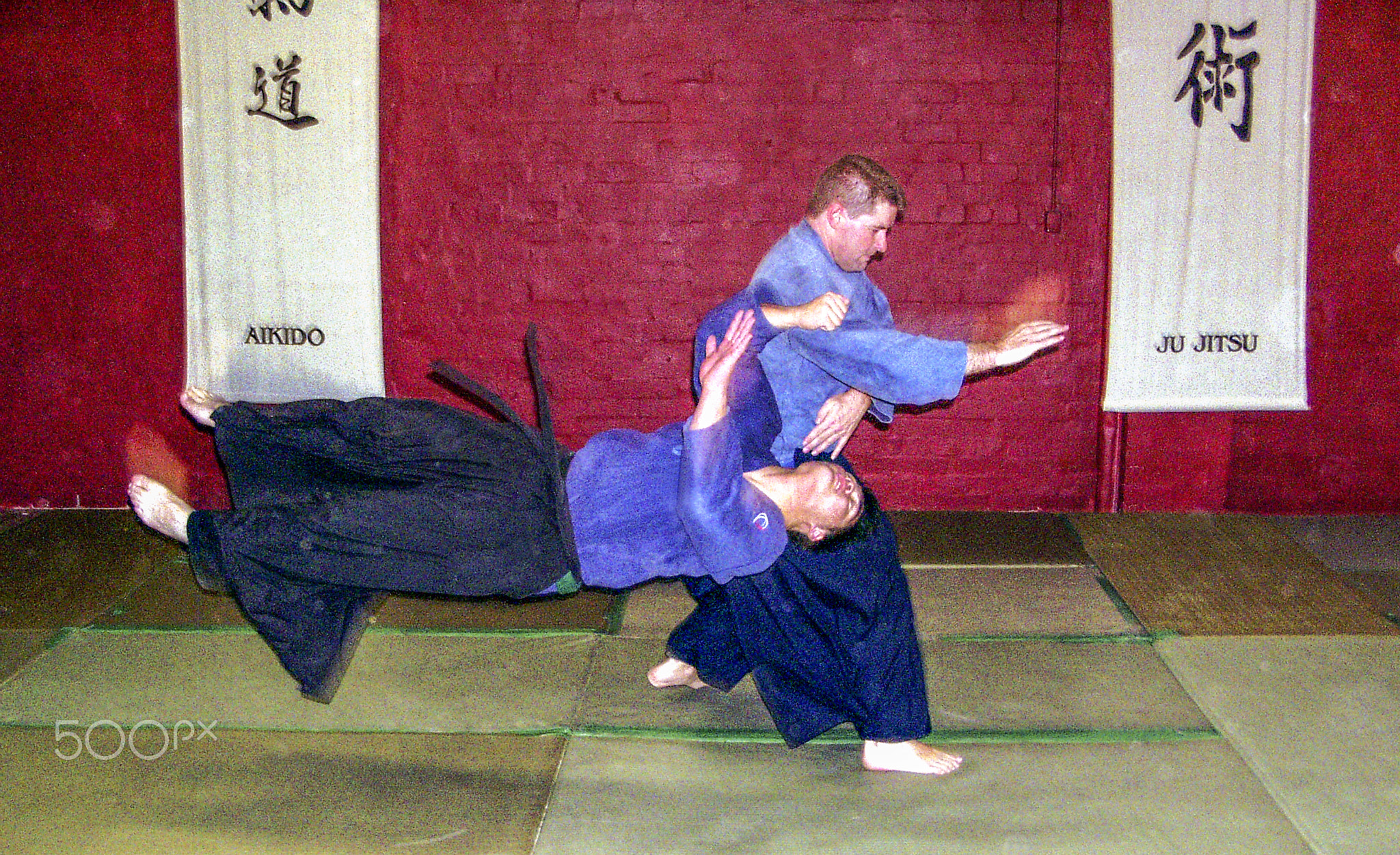
Ura Tai Otoshi from Yoseikan Aikido as taught by Shihan Jan de Jong. Shot using an Olympus C-720 Ultra using slow sync flash. Edited using Photoshop Elements 2 and Genuine Fractuals
Lens sharpness is something to be coveted. After all Leica, Zeiss, Schneider, Rodenstock, Canon and Nikon have made an art form of it. Those who worship at the high altar of lens sharpness are prepared to spend the equivalent of the GDP of a small African nation on the lenses that have the highest DXO score. The Carl Zeiss Distagon T* Otus 1.4/55 ZF.2 Nikon has a DXO score of 45 while the lowly Canon EF 50mm f/1.8 II only has a rating of 25. So the Otus is nearly twice as good as the plastic fantastic Canon. Phwoaaaaarrrrr forum domination and photographic greatness here I come, I’ll go out and buy one straight away. The Australian list price for the Zeiss is $4474 while the Canon is $135, so the Zeiss must be 33 times better. Er no. To quote DXO “The DxOMark Score shows the performance of a lens, mounted on a given camera body, for its optimal focal length/aperture combination and for defined exposure conditions.” So the lens has been mounted to a camera on an optical bench shooting a 2D lens chart at an aperture that is guaranteed to give the best results in carefully controlled lighting. So in other words it does not reflect real world usage unless your photographic interests lie in shooting charts or brick walls with a camera on a heavy tripod so you can orgasm over how sharp the image is at the edges. Shoot a complex 3D object in rapidly changing light conditions at sub optimal aperture settings and these ratings really don’t mean anything.
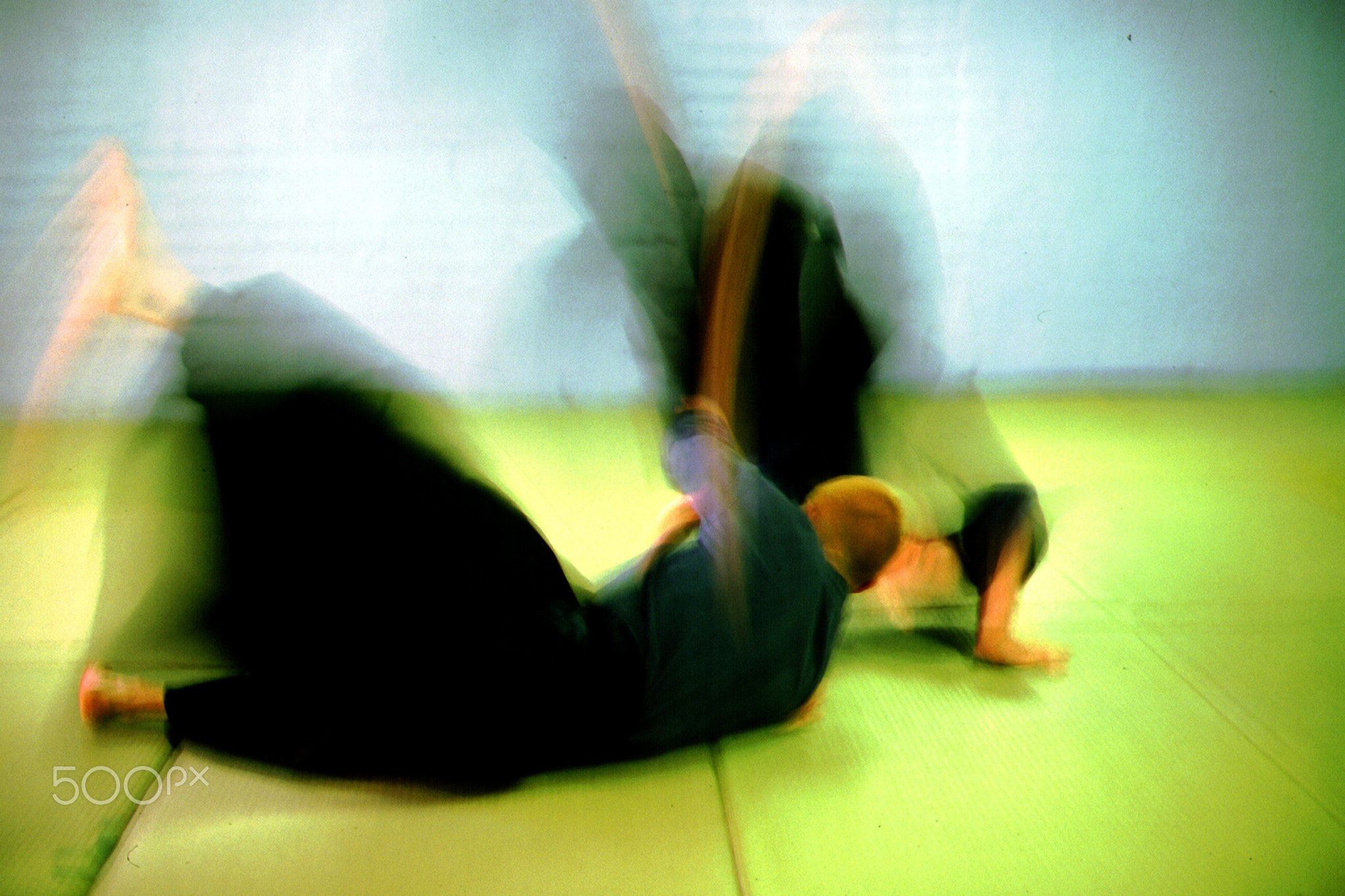
A sacrice throw from Yoseikan Aikido. Taken using an Olympus OM 4 with a Zuiko 35-105 lens on Fujichrome 400 pushed to 800 ISO. Scanned using an Olypus ES-10 scanner and edited using Adobe Photoshop Elements 2 and Genuine Fractuals.
There is no doubt that lenses have become a lot sharper over recent years, but I find it amusing to see that they have become so sharp that they are now unflattering for portraiture as they show every blemish and pore. So much so that photographers are now spending time and money on lessening the sharpness (blurring if you will) on portraits. Don’t you think that is ironic? I’ll spend a fortune on a very sharp lens that is so clinically sharp that no-one likes the results so I’ll spend some more money on a Photoshop plugin to blur it.
A famous quote and often mis-quoted as nobody can really tell you the context in which Cartier-Bresson said it. If we forget the Marxist definition of bourgeois and just concentrate on the dictionary definition we get:
“belonging to or characteristic of the middle class, typically with reference to its perceived materialistic values or conventional attitudes: a rich, bored, bourgeois family | these views will shock the bourgeois critics.”
I would hazard a guess that dear old Henri was stirring a bit when he said it and meant something along the lines that sharpness in a photograph is a very conventional and staid way of judging it and doesn’t look at its other qualities. How can I be sure, well I can’t but he also said:
“It is an illusion that photos are made with the camera, they are made with the eye, heart & head.” – Henri Cartier-Bresson
So I think it is more than likely to assume that Cartier-Bresson felt that there is a lot more to photography than technical perfection.
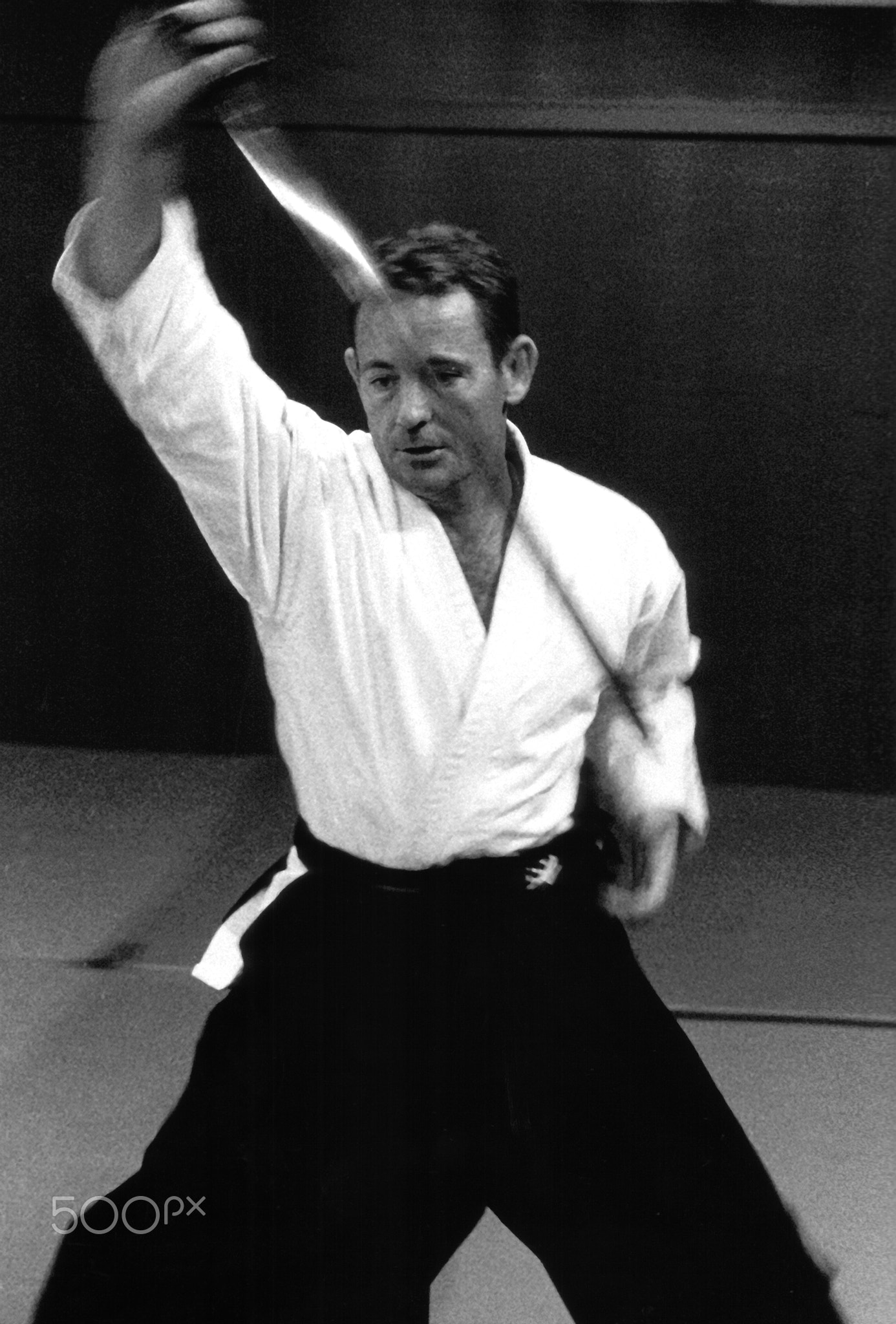
The Japanese art of sword drawing. Taken with an Olympus OM 4 with a Tamron 28 mm lens, using Ifford Delta 3200. Scanned using an Olypus ES-10 scanner and edited using Adobe Photoshop Elements 2 and Genuine Fractuals.
So by now you’ll have read this and seen some photos I made years ago of some people practicing Aikido and Iado, both Japanese martial arts. You’ll also have noticed that there is a lot of blurred movement and very little sharpness. The reason why is that I wanted to capture the beauty of the flowing energy that is involved in them and I felt that while static shots might capture the technical aspects of the techniques being demonstrated they don’t capture the nature of the philosophy behind them nor the dynamism. I like to feel that these are photos “made with the eye, heart & head” rather than the clinical gaze of the optically perfect lens. This is for me where the beauty of any art lies, not in technique but in the expression of ideas and emotions. None of the equipment used in the making of those photographs warrants a mention on DXOMark so I guess that gives them a score of zero. The equipment HCB used also isn’t on the DXO charts, and guess what quite a few of his pictures are blurred because he often relied on zone focusing and didn’t get it right, but I’d sooner have one of his pictures on my wall than a lens test chart any day.
Comparing the sizes of full frame, APSc and m4/3 cameras and lenses.
Internet forums are full of self-proclaimed experts spouting absolute crap about things they know nothing about. Unless you were hiding out in a cave with Osama Bin Laden or not visited the home of countless pointless photographic brand based crusades that is otherwise known as dpreview.com you maybe aware of this hot topic that has spawned a thousand fevered posts and countless character assassinations. If not it goes like this: equivalence is the idea that the size of the camera format effects focal length, depth of field, and exposure, and that when talking about equipment one should express this in terms relating to 35mm equivalents. These arguments became particularly prevalent when Olympus and Panasonic started to have some success with their micro four thirds format. The people express this idea most fervently are those who have sold two of their children and a kidney on Ebay to fund the purchase of a so-called full-frame dSLR and they want to let everyone who uses a smaller format that they are using an inferior product. Usually these arguments go like this:
m4/3 user: Hey I’ve just got my self a new lens, it’s the Olympus 45mm f1.9. It’s a lovely lens, wide open it produces very portraits wide open.
Full framer: It’s not a 45mm f1.8 it is a 90mm f3.8. It cannot render out of focus backgrounds and the smaller sensor needs more light and therefore longer exposures or higher ISO. A proper photographer would use an 85mm f1.2 on a full frame camera.
The argument will typically degenerate and lead to insults and other full frame users diving in to bolster the argument with lots of spurious mathematical equations, graphs and claims of mental deficiency on the part of any smaller format user and maybe even casting doubts on the mental faculties of their parents as well. So what is all this about then and why are people getting so hot under the collar?
Equivalence is not a new thing, it didn’t come with digital, it was a known fact back in the dim dark ages of film, and then funnily enough 35mm film was seen as the miniature inferior format. In those far off times a lot of professional work, and when I use the term professional I mean done for money, was shot using large format, the smallest was 5×4 inches and the largest practical was 10×8 inches. The next step down was medium format where a roll of film was used that was nominally 6cm wide, the popular sizes were 6×7, 6×6 and 6×4.5 cm. Small format, or miniature format was 35mm and smaller. It wasn’t until the advent of modern electronics and a significant breakthrough with tabular grain film in the 1980’s that 35mm really took off as a format. The ease of use that automation made with sharper finer grained films that made many professional photographers and advanced amateurs take up using 35mm and by the end of the 1990’s the larger formats had become niche products for specialised uses.
Professional photographers were well aware of equivalence. A 10×8 camera with a 300mm lens has the same angle of view as a 5×4 camera with 150mm, a 6x6cm camera with 80mm and a 35mm camera with a 50mm. As most working photographers ran more than one format and some three or more favourite angles of view would be duplicated across the systems. So for 5×4 a photographer may have a 90mm, a 150, and a 300. His/her 6×6 system would then have a 55, 80 and 150mm lenses, and the 35mm system 35, 50 and 100mm lens all giving roughly the same angles of view.
Factors that influence depth of field are:
format size
focal length
distance to subject
magnification
lens aperture
From this we can, therefore assume that the larger the format size , the longer the focal length, the closer to the subject, the larger the lens aperture, and the greater the magnification the less the depth of field. So that is clear then. Well no because when we talk about depth of field it is also important to remember that what we are really talking about is acceptable sharpness because a lens can only render one single distance in focus (the plane of critical focus) and objects at other distances to the front and rear will have diminishing sharpness the further they are away from that point. The reality of this is that for most normal usage part of the scene will be acceptably sharp both in front of and behind the point of critical focus, and this zone will be formed that 1/3 of it is in front of the subject and 2/3 behind. This zone can be shallow with only a small part of the scene appearing to be sharp, or it can be deep with the apparent sharpness seemingly covering everything. Seems simple so far, well it gets more complicated because you can break these relationships. As magnification increases the depth of field decreases and the zone of apparent sharpness also shifts from the one-third in front and two-thirds to the rear to an equidistant amount front and rear. Also once you start playing with the plane of the lens in relation to the sensor and subject then everything can go a bit strange. Typically one of the problems that plagued large format shooters was that of getting enough depth of field. Large sensor, small depth of field, not much chop if you’re a landscape shooter. Well using the Scheimpflug rule you can place the plane of focus wherever you want in a scene by positioning the plane of the lens to be parallel with the plane of the subject by tilting the camera front, if that does not completely achieve what you want then you tilt the sensor plane as well so that the planes of the subject, lens and sensor form an intersecting point and this will mean that the subject plane will then be completely sharp while shooting wide open. Working the other way round you can diminish the zone of sharpness by swinging and tilting the camera front. This is not the sole prerogative of large format camera, tilt and shift lenses are available in medium format, 35mm, APS and even m4/3 . The other thing that throws a spanner in the works for depth of field is that the size of the output and viewing distance plays a big part. Simply put big print viewed at a distance and apparent sharpness is reduced.
12mm .v. 24mm
To test the theory I decided to print out an A3 sized lens resolution test chart and this was then set up on an easel in my garden. A tripod was then set up 1.8 metres away from the easel. The cameras tested were the Olympus EP-2 and the Canon EOS5d, both having roughly the same number of megapixels. Choosing lenses was somewhat problematic although I have a set of professional grade fast aperture constant zooms for my 5d I don’t for the EP-2. The lenses used were for the Canon an EF 24mm f2.8, a Sigma 105 f2.8 macro and an 75-300mm f/4-5.6 IS USM. For the Olympus the lenses were a Zuiko 12-50mm f3.5-6.3, a Zuiko 60mm f2.8 macro, and a Zuiko 40-150mm f4-5.6. Each camera was mounted on the tripod in turn and set to shoot large quality jpegs in aperture priority, image stabilisation where appropriate was switched off and the self timer was used to prevent any camera shake. The lens was focused on the chart. None of the images have been processed in any way and the full-sized images can be seen by clicking on any of the composite shots below where you’ll be taken to my Flickr account. At the 24mm and equivalent view the DOF was pretty much equal, although I suspect that there maybe more apparent differences at apertures of f2 and wider, but I wasn’t able to test that. The comparison between the two short telephoto macro lenses highlighted the most difference and at wide open at f2.8 the Olympus manages to resolve some background detail while the Canon doesn’t at all. At the equivalent of 300mm at f5.6 there is very little discernible difference, but that changes at f8 and smaller where the m4/3 camera starts to resolve more detail.
Zuiko 60mm .v. Sigma 105mm150mm .v. 300mm
So what happens to exposure. Doesn’t that change? The short answer is no. When I got my first medium format camera, a secondhand Mamiya C330 Professional , it had no built in metering and the handheld Weston meter that came with it had obviously been dropped and no longer worked properly so I used my Olympus OM1n as a meter and guess what? It worked! Much later when working in the studio with studio flash I determined the exposure with my flash meter and would often make exposures with different format cameras but the exposure value remained the same and the images were correctly exposed. Memory is a fine thing, but I wanted to make definitely sure so I decided to run a quick test comparing full frame, to APS-c, m4/3 and compact camera with a sensor measuring 8.07 x 5.56 mm. The test was simple each camera would use a lens of as near as possible field of view equivalent to 105mm on full frame. The ISO was set to 200, and the shutter speed was set to the maximum synch speed so as not to let ambient light interfere with the result. White balance was set to flash, and pictures settings were natural and the images recorded as fine jpegs. A Canon 550EX speedlite was mounted on a light stand, set on manual to 1/2 power and fired at the test scene through an umbrella diffuser and was triggered by a synch cord. The flash output was measured with my Minolta flash meter which is accurate to 1/10 of a stop, the aperture required for correct exposure was f7.7, each cameras lens was set to the nearest corresponding value which was f7.1. All images are straight out of the camera without any processing. Each cameras image was opened up large in Lightroom 3 and screen shot was taken of the image showing the histogram. Looking at the histogram shows that there’s barely any discernible difference between each cameras recording of the scene.
So what does all this mean? Well the full framer is right in that a 45mm lens on m4/3 does have an angle of view equal to a 90mm on a 35mm sensor. As to the inability to have shallow depth of field that is wrong, it is definitely possible to minimise depth of field but we are talking about subjective differences here as there is that nebulous term “acceptable sharpness” and then it depends on how big you print, and how close you are when you view it. Personally when I take a head and shoulders portrait of someone I like to have from the tip of the nose to the ears in focus as I like to be able to see who I’m looking at. Shooting at 85mm f1.2 the depth of field can be measured in millimetres and so the iris of the eye might be in focus but the rest is just blur. This is just a matter of taste. If you were shooting landscapes using wide-angle lenses then there is little to choose between m4/3s and full frame, and in fact I might go as far to say that the smaller camera has the advantage being smaller and lighter. As to the matter of the smaller format needing more light to form an image that is just plain wrong.
So is the 35mm dSLR superior to m4/3? Yes and no. Infuriating aren’t I! It all depends upon your photographic priorities. If you want to squeeze every last ounce of image quality out of a scene then 10×8 or whole plate large format film cameras either contact printed or drum scanned cannot be beat. Hopeless though for getting shots of the rug rats playing at the park, expensive to run, not very portable and definitely not conducive to spontaneity. Want something you take anywhere and be able to upload images to the web, well your phone cam is your best bet. My Olympus EP-2 is my favourite go anywhere camera. I can rig it up to be like a dSLR by adding its optional electronic viewfinder when I want to use a long lens, put on the 17mm f2.8 pancake lens and it fits in my jacket pocket, put on a mic, a loupe, put it in its cage or rig and its a great little video camera. It perfect for lightweight travel. Out walking the dog or shopping then chances are I’ve got my Panasonic LX-5. My Canon EOS5d is the original 13Mp version and I still keep for certain things and for certain lenses that I just don’t want to give up. There are no absolutes, pick your camera for what you need not what other people think that you should use.





You must be logged in to post a comment.