Young kids on the Avon Walk Trail in York, Western Australia. Sony A7r with Voigtlander 35mm f2.5 Color Skopar lens mounted via a Fotodiox DLX Stretch Leica M to NEX mount adapter. Exposure: 1/200th sec, f5.6 at ISO 100.
Most morning I walk the dog along the Avon River and regular readers will have seen some of the photos I’ve taken while doing so. We walk past this garden which is home to a sheep, an alpaca and these two kids. The kids are about four times the size from when we first met them. Frida is fascinated by them as they come to the fence and prance about. They certainly aren’t scared of her. The male puts his head to the wire and Frida does the same, generally they just push but sometimes they gently but each other all while the alpaca watches on disapprovingly.
The town hall in the historic Western Australian town of York in pre-dawn light. Sony A7r with Olympus OM Zuiko 35mm f2 lens and Cokin 3 stop graduated neutral density filter. Exposure: 2.5 sec, f8 at ISO 100.
The other morning I got up at stupid O’clock to shoot a dawn time-lapse of the York Town Hall. So what do you do while you’re hanging around waiting for it to finish? Why take photos of course! So while the Leica D-Lux clicked away doing it’s time lapse thing I set up the Sony A7r and started taking snaps of the town hall. Good job I did as the time lapse wasn’t that crash hot.
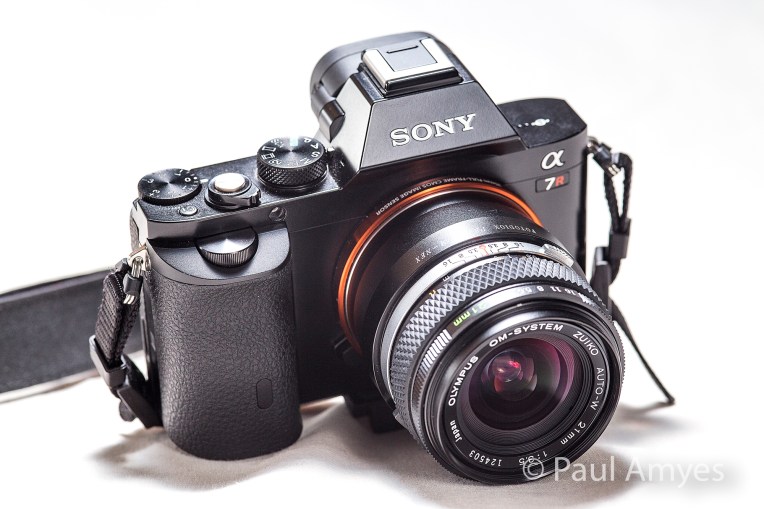
The Olympus OM Zuiko 21mm f3.5 was one of the original lenses released with the OM1 in 1972. It is fair to say that the lens has tended to be ignored somewhat since the release of the f2 version, this was true in the days of film and it is especially true today with the current trend of mounting legacy glass on cameras such as the Sony A7r. Demand for a product dictates the price and copies of the f2 change hands on eBay for over $1000 USD while the f3.5 goes for around $350 USD. Apart from the aperture what other differences are there between the two? Well asymmetrical-type ultra wide-angle lenses are designed for optimum performance at infinity and unfortunately when used at their closest focusing distance picture quality has a tendency to deteriorate. The 21mm f2 lens incorporates a floating element system for improved sharpness from its close 0.2 meter (0.7 ft) minimum focusing distance to infinity and ensuring its superlative optical performance be extended to its closest working range. So what are the advantages of the 21mm f3.5? Well it fits Yoshihisa Maitani’s design criteria for the OM system – being lightweight and very compact. This thing is
The Fotodiox OM to Nex adapter is bigger than the OM Zuiko 21mm f3.5 lens.
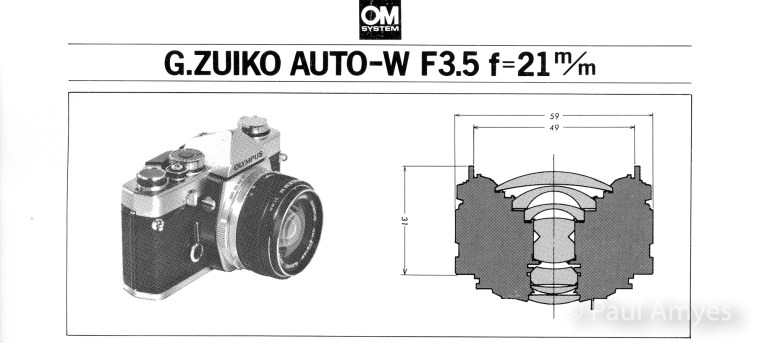
absolutely tiny. It is about the same size as the Fotodiox OM to NEX adapter. Most other camera systems would call this a pancake lens – it’s not, it’s just that most modern DSLR cameras are very bloated and unnecessarily large. Optically it has 7 elements in 7 groups, is 31mm (1.2 inches) long, 59mm (2.3 inches) in diameter and has a filter thread of 49mm. Like most Olympus OM lenses there are different versions of the lens – the original weighed in 185g (6.5 oz) while the newer MC (multi coated) one, which is tested here, is 180g (6.3 oz) while sharing the same optical construction and exterior dimensions. Although it does not have the floating rear element of the f2 version it still focuses down to 20cm (7.87 inches) and the quality is reasonable.
Test Results
The book shelf optical test. The camera is mounted on a tripod so as to get the whole shelf in the frame without causing loss of the parallel vertical lines.
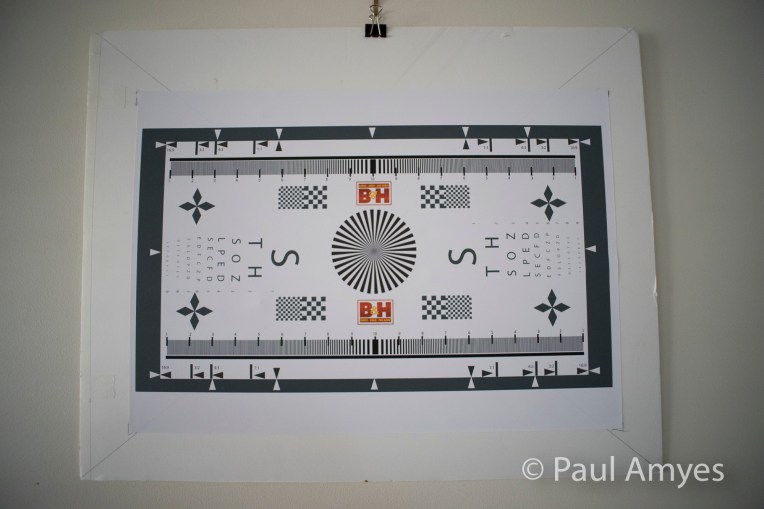
Using my standard book shelf test it is immediately apparent that the lens has noticeable barrel distortion. This is not uncommon in wide-angle lenses and occurs where the image magnification decreases with distance from the optical axis and makes parallel straight lines look like the edges of a wooden barrel. These days this can be easily corrected in post. Looking more closely it is easy to see chromatic aberration on high contrast edges, again easily corrected in post. Wide open at f3.5 the centre of the image is sharp with what would now be construed as having low contrast but is actually quite good and can easily be improved on with a quick adjustment in curves. The edges are very soft and lacking in contrast – not mush but would be easily noticeable in architectural shots. At f8 the centre has improved and you can forget the thoughts of a contrast adjustment. The edges have improved but they are still not good. It is at f11 where things start to come very good, the centre is excellent and the edges are not far off. Any further stopping down and optical quality will drop off due to the effects of diffraction. Vignetting is very apparent when wide open – maybe 2 to 2 1/2 stops difference between the centre and the corners. Things improve significantly by f8. Flare is very well controlled considering the angle of view and the sun stars are quite nice considering there are only six aperture blades.
All images are SOOC with no sharpening or optical corrections. The sections are 100% views from the centre and top left corner of the image. This can be viewed larger by clicking on the image.
Wide open vignetting causes a light loss of 2-21/2 stops in the corners.
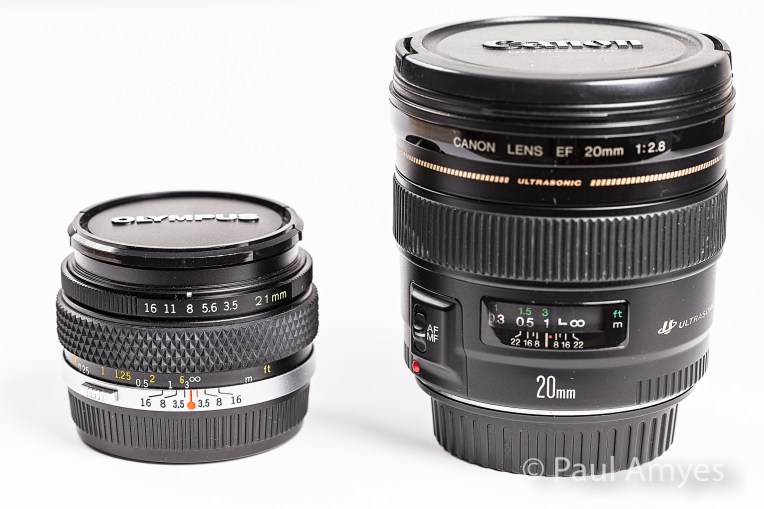
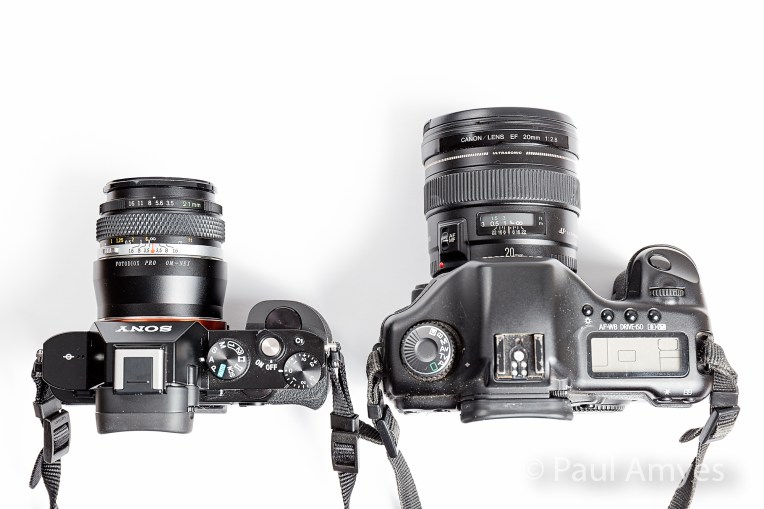
A comparison between the Olympus OM Zuiko 21mm f3.5 and the Canon EF 20mm f2.8.
A comparison between the Olympus OM Zuiko 21mm f3.5 and the Canon EF 20mm f2.8.
So keeping in mind this is a sample of just 1 and I have no idea if this is a good example or a bad what can I say about this lens. Well I happen to own a Canon EF 20mm f2.8 and while not one of Canon’s primo L lenses it is considered quite a respectable performer when stopped down. When we compare the two the first thing that comes to mind is the size difference. As I said before the Olympus is tiny, and it still looks small when attached to the lens adapter. Vignetting on the Canon is very well controlled, this is the big benefit of that large front element (72mm filter size compared with 49mm). Chromatic aberration is no better and no worse. It is the wide open corner sharpness where the Canon beats the little Olympus, but not hugely so and by f5.6 they are both pretty much the same. The big advantage the Olympus has over the Canon is filter use – the smaller size makes filters more affordable and I would hazard that is one of the few, if not only, ultra wide-angle lens that safely use the Cokin P system (84mm in width). My Canon still vignettes with the larger Cokin Z-Pro system (100mm in width).
Real World Examples
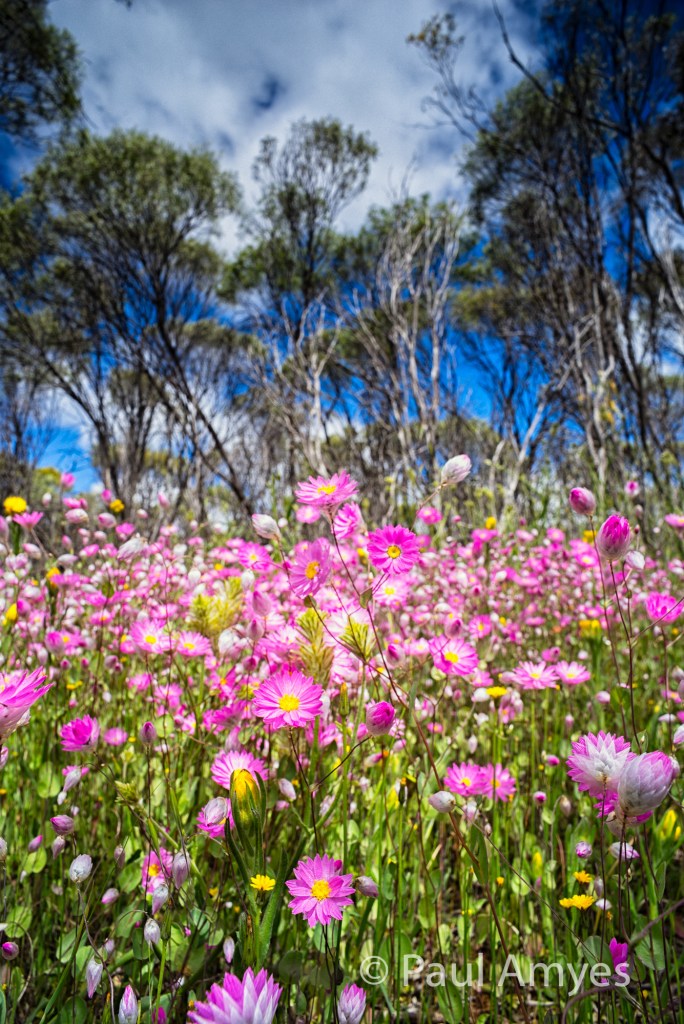
Stopping the lens down to f16 and then using the closest focusing distance of 0.2m I was able to capture a wide-angle close up of these flowers with plenty of DOF. Everlastings on Mount Brown in York, WA.
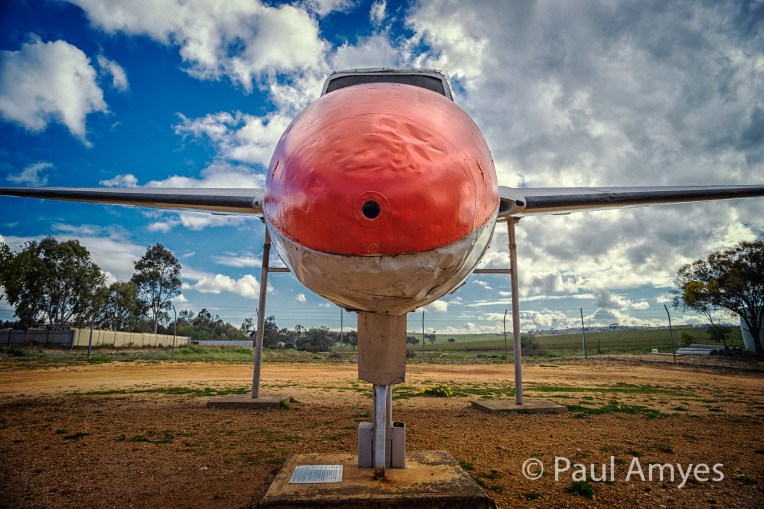
This lens encourages you to look for unusual points of view. A Vampire jet on the Beverley-York Road advertises the Beverley Aeronautical Museum.
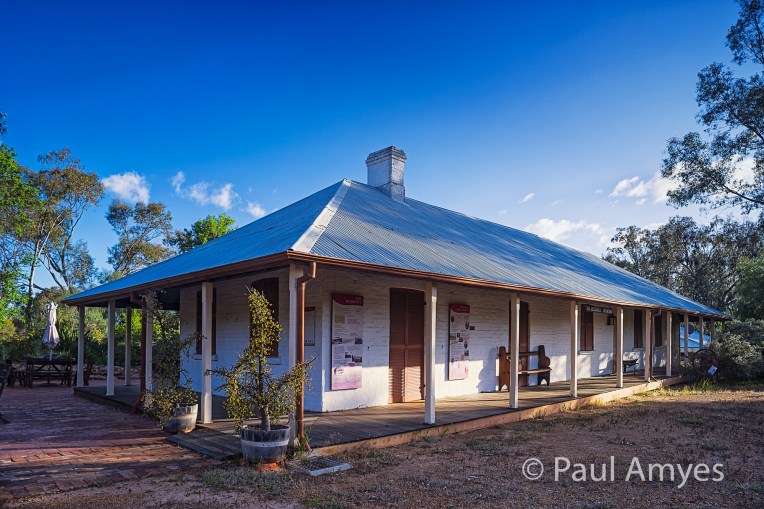
The OM 21mm f3.5 is well suited to architectural photography. The York Residency Museum. Built in the 1850’s as the quarters for the superintendent of the York Convict Depot and is the last remaining building from the depot. Later it became the official residence of the magistrate, then it was used as part of the old York Hospital. It fell into disrepair and was saved by the work of the York Society. In 1972 it opened as a museum and has been used as such since.
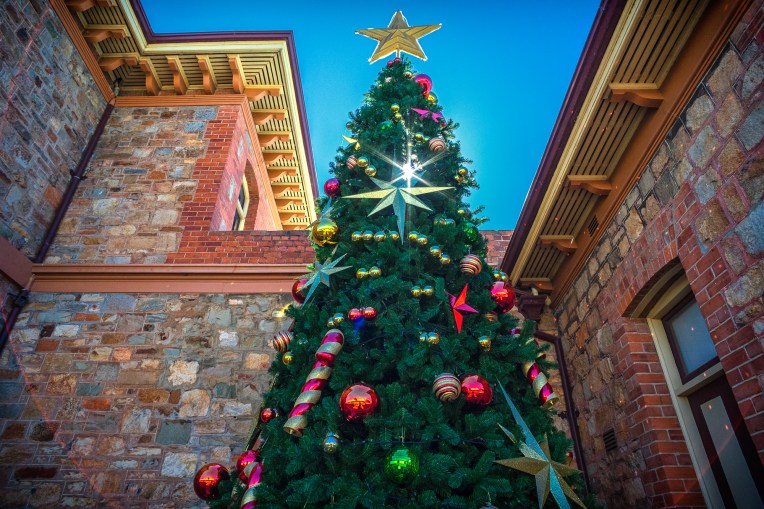
Shooting into the sun flare is very well controlled for such a wide lens. Note the sun star – the six aperture blades create a nice effect when stopped down to f16. The Shire of York Christmas tree for 2016 on Avon Terrace.
Conclusion
Well my only criticism of this lens is really nit-picking. It is just that aperture of f3.5 is a little dim and if I were to use it on an SLR (digital or analogue) it would make focusing using a split screen finder a little bit tricky. With the EVF of the A7r it makes no difference as the view can be made brighter and the focus peaking is easy to see. Probably this is not the lens to buy if you’re into astro, but if you shoot landscape and architecture as I do then it is a worthy addition to the camera bag.
The other OM lenses I’ve looked at are:
The Faversham vintage van in Avon Terrace, York, Western Australia. Olympus OMD EM-1 with Olympus OM Zuiko 35-105mm f3.5-4.5 lens. Exposure: 1/200 sec, f5.6 ISO 400.
If you have slightly geeky bent, and to be honest if you are reading a photography blog it’s pretty much a given that you have, then Adobe’s Lightroom has several useful tools. One of the ones I’ve been looking at is the ability to look at your photographic work for a specific time frame, and in this case it’s for the year 2016. You can also look at the cameras and lenses you used for that period which enables you to see what patterns of equipment usage emerge. It might ultimately save you money i.e. if you have a hankering for an expensive lens you can look back on your past year to see if that focal length/s you used and whether the objective lens of your desires is one you’d actually use or not. This has actually happened to me – a while back I was working on my project Broncos and Bulls and I felt that the Canon EF 75-300 f4-5.6 IS was costing me shots as it wasn’t the fastest lens to focus and the images at the long end were pretty soft. I wanted a Canon 100-400 L IS but my then preferred local dealer didn’t have one in stock and after waiting nearly 3 months they informed they couldn’t get one. I allowed them to talk me into buying the Canon 70-200 f2.8 L IS with the Canon x2 converter which they had in stock. Their logic was that I’d end up using the 70-200 much more and would hardly use it combined with the teleconverter. Now looking back through my Lightroom library I can see that I’ve hardly used the 70-200 at all on its own and virtually all the times I have used it was in conjunction with the teleconverter. I should have stuck to my guns and gone to another dealer and that way I’d have a lens that met my needs gave and gave good image quality rather than put up with a convenient compromise.
Gotcha. Steer roping, Boddington Rodeo Western Australia. Canon EOS 5D with Canon 70-200 f2.8 IS L and x2 converter. Exposure: 1/800 s at f/5.6 ISO 200
So what have I deduced about my photography for 2016? Well I’ll start with commenting on 2015 – for that year over half my photographic output was shot with a DSLR (50:50 split between full frame and APS-C). In 2016 that dropped to 10% the other 90% was shot on mirrorless. The DSLR was only used for some macro work (radio controlled TTL flash), some architecture (a specialised lens) and one event where I had a crisis of confidence and didn’t think the mirrorless cameras would cope with high ISOs and low light focussing. When I look at lens usage it comes as a big surprise that one-quarter of the images were taken using adapted lenses and these with a focal range of between 15-135mm in full frame terms. Hmmm well I knew I preferred shorter lenses than
Aboriginal art at Quairading Railway Station, Western Australia. Sony A7r with Olympus OM Zuiko 24mm f2.8 lens. Exposure: 1/4000, f8 at ISO 400.
longer already, the main thing is that I enjoyed using legacy lenses and was more than happy with them in terms of image quality. I don’t have to use legacy lenses at all as I have 20 to 600mm covered by modern dedicated AF lenses. For work where it is appropriate I will use the legacy lenses because they give a certain aesthetic that I like which is a less digital and clinical look.
As you drive into York on the Great Southern Highway standing tall on your left is the historic York Flour Mill built in 1892, home to The York Mill. Sony A7r with Voigtlander 15mm f4.5 Super Wide – Heliar lens. Exposure: 1/25 sec, f16 at ISO 100.
Well what will 2017 bring. Well for 2016 I experimented with finding a certain look. For 2017 will be more project driven as I have found the style I wanted and now want to put it to practice. There will be at least one new book (work on that has already started) and there will be some multi media projects. So exciting times indeed.
Hillside Farmhouse was designed by Sir Talbot Hobbs, a leading architect and built in 1911 for Morris Edwards in the historic Wheatbelt town of York in Western Australia. Sony A7r with Olympus OM Zuiko 35-105mm f3.5-4.5 lens mounted via a Fotodiox adapter, Cokin circular polarizing filter and +3 stop graduated neutral density filter. Exposure 4 seconds, f16, ISO 50.
I hope for my readers that 2017 will be all that you hope and that you’ll be healthy and happy.
Everlastings on Mount Brown in York, WA. Sony A7r with Olympus OM Zuiko 135mm f2.8 lens. Exposure: aperture priority with +1 stop exposure compensation, 1/1000th sec, f2.8 at ISO 100.
The Shire of York Christmas tree for 2016 on Avon Terrace. Sony A7r with Cosina Voigtlander 15mm f4.5 Super Wide – Heliar lens. Exposure: 1/125th sec, f16 ISO 800.
This is my fifth look at classic Olympus OM Zuiko lenses and how they perform on a Sony A7r.
The Olympus OM Zuiko 135mm f2.8 fresh out of the box. Even though it is thirty years old it is brand new, never having been used.
Many years ago I had a very basic camera kit consisting of an Olympus OM Zuiko 50mm f1.8 and 135mm f2.8 lenses with an Olympus OM20.One summer I made a series of portraits of friends down on the beach at Bognor Regis and shot a couple of concerts using the 135mm. The speed and shallow depth of field enabled me to get some shots that sold very well and that cemented the idea of my turning professional in my mind. Unfortunately I was seduced by the lure of zoom lens convenience and part exchanged the 135 for the Olympus 35-105mm. While the zoom was very good and became my photographic workhorse I regretted letting the 135 go.
The Olympus OM Zuiko 135mm f2.8 mounted on a Sony A7r using a Fotodiox adapter.
Fast forward some 30 years and I’ve been re-appraising my OM lens collection by mounting them on a Sony A7r. The results have exceeded my expectations so a little while ago I found my trawling EBay idly when I found a brand new OM 135mm f2.8 lens – and I mean brand new, never used complete in its unopened box. So I hit the “buy now” button and waited patiently for the lens to arrive. When it finally got here it was like being re-united with an old friend. The lens feels gorgeous – reassuringly sold and just oozing quality.The detents of the aperture ring cause it to have a very pleasing click as the ring is turned, and the focusing ring has a wonderfully smooth dampened action. The built in lens hood is a delightful touch in this day of $100 options one has to pay to get one for many modern lenses.
Part of the original instruction manual showing the optical construction of the lens. It is a very simple design of five elements in five groups.
The E-Zuiko AUTO-T 135mm f/2.8 was one of the first lenses released when the OM system was launched in 1972. It is easily identifiable thanks to the chromed front filter ring (the so-called “silver nose”). In 1977 it was replaced by the Zuiko AUTO-T 135mm f/2.8. Other than the improved multi-coated optics and some cosmetic changes (notably the loss of the silver nose) the lenses are largely the same with an optical formula of 5 elements in 5 groups and both versions come in at a svelte 360g (12.7 oz) The lens departs from the common Olympus filter size of 49mm and uses one of 55mm to allow a larger front element to facilitate the extra light gathering capability of this over the f3.5 version. This is a very modest size though in this day of 77 and 82 mm filter threads used on many modern lenses. Common to all Olympus OM prime lenses the aperture ring is forward of the focusing ring which makes the lens well-balanced in the hand and easy to use. In this day and age of F1.4 and f1.2 primes the maximum aperture seems a little pedestrian, but the aperture range of f2.8 to f22 allows for depth of field control when combined with the compression effect of a true telephoto.
Just to demonstrate the effect of stopping this lens down has on DOF. This is wide open at f2.8.
Just to demonstrate the effect of stopping this lens down has on DOF. This is f8.
Just to demonstrate the effect of stopping this lens down has on DOF. This is f22.
So down to the nitty-gritty – how does the lens perform on a modern digital camera. The quick answer is very well. Barrel distortion is virtually non-existent. In term of sharpness wide open the lens is pleasantly sharp although lacking in contrast and this improves when the lens is stopped down to f8. At the edges at f2.8 predictably the lens is very soft and has poor contrast. This is not altogether surprising considering the very simple design with no exotic elements. Things improve by f8 although it does not reach the standards of the centre.Vignetting is obvious wide open and again clears up as the lens is stopped down and disappears at f8. There is some chromatic aberration but it is very mild and easily fixed in Lightroom. The bokeh is nice and smooth but with only 8 aperture blades the “bokeh balls” turn into octagons as you stop down. When stressed by shooting into the sun veiling flare is very apparent, the solution to this is use a lens hood and that is easy as it is built into the lens.
Shooting into the sun without a lenshood at f2.8. The veiling flare is very apparent.
What a difference a lens hood makes. Shooting into the sun with a lenshood at f2.8. The rendition of the out of focus highlights (bokeh) is very pleasing.
With a minimum focusing distance of 1.5m the range of the depth of field at f2.8 is just 0.02m. Using the focus peaking set to mid on the A7r caused me no problems with finding focus on this shot. Everlastings on Mount Brown in York, WA.
One of the things I noticed when using this lens is that the weight and the resistance of the focusing ring shows the short comings of the Fotodiox adapter. You can feel the lens moving in the adapter as you turn the focus ring. The cheap no-name Chinese version was a lot worse. I am thinking about getting some longer lenses, but after this I think I’ll have to investigate a better adapter such as the one made by Novoflex.
Frida posing in the river. At f5.6 the lens is very sharp in the centre. Zoom into the area around Frida’s eye and ear and the fine detail of her fur is clear.
Subject isolation is what this lens is all about. Shooting at f4 through a chain link fence at this alpaca demonstrates this.
So to sum up – to get a better lens you’ll have to spend a lot of money on a more modern highly corrected design. With the softer edges the lens makes a very good portrait lens and you could make a strong argument that the decreased contrast in the centre at f2.8 and f4 would make it very suitable for glamour photography. The true telephoto effect of this focal length makes it a useful lens when you wish to compress perspective when shooting landscapes. The focus throw is a little over 180º and that makes finding focus a precise affair and would appeal to film makers. All in all if you want a manual focus telephoto for use on a full frame sensor then seriously consider this one.
At f11 the lens has bags of resolution and is capable of recording very fine detail. There is no sign of diffraction reducing the image quality. Wandoo tree (white gum) on the outskirts of the Western Australian town of Beverley.
So far I have looked at the following Olympus lenses:-
Everlastings on Mount Brown in York, WA. Sony A7r with Olympus OM Zuiko 21mm f3.5 lens and Cokin “P” 2 stop graduated neutral density filter. Exposure: 1/30th sec, f16, ISO 100.
Everlastings on Mount Brown in York, WA. Sony A7r with Olympus OM Zuiko 135 f2.8 lens. Exposure: 1/1000th sec, f2.8, ISO 100.
The entrance to Beverley Station Arts in the Western Australian town of Beverley.
Those who regularly follow my blog will know that I’m currently the artist in residence at Beverley Station Arts in Western Australia. So for this entry I’ll talk a little about the place. The town of Beverley is located some 130Km (or 80 miles for those still using imperial measurements) east of Perth in the Avon Valley in the Wheatbelt of Western Australia. The Beverley Arts Gallery Committee was inaugurated in 1967 with the aim of establishing a venue for the fine arts in the town. Sir Claude Hotchin a noted arts benefactor donated work from his collection with the aim of starting the fledgling gallery off. The collection is now housed in what was the old railway station in Beverley.
Inside the exhibition space at Beverley Station Arts. Sony A7r, Fotodiox OM to Nex adapter, Olympus OM Zuiko 21mm f3.5 lens. Exposure: 1/400th sec, f5.6 at ISO 6400.
The old station master’s quarters is now where the visiting artists in residence are accommodated. Beverley Station Arts, Western Australia. Sony A7r, Fotodiox OM adapter, Olympus OM Zuiko 21mm f3.5 lens. Exposure: 1/400th sec, f8 ISO 400.
Beverley Station Arts also utilizes the former station masters living accommodation for the artist in residence program. This allows an artist to base themselves at the gallery and produce work, put on an exhibition, run workshops and generally interact with the community. Recently an open air stage was built which is suitable for all the performing arts. It has a seating capacity of 500 and local audiences enjoy music, theatre, movies and dance under the stars during the summer months. On Saturday 10th September 2016 the venue hosted the Voice Moves Country Choir Bash. This year there were eight participating choirs:
The Platform Theatre performing space at Beverley Station Arts, Western Australia. Sony A7r, Fotodiox OM to Nex adapter, Olympus OM Zuiko 21mm f3.5 lens. Exposure: 1/200th sec, f8 at ISO 400.
As is usual in country Western Australia a sumptuous afternoon tea was provided in the intermission. The event was great fun and enjoyed by both the audience and the participants alike. Below is a short video featuring the Beverley Station Singers.
The garden bench even has a railway theme. Beverley Station Arts, Western Australia. Sony A7r, Fotodiox OM to Nex adapter and Olympus OM Zuiko 21mm f3.5 lens. Exposure: 1/80th sec, f16, at ISO 400
It seems like absolutely ages since I last made a post. The break came about because I moved house (yes again!) and as usual Telstra and iiNet cocked the whole re-location up resulting in me being without phone and internet for 6 weeks. Now I have signed up with Optus and I’m the proud owner of a fantastic broadband connection.
So in the last six weeks what have I been up to? Well I’ve definitely not been slacking off I can tell you! I’m pleased to announce that for the whole of September I will be artist in residence at Beverley Station Arts and I’ll also be showing a body of work entitled “Sex, Lies, and Flowers”. Sex, Lies and Flowers is a project on the terrestrial orchids of the Wheatbelt of Western Australia. The word orchid comes from the Greek “orchis”, which literally means ‘testicle’ (with reference to the shape of its tuber). Orchids are distinguished from other flowers by their uniquely shaped column which is composed of the fused stamens and pistils. Often the petals are modified to mimic the shapes of insects to attract male insects to mate with the faux female and pollinate the flowers. Some of the forms they take also resembles human genitalia Hence the title “Sex, Lies and Flowers”. Over the last eight years I have travelled within the region photographing the plants on location. Instead of taking the standard approach of photographing the plant in its environment showing its full structure I’ve chosen to photograph them in a style more used in portraiture so as to bring out the distinguishing features and characteristics of the plants. The aim is not to produce an exhaustive catalogue of the plants but to produce a series of images that show case the beauty of the plants and raise awareness of them and how fragile they are. Hopefully some of you can pop in and see me and the work, if you are unable then the images from the exhibition and many more can be seen here.
Below is a video clip I made a while ago about photographing orchids in the Avon Valley of Western Australia.
Thanks for your patience everyone and regular programming should now resume.







You must be logged in to post a comment.