We’d travelled into Perth to see The Choral (well recommended) and were staying over for the night. The hot summer air was oppressive and it seemed that a walk around a body of water to make the most of the cool breeze coming off it seemed like a good idea. Tomato Lake was close to where we were staying and so we went there. There’s nothing like a slow relaxed walk in the evening while watching things going on around you. As we pulled up in the car park it was very apparent that lots of other people had the same idea – families were either set up on picnic blankets or walking around the lake foreshore looking to get some relief from the hot summer sun. It reminded us of being in countries in the Mediterranean, the Middle East and the Indian Subcontinent where people promenade in the evenings.I’ve never really understood why in a hot country like Australia that our pattern of the day is based upon those in cool northern countries.
As we pulled up there was raucous honking coming from the island in the middle of the lake. There were dozens of Australian White Ibis and their young were nosily demanding food. Added to that was the grating screeching of Little Corellas looking for a place to roost for the night. Further back from the lake amongst the larger trees Red Wattle Birds were jockeying for the prime locations for the night. They are very combative chasing off other birds with their loud and conspicuous squawking. Meanwhile back on the lake Black Swans and Australian Grebes glided silently and gracefully through the duck weed while feeding. It was all very idyllic.
Ngalkaning or Australian White Ibis (Threskioris molucca). Tomato Lake Reserve, Kewdale, Western Australia.
A juvenile Australian White Ibis pestering its parent for food.
Little Corella or (Cacatua sanguinea subsp. westralensis).
Getting ready to settle in for the night.
Having chased off the other birds this Djangkang or Red Wattlebird (Anthochaera carunculata) is getting ready to roost.
This Bulland or Great Egret (Ardea alba) flies lazily over the lake.
Maali or Black Swan (Cygnus atratus) effortlessly swimming in the lake.
Flippin’ heck has it been warm here lately. I got up early a few days ago to photograph birds just after sunrise and it was 27ºC and a lot of the birds had already taken shelter in the deep shade. Yesterday it was 41ºC and the garden was a crispy brown and what vegetations there is was wilted. So this morning the garden sprinkler was put on. I was sent out to move the sprinkler in the back garden when I spotted some Yellow-rumped Thornbills playing in the water trying to keep cool.
A Yellow-rumped Thornbill taking up position to get maximum benefit from the garden sprinkler.
Adjusting the position so the feathers don’t repel the water.
It’s safe to say this summer has been hotter than a very hot thing that is feeling hot. The knock on effect of all that heat is that motivation evaporates – literally. It is very hard to get out and about when temperatures are above 40ºC (104ºF). The UV index is so high that if you’ve been outside for longer than 5 minutes you need to see a dermatologist to have skin cancers removed.
Frida trying to trying to escape the summer heat in what’s left of the Avon River
So summer days are spent dreaming up ways to keep cool. You can go for the psychological approach like my Beloved Significant Other (BSO) – she is reading Scandi noir books set in chilly sub Arctic nordic climes hoping that she can convince her body that it is cold. I’ve tried watching a few films along those lines but my body is not easily fooled. Next is the physical approach. The BSO has also taken to spending as much time as possible at the swimming pool. I don’t go as when I get into the pool the water gets out. More seriously the pool isn’t heated in any way and the cold water has me shrieking like a teenage girl at a Beatles concert. So I’ve given up on that idea. I’ve taken to hanging around the freezer cabinet in the local super market along with the rest of the town. The competition for the best spots can be brutal. The little old ladies are the worst – they’ve got sharp pointy elbows that they use to great effect to secure prime position and maximum coolness. The best place to go is the bottle shop’s (liquor store or off-licence for non Aussies) coolroom. Absolutely blissful. Unfortunately I was banned after I tried to smuggle in a chair and a TV. The best strategy is to get up early and try and do everything before it gets too hot. Then you retreat back to the sanctity of home and crank up the air con. This is why I’ve been printing photos lately.
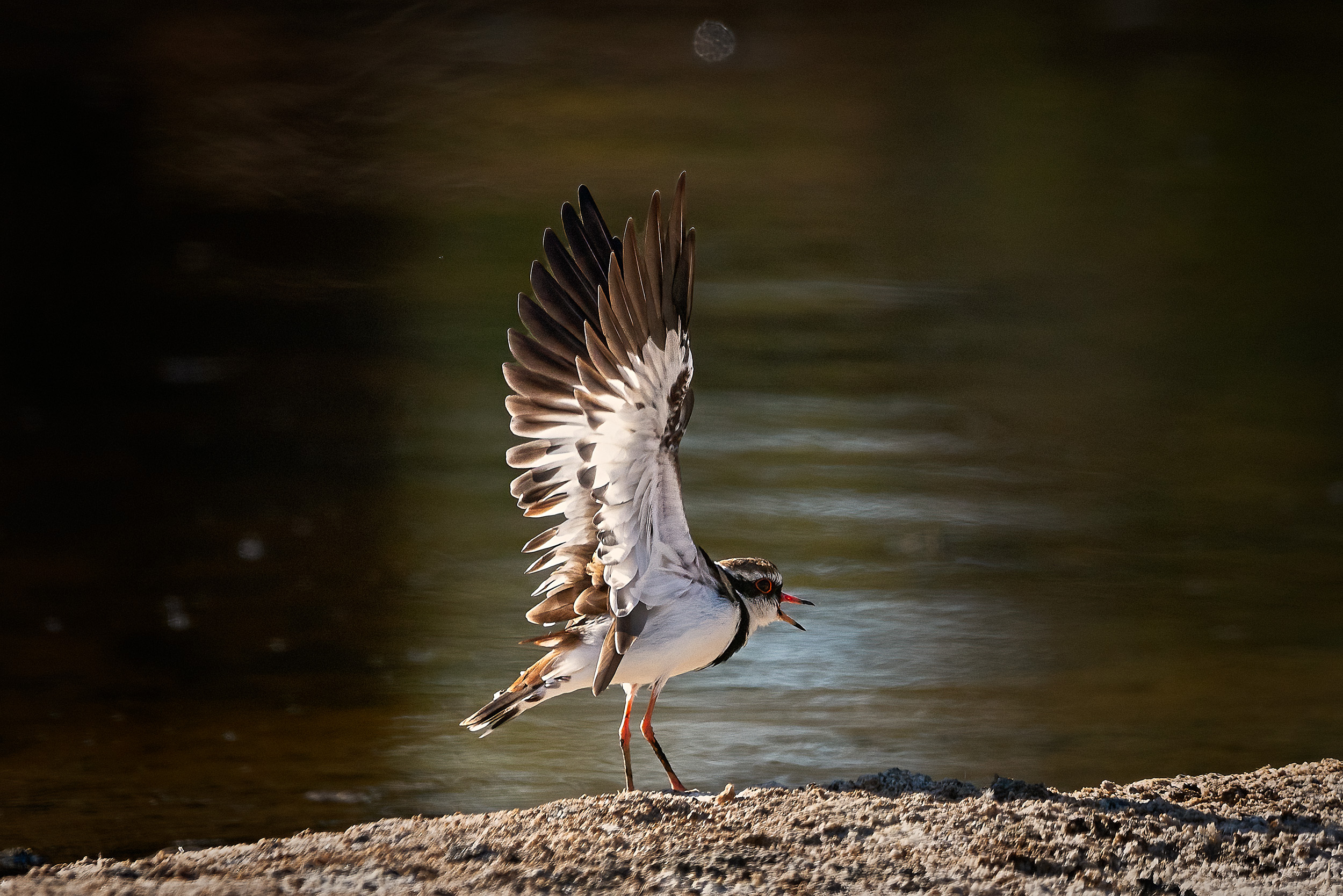
Nidoolyorong or Black-fronted Dotterel (Elseyornis melanops). York, Western Australia.
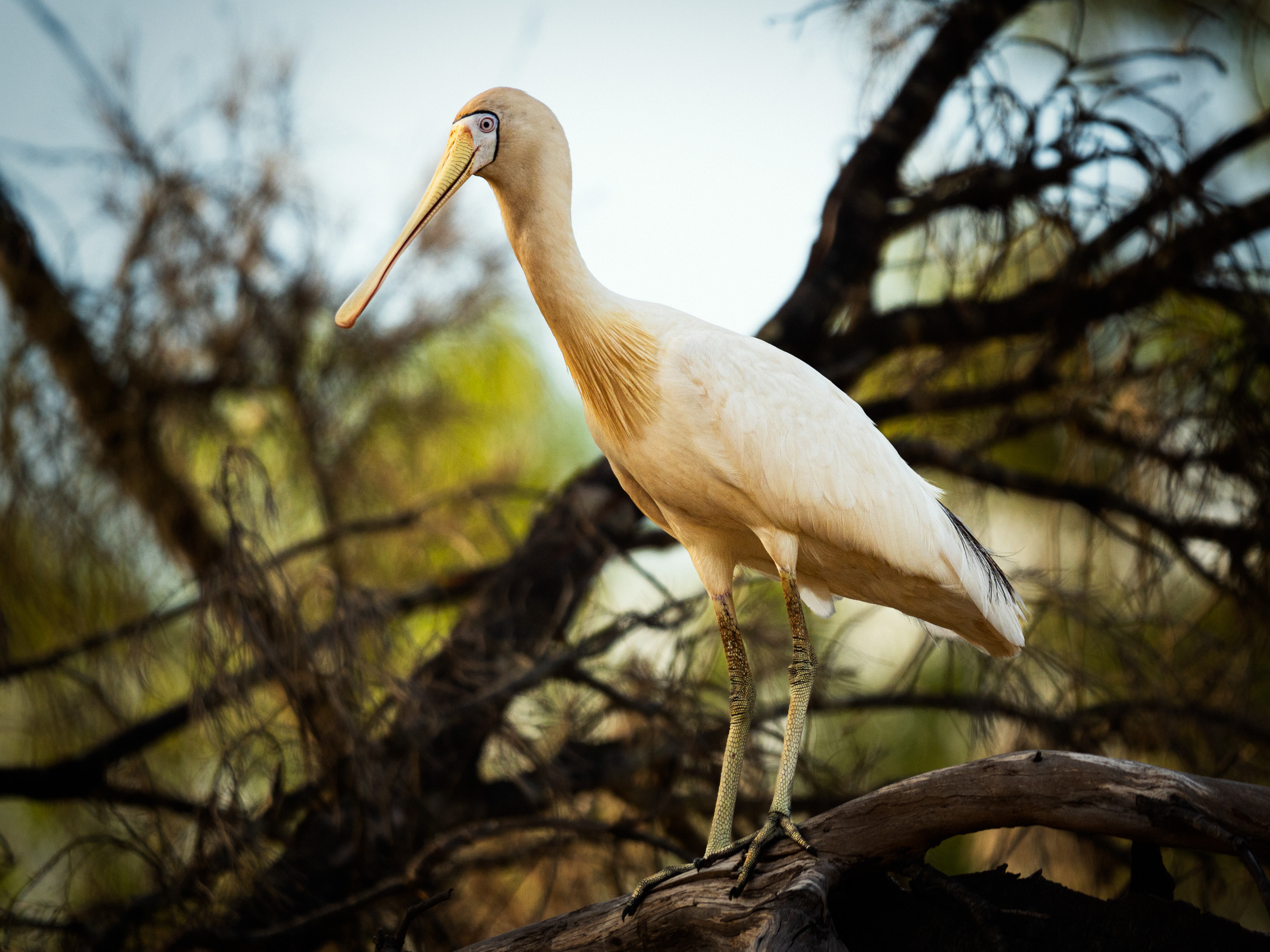
Yellow billed Spoonbill, Platalea flavipes. York, Western Australia.
A Willie Wagtail wondering if the Rainbow Bee Eater is going to share its dragon fly.
The impact of all this hot weather on the local wildlife has been considerable. The numbers of birds around is quite low. Lack of food and water. Even along the river, which now no longer resembles a river but a series of small fetid murky pools, there seems to be less activity. It has been a bumper year for dragon flies. I guess they must like it a little on the warm side. Once a week I’ve been going out to a large freshwater lake about 50Km from here to work on a new project. There’s been a bit more activity there but not much. Early in the mornings there is no vehicular access so you have to walk in through the bush and a couple of times I’ve come across a mob of kangaroos sparked out in the shade under the trees. They’re so hot and lethargic they can’t summon up the energy to move and they just lazily watch as I walk past. The only real activity at the lake has come in the form of a randy male musk duck desperately swimming up and down looking for a victim – err I mean prospective breeding partner. That duck can certainly move fast. Funnily enough I’ve not yet spotted a female musk duck – I guess they must be too hot and bothered and are avoiding him by hiding in the reed beds.
A male musk duck – not the randy one mentioned above.
Thankfully it is the end of February. That means we’ve only got to survive March and the the weather will start to cool in April. Can’t wait!!
A female Brown Goshawk, Accipiter fasciatus. York, Western Australia. Olympus OMD EM1 mk ii with Panasonic Leica 100-400mm f4-6.3 lens. Exposure: 1/1000 sec, f6.3 at ISO 3200.
While day time temperatures have ranged from hot to bloody hot (46ºC) here in the Wheatbelt metropolis of York we have had some very cool mornings around the 14ºC mark. I was out the other day on one of those mornings, it was almost too cold and I was tempted to go back to the car. A few days prior while walking the dog along the Avon River I’d noticed piles of feathers underneath a couple of tall trees. At first I thought that the birds had been killed by a fox or a cat but a closer look convinced me that the birds hadn’t been killed there and there were no wings, legs or head. Just a pile of feathers. So I decided to to go out and see if I could find the culprits. As I got close to where I’d previously found the bird remains I could hear a couple of goshawks calling out to each other – they can be quite vociferous – but I was quite confused as to where they were. I was scanning the the branches above me without seeing anything and as I kept walking the noise got louder. Then I realised that the calls weren’t coming from above me, but rather to the left and slightly below the river bank. So I got down on the ground and slowly crept towards the source of the noise and there on a paperbark tree were a male and female Brown Goshawk. The smaller male took off almost immediately but the female was all puffed up against the cool air just sat there watching me and continuously calling out to her mate. I stayed for about half an hour and then headed back to the car and home.
When I was a kid one of the many rebuffs used was “take a long walk on a short pier” – it was, I suppose, a more imaginative way of saying get lost. Well whoever first coined the phrase hadn’t taken into account Busselton Jetty in Busselton Western Australia.
Busselton Jetty is longest timber piled jetty in the southern hemisphere and is a popular tourist attraction. Canon EOS6d with Canon EF 24-70mm f4 IS L lens. Exposure: 1/60 sec, f11 at ISO 100.
Busselton Jetty is the longest wooden jetty in the Southern Hemisphere and it is 1.81Km or 1.12 miles long. Building the jetty commenced in 1853 and it opened in 1865 and by the 1880’s it was already attracting tourists. By 1972 the jetty ceased operation as a commercial port and today it attracts a staggering 450,000 people per year.
The sculpture “Fish” (the sea in her belly) stares enigmatically out to sea by the Busselton Jetty. Canon EOS6d with Canon EF 24-70mm f4 IS L lens. Exposure: 1/80 sec, f16 at ISO 400.
X marks the spot. Over the course of the jetty’s 152 year history it has been extended several times. Each red X indicates the previous limit of the jetty Canon EOS6d with Canon EF 24-70mm f4 IS L lens. Exposure: 1/20 sec, f16 at ISO 100.
At the end of the jetty is the Underwater Observatory which takes visitor down 8m to the seabed where they can observe the huge variety of marine life that has made the jetty home.
At the end of Busselton Jetty is the Underwater Observatory where you cab descend to a depth of 8 metres to view the marine life that calls the jetty home. Canon EOS6d with Canon EF 24-70mm f4 IS L lens. Exposure: 1/125 sec, f5.6 at ISO 6400.
The piles that support the Busselton Jetty form a vertical reef. More than 300 species of tropical and sub-tropical corals, sponges, fish and invertebrates live there. Canon EOS6d with Canon EF 24-70mm f4 IS L lens. Exposure: 1/125 sec, f5.6 at ISO 6400.
To get there you don’t have to walk, there is a solar-powered electric train, the Stocker Preston Express, which can carry up to 90 people. So now it is the case of a small train journey on a long pier.
Busselton Jetty is 1.81Km (1.12 miles) long and it has a train service that takes 90 passengers 1.7 Km to Underwater Observatory. Canon EOS6d with Canon EF 24-70mm f4 IS L lens. Exposure: 1/200 sec, f5.6 at ISO 100.
The Jetty Train on Busselton Jetty takes passengers on a 1.7 kilometre journey across the calm, clear waters of Geographe Bay. Canon EOS6d with Canon EF 24-70mm f4 lens. Exposure: 1/125 sec, f8 at ISO 100.
The weather has gone absolutely mental!!!! We’ve gone from having days in the high 30’s to the low 40’s to belting rain and temperatures of 15℃. It is really strange to say the least.
The video footage was mainly shot on my iPhone and some on a Sony Action Cam. I must say I am a very late starter to using a mobile phone for photography and video. Dunno why – it just never appealed. Yesterday I was out walking the dog and I thought I better shoot some footage about the weird weather and the only camera I had to hand was my phone. I had no microphone nor anything to steady the footage. It was all flying by the seat of my pants. I went out again this morning and decided to take my Sony Action Cam to take some additional footage. Most of what I took was unusable – the quality from the iPhone is so much better. I did for a crazy moment think about editing the footage on my phone but I decided against it as I’d never used iMovie on my phone before and thought it would be quicker and easier to bang out the edit on my laptop.
The colours of sunset reflected by the sun bleached grass on the Dyott Range. York, Western Australia. Olympus OMD E-M10 with an OLYMPUS M.75-300mm F4.8-6.7 II lens. Exposure: ƒ/8.0/1/1000s/ISO 1600
Back in August I posted a blog called Mellow Yellow showing the yellow canola on the hills opposite our house. Well Summer is well and truly here and the crop has been harvested just leaving the sun bleached stubble. When the sun sets the colours are reflected on those hills with quite impressive results.
Yellow-billed Spoonbill (Platalea flavipes) on the banks of the River Avon in York, Western Australia. Olympus OMD EM1 with OLYMPUS M.75-300mm F4.8-6.7 II lens. Exposure: 1/250 s at f/6.7 ISO 800.
There’s no denying that summer and autumn here in the Wheatbelt of Western Australia is hot. The best time of day is just after sun up – the air is cool and refreshing. That is when I take Frida for her daily walk. Sometimes I also take a camera as well and on this morning I was rewarded with this yellow-billed spoonbill backlit by the sun.





You must be logged in to post a comment.