Cowslip Orchid, Caladenia flava subs. flava. Williams, Western Australia
I’ve been a bit miffed lately with Olympus/OM Systems. A lens that I bought recently was not functioning properly and has spent more time at the service department than with me. Then there’s my Olympus STF-8 a supposedly rugged, weatherproof and very expensive macro flash whose buttons have fallen off and is now inoperable and unrepairable (as in it’s not designed to be repairable but be disposable). I’ve been so miffed that of late I’ve stopped using my Olympus kit and relegated it to the cupboard while having thoughts of getting rid of it all and changing systems. In fact I’d already decided which ship I was going to jump on – Sony – and which items I’d buy after watching a lot of YouTube videos.
Clubbed Spider Orchid, Caladenia longiclavata. Williams, Western Australia.
To that end for last weeks road trip to Williams in search of the Common Dragon Orchid I dug out my much neglected Sony A7r2 and some lenses to reinforce this new plan and familiarise my self with the Sony ecosystem again.
Banded Greenhood, Pterostylis vittata. Williams, Western Australia.
The trip to Williams was great – it was a beautiful day and there were plenty of orchids to photograph. The only fly in the ointment was the photographic experience. It should be easy – I’ve done it so many times before. Find an orchid. Set up the camera on a tripod and point it at the orchid. Take the picture. What could go wrong? Well for this type of photography I rely heavily on the rear LCD screen and I’d forgotten that the screen on the Sony A7r2 is unusable in bright sunlight. Secondly I’ve become very reliant on having touch control on the rear LCD so I can easily select the focus point and trip the shutter. There’s no such function on the Sony and there is a very convoluted system of setting the AF point. Then there is the woeful battery life of the Sony A7r2. I went through 4 batteries in two hours where as with the Olympus I wouldn’t even get through 1/2 a battery. I could continue with more points of frustration and irritation, Lord knows there were loads of them, but I’ll refrain. By the end of the morning I was wishing I’d taken my Olympus EM1 mk ii with me. Were there any positive points? Well yes I love the files from that 42Mp Sony sensor. I really like the Sigma 105mm macro lens. But, unfortunately the negatives outweighed the positives and it made me realise why I’ve stopped using the Sony A7r2.
Banded Greenhood, Pterostylis vittata. Williams, Western Australia
I’ve already started to get things together for this week’s trip and my Olympus kit, minus the flash, has gone back in the bag. As to whether I will change will depend upon whether OM Systems Australia returns my lens in a functioning state.
Common Dragon Orchid, Caladenia barbarossa.Williams, Western Australia
Clubbed Spider Orchid, Caladenia longiclavata. Williams, Western Australia
This shot of a Scented Sun Orchid was what I considered my first successful photo of an orchid. The subject is separated from the background making easy to see.
I took what I call my first proper shot of an orchid back in 2008. Back then my technique was very simple – handheld with a macro lens. The problem was that it was often very difficult to isolate the flower from the background while having sufficient depth of field and a low ISO. For every successful photo there were hundreds of duds.
This shot of a Butterfly Orchid is one of the hundreds of duds. The messy background threatens to overwhelm the subject.
After about a year of trial and error (mostly error) I decided to photograph the orchids in the same way I would take a portrait of a person. Get down at “eye” level, use an off axis flash to provide the key light and have the natural light as my fill light at -1 to -2 stops. This was a huge improvement, but I still wasn’t getting the clarity and sharpness in the images I desired.
My first flash rig for photographing orchids. Using a flash brake allowed me to get the flash off of the lens axis and get a more pleasing lighting effect.
The next attempt at better lighting was a heavy tripod and light stand. My back hurts just looking at this photo.
The next evolution was to mount the camera on a tripod and then mount the flash to one of the tripod legs via a “magic arm”. This allowed greater choice in the positioning of the flash and allowed me to use different flash modifiers such as soft boxes, grids and snoots. The arrival of affordable and reliable wireless flash triggersmeant I could use multiple speedlights for more sophisticated lighting. This came a tremendous cost. I have a chronically bad back and all that kit was heavy, the tripod and “magic arm weighed just under 6Kg. Then there was the futzing about setting everything up, taking the shot, breaking it all down, walking to the next subject and then repeating it all again. Suddenly it wasn’t fun anymore. Something had to give and it was my back.
The diminutive Olympus EP-2. Just what the orthopaedic surgeon ordered.
A size comparison of my DSLRs (Canon 5d and 550d) and the Olympus EP-2 which replaced them.
In 2013 I bought an Olympus EP-2 mainly for travel and street photography. It was a revelation – small size, In Body Image Stabilisation (IBIS), and excellent flash implementation. It quickly became my orchid camera of choice. I could chuck out the tripod and become more mobile. It wasn’t all beer and skittles though. The 12Mp sensor wasn’t the best in terms of high ISO performance and dynamic range, the lack of a viewfinder made usage in bright sunlight problematic (solved with the addition of the optional EVF) and the contrast based autofocus system was a bit on the temperamental side. But the positives were enough to keep me using it and when the EM10 came out with a built in EVF, a better IBIS system and an improved sensor then I knew that the system would be just about perfect for what I did. I could walk around in the bush for hours at a time without back pain which meant I could explore further afield. This freedom allowed me to experiment a lot more.
Sigma’s 105mm f2.8 DG DN macro lens attached a Sony A7Rii.
The Tamron 35mm f2.8 lens has excellent macro capabilities.
Curly Locks, Thelymitra spiralis. Wandoo National Park, Western Australia. Sony A7r2 with Sigma 105mm f2.8 DG DN macro lens.
White Spider Orchid, Caladenia longicauda subsp longicauda. Wambyn, Western Australia. Sony A7r with Tamron 35mm f2.8 lens.
In 2021 I felt that I wanted more resolution than the 20Mp EM1 mk ii was giving me. So I tentatively dipped my toe into the world of full frame mirrorless and I went with a second hand Sony A7r2. The image files produced by the camera were absolutely gorgeous. Alongside my usual working method of using flash with macro lens I decided to experiment with environmental portraiture of orchids. For this I used a 35mm lens with a half size macro capability and the results were pleasing. The downsides were as follows. The rear LCD is hopeless in bright light and it has no touch control facility. The IBIS wasn’t as effective as that on my Olympus cameras and the sensor resolution emphasised very tiny camera shake. A tripod was the solution. The sensor is a dust magnet which means that changing lenses enables dust bunnies to proliferate. The answer was to have one camera with the 105mm macro and one camera with the 35mm. Arrrrrgh! I was back carrying a load of heavy equipment. So it was back to the Olympus kit.
This shot of a Lemon Scented Sun Orchid was made with the Olympus Em1 mk ii, Olympus 40-150mm f2.8 lens with 1.4 x teleconverter and the Olympus FL600R flash using the focus stacking function.
I’m still trying to evolve a style which produces a nice clean portrait of an orchid. One of the great benefits of Olympus’s cameras and lenses is that it allows very long telephoto lenses to have an almost macro capability. The use of such long lenses allows you to throw backgrounds well out of focus by dint of their increased magnification which reduces depth of field. The problem is that that decreased DOF means that it is hard to get your subject rendered sharp whilst retaining all that loverly bokeh. The counter to this is focus stacking which involves taking a series of pictures of the subject while moving the focus point and then blending the images in post. Olympus has a very neat feature that allows you to do this automatically in camera which is fantastic. Unfortunately the function limits your flash usage by restricting your maximum flash sync speed to 1/50th second and you have to manually set the flash exposure. I tried doing this for a while and it was a right royal pain. So now I don’t use the flash and just make the exposure using ambient light. The lens I’m using is the Olympus 40-150mm f2.8 with the the mc-14 1.4 x teleconverter. This gives me a 210mm f4 lens (420mm in full frame terms). Despite shooting wide open this invariably means shooting at a low shutter speed. So while the IBIS is fantastic on my EM1 mk ii using it with a long lens while focus bracketing wasn’t the best way to proceed. So it was back to a tripod. My aluminium Manfrotto 055 tripod is a good tripod but it is that heavy you could use it as a boat anchor. It was time to get a bit of fibre in my life – carbon fibre. So I bought a nice SiruiAM-254 carbon fibre tripod which weighs just a smidge over 1Kg. It doesn’t have a centre column and so a minimum working height of 7.8cm which means you can get down and close to the subject. The results have been excellent and now I feel that using both my normal macro lens and the telephoto zoom with converter I’m getting closer to what I have envisioned.
The Sirui AM 254 tripod in action.
So this has been my journey of finding what works for me. I’ve discovered that learning how your equipment works is just as an important step in developing vision and style as is technique. Continual learning and experimentation will help you develop as an artist and we shouldn’t be afraid to do so. A few times I’ve felt that I was going backwards, but it was worth persevering. I’ve still got a couple of things to sort out, but I feel now I’m on the right track.
The following shots were made this last week.
Common Bunny Orchid, Eriochilus dilatatus subsp. multifloris. Oswald Sargent Reserve, Western Australia.A focus stack using the Olympus EM1 mk ii with the Olympus 40-150mm f2.8 lens and 1.4 x teleconverter.
Hare Orchid or Fringed Hare Orchid (Leporella fimbriata). Oswald Sargent Reserve, Western Australia.
Helen starting the walk up to the summit of Boyagin Rock.
There’s no shortage of granite outcrops to walk up in the Wheatbelt of Western Australia. This time we chose to go to Boyagin Rock. The journey there was a bit eventful as the navigator in charge had me drive up a very steep, narrow and heavily rutted gravel track in the belief that it was the turn off to take us to Boyagin Rock. After a couple of kilometres the track deteriorated even further and it was obviously not the way. With no way of turning round I had to reverse back down the hill avoiding the larger holes all while the navigator in charge was warning me of our impending doom. After a few tense moments we got back onto Boyagin Road, whilst it is also a gravel road it was as smooth as a billiard table compared to what we’d just come down. After a couple more kilometres the sign for the turn off for the rock was visible and we got to the car park and picnic area with no further dramas.
It’s not the first time we’ve visited, but this time it wasn’t wet which made walking across the granite a lot easier because when it is wet it’s like walking across an ice rink . The bush around the base looked terrific with lots of flowers out and birds calling from the trees. We were hoping to see dragon lizards basking on the rock itself, but there was a slight nip to air that was enough to keep the lizards in the shelter of the crevices. We flushed some Australian Pipits as we walked up, unfortunately I didn’t have a long enough lens to photograph them. As we walked up onto the granite Helen had a close encounter of the spiny kind with an echidna – it was a bit on the shy side and curled up in a ball at the bottom of a tree.
Everlastings form in smasll patches of grass between the trees.
Lemon scented orchids could be found growing among the yellow everlastings.
A well earned rest on a convenient rock.
It’s not a difficult walk and the Nyoongar people, who call it “Boogin”, believe that if you walk to the top of the rock without stopping you will live a long life. We’ve now done it twice so we should live to a very ripe old age. When we got to the top I was surprised to see a pool of water, it must be fed totally by rainfall. Even more surprising was the number of tadpoles swimming in it. Australian frogs never cease to surprise me – you find them in all sorts of strange places and you can’t help but wonder how they survive.
The rock pile in the middle of the pool on the top of Boyagin Rock.
Helen celebrates reaching the summit.
A quick jaunt down the rock retracing our tracks and we were back at the car. A leisurely picnic followed and we discussed where we will go for our next trip.
Yep you read that right. You know how you can stand at a bus stop for ages and not see a single one and then suddenly three come along together? Well orchids are like that. I’ve been walking the same patch of woodland looking for the Curly Locks Orchid for years without seeing a single one and then the other day low and behold there were three of them just standing there.
Curly Locks, Thelymitra spiralis. Wandoo National Park, Western Australia.
Curly Locks, Thelymitra spiralis. Wandoo National Park, Western Australia.
Curly Locks, Thelymitra spiralis. Wandoo National Park, Western Australia.
I’ve spent the last couple of weeks walking the Wandoo forest looking for various orchids. I’ve bumped into a male emus and his brood (too quick to photograph), met bob tailed lizards and countless Western Grey Kangaroos (again too quick to photograph). So even if I’ve not found the particular flower I’m looking for it has still been quite an experience.
The slower bob tailed lizards are easier to photograph than fleeing emus and kangaroos.
Speaking of finding orchids well I’ve seen plenty. On Thursdays outing to Wambyn Reserve I saw eleven different species and was amazed by how early some of them were.
A very early flowering Clubbed Spider Orchid, Caladenia longiclavata. Wambyn Reserve, Western Australia.
Little Pink Fairy Orchid or dwarf pink fairy orchid, Caladenia reptans subspecies reptans. Wandoo National Park, Western Australia.
Sugar Orchid, Ericksonella saccharata. Wambyn Reserve, Western Australia.
Frog Greenhood, Pterostylis sargentii. Wambyn Reserve, Western Australia.
Jug orchid or recurved shell orchid, Pterostylis recurva. Wandoo National Park, Western Australia.
Common Donkey Orchid or wallflower orchid, Diuris corymbosa. Wambyn Reserve, Western Australia.
Stark White Spider Orchid, Caladenia longicauda subsp eminens. Wambyn Reserve, Western Australia.
Photographically I’ve been on a bit of a full frame kick preferring to either use the Sony A7r ii and sigma 105mm macro lens or the Canon EOS6d with Canon 100mm macro lens. All the shots are lit with a flash being used as the key light and natural light as the fill. I’ve enjoyed the change but my back doesn’t. There’s a huge weight difference between the full frame cameras, lenses and flash equipment compared to the usual Olympus micro four thirds system I usually use. But to be honest shooting at base ISO using artificial lighting and only printing at A3+ I can’t see any real advantage to shooting full frame so this next week I’ll go back to using the Olympus kit.
Out and about again looking for orchids and birds. This trip took me to the Old Jooralying townsite just east of Narrogin. It was marked as such on my mud map but other than that I could find no other reference to it. When I got there there wasn’t too much to see. Amongst the scrubby rock sheoaks were some faint trails that once could have been dirt roads, and a few old timbers from some sort of structure. A bit more investigation and I found an old car wreck. It was remarkably intact considering how long it must have been there.
Abandoned car at the Old Jooralying Townsite in Western Australia.
It took a while but eventually I found the orchids – a small colony of them. They’re nothing special to look at, but they are a variety I’d not seen or photographed before so that made the journey worthwhile.
Cupped Banded Greenhood, Pterostylis concava. Jooralying, Western Australia.
Cupped Banded Greenhood, Pterostylis concava. Jooralying, Western Australia.
Christmas Rock Walk Trail that is. Christmas Rock is in Wongan Hills and I’ve written about going there before. This time I’m writing about the Christmas Rock walk trail which is located in a 2000 hectare reserve. It is an easy 2.7Km walk along relatively flat well marked paths not far from the centre of the town site. Along the trail are interpretive panels which give insights into the reserve. What makes it worthwhile is that at wildflower time the walk passes through country that is a riot of colourful flowers. It is a gobsmackingly beautiful sight this year as the weather conditions have been ideal. The bird life in the reserve is also pretty impressive and their song provides a fitting score for a very pleasant walk.
Cristmas Rock Walk trail is an enjoyable easy 2.7Km walk trail in the Wheatbelt Town of Wongan Hills. Sony A7r with Tamron 35mm f2.8 lens. Exposure: 1/160 sec, f8 at ISO 100.
Yellow everlastings at Christmas Rock, Wongan Hills. Sony A7r with Tamron 35mm f2.8 lens. Exposure: 1/125 sec, f8 at ISO 100.
Pink Everlastings, Christmas Rock, Western Australia. Sony A7r with a Tamron 20mm f2.8 lens. Exposure: 1/160 sec, f8 at ISO 100.
The rock gets its name from the Western Australian Christmas Trees (Nuytsia floribunda) which used to be found there and flowered at Christmas time. On the top of the rock is an elaborate series of channels that were designed to harvest rain water run off for the “Railway Water Supply” which was built in 1916. But the rock is also home to a wide variety of plants such as lichens and mosses. On a warm sunny day if you’re quick enough you might see the lizards who live in the various cracks and crevices.
The walk takes you up on the top of the rock which was part of the “Railway Water Supply” built in 1916. Rainwater runoff was harvested through a series of channels and creeks. Sony A7r with Tamron 20mm f2.8 lens. Exposure: 1/800 sec, f8 at ISO 100.
A suprising number of plants grow on Christmas Rock. Sony A7r with Tamron 20mm f2.8 lens. Exposure: 1/320 sec, f8 at ISO 100.
Rainwater captured on Christmas Rock in natural forming crack, depressions and gullies. Sony A7r with Tamron 20mm f2.8 lens. Exposure: 1/400 sec, f8 at ISO 100.
But for me it is the display of orchids which brings me to Wongan Hills. There are so many different types in large quantities. It made me feel like a kid on Christmas Day. The funny thing is that it could have been very, very different. Prospectors actually dug pits looking for asbestos. Luckily they didn’t find it in large enough quantities to make it a viable commercial operation and went looking elsewhere. So in September give Wongan Hills a visit. This isn’t the only walk as there’s Mount O’Brien Lookout, Gathecole Nature Reserve, and the Mt Matilda walk trail. Then there are the lakes which host lots of water birds. So instead of a day trip why not make a long weekend of it.
Pendant Spider Orchid (Caladenia pendens, subsp pendens). Christmas Rock, Western Australia. Sony A7r2 with a Canon EF 100mm f2.8 IS L macro lens. Exposure: 1/40 sec, f5.6 at ISO 125.
Lemon Scented Sun Orchid aka the vanilla orchid (Thelymitra antennifera). Christmas Rock, Western Australia. Sony A7r2 with a Canon EF 100mm f2.8 IS L macro lens. Exposure: 1/200 sec, f5.6 at ISO 125.
Lemon Scented Sun Orchid aka the vanilla orchid (Thelymitra antennifera). Christmas Rock, Western Australia. Sony A7r with Tamron 20mm f2.8 lens. Exposure: 1/250 sec, f8 at ISO 100.
A White Spider Orchid (Caladenia longicauda subsp longicauda) among the everlastings on Christmas Rock in Western Australia. Sony A7r2 with a Canon EF 100mm f2.8 IS L macro lens. Exposure: 1/125 sec, f5.6 at ISO 125.
Chameleon Spider Orchid (Caladenia dimidia). Christmas Rock, Western Australia. Sony A7r2 with a Canon EF 100mm f2.8 IS L macro lens. Exposure: 1/800 sec, f5.6 at ISO 200.
Sugar Candy Orchid, Caladenia hirta subsp. hirta. Christmas Rock, Western Australia. Sony A7r2 with a Canon EF 100mm f2.8 IS L macro lens. Exposure: 1/250 sec, f5.6 at ISO 125.
Pink Candy Orchid, Caladenia hirta subsp. rosea. Christmas Rock, Western Australia. Sony A7r2 with a Canon 100mm f2.8 IS L macro lens. Exposure: 1/80 sec, f5.6 at ISO 125.
Cowslip Orchid, Caladenia flava subs. flava. Christmas Rock, Western Australia. Sony A7r with a Tamron 20mm f2.8 lens. Exposure: 1/160 sec, f8 at ISO 100.
After all that talk the other day about street photography lets talk about a focal length that is synonymous with the street photography genre – the 35mm. In particular the Tamron 35mm f2.8 Di III lens.
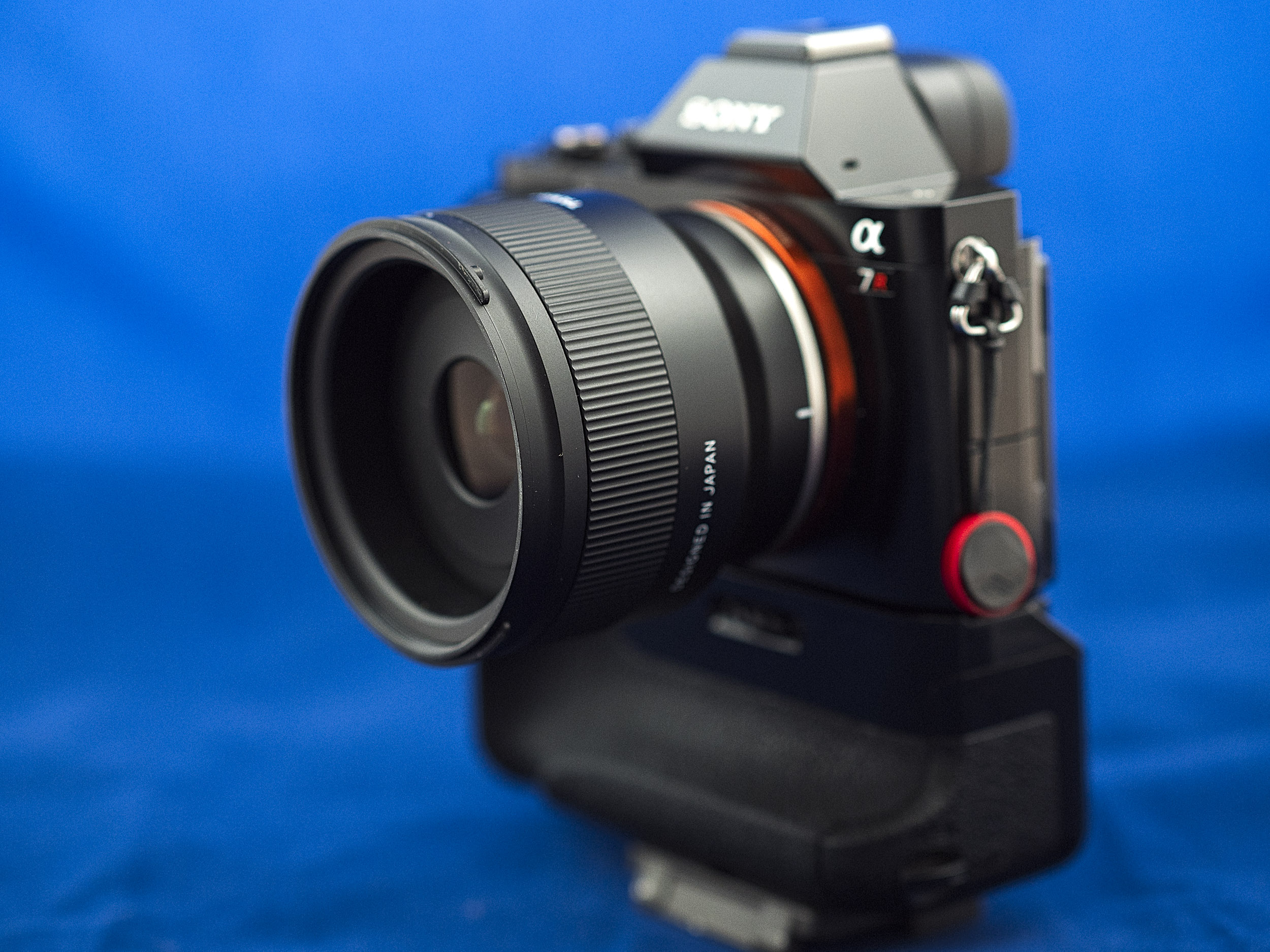
Tamron 35mm f2.8 Di III lens mounted to a Sony A7r.
TLDR
Introduction
The Tamron 35mm f2.8 lens for Sony E mount cameras was announced back in November 2019 as part of a trio of prime lenses which share the same exterior design, construction, size, filter diameter and f stop. The other lens being the 24 and 20 mm. As lenses are becoming ever faster and even larger with price tags to match it is nice to see Tamron do something significantly different. The modest apertures and price tags may put off lens snobs, but they have enabled Tamron to give good optical performance at very reasonable price of $450 AUD. To many f2.8 may be disappointing, but honestly apart from bragging rights about shallow DOF we do not honestly need ultra fast lenses as todays cameras have absolutely astounding high ISO performance. When I started photography you needed fast lenses because film speeds were slow. I regularly shot ISO 25, 50 and 64 film emulsions and I wanted to do it handheld not on a tripod. Now shooting full frame digital at ISO 6400 gives the same image quality as as shooting ISO 64 film stock.
Specifications
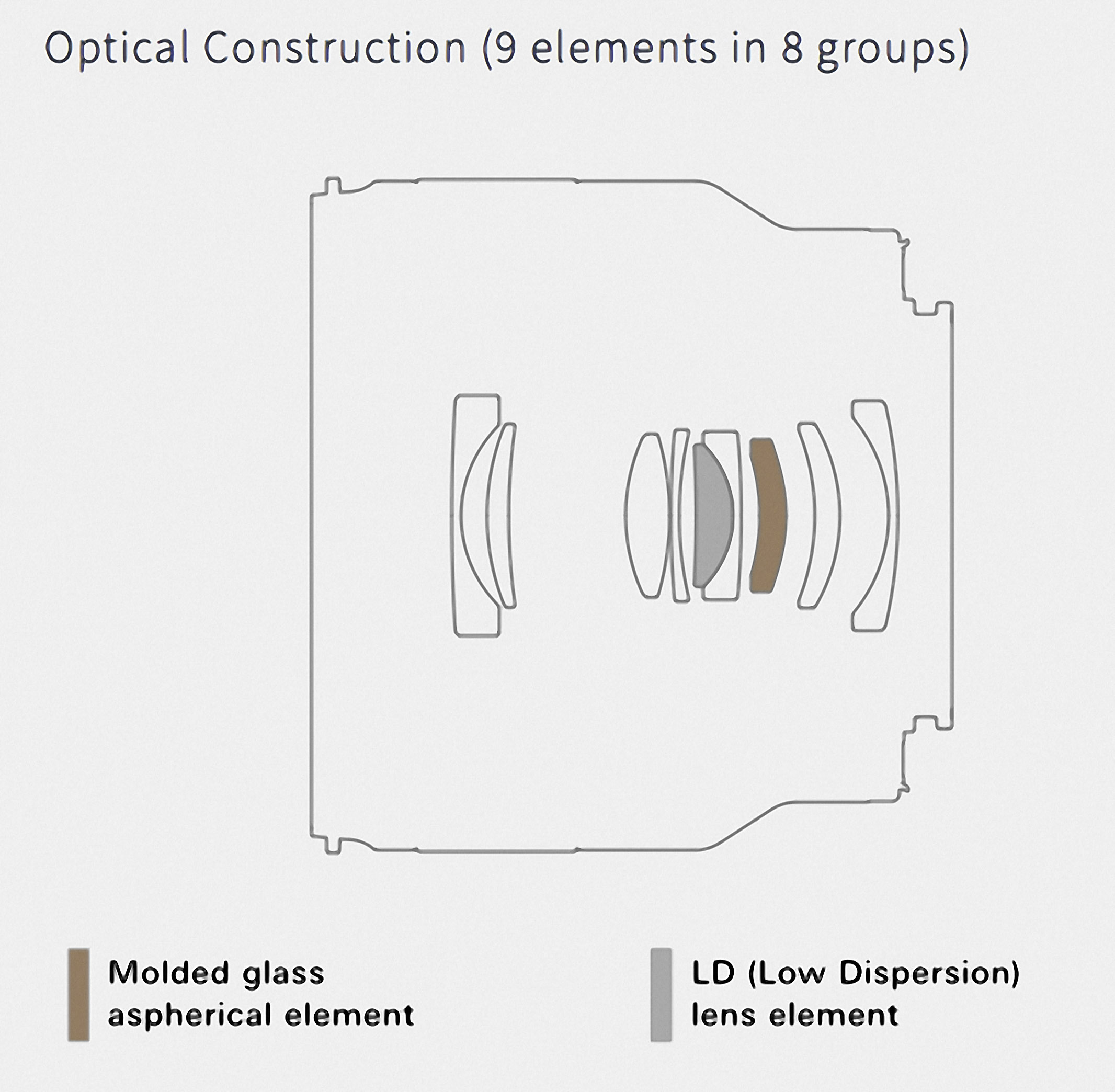
A schematic of the lens construction.
Focal Length
35mm
Maximum Aperture
F/2.8
Angle of View (diagonal)
63° 26′ (for full-frame mirrorless format)
Optical Construction
9 elements in 8 groups with 1 low dispersion element and 1 moulded glass aspherical element
Minimum Object Distance
0.15m (5.9 in)
Maximum Magnification Ratio
1:2
Filter Size
Φ67mm
Maximum Diameter
Φ73mm
Length*
64mm (2.5 in)
Weight
210g (7.4 oz)
Diaphragm Blade Number
7 (circular diaphragm) The circular diaphragm stays almost perfectly circular up to two stops down from maximum aperture.
Minimum Aperture
F/22
Standard Accessories
Flower-shaped hood, Lens caps
Compatible Mounts
Sony E-mount
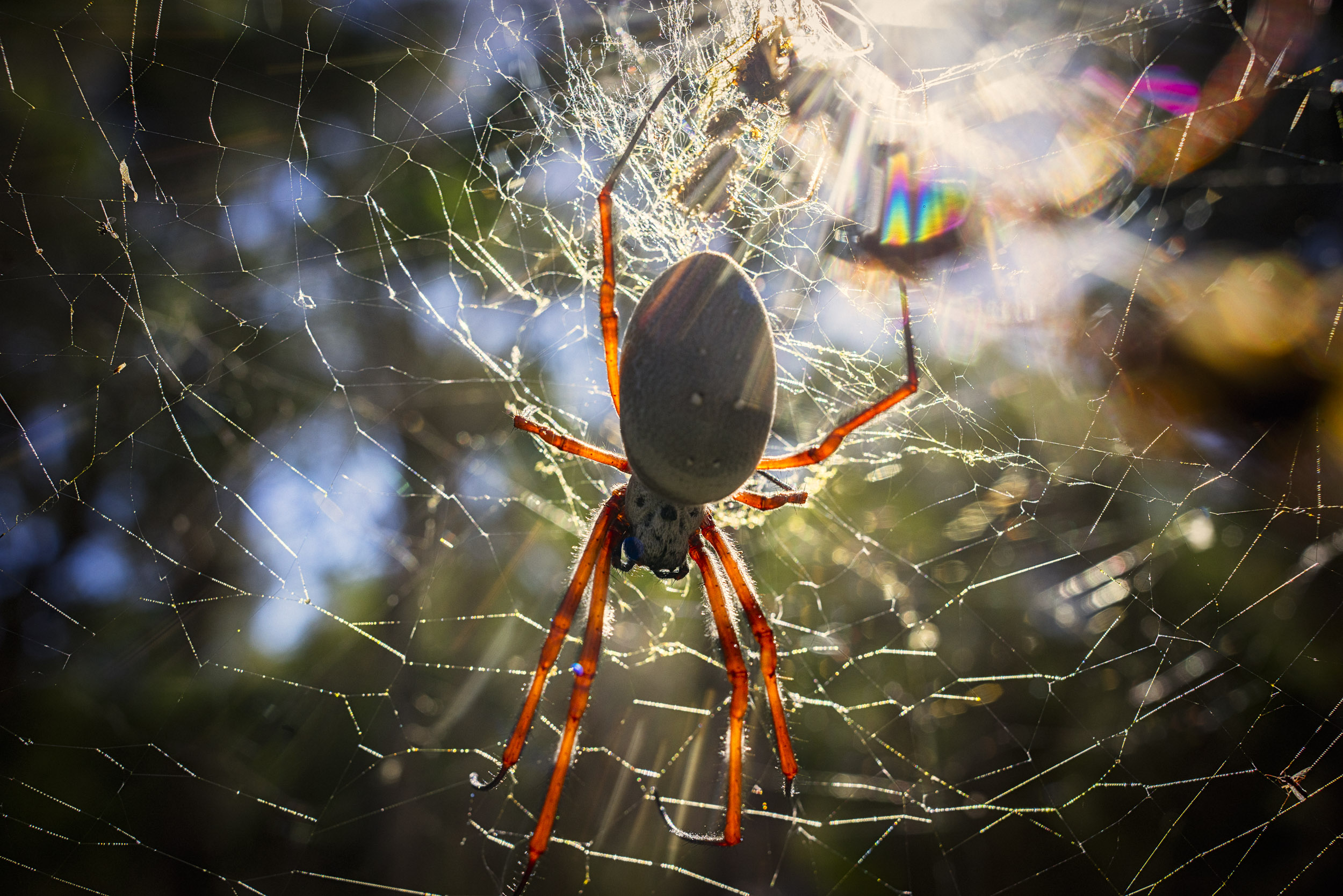
Golden Orb-Weaving Spider, Nephila edulis. Despite its size and their massive webs they are harmless to humans. Yellagonga Regional Park, Western Australia. The 1:2 magnification of the Tamron 35mm f2.8 makes this sort of photography a breeze.
For me the interesting aspect of this lens and indeed of its siblings is the cminimum focusing distance and it’s ability to shoot half life size. For me this makes them very suitable to creative macro and close up work. It’s not what you’d use to photography small critters as the lens has to be very close to the subject and will scare them off. For product shots, still life and another form of table shot photography it is a very interesting choice.
With a close focusing distance of just 15cm and a magnification ratio of 1:2 the Tamron 35mm f2.8 Di III is very suited to product photography.
Build Quality
In terms of build quality the Tamron 35mm the internet has largely been critical of it. The body is made out of some form of engineering plastic which you’d think had been manufactured by Tupperware judging by a lot of the reactions. Comparing this to recent Sigma lenses and Canon L lenses there is very little to distinguish the Tamron from the others. The only difference I can find without some sort of destructive testing is that the Tamron has a slightly more “satin” finish than the more “mat” of the Canons and Sigmas. The lens mount appears to be chrome plated brass which is nice, and there is an “o” ring which provides some semblance of sealing from the elements at the mount. There is no other weather sealing so I would say the lens isn’t really weather sealed at all despite Tamron’s claims. Tamron isn’t alone in this and I think it is high time the industry took a leaf out of Olympus’s book and actually stated to what level their products are sealed and give an IPX rating. Anything else is just weasley marketing BS as the majority of the camera and lens manufacturers state their products are weather sealed but won’t cover water water ingress under their warranties.
The metal lens mount as a gasket to provide some weather sealing.
The lens is larger than other 35mm lenses of similar specifications and feels quite light in the hand, but it doesn’t feel cheap. It feels quite sturdy and well made. On the lens barrel there is only a ribbed focusing ring which is of the focus by wire type which means there is little chance of getting repeatable focus pulls using it.A the front of the lens the front lens element is well recessed and while the lens doesn’t focus internally it extends within that recess so it does not protrude beyond the front of the lens barrel. Like all Tamron’s mirrorless range so far the 35mm f2.8 has a 67mm filter thread. Tamron thoughtfully include a lens hood with the lens. Other manufacturers please take note – if Tamron can include a lens hood with its budget lenses there no reason why you can’t. I’m looking at Olympus and Canon here. The lens hood warrants some discussion here as it is quite an interesting design. It is not the conventional bucket or petal shape. Instead it is like a plastic blank that has had a rectangular hole cut in the front and it is very effective at preventing flare and would also provide a degree of protection for the front element. The hood is threaded to take 67mm filters which means that you don’t have to remove it if you want to use a polarising filter. Somebody at Tamron has been doing some thinking. The hood bayonets into place.
The front lens element is well recessed.
Optical Performance
The Tamron 35mm f2.8 has built in lens profiles that are applied to jpgs and RAW files if so selected in the camera’s menu. I’ve opened the files in both Lightroom with the profiles switched on and then in RawTherapee with no profiles.
Click on the chart to see larger.
In terms of sharpness well at f2.8 at the centre of the image the lens is nicely sharp and contrasty. At f4 the it reaches its best performance and stays there to f11. At the edges wide open it isn’t quite as sharp as the centre, but by f5.6 the edges are as good as the centre. The old adage of stoping down two stops from wide open to achieve optimum performance certainly holds true of this lens. By f16 the image starts to soften as diffraction rears its ugly head.
In terms of optical aberrations well once the lens profile is switched off there is very slight evidence of pincushion distortion and vignetting. At f5.6 the vignetting disappears. A small amount of lateral chromatic aberration can be seen, but it is so slight I had to magnify the images to 300% to see them. Easily fixed in Lightroom. With a maximum aperture of f2.8 longitudinal chromatic aberration is not a problem. It is really fast apertures of f1.2 and f1.4 that really cause problems with this.
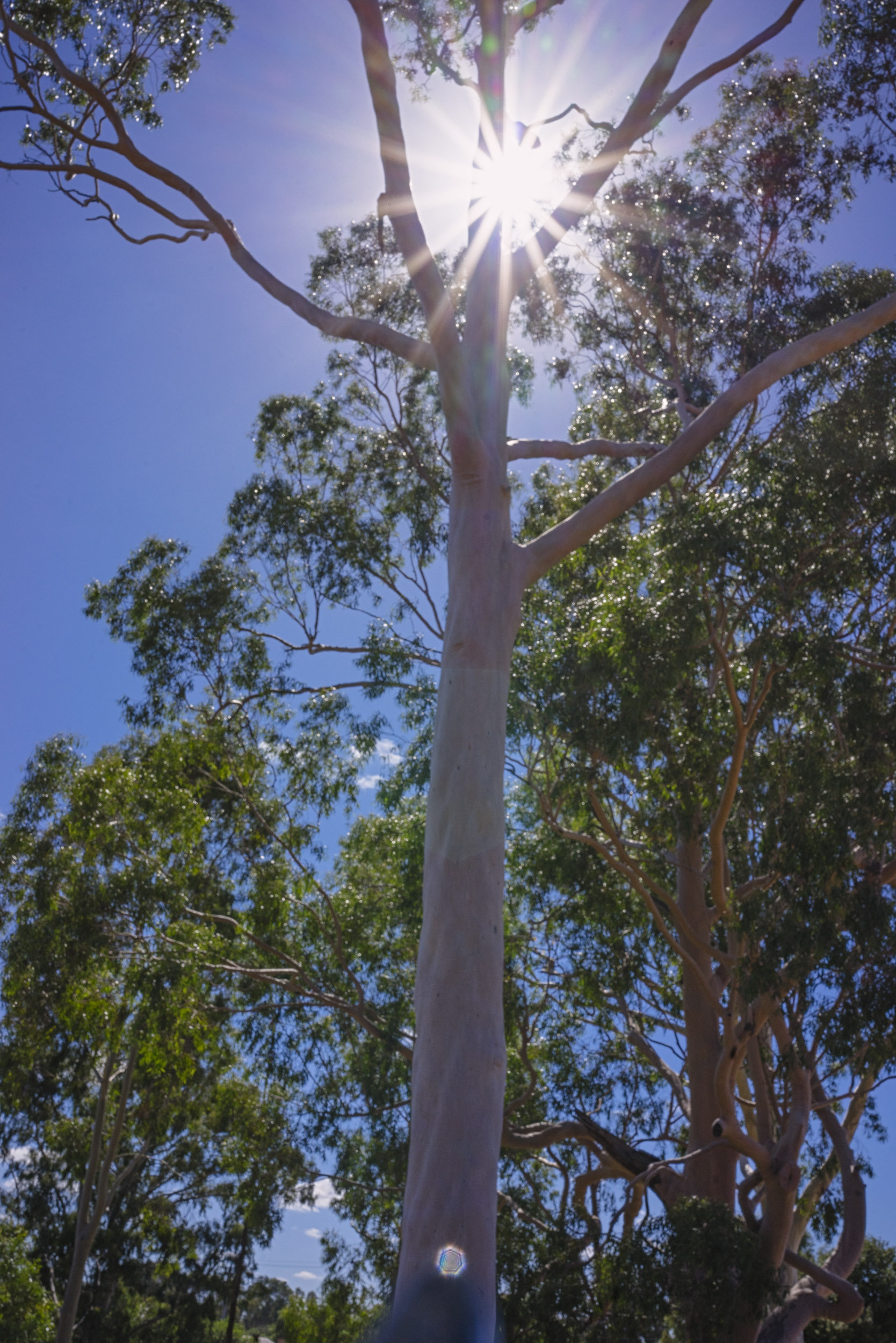
Without a lenshood the lens exhibits quite pronounced ghosting flare. Note the discolourateion on the tree trunk halfway down and the polygonal shape on the trunk at the bottom of the frame. At f22 the sunstars are pronounced, but aren’t that well defined.
Flare resistance is a bit on the pedestrian side without the lens-hood with ghosting visible. The lens-hood is included in the box for a reason so use it. The seven bladed iris produces what to me are quite attractive sun-stars. Speaking of how the lens handles specular highlights the bokeh is not what I would call thrilling but it is not offensive either.Wide open in the centre there are round balls with faint onion rings present from moulded aspherical element. I suppose the final polishing wasn’t as smooth as that on more expensive lenses as a cost cutting measure. The edges of the balls are not smooth, they have a fuzzy appearance as the light bleeds into the darker areas which is a form of halation. At the edges of the image the bokeh balls take on that elliptical cats eye shape. By f8 the bokeh balls take on a definite polygonal shape.
In the bokeh test we can see quite nice round balls in the centre of the image wide open, but on closer inspection onion rings are present and the edges have a fuzzy appearence to them. At the edge of the frame the balls have a definite cats eye shape. As the lens stops down the bokeh balls take on a polygonal shape which is really apparent from f8 and beyond.
Click on the image to see larger.
Comparison
The Olympus OM Zuiko 35mm f2 mounted on a Sony A7r.
Is a cheap auto focusing lens worth getting over a classic manual focusing version? Well to find out I’m comparing the Tamron 35mm f2.8 lens to the Olympus OM Zuiko 35mm f2 lens. Forty five years separate the two optical designs and a lot has changed. There are several different version of the Olympus lens. It had a long production run from 1974 to 2002. I’m using a later multi-coated version. This MC version is 43mm in length, 240g in weight and has a filter thread of 55mm. It has an optical construction of eight lens elements in 7 groups and a minimum focusing distance of 0.3m. When it’s performance is studied we can see there is slight barrel distortion evident in the test image. CA is present when wide open and clears up on stopping down Wide open the lens is quite soft and lacking in contrast both in the centre and at the edges. Both sharpness and contrast improve in the centre when stopped down to f8. The edges show some signs of improvement but not as much as the centre.
Our test subject for the comparison.
Comparing the two lenses in an actual real world shooting scenario we can see that with both lenses set to an aperture of f2.8 in the centre of the frame there is virtually no difference between them and I’d say they they are equal. In the corners, however, it is a very different story. The Tamron has a good level of sharpness while the Olympus is very soft. Stopping down to their respective minimum apertures – f22 for the Tamron and f16 for the Olympus -we see again in the centre that there is just a very marginal difference. In the corner the Tamron is better by a gnat’s whisker. Just remember that the Olympus was given an advantage. The Tamron shot wide open at f2.8 while the Olympus was stopped down at to f2.8 allowing an improvement in optical performance. At f16 the Olympus didn’t suffer the amount of diffraction the Tamron did at f22.
A comparison between the Tamron 35mm and the Olympus 35mm at f2.8. Click on the image to see it larger.
The same again but at f22.
Conclusion
When Sony launched the original A7 and A7r in 2014 critics poured scorn over the nascent system by saying there were no lenses. Early adopters divided into the system and tried their hand at adapting lenses they did have to fill the gaps in the line up. Fast forward to 2021 and Sony have done a tremendous job at fleshing out their line up. But the most significant thing is that Sony allowed third parties to access the lens mount protocols and this has meant that are lenses that range in price from decidedly wallet friendly all the way to those that would make a trust fund baby wince. At the time of testing the Tamron lens is selling for $350 AUD (which is the equivalent of being given away with a McDonalds Happy Meal in the USA). Looking on EBay the Olympus is selling for between $300 to $700 AUD depending upon condition and version. The version I have would count as a mint late model which would place it in the upper range. So the question is whether having a new autofocuslens is worth more to you than having a potentially more expensive 20-40 year old lens. Well I had the Olympus lens left over from OM film days (along with quite a few others) and I actually got a secondhand Sony A7r camera so I could use the Olympus lenses. I was very happy with that arrangement. The Tamron registered on my radar because of its macro capabilities.
So you want to go full frame mirrorless with a 35mm prime lensbut don’t want f1.2 lenses or can’t afford them then buy the Tamron. Don’t want want to carry around a lens that is capable of blocking the Suez Canal buy the Tamron. It is nowhere near a perfect lens. It is a modest lens, with a modest price and with a better than modest performance. So with what it costs and with what it can do it is a great buy.
A few days ago I made the 260Km round trip out to Corrigin to try and find the Pygmy Orchid, Corunastylis tepperi. I’d never seen it before and it is an early start to the orchid season. I also wanted to try out some new ideas for photographing orchids before the season proper starts. I knew roughly where to look, but once there it was like looking for a needle in a haystack. The plant lives up to its name – it is very small. The flowers are about 3mm and they can be found on a stalk 2-3 cm tall. As the the orchid prefers leaf litter found in mallee woodlands this makes them even harder to find.
Pygmy Orchid, Corunastylis tepperi. Corrigin, Western Australia.
When I drove up to the spot my heart sank a little as I had hoped that having just come up a fresh green plant would be fairly easy to spot, but as luck would have thanks to some rains we had a few weeks ago some grasses had begun to sprout as well. The area was covered in litter – not recent, it was old, very old. There were rusty steel ring pull cans all over the place. Now I’ve been in Australia thirty three years and drinks cans were aluminium back then, so I would say they were forty years old at least. The beer bottles looked even older. Take your litter home folks and then you can collect the 10c deposit on each item. As luck had it I found a whole patch of the pygmy orchids about 700m from where I’d parked the car.Having finished so quickly I decided to head off to experience the delights of downtown Corrigin.
Pygmy Orchid, Corunastylis tepperi.
Now besides orchids Corrigin’s other claim to fame is its association with dogs. The town holds the world record for the most dogs in a ute. Non Australians probably will be a bit perplexed by this but for a few years it seemed like very country town wanted to cram as many dogs as physically possible into a ute. The town also has a dog cemetery which has become quite a big tourist attraction so I made a quick stop there. It’s not the first time I’ve visited but I wanted to see if there was anything new as the owners of the dogs erect memorials and I’m fascinated with how their love for their dogs expresses itself.
The entrance to Corrigin Dog Cemetery, Western Australia.
One of the good things with photographing orchids as opposed to photographing wildlife and in particular birds is that you don’t have to get up at stupid o’clock. In fact some species of orchids will only be at their best in the middle of a bright sunny day. So by the time I hit down town Corrigin it was well past lunch time so I went into one of the two cafes and ordered a BLT sandwich. Two minutes later the waitress informs me that there is no sliced bread would I mind it being in a roll. Another two minutes and I’m informed there’s no lettuce. A further two minutes passes and I’m told there’s no tomato. At this point I’m starting to think that I’ll be told there’s no bacon when the waitress brings this enormous baguette with half a pig in it. It is literally the biggest bacon roll I’ve ever seen.
Hooch’s grave in Corrigin Dog Cemetery.
The night before we’d watched the movie “The Dry” staring Eric Bana. Although we’ve not had a drought the drive out to Corrigin reminded me very much of the movie. I love driving through the Wheatbelt – you get the feeling that the roads could go on forever and the movie very much captured that feeling. If you’ve never seen the movie give it a watch as I thought it was very good.
Graffiti is a subject that seems to upset a lot of people – especially members of the “hang ’em high” brigade. Personally I don’t get bent out of shape by it, and in fact some I even enjoy. The other day we were walking in Enright Park in Northam and we ventured under the Brookfield Railway Bridge and we were treated with an extensive graffiti gallery which I quite liked.
These colourful pieces on the bridge piers where what caught our eye and encouraged us to explore under the bridge.
White Crow and a white face.
I don’t think the artists are paying attention to the warning signs.
Graffiti on the Brookfield Railway Bridge near Enright Park in Northam, Western Australia.
For those that complain about graffiti and demand the death penalty for it here’s a few facts. The only known written material in the ancient Safaitic language (an early form of Arabic) comes from graffiti. In the classical era most graffiti was rather sophisticated and demonstrated a very high level of literacy and a deep appreciation of art and poetry which indicates that it was done by the elites in society (Ponnamperuma, Senani (2013). Story of Sigiriya. Melbourne, Australia: Panique Pty Ltd. p. 157). In the Nineteenth Century Lord Byron avoiding his creditors, ex-lovers and looking for lots of non-binary rumpy pumpy graffitied his way round Europe in-between writing poetry and fighting for Greek independence (Shanks, Michael (1996). Classical Archaeology of Greece: Experiences of the Discipline. London, New York: Routledge. p. 76). I don’t know where Byron got the time and all the energy from.











You must be logged in to post a comment.