The pavillion at the Cairns Chinese Friendship Garden. Cairns Botanic Garden, Queensland.
The Moon Gate in the Cairns Chinese Friendship Garden.
No it’s the the Cairns Chinese Friendship Garden in the Cairns Botanic Garden actually.
Grand View Garden, its layout is based upon the book Dream of a Red Chamber by Cao Xue Qin. The garden reflects the style of the Yongzheng and Qianlong reigns during the Qing dynasty, although they are a modern creation. May 2007. Canon EOS 300d with Canon EF-s 18-55 f3.5-5.6.
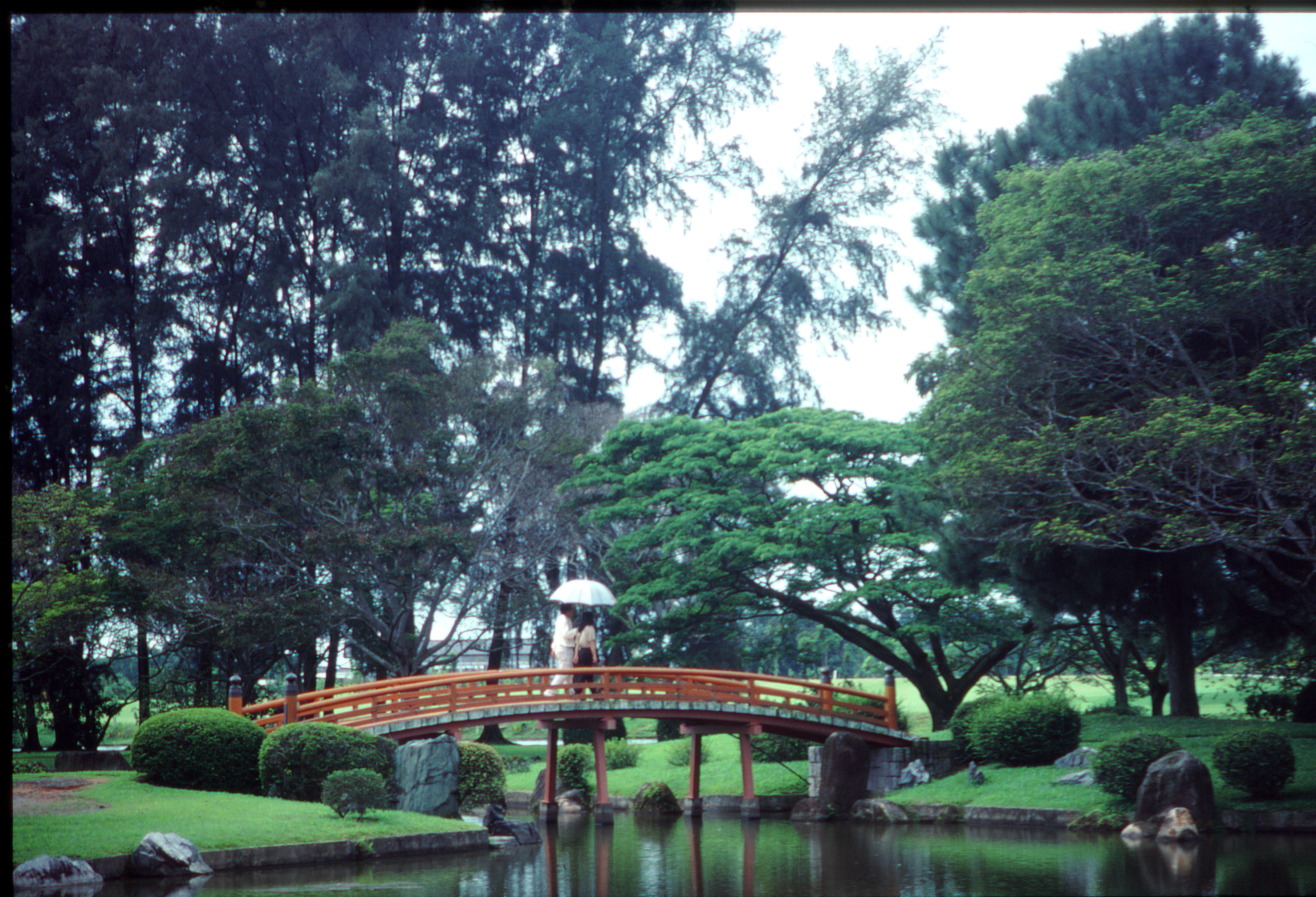
The Japanese Garden in Jurong Lake Gardens, Singapore. February 1994. Olympus OM4 with an Olympus 35-105mm lens on Fuji Velvia. Time has not been kind to the emulsion and the colours have started to shift.
Love a good botanic garden. I’ve been to some quite memorable ones over the years. The Grand View Garden in Beijing, the George Brown Darwin Botanic Gardens, Kings Park in Perth, Jurong Lake Gardens in Singapore, and the gardens and courtyards of the Alhambra in Granada, Spain. The Cairns Botanic Garden has a lot to offer from walking trails to an arts centre to walking tours exploring the animals and plants that are found there.
Yours truly at Jack Barnes Mangrove Boardwalk wondering where all the birds have gone while being feasted upon by mosquitoes. Courtesy of Helen Amyes.
Unfortunately we went to the Jack Barnes Mangrove Boardwalk first thing and that didn’t work out so when we got to the Botanic Gardens it was qute late on in the morning. It was aSaturday and the park was quite busy so there wasn’t as much wildlife around as we had hoped. But, having said that we went and walked the Rainforest Broadwalk and did a turn around the fresh and salt water lakes followed by a visit to the Chinese Friendship Gardens. It’s definitely a place I’d want to visit again should I find myself in Cairns again.
A Great Egret (Ardea alba modesta) having a bad feather moment. Cairns Botanic Garden.
All sorted. Now looking for something to eat.
Australian Brushturkey, Alectura lathami. Cairns Botanic Gardens.
Kurunda is a small town on the Atherton Tableland some 25Km from Cairns in the middle of the rainforest. Originally it was primarily a timber town, but in the 1970’s it became a bit of bohemian enclave and was thus marketed as the ‘village in the rainforest’ and it became a major tourist drawcard and continues to be to this day. Most tourists make the trip up from Cairns via the very quaint railway, the Skyrail, or a combination of the two. We chose to drive up the narrow and incredibly steep and windy road. We wanted to get there early and have the freedom to come and go as we wanted without being conscious of timetables. All have their merits.
The very characterful Kuranda railway station in Queensland.
For me the major attraction is that the rainforest surround Kuranda is the world’s oldest living rainforest and the town has a network of 5 walk trails that enable you to explore. If you combine the Jumrun Walk, the Jungle Walk, River Walk and Market Walk you have loop that will take you in a circuit around the town of 3.8Km. It’s all very well laid out and well signposted. There is an enormous amount of wildlife that calls the rainforest home including the very rare but iconic Southern Cassowary. For us we saw very little wildlife. The forest is so dense and dark it makes seeing things very difficult. I did manage to take a few pictures but I was forced to use very high ISOs and slow shutter speeds which meant that I only got one sharp photo of a bird. The scenery more than made up for it though – it was absolutely amazing.
The River Walk takes you along the banks of the Baron River.
The Jungle Track takes you through the rainforest and crosses Jumrum Creek. Kuranda,
The only decent bird photo I managed to get. Pale-yellow Robin, Tregellasia capito nana.
By 10:30 we’d finished the walk and walked along the main drag looking for a place to get a brew. The place was pretty deserted with the overwhelming majority of shops being closed. In the shop windows was all this kitsch “hippy wear”. Does anyone still wear tie dye and cheesecloth anymore? It seems sad that they’re trying to cash in on the whole notion of Kurunda being a centre for an alternative lifestyle and all they can think to sell is bad caricature of the the 1970’s. Eventually we did find a cafe that was open, but, when we got inside the two staff were more engrossed in their social media feeds than serving customers so we left. Luckily for us the local IGA supermarket was open and we got some drinks and morning tea from there.
On leaving Kuranda we went to the Barron Falls Lookout. The walk from the carpark is along a suspend broad walk that keeps you high in the tree canopy. It was a stunning experience walking through the jungle like that. The views out over the water fall weren’t too shabby either. Being the end of the wet season there wasn’t as much water going over the falls, but, it was still very impressive.
The Baron Falls viewed from the Baron Falls Lookout. Kuranda, Queensland.
If you are in or around Cairns then definitely visit Kurunda. If you stay clear of the hippy shops and just explore the natural environment you’ll have a ball.
In terms of photography – well I hardly used my Panasonic G9 mk ii, but the little Leica D-Lux Type -108 acquitted itself with flying colours. The camera is a very tactile experience. There is a shutter speed dial and an aperture ring. Select your aspect ratio from 4:3, 3:2, 16×9, and 1:1 and put the camera in auto ISO and it’s a delight to use. The lens renders images beautifully and the RAW files have plenty of latitude if you do your part. I was very glad I brought it on this trip.
The title of today’s post is from the late great John Mayall’s classic track “Life In The Jungle”.
Helen walking around Cattana Wetlands, Queensland.
When you first look at Cattana Wetlands it’s hard to get your head around the fact that it’s only been like this since 2009. The rainforest, the salt and fresh water lakes look like they have been there forever. It’s hard to believe that up to the 1990’s it was a sugar cane farm and up to 2005 there was a sand and gravel quarry there. Now the rehabilitated site has had over 200 bird species recorded, mammals include Sugar-gliders and Striped Possums, and there is the occasional saltwater crocodile. Crocodiles aren’t the largest predator to found in the Cattana Wetlands. That honour goes to the Australian Scrub Python (Simalia kinghorni) which can grow up to 5m long and weigh just short of 30Kg. They’e not poisonous, but I wouldn’t ask one for a cuddle. We didn’t see either pythons or crocodiles when we visited.
The Kingfisher Hide at Cattana Wetlands, Queensland.
“Where are the birds?” the Kingfisher Bird Hide at Cattana Wetlands.
The wetlands is comprised of 80ha of rainforest and five small pools or lakes. Some are freshwater others are saltwater. There are several walking tracks through the reserve which are graded and are accessible to those who have mobility issues. The trails are well signposted and there is a self guided tour that has information boards describing various features. There is a written guide to the tour which is worth reading, but, it is not necessary to have it. We enjoyed it so much that we visited it twice and we saw different things each time. To my mind it’s the best nature experience in Cairns. I’d love to be able to spend a week there just going at dusk and dawn. It’s definitely one of those places where the more hours you put in the more you’ll see.
An Azure Kingfisher (Ceyx azureus) at the aptly named Kingfisher Bird Hide in the Cattana Wetlands, Queensland.
Baron River at Lake Placid Recreation Park in Queensland.
FNQ is not some acronym from yoof culture or some obscure quango, it is the common geographical abbreviation for Far North Queensland, a vast, tropical region in Australia covering over 270,000 square kilometres. Cairns is the gateway hub for the region and that is where we went for our third tropical birding trip. The tropical rainforest and mountainous terrain provide a home for a huge variety of fauna – most of which is not seen anywhere else in the world. Cairns is also the gateway for the Great Barrier Reef which is the world’s largest coral reef system and according to CNN one of the Seven Natural Wonders Of The World. Reefs and fish aren’t our thing we were there primarily for the wildlife that could be seen from dry land.
The Bush Turkey Cafe at the Lake Placid Rainforest Retreat. Queensland.
We elected to stay well away from the tourist strip at the Lake Placid Rainforest Retreat. It was to my mind the best caravan park we’ve ever stayed at. The amenities, the accommodation, the staffand the overall friendliness made for a delightful stay. The icing on the cake was the sheer amount of wildlife at the park. I’d seen animals that I’d never seen before without stepping foot outside of the caravan park. Absolutely bloomin’ brilliant! Here in Western Australia Bush Stone Curlews are quite shy and although I’ve seen them I’ve not managed to get a “good” photograph of one. There were about half a dozen of them wandering around the campsite in the evening and it was possible to get close to them. Then there were the Australian Brushturkeys. They’ve got a face only a mother could love, but they are so full of character. These were wandering around all over the place. If you are interested in butterflies then it would be your idea of heaven. There were so many different types flitting around the bush.
Bush-Stone Curlew, Burhinus grallarius, wandered freely around the caravan park at dusk.
They would get quite close to you allowing good portrait opportunities.
Australian Brushturkey, Alectura lathami. Lake Placid, Queensland.
The Brushturkeys were everywhere.
Blue Tiger, Tirumala hamata. Lake Placid, Queensland.
The magnificent Ulysses Butterfly, Papilio ulysses. Try as I might this was the only half decent photo I managed to get and it doesn’t do it any justice at all.
Chocolate Argus, Junonia hedonia. Lake Placid, Queensland.
Orange Aeroplane, Pantoporia consimilis. Lake Placid,
White-lipped tree frog, Sandyrana infrafrenata, on our bathroom window. Lake Placid Rainforest Retreat, Queensland.
We were already talking of visiting again before the trip had finished.
…to be beside the seaside! I do like to be beside the sea! I do like to stroll along the Prom, Prom, Prom! Where the brass bands play, “Tiddely-om-pom-pom!”
So just let me be beside the seaside! I’ll be beside myself with glee And there’s lots of girls beside, I should like to be beside, Beside the seaside, Beside the sea!”
by
John H. Glover-Kind 1907
Cairns Esplanade is a sight to behold early in the morning. It seemed like the whole of Cairns is there clad in lycra leggings, shorts, and vests exercising in every conceivable form. I immediately felt slovenly, ill disciplined, and over dressed. It definitely felt as if this was an odd place to be looking for birds and I did feel surprisingly self conscious. But, having said that, the seafront at Cairns is not some luxurious tropical palm fringed sandy beach, but a mudflat with mangroves at the northern end and that means birds. Lots of birds. So many birds that Sue Taylor in her book “The 100 Best Birdwatching Sites In Australia” rates it as her number three destination. So that is what drew us to the Esplanade.
Cairns Esplanade, Queensland.
It is Australia.
As I settled in to get some photos a woman sidled up to me and said “You’re not from here are you? I know all the birders here and you’re not local. Where are you from?”. I politely told her I was from Western Australia and was over on a birding holiday thinking I could gain some valuable local information. “Oh I went to Western Australia once. There was nothing there.” At this point I could sense that the conversation was already starting to take a strange turn. She carried on. “You’re wasting your time coming here. They’ve all gone. There’s nothing left. Nothing to see.” I’d just seen 4 species I’d never seen before and told her so. “There’s no point,” she replied, “the light is too bad it makes it pointless to take photos.” . At this point I quietly and quickly moved in the general direction of away.
Apparently the light was so bad it was a waste of time trying to take photos of birds that weren’t there. Bar-tailed Godwit, Limosa lapponica.
A different species of non-existent birds – Great Knot, Calidris tenuirostris.
Masked Lapwing, Vanellus miles.
In hindsight Moaning Minnie was sort of right about the light. The rising sun meant that the birds were strongly backlit, but I never subscribed to the old school photographic technique of having the sun at your back. I’ve always liked contre-jour lighting and as long as you know how to meter and avoid lens flare there’s nothing to worry about. What was bothering me more was that I couldn’t get at eye level with the birds as the Esplanade was about 1m above the mud. The obvious answer to this was to get out onto the mud and lie down, but this is Australia and the mudflats were perfect for saltwater crocodiles and there were signs warning about their presence everywhere. Not wanting to be breakfast for a large ravenous reptile I decided to stay on the Esplanade.
Striated Heron, Butorides striata.
Nankeen Night Heron, Nycticorax caledonicus.
As I walked along the Esplanade I kept seeing this small brown bird flitting between the trees. I thought it was vaguely familiar but couldn’t place it in context. It was only when I looked at a photo of it I realised that I had see it before as it was a House Sparrow (Passer domesticus), another animal that some homesick Brit introduced circa 1870 thinking it was a good idea. Like all these events it was disastrous and the birds soon became a major pest and colonised the whole of Eastern Australia. Another introduced species that could be seen in great numbers was the Common Myna (Acridotheres tristis). It was introduced about the same time as the House Sparrow to control pests, and particularly in the case of Northern Queensland, plague locusts and cane beetles, but they bred prolifically and soon became another introduced pest on the eastern seaboard. It’s not everywhere you can witness two ecological disasters within 2 minutes. It wasn’t all bad news though we saw loads of different birds and 4 completely new species – Bar-tailed Godwits, White-breasted Swallows, Great Knots, and Striated Herons.
White-breasted Woodswallow, Artamus leucorynchus.
Common Myna, Acridotheres tristis.
House Sparrow, Passer domesticus.
While walking back to the car I was amazed by the Nankeen Night Herons. We have them here in York so they are not new to me, and are actually one of my favourite birds. What was so surprising was how chilled they were around people. Here in York a mere glimpse of a person will put them to flight. On the Cairns Esplanade they were walking along the walkway amongst the people. We sat down to have morning tea by a BBQ and one came up looking for food. It was so close that to photograph it I had to use my compact camera as my other camera’s lens was too long.
All up a good haul for the morning and a great start to the trip.
A Nankeen Night Heron hoping to score a free meal from the BBQ. Cairns Esplanade, Queensland.
This Nankeen Night Heron was literally at my feet forcing me to use my compact camera to take a photo of it.
We recently went to Cairns in Queensland on a birding trip – more about that later – part of the deal on the flight was that we were limited to carry on luggage only. We’d been able to increase my allowance from 7Kg to 14Kg. At first glance this looks easily doable, but the devil is in the details. The main bag could weigh a maximum of 10Kg and measure 56 x 36 x 23cm. The second bag had to be able to fit under the seat in front of you. This pretty well meant that my camera equipment had to be 4Kg in a small bag. I can tell you this caused weeks of furious activity in terms of weighing equipment, doing test packs, looking online at small bags, studying various videos for how wildlife photographers pack for flights, and an inordinate amount of worry.
The Olympus EM1x and OM Systems 100-400mm f5-6.3 is my preferred choice for wildlife photography.
For our last two trips where we flew (Darwin and Broome) we had the luxury of checked baggage which meant my photographic kit could weigh 7 Kg and fit in a photo backpack that went as carry on. For the last few trips I’d settled on the following equipment:
This all came to 7.25kg. Clearly something would have to go. The other headache was that my bag wasn’t small enough to fit under a seat. I did countless test packs and made countless changes. Two days before our flight I was stillplagued with doubt and indecision. In the end at literally the twelfth hour I made a radical decision and then spent the whole 5 hour flight worrying about whether I’d done the right thing.
The Panasonic Lumix G9 mk 2 with Panasonic Leica 100-400mm f4-6.3 lens for wildlife photography.
So what did I leave behind? All of the above except batteries and SD cards. I took instead a totally untested combination. A brave decision or totally bonkers? Well in the end it was the right decision. So what did I take?
Total combined weight 3.83Kg so a 3.42Kg weight saving. So in practical terms I reduced the load by nearly half and importantly it would fit under the seat in front of me.
To carry my camera equipment while in Cairns I used a Think Tank Digital Holster 50 v2.0, a Think Tank Speed Changer v2.0, and a Think Tank Thin Skin Belt v2.0 in carry on luggage configation.
Yours truly sitting on a houseboat in Kashmir, India, in 1987. You can just see the Camera Care Systems belt pouch on my hip. Oh to be young and thin again! Photo by Helen Amyes.
Before we talk about the camera and lens choice let’s address the carrying system – it is a a modular belt system which means it is easy to configure for the job in hand. I’ve been using these since the late 1980’s after a trip to the island of Santorini in the Mediterranean. The bag I used for that was heavy without any load, configured badly and the designers had obviously never heard of the concept of ergonomics. At one point on a walk across the island I could have quite happily thrown the the bag and its contents off of a cliff and into the sea. I quickly bought a belt and series of pouches that were made by the now sadly defunct Camera Care Systems. After twenty or so years I started using the Lowe Pro Street and Field System which was originally designed for working professional photojournalists. After a while Lowe Pro made changes to the system and it was no longer as extensive or flexible and I moved over to the Think Tank System. It’s basically a series of pouches and camera holsters that can be used singularly or in various combinations using a waist belt and/or straps. These are great when working events as all the weight is carried on your hips, they are easy to work out of and means you can walk through crowds without knocking anyone flying with a big photo backpack. The major down side is that unlike a backpack there is nowhere to stuff a jacket or anything else.
What the well dressed bird photographer is wearing this season at the Cattana Wetlands. Here I’m wearing the Think Tank Modular Belt System. Photo by Helen Amyes.
So how did it go? The short answer is very well. Not having a backpack while I walked through the rainforest in high humidity was heaven. The only downside was that it often caused my trousers to migrate south towards my ankles, so I was walking around hitching them up all the time.
The Panasonic G9 mk2 and the 100-400mm lens worked flawlessly even in quite dim conditions. The new 25Mp dual gain sensor produces lovely files that are a pleasure to work with and the high ISO performance is much better than my Olympus EM1x. There were a couple of aspects that initially caused concern. The first was that the G9 mk ii RAW files are really large – about twice the size of those from the 20Mp EM1x which meant that I’d have to take a lot more SD cards. Normally I take 12 64Gb V60 SD cards and that is all I have of them. I didn’t want to go out and buy a load more as the current price of memory cards is very high. I had a load of 64Gb cards in the slower V30 rating which would mean that the camera buffer would take longer to clear. I took the slower cards but didn’t end up using them. The second was that my EM1x has a built in GPS and tags the files with the location while the G9 mk2 doesn’t. So I had to manually annotate the EXIF with the GPS co-ordinates when I got home. It was only a minor inconvenience.
The Leica D-Lux Type -108 had all other photographic opportunities covered.
The Leica D-Lux Type 109 camera was a little gem. The fast standard zoom did everything I wanted. I really should use this camera more.
The pavillion at the Cairns Chinese Friendship Garden. Cairns Botanic Garden, Queensland. Leica D-LUX (Typ 109).
The trip went really well, probably one of the best we’ve ever done. I’ll post some stuff about it a bit later.
The world has become a very grim place at the moment now that the Mango Menace has unleashed “Operation Epic Fury” (really who comes up with these ridiculous names?) which means we have to take out a mortgage to buy a tank of petrol if we canfind a servo with any in stock. So we decided to launch “Operation Numbat” whose sole function was to produce joy.
Dryandra, Western Australia.
The goal was to spend a couple of nights at Dryandra and find a numbat. Easier said than done as we have been looking for around thirty years and never seen one. A numbat for the uninformed is smallish, about 30-40 cm long, marsupial that eats termites. It was once quite common across southern Australia, but was driven to the point of extinction when somebody thought that introducing foxes to Australia would be a good idea. There now exist only a few small isolated populations in Australia and Dryandra is one of them. The Western Australian state government introduced Operation Western Shield (another silly name) to protect vulnerable native fauna from feral foxes and cats. In Dryandra this is done with a combination of 1080 baiting and trapping. It’s reckoned that the programme has reduced the fox population by 80% (Marlow et al., 2015).
We weren’t there just for the numbats, we there for Woylies, Echidnas, birds and everything and anything wildlife related.
Day 1
Helen on the Wandoo walk at Dryandra, Western Australia.
We arrived at Dryandra at at lunch time and once we’d eaten we set off to walk the Wandoo Walk (day walk) the start of which is located at the Old Mill Dam. The walk is 2.7 Km long and takes about 1 1/2 hours – more if you are looking for animals like we were. It is touted as being good for wildlife with a chance of seeing Numbats. Now the great thing about Numbats is that unlike other small marsupials they are diurnal, and to cap it off like sunning themselves in open areas which in theory should make them easier to see. I say in theory as we have been looking for over thirty years without any luck and I was hoping that this trip would be fruitful. It was a really enjoyable walk and we saw loads of birds – in fact I’d never seen so many Rufous Treecreepers in one day. But, when it came to Numbats we saw neither hide nor hair.
Jacky Winter, Microeca fascinans. Dryandra, Western Australia.
Djini or Rufous Treecreeper (Climacteris rufa), Dryandra, Western Australia.
Just before sunset we decided to walk around the large open paddock adjacent to the Dryandra Lions Village where we were staying. Western Grey Kangaroos were grazing on the grass and then we saw something we’d never seen before. We’d spotted an Echidna wandering round looking for ants when it encountered another Echidna. Now Echidnas are incredibly solitary animals and are rarely seen in the company of others. The two animals sniffed each other carefully and then went on their separate ways continuing their search for ants. As I continued walking along the perimeter of the paddock I found another Echidna and it came quite close allowing me to get some nice close ups.
Dryandra Lions Village is comprised of old forestry bush cottages.
A pair of Nyingarn or Short Beaked Echidnas aka Spiny Anteaters (Tachyglossus aculeatus). Dryandra, Western Australia.
Nyingarn or Short Beaked Echidna.
Day 2
Kawana Trail information board. Dryandra, Western Australia.
The morning saw us out on the Kawana Walk which is a 3.3Km walk through the Brown Mallet plantation, through the kwongan heath and then back through the Mallet trees. The varied landscape gives great opportunity to spot different birds, Kangaroos, Echidnas and fingers crossed Numbats. Again, like yesterday’s walk, we saw loads of wildlife – birds, kangaroos, and skinks – but no Numbats. It was hard not to feel a little dispirited at this stage. You plan trips and hope to see certain animals, like we did in our recent trip to Broome, but when you don’t find them you can feel very deflated even though you saw other animals.
More Rufous Treecreepers
Miyamit or Yellow-plumed Honeyeater (Ptilotula ornatus).
Yongka or Western Grey Kangaroo (Macropus fuliginosus).
Buchanan’s snake-eyed skink, Cryptoblepharus buchananii. Dryandra, Western Australia.
My companion in the Old Mill Dam hide – a Southern Slider (Lerista dorsalis). Dryandra, Western Australia.
After grabbing a quick drink I set off to walk down to the Old Mill Dam and sit in the hide there. Apart from seeing a Southern Slider Skink and a dragonfly I saw nothing. Desperation was really starting to set in now, so at 4pm we decided to go on a very slow drive around the park in the hoping that we’d see something. Driving along a deeply corrugated gravel road at 20Kph is enough to shake your fillings out of your teeth. It was torturous. At this stage your mind starts to play tricks on you. You so want to see that animal and you are desperately willing it to happen and every time a branch moves or a bird flies just above the ground you think NUMBAT! Your head twitches backwards and forwards trying to get a better glimpse of what wasn’t there. Suddenly at a junction just standing there as cool as you like was a Numbat just 20 metres away from the car. Gently stopping the car and winding the front passenger window down I managed to rattle off a few frames before it started moving. As it walked further round I could no longer shoot through the open window and I was having to use the front passenger quarter light window. At the time I knew this would seriously degrade the image quality, but I continued anyway in the hope that I might be able to salvage the images in post later. Then within 5 or 10 seconds it was off into the bush and we lost sight of it. We were both exhilarated – we had huge grins on our faces. We’d seen a Numbat! We had really seen a Numbat. Operation Numbat had been a huge success.
At long last! A Numbat (Myrmecobius fasciatus). Dryandra, Western Australia.
Numbat on the move. Shooting through the glass of a car window gives less than optimum image quality.
I love this pose, but the image quality is shot to hell.
Maybe it works better as a black and white.
It’s now a week since that sighting and the memory of it still brings a huge smile to my face and a feeling of excitement. One Numbat isn’t enough – I want to back and see and photograph more. Hopefully it won’t take another 30 years to do it.
My last birding outing in Broome was to Town Beach – a whopping 5 minutes walk from where we were staying. It was the evening before we were due to leave Broome and I wanted to get some photos of the migratory shorebirds that are found in Broome at this time of year.
I didn’t notice the Eastern Osprey (Pandion cristatus subs leucocephalus) perching on a lamp post on the Town Beach Jetty when I took the photo. It was only when I was processing it that I saw it.
The tide was out and a long way to boot. Ideally I’d want the tide to be coming in as it would push all the birds closer to me. A receding tide would take them away from me. So the question was how to get close to the birds while avoiding the liquid mud that was between us. The obvious answer was the jetty as it extends 112m out from the shoreline. The only problem was that it is very high to account for Broome’s 10m+ tides. Then I noticed some kids playing on what appeared to be a lower level and watching them carefully I saw how they were accessing this level and I quickly took up position. Most of the birds were still a long way out – well over 500m. After watching for a while I saw that there were a few different species of bird that were closer to me, but even so I’d need to fit my 1.4 x teleconverter to my 100-400mm lens. Not ideal because of the hit on image quality and having a maximum aperture of f9 forcing the use of high ISOs and lower shutter speeds.
An assortment of shorebirds lands looking for food.
Ruddy Turnstone, Arenaria interpres. Town Beach, Broome, Western Australia.
There were quite a few different species out on the mud. There was an Eastern Reef Egret and a Little Heron poking around amongst some rocks for something to eat. A Whimbrel stayed for ages going back and forth. Every now and again a little flock of assorted birds – Rudy Turnstones, Terek Sandpipers, Greater Sand-plovers and Grey-tailed Tattlers – would land and have a bit of a feed then something would spook them and they’d all take off again. It was brilliant and time just flew past. All too soon the sun was starting to dip below the horizon and the light levels were too low to continue photographing. All in all it was an excellent end to an excellent trip.
Eastern Curlew, Numenius madagascariensis. Town Beach, Broome, Western Australia.
Eastern Reef Egret, Egretta sacra. Town Beach, Broome, Western Australia.
The title for this blog entry comes from the song by the great Robert Cray.
Red-collared Lorikeet, Trichoglossus rubritorquis. Discovery Parks – Broome, Western Australia.
I enjoyed our trip to Broome immensely, it was great to see a region we’d never seen before at a time of year most people avoid. From a bird photography point of view things didn’t turn out how I’d expected them to. I must say that this is probably my fault as I’d been wanting to go for a while and as a result of reading numerous articles and watching countless videos on birding in Broome my expectations were probably too high.
Crested Pigeon, Ocyphaps lophotes. Broome Golf Course, Western Australia.
Little Friarbird, Philemon citreogularis. Broome, Western Australia.
We saw plenty of birds including eight new to me species. Photographing them was another thing all together. The first thing that made this difficulty was the heat and the humidity – lenses would fog up and take ages to clear. There was a lot of heat haze which combined with long focal lengths meant quite a lot of photos were unsharp. We didn’t experience these problems in Darwin, but then again we visited there at the end of the dry season. One of the ways to overcome this was by getting close to the subject and don’t shoot them at ground level. This worked very well with small bush birds and I got some nice photos with plenty of detail. The real problems set in when shooting the shorebirds. Firstly the tidal range in the Kimberley is huge – Town Beach has 10m+ tides and it can be 1 Km or more between the high tide mark and the water. You can of course walk out on the mud, but eventually it gets too soft and you sink into it – I speak from personal experience here. So a lot of the time the birds were a speck on the horizon and the OM System 100-400mm mk ii wasn’t long enough. I did try slapping on the 1.4 x teleconverter, but that magnified the heat haze problem and detail disappeared.
Brown Honeyeater, Lichmera indistincta. Minyirr Park, Broome, Western Australia.
Brown Honeyeater, Lichmera indistincta. Minyirr Park, Broome, Western Australia.
Rainbow Bee-eater, Merops ornatus. Minyirr Park, Broome, Western Australia.
The best locations we visited were Kabbarli Lookout (Entrance Point and Port [Broome]), Minyirr Park and Town Beach. We didn’t go to the Broome Bird Observatory as the dirt road becomes almost impassable during the wet and the hire car companies don’t like you going down it. We’ll leave that one for a dry season visit. So yes I would love to go again.
Black Kite, Milvus migrans. Minyirr Park, Broome, Western Australia.
Common Sandpiper, Actitis hypoleucos. Kabbarli Lookout, Broome, Western Australia.







You must be logged in to post a comment.