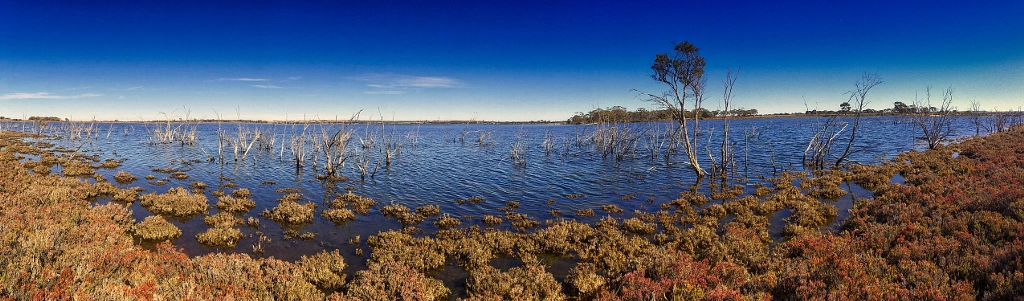
Kondinin Lake is a large Salt lake 5km west of the Kondinin townsite. After sufficient rain there is an abundance of water birds. iPhone SE panorama mode. Exposure: 1/1900, f2.2, ISO 25.
Talk to a lot of people in Perth (Western Australia) – especially migrants – and many haven’t left the metro area. They know nothing of rural Western Australia at all. Few people realise that the Wheatbelt has a large number of lakes such as Kondinin Lake pictured above. The assumption is that because the rainfall is low there can’t be any large bodies of water. The truth is that the Wheatbelt has a very low drainage profile which means that water collects in large shallow depressions. During the hot summers the rate of evaporation is high and tat creates these salt lakes. Kondinin Lake is huge – it covers an area of 15 square kilometres – and after a decent bit of rain it attracts a huge variety of wild birds. It is also a popular boating and water ski destination. Now who would have thought that.
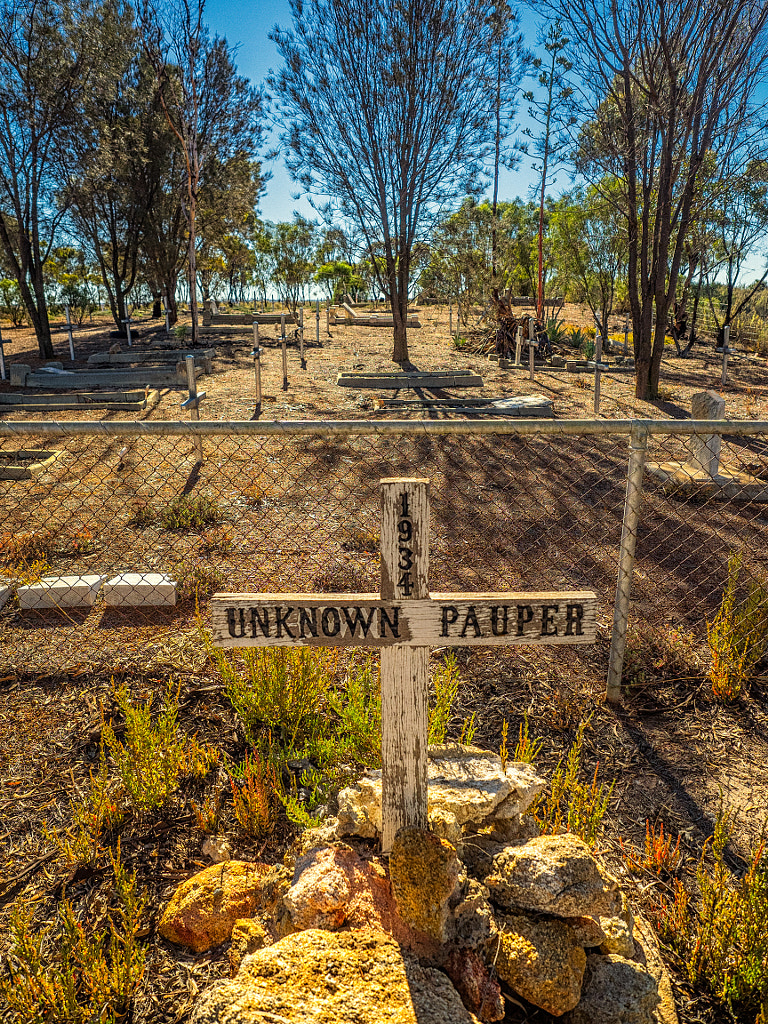
The grave of the unknown pauper outside of the Kondinin Pioneer Cemetery. Olympus OMD EM1 mki with Olympus m.Zuiko 12-40mm f2.8 lens. Exposure: 1/1000, f2.8, ISO 200.
On the shore of the lake is the Kondinin Pioneer Cemetery. A final resting place with a nice view. It’s not the most interesting cemetery but it does make you think at what life must have been like as you walk around. The saddest part of the cemetery the grave of the “unknown pauper” who in 1934 shuffled off of this mortal coil. The people of Kondinin couldn’t find it in their hearts to bury the poor wretch in the cemetery itself so the grave lies outside it. Unfortunate in life and unfortunate in death.
So if you are driving to Esperance or Hyden, then do a bit of a detour and see the lake.
*Today’s musical reference is of course Road To Nowhere by Talking Heads.
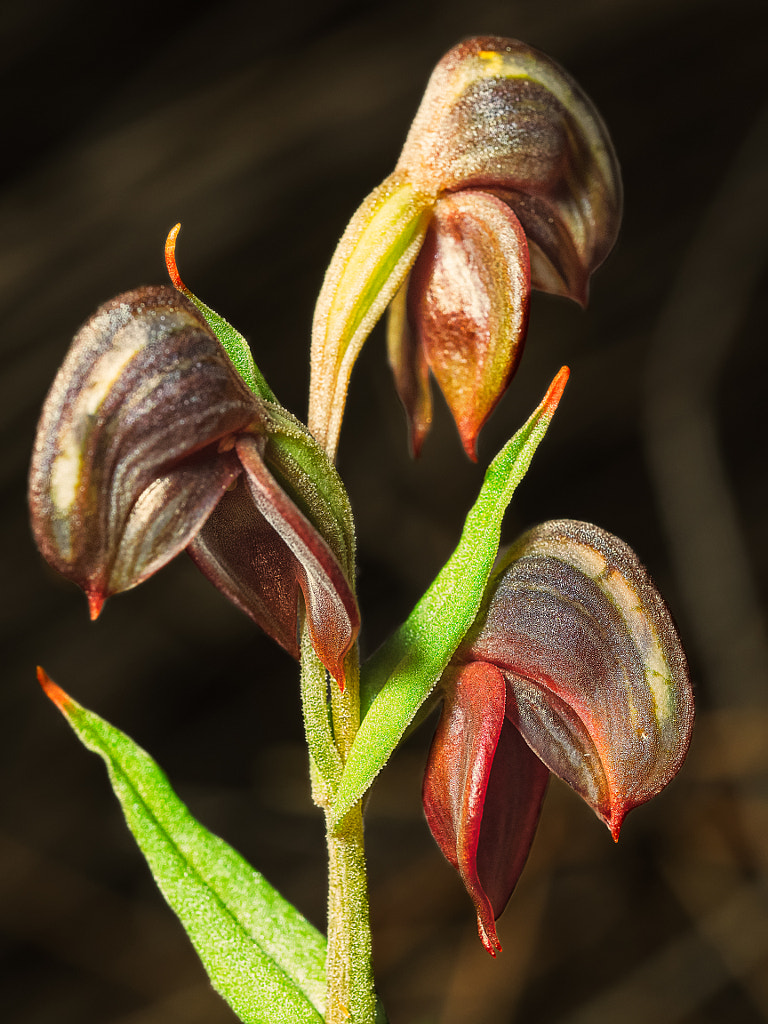
Dark Banded Greenhood, or Pterostylis sanguinea, found at the base of Wave Rock near Hyden in Western Australia. Olympus OMD EM1 with OLYMPUS M.60mm F2.8 Macro lens and Olympus FL600r speed light mounted off camera.. Exposure: 1/250th sec, f8, ISO 400.
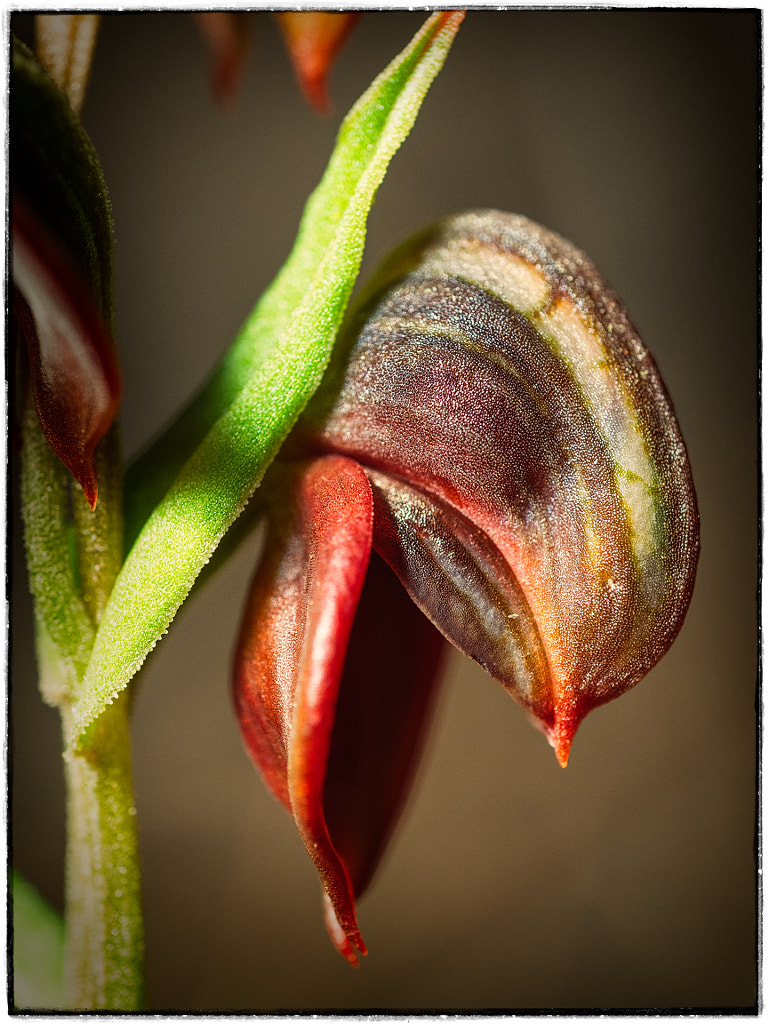
As you might have gathered from my last post I didn’t pay a lot of attention to Wave Rock itself. Besides watching tourists I spent my time looking for orchids. I had seen on my Facebook feed someone had found some dark banded greenhoods at the base of the rock so I spent ages walking along the vegetation looking for a small green and brown plant amongst a sea of other small green and brown plants. Amazingly I found a patch of half a dozen under a clump of sedge. I did my usual thing of lying down to photograph them. So there I am my torso in amongst the sedge and my legs out on the path quietly photographing flowers.
Me in orchid mode lying on the ground. Photo by Helen Amyes.
After a little while of me lying completely flat trying to get the best possible viewpoint a woman walks along the path and finds my prostrate form. Perhaps being a fan of the “cosy crime” genre she thinks she has found a body, or at best someone who has collapsed sick while sightseeing. So she kneels down to touch me – I suppose to check whether I’m alive or not. I say “Hullo” and she jumps out of her skin and looks like she could keel over with a heart attack. I quickly explain that I’m fine really, and it’s very kind of her to be so concerned, but I’m just photographing some flowers. From the look she gave me I think she would have rather found a dead body than a mad man lying in the mud taking photos.
Up close and personal with a dark banded geenhood. Olympus OMD EM1 with OLYMPUS M.60mm F2.8 Macro lens, and Olympus FL600r speed light. Exposure: 1/250th sec, f4, ISO 400.
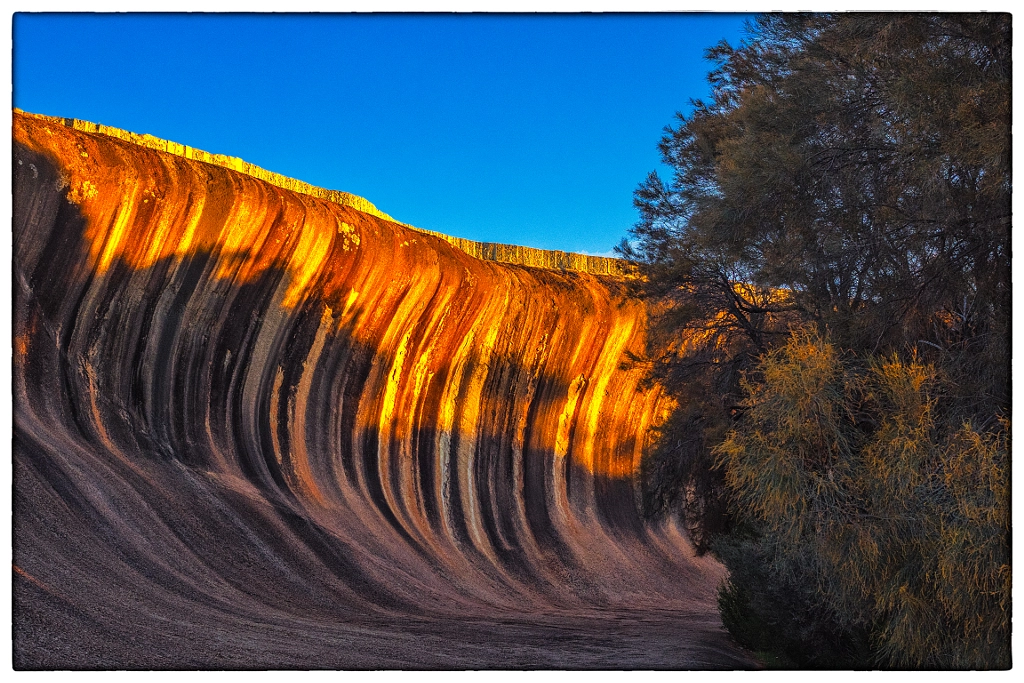
Wave Rock at sunset. Hyden, Western Australia. Olympus OMD EM1 mki with Olympus m.Zuiko 12-40 f2.8 lens. Exposure: 1/160 th sec, f5.6, ISO 200.
Every day tour buses stop over in York on their way to Wave Rock near Hyden. The Northern Territory has Uluru (formerly known as Ayres Rock) and Western Australia’s tourism industry markets Wave Rock as our equivalent. I often feel sorry for the tourists, particularly the Chinese and Japanese ones, as they drive out from Perth to the middle of nowhere to see a large rock that looks like an enormous ocean wave frozen for posterity. I wonder what they think when they get there.
A week or so ago we went out to Hyden to visit Wave Rock. It’s not the first time we’ve visited, we first went in 2008. I find it very hard to be enthusiastic about it – it is just a curved rock face. My over all feeling is that Wave Rock is more marketing than substance. What I find more interesting is the way people interact with it. The majority of people just pull up in the car park and jump out to quickly take a selfie with their phone or a couple of seconds of video on a GoPro on one of those annoying sticks that they nearly poke someones eye out with as they are too busy on making strange faces for the camera. They then jump back into their cars and race off to the next destination on their itinerary. The next group of people are harried parents herding their bored looking children around and eventually persuading them to have their photo taken while they pretend to surf the perfect stone wave. The best was a young Chinese couple – he was shooting “glamour” photos of her while she was standing halfway up the curve in skimpy attire and the most incredible high heels – the sort that you need a ladder to get into and induce vertigo. My immediate reaction was not to perv the girl, but one of how the hell did she get up their dressed like that. The answer was obvious – when he finished taking photos he threw a bag up to her and she changed into a pair of track pants, a t-shirt and trainers and slid down on her backside.
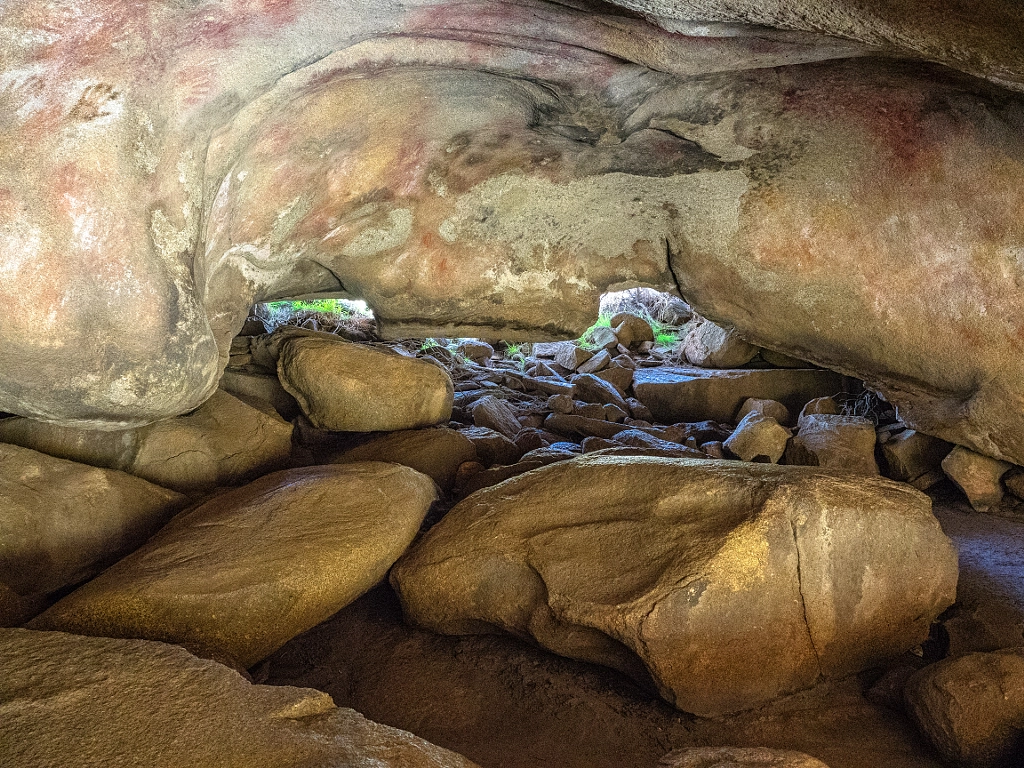
Mulka’s Cave in the Humps Nature Reserve is a site of special significance to the Nyoongar people. Apart from being the subject of local folklore it also has the largest collection of rock paintings in the south of Western Australia. Olympus OMD EM1 mki with Olympus m.Zuiko 12-40 f2.8 lens. Exposure: 1/30 sec, f5.6, ISO 3200.
Sixteen Kilometres north-east of Wave Rocks is The Humps Nature Reserve. It’s not a very appealing name and probably doesn’t help with marketing to the tourist hordes. The Humps are a massive granite outcrop some 2 km x 1.5 km in area and rises to 80 m above the surrounding plain which was and is of huge cultural significance to the Nyoongar people. Mulka’s Cave is a gallery for 452 motifs which makes it the largest collection in southern Western Australia.It is thought that the paintings were produced over the last two or three thousand years and it feels like the people who made them are reaching out from the past to the present day. It really reinforces the impression of spirit of place and of belonging to the land. To me this is what makes The Humps more special than Wave Rock, it engenders a feeling to that felt at Uluru or Ubirr. Powerful stuff. Mulka’s Cave is named after one of its inhabitants about which there is a gruesome Dreamtime story.
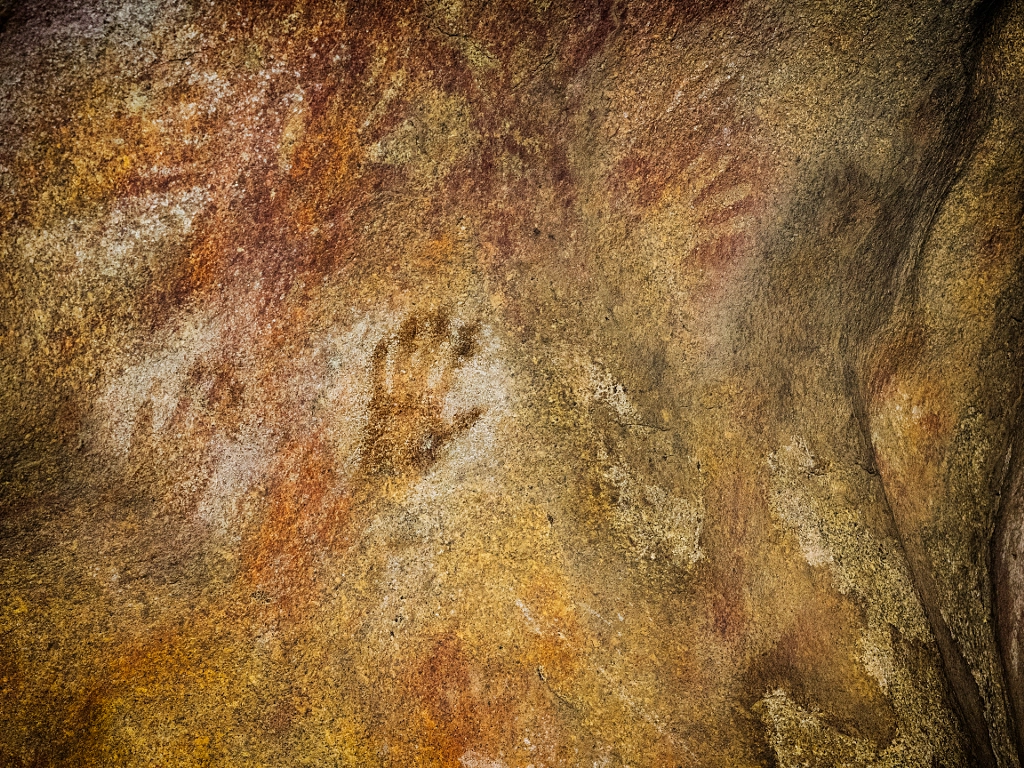
‘Mulka was the illegitimate son of a woman who fell in love with a man to whom marriage was forbidden. As a result, Mulka was born with crossed eyes. Even though he grew up to be an outstandingly strong man of colossal height, his crossed eyes prevented him from aiming a spear accurately and becoming a successful hunter. Out of frustration, Mulka turned to catching and eating human children, and he became the terror of the district. He lived in Mulka’s Cave where the impressions of his hands can still be seen much higher than those of an ordinary man. His mother became increasingly concerned with Mulka and when she scolded him for his anti-social behaviour, he turned on his own mother and killed her. This disgraced him even more and he fled the cave, heading south. Aboriginal people were outraged by Mulka’s behaviour and set out to track down the man who had flouted all the rules. They finally caught him near Dumbleyung 156 km south-west of Hyden, where they speared him. Because he did not deserve a proper ritual burial, they left his body for the ants – a grim warning to those who break the law.’
R.G.Gunn, Mulka’s Cave Aboriginal rock art site: its context and content, Records of the Western Australian Museum 23: 19-41 (2006).
Nyoongar hand prints reach out from the past in Mulka’s Cave. Hyden, Western Australia. Olympus OMD EM1 mki with Olympus m.Zuiko 12-40mm f2.8 lens. Exposure: 1/100 sec, f4, ISO 1600.
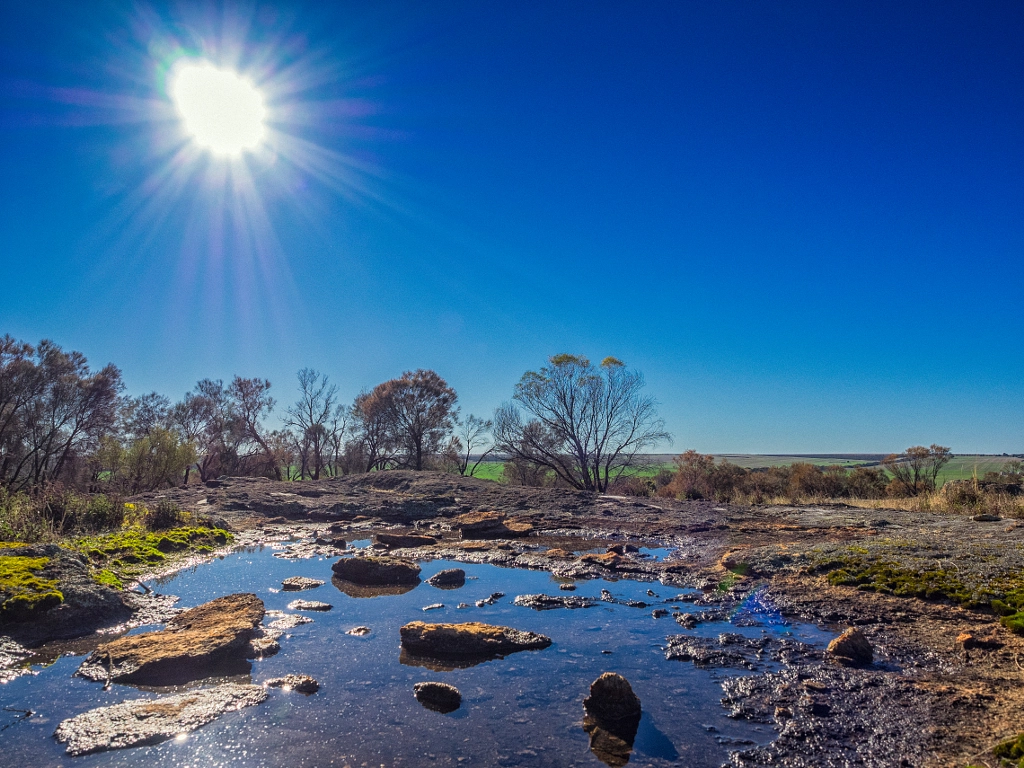
There are a couple of walks in the reserve – The Gamma Trail a 1.2km interpretative walk explains the significance of the area to the local Nyoongar people, and the Kalari Trail, a 1.6 Km trail climbs to the summit. The early morning walk to the summit was fantastic. There were kangaroos amongst clumps silver princess trees (Eucalyptus caesia), nankeen kestrels were riding the thermal currents looking for prey and there were hosts of wrens bathing in the shallow pools of water on the rock surface. You get the feeling that this is a place where everything has been stripped back to the elemental essentials. Time was standing still. Of course the moment was lost as the multitudes of tourists pulled up in the car park jumped out to grab a selfie in the cave and use the toilet, their chattering voices carrying up to the summit shattering the tranquility. For a brief couple of hours on top of the humps I was somewhere else quite magical.
Rock pool on the Humps. The Humps are a large granite outcrop to the north-east of Hyden, Western Australia. Olympus OMD EM1 mki with Olympus m.Zuiko 12-40mm f2.8 lens. Exposure: 1/640, f8 at ISO 200.
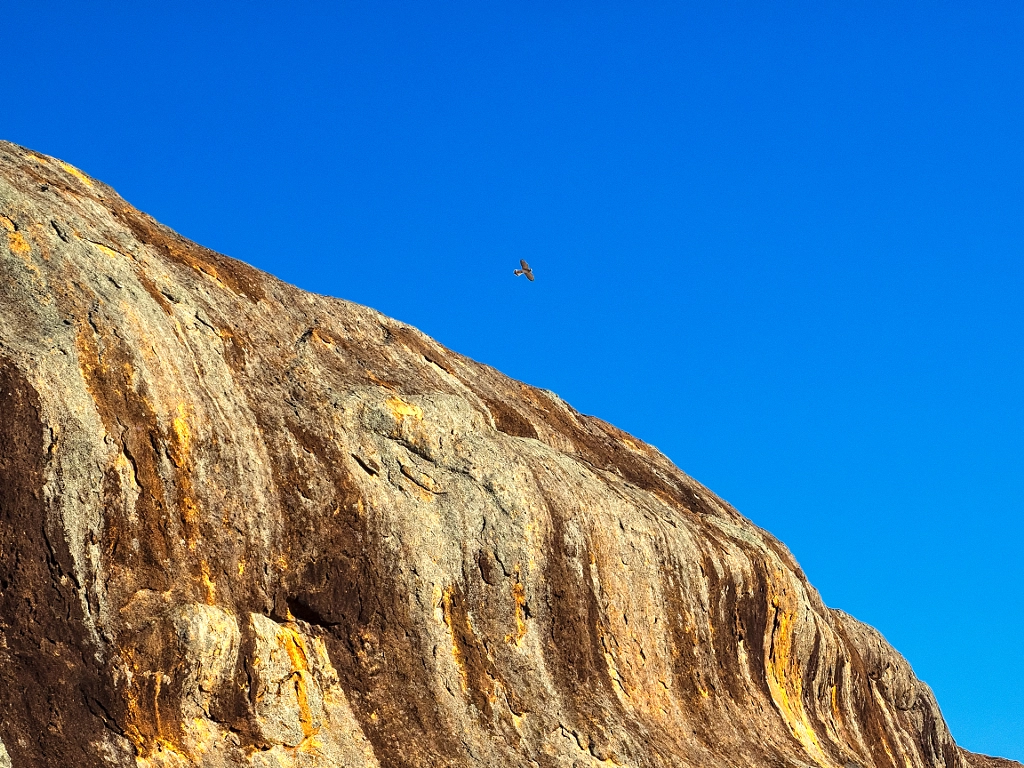
A nankeen kestral soaring the summit of the Humps. Hyden, Western Australia. Olympus OMD EM1 mki with Olympus m.Zuiko 12-40mm f2.8 lens. Exposure: 1/500, f9, ISO 200.
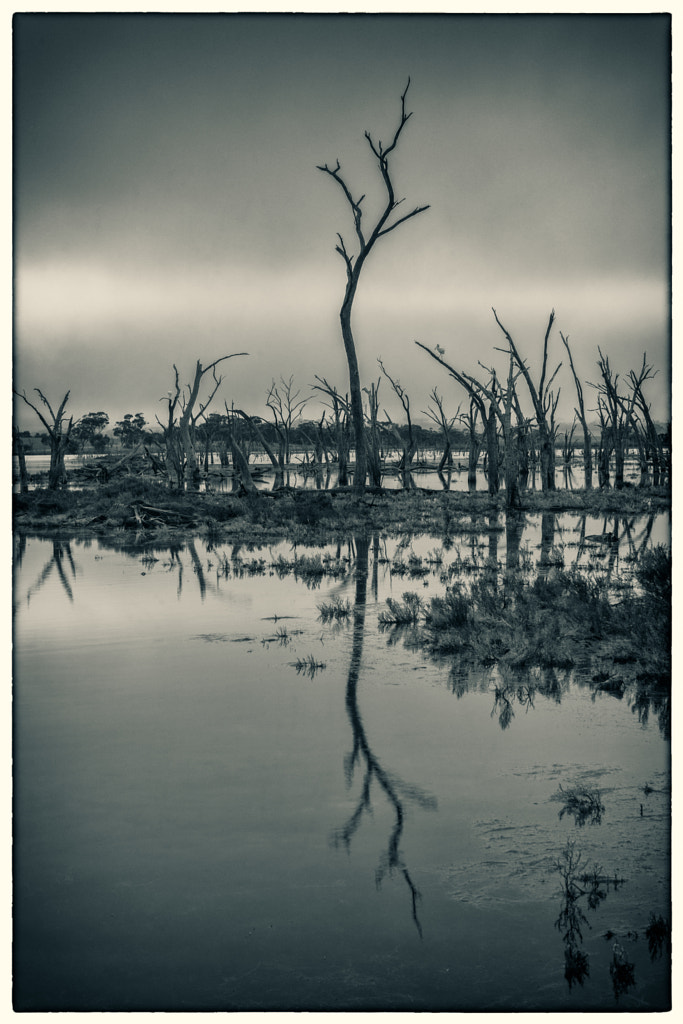
Dead trees on a winters misty morning in Yenyenning Lake. Beverley, Western Australia. Sony A7r with Sony FE 28-70mm F3.5-5.6 OSS lens, and Cokin 3 stop graduated neutral density filter and a circular polarizing filter. Exposure: 0.3 sec, F16, ISO 100.
Plus One – a winter spider orchid (Caladenia drummondii) and its visitor. Sorenson’s Reserve, Western Australia. Canon EOS 6d with Canon EF 100mm f2.8 IS L macro lens. Exposure: 1/250 sec, f11, at ISO 400.
Yesterday I decided to go on a little road trip to Babakin in search of the winter spider orchid. You’ve got to be mad to do a round trip of 320Km in the hope of finding one very small flower. It was a good day for it, the weather was cloudy and overcast, perfect for this type of photography, and I had nothing else scheduled. So packed my camera gear into the car, made sure the mobile was loaded with music and set off to the teeming Wheatbelt metropolis of Babakin. Now Babakin is in the local government area of Bruce Rock, which according to the Australian Bureau of Statistics covers an area of 2,727 square kilometres (1,053 sq mi) and has a population as of 2015 of 939 people. Babakin itself has a population of 25 – it is safe to assume that the local canine population out numbers the people – so there’s not a lot out there except wheat fields.
The drive was great, a lot of it on dirt track so plenty of red dust, and the time and distance just flew by thanks to the music. The shuffle play threw up some golden oldies – the best being Crazy On You by American group Heart. Put that one on full-bore. I wasn’t exactly head banging but lets say that the bouncing around of the car wasn’t entirely due to the road surface. Oh that took me back to the Chichester RocSoc at the New Park Road Community Centre.
Now these days we rely an awful lot on technology, I’m no exception, I was using my mobile phone for music and navigation. As I got close to my destination the phone just cut out – no more navigation, no more music. No mobile network coverage could explain the first but not the later. I switch to my TomTom SatNav and that packed up – couldn’t get a signal. OOOOeeeeeerrrrrr! Luckily I was nearly there. When I got to the nature reserve I did what I normally do and that is switch on my handheld GPS and mark the position of the car. These reserves have no facilities of any kind, not even paths or tracks, so I do this so I can just wander around in the bush and then when I’ve had enough I just follow the GPS to get me back. So off I walk. After an hour and a half I eventually find a single tiny specimen and proceed to photograph it. I use off camera flash fired by radio triggers to light my pictures of orchids. I set everything up as usual took a shot and noticed the flash didn’t go off. Tried again – nothing. Checked everything was firmly in place – nothing. Changed the batteries in the transmitter and receiver – still nothing. Bugger! Had a rummage around in my camera bag and found an old TTL cable so that got me out of the fix. Eventually I packed up and started walking to the car. I looked at the GPS screen and saw that it was blank. Bugger! I replaced the batteries – nothing. Another set of batteries and still NOTHING!!! Buggeration with bloody great knobs! A rising tide of panic starts to wash over me. Wash? No it was more like a tsunami. After a little pep talk I heard a truck go past. Now remember how I said earlier that this was a sparsely populated area? Yes? Well I can tell you I have never been so glad to hear a truck. I walked off in that direction battling through the scrub and eventually hit the road about 300 metres from the car. Phew!
The drive home was quiet – no phone, no SatNav, no music. When I got there after an hour and a half I carried everything into my office and started my usual post shoot ritual of zeroing all the camera settings, downloading the images and checking batteries prior to packing everything away. I almost jumped out of my skin when my phone beeped and started to play music. I checked the SatNav and it was picking up a signal, as was the handheld GPS. I tentatively got the flash triggers out and checked them and they were working just fine. WEIRD! Perhaps there’s just something about Babakin.
I can’t go without putting a YouTube video up for Heart’s Crazy On You. It’s a cracking track and this time I’ll put up a live recording from 1978 and from 2013 so you can see how the band has fared over time. All I can say is that Anne and Nancy Wilson can still strut their stuff in their sixties. Respect!
Helen and Frida pausing for a sit down while following the Bibbulmun Track alongside Wilson Inlet, Denmark, Western Australia. iPhone panorama.
Normally summer is pretty full on here in the vast Wheatbelt Metropolis that is York – temperatures hovering around the 40 ℃ (104 ℉) mark. Consequently most people here plan on getting away to the coast during summer for some respite from temperatures more akin to a low oven setting rather than the weather. I say “normally” as this years weather is really topsy-turvy, but as we had to make the accommodation booking some 6 months in advance we went any way. Our preferred escape York/the heat destination is Denmark – no not the country, the town on the south coast of Western Australia.
Walking round Wilson Inlet on the Bibbulmun Track. Denmark, Western Australia. iPhone panorama.
We rent the same house on Wilson Inlet as it enables us to walk the Bibbulmun Track that follows the edge of the Inlet for some distance. The track has been an abiding interest for us for many years, Helen has end to ended on it, me I’ve just done one over night and lots of day walks. It is always a great pleasure to get out into the bush.
Looking Up. Walking up to Mount Hallowell on the Bibbulmun Track, Denmark, Western Australia. Olympus OMD EM1 with Olympus m.Zuiko 12-40mm f2.8 lens. Exposure: 1/100th sec, f8, at ISO 200.
For a more strenuous walk we climbed Mount Hallowell, Helen reckons it is one of the harder sections on the whole track. We managed it relatively easily – which probably has more to do with the fact that we weren’t encumbered by 10Kg back packs.
Follow the Snake – the Wagyl trail markers. Helen on the granite outcrops on Mount Hallowell. Denmark, Western Australia. Olympus OMD EM1 with Olympus m.Zuiko 12-40mm f2.8 lens. Exposure: 1/160 th sec, f4, at ISO 400.
We walked up Mount Hallowell – which is more of a big hill than a mountain, and then on to Monkey Rock, which is a granite outcrop on the southern side of the hill that gives 270 degree views over the surrounding karri forest, southern coastline and Wilson Inlet. Despite the stunning views I took no photos as the air was very hazy. Still there’s always next time!
Sun Up. The sun comes up over the peak. Mount Hallowell, Denmark, Western Australia. Olympus OMD EM1 with Olympus m.Zuiko 12-40mm f2.8 lens. Exposure: 1/400th sec, f8, at ISO 200.
The town hall in the historic Western Australian town of York in pre-dawn light. Sony A7r with Olympus OM Zuiko 35mm f2 lens and Cokin 3 stop graduated neutral density filter. Exposure: 2.5 sec, f8 at ISO 100.
The other morning I got up at stupid O’clock to shoot a dawn time-lapse of the York Town Hall. So what do you do while you’re hanging around waiting for it to finish? Why take photos of course! So while the Leica D-Lux clicked away doing it’s time lapse thing I set up the Sony A7r and started taking snaps of the town hall. Good job I did as the time lapse wasn’t that crash hot.
The rainbow lorikeet (Trichoglossus haematodus) is a feral bird in Perth that commonly nests on the platforms at the base of palm fronds. Olympus Pen EP-5 with OLYMPUS M.45mm F1.8 lens. Exposure: 1/25 sec, f5.8 at ISO 200.
Warning this blog entry contains avian themes!
The other day I had to take the car into be serviced in Victoria Park near the Causeway. This meant I had time to kill so I decided to take a walk along the northern bank of the Swan River Foreshore. I hadn’t been along there for ages and there has been some recent redevelopment of the area so I decided to have a sticky beak. These are a few of the pictures I took as I wandered around.
Little Corellas (Cacatua sanguinea) Swan River foreshore, Perth, Western Australia. Olympus Pen EP-5 with OLYMPUS M.45mm F1.8 lens. Exposure: 1/800 sec, f4 at ISO 200.
Australian darter (Anhinga novaehollandiae) on the Swan River foreshore, Perth, Western Australia. Olympus Pen EP-5 with OLYMPUS M.45mm F1.8 lens. Exposure: 1/2000 sec, f4 at ISO 200.
Little Dove. The Duyfken (Little Dove in English) replica moored at Elizabeth Quay on the Swan River, Perth, Western Australia. Olympus Pen EP-5 with OLYMPUS M.17mm F2.8 lens. Exposure: 1/125 sec, f8 at ISO 200.
First Contact , Elizabeth Quay in Perth, is a five metre tall artwork by Nyoongar artist Laurel Nannup. The work depicts the arrival of European settlers to Perth. As the European boats arrived, the local Nyoongar people believed that these ships, were their past ancestors returning from the sea. Olympus Pen EP5 with OLYMPUS M.17mm F2.8 lens. Exposure: 1/400 sec, f8 at ISO 200.
The 20-metre high suspension bridge is an iconic architectural feature of Elizabeth Quay. The bridge forms part of the popular ‘bridges’ recreational route along the Swan River and provides a link between the promenades, the island and Barrack Street Jetty. Olympus Pen EP5 with OLYMPUS M.17mm F2.8 lens. Exposure: 1/500 sec, f8 at ISO 200.
*Swanning around and swanning about mean to move about aimlessly, irresponsibly and in a carefree manner. Related terms are swan around or about, swans around or about, swanned around or about. When the terms swanning around and swanning about first appeared in the late nineteenth century, they simply described the process of swimming like a swan. Today’s meaning of the term swanning about has its origins in World War II, interestingly. At that time, swanning around and swanning about described the movements of tanks in battle, in seemingly aimless maneuvers. The term made its way into mainstream English to mean anyone moving about in an irresponsibly carefree or aimless pattern. Swanning around and swanning about are primarily British terms, they are rarely seen in the United States.
Last weekend you could be forgiven in thinking that the War of The Roses had broken out afresh in the Western Australian town of York. There were lots of grim looking men glad in chain mail and armour brandishing an assortment of fearsome looking weapons while women wafted around wearing hose, kirtles, gowns, surcoats, girdles, and bonnets while listening to bards strum away on lutes.
A grim looking man in chain mail with a fearsome looking axe.
The images were shot with an Olympus OMD EM-1, an OMD EM-10 with Olympus m.Zuiko 12-40mm f2.8 and 40-150mm f2.8 lenses. The files were processed in Adobe Lightroom and Alienskin Exposure X.




You must be logged in to post a comment.