Evolution Of Technique And Style

Scented Sun Orchid by Paul Amyes on 500px.com
This shot of a Scented Sun Orchid was what I considered my first successful photo of an orchid. The subject is separated from the background making easy to see.


I took what I call my first proper shot of an orchid back in 2008. Back then my technique was very simple – handheld with a macro lens. The problem was that it was often very difficult to isolate the flower from the background while having sufficient depth of field and a low ISO. For every successful photo there were hundreds of duds.


Butterfly Orchid by Paul Amyes on 500px.com
This shot of a Butterfly Orchid is one of the hundreds of duds. The messy background threatens to overwhelm the subject.


After about a year of trial and error (mostly error) I decided to photograph the orchids in the same way I would take a portrait of a person. Get down at “eye” level, use an off axis flash to provide the key light and have the natural light as my fill light at -1 to -2 stops. This was a huge improvement, but I still wasn’t getting the clarity and sharpness in the images I desired.


Photographing Orchids
My first flash rig for photographing orchids. Using a flash brake allowed me to get the flash off of the lens axis and get a more pleasing lighting effect.


120907-York-1324
The next attempt at better lighting was a heavy tripod and light stand. My back hurts just looking at this photo.


The next evolution was to mount the camera on a tripod and then mount the flash to one of the tripod legs via a “magic arm”. This allowed greater choice in the positioning of the flash and allowed me to use different flash modifiers such as soft boxes, grids and snoots. The arrival of affordable and reliable wireless flash triggers  meant I could use multiple speedlights for more sophisticated lighting. This came a tremendous cost. I have a chronically bad back and all that kit was heavy, the tripod and “magic arm weighed just under 6Kg. Then there was the futzing about setting everything up, taking the shot, breaking it all down, walking to the next subject and then repeating it all again. Suddenly it wasn’t fun anymore. Something had to give and it was my back.


Olympus Pen EP-2
The diminutive Olympus EP-2. Just what the orthopaedic surgeon ordered.


Three Way Comparison
A size comparison of my DSLRs (Canon 5d and 550d) and the Olympus EP-2 which replaced them.


In 2013 I bought an Olympus EP-2 mainly for travel and street photography. It was a revelation – small size, In Body Image Stabilisation (IBIS), and excellent flash implementation. It quickly became my orchid camera of choice. I could chuck out the tripod and become more mobile. It wasn’t all beer and skittles though. The 12Mp sensor wasn’t the best in terms of high ISO performance and dynamic range, the lack of a viewfinder made usage in bright sunlight problematic (solved with the addition of the optional EVF) and the contrast based autofocus system was a bit on the temperamental side. But the positives were enough to keep me using it and when the EM10 came out with a built in EVF, a better IBIS system and an improved sensor then I knew that the system would be just about perfect for what I did. I could walk around in the bush for hours at a time without back pain which meant I could explore further afield. This freedom allowed me to experiment a lot more.


Sigma’s 105mm f2.8 DG DN macro lens attached a Sony A7Rii.


The Tamron 35mm f2.8 lens has excellent macro capabilities.


Curly Locks by Paul Amyes on 500px.com
Curly Locks, Thelymitra spiralis. Wandoo National Park, Western Australia. Sony A7r2 with Sigma 105mm f2.8 DG DN macro lens.


White Spider Orchid by Paul Amyes on 500px.com
White Spider Orchid, Caladenia longicauda subsp longicauda. Wambyn, Western Australia. Sony A7r with Tamron 35mm f2.8 lens.


In 2021 I felt that I wanted more resolution than the 20Mp EM1 mk ii was giving me. So I tentatively dipped my toe into the world of full frame mirrorless and I went with a second hand Sony A7r2. The image files produced by the camera were absolutely gorgeous. Alongside my usual working method of using flash with macro lens I decided to experiment with environmental portraiture of orchids. For this I used a 35mm lens with a half size macro capability and the results were pleasing. The downsides were as follows. The rear LCD is hopeless in bright light and it has no touch control facility. The IBIS wasn’t as effective as that on my Olympus cameras and the sensor resolution emphasised very tiny camera shake. A tripod was the solution. The sensor is a dust magnet which means that changing lenses enables dust bunnies to proliferate. The answer was to have one camera with the 105mm macro and one camera with the 35mm. Arrrrrgh! I was back carrying a load of heavy equipment. So it was back to the Olympus kit.


Lemon Scented Sun Orchid by Paul Amyes on 500px.com
This shot of a Lemon Scented Sun Orchid was made with the Olympus Em1 mk ii, Olympus 40-150mm f2.8 lens with 1.4 x teleconverter and the Olympus FL600R flash using the focus stacking function.


I’m still trying to evolve a style which produces a nice clean portrait of an orchid. One of the great benefits of Olympus’s cameras and lenses is that it allows very long telephoto lenses to have an almost macro capability. The use of such long lenses allows you to throw backgrounds well out of focus by dint of their increased magnification which reduces depth of field. The problem is that that decreased DOF means that it is hard to get your subject rendered sharp whilst retaining all that loverly bokeh. The counter to this is focus stacking which involves taking a series of pictures of the subject while moving the focus point and then blending the images in post. Olympus has a very neat feature that allows you to do this automatically in camera which is fantastic. Unfortunately the function limits your flash usage by restricting your maximum flash sync speed to 1/50th second and you have to manually set the flash exposure. I tried doing this for a while and it was a right royal pain. So now I don’t use the flash and just make the exposure using ambient light. The lens I’m using is the Olympus 40-150mm f2.8 with the the mc-14 1.4 x teleconverter. This gives me a 210mm f4 lens (420mm in full frame terms). Despite shooting wide open this invariably means shooting at a low shutter speed. So while the IBIS is fantastic on my EM1 mk ii using it with a long lens while focus bracketing wasn’t the best way to proceed. So it was back to a tripod. My aluminium Manfrotto 055 tripod is a good tripod but it is that heavy you could use it as a boat anchor. It was time to get a bit of fibre in my life – carbon fibre. So I bought a nice Sirui  AM-254 carbon fibre tripod which weighs just a smidge over 1Kg. It doesn’t have a centre column and so a minimum working height of 7.8cm which means you can get down and close to the subject. The results have been excellent and now I feel that using both my normal macro lens and the telephoto zoom with converter I’m getting closer to what I have envisioned.


20200818-Beverley-0002-Edit
The Sirui AM 254 tripod in action.


So this has been my journey of finding what works for me. I’ve discovered that learning how your equipment works is just as an important step in developing vision and style as is technique. Continual learning and experimentation will help you develop as an artist and we shouldn’t be afraid to do so. A few times I’ve felt that I was going backwards, but it was worth persevering. I’ve still got a couple of things to sort out, but I feel now I’m on the right track.

The following shots were made this last week.


Common Bunny Orchid by Paul Amyes on 500px.com

Common Bunny Orchid, Eriochilus dilatatus subsp. multifloris. Oswald Sargent Reserve, Western Australia.A focus stack using the Olympus EM1 mk ii with the Olympus 40-150mm f2.8 lens and 1.4 x teleconverter.


Hare Orchid by Paul Amyes on 500px.com
Hare Orchid or Fringed Hare Orchid (Leporella fimbriata). Oswald Sargent Reserve, Western Australia.


It’s Christmas


Christmas Rock Walk Trail that is. Christmas Rock is in Wongan Hills and I’ve written about going there before. This time I’m writing about the Christmas Rock walk trail which is located in a 2000 hectare reserve. It is an easy 2.7Km walk along relatively flat well marked paths not far from the centre of the town site. Along the trail are interpretive panels which give insights into the reserve. What makes it worthwhile is that at wildflower time the walk passes through country that is a riot of colourful flowers. It is a gobsmackingly beautiful sight this year as the weather conditions have been ideal. The bird life in the reserve is also pretty impressive and their song provides a fitting score for a very pleasant walk.


Christmas Rock Walk Trail by Paul Amyes on 500px.com
Cristmas Rock Walk trail is an enjoyable easy 2.7Km walk trail in the Wheatbelt Town of Wongan Hills. Sony A7r with Tamron 35mm f2.8 lens. Exposure: 1/160 sec, f8 at ISO 100.
Yellow Everlastings by Paul Amyes on 500px.com

Yellow everlastings at Christmas Rock, Wongan Hills. Sony A7r with Tamron 35mm f2.8 lens. Exposure: 1/125 sec, f8 at ISO 100.


Everlastings by Paul Amyes on 500px.com
Pink Everlastings, Christmas Rock, Western Australia. Sony A7r with a Tamron 20mm f2.8 lens. Exposure: 1/160 sec, f8 at ISO 100.


The rock gets its name from the Western Australian Christmas Trees (Nuytsia floribunda) which used to be found there and flowered at Christmas time. On the top of the rock is an elaborate series of channels that were designed to harvest rain water run off for the “Railway Water Supply” which was built in 1916. But the rock is also home to a wide variety of plants such as lichens and mosses. On a warm sunny day if you’re quick enough you might see the lizards who live in the various cracks and crevices.


Christmas Rock Walk Trail by Paul Amyes on 500px.com
The walk takes you up on the top of the rock which was part of the “Railway Water Supply” built in 1916. Rainwater runoff was harvested through a series of channels and creeks. Sony A7r with Tamron 20mm f2.8 lens. Exposure: 1/800 sec, f8 at ISO 100.


Christmas Rock by Paul Amyes on 500px.com
A suprising number of plants grow on Christmas Rock. Sony A7r with Tamron 20mm f2.8 lens. Exposure: 1/320 sec, f8 at ISO 100.


Christmas Rock Walk Trail by Paul Amyes on 500px.com

Rainwater captured on Christmas Rock in natural forming crack, depressions and gullies. Sony A7r with Tamron 20mm f2.8 lens. Exposure: 1/400 sec, f8 at ISO 100.


But for me it is the display of orchids which brings me to Wongan Hills. There are so many different types in large quantities. It made me feel like a kid on Christmas Day. The funny thing is that it could have been very, very different. Prospectors actually dug pits looking for asbestos. Luckily they didn’t find it in large enough quantities to make it a viable commercial operation and went looking elsewhere. So in September give Wongan Hills a visit. This isn’t the only walk as there’s Mount O’Brien Lookout, Gathecole Nature Reserve, and the Mt Matilda walk trail. Then there are the lakes which host lots of water birds. So instead of a day trip why not make a long weekend of it.


Pendant Spider Orchid by Paul Amyes on 500px.com
Pendant Spider Orchid (Caladenia pendens, subsp pendens). Christmas Rock, Western Australia. Sony A7r2 with a Canon EF 100mm f2.8 IS L macro lens. Exposure: 1/40 sec, f5.6 at ISO 125.


Lemon Scented Sun Orchid by Paul Amyes on 500px.com

Lemon Scented Sun Orchid aka the vanilla orchid (Thelymitra antennifera). Christmas Rock, Western Australia. Sony A7r2 with a Canon EF 100mm f2.8 IS L macro lens. Exposure: 1/200 sec, f5.6 at ISO 125.


Lemon Scented Sun Orchid by Paul Amyes on 500px.com

Lemon Scented Sun Orchid aka the vanilla orchid (Thelymitra antennifera). Christmas Rock, Western Australia. Sony A7r with Tamron 20mm f2.8 lens. Exposure: 1/250 sec, f8 at ISO 100.


White Spider Orchid by Paul Amyes on 500px.com

A White Spider Orchid (Caladenia longicauda subsp longicauda) among the everlastings on Christmas Rock in Western Australia. Sony A7r2 with a Canon EF 100mm f2.8 IS L macro lens. Exposure: 1/125 sec, f5.6 at ISO 125.


Chameleon Spider Orchid by Paul Amyes on 500px.com

Chameleon Spider Orchid (Caladenia dimidia). Christmas Rock, Western Australia. Sony A7r2 with a Canon EF 100mm f2.8 IS L macro lens. Exposure: 1/800 sec, f5.6 at ISO 200.


Sugar Candy Orchid by Paul Amyes on 500px.com

Sugar Candy Orchid, Caladenia hirta subsp. hirta. Christmas Rock, Western Australia. Sony A7r2 with a Canon EF 100mm f2.8 IS L macro lens. Exposure: 1/250 sec, f5.6 at ISO 125.


Pink Candy Orchid by Paul Amyes on 500px.com

Pink Candy Orchid, Caladenia hirta subsp. rosea. Christmas Rock, Western Australia. Sony A7r2 with a Canon 100mm f2.8 IS L macro lens. Exposure: 1/80 sec, f5.6 at ISO 125.


Cowslip Orchid by Paul Amyes on 500px.com

Cowslip Orchid, Caladenia flava subs. flava. Christmas Rock, Western Australia. Sony A7r with a Tamron 20mm f2.8 lens. Exposure: 1/160 sec, f8 at ISO 100.

Fantastic Spring Show

According to those that know it has been an amazing spring here in the Avon Valley. We’ve had rainfall that hasn’t been seen for decades and we’ve had a flush of wildflowers that hasn’t been equalled for fifty years. It has been frustrating as I’ve only managed to get out and photograph the orchids three times, but when I did get out it was beyond superlatives. Here are the highlights.


Dark Banded Greenhood by Paul Amyes on 500px.com
Pterostylis sanguinea, or , , Mount Observation, Western Australia. Canon EOS 6d, Sigma 105mm f2.8 macro lens and Canon 430 EX Speedlite. Exposure: AE priority 1/50th sec, f16, ISO 3200 with -1 stop exposure compensation.


Hairy-stemmed Snail Orchid by Paul Amyes on 500px.com
The Hairy-stemmed Snail Orchid (Pterostylis nana) most common and widespread of the Pterostylis species in Western Australia. Mt. Observation, Western Australia. Canon EOS 6d with Sigma 105mm f2.8 macro lens and Canon 430EX Speedlite. Exposure: Aperture priority with -1 stop exposure compensation 1/100th sec, f8 at ISO 400.


Wallflower Orchid by Paul Amyes on 500px.com
The wallflower orchid, aka the common donkey orchid (diuris corymbosa) lives up to it’s name and is commonly found in the south-west of Western Australia. Mount Observation, Western Australia. Canon EOS 6d with Sigma 105mm f2.8 macro lens and Canon 430 EX Speedlite. Exposure: aperture priority mode with -5 stops exposure compensation, high-speed flash sync 1/2000, f11 at ISO 200.


White Spider Orchid by Paul Amyes on 500px.com
White Spider Orchid (Caladenia longicaudia). Mokine, Western Australia. Olympus OMD EM-10 with Olympus m.Zuiko 60mm f2.8 macro and Metz ring flash. Exposure: ƒ/16.0 , 1/80s, at ISO 800, manual mode with -2 stops exposure.


Purple Enamel Orchid by Paul Amyes on 500px.com
Easily recognisable the Purple Enamel Orchid has glossy purple flowers which fade and become pink with age. Mokine, Western Australia. Olympus OMD EM-10 with Olympus m.Zuiko 60mm f2.8 macro lens and Metz ring flash.


Dancing Spider Orchid by Paul Amyes on 500px.com
The dancing spider orchid (Caladenia discoidea) is also known as the antelope orchid and the bee orchid. Mokine, Western Australia. Olympus OMD EM10 with Olympus m.Zuiko 60mm f2.8 macro lens, & Metz ring flash. Exposure:


Lemon Scented Sun Orchid by Paul Amyes on 500px.com
The lemon scented sun orchid, also known as the vanilla orchid,(Thelymitra antennifera) is named after its strong lemon scent. Mokine, Western Australia. Olympus OMD EM-10 with Olympus m.Zuiko 60mm f2.8 macro and Metz ring flash. Exposure: 1/160th sec, f8 ISO 200.


Blue China Orchid by Paul Amyes on 500px.com
Recognised by its intense blue colour, the Blue China Orchid is like the Thelymitra species in that it is heat sensitive and the flowers close at night on overcast days. Mokine, Western Australia. Olympus OMD EM-10 with Olympus M.Zuiko 60mm F2.8 Macro lens and Metz mecablitz 15 MS-1 ring flash. Exposure: manual mode, 1/100th sec, f8 at ISO 200.


Fringed Mantis Orchid by Paul Amyes on 500px.com
The Fringed Mantis Orchid (Caladenia falcata) is also known as the green spider orchid. Mokine, Western Australia. Olympus OMD EM-10 with Olympus m.Zuiko 60mm f2.8 macro lens and Metz ring flash.


Custard Orchid by Paul Amyes on 500px.com
Custard orchid (Thelymitra villas), York, Western Australia. Olympus OMD EM-10 with Olympus M.Zuiko 60mm F2.8 Macro lens. Exposure: AE priority 1/320th sec, f8 at ISO 200.

Clicking on an image will take you through to my online gallery.

Mistaken Identity

Easy Rider Horse
Easy Rider Horse, Kulin Tin Horse Highway, Western Australia


The other day I got an email from 500px telling me that some of the pictures I had listed with them for licensing could not be accepted because I didn’t have model releases for them. On contacting 500px I got the following reply:

 “We recently ran an algorithm to detect images that had people in them with no release attached, this was our attempt to speed up the ingestion process since we are working through a bit of a backlog at the moment. It has certainly been effective in identifying unreleased photos, but it sometimes tags photos that don’t have people in them so we still have some tweaking to do :)”

Heather
500px Prime

Now I can sort of understand how the shot at the top got selected by the computer as the sculpture does have some anthropomorphic features. But this next one sort of defies any sort of reasoning.

White Spider Orchid
White spider orchid, caladenia longicauda, is one of Western Australia’s most well known orchids. Mokine, Western Australia


Tiananmen Square.
A stone lion guarding Tiananmen Square.

Here the program picked the face of Chairman Mao on the wall of the Tiananmen gate tower to the Forbidden City north of Tiananmen Square. I don’t think I’d have much chance of getting a model release from Mao Zedong  seeing as he’s been dead for 39 years! I also think it’s a bit late to get a release from the subject of this next photo.

Australian Gothic
Australian Gothic. An old kangaroo skull found on Mount Brown.


I was even expected to get a model release from Elvis Presley for this next shot.
York Motor Show 2013
There’s a little bit of Elvis in all of us. York Vintage Car Show 2013. York, Western Australia

The annoying thing was that were 134 photos with this error so it doesn’t inspire a lot of faith in 500px to actually do a good job of selling the work because when you buy stock you enter what you want into a search engine and their computer has just demonstrated that it has no clue as to the subject content despite captioning and tagging.

Ambling In The Avon Valley – part 2

York

York Town Hall and the Imperial Hotel on Avon Terrace.

The pearl in the Avon Valley, York is approximately 100 Km east of Perth. First settled in 1831 it is WA’s oldest inland town and it prospered as an important agricultural centre. The Gold Rush saw York become an important commercial centre and fueled its rapid growth. Many of York’s historic buildings date from this era and it is the number of intact Colonial and Federation buildings that has earned the town its National Trust classification of historic town. The main focus of activity is Avon Terrace and walking along it is like stepping back in time. The town hall was built in 1897 and was renovated in 1911 to give it the large and grandiose Romanesque entrance hall that is seen today. Next door is the Imperial Hotel opened in 1886 and is a particularly fine example of a railway hotel. It was the first two storey commercial building in York to be made out of local stone.

The historic streetscape of York’s Avon Terrace, Western Australia’s oldest inland town. The old Saregent’s Pharmacy building, and the Castle Hotel are fine examples of Gold Rush era colonial architecture.

The Castle Hotel , just a little further up Avon Terrace, has the distinction of being the oldest inland hotel in WA and was built by ticket of leave men from the York Convict Hiring Depot in 1853.  Other significant buildings on Avon Terrace are the Courthouse and Gaol Museum  and Settlers House .

York Motor Museum on Avon Terrace in York.

Also on the terrace is the York Motor Museum  which houses the Peter Briggs collection of one hundred and fifty vehicles that range from an 1894 Peugeot to a Williams FW07 which Alan Jones drove on his way to becoming the 1980 World Grand Prix Champion. The  Residency museum on Brook Street ((08) 9641 1751) is all that remains of the original Convict Hiring Depot which was built in 1852. In 1867 the building became the residence of the colonial governor and now houses an interesting museum. Close by is the old hospital building which opened in 1896 in response to a cholera outbreak in the Goldfields.

An old farmhouse sits derelict on a hill just outside York in Western Australia.
Parts of Mount Brown, in York Western australia, are covered in a carpet of pink everlastings.
White spider orchid, caladenia longicauda, is one of Western Australia’s most well-known orchids. Mokine, Western Australia.

In spring the surrounding areas of York become festooned with a huge variety of wildflowers, many of which can be found on the roadside verges. If you wish to see more prolific displays the main wildflower sites are:

  •  Mokine Reserve  has great many different species of wildflower with silky blue orchids, white spider orchids, donkey orchids, leschenaultia, and fringed lily being just a few.
  • St Ronan’s Reserve just off the Great Southern Highway does not have the density or variety of Mokine Reserve, but if you have time to walk around it will not disappoint.
  • Wallaby Hills Reserve off the Goldfields Road also puts on an impressive display including climbing fringed lilly, calytrix, yellow hibertia, rosy cheeked donkey orchids, paperlilly, peabush, cowslip orchids, and dryandra.
  • Mt Brown in York itself is also a great spot for everlastings and donkey orchids.
  • The roadside verges along Wambyn Road, which is a turn off from the Great Southern Highway, have blue leschenaultia, blue/purple dampiera, yellow/orange pea flowers, cowslip orchids, Donkey orchids, everlastings, white candle flowers, kangaroo paws, fringed lily flowers, and running postman creeper.
Beverley

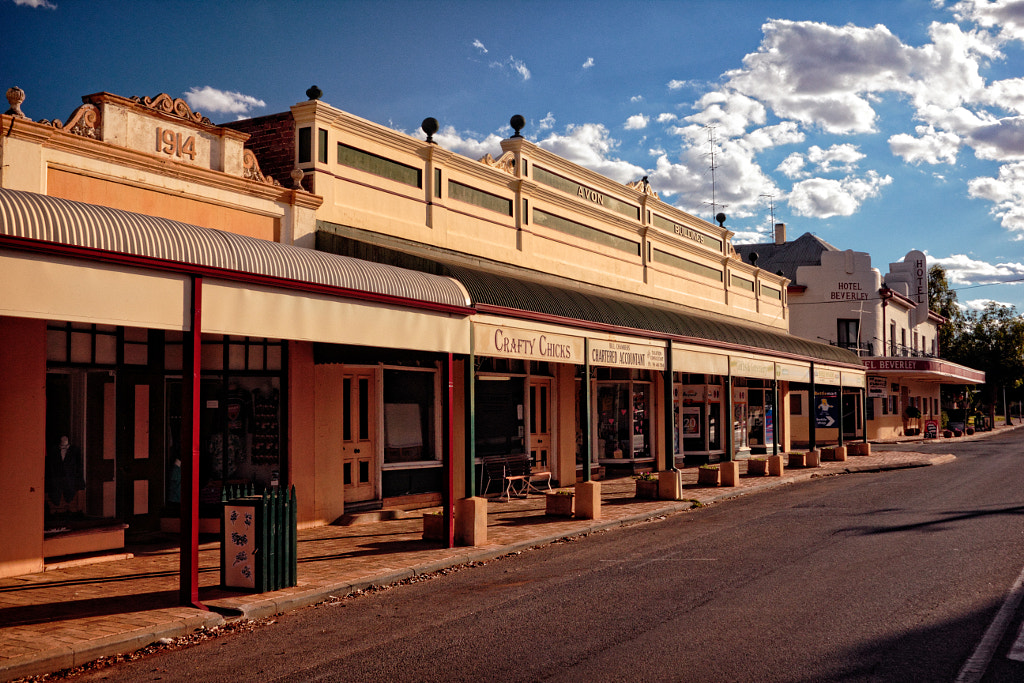
Beverley by Paul Amyes on 500px.com
Beverley is 130Km east of Perth in the historic Avon Valley. It is a quiet agricultural town with a unique blend of architectural styles that gives its characterful appearance.


Beverley is 130 Km east of Perth and is a quiet agricultural town with its own distinct character which has been created by the wide range of architectural styles used to build it. A walk down Vincent Street will take you from Colonial, to Federation, to art deco to a 1960’s geodesic dome. It all sounds a bit of a hodge podge but it really hangs together well. There is a collection of farm machinery at Ferguson’s Machinery Shed on Hunt Road that recalls Beverley’s by-gone years as an important agricultural hub.


Vampire by Paul Amyes on 500px.com
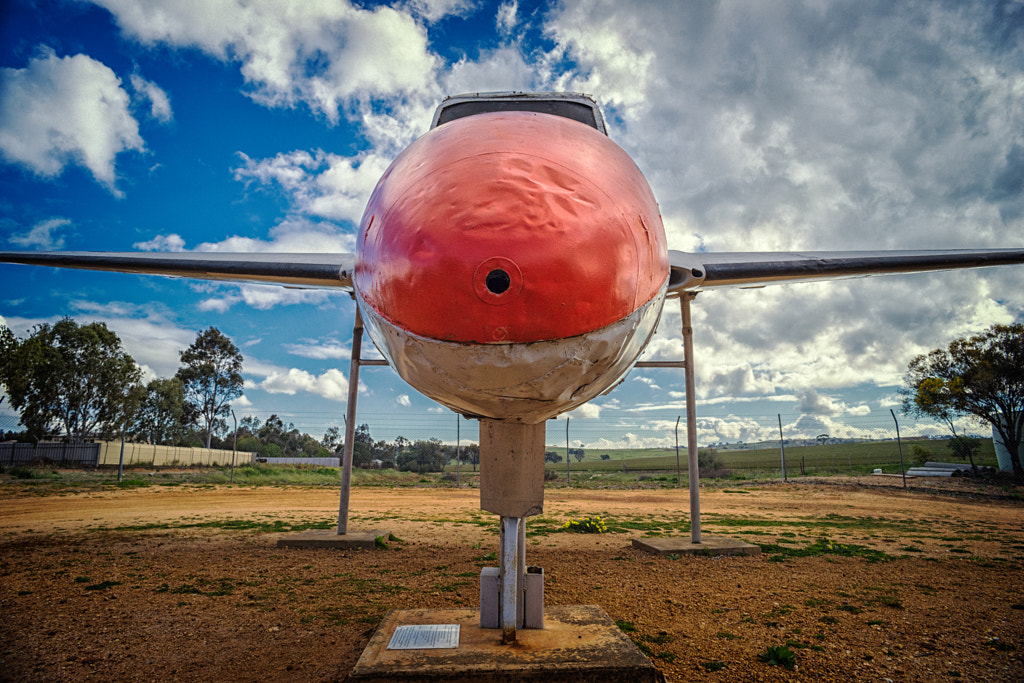
A Vampire jet on the Beverley-York Road


Beverley Station Arts by Paul Amyes on 500px.com
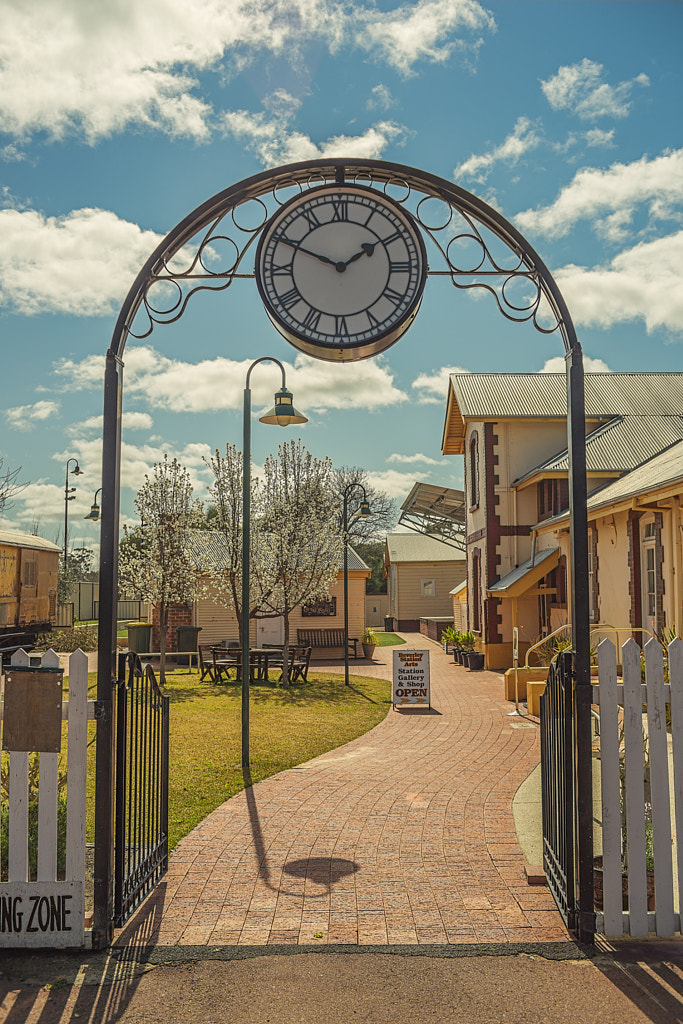
The entrance to Beverley Station Arts in the Western Australian town of Beverley.


The Railway Station was designed by George Temple-Poole and built in the Victorian Tudor style in 1886. It ceased to be a working station some years ago and has been renovated and converted into an arts centre. The Beverley Art Collection is on permanent display, there are resident artists, workshops and an outdoor theatre. The Dead Finish Museum was originally a hotel of the same name, its displays give an insight into what life was like in the early days of the district.

Dead trees ring Lake Yenyenning which became a salt lake after the land surrounding it was cleared for agricultural use. Beverley, Western Australia.

Outside of town are the Yenyenning Lakes which are a haven for birdlife and used for water sports, for directions ask at the Visitor Centre. Also out-of-town is Avondale Discovery Farm  which has an 1850’s era homestead and is a working farm run by the National Trust using historic agricultural machinery and techniques.


Beverley by Paul Amyes on 500px.com
Ute Muster at The Beveley Agricultural Show.


Events:

All the details for these events can be found at www.beverleywa.com/calendar.html .

  •  Beverley Ester Art Exhibition – a very popular event which attracts lots of visitors to the town.
  • Beverley Clydesdale and Vintage Day has demonstrations of horse-drawn ploughing and vintage tractors and is held at the Avondale Discovery Farm in June.
  • The Great Southern Working Sheepdog Society Finals coincide with the above event and are also held at Avondale.
  • Beverley Agricultural Show is  a real agricultural show. There are jam and cake competitions, pony events, tug of war, competitions for the best poultry, sheep, and cattle, and displays of country crafts. It is held in August of every year.
  • Beverley Harvest Festival at Avondale has displays of historic harvesting methods, working dogs, local produce to taste all capped off with music and dancing.
 

Beverley by Paul Amyes on 500px.com
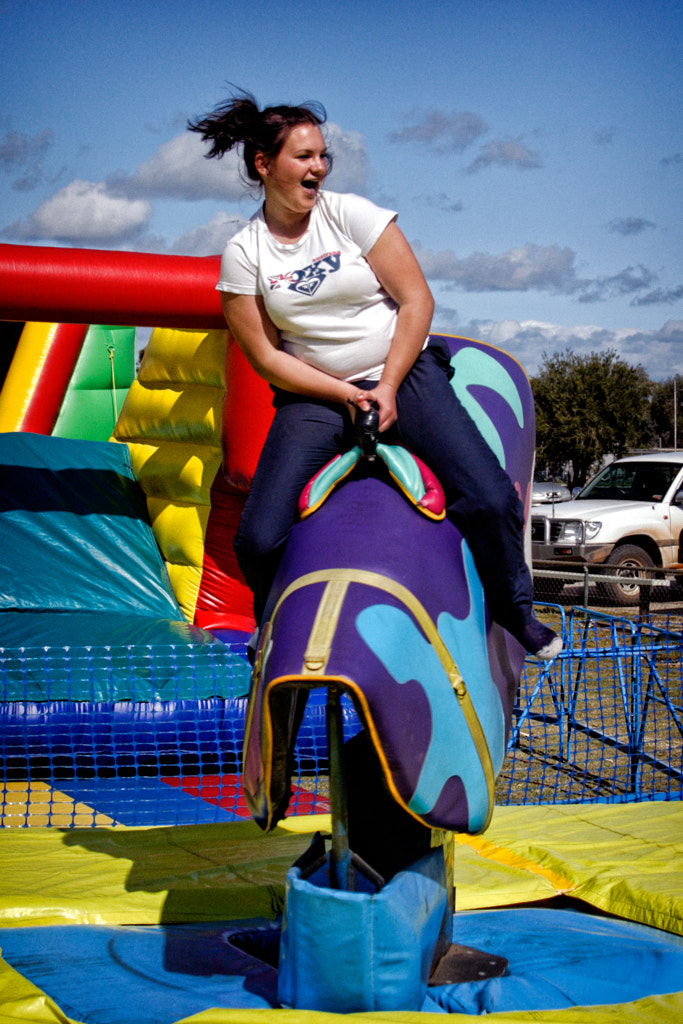
Riding the mechanical bull at the Beverley Agricultural Show.