State Route 120 is perhaps better known as the Great Southern Highway. It is the road that takes you to York once you leave Perth via the Great Eastern Highway. I always breathe a sigh of relief once we turn onto it because it means we’re leaving the madness of Perth and returning to our quiet country existence. I love driving down it watching the forest change gradually from Jarrah to Wandoo.The other thing I look forward to is the art work you see. For the last twenty or so years people have been decorating some of the trees. It maybe a complete paint job of a long dead tree or it maybe a small painting on board or sheet metal that has been attached to a tree.Every now and again a new piece turns up and its always a pleasant surprise.
Dave Minion. Great Southern Highway, Western Australia.
Australian Easter Stump. Great Southern Highway, Western Australia.
Startled stump. Gret Southern Highway, Western Australia.
Mary has seen better days. Great Southern Highway, Western Australia.
Tipper is not what he used to be – his ears have been broken off. Great Southern Highway, Western australia.
Happy to see you. Great Southern Highway, Western Australia.
Lucky The York Tree. Great Southern Highway, Western Australia.
I was feeling a bit of a loose end. The weather has been unpleasant and I didn’t feel like going out to photograph wildlife or wildflowers. I suddenly had the bright idea of documenting the art along the Great Southern Highway. To make it more interesting I decided to use some of my old classic film era Olympus lenses – specifically the OM Zuiko 21mm f3.5, the OM Zuiko 35mm f2, and the OM Zuiko 135mm f2.8 – on my Sony A7r. The whole process of framing up, setting up a tripod and manually focusing the cameras and carefully making the exposure is the complete antithesis of photographing birds and it made a nice change.
I’ve not been very active of late. I’ve had a few niggling injuries that’ve meant that I’ve not been able to get out and about much. What little photography I’ve done, and it is very little, has been taking piccies of the garden birds. Hopefully over the next week or so I’ll start getting out and about again.
Kool-boort or Singing Honeyeater (Gavicalis virescens) in my back garden.
Bandin or White-cheeked honeyeater (Phylidonyris nigra) in my back garden.
Based on the evidence of what I post on this blog I go out to take nature and wildlife photos, but actually I go to be out in nature. The photos below are what I love being out in.
The warm light of sunset reflected by the trees in the Oswald Sargent Reserve.
Driving back home from the Oswald Regent Reserve at sunset.
The last few weeks I’ve been concentrating on the Avon River and I wanted a change. So early one morning I got up so I could be in the wandoo woodland of Mount Ronan’s Nature Reserve as the sun comes up. There is nothing like the first rays of the sun hitting the trunks of the wandoo trees. The golden rays illuminate their pale bark and they all but glow in the warm light.
Wardawort or Grey Butcherbird (Cracticus torquatus). Mount Ronan Nature Reserve, Western Australia.
I got off to a promising start – as I pulled up I was greeted by a mob of kangaroos. They weren’t so keen to see me however and took off into the bush. There was an incredibly loud melodious piping and warbling coming from the tops of the trees. At first I thought it was magpies singing a bit strangely, but after closer inspection I found it was about a dozen grey butcher birds calling out to each other. What was amazing about it was they were all singing the same phrases taking turns with no gaps. You would be forgiven for thinking it was one bird as the performance was so seamless. It was like a choir recital.
Djini or Rufous Treecreeper (Climacteris rufa) climbing up the trunk of a tree. Mount Ronan Nature Reserve, Western Australia.
Djini or Rufous Treecreeper (Climacteris rufa) taking some time out in the sun. Mount Ronan Nature Reserve, Western Australia.
Stalking animals in the wandoo forests is hard as the trees shed bark, twigs, branches and leaves in great quantities which means that the ground is covered in a thick crunchy mulch and no matter how hard you try to move quietly you always end up making a racket. The end result is that it is hard to get close enough to take photos. The ideal approach is to sit down and wait for the birds to come to you. After about half an hour I could hear the sound of small birds chasing insects and was rewarded with several rufous tree creepers. A few minutes later and I could see one climbing up the trunks of a tree to foraging for insects and grubs – I’ve never seen one going down they always seem to climb, and when they get as far up as they want the glide down to the ground or the next tree.
Djida or Yellow-rumped Thornbill (Acanthiza chrysorrhoa). Mount Ronan Nature Reserve, Western Australia.
As I continued to walk around the forest I must confess that I lost focus as I spotted a couple of orchids. It was annoying that I only had my bird photography rig with me and nothing really suited to photographing very small flowers. From that point on I was trying to watch for birds while looking on the ground for orchids. It is an impossible task.
Hare Orchid or Fringed Hare Orchid (Leporella fimbriata). Mount Ronan Nature Reserve, Western Australia.
Common Bunny Orchid, Eriochilus dilatatus subsp. multifloris. Mount Ronan Nature Reserve, Western Australia.
By 9:30 the best light had gone so I decided to call it a day and walk back to the car. Waiting for me was a female red-capped robin sitting on the fence. She was quite obliging and sat for a while allowing me to take her photo.
Female Dermokalitj or Scarlet Robin (Petroica boodang aka Petroica multicolour subsp campbelli). Mount Ronan Nature Reserve, Western Australia.
Moonset over Mount Ronan Nature Reserve, Western Australia.
Big Bob is the resident Yoorn or Bobtailed Lizard. He lives under the house and can occasionally be seen exploring the garden. Normally he is a very feisty lizard with a lot of attitude, but on Monday we found him in the shade house looking very sorry for himself. At first we thought he’d gone down with Bobtailed flu, but on closer inspection he was shedding his skin. We often find the old skins in the garden but I’ve never seen this happen. So we thought we’d just leave him be and get on with it. On Tuesday he’d moved out onto the grass and we were worried about him as we often get kestrels, goshawks or sparrow hawks use our TV aerial as an observation post and they’d have no qualms about making a meal of him. He started wriggling and writhing in the grass in an attempt to get his old skin off. By lunch time apart from a few scraps between his toes he’d got the job done. By Wednesday he was back to scaring our Bull Terrier, Frida, and walking round the garden like he owns it. Another couple of weeks and he’ll be tucking himself up for the winter.
Big Bob our resident Bobtailed Lizard found in the shadehouse looking very sorry for himself.
He’d started to shed his skin and was looking very tatty.
Not dead, wriggling in the wet grass trying to remove the old skin.
As the sun warmed everything up he was content to lie like this for about half an hour.
Right side up again.
Still looking a bit manky.
After another hour mission accomplished – looking all new and neat again.
Wayan or White-faced Heron (Ardea novaehollandiae) shrouded in the mist on the banks of the Avon River. York, Western Australia.
Early mornings along the River Avon have taken on a decidedly misty appearance. Going down to Monger’s Crossing at first light and I’ve been hard pushed to see across the river. The upside of this is that by carefully walking and crawling I can get quite close to the herons and spoonbills there. The spoonbills seem a bit more stoic than the herons. They just get on with the normal morning routine of foraging in the shallows for food. In contrast the heron looked decidedly unimpressed with the weather just standing in the long grass with its shoulder hunched up and looking forlornly at the water coming down from the weir.
Kaaka-baaka or Yellow-billed Spoonbill (Platalea flavipes) foraging on a misty morning.
Ngalkaning or Nankeen Night Heron (Nycticorax caledonicus subsp mannillenis) in the early morning mist.
Looking up the Avon River with Mount Bakewell shrouded in the early morning mist. York, Western Australia.
After an hour or so the sun gradually started burn off the mist and the golden light gave a radiance to everything. The sun’s warmth began to take effect and the birds became a lot more active and I was able to get some photos of birds flying, which is always a thrill. The still and quietness of the mist was gone and replaced by the raucous noise of the corellas and the honking of the herons as they flew overhead. By 9 o’cock it was all over. The birds had settled and no activity could be seen.
Golden Orb-weaving Spider’s web lit by the golden dawn light.
Wayan or White-faced Heron (Ardea novaehollandiae) flying in the warm light of dawn.
Manatj or Western Corellas (Cacatua pastinator) flying over the Avon River in York Western Australia.
Wayan or White-faced Heron (Ardea novaehollandiae) taking in the suns rays. York, Western Australia.
As we approach winter it is now easier to get up before first light as it gets light so much later. On Thursday, which just happened to be my 60th birthday, I got up and head down to the river just getting there as the sun started to rise above the tree line. I was hoping to see some Nankeen Night Heron’s but couldn’t find them, but I did find a strangely cooperative White-faced Heron who was happy to sit on a branch and allow me to get close enough to photography. The bird was looking into the rising sun and the warm glow was reflected off his feathers. The heron looked very majestic just perched there. A wonderful start to the day.
Geat Egret, Ardea alba. York, Western Australia.
Put to flight.
Feeling safer.
Walking up past Monger’s Weir I didn’t see anything more so I decided to head back and grab a coffee at the local bakery. As I was walking back I spied a Great Egret in one of the billabongs beside the main river. We’ve recently had a lot of rain so it was full and the egret was in the cooler shade of the trees while the golden light played on the foliage. Again another magical moment. Although Great Egrets are fairly common along the river it had been ages since I’d last photographed one. Again it was quite happy to let me sit quietly and take its picture. It knew I was there as occasionally it would stare at me as if to say “You still here?”. Eventually a boisterous dog burst through the undergrowth and put the bird to flight. It didn’t fly far – just 10 metres or so to the top of a dead sheaoak tree. By now the sun was well and truly up and we had the most brilliant blue sky so I quickly grabbed some shots of the egret against it.
Playing silly buggers in the trees. Djakal-ngakal or Galah (Cacatua roseicapilla). York, Western Australia
As I got near to the swing bridge to cross over into town some galas were playing around in the trees so I spent the next half hour photographing their antics. After a coffee I walked back to the car and saw four Nankeen Night Herons – three adults and a juvenile – so I grabbed a few shotsof them. A perfect end to a great photo session and a perfect start to a great day.
A juvenile Nankeen Night Heron, (Nycticorax caledonicus subsp mannillenis). York, Western Australia.
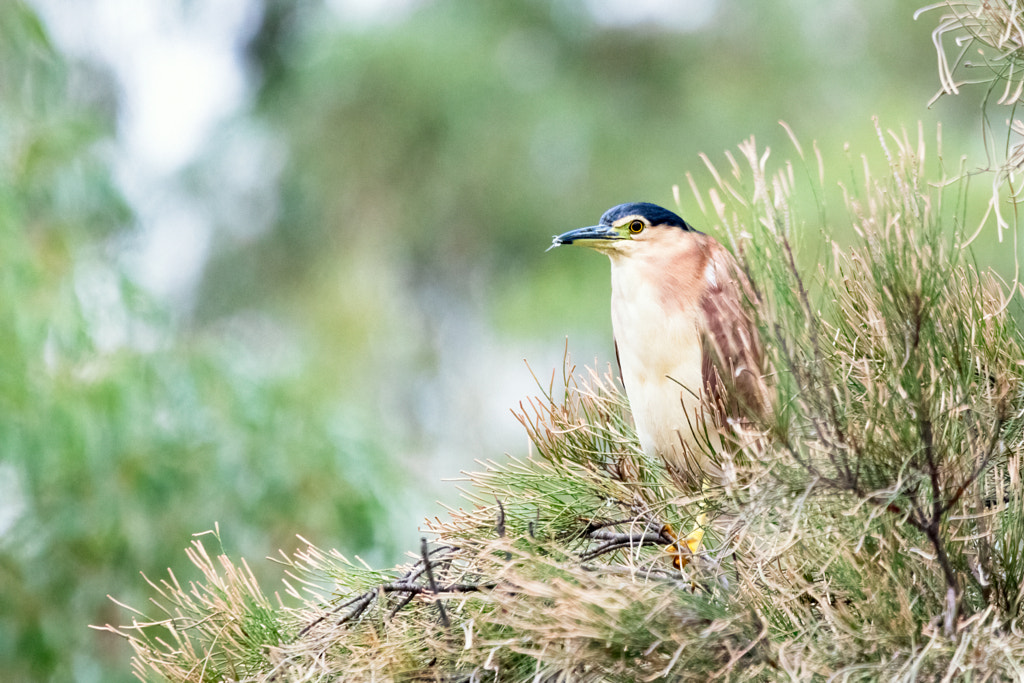
Ngalkaning or Nankeen Night Heron (Nycticorax caledonicus subsp mannillenis). York, Western Australia.
Ngalkaning or Nankeen Night Heron (Nycticorax caledonicus subsp mannillenis). York, Western Australia.



You must be logged in to post a comment.