
Reunited

Reunited, and it feels so good

Reunited ’cause we understood

There’s one perfect fit

And, sugar, this one is it

We both are so excited ’cause we’re reunited, hey, hey

Songwriters: Dino Fekaris / Frederick J. Perren


This is the first part of a two part series.
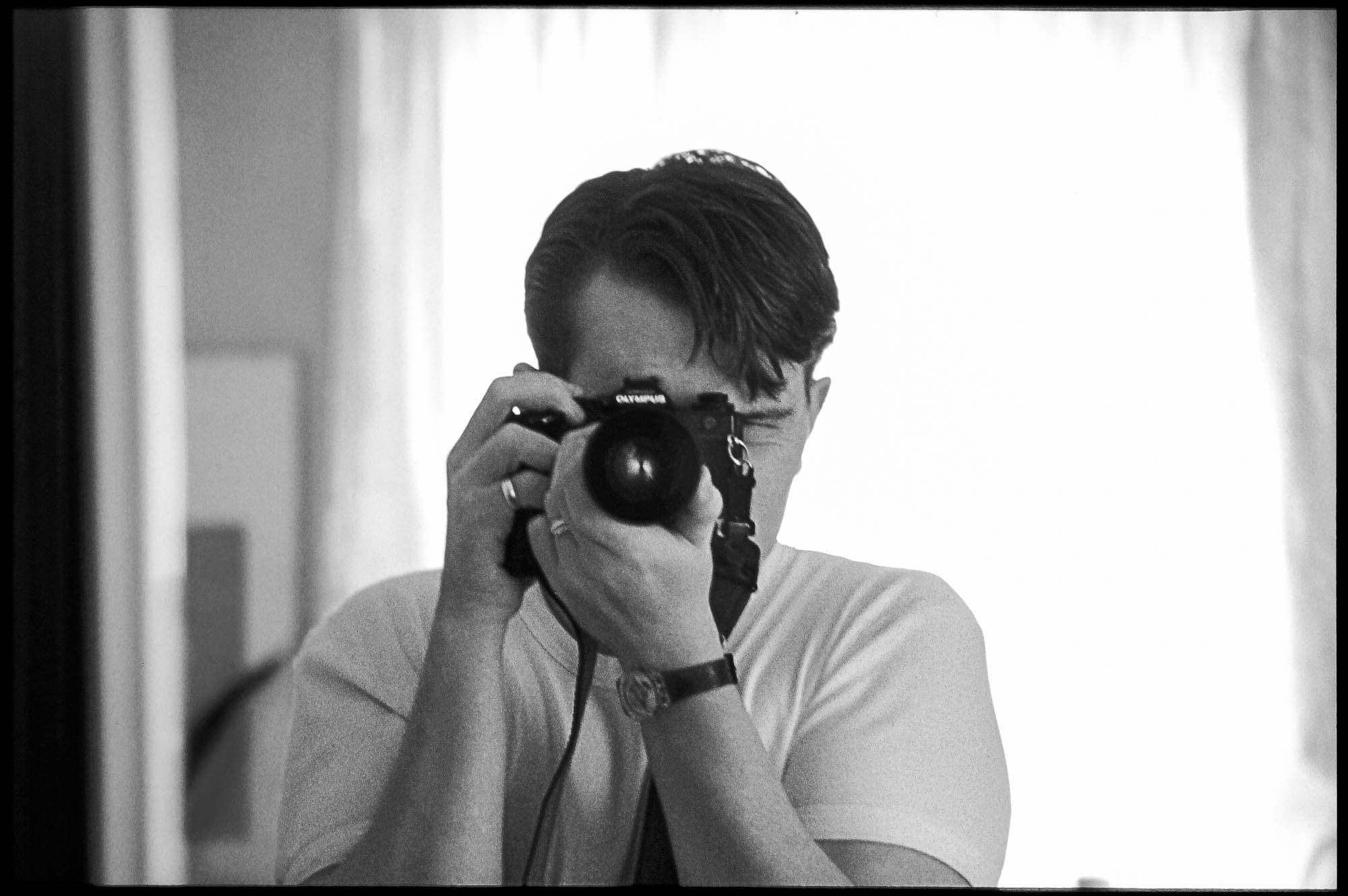
 

My earliest selfie, taken in 1987 just before we headed off to India. The camera is an Olympus OM4 with 35-105mm lens.


The camera that I have most enjoyed using is not a modern digital mirrorless one, nor is it a DSLR. It is a film SLR from the early 1980’s. What was so special about it? Well it never got in the way of me doing what I wanted. Some devices are designed in such a way that they impose upon you a certain way of working and you have to alter your thinking and behaviour to use them. This means you can’t use it intuitively and you have to take a moment to figure out how to use it. The device literally gets in the way. The best industrial design emphasises a mixture of function and haptics so that the object virtually disappears and you can just concentrate on the matter in hand. So what was this magical camera? It was the Olympus OM4.


Olympus OM 4 SLR


The OM4 was the successor to the OM2n as the flagship of the OM system when it was introduced in 1983 and remained so until it was superseded by the improved OM4 Ti in 1986. The OM system itself was the brainchild of Yoshihisa Maitani whose design philosophy was to produce low cost high quality cameras that were Leica like in image quality. They had to be small enough to carry everywhere and also be durable. The system had to be capable of handling any task from microscopy, macro, astronomy, photojournalism and wildlife. Above all he wanted it to be the “kind of camera that inspires increasing satisfaction as the photographer gets to know it better, it will gain a permanent place in his affections as an indispensable photographic tool”. Burrows, P., 2023, The man behind the Olympus OM camera: Yoshihisa Maitani, DigitalCamera World). It worked for me and as far as I was concerned the OM 4 was/is the perfect camera.


Olympus OM 4 SLR
Although looking very simple by todays standards this was a very sophisticated camera back in the 1980’s


What made it so good? The strong weatherproof body meant it could be taken anywhere (mine accompanied me to Moscow in winter, -30ºC outside, and to Malaysia, 40ºC and 100% humidity, without missing a beat. The enormous catalogue of high quality Olympus OM Zuiko lenses. The amazing for it’s time TTL flash control system that let you use off camera flash and control it from the camera. It was the first camera with a built in multi-spot exposure meter (2% field of view) which enabled you take take 8 spot readings and average them. This made it ideal for practitioners of Ansel Adams’ Zone System. Only two other manufacturers did this – the Hasselblad 205TCC and  the Rollei 6008. Another unique metering feature was the ability expose for highlights or shadows automatically at the touch of a button. The viewfinder was big and beautiful with a build in diopter correction with a range from +1 to -3 diopters. Then there was the shutter with its enormous range of of 240 seconds to 1/2000. It wasn’t just the specs that made it so good, it was the way it sat in your hand. It is a beautiful thing. Were there any downsides. Well there were actually as no camera is perfect. The first was the flash sync speed of 1/60 sec. It meant using fill in flash outside was nigh on impossible in bright conditions. The second was its insatiable appetite for SR44 batteries. It went through them like a trust fund baby goes through money. Thankfully there was a workaround and it was to switch the shutter speed dial to “B” when you weren’t using it. This would disable the electronics and prevent battery drain. You just have to remember to switch off the B setting when you go to use it again.


Olympus OM 4 SLR
It just felt so perfect in my hands.


I bought a second hand OM 4 in 1986 and I used it heavily until 2005 when the shutter gave up the ghost and jammed. I couldn’t get it repaired as there were no parts. I thought about replacing it as I had quite a selection of lenses, but I was transitioning to digital and Canon looked the way to go. I’ve been toying with the idea of shooting film again and I’d still got the use of a couple of film SLRs. The first being my wife’s Olympus OM40 and the second being my Canon EOS30. I didn’t gel with either camera as I didn’t find them enjoyable to use and I didn’t feel as if I had any incentive to try something else. The debate about AI in photography really spurred me on to think about film photography again and it was my 61st birthday coming up so I decided to buy myself a present in the form of an OM4. I searched on line extensively and eventually I found a very nice copy on EBay at Japan Seto Inland Sea Camera with an Olympus OM G.Zuiko 50mm f1.4 lens for a very good price. When it arrived I opened the box and took it out. Even after twenty years I could operate all the controls with my eyes closed. It felt so good – like seeing a long lost friend.


Olympus OM 4 SLR


So I’ve now got the camera and lenses and a sizeable stash of film in the freezer. I’ve got a couple of ideas for projects and I’m learning how to scan the negatives using a DSLR and macro lens. I’ll shoot a few rolls of film and get them developed by a lab and if all goes well, which I’m sure it will, I’ll get everything together to process the films at home. I’ve already decided I don’t want to run a full darkroom again so any printing I do will be via my inkjet printer.


The title for this blog and the lyrics come from the 1970’s hit for Peaches and Herb.

OM*

My new full frame Olympus with the Olympus OM Zuiko 50mm f1.4 lens mounted on a Fotodiox adapter.

Well I’ve done it. I’ve gone full frame digital with Olympus. No I’ve not got access to some top-secret prototype from Olympus. Instead I’m mounting OM Zuiko lenses on a “full frame” (I hate that term, I much prefer 35mm sensor) camera digital – the Sony A7r to be precise – with a Fotodiox pro OM-NEX adapter.

“If you date your cameras, you marry your lenses.”

– David Hobby

Sony A7r with Olympus 24mm, 35mm and 50mm lenses. The Fotodiox Pro OM to Nex lens mount adaptor allows them to be mounted to the camera.

I was left with a collection of Olympus OM lenses when Olympus in their infinite wisdom decided to abandon the OM mount – this did not occur with the advent of digital imaging, but back in the film era. I migrated to the Canon EOS system reluctantly and left my lovely jewel like Zuiko lenses sitting in a drawer. Every now and again I would get one out and fondle it. Oh the beautiful feel of the buttery smooth focusing ring with its long throw. The cool feeling of the metal body with that heft that instantly denotes high quality precision engineering. To cap it off and send me into a rapturous state is the aperture ring – firstly there is one, and then there is the feel and sound of that ring as you change aperture. Just thinking about sends me into the throes of ecstasy.

Now it is a little known fact that when Yoshihisa Maitani designed the OM system he chose to make the flange distance a mere 46mm. At the time he probably thought that this would make a very compact SLR. But the unforeseen benefit of this decision is that it makes the OM lenses very easy to adapt to other cameras. Indeed when Canon brought out the ground breaking EOS 5d I was aware that you could buy an adapter to fit Olympus lenses to the body. But the experience was to me somewhat dismal. DSLRs really aren’t made to use manual lenses. It’s like expecting to find meat in a chicken McNugget. A disappointing experience. When Panasonic and Olympus announced the birth of micro four thirds in 2008 one of key features was the jettisoning of the mirror box found in SLRs. This has a couple of benefits. Firstly it means that a much shorter flange focal distance can be used. In ordinary speak this is the distance between the sensor/film plane and the lens mount on the camera body. Micro four thirds has a distance of 19.25mm which meant it was ideally suited to adapting lenses. I talked about this in April 2013 and again in April 2016. The second benefit was the provision of focus peaking. Focus peaking had long been found on video cameras by dint of them having an electronic viewfinder, it was quickly added to the feature list of mirrorless cameras. I first used it with the EM10 and was very happy with it. But there was a fly in the ointment. My carefully considered lens collection had been altered by virtue of the crop factor, basically a 50mm lens on m4/3 gives an angle of view equivalent to a 100mm lens on a 35mm sensor. Bugger! So apart from video use I put the old lenses away again.

A little while later Sony heralded the launch of their A7 series of full framed mirrorless cameras and initially my interest was piqued but the reality of buying into another camera system (I was already running Olympus m4/3 and Canon EOS) was just not an option. So I feigned disinterest. But an interesting thing happened, Sony update their models with incredible speed and that meant the prices of second-hand A7 and A7r dropped faster than an Essex girl’s knickers. All of a sudden my beautiful OM lenses were restored to their full frame glory.


Olympus OM Zuiko 50mm f1.4 at f8.

To test the lenses I shot a standard scene which was composed of a book shelf in my sitting room. Mounting the camera on a tripod I then framed up so that the complete height of the shelf filled the frame. The shots were taken wide open and then stopped down to f8. To see more detail in the test shots just click on the image and it will open in a new browser. This will be an evolving series of articles about using various OM lenses.


Olympus OM Zuiko MC 50mm f1.4


Olympus OM Zuiko MC 50mm f1.4

The first lens most people whack an adapter on is a fast standard. The 50mm f1.4 was one of the original lenses that was introduced when the OM system was launched at Photokina in 1972. The original silver nosed (a term referring to chromed front mount ring) had a single lens coating and was 36mm in length.The newer MC version was introduced in 1984. Along with the new improved lens multi coating the design was changed resulting in a length of 40mm with a weight of 280g. The lens construction is seven elements in six groups. Despite being a fast lens it has a modest size and has a 49mm filter thread.

50mmf14optic


Shooting my test subject one of the very first things I noticed is that the image displays very slight barrel distortion. This is where image magnification decreases with distance from the optical axis and makes parallel straight lines look like the edges of a wooden barrel. This phenomenon is usually associated with wide-angle prime lenses or the wide end of standard zooms. It does happen in standard primes lenses but usually only at close focussing distances so it was surprising to see it here. Wide open lateral chromatic aberration (CA) is perceptible and at f8 cannot be seen. In terms of sharpness at f1.4 the image is universally soft and lacking in contrast. Stopping down to f8 improves the image and the lens is sharp across the frame. The lens renders beautifully with a gentle fall off in tones and the bokeh is a delight being soft and smooth. The lens is quite resistant to flare and I haven’t felt any great need to put on a lens hood.

olympus-50-cpmparison-1

A street sign on Avon Terrace in York, Western Australia. Taken on a Sony A7r with Olympus OM Zuiko 50mm f14. Shot at f1.4.


Al fresco at Henry Saw in Grand Lane in Perth WA. Olympus OM Zuiko 50mm f1.4

In conclusion – well I always thought that it was a very good lens when I shot film and now having had the opportunity to mount it on a high megapixel digital camera I am not disappointed. If adapted lenses are your thing I would definitely recommend you to acquire a copy.


* today’s musical reference is to the Moody Blues the pioneers of art rock and progressive rock.