
I had a load of bits and pieces from various experiments shooting at Park Beach scattered over my hard drive so I put them together in a short video.
multi media
FlatPack Hell
To visit and buy Ikea furniture is an experience that sears the psyche, but assembling it is a journey to the deepest and darkest levels of Hell itself and threatens your mortal soul.
Having fun with the time-lapse function of the Leica D-Lux. It is so much easier to use than the one in Olympus m4/3 cameras and will even generate the movie file for you at the end.
When The Saints…
This wasn’t intended to be a video project – I’d just gone along to take some photos using my Olympus EM1 and EM10 with the 12-40mm and 40-150mm f2.8 zooms. Then right at the end I’d realised that I had never shot any video on the EM1. So without a tripod or monopod I filmed one song hand-held using the 12-40mm. Luckily I had my Rode VideoMic Pro in my bag and I just mounted this in the flash hot shoe and hoped the sound was good enough. I just love the built in image stabilisation – it did a fantastic job here.
The Long And The Short Of It

The Olympus m.Zuiko 75-300mm f4.8-6.7 mk ii (which shall now on referred to as the 75-300) is an updated version of their original super telephoto zoom for the micro four thirds format.Yes I said super telephoto zoom because that is what it is as it is equivalent to a 150-600mm lens in 35mm sensor terms.


Keeping up with the m4/3s promise of smaller cameras and lenses this lens does not disappoint. It fits comfortably in the hand is quite a bit smaller than my Canon 75-300mm f3.5-5.6 IS which only covers half the focal range when mounted on my EOS5d. There are rumours on the various forums that the lens is designed and built by Sigma, but there is no evidence of that fact when looking at it. The 75-300 is largely constructed from engineering plastic and has a metal mount. There is no weather sealing. The lens extends while zoom, roughly doubling its length, there is no lens creep which is nice. While not heavy it feels reassuringly dense in the hand and not at all cheap and wobbly like some budget zoom lenses.The filter diameter is 58mm which it shares with the 40-150mm f4-5.6 and means that filters won’t be too pricey. Optically the lens has 18 elements in 13 groups, two of which are ED glass and one is Super ED (extra low dispersion). These exotic elements are there to minimise chromatic aberration throughout the zoom range. They certainly do the job for when I open up images shot with the 75-300 in Lightroom they are remarkably free of CA. The lenses elements are coated with Olympus propriety ZERO (Zuiko Extra-low Reflection Optical) coatings and I’ve found the lens to be quite resistant to backlit flare, however flare can be induced by bright light sources just outside of the frame so I would heartily recommend the use of a lens hood. Unfortunately Olympus does not include one in the box.


Performance wise the 75-300 is remarkably good for a lens of this price and zoom range. The AF is quick and precise when shooting stills on both my EM-10 and EP-5, and quite a lot slower when shooting video. Optically the lens is very sharp up until the 200mm mark and then it does soften slightly, but this is not at all unusual with zoom lenses, which is unfortunate because this lens will be bought more for its uses at 300mm than 75mm. There is not a lot of love for this lens on the internet forums where it is harshly criticised for it performance at the long end, but from my experience with it it’s not as bad as people make out. I wonder whether camera shake is a contributing factor here. While Olympus bodies have In Body Image Stabilisation (IBIS) there is a limit to what it can achieve and we have to remember that this is the equivalent of a super telephoto 600mm lens in full frame terms and not many people would expect to handhold one of those and get tack sharp results. When using the lens on a tripod and monopod it certainly delivers the goods. When handholding I would certainly recommend not using a shutter speed of lower than 1/300th sec even when using IBIS.


Downsides of the 75-300. Well the slow maximum aperture will be a drawback for many, and I’ve read many threads where people have stated they would have preferred a constant f4. This all very well but lens design is a compromise and such a lens would be very large and heavy and cost considerably more. Personally I don’t mind using higher ISOs to keep the shutter speeds up as I’m happy to clean up my images with Niksoft’s Denoise. Another downside is when shooting video – this is not really a lens for run and gun style shooting, it is much to long to effectively control shooting handheld. Even on a tripod the lens showed up the failings of my fluid head for when panning there was quite a pronounced shudder when using it at its longest end.
Overall I feel that the few drawbacks are outweighed by the positives and I like this lens a lot. It is a very good lens when one considers the price. In Oz a full frame equivalent will cost at least double. I would recommend the 75-300 to anyone who was prepared to accept the trade offs involved i.e compact size and affordability versus the slow maximum aperture and the slight softening of the image at the long end. At the time of writing this there is only one other alternative, the Panasonic Lumix G.Vario 100-300mm f4-5.6 OS, which is at the same price point and has a similar performance. I would only consider the Panasonic over the Olympus if I was shooting on a Panasonic camera which has no IBIS. Both Olympus and Panasonic are introducing higher performance lenses at the 300mm focal length at some time in the near future, but I think we’ll find they are considerably bigger and more expensive.


So if you fancy doing a bit of sport or wildlife photography then I would thoroughly recommend this lens to all Olympus users.
ActionCam!
Regular readers will have noticed that since Christmas that I have been putting up video and stills that had been taken with a fish eye lens. For a while I was considering purchasing a suitable lens for either my Canon or Olympus systems as I had been intrigued by the effect. I was also very mindful that having bought such an item I would quickly tire of it and see it as a gimmick and so feel I had wasted my money. So when Dick Smiths (a popular chain of electronic stores here in Australia) offered the Sony HDR-AS20 ActionCam for $120 AUD just before Christmas I bought one seeing it as an affordable way of trying out extreme wide-angle photography and videography.
So what are my feelings about the camera. Well I do believe every photographer should have one of these cameras. They open up a world of creative photography. The lens is outside of the protective case pretty decent. It has a 170º field of view which is roughly equivalent to a 17mm on a full frame 35mm camera, a minimum focusing distance of 30cm (12 inches), a fixed aperture of f2.8 and is pan focus. There is obvious barrel distortion and some chromatic aberration. The distortion is all part of the look of fish eye lenses and the CA can be easily fixed in still images in apps such as Lightroom with a single click. The camera only produces jpegs, which bright and contrasty without too many artefacts. There is no control over sharpening and there are only two pictures styles, normal and underwater. You can’t control the ISO, the shutter speed nor the white balance. All being said it produces nice files and the exposures and white balance were largely spot on requiring minimal adjustments in post. For video the Steadyshot image stabilisation while being software based produces impressive results and was one of the major selection criteria for me when purchasing the camera. It’s not got the best video codec in the world nor the best bit rate and compression but it edits reasonably well as long as you don’t push it too far. A very nice feature is that the supplied software for the camera is embedded as firmware so that you don’t have to mess around with downloads or install discs. So what’s not to like – well the optical quality of the lens port on the protective case is pretty appalling, the supplied software is pretty flakey and crashes a lot on my relatively new iMac. No matter what I tried I couldn’t get the WiFi function to work using either my Sony Android phone or iPad. The Sony mount system isn’t as comprehensive nor widely as available as that of the GoPro alternatives. No problem just get an inexpensive adapter and then you can use anything made for GoPro. A real annoyance is that Sony have made it very difficult to plug in an exterior microphone. You can’t use one with the LCD case nor the standard protective housing. The one you can use it with means you loose the LCD and the protection.

Overall I’m very happy with the camera and have had a load of fun using it. The only thing is that it is totally addictive and I keep coming up with ideas for shots which inevitably means I have to buy another mount for it. Luckily they are cheap, but I have quickly acquired a bag full of them.


Quite a few scenes in this video were shot with the Sony HDR-AS20. I was surprised that the camera proved parrot proof!
Simply Sublime
I know I’ve said in the past that I’m not a great fan of MONA but just lately I’ve been going up there a bit because I’ve signed up to study a unit in Art Theory at University of Tasmania (UTas). I got up extra early to see an installation by American artist James Turrell called Amarna. There’s not a lot I can say about this work except that it is gob smackingly beautiful and very serene.
Here are a few stills.


Technical notes: the time-lapse sequence was made with a Sony ActionCam HDR AS20. The stills were shot using an Olympus OMD EM-10 with either an Olympus mZuiko 17mm f2.8 or an Olympus mZuiko 25mm f1.8 lens.
Quoll-ity Time
Filmed with an Olympus EP-2 with 40-150mm f4-5.6 lens and an Olympus EM-10 with 60mm f2.8 macro lens.
The Future Is Now
Over the last few months I have been sharing about some of the features that I have found interesting with the Olympus m4/3s system. To me personally the remote control of flash and the wireless control of the camera are exciting, not necessarily in the form that they’re in now but in what they herald for the future. I know I talk a lot about the old days but I think its important to know where we have come from in order to understand the potential of modern equipment. I am as I keep saying a very promiscuous photographer – I rarely stick to any genre for long and photograph what gives me pleasure and interest. At the moment I’m taking photos of the wildlife we find in our garden to document it because my wife has joined gardens for wildlife and because I’m lazy and like taking photos close to home, The following are just some photos of birds that can be found in the garden.


With the modern technology we have at our disposal taking these pics was straight forward. When we look at the work of pioneer ornithological photographer Eric Hosking and see the amount of kit he had to set up to take similar types of photos it is quite staggering. Examples of Hosking’s work can be seen here.

Now an EM-10, a telephoto zoom, a couple of flash lights and an iPad takes the place of a van load of stuff. I decided to put the kit to the test and then Mother Nature sank my plans. Here in the island paradise of Tasmania we are in the middle of what is laughingly called summer. The last few days it has been sheeting down and blowing a gale. In fact the weather has been so bad that 120mm rain fell overnight and this morning on my daily perambulation I had to wear a fleece and a soft shell water proof. As you can imagine the local wildlife isn’t too keen at putting in an appearance and I doubt that any equipment setup outside would last long. So in place of the local wildlife you’ve got me showing you how to do a hi-tech selfie. My wife would probably say that there is no difference as I’m pretty feral!
OK having done this what have I learnt? Well first of all using WiFi and the RC function uses power like a trust fund baby spends money. Setting up is easy but the amount of control offered by the Olympus Image Share App is very basic. You can control the exposure but you can’t get access to the Olympus Super Control Panel and that means that you still have to access the camera itself if you want to change your lighting ratios or switch from TTL to manual or vice versa. Although the camera is connected to the iPad via WiFi you still have to physically touch the screen to trigger the camera. So in future what would I like to see, well to start I’d like to have access to the SCP via the app so I’ve got more control over the camera and lights. Secondly I’d like to have more options to trigger the camera. At the moment I can’t use the ioShutter™ as my Olympus cameras have a proprietary connection to allow the use of a remote cable, so I’d certainly welcome either Olympus or the makers of ioShutter to make a remote that allows me to trigger the camera via sound or with a light trigger. I really think that we’re just at the very start of connectivity when it comes to cameras. Back in August 2012 I wrote about shooting using my Canon EOS5d tethered via a USB cable to a laptop and using Lightroom. Now I can do the same and more but wirelessly using a mobile phone or tablet. I hoping that in 2 or 3 years time we’ll see the functions I’ve talked about here.
Thylacine Sighted In Richmond
I went to the touristy olde world town of Richmond a little while ago and saw a Tasmanian Tiger or Thylacine. It had been turned into a garden ornament – “gnomified” if you like, just like the Buddha has been.

Tasmanians have a very complicated relationship with the Tassie Tiger. Images of the thylacine can be seen everywhere, it’s on beer labels, the state coat of arms, the coat of arms for Launceston, the logo for Tourism Tasmania. In fact it is everywhere. You might, therefore, come to the conclusion that it is a much-loved animal. In a way it is, but the truth is it wasn’t.
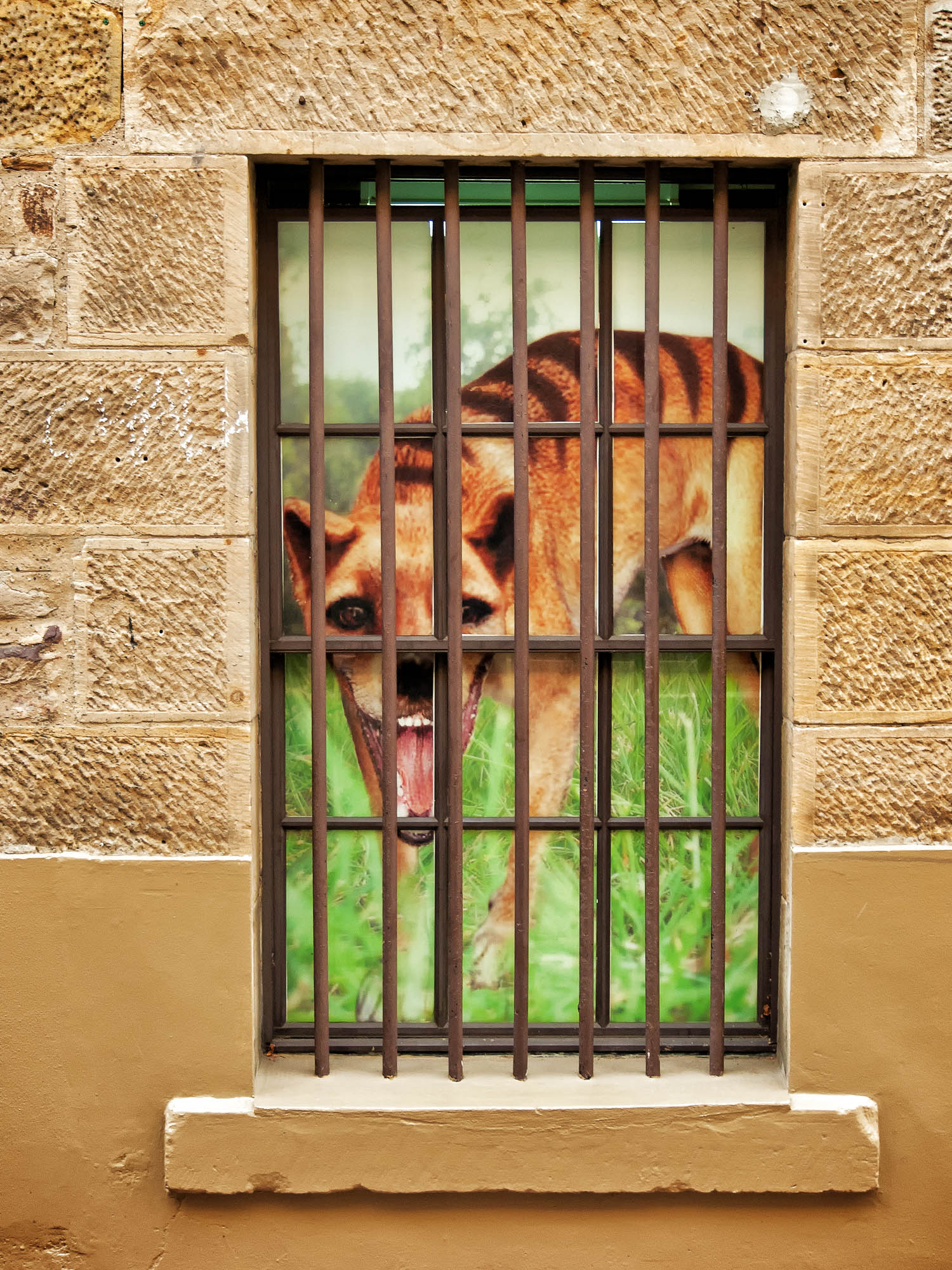
The Thylacine was a shy reclusive animal, the last of its kind – a carnivorous marsupial that was an apex predator and whose relatives went back into the mists of the mammalian era some 5 to 23 million years ago (the Miocene). Computer modelling has shown that the thylacine was not a very strong animal and would have been incapable of handling anything larger than 5Kg and it is now widely believed that they were ambush predators who preyed on small animals such as bandicoots and possums. When the first aboriginal people crossed to the Australian Continent via a land bridge some 40,000 years they brought with them the first dogs, the descendants of what we now call the dingo. The dog was simply a much better and more adaptable predator than the thylacine and by the time British colonisation started they were already extinct on the mainland. When the first settlers in Tasmania saw the thylacine they named it the Tasmanian Tiger or Tasmanian Wolf. There was an apocryphal tale appealing to Victorian gothic drama that can be traced back to just one source that the Thylacine was a blood drinker which preyed on sheep and poultry. That sealed its fate and a bounty was placed upon it and it was hunted vigorously.
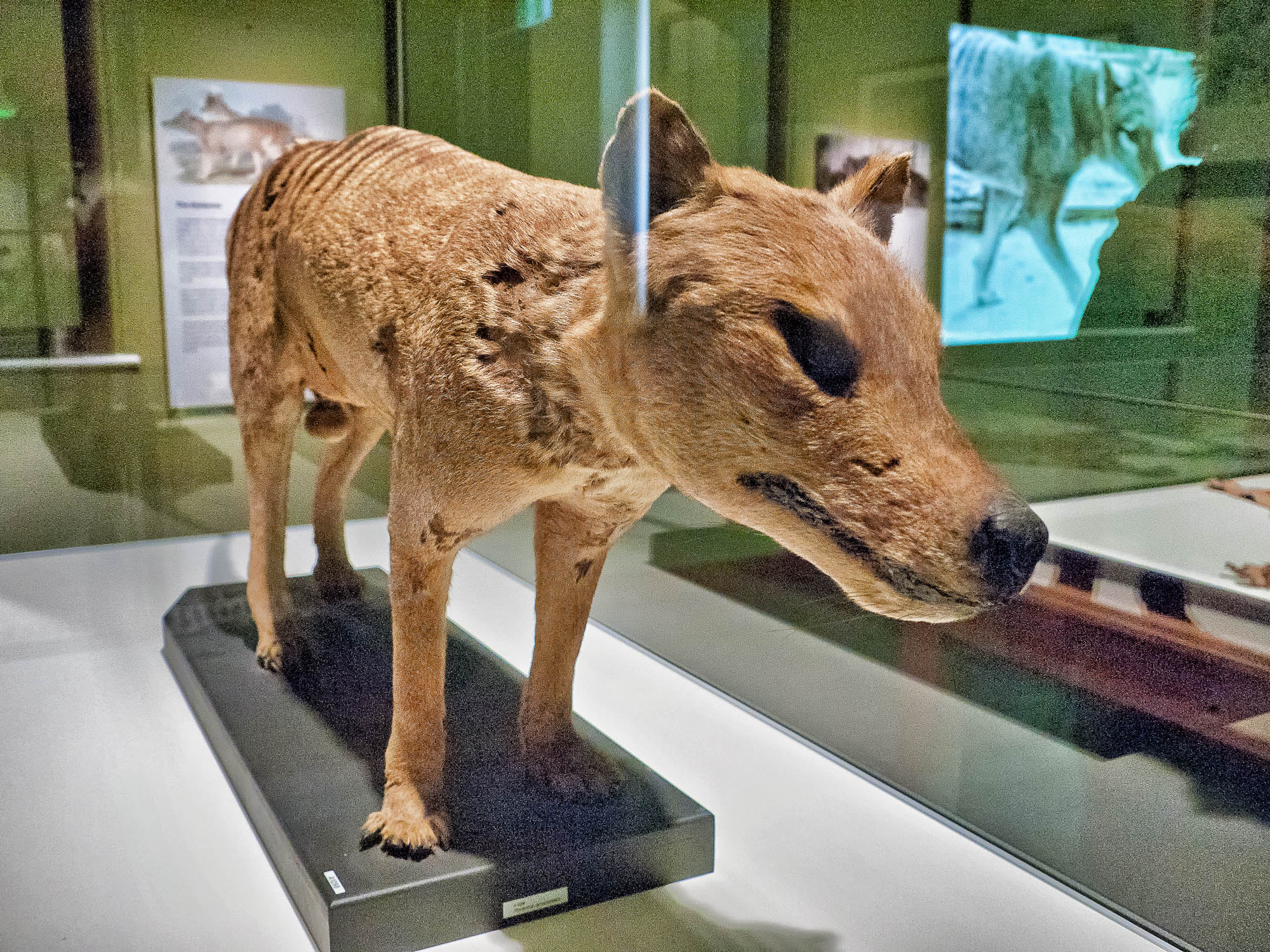
The bounty of £1 for a dead adult and 10 shillings for a dead pup meant that by the 1920’s it was rare to see a thylacine in the wild. In 1930 a farmer by the name of Wilf Batty shot the last wild one. This was bad enough but the tale takes a more tragic turn. In 1933 the Hobart Zoo acquired a thylacine, which was later referred to as Benjamin, which lived there for three years. Inevitably the animal died not of old age but because it was locked out of its shelter on a very cold Tasmanian night. In effect killed by neglect. The last of a species going back millions of years killed because somebody couldn’t be bothered to make sure it was sheltered safely for the night. So after 133 years of settlement, thirty years after a conservation movement was founded seeking its protection and just 59 days after the Tasmanian government signed a conservation order to protect it the last thylacine had died. Optimistically it remained on the endangered list until the 1980’s , but with no confirmed sightings for 50 years it was declared officially extinct.Every now and again there is some crack pot scheme to clone it from DNA harvested from remains in museums, or some millionaire will put a reward for the capture of a live one, but the reality is that the thylacine is long gone because of an indifference to its plight.
In the mid 1990’s a biologist by the name of Nick Mooney gave an interview to the Hobart Mercury newspaper. Mooney was concerned that the attention the thylacine was getting was diverting the attention away from Tasmania’s other iconic animal – the Tasmanian Devil. He argued that the Devil should be researched and protected. Many people thought that he was barmy as there were more Devils in Tasmania then than at the time of first settlement and farmers were claiming that they were at plague proportions and were a threat to livestock. Fast forward twenty years and the devil is now on the verge of extinction from a combination of devil facial tumour (a transmissible cancer), habitat destruction, traffic fatalities and environmental pollution caused by high levels of flame retardant chemicals found in consumer electronics. These chemicals are banned and were phased out in the 1980’s but their effects are still being felt and it is thought that they play a part in devil facial tumour disease. Because devil populations are declining the gene pool is also diminishing this had laid the Devils very vulnerable to disease.
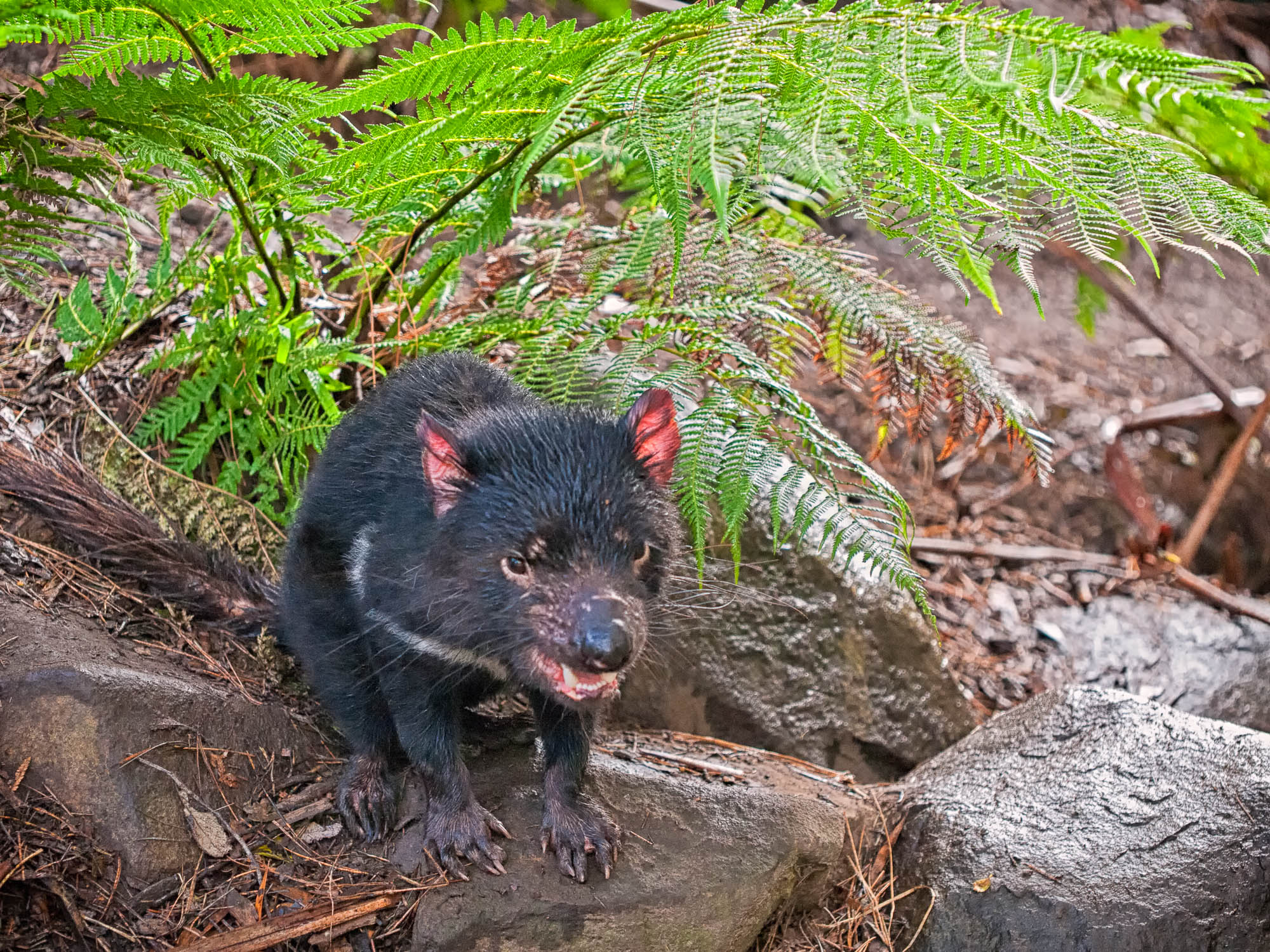
Today Tasmanians mourn the passing of the thylacine even though there are very few people who are left alive that actually saw one. All that remains are a few preserved specimens in museums, some black and white photos and some grainy film footage. Tourist operators say that the extinction of the devil will severely impact their industry and slowly people are starting to wake up to the fact that the devil is likely to go the same way if something is not done. There has been some research on the on devil facial tumour disease which is fantastic. So is devil saved? Well some scientists believe that the only way for the devil to survive is to quarantine healthy devils in captivity and let the wild population die out. Even if the wild population could survive the current Tasmanian state and Australian Federal governments are working to open up Tasmania’s national parks and world heritage areas to commercial logging. The federal government is also not prepared to fund research into Devil Facial Tumour Disease. So at present your best chance of seeing a Tasmanian devil is either at a zoo, animal sanctuary or dead beside a road. In another twenty years all we could be left with is some video footage and some memories. I would urge every Australian and prospective visitor to Tasmania to write to:
Matthew Groom the Tasmanian minister for the environment
and
Greg Hunt the federal minister for the environment
asking that more funding should be given to ensure the survival of the devil and to ask them not to open the Tasmanian national parks to logging.
They’re not the most loveable of creatures but the world would be a worse place without them.
You must be logged in to post a comment.