“I Do Like…

…to be beside the seaside!
I do like to be beside the sea!
I do like to stroll along the Prom, Prom, Prom!
Where the brass bands play, “Tiddely-om-pom-pom!”

So just let me be beside the seaside!
I’ll be beside myself with glee
And there’s lots of girls beside,
I should like to be beside,
Beside the seaside,
Beside the sea!”

by
John H. Glover-Kind 1907


Cairns Esplanade is a sight to behold early in the morning. It seemed like the whole of Cairns is there clad in lycra leggings, shorts, and vests exercising in every conceivable form. I immediately felt slovenly, ill disciplined, and over dressed. It definitely felt as if this was an odd place to be looking for birds and I did feel surprisingly self conscious. But, having said that, the seafront at Cairns is not some luxurious tropical palm fringed sandy beach, but a mudflat with mangroves at the northern end and that means birds. Lots of birds. So many birds that Sue Taylor in her book “The 100 Best Birdwatching Sites In Australia” rates it as her number three destination. So that is what drew us to the Esplanade.


Cairns Esplanade by Paul Amyes on 500px.com
Cairns Esplanade, Queensland.


Warning by Paul Amyes on 500px.com
It is Australia.


As I settled in to get some photos a woman sidled up to me and said “You’re not from here are you? I know all the birders here and you’re not local. Where are you from?”. I politely told her I was from Western Australia and was over on a birding holiday thinking I could gain some valuable local information. “Oh I went to Western Australia once. There was nothing there.” At this point I could sense that the conversation was already starting to take a strange turn. She carried on. “You’re wasting your time coming here. They’ve all gone. There’s nothing left. Nothing to see.” I’d just seen 4 species I’d never seen before and told her so. “There’s no point,” she replied, “the light is too bad it makes it pointless to take photos.” . At this point I quietly and quickly moved in the general direction of away.


Bar-tailed Godwit by Paul Amyes on 500px.com
Apparently the light was so bad it was a waste of time trying to take photos of birds that weren’t there. Bar-tailed Godwit, Limosa lapponica.


Great Knot by Paul Amyes on 500px.com
A different species of non-existent birds – Great Knot, Calidris tenuirostris.


Masked Lapwing by Paul Amyes on 500px.com
Masked Lapwing, Vanellus miles.


In hindsight Moaning Minnie was sort of right about the light. The rising sun meant that the birds were strongly backlit, but I never subscribed to the old school photographic technique of having the sun at your back. I’ve always liked contre-jour lighting and as long as you know how to meter and avoid lens flare there’s nothing to worry about. What was bothering me more was that I couldn’t get at eye level with the birds as the Esplanade was about 1m above the mud. The obvious answer to this was to get out onto the mud and lie down, but this is Australia and the mudflats were perfect for saltwater crocodiles and there were signs warning about their presence everywhere. Not wanting to be breakfast for a large ravenous reptile I decided to stay on the Esplanade.


Striated Heron by Paul Amyes on 500px.com
Striated Heron, Butorides striata.


Nankeen Night Heron by Paul Amyes on 500px.com
Nankeen Night Heron, Nycticorax caledonicus.


As I walked along the Esplanade I kept seeing this small brown bird flitting between the trees. I thought it was vaguely familiar but couldn’t place it in context. It was only when I looked at a photo of it I realised that I had see it before as it was a House Sparrow (Passer domesticus), another animal that some homesick Brit introduced circa 1870 thinking it was a good idea. Like all these events it was disastrous and the birds soon became a major pest and colonised the whole of Eastern Australia. Another introduced species that could be seen in great numbers was the Common Myna (Acridotheres tristis). It was introduced about the same time as the House Sparrow to control pests, and particularly in the case of Northern Queensland, plague locusts and cane beetles, but they bred prolifically and soon became another introduced pest on the eastern seaboard. It’s not everywhere you can witness two ecological disasters  within 2 minutes. It wasn’t all bad news though we saw loads of different birds and 4 completely new species – Bar-tailed Godwits, White-breasted Swallows, Great Knots, and Striated Herons.


White-breasted Woodswallow by Paul Amyes on 500px.com
White-breasted Woodswallow, Artamus leucorynchus.


Common Myna by Paul Amyes on 500px.com
Common Myna, Acridotheres tristis.


House Sparrow by Paul Amyes on 500px.com
House Sparrow, Passer domesticus.


While walking back to the car I was amazed by the Nankeen Night Herons. We have them here in York so they are not new to me, and are actually one of my favourite birds. What was so surprising was how chilled they were around people. Here in York a mere glimpse of a person will put them to flight. On the Cairns Esplanade they were walking along the walkway amongst the people. We sat down to have morning tea by a BBQ and one came up looking for food. It was so close that to photograph it I had to use my compact camera as my other camera’s lens was too long.


All up a good haul for the morning and a great start to the trip.


A Nankeen Night Heron hoping to score a free meal from the BBQ. Cairns Esplanade, Queensland.


This Nankeen Night Heron was literally at my feet forcing me to use my compact camera to take a photo of it.

Operation Numbat

The world has become a very grim place at the moment now that the Mango Menace has unleashed “Operation Epic Fury” (really who comes up with these ridiculous names?) which means we have to take out a mortgage to buy a tank of petrol if we can  find a servo with any in stock. So we decided to launch “Operation Numbat” whose sole function was to produce joy.


Dryandra, Western Australia.


The goal was to spend a couple of nights at Dryandra and find a numbat. Easier said than done as we have been looking for around thirty years and never seen one. A numbat for the uninformed is smallish, about 30-40 cm long, marsupial that eats termites. It was once quite common across southern Australia, but was driven to the point of extinction when somebody thought that introducing foxes to Australia would be a good idea. There now exist only a few small isolated populations in Australia and Dryandra is one of them. The Western Australian state government introduced Operation Western Shield (another silly name) to protect vulnerable native fauna from feral foxes and cats. In Dryandra this is done with a combination of 1080 baiting and trapping. It’s reckoned that the programme has reduced the fox population by 80% (Marlow et al., 2015). 

We weren’t there just for the numbats, we there for Woylies, Echidnas, birds and everything and anything wildlife related.


Day 1


Wandoo Walk by Paul Amyes on 500px.com
Helen on the Wandoo walk at Dryandra, Western Australia.

We arrived at Dryandra at at lunch time and once we’d eaten we set off to walk the Wandoo Walk (day walk) the start of which is located at the Old Mill Dam. The walk is 2.7 Km long and takes about 1 1/2 hours – more if you are looking for animals like we were. It is touted as being good for wildlife with a chance of seeing Numbats. Now the great thing about Numbats is that unlike other small marsupials they are diurnal, and to cap it off like sunning themselves in open areas which in theory should make them easier to see. I say in theory as we have been looking for over thirty years without any luck and I was hoping that this trip would be fruitful. It was a really enjoyable walk and we saw loads of birds – in fact I’d never seen so many Rufous Treecreepers in one day. But, when it came to Numbats we saw neither hide nor hair.


Jacky Winter by Paul Amyes on 500px.com
Jacky Winter, Microeca fascinans. Dryandra, Western Australia.


Djini by Paul Amyes on 500px.com
Djini or Rufous Treecreeper (Climacteris rufa), Dryandra, Western Australia.


Djini by Paul Amyes on 500px.com


Just before sunset we decided to walk around the large open paddock adjacent to the Dryandra Lions Village where we were staying. Western Grey Kangaroos were grazing on the grass and then we saw something we’d never seen before. We’d spotted an Echidna wandering round looking for ants when it encountered another Echidna. Now Echidnas are incredibly solitary animals and are rarely seen in the company of others. The two animals sniffed each other carefully and then went on their separate ways continuing their search for ants. As I continued walking along the perimeter of the paddock I found another Echidna and it came quite close allowing me to get some nice close ups.


Dryandra Lions Village is comprised of old forestry bush cottages.


Nyingarn by Paul Amyes on 500px.com
A pair of Nyingarn or Short Beaked Echidnas aka Spiny Anteaters (Tachyglossus aculeatus). Dryandra, Western Australia.


Nyingarn by Paul Amyes on 500px.com
Nyingarn or Short Beaked Echidna.


Day 2

Kawana Trail information board. Dryandra, Western Australia.


The morning saw us out on the Kawana Walk which is a 3.3Km walk through the Brown Mallet plantation, through the kwongan heath and then back through the Mallet trees. The varied landscape gives great opportunity to spot different birds, Kangaroos, Echidnas and fingers crossed Numbats. Again, like yesterday’s walk, we saw loads of wildlife – birds, kangaroos, and skinks – but no Numbats. It was hard not to feel a little dispirited at this stage. You plan trips and hope to see certain animals, like we did in our recent trip to Broome, but when you don’t find them you can feel very deflated even though you saw other animals. 


Djini by Paul Amyes on 500px.com
More Rufous Treecreepers


Miyamit by Paul Amyes on 500px.com
Miyamit or Yellow-plumed Honeyeater (Ptilotula ornatus).


Yongka by Paul Amyes on 500px.com
Yongka or Western Grey Kangaroo (Macropus fuliginosus).


Buchanan’s snake-eyed skink, Cryptoblepharus buchananii. Dryandra, Western Australia.


My companion in the Old Mill Dam hide – a Southern Slider (Lerista dorsalis). Dryandra, Western Australia.


After grabbing a quick drink I set off to walk down to the Old Mill Dam and sit in the hide there.  Apart from seeing a Southern Slider Skink and a dragonfly I saw nothing. Desperation was really starting to set in now, so at 4pm we decided to go on a very slow drive around the park in the hoping that we’d see something. Driving along a deeply corrugated gravel road at 20Kph is enough to shake your fillings out of your teeth. It was torturous. At this stage your mind starts to play tricks on you. You so want to see that animal and you are desperately willing it to happen and every time a branch moves or a bird flies just above the ground you think NUMBAT! Your head twitches backwards and forwards trying to get a better glimpse of what wasn’t there. Suddenly at a junction just standing there as cool as you like was a Numbat just 20 metres away from the car. Gently stopping the car and winding the front passenger window down I managed to rattle off a few frames before it started moving. As it walked further round I could no longer shoot through the open window and I was having to use the front passenger quarter light window. At the time I knew this would seriously degrade the image quality, but I continued anyway in the hope that I might be able to salvage the images in post later. Then within 5 or 10 seconds it was off into the bush and we lost sight of it. We were both exhilarated – we had huge grins on our faces. We’d seen a Numbat! We had really seen a Numbat. Operation Numbat had been a huge success.


At long last! A Numbat (Myrmecobius fasciatus). Dryandra, Western Australia.


Numbat on the move. Shooting through the glass of a car window gives less than optimum image quality.


I love this pose, but the image quality is shot to hell.


Maybe it works better as a black and white.


It’s now a week since that sighting and the memory of it still brings a huge smile to my face and a feeling of excitement. One Numbat isn’t enough – I want to back and see and photograph more. Hopefully it won’t take another 30 years to do it.

Waiting for the tide to turn

“I’m waiting

Waiting for the tide to turn

Patience, patience, patience

Is one sure thing that I’ve learned”

By

Robert Cray, Mike Vannice and Dennis Walker


My last birding outing in Broome was to Town Beach – a whopping 5 minutes walk from where we were staying. It was the evening before we were due to leave Broome and I wanted to get some photos of the migratory shorebirds that are found in Broome at this time of year.


Town Beach Jetty by Paul Amyes on 500px.com
I didn’t notice the Eastern Osprey (Pandion cristatus subs leucocephalus) perching on a lamp post on the Town Beach Jetty when I took the photo. It was only when I was processing it that I saw it.


The tide was out and a long way to boot. Ideally I’d want the tide to be coming in as it would push all the birds closer to me. A receding tide would take them away from me.  So the question was how to get close to the birds while avoiding the liquid mud that was between us. The obvious answer was the jetty as it extends 112m out from the shoreline. The only problem was that it is very high to account for Broome’s 10m+ tides. Then I noticed some kids playing on what appeared to be a lower level and watching them carefully I saw how they were accessing this level and I quickly took up position. Most of the birds were still a long way out – well over 500m. After watching for a while I saw that there were a few different species of bird that were closer to me, but even so I’d need to fit my 1.4 x teleconverter to my 100-400mm lens. Not ideal because of the hit on image quality and having a maximum aperture of f9 forcing the use of high ISOs and lower shutter speeds. 


20260305-Broome-0328-Edit by Paul Amyes on 500px.com
An assortment of shorebirds lands looking for food.


Ruddy Turnstone by Paul Amyes on 500px.com
Ruddy Turnstone, Arenaria interpres. Town Beach, Broome, Western Australia.


There were quite a few different species out on the mud. There was an Eastern Reef Egret and a Little Heron poking around amongst some rocks for something to eat. A Whimbrel stayed for ages going back and forth. Every now and again a little flock of assorted birds – Rudy Turnstones, Terek Sandpipers, Greater Sand-plovers and Grey-tailed Tattlers – would land and have a bit of a feed then something would spook them and they’d all take off again. It was brilliant and time just flew past. All too soon the sun was starting to dip below the horizon and the light levels were too low to continue photographing. All in all it was an excellent end to an excellent trip.


Eastern Curlew by Paul Amyes on 500px.com
Eastern Curlew, Numenius madagascariensis. Town Beach, Broome, Western Australia.


Eastern Reef Egret by Paul Amyes on 500px.com
Eastern Reef Egret, Egretta sacra. Town Beach, Broome, Western Australia.


The title for this blog entry comes from the song by the great Robert Cray.


“Weaving spiders, come not here…

…Hence, you long legged spinners, hence!”

Willian Shakespeare. A Midsummer Night’s Dream (Act 2, Scene 2)


“Run Harry! Run!”


I must say at the outset that I don’t like spiders very much. The bloody great hairy jobs in the Hobbit, Lord of The Rings and Harry Potter movies didn’t help much either. Coming to Australia has meant that the chances of coming into contact with some horrible large spider with a venomous bite have increased. However, of late that maybe changing. That could be because I’ve seen some rather cute jumping spiders and the rather spectacular looking Jewel Spiders. It maybe that I’ve just become desensitised by seeing so many, referred to as “flooding” in psychotherapy. Nah! Got to be honest the large hairy ones still give me the heebie-jeebies.


Shaggy Red-headed House Hopper (Hypoblemum villosum) sitting on the flex of our iron in the laundry. They grow between 4-8mm long.


A different view of the Shaggy Red-headed House Hopper (Hypoblemum villosum). They grow between 4-8mm long.


A male jumping spider (Sandalodes superbus), another species of Jumping Spider, found in the garden. I like the way they look up at you.


I think it was the jumping spiders that made me more comfortable about spiders as they are sort of cute with that turret head and the way that they look at you. I was particularly enamoured with the Shaggy Red-headed House Hopper (Hypoblemum villosum) I found in the laundry. He was tiny, no bigger than 5mm. Since then I’ve seen other varieties around the garden – they’re a bit bigger but I can tolerate them.


Jewel spiders (Austracantha minax) are often called Christmas spiders as they are commonly found during December and January. Oyster Bay, Western Australia.


Christmas spiders or jewel spiders (Austracantha minax) can be readily found in the usndergrowth surrounding Thomsons lake in Western Australia.


The Christmas Spider or jewel spider (Austracantha minax) is associated with the comming of Christmas in Western Australia.


The jewel spiders are also quite attractive to look at. They come out around Christmas time, hence their more common name of Christmas Spider. What they and the jumping spider have in common is that they are not large nor are they poisonous.


The Golden orb weaving spider, Nephila edulis., is so called because of its web that takes on a golden sheen. York Western Australia.


A female Golden Orb-weaving Spider (Nephila edulis) in our front garden. That messy tangled bit hanging down is the larder.


Male Nephila edulis or Golden Orb Web Spider. He’s only 6mm in length while his mate can be up to 4cm. Let’s hope he doesn’t end up in the larder after the deed is done.  Oswaild Sargent Reserve, York, Western Australia.


The next spider I’ve become reasonably  tolerant to is the Golden Orb Weaver (Nephila edulis). Now these are big – well the females are at 4cm in body length, the males don’t get much bigger than 6mm. Thankfully they are very reluctant to bite and when they do according to the Australian Museum “Symptoms are usually negligible or mild local pain, numbness and swelling. Occasionally nausea and dizziness can occur after a bite. Seek medical attention if symptoms persist.”. Re-reading that I now don’t  feel reassured. The webs are what attracts me to them. They are magnificent creations at over 1 metre in diameter and the golden silk that they are made from shimmers spectacularly in the early morning light.  I can’t walk past one without stopping to take a photo. So it’s very convenient that I’ve got one just outside the front door.


The huntsman spider (Delena cancerides) can grow to the size of the palm of your hand and is often found in peoples homes. You don’t need a macro lens to photograph these. As far as I’m concerned a long telephoto helps keep the distance between me and it.


So far it sounds like I’m fairly tolerant to spiders. Well let me tell you there is one species that can induce a full on panic reaction  that is the Huntsman Spider. It’s not that they are big – they are flippin’ big and have a leg span of 15cm and a large hairy body to boot. It’s the way they move and the speed of them as they run across the walls and disappear behind the sofa.  They are the stuff of scary movies. If you should try and swat one with a rolled up newspaper or magazine they’re just as likely to snatch it off you and give you a good walloping. I don’t care how beneficial they are to have in the garden or that they are relatively harmless. “Relatively harmless” – who decides these things? That’s like saying Donald Trump is relatively harmless unless you live in the Middle East. Sorry I’ve gone off piste.  Huntsman Spiders – well I don’t like having them in the house. They make me do the spider dance – it’s where you manically hop from leg to leg while swating the imaginary spiders on your body and screaming like an adolescent girl in a slasher B movie. Thankfully we have our resident house geckos and spider wasps to keep them away.


My saviour! Bibdjool or Marbled Gecko, aka house gecko (Christinus marmoratus) on our back window at a previous house. York, Western Australia.

A Raucous Dawn Chorus

As summer draws to a close dawn comes round a little later meaning that I don’t need to get up early. It gives an opportunity to enjoy a leisurely cup of that all important morning coffee and head out.


A New Morning by Paul Amyes on 500px.com
Wayan or White-faced Heron (Egretta novaehollandiae) greets the new morning. York, Western Australia.


Once down at the river I’m met with sight of the sun just peaking through the clouds and it was a joy to behold. Then the moment is shattered as several hundred Little Corellas take to the air in a whirling squawking mass. Successive waves of birds fly over me each one noisier than the one that preceded it. It was an incredibly intense experience. Eventually the birds all decided to settle in the gum trees along this section of the river bank. Physically they may have settled but their incessant squawking didn’t stop. I was transfixed. I didn’t bother continuing along the river bank I just stayed and watched and photographed. 


Playing Around by Paul Amyes on 500px.com
As the sunrises the Manatj or Little Corellas (Cacatua sanguinea) start to become active.


Manatj by Paul Amyes on 500px.com
Then as the sun rises over the horizon the Little Corellas take to the air en masse.


Manatj by Paul Amyes on 500px.com
Eventually they begin to settle in the trees.


Manatj by Paul Amyes on 500px.com
Some continue to cry out.


I
While others are content to perch quietly.


Patience Is A Virtue…

Virtue is a grace.

Grace is a little girl

who would not wash her face..

From “Lady Daisy” by Dick King-Smith

When you start wildlife photography it is very easy to get disappointed. You see all these marvellous photos other people put up on social media and you are left wondering why your photos are not as good. Usually people put it down to not having the best gear – if only I had that 800mm F5.6 lens – maybe if they had better photographic technique or access to exotic animals in exotic locations the photos would be better. Photographic technique is easily learnt, you don’t need expensive equipment and nor do you need to travel to exotic locations. I think patience is very important and that is something we can all develop.


Koordji-koordji by Paul Amyes on 500px.com
Koordji-koordji or Australian Reed Warbler (Acrocephalus australis subspecies gouldi). Lake Leschenaultia, Chidlow, Western Australia.


Koordji-koordji by Paul Amyes on 500px.com
Breakfast.


The other morning I was at Lake Leschenaultia. The previous day there had been the tail end of cyclone coming down the coast which brought rain and strong winds. The rain had passed, but, there was still quite a bit of wind about. As I got down to the lake I could see it was choppy and there were no waterfowl about and there was nothing much happening in the trees. I could have given up and gone home, but I know from experience that there are a few sheltered spots to be found as you walk round the lake so I set off for them. The first couple yielded nothing, the third was alive with the sound of Australian Reed Warblers, Splendid Fairy Wrens, Silvereyes and Inland Thornbills. They were feeding on the insects found amongst the reeds. There was no way I could quietly approach – the forest floor down to the lake was covered in dry leaves and bark. It is like walking over corn flakes – very crunchy and noisy. Even if I could get down there quietly suddenly appearing out of the tree cover would put everything to flight. Nevertheless I made my way into the dry portion of the reed bed and as expected everything cleared off. Now this is the point where it was tempting to think that’s it and move on. However, I knew that the food source won’t have moved and the birds were hungry. I also know that these particular birds are quite tolerant to people if you are quiet and don’t move around much so all I had to do was wait. I’ll admit it was hard – the mosquitoes were ferocious – but after 20 minutes or so the birds came back. In that time I positioned myself to ensure I had a good background and if the birds wanted to take off they would have to fly towards me. All these birds are incredibly quick, but the knack is observing how they move through the reeds and where they like to perch when having a breather. Pre-focus on one of those spots as it will give your cameras AF system a good chance of locking on to the bird. Then it was a case of being patient and waiting until they came close to me and taking the photo. Forty minutes later and it was all over. The birds had moved onto another spot which was too inaccessible for me to follow.


Doolor by Paul Amyes on 500px.com
Doolor or Silvereye (Zosterops lateralis). Lake Leschenaultia, Chidlow, Western Australia.


Doolor by Paul Amyes on 500px.com
Having a closer look at me.

Chance…

… favours the prepared mind.”  Louis Pasteur, December 7, 1854, and in 161BC the Roman playwright Terrance said that “fortune favours the brave” in his play Phormio.


All of which basically means that if you have the necessary mind set be bold enough to seize the opportunities that present themselves. That is what happened the other evening. We had found a new possible nesting site for Rainbow Bee-eaters here in York and the beloved significant other suggested we go and have a closer look the other evening. So I picked up my Sony A7r2 with Sigma 150-600mm lens and we drove down to the location. On getting there there was not a Rainbow Bee-eater to be seen. In fact there weren’t many birds about at all. Scanning the tree tops we soon found out why. In the top of a dead tree were a pair of Australian Hobbys. These beautiful birds of prey will take small flying birds so everything had taken cover. The Hobbys looked magnificent against the bright blue sky. I only managed a short burst before they resumed flying up and down the river bank looking for something to eat.


Wowoo by Paul Amyes on 500px.com
Wowoo or Australian Hobby (Falco longipennis) are often seen in pairs whilst out hunting.


The adapted Sigma 150-600mm doesn’t focus very fast on the Sony A7r2 and the 5 frames per second burst rate isn’t exactly the best, but, it was all good enough for the task in hand.

Ambling In The Evening

We’d travelled into Perth to see The Choral (well recommended) and were staying over for the night. The hot summer air was oppressive and it seemed that a walk around a body of water to make the most of the cool breeze coming off it seemed like a good idea. Tomato Lake was close to where we were staying and so we went there. There’s nothing like a slow relaxed walk in the evening while watching things going on around you. As we pulled up in the car park it was very apparent that lots of other people had the same idea – families were either set up on picnic blankets or walking around the lake foreshore looking to get some relief from the hot summer sun. It reminded us of being in countries in the Mediterranean, the Middle East and the Indian Subcontinent where people promenade in the evenings.  I’ve never really understood why in a hot country like Australia that our pattern of the day is based upon those in cool northern countries. 

As we pulled up there was raucous honking coming from the island in the middle of the lake. There were dozens of Australian White Ibis and their young were nosily demanding food. Added to that was the grating screeching of Little Corellas looking for a place to roost for the night. Further back from the lake amongst the larger trees Red Wattle Birds were jockeying for the prime locations for the night. They are very combative chasing off other birds with their loud and conspicuous squawking. Meanwhile back on the lake Black Swans and Australian Grebes glided silently and gracefully through the duck weed while feeding. It was all very idyllic.


Ngalkaning by Paul Amyes on 500px.com
Ngalkaning or Australian White Ibis (Threskioris molucca). Tomato Lake Reserve, Kewdale, Western Australia.


Ngalkaning by Paul Amyes on 500px.com
A juvenile Australian White Ibis pestering its parent for food.


Little Corella by Paul Amyes on 500px.com
Little Corella or (Cacatua sanguinea subsp. westralensis).


Little Corella by Paul Amyes on 500px.com
Getting ready to settle in for the night.


Djangkang by Paul Amyes on 500px.com
Having chased off the other birds this Djangkang or Red Wattlebird (Anthochaera carunculata) is getting ready to roost.


Bulland by Paul Amyes on 500px.com
This Bulland or Great Egret (Ardea alba) flies lazily over the lake.


Maali by Paul Amyes on 500px.com
Maali or Black Swan (Cygnus atratus) effortlessly swimming in the lake.


Feed Me!

At this stage in summer most of the birds are busy feeding their young, with the majority about to fledge soon. The constant foraging for food and hunting must be exhausting for the parents especially in the 40ºC + days we’ve been having lately. Over the last couple of weeks I’ve stumbled across a few nests with demanding offspring and I’ve observed a range of different behaviours designed to get food from a parent.


Kanamit by Paul Amyes on 500px.com
Hungry Kanamit or Welcome Swallow (Hirundo neoxxena) chicks demanding to be fed. Avon Terrace, York, Western Australia.


Kanamit by Paul Amyes on 500px.com
The food arrives.


Kanamit by Paul Amyes on 500px.com
The two larger chicks get fed while the little one at the end misses out.


On Avon Terrace, the main drag in York, a lot of the shop fronts have Welcome Swallow nests tucked away in the shade of the verandas. Most people walk along the street under them not even aware of what is happening above them. I spent an hour watching this particular nest. The adults returned every five minutes or so with food for the three chicks. Two chicks got the bulk of the food as is often the case in birds. I don’t know if the little runt of the brood managed to survive until fledging or not.


Kaaka-baaka by Paul Amyes on 500px.com
Kaaka-baaka or Yellow-billed Spoonbill (Platalea flavipes) adolescent demanding food from its parent.


Yellow-billed Spoonbills
Click to play the video clip.


In Northam, on the banks of the River Avon, I witnessed something I’d never seen before. There were two Yellow-billed Spoonbills in a tree, one a mature adult and the other an adolescent. The adolescent was trying hard to get the parent to regurgitate some food and it did this by first bobbing its head vigorously while flapping its wings. After a while of this it would then start rubbing the parent on the side of its head. The photos don’t do it justice, the video is better.


Djidi-djidi by Paul Amyes on 500px.com
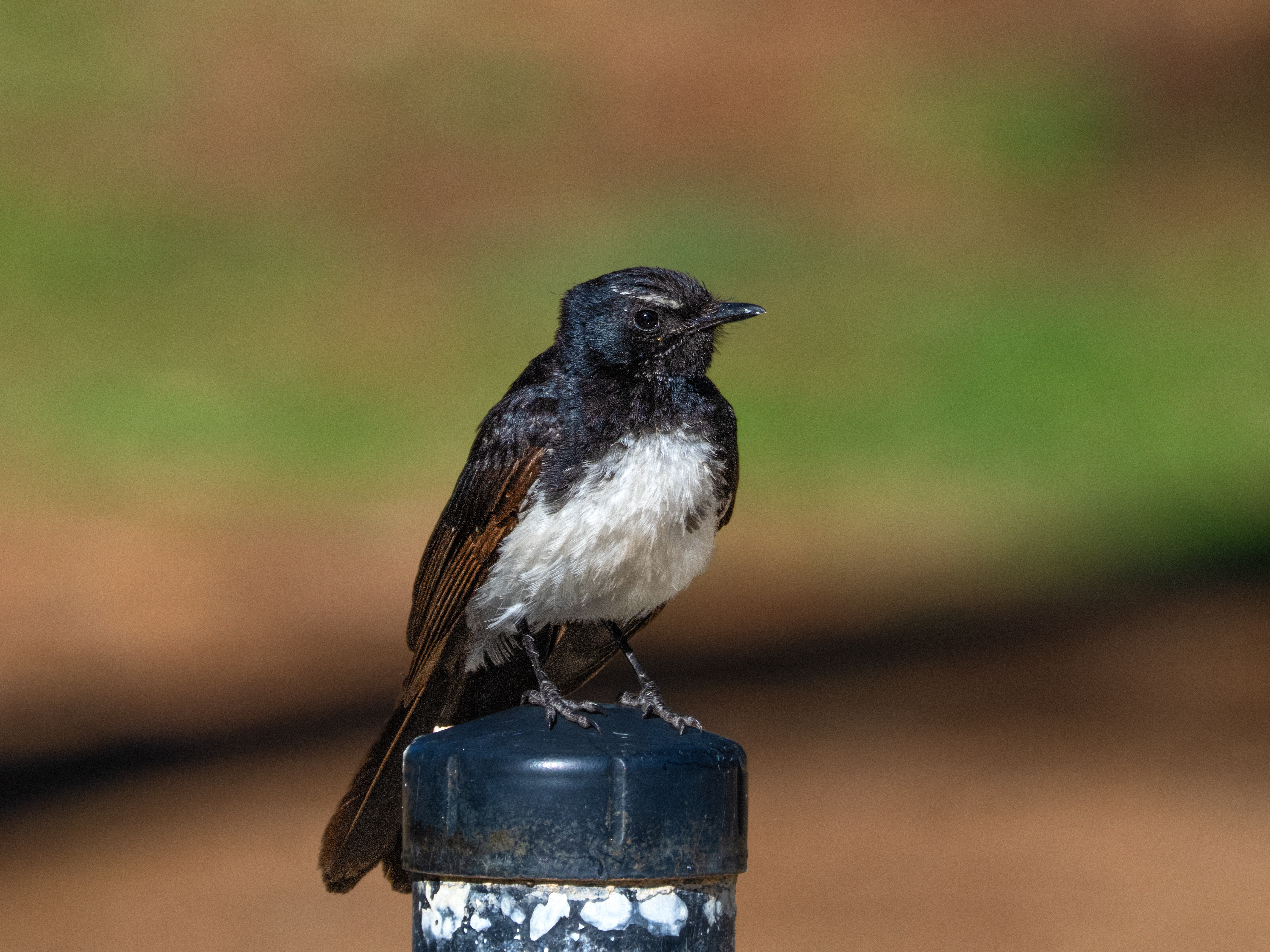
Djidi-djidi or Willie Wagtail (Rhipidura leucophrys) chicks that have out grown their nest.


The unusually placid Djidi-djidi or Willie Wagtail (Rhipidura leucophrys) parent.


Willie Wagtails make incredibly tiny nests – smaller than a tea cup. The typical clutch of eggs is 2-4 which is fine until they hatch and then overcrowding sets in. I spotted this nest while walking back to the car. It looked quite a comical situation – 2 adolescent Willie Wagtails just about ready to fledge crowding round this tiny nest with one in it. All three looked incredible grumpy – it’s the eyebrow and the down turned mouth that gives that impression. One of the parents was sat on a fence post just 5m away closely watching. I was very surprised it didn’t try to chase me off as Willie Wagtails are incredibly aggressive and territorial. Perhaps it was too knocked form taking care of the chicks.