Things have taken a dire turn at Paul Amyes Photography. For some reason the links to the images are all of a sudden broken. I’m not sure what has happened, but it does mean that I’m having to go through all 616 pages and re-link the photos. It is a mammoth undertaking and will keep me occupied for some while.
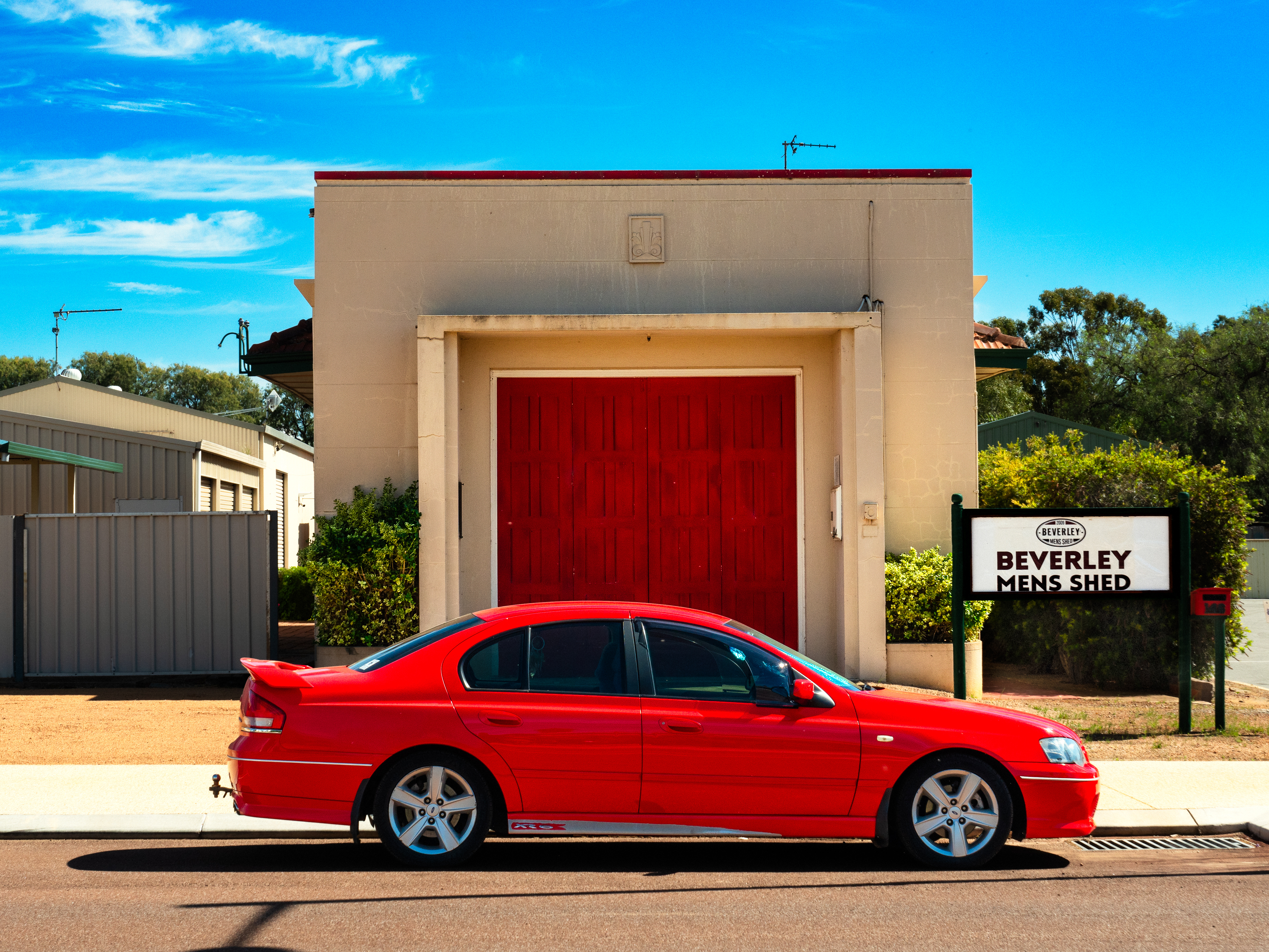
I saw the accompanying image when we went to Beverley for the Spring Equinox Flower Festival. I couldn’t resist the red and the blue. It was taken with one of my everyday cameras. I did take some photos of the flower exhibits, but, they were a bit meh when compared to this one.
Helen walking around Cattana Wetlands, Queensland.
When you first look at Cattana Wetlands it’s hard to get your head around the fact that it’s only been like this since 2009. The rainforest, the salt and fresh water lakes look like they have been there forever. It’s hard to believe that up to the 1990’s it was a sugar cane farm and up to 2005 there was a sand and gravel quarry there. Now the rehabilitated site has had over 200 bird species recorded, mammals include Sugar-gliders and Striped Possums, and there is the occasional saltwater crocodile. Crocodiles aren’t the largest predator to found in the Cattana Wetlands. That honour goes to the Australian Scrub Python (Simalia kinghorni) which can grow up to 5m long and weigh just short of 30Kg. They’e not poisonous, but I wouldn’t ask one for a cuddle. We didn’t see either pythons or crocodiles when we visited.
The Kingfisher Hide at Cattana Wetlands, Queensland.
“Where are the birds?” the Kingfisher Bird Hide at Cattana Wetlands.
The wetlands is comprised of 80ha of rainforest and five small pools or lakes. Some are freshwater others are saltwater. There are several walking tracks through the reserve which are graded and are accessible to those who have mobility issues. The trails are well signposted and there is a self guided tour that has information boards describing various features. There is a written guide to the tour which is worth reading, but, it is not necessary to have it. We enjoyed it so much that we visited it twice and we saw different things each time. To my mind it’s the best nature experience in Cairns. I’d love to be able to spend a week there just going at dusk and dawn. It’s definitely one of those places where the more hours you put in the more you’ll see.
An Azure Kingfisher (Ceyx azureus) at the aptly named Kingfisher Bird Hide in the Cattana Wetlands, Queensland.
Baron River at Lake Placid Recreation Park in Queensland.
FNQ is not some acronym from yoof culture or some obscure quango, it is the common geographical abbreviation for Far North Queensland, a vast, tropical region in Australia covering over 270,000 square kilometres. Cairns is the gateway hub for the region and that is where we went for our third tropical birding trip. The tropical rainforest and mountainous terrain provide a home for a huge variety of fauna – most of which is not seen anywhere else in the world. Cairns is also the gateway for the Great Barrier Reef which is the world’s largest coral reef system and according to CNN one of the Seven Natural Wonders Of The World. Reefs and fish aren’t our thing we were there primarily for the wildlife that could be seen from dry land.
The Bush Turkey Cafe at the Lake Placid Rainforest Retreat. Queensland.
We elected to stay well away from the tourist strip at the Lake Placid Rainforest Retreat. It was to my mind the best caravan park we’ve ever stayed at. The amenities, the accommodation, the staffand the overall friendliness made for a delightful stay. The icing on the cake was the sheer amount of wildlife at the park. I’d seen animals that I’d never seen before without stepping foot outside of the caravan park. Absolutely bloomin’ brilliant! Here in Western Australia Bush Stone Curlews are quite shy and although I’ve seen them I’ve not managed to get a “good” photograph of one. There were about half a dozen of them wandering around the campsite in the evening and it was possible to get close to them. Then there were the Australian Brushturkeys. They’ve got a face only a mother could love, but they are so full of character. These were wandering around all over the place. If you are interested in butterflies then it would be your idea of heaven. There were so many different types flitting around the bush.
Bush-Stone Curlew, Burhinus grallarius, wandered freely around the caravan park at dusk.
They would get quite close to you allowing good portrait opportunities.
Australian Brushturkey, Alectura lathami. Lake Placid, Queensland.
The Brushturkeys were everywhere.
Blue Tiger, Tirumala hamata. Lake Placid, Queensland.
The magnificent Ulysses Butterfly, Papilio ulysses. Try as I might this was the only half decent photo I managed to get and it doesn’t do it any justice at all.
Chocolate Argus, Junonia hedonia. Lake Placid, Queensland.
Orange Aeroplane, Pantoporia consimilis. Lake Placid,
White-lipped tree frog, Sandyrana infrafrenata, on our bathroom window. Lake Placid Rainforest Retreat, Queensland.
We were already talking of visiting again before the trip had finished.
Ramasees, Frida’s favourite toy lying on Frida’s pillow.
It only seems like yesterday when I blogged about the arrival of Frida into our lives, and now 13years later I’m writing that she has passed away.
It has been an incredibly strange few days with no Frida. While she wasn’t a noisy dog the house seems so quiet now. I didn’t realise how much of a presence she was in our lives. If you went to the washing line she went with you. Every time I cooked she was sitting beside me. She’d follow us into the bathroom and wait while we showered. Now that constant presence has gone and the silence is deafening.
I first went to Gnomesville in January 2018. It was a fun experience and I used it to experiment with mounting some of my vintage (that makes me feel very old as I bought these lenses new) Olympus OM Zuiko lenses on a Sony A7r2. Well just recently we were in Balingup which isn’t far away and my partner expressed a desire to visit as she had never been. So we duly went.
This time round I was still taking the same OM Zuiko lenses, but they were being used with an Olympus OM40 film camera. The film stock I was using was the new to me Ilford Ilfocolor 400+ Vintage Tone colour negative. I must say I didn’t really understand what I was letting myself in for with this film. It has a very distinct look – muted tones with the reds boosted. More by chance than judgement the film suited the gnomes. Whether I continue to use the film stock is another question. The problem being is that the look is baked in and it doesn’t suit all subjects.



You must be logged in to post a comment.