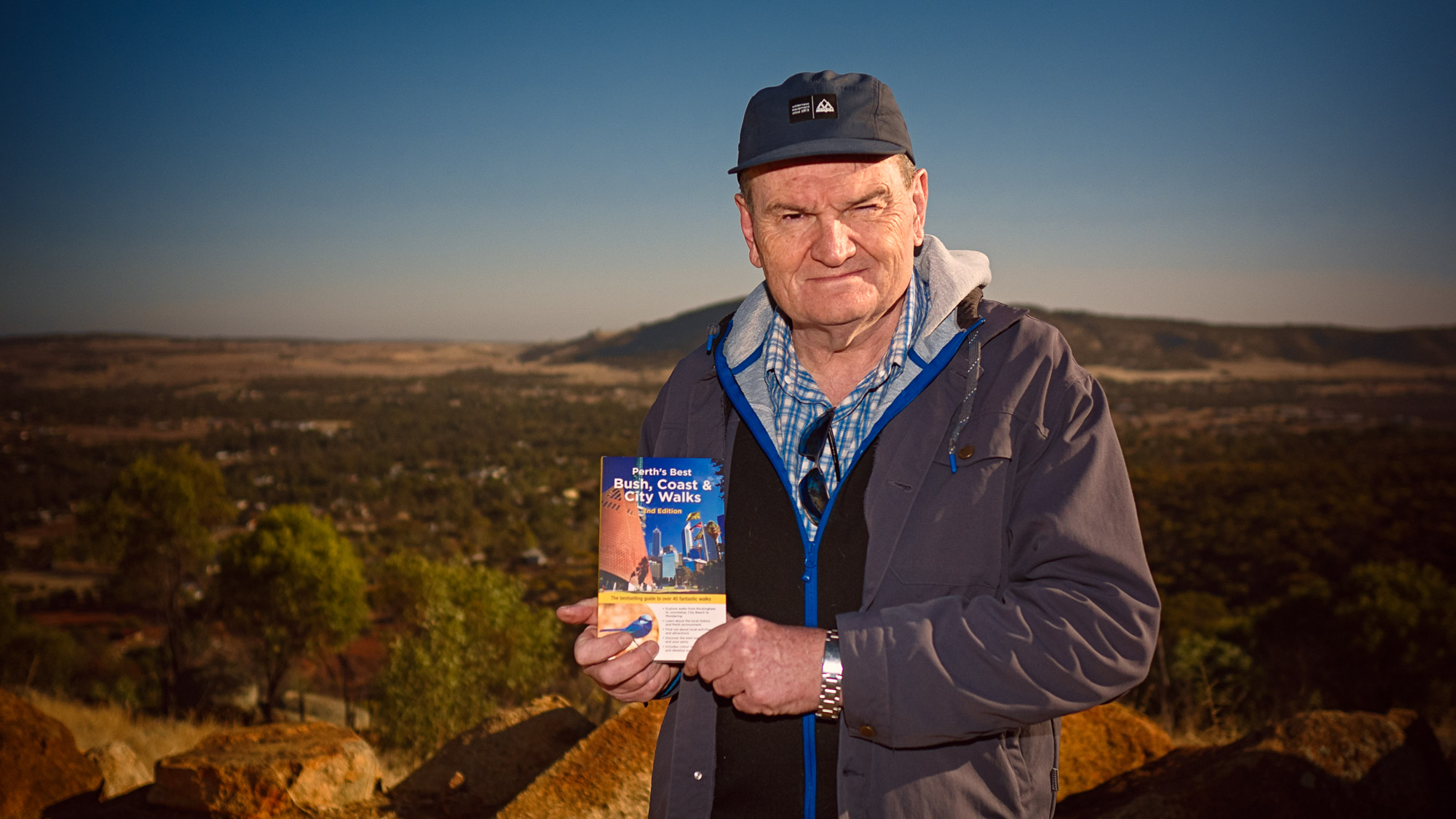
Me with the second edition of my best selling book “Perth’s Best Bush, Coast, and City Walks” published by Woodslane.
Join me for a quick shufti of the second edition of my best selling book “Perth’s Best Bush, Coast and City Walks”.
My publishers description of the book
“Perth and its environs boast a huge range of beautiful environments, making the region perfect for exploring on foot. This second edition of Perths Best Bush, Coast & City Walks introduces the best walks for visitors and residents alike, ranging from leisurely beach-side strolls to the more rugged tracks deep in the bush. Detailed descriptions and maps help the reader explore the regions parks, bushland, lakes, coasts and most interesting urban areas. As with previous titles in the series, the book is richly illustrated with over 150 full-colour photographs and dozens of detailed maps. A summary table of walks indicating distances, facilities and highlights is included to help the reader find exactly the right walk for the occasion. Walking chapters: Perth Metropolitan, Coastal Walks, Swan and Canning Rivers, Wetlands, Darling Ranges.”
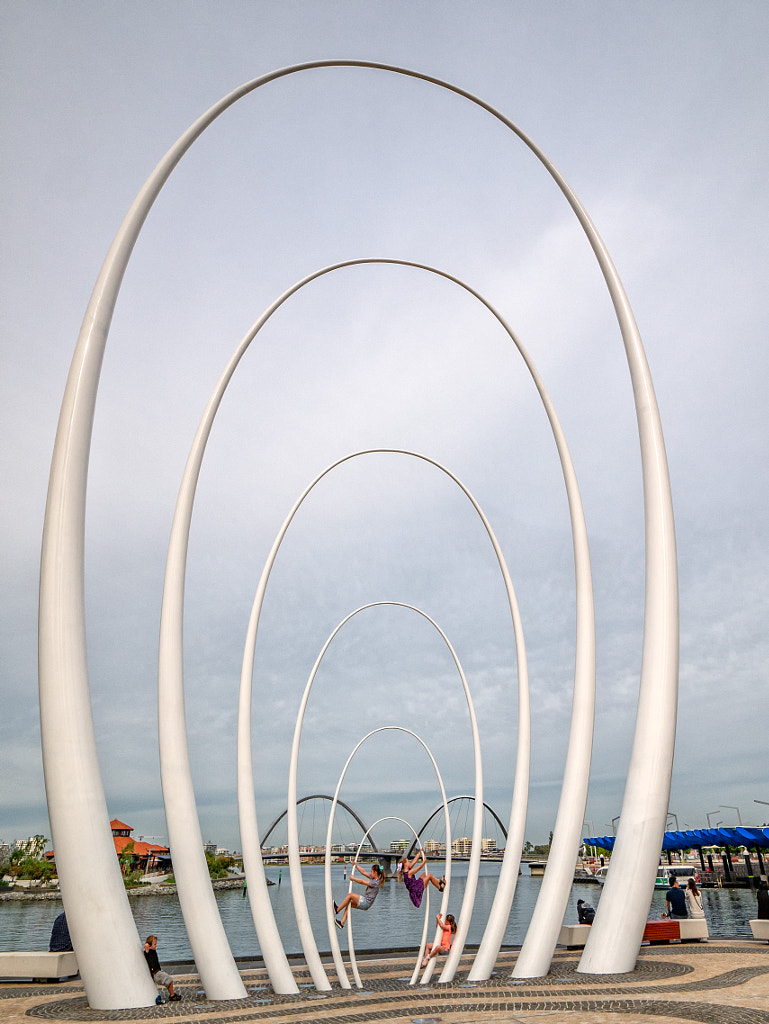
Spanda by Christian de Vietri is a striking sculpture that arrests the attention of visitors to Elizabeth Quay. “Spanda is a Sanskrit word that means ‘divine vibration’. The term is used to describe how consciousness moves in waves of contraction and expansion. The sculpture gives form to this primordial energy. My intention in making this sculpture is to express and facilitate oneness of the individual with the universal.” Artist, Christian de Vietri
Panasonic G85 with Panasonic LEICA DG 8-18/F2.8-4.0 lens. Exposure:1/320 sec, f8 at ISO 200.
When I was a kid one of the many rebuffs used was “take a long walk on a short pier” – it was, I suppose, a more imaginative way of saying get lost. Well whoever first coined the phrase hadn’t taken into account Busselton Jetty in Busselton Western Australia.
Busselton Jetty is longest timber piled jetty in the southern hemisphere and is a popular tourist attraction. Canon EOS6d with Canon EF 24-70mm f4 IS L lens. Exposure: 1/60 sec, f11 at ISO 100.
Busselton Jetty is the longest wooden jetty in the Southern Hemisphere and it is 1.81Km or 1.12 miles long. Building the jetty commenced in 1853 and it opened in 1865 and by the 1880’s it was already attracting tourists. By 1972 the jetty ceased operation as a commercial port and today it attracts a staggering 450,000 people per year.
The sculpture “Fish” (the sea in her belly) stares enigmatically out to sea by the Busselton Jetty. Canon EOS6d with Canon EF 24-70mm f4 IS L lens. Exposure: 1/80 sec, f16 at ISO 400.
X marks the spot. Over the course of the jetty’s 152 year history it has been extended several times. Each red X indicates the previous limit of the jetty Canon EOS6d with Canon EF 24-70mm f4 IS L lens. Exposure: 1/20 sec, f16 at ISO 100.
At the end of the jetty is the Underwater Observatory which takes visitor down 8m to the seabed where they can observe the huge variety of marine life that has made the jetty home.
At the end of Busselton Jetty is the Underwater Observatory where you cab descend to a depth of 8 metres to view the marine life that calls the jetty home. Canon EOS6d with Canon EF 24-70mm f4 IS L lens. Exposure: 1/125 sec, f5.6 at ISO 6400.
The piles that support the Busselton Jetty form a vertical reef. More than 300 species of tropical and sub-tropical corals, sponges, fish and invertebrates live there. Canon EOS6d with Canon EF 24-70mm f4 IS L lens. Exposure: 1/125 sec, f5.6 at ISO 6400.
To get there you don’t have to walk, there is a solar-powered electric train, the Stocker Preston Express, which can carry up to 90 people. So now it is the case of a small train journey on a long pier.
Busselton Jetty is 1.81Km (1.12 miles) long and it has a train service that takes 90 passengers 1.7 Km to Underwater Observatory. Canon EOS6d with Canon EF 24-70mm f4 IS L lens. Exposure: 1/200 sec, f5.6 at ISO 100.
The Jetty Train on Busselton Jetty takes passengers on a 1.7 kilometre journey across the calm, clear waters of Geographe Bay. Canon EOS6d with Canon EF 24-70mm f4 lens. Exposure: 1/125 sec, f8 at ISO 100.
Mounted archery demonstration at the 2017 York Medieval Fayre. Western Australia. Sony A7r with Cosina Voigtlander 75mm f2.5 Color-Heliar lens. Exposure: 1/1600 sec, f4, ISO 200.
The other morning I took the dog for her usual perambulation along the river, as we were walking along deep in thought (well I was I can’t vouch for the dog) our tranquility was disrupted by the sound of thundering hooves and the odd sound of something being hit at high velocity. Getting closer I was met with a sight redolent of the medieval Eastern European steppes – not what you expect to see in Western Australia in Twenty First Century. But little did I realise that actually mounted archery or more specifically horse archery is quite a popular pastime. It is a new sport in WA, only 5 years old but is quickly attracting enthusiastic participants some of whom are jetting off to South Korea to represent Australia at the World Horseback Archery Championships. What I was seeing was a demonstration that was part of the 2017 York Medieval Fayre. If you are interested you can contact the fine people at the Western Australian Horse Archery Association via their Facebook page and they have regular events at the State Equestrian Centre in Brigadoon.
Mounted archery demonstration at the 2017 York Medieval Fayre. Sony A7r with Cosina Voigtlander 75mm f2.5 Color-Heliar lens. Exposure: 1/1600, f4, ISO 200.
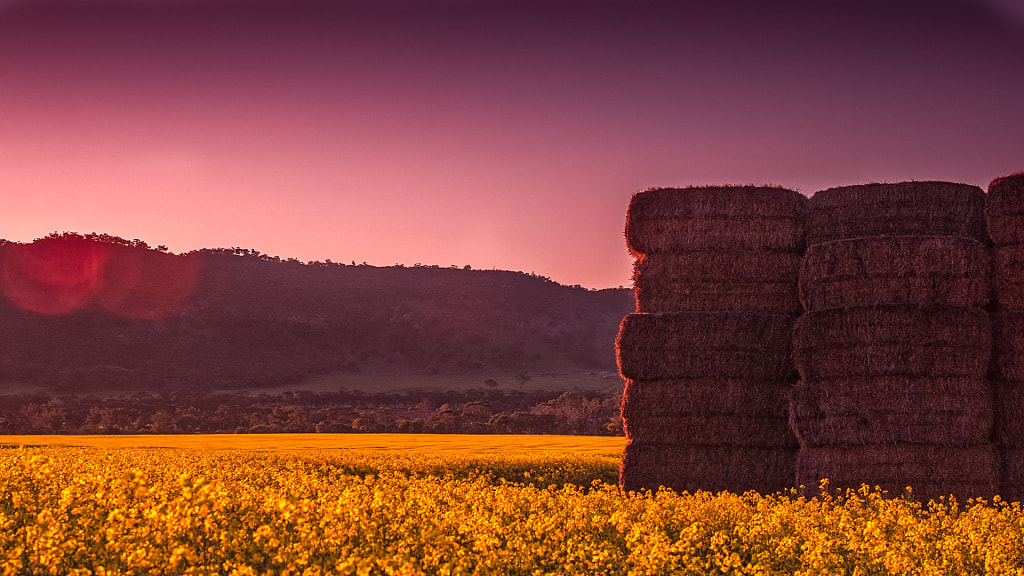
Rural Idyll. The sun sets on the canola by Mount Bakewell in York, Western Australia. Olympus OMD EM1 with Olympus 12-40mm f2.8 lens and Cokin 3 stop ND and 3 stop GND filters. Exposure: 1/13th sec, f8 ISO 200.
Photography and video are both media that allow the artist to play with the concept of time. Up until recently I primarily worked using still photography. With the advent of good quality video being added to most digital cameras I started playing tentatively with moving images and enjoying the whole idea of capturing movement in another way. Now I’m playing with time-lapse which is a way of using still photos to play with movement that the eye doesn’t normally perceive.
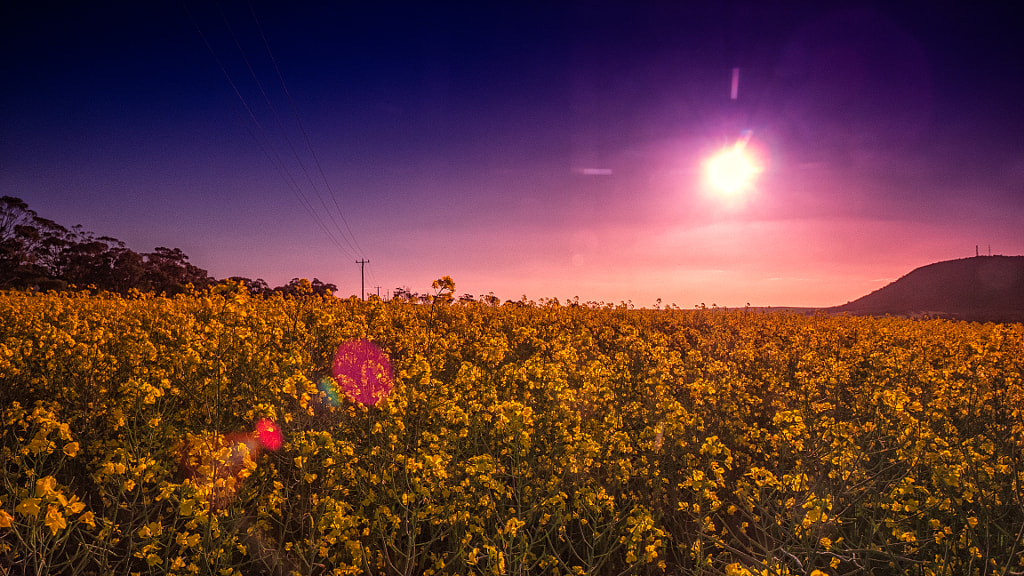
Sunset over the canola fields. York, Western Australia. Olympus OMD EM1 with Panasonic Leica 8-18/F2.8-4.0 lens a Cokin 3 stop ND and a 3 stop GND. Exposure: 1/50th sec, f8 at ISO 200.
The last couple of weeks have seen me shooting the canola fields around York. I’ve yet to do anything with the resulting video footage, but the pictures illustrating today’s post are still out takes. It is just a matter a shooting hundreds of shots of the same scene over a defined time period. My normal landscape gear and technique are used. I’m also experimenting with adding my own movement in the form of pans, tilts and slider moves. Thankfully my camera has an electronic shutter so I’m not burning through the shutter life.
Abandoned. An old colonial farmhouse amidst the canola. York, Western Australia. Olympus OMD EM1 with Olympus M.Zuiko Digital ED 75-300mm f/4.8-6.7 II lens and Cokin 3 stop GND. Exposure: 1/30th sec, f8 at ISO 200.
The thing with experiments is to allow ourselves to make mistakes. This can be difficult if you have, like I have, been practicing in a medium for many years because you tend to develop a certain competence/mastery (pick whichever is the most appropriate) and expect a certain result for your efforts. So when confronted with learning something new and seeing all the mistakes and failures it is tempting to run back to the security of our old established ways of working as it is more ego friendly. In our society the notion of mistakes and failure is seen as a negative, but they really should be embraced. We need to give ourselves freedom to explore and experiment in a nurturing environment so that we can learn and progress. At the moment I’ve got a couple of dozen time-lapse clips sitting on my hard drive, two of them are OK the rest suck big time. Looking at them objectively and looking at the work of people who are considered masters of this art form I can see where I have made my mistakes and so I can now work to avoid repeating them. Who knows in another couple of years I might actually get good at it.
The secret to time lapsing is having a comfortable chair to sit in while you wait for the shoot to finish.
Got up at “stupid o’clock” the other morning to try out a new bit of time lapsing equipment. Streuth it was cold, and as I drove down to Monger’s Crossing I mused that the brass monkey would be tucked up at home in bed if he was sensible. A Swedish friend of mine once told me that there’s no such thing as cold weather just poor clothing choices. Well I took Matts’ advice to heart and I had more layers than an onion. On reaching the river it was dark and foggy, not the most photogenic conditions, but I thought for the purpose of this test it would be OK. So I set up the camera and sat down to wait for it to shoot one frame every twenty seconds for one hour.
The Canon EOS 550d and Sigma 17-50mm f2.8 OS on the Syrp Genie Mini pan and tilt kit.The observant will have noticed that the camera is held together with gaffer tape.
I tried watching a video on my iPod but it was so cold that the battery ran flat real quick so I thought I’d take a few pictures of my companions on the river bank.
A yellow billed spoon bill searching for food on a cold and misty morning on the banks of the River Avon. York, Western Australia.
A white-faced heron wading on the banks of the River Avon on a misty winter’s morning. York, Western Australia.
As to the time-lapse, well bearing in mind it was just a test to see how it worked, well it was a reasonable first attempt. The only downside was that the camera sensor was filthy and that meant a lot of cloning in Photoshop.
* English is pretty confusing at the best of times for non native speakers. “Taters in mould” is Cockney rhyming slang for cold.
Wave Rock at sunset. Hyden, Western Australia. Olympus OMD EM1 mki with Olympus m.Zuiko 12-40 f2.8 lens. Exposure: 1/160 th sec, f5.6, ISO 200.
Every day tour buses stop over in York on their way to Wave Rock near Hyden. The Northern Territory has Uluru (formerly known as Ayres Rock) and Western Australia’s tourism industry markets Wave Rock as our equivalent. I often feel sorry for the tourists, particularly the Chinese and Japanese ones, as they drive out from Perth to the middle of nowhere to see a large rock that looks like an enormous ocean wave frozen for posterity. I wonder what they think when they get there.
A week or so ago we went out to Hyden to visit Wave Rock. It’s not the first time we’ve visited, we first went in 2008. I find it very hard to be enthusiastic about it – it is just a curved rock face. My over all feeling is that Wave Rock is more marketing than substance. What I find more interesting is the way people interact with it. The majority of people just pull up in the car park and jump out to quickly take a selfie with their phone or a couple of seconds of video on a GoPro on one of those annoying sticks that they nearly poke someones eye out with as they are too busy on making strange faces for the camera. They then jump back into their cars and race off to the next destination on their itinerary. The next group of people are harried parents herding their bored looking children around and eventually persuading them to have their photo taken while they pretend to surf the perfect stone wave. The best was a young Chinese couple – he was shooting “glamour” photos of her while she was standing halfway up the curve in skimpy attire and the most incredible high heels – the sort that you need a ladder to get into and induce vertigo. My immediate reaction was not to perv the girl, but one of how the hell did she get up their dressed like that. The answer was obvious – when he finished taking photos he threw a bag up to her and she changed into a pair of track pants, a t-shirt and trainers and slid down on her backside.
Mulka’s Cave in the Humps Nature Reserve is a site of special significance to the Nyoongar people. Apart from being the subject of local folklore it also has the largest collection of rock paintings in the south of Western Australia. Olympus OMD EM1 mki with Olympus m.Zuiko 12-40 f2.8 lens. Exposure: 1/30 sec, f5.6, ISO 3200.
Sixteen Kilometres north-east of Wave Rocks is The Humps Nature Reserve. It’s not a very appealing name and probably doesn’t help with marketing to the tourist hordes. The Humps are a massive granite outcrop some 2 km x 1.5 km in area and rises to 80 m above the surrounding plain which was and is of huge cultural significance to the Nyoongar people. Mulka’s Cave is a gallery for 452 motifs which makes it the largest collection in southern Western Australia.It is thought that the paintings were produced over the last two or three thousand years and it feels like the people who made them are reaching out from the past to the present day. It really reinforces the impression of spirit of place and of belonging to the land. To me this is what makes The Humps more special than Wave Rock, it engenders a feeling to that felt at Uluru or Ubirr. Powerful stuff. Mulka’s Cave is named after one of its inhabitants about which there is a gruesome Dreamtime story.
‘Mulka was the illegitimate son of a woman who fell in love with a man to whom marriage was forbidden. As a result, Mulka was born with crossed eyes. Even though he grew up to be an outstandingly strong man of colossal height, his crossed eyes prevented him from aiming a spear accurately and becoming a successful hunter. Out of frustration, Mulka turned to catching and eating human children, and he became the terror of the district. He lived in Mulka’s Cave where the impressions of his hands can still be seen much higher than those of an ordinary man. His mother became increasingly concerned with Mulka and when she scolded him for his anti-social behaviour, he turned on his own mother and killed her. This disgraced him even more and he fled the cave, heading south. Aboriginal people were outraged by Mulka’s behaviour and set out to track down the man who had flouted all the rules. They finally caught him near Dumbleyung 156 km south-west of Hyden, where they speared him. Because he did not deserve a proper ritual burial, they left his body for the ants – a grim warning to those who break the law.’
R.G.Gunn, Mulka’s Cave Aboriginal rock art site: its context and content, Records of the Western Australian Museum 23: 19-41 (2006).
Nyoongar hand prints reach out from the past in Mulka’s Cave. Hyden, Western Australia. Olympus OMD EM1 mki with Olympus m.Zuiko 12-40mm f2.8 lens. Exposure: 1/100 sec, f4, ISO 1600.
There are a couple of walks in the reserve – The Gamma Trail a 1.2km interpretative walk explains the significance of the area to the local Nyoongar people, and the Kalari Trail, a 1.6 Km trail climbs to the summit. The early morning walk to the summit was fantastic. There were kangaroos amongst clumps silver princess trees (Eucalyptus caesia), nankeen kestrels were riding the thermal currents looking for prey and there were hosts of wrens bathing in the shallow pools of water on the rock surface. You get the feeling that this is a place where everything has been stripped back to the elemental essentials. Time was standing still. Of course the moment was lost as the multitudes of tourists pulled up in the car park jumped out to grab a selfie in the cave and use the toilet, their chattering voices carrying up to the summit shattering the tranquility. For a brief couple of hours on top of the humps I was somewhere else quite magical.
Rock pool on the Humps. The Humps are a large granite outcrop to the north-east of Hyden, Western Australia. Olympus OMD EM1 mki with Olympus m.Zuiko 12-40mm f2.8 lens. Exposure: 1/640, f8 at ISO 200.
A nankeen kestral soaring the summit of the Humps. Hyden, Western Australia. Olympus OMD EM1 mki with Olympus m.Zuiko 12-40mm f2.8 lens. Exposure: 1/500, f9, ISO 200.
Young kids on the Avon Walk Trail in York, Western Australia. Sony A7r with Voigtlander 35mm f2.5 Color Skopar lens mounted via a Fotodiox DLX Stretch Leica M to NEX mount adapter. Exposure: 1/200th sec, f5.6 at ISO 100.
Most morning I walk the dog along the Avon River and regular readers will have seen some of the photos I’ve taken while doing so. We walk past this garden which is home to a sheep, an alpaca and these two kids. The kids are about four times the size from when we first met them. Frida is fascinated by them as they come to the fence and prance about. They certainly aren’t scared of her. The male puts his head to the wire and Frida does the same, generally they just push but sometimes they gently but each other all while the alpaca watches on disapprovingly.
The weather has gone absolutely mental!!!! We’ve gone from having days in the high 30’s to the low 40’s to belting rain and temperatures of 15℃. It is really strange to say the least.
The video footage was mainly shot on my iPhone and some on a Sony Action Cam. I must say I am a very late starter to using a mobile phone for photography and video. Dunno why – it just never appealed. Yesterday I was out walking the dog and I thought I better shoot some footage about the weird weather and the only camera I had to hand was my phone. I had no microphone nor anything to steady the footage. It was all flying by the seat of my pants. I went out again this morning and decided to take my Sony Action Cam to take some additional footage. Most of what I took was unusable – the quality from the iPhone is so much better. I did for a crazy moment think about editing the footage on my phone but I decided against it as I’d never used iMovie on my phone before and thought it would be quicker and easier to bang out the edit on my laptop.







You must be logged in to post a comment.