On The Right Track


Beverley Station Arts
The entrance to Beverley Station Arts in the Western Australian town of Beverley.


Those who regularly follow my blog will know that I’m currently the artist in residence at Beverley Station Arts in Western Australia. So for this entry I’ll talk a little about the place. The town of Beverley is located some 130Km (or 80 miles for those still using imperial measurements) east of Perth in the Avon Valley in the Wheatbelt of Western Australia.  The Beverley Arts Gallery Committee was inaugurated in 1967 with the aim of establishing a venue for the fine arts in the town. Sir Claude Hotchin a noted arts benefactor donated work from his collection with the aim of starting the fledgling gallery off. The collection is now housed in what was the old railway station in Beverley.


Beverley Station Arts
Inside the exhibition space at Beverley Station Arts. Sony A7r, Fotodiox OM to Nex adapter, Olympus OM Zuiko 21mm f3.5 lens. Exposure: 1/400th sec, f5.6 at ISO 6400.


Beverley Station Arts
The old station master’s quarters is now where the visiting artists in residence are accommodated. Beverley Station Arts, Western Australia. Sony A7r, Fotodiox OM adapter, Olympus OM Zuiko 21mm f3.5 lens. Exposure: 1/400th sec, f8 ISO 400.


Beverley Station Arts also utilizes the former station masters living accommodation for the artist in residence program. This allows an artist to base themselves at the gallery and produce work, put on an exhibition, run workshops and generally interact with the community. Recently an open air stage was built which is suitable for all the performing arts. It has a seating capacity of 500 and local audiences enjoy music, theatre, movies and dance under the stars during the summer months. On Saturday 10th September 2016 the venue hosted the Voice Moves Country Choir Bash. This year there were eight participating choirs:

Born To Sing
Rossmoyne Community Singers
Beverley Station Singers
Strike A Chord
Voices In Sync
Two Up Two Down
The Semi Tones
Summerhouse


Beverley Station Arts
The Platform Theatre performing space at Beverley Station Arts, Western Australia. Sony A7r, Fotodiox OM to Nex adapter, Olympus OM Zuiko 21mm f3.5 lens. Exposure: 1/200th sec, f8 at ISO 400.


As is usual in country Western Australia a sumptuous afternoon tea was provided in the intermission. The event was great fun and enjoyed by both the audience and the participants alike. Below is a short video featuring the Beverley Station Singers.


Beverley Station Arts
The garden bench even has a railway theme. Beverley Station Arts, Western Australia. Sony A7r, Fotodiox OM to Nex adapter and Olympus OM Zuiko 21mm f3.5 lens. Exposure: 1/80th sec, f16, at ISO 400


Sex, Lies, and Flowers


It seems like absolutely ages since I last made a post. The break came about because I moved house (yes again!) and as usual Telstra and iiNet cocked the whole re-location up resulting in me being without phone and internet for 6 weeks. Now I have signed up with Optus and I’m the proud owner of a fantastic broadband connection.

So in the last six weeks what have I been up to? Well I’ve definitely not been slacking off I can tell you!  I’m pleased to announce that for the whole of September I will be artist in residence at Beverley Station Arts and I’ll also be showing a body of work entitled “Sex, Lies, and Flowers”. Sex, Lies and Flowers is a project on the terrestrial orchids of the Wheatbelt of Western Australia. The word orchid comes from the Greek “orchis”, which literally means ‘testicle’ (with reference to the shape of its tuber). Orchids are distinguished from other flowers by their uniquely shaped column which is composed of the fused stamens and pistils. Often the petals are modified to mimic the shapes of insects to attract male insects to mate with the faux female and pollinate the flowers. Some of the forms they take also resembles human genitalia Hence the title “Sex, Lies and Flowers”. Over the last eight years I have travelled within the region photographing the plants on location. Instead of taking the standard approach of photographing the plant in its environment showing its full structure I’ve chosen to photograph them in a style more used in portraiture so as to bring out the distinguishing features and characteristics of the plants. The aim is not to produce an exhaustive catalogue of the plants but to produce a series of images that show case the beauty of the plants and raise awareness of them and how fragile they are. Hopefully some of you can pop in and see me and the work, if you are unable then the images from the exhibition and many more can be seen here.

Below is a video clip I made a while ago about photographing orchids in the Avon Valley of Western Australia.

Thanks for your patience everyone and regular programming should now resume.

Mellow Yellow*

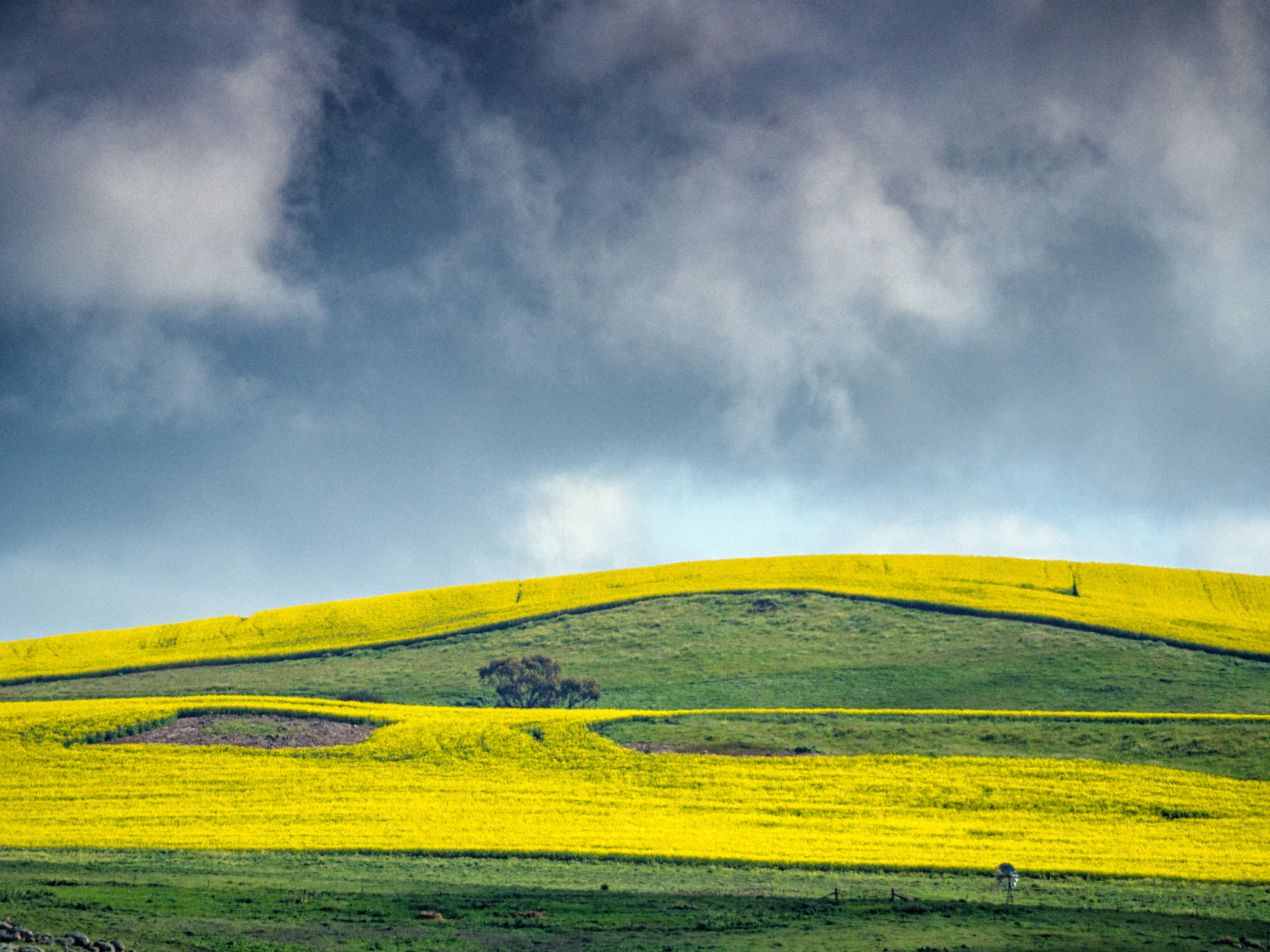
Canola growing on Daliak Estate in York, Western Australia. Olympus OMD EM-10 with Olympus M.75-300mm F4.8-6.7 II lens, Cokin circular polarizing filter and 3 stop graduated neutral density filter. Exposure 1/160 sec, f8 at ISO 200.

Well we have finally moved into our own home and this is the view from the front door. It’s nice to be a home owner again, and it’s nice to have such a brilliant view.

* This weeks musical reference is obvious – it is of course the 1967 hit song Mellow Yellow by Scottish singer song writer Donovan. Back in the day the song was rumoured to be about smoking dried banana peel for its hallucinogenic effect. For the children at home you can’t get munted off smoking bananas it was all a hoax. I wonder how many people spent hours drying bananas and then smoking them over the years. It would have to be millions. Oh the gullibility of youth!!! So what was Donovan’s song about then? Well the clue is in the phrase “electrical banana“.


Recycled

Recycling Marxism
Recycling Marxism. Waste bin, Parliament Square, Hobart. Olympus Pen EP-5 with Olympus mZuiko 25mm f1.8. Exposure: 1/800, f2.0 at ISO 200.

My last post from Tasmania. On Saturday we move back to York in Western Australia. According to my dictionary recycle can mean “return to a previous stage in a cyclic process “. So heading back to York is indeed returning to a previous stage. Can’t wait!


Southern Beaches Market

poster southern beaches market


Next Sunday, the 18th October 2015 to be precise, my wife, Helen,  and I are starting to sell fine art cards, prints and other items at Southern Beaches Markets which is held at Okines Community House in Dodges Ferry. The market is held on the third Sunday of every month for the next six months. We hope to see you there. Please feel free to stop by and have a chat.

All the art on sale will be predominantly about this part of Tasmania. More details about Helen’s art practice can be found here and here.

Diminishing Returns

A bloke I know has just got into photography and has bought an Olympus OMD EM1 with the 12-50 kit lens. By his own admission he knows very little about photography and hasn’t settled into any specific genre. He now wants some more lenses, specifically the so-called Olympus Holy Trinity of f2.8 zooms – the 7-14mm f/2.8, the 12-40mm F2.8 and the 40-150mm F2.8. Nice lenses and in Australia you expect to pay around $4000 for them, and that is the problem. He is pretty convinced that he “needs” these lenses to be a good photographer and has read countless gear oriented forums about them. The major hurdles are that he can’t afford them, and he doesn’t know what to do with them. All he knows is that he wants to post the shots on a photo sharing web site and maybe make the occasional 10×15 cm print. Pushed hard he said that if he were to only have the one it would be the 40-150, but the reality is that he can’t afford even that on its own. I suggested he look at the 40-150mm F4.0-5.6 R which can be picked up for around $200 AUD, sometimes less if a white box special. The look on his face gave the impression that he thought I was stark raving bonkers. He then went onto to site all the usual internet complaints about the lens – its cheap and nasty, slow maximum aperture, unpleasant bokeh, plastic body and lens mount, soft at the longest end. My answer was that the f2.8 model costs around 8 times more than the cheaper one and I doubted whether he would see 8 times difference in terms of optical quality.

I don’t own or have access to the 40-150 f2.8, but I do own the 40-150mm f/4.0-5.6 R and I then decided to test it against a comparable lens from another manufacturer that costs nearly $3000 AUD. The pictures were processed exactly the same way in Lightroom and because the non m4/3 camera had a different aspect ration its image was cropped and sized to same as that from my Pen EP-5. I’m not saying which is which, that’s for you to decide. All I will say is that the 40-150mm f/4.0-5.6 R comes out of the test quite well.

Park Beach Surf #1

Park Beach Surf #2All this reminds me of a conversation I had many years ago with a work colleague Steve. We were chewing the fat one boring night shift and he let on that he had been a full on Hi Fi tragic and had spent an absolute fortune on buying the ultimate set up. I nearly choked when he told how much he spent on speaker cables. I thought that photographers were gear obsessives. Anyway after a while of swapping components in and out and reading lots of technical papers he had the realisation that he was forking out literally thousands of dollars to gain frequencies that only dogs and bats could hear. After that epiphany he settled on the equipment that he had and used it for what it was designed for – listening to music. It’s the same here, you could spend thousands on a lens and most people would not be able to tell the difference. Therein lies the problem for my acquaintance. He is new to the hobby and has been led to believe that to be any good he has to go out and spend a bucket load of whonga on buying the best lenses. He doesn’t have the cash and so he will probably give photography away as he will feel he can’t afford it. My advice was to buy the cheaper alternative and really use it. Push the lens as hard as you can in a variety of situations and then see is you like the focal range, and if that lens prevents you from getting any pictures. If after a year or so you feel that the lens is a must have and that you absolutely need the extra performance and can use it then buy the expensive version. Just to finish I’ll post a picture taken with a camera that internet forums love to hate – the Canon EOS 550d. Its plastic, has a slow frame rate, a poor sensor with little dynamic range, dog slow auto focus, and a minuscule buffer.


Park Beach Surf #4

Nepal Earthquake

I have very fond memories of Nepal. I went there in November to December 1987, and although the people are among the poorest in the world I found them to be some of the most cheerful and hospitable people I have ever met. One of my fondest memories is of a night when we stayed at a remote farmhouse while trekking. I had been ill with dysentery for a couple of months and had lost a lot of weight and looked pretty awful. We arranged for a bed for the night and a meal of dhal baht (the local staple of lentils, rice, and potato and cauliflower curry, sometimes topped with a fried egg if you were lucky). The older man of the household was very concerned about me – he literally tucked me in bed and soothed my forehead while making clucking sounds.  It was one of many wonderful and hospitable moments from people who had not much more than nothing.


Elephant In The Mist
Working elephant heading off to work in the early morning mist in Chitwan National Park, Nepal.

On the 25th April Nepal was hit by a devastating earthquake which has killed over 6000 people and has an expected death toll of 10,000. Worse than tat it is estimated that twice that number will have been injured and tens of thousands of people have been made homeless. As photographers we take a great deal of pleasure from the world around us and those that live in it. Perhaps it is time to give a little something to those in need – maybe you already have and if so thank you. Many aid agencies, retail chains, iTunes and banks are taking collections for the people of Nepal. I’ll list some of the Australian ones but you can use those in your own country if you’d rather.


Chitwan National Park
Sam, Ewan, and Mark the local guide on our illicit elephant safari in Chitwan National Park, Nepal. Olympus OM4 with Sigma 75-210 lens. Illfochrome 200.

 UNHCR

Oxfam

World Vision Australia

Red Cross

Hanuman Dhoka
Hanuman Dhoka is a complex of structures with the Royal Palace of the Malla kings and also of the Shah dynasty in the Durbar Square of central Kathmandu, Nepal. Olympus OM4 with Sigma 75-210 lens, Kodak Ektachrome 100.


Waiting
A cycle rickshaw operator waiting for a fare. Kathmandu, Nepal. Olumpus OM4 with Sigma 75-210 Kodak Ektachrome 100.


Stuppa
One of the many stupas in Kathmandu. Olympus OM40 with Zuiko 35-105 lens Kodak Ektachrome 100.


On the steps
Watching the world go by from from the temple steps in Durbar Square, Kathmandu. Olympus OM4 with 75-210 lens Kodak Ektachrome 100.


Hopscotch
Nepali children playing on hopscotch on the temple steps in Durbar Square, Kathmandu. Olympus OM4 with Sigma 75-210 lens Kodak Ektachrome 100.


Smoko
A Nepali man sitting on the temple steps in Durbar Square, Kathmandu. Olympus OM4 Sigma 75-210 Kodak Ektachrome 100.


The Flute Seller
Flute seller, Freak Street, Kathmandu. Olympus OM4 with Sigma 75-210 lens Kodak Ektachrome 100.


Swayambhunath
The Swayambhunath Stuppa, Kathmandu. Olympus OM4 with Sigma 75-210 lens Kodak Ektachrome 100.


Just as an aside – all these photos were taken in 1987 on E6 slide film, mostly Kodak Ektachrome 100 and some on Ilford Ilfochrome 200. The slides have been stored in archival binders ever since. When I got them out to scan them for this post all had started to fade, and some the dyes had perished badly leaving just a magenta cast – hence that is why some are black and white. So if you have any valuable slides scan them now before they disappear for ever.


Homesick

A Walk Down The Lane
A Walk Down The Lane. Canon EOS 5d with Canon EF 28-135mm f3.5-5.6 IS lens, Cokin circular polarising filter and Cokin graduated neutral density filter.

Missing the endless blue skies and red dirt of the Wheatbelt of Western Australia terribly.


Seen Better Days
Seen Better Days. Pentax 645 IIn with Pentax 45-85 f4 lens with Cokin circular filter and Cokin graduated neutral density filter. Fujicolor 160S


York Panorama
York Panorama. Olympus EM10 with Olympus 12-50mm f3.5-6.3 lens.


As always clicking on the photo will take you to my online gallery.