Moving to Tassie means that we have rediscovered autumn. When we lived in Western Australia’s Wheatbelt according to Nyoongar tradition had six seasons in a year. Me not being a Black Fella’ could only really differentiate three – hot, not so hot, and not so hot and raining. So it’s quite nice walking around and seeing the trees turn and drop their leaves.
Along side the Sorell Rivulet in Pioneer park there are several oak trees. Now it is autumn they are starting to drop their acorns and the leaves are turning golden.
I know I’ve said in the past that I’m not a great fan of MONA but just lately I’ve been going up there a bit because I’ve signed up to study a unit in Art Theory at University of Tasmania (UTas). I got up extra early to see an installation by American artist James Turrell called Amarna. There’s not a lot I can say about this work except that it is gob smackingly beautiful and very serene.
Here are a few stills.
Wim Delvoye’s Seventeenth Century Flemish Baroque style.Truck and James Turrell’s Amarna at dawn. MONA, Hobart, Tasmania.Amarna At DawnJames Turrell’s Amarna at dawn. MONA, Hobart, Tasmania.
Technical notes: the time-lapse sequence was made with a Sony ActionCam HDR AS20. The stills were shot using an Olympus OMD EM-10 with either an Olympus mZuiko 17mm f2.8 or an Olympus mZuiko 25mm f1.8 lens.
I went to the touristy olde world town of Richmond a little while ago and saw a Tasmanian Tiger or Thylacine. It had been turned into a garden ornament – “gnomified” if you like, just like the Buddha has been.
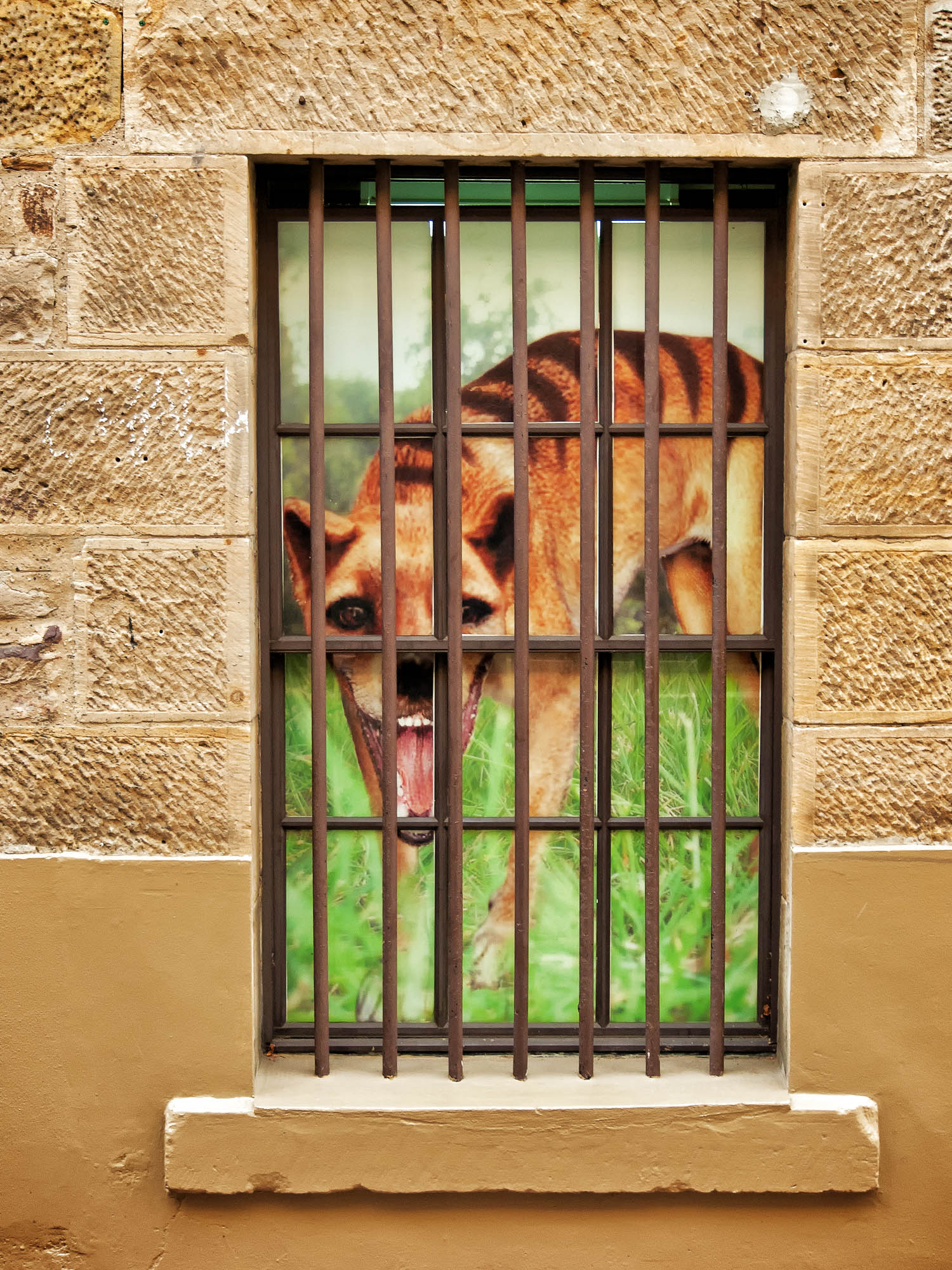
Tasmanian Tiger, aka the thylacine, spotted in a front garden in Tasmania’s historic town of Richmond.
Tasmanians have a very complicated relationship with the Tassie Tiger. Images of the thylacine can be seen everywhere, it’s on beer labels, the state coat of arms, the coat of arms for Launceston, the logo for Tourism Tasmania. In fact it is everywhere. You might, therefore, come to the conclusion that it is a much-loved animal. In a way it is, but the truth is it wasn’t.
The Tasmanian Tiger roams in Salamanca, Hobart, Tasmania.
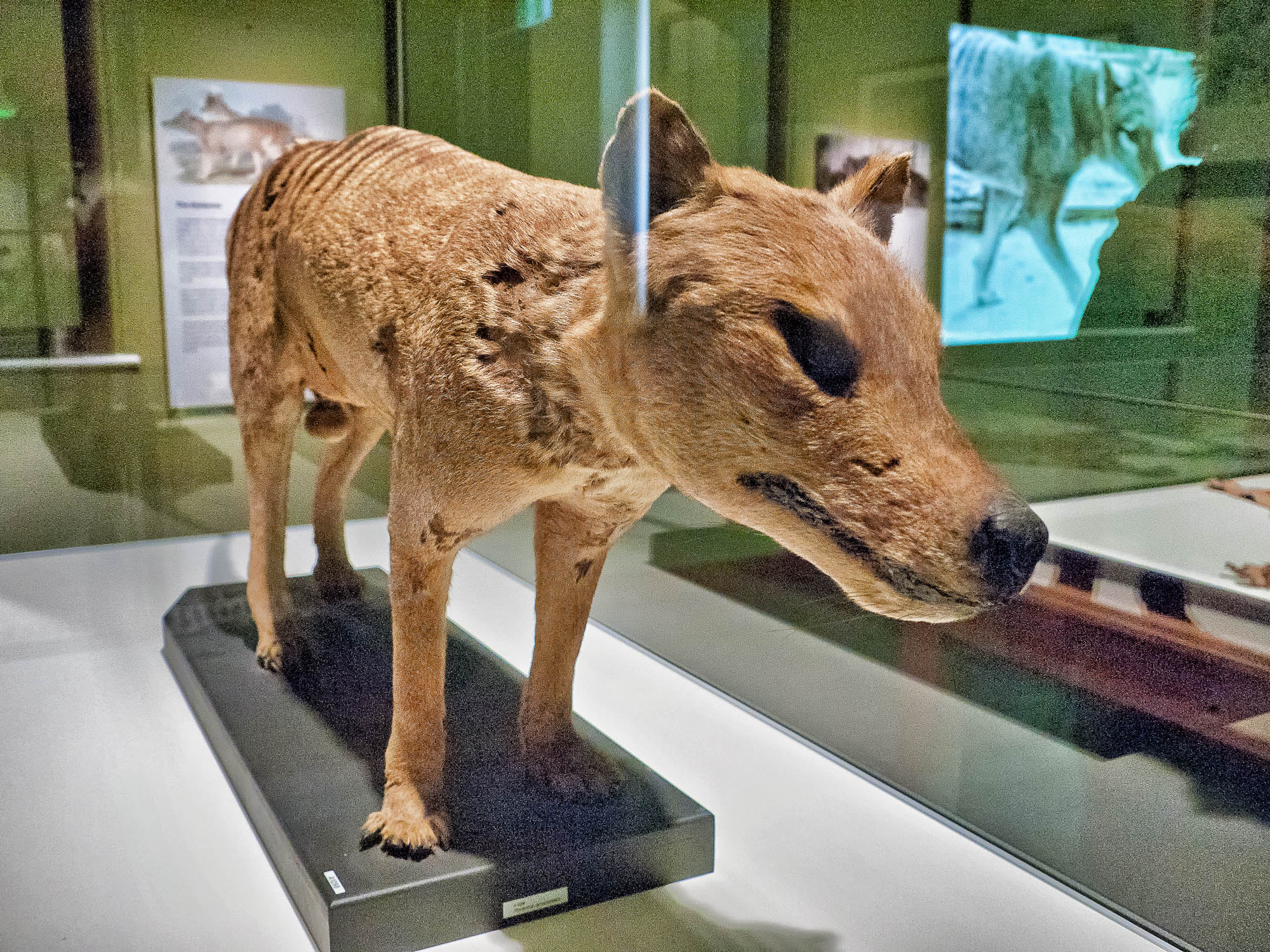
The Thylacine was a shy reclusive animal, the last of its kind – a carnivorous marsupial that was an apex predator and whose relatives went back into the mists of the mammalian era some 5 to 23 million years ago (the Miocene). Computer modelling has shown that the thylacine was not a very strong animal and would have been incapable of handling anything larger than 5Kg and it is now widely believed that they were ambush predators who preyed on small animals such as bandicoots and possums. When the first aboriginal people crossed to the Australian Continent via a land bridge some 40,000 years they brought with them the first dogs, the descendants of what we now call the dingo. The dog was simply a much better and more adaptable predator than the thylacine and by the time British colonisation started they were already extinct on the mainland. When the first settlers in Tasmania saw the thylacine they named it the Tasmanian Tiger or Tasmanian Wolf. There was an apocryphal tale appealing to Victorian gothic drama that can be traced back to just one source that the Thylacine was a blood drinker which preyed on sheep and poultry. That sealed its fate and a bounty was placed upon it and it was hunted vigorously.
A particularly moth eaten stuffed thylacine, or Tasmanian Tiger, in the Tasmanian state museum.
The bounty of £1 for a dead adult and 10 shillings for a dead pup meant that by the 1920’s it was rare to see a thylacine in the wild. In 1930 a farmer by the name of Wilf Batty shot the last wild one. This was bad enough but the tale takes a more tragic turn. In 1933 the Hobart Zoo acquired a thylacine, which was later referred to as Benjamin, which lived there for three years. Inevitably the animal died not of old age but because it was locked out of its shelter on a very cold Tasmanian night. In effect killed by neglect. The last of a species going back millions of years killed because somebody couldn’t be bothered to make sure it was sheltered safely for the night. So after 133 years of settlement, thirty years after a conservation movement was founded seeking its protection and just 59 days after the Tasmanian government signed a conservation order to protect it the last thylacine had died. Optimistically it remained on the endangered list until the 1980’s , but with no confirmed sightings for 50 years it was declared officially extinct.Every now and again there is some crack pot scheme to clone it from DNA harvested from remains in museums, or some millionaire will put a reward for the capture of a live one, but the reality is that the thylacine is long gone because of an indifference to its plight.
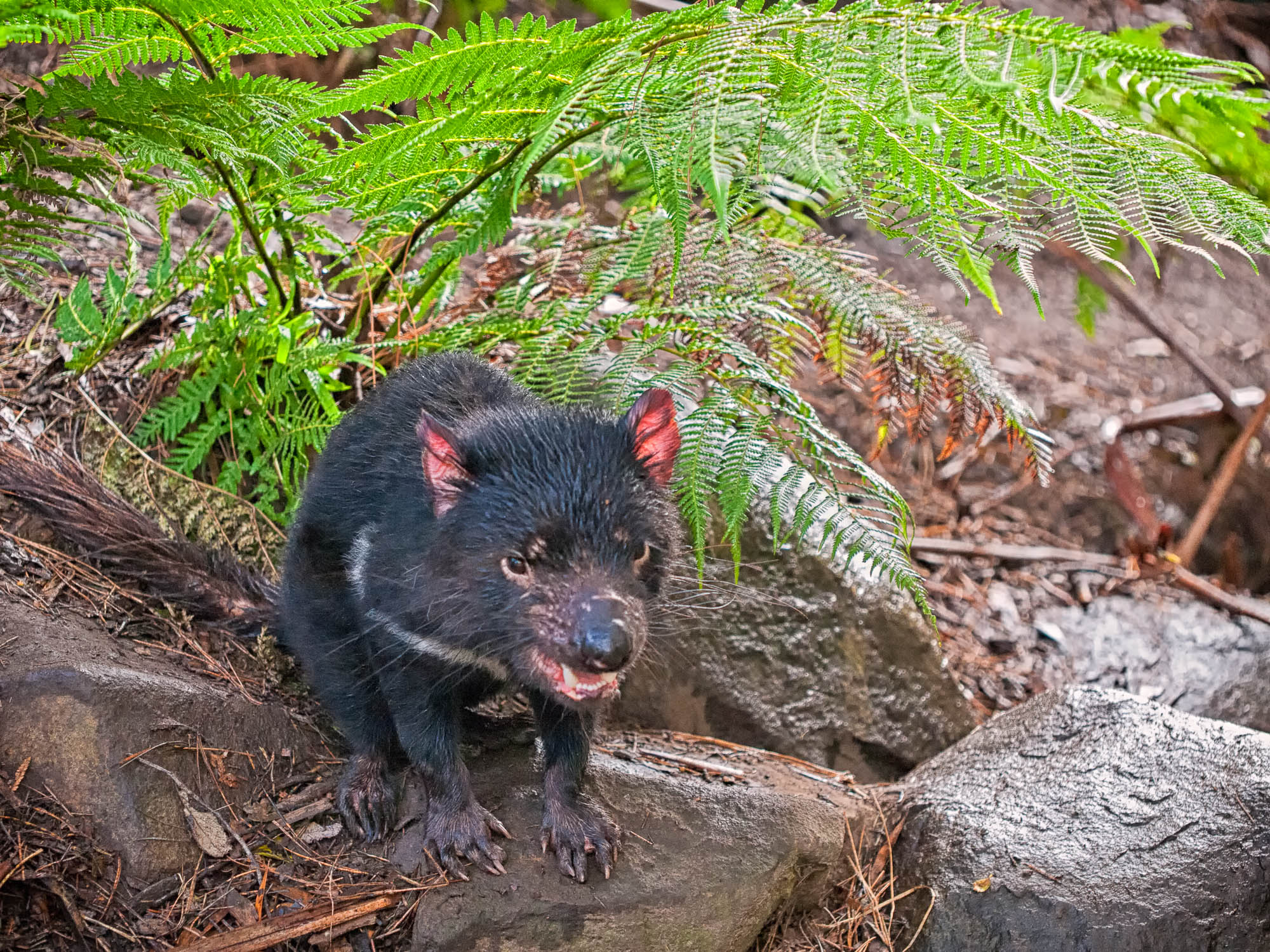
In the mid 1990’s a biologist by the name of Nick Mooney gave an interview to the Hobart Mercury newspaper. Mooney was concerned that the attention the thylacine was getting was diverting the attention away from Tasmania’s other iconic animal – the Tasmanian Devil. He argued that the Devil should be researched and protected. Many people thought that he was barmy as there were more Devils in Tasmania then than at the time of first settlement and farmers were claiming that they were at plague proportions and were a threat to livestock. Fast forward twenty years and the devil is now on the verge of extinction from a combination of devil facial tumour (a transmissible cancer), habitat destruction, traffic fatalities and environmental pollution caused by high levels of flame retardant chemicals found in consumer electronics. These chemicals are banned and were phased out in the 1980’s but their effects are still being felt and it is thought that they play a part in devil facial tumour disease. Because devil populations are declining the gene pool is also diminishing this had laid the Devils very vulnerable to disease.
The devil is an iconic symbol of Tasmania and many organisations, groups and products associated with the state use the animal in their logos. It is seen as an important attractor of tourists to Tasmania.
Today Tasmanians mourn the passing of the thylacine even though there are very few people who are left alive that actually saw one. All that remains are a few preserved specimens in museums, some black and white photos and some grainy film footage. Tourist operators say that the extinction of the devil will severely impact their industry and slowly people are starting to wake up to the fact that the devil is likely to go the same way if something is not done. There has been some research on the on devil facial tumour disease which is fantastic. So is devil saved? Well some scientists believe that the only way for the devil to survive is to quarantine healthy devils in captivity and let the wild population die out. Even if the wild population could survive the current Tasmanian state and Australian Federal governments are working to open up Tasmania’s national parks and world heritage areas to commercial logging. The federal government is also not prepared to fund research into Devil Facial Tumour Disease. So at present your best chance of seeing a Tasmanian devil is either at a zoo, animal sanctuary or dead beside a road. In another twenty years all we could be left with is some video footage and some memories. I would urge every Australian and prospective visitor to Tasmania to write to:
Matthew Groom the Tasmanian minister for the environment
and
Greg Hunt the federal minister for the environment
asking that more funding should be given to ensure the survival of the devil and to ask them not to open the Tasmanian national parks to logging.
They’re not the most loveable of creatures but the world would be a worse place without them.
I had been in Western Australia for 26 years, and to be honest although I hadn’t seen everything in WA things were starting to feel a little stale. Now I’m in Tasmania and everything is brand new. A change in the environment has suddenly got the creative juices flowing.
Yesterday I went unto Woodvine Reserve. It is a farm that has been held by one family since colonial times and has now been gifted to the Crown as a reserve. To me it is interesting to see how nature is reclaiming the land and gradually traces of human settlement are disappearing. The farm building are largely intact as they show the changes that occurred for the owners over the life of the farm. But the fields, the boundary fences, the farm tracks are all being over grown.
The comforting warning sign on the entrance to the reserve.
Woodvine Farm was gifted to the Crown on the condition that it was to be made a reserve in order to protect the animals that lived there. Prior to proclamation, the property had belonged to his family since it was first settled in 1861.
The back garden of the third house to be built on the farm.
Daffodils growing in what used to be the front garden of the second dwelling to be built at Woodvine.
The first building on the farm was this slab timber structure which provided the first home. When a new dwelling was built it was converted into a sheering shed.
Peat soils support wetlands, button grass moorland and fern fields. Woodvine Reserve.
Waxlip orchid (Glossodia major) found in Woodvine Reserve. Tasmania, Australia.
Small Duck Orchid or Paracaleana minor. Also called Caleana minor in some reference books. Woodvine Reserve, Tasmania.
Hot off of the press – no that’s not right. Hot off of the Mac is my new book Paul’s Guide To Perth – Western Australia. It is available exclusively through the Apple iTunes Book Store for the modest price of $5.99 AUD. It is 232 pages, lavishly illustrated with photos and maps, of things to do out and about in Perth. Click on the image and it will take you to the bookstore.
Description
Perth has the dubious title of being the most isolated capital city in the world, closer to Singapore than to Sydney or Melbourne. When most Australians think of Western Australia they see the Australian equivalent of the American Wild West, a land given over to mining and large-scale agriculture. When they think of Perth they see a mining town inhabited by cashed up bogans and dodgy entrepreneurs. But it is not all flannel shirts, thongs and flakey business deals in Perth, if you take the time to have a closer look you will find excitement, exuberance, and entertainment. So what does Perth have to offer? Well in short everything. Perth boasts more sunny days than any other Australian capital city, and with an average daytime temperature range of 32℃ in summer to 14℃ in winter it is very conducive to a relaxed outdoor lifestyle. In fact the American Consul to Western Australia once said that “Perth has the kind of weather that California thinks it has!”.
Situated on the Swan River Basin, by the indian Ocean and at the foot of the Darling Escarpment Perth has some of the finest beaches in the world and some of the world’s most unique fauna and flora. Paul’s Guide helps the reader discover Perth with detailed descriptions, maps and photographs, information on Perth’s history and the environment.
The “blood moon” or the red lunar eclipse brought out the apocalyptic in me.
According to Wikipedia…”A lunar eclipse occurs when the Moon passes directly behind the Earth into its umbra (shadow). This can occur only when the Sun, Earth, and Moon are aligned exactly, or very closely so, with the Earth in the middle. Hence, a lunar eclipse can only occur the night of a full moon… the red colouring arises because sunlight reaching the Moon must pass through a long and dense layer of the Earth’s atmosphere, where it is scattered…Several cultures allude to the lunar eclipse as being a good or bad omen. For example, in some Chinese cultures, people would ring bells to remove wild animals that bit the moon. During the Zhou Dynasty in the Book of Songs, the sight of a red moon engulfed in darkness led them to believe the sign as a foreshadowing of famine or disease.” SPOOKY!
Thankfully we all woke up happy and well the next morning.
The weather conspired against me. I had planned my shoot using The Photographer’s Ephemeris, got my angles and location sorted out and then just half an hour before heading out I stuck my head outside and we have thick cloud cover. Bugger! What to do? I didn’t want to drive out to my location, walk to the point and stand in cold wind coming straight off of the Antarctic for nearly 3 hours with the chance of getting nothing. So I decided to set up my cameras on my deck and only start filming when there was a break in the cloud cover. So out of 3 hours and 20 minutes of potential eclipse action I got in total about 30 minutes. Ah well I shall wait until the next one on the 04/04/2015.
Filmed using the time-lapse movie function on the Olympus OMd EM-10 with a 75mm f2.5 Color-Heliar and a Zuiko 40-150mm f4-5.6 lens. Additional footage filmed on a Canon 550d with 70-200mm f2.8 L IS lens
It’s been a busy time at Paul Amyes Photography (PAP) Towers. I attended the Hobart, Tasmania Climate Change rally at MOMA this afternoon and then rushed back to the secret bunker “toute suite” to process and upload the images to be part of the global event that will culminate in United Nations Climate Summit in New York, where it is hoped that United Nations secretary-general Ban Ki-moon can talk some sense into our numskull leaders that the time to do something is now. Although Australia’s PM is in New York he has stated that he will not be attending as he has gone on public record as declaring climate change as “bullshit”, but this is probably because Rupert Murdoch, large multi-national mining companies and several prominent Australian billionaires have made up his mind for him. Hopefully the summit will be a success and the current government will have external pressure brought to bear.
It was a good turn out and everyone was in a happy and positive frame of mind despite the seriousness of the issue. It certainly wasn’t a “rent a crowd” gathering as our politicians and the Murdoch controlled media so often choose to call such gatherings. There was a broad range of social groups represented from kids to pensioners who were united in their concern at what is happening to the Earth that we live on.
Standing on the beach looking out to Mount Wellington.
Well with the help of a horde of minions Paul Amyes Photography (PAP), the global producer and purveyor of photo media par excellence, has relocated from the Wheatbelt of Western Australia to the Southern Beaches of Tasmania. Now as anyone with any kind of aspiration to any sort of global domination will know that one of the keys to success is a top-secret location, preferably hidden on a tropical island in an extinct volcano or a vast subterranean labyrinth of tunnels under a suitably gothic city scape. Well we’re no different, we have established our headquarters on a gargantuan private estate that is patrolled by a roving multitude of attack possums and killer quolls. We tried to get the more ferocious Tasmanian Devils, but the double whammy effect of Devil Facial Tumour and Tasmanian motorists decimating their numbers means that are too few in number and therefore they just won’t work for peanuts. However, there was a slight problem with the plan. Being top-secret and heavily guarded made setting up telecommunication links very difficult. The technicians either didn’t know where to find us or were put to flight by the packs of marauding marsupials. After four weeks with only dodgy mobile phone reception and non- existent 3G mobile internet we finally relented and gave out our address and told security to take the day off. With the arrival of the electric interwebs social intercourse can now resume and we can open for business again. Hoorah!
One of the deadly attack possums
A killer quoll
Seriously folks our move to Tassie went smoothly and we are now planning to re-launch the business. Consequently over the next couple of months the blog and website will be re-worked and refreshed. Blogging will continue, but I hope it will become a little more focussed on the launch of new projects, products and services. Shortly after arriving I was invited to The Mercury’s short film festival as my film had been short listed for an award. Alas I did not win anything (the competition was just too good) I have been emboldened to take my film making more seriously and will look at gaining more skills and then using them to produce a lot more work with aim of taking on editorial and commercial projects.
Just back from another visit to Tasmania – our third in just over a year.
In The Pink. Salamanca Market, Hobart Tasmania. Olympus EM-10 with 17mm f2.8 lens. 1/250, f4 at ISO 400.Pink and Yellow, Salamanca Market, Hobart, Tasmania. Olympus EM-10 with 17mm f2.8 lens. 1/400 sec, f4, ISO 400.
Despite being cold and wet Salamanca Markets was its usual funky self and pink fairy floss and strange fury hats were the order of the day.
Clothes Tree. Salamanca Markets, Hobart, Tasmania. Olympus EM-10 with 17mm f2.8 lens. 1/160, f4, ISO 400.
As usual the scenery didn’t fail to disappoint, and like always I just wish that I’d had more time and better range of equipment than I had on hand.
Baranjay, Franklin, Tasmania. Olympus EM-10 with 40-150mm F4.0-5.6 lens.
Sea Shells By The Sea Shore, Primrose Sands, Tasmania. Olympus EM-10 with 17mm F2.8 lens. 1/50 sec, f22, ISO 200.No One Home, Randalls Bay. Olympus EM-10 with 12-50mm F3.5-6.3 lens. 1/100 sec, f6.3, ISO 400.
Then there was the usual close encounter of the animal kind. The wildlife in Tassie is amazing and thankfully not all of it lies dead on the side of the road.
The eastern quoll (Dasyurus viverrinus), also known as the eastern native cat, is a medium-sized carnivorous marsupial native to Australia. Olympus EM-10 with 40-150mm F4.0-5.6 lens. 1/15 sec, f5.1 at ISO 12800!!
Well I guess there’s only one thing for it – the global photographic juggernaut that is Paul Amyes Photography (PAP) is now relocating to the southern beaches of Tasmania. We apologise profusely in advance for the break in our regular programming schedule and hope to get everything back online Telstra permitting.





You must be logged in to post a comment.