Lady Franklin Museum “Ancanthe” Park, Lenah Valley, Tasmania.
Following hot on the heels from last week’s entry about MONA. David Walsh is not the first person to try to bring a bit of culture to the denizens of Hobart. Way back in 1842 Lady Jane Franklin wife of the governor Sir John Franklin felt that there was a “lack of cultural institutions” in Tasmania. She sought to remedy this with the help of the convict architect, James Blackburn, by building a classical edifice on the slopes of Mount Wellington set in 400 acres parkland. This building was to be the centrepiece of a botanical garden and hopefully instil some cultural aspiration into the good people of Hobart. Fat chance! The Franklins left Hobart in 1843 and the building and land were transferred to the Anglican Church, notably Christ College. After nearly 100 years of neglect by the church the building became an apple shed. Apples are very important to Tasmanians. The nice thick stone walls probably made it a very good store. In 1949 it was acquired, along with 5 acres of land by the Hobart City Council and then leased to the Art Society of Tasmaniawho are now using it as it was originally intended.
Lady Franklin Museum illuminated by the first rays of the sun at dawn.
I know I’ve said in the past that I’m not a great fan of MONA but just lately I’ve been going up there a bit because I’ve signed up to study a unit in Art Theory at University of Tasmania (UTas). I got up extra early to see an installation by American artist James Turrell called Amarna. There’s not a lot I can say about this work except that it is gob smackingly beautiful and very serene.
Here are a few stills.
Wim Delvoye’s Seventeenth Century Flemish Baroque style.Truck and James Turrell’s Amarna at dawn. MONA, Hobart, Tasmania.Amarna At DawnJames Turrell’s Amarna at dawn. MONA, Hobart, Tasmania.
Technical notes: the time-lapse sequence was made with a Sony ActionCam HDR AS20. The stills were shot using an Olympus OMD EM-10 with either an Olympus mZuiko 17mm f2.8 or an Olympus mZuiko 25mm f1.8 lens.
The Victorian era was a time of incredible innovation and some of the inventions and processes are still practiced in their original form. In the field of photography despite the march of technology some photographers like Sally Mann and Robb Kendrick use antiquated processes in a modern context to express themselves. Well besides my interest in all things photographic I am also interested in cycling. A little after I migrated to Australia I heard about the Australian National Penny Farthing Championships which are held at the historic Tasmanian town of Evandale and I put on the bucket list of things to see. Well the other week I noticed in the upcoming events column of the Mercury newspaper that the races were on and I just had to go. The whole idea that anyone wants to race, let alone ride, a penny farthing is to me totally mad while at the same time seems a perfectly logical steampunk activity.
Evandale is a pretty colonial era town just south of Launceston in the north of Tasmania. Every year in February, since 1983, the town puts on The Evandale Village Fair in conjunction with the penny farthing championship. This means that the town is a bustling hive of activity that attracts visitors not only from all over Tasmania but also from the Big Island, also known as the Australian Mainland.The fair has market stalls, live musical entertainment, Morris Dancing, vintage cars, costume parades and even a genuine old-time Punch and Judy show.
That’s The Way To Do It
But there is no doubt, the star attraction is the penny farthing racing which attracts riders from all over Australia.The event lasts a weekend with the Saturday hosting the main short course events that are held on a course in the township itself. On the Sunday the longer distance races are held, including the Century Ride, which is a penny farthing tradition that goes back to the 1880’s, which is a 162 Km race or 100 miles. Totally bonkers!!
Shadow
The bikes maybe old-fashioned but the riders can certainly shift while on the 1 mile 91.6 Km) course. Evandale National Penny Farthing Championship.
Having a perfectly groomed handlebar moustache is a requirement for the successful penny farthing racer. 2015 Evandale Village Fair and national penny farthing championship. Tasmania, Australia.
The details for next years event has already been posted on the website. If you want a fun, action packed and unusual day out then go to Evandale in February 2016.
The Man In Black
As always clicking on an image will take you through to my online store.
Regular readers are aware that I my blogs have musical references to them and so here is the pop video for this entry.
Now according to Wikipedia the Highlands of Scotland are:
“…north and west of the Highland Boundary Fault, although the exact boundaries are not clearly defined, particularly to the east. The Great Glen divides the Grampian Mountains to the southeast from the Northwest Highlands. The Scottish Gaelic name of A’ Ghàidhealtachd literally means “the place of the Gaels” and traditionally, from a Gaelic-speaking point of view, includes both the Western Isles and the Highlands.”
The other day I knew that I was in the Georgian Town of Richmond in Tasmania, Australia, but you could be forgiven for looking out over the Coal River Valley at the distant hills and imagining that you had suddenly been transported 17,324 km (10764 miles) to the Scottish Highlands. This was particularly reinforced when the skirl of the pipes was to be heard floating across the valley. The reality was not that I had been suddenly swept up in Gaelic daydream and astral planed to a far off land but I was at the St Andrews Richmond Highland Gathering where all things Scottish were being celebrated. According to their Facebook page:
“The St Andrew Society Hobart Incorporated was formed in 1960 by a group of people who wanted to keep alive the traditions, dancing, music, sports and literature of Scotland. The motto of the Society is “Cairdeas”, a Gaelic word meaning “Friendship”. Membership of the Society is open to persons who are interested in fostering the objectives of the Society. “
The Scots are the third largest migrant group in Tasmania and they were numerous among the early settlers lured across by the prospect of farming in the Midlands of Tasmania which reminded them of their homelands. Prior to 1830 most Scots who migrated were farmers and landowners who were trying to escape the economic recession of the 1820’s. Other Scots came because they had served in the British Colonial forces and they stayed on when their term of service ended. From the 1830’s onwards the working poor joined the diaspora and they headed for Hobart to work in the industries there. This rate of migration has remained steady throughout the Twentieth Century and into the Twenty First.
So it was no wonder that as we pulled up in Richmond that the town was positively heaving with visitors. Now Richmond is well and truly on tourist route number 1 in Tasmania and can be busy throughout most of the year, especially so in summer. But nothing prepared us for this. I struggled to find a parking space, but luckily after a slow lap of the town I found a spot down by the Coal River and just a short walk from the village green where the action was happening.
At this point I feel compelled to make a public disclosure. When I was a young lad I had been exposed to the bagpipes through attending things like the The Royal Tournament at Earls Court in London. At that point I was fairly bagpipe neutral – I neither liked or disliked them. Then in December of 1987 we were in Kathmandu, Nepal, during the wedding season. Part of the wedding ceremony is to have a procession through the streets which is led by a marching (and I use the term loosely here as most seemed rather shambolic) band. Here I was subjected to bag pipe-playing of the most hideous nature. There are not words in the English language that adequately describe how bloody awful it was. The nearest I can get is to imagine a cat with a soprano voice being fed through a mangle while gargling on razor blades whilst having its nether regions probed by red-hot pokers and that doesn’t nearly describe the aural torture that I experienced. Ever since then I would rather slide down a banister rail made out of razor blades using my testicles as brakes rather than listen to bagpipes. It was, then, with some trepidation that I approached the green. The first thing I saw was the Scottish dancing with young tartan clad girls deftly defying gravity as they leapt and pranced on the stage. A walk around the perimeter of the green found a plethora of stalls selling on manner of Scottish items ranging from Celtic crosses to your clan’s genealogy. In the centre of the green there were competitions for the best pipe band, the best piper, the best pipe major, the best dressed band, demonstrations of Scottish country dancing and a choir. The strange thing was that I really enjoyed it. There was no sound of screaming mangled cats – it was all a thoroughly enjoyable experience.
So if you ever find your self in Southern Tasmania in February nip up to Richmond for the Highland Gathering its a fun day out.
“What?” cried the Rat, open-mouthed: “Never been in a—you never—well I—what have you been doing, then?””Is it so nice as all that?” asked the Mole shyly, though he was quite prepared to believe it as he leant back in his seat and surveyed the cushions, the oars, the rowlocks, and all the fascinating fittings, and felt the boat sway lightly under him.
“Nice? It’s the only thing,” said the Water Rat solemnly as he leant forward for his stroke. “Believe me, my young friend, there is nothing—absolute nothing—half so much worth doing as simply messing about in boats. Simply messing,” he went on dreamily: “messing—about—in—boats; messing—”
“Look ahead, Rat!” cried the Mole suddenly.
It was too late. The boat struck the bank full tilt. The dreamer, the joyous oarsman, lay on his back at the bottom of the boat, his heels in the air.
“—about in boats—or with boats,” the Rat went on composedly, picking himself up with a pleasant laugh. “In or out of ’em, it doesn’t matter. Nothing seems really to matter, that’s the charm of it. Whether you get away, or whether you don’t; whether you arrive at your destination or whether you reach somewhere else, or whether you never get anywhere at all, you’re always busy, and you never do anything in particular; and when you’ve done it there’s always something else to do, and you can do it if you like, but you’d much better not. Look here! If you’ve really nothing else on hand this morning, supposing we drop down the river together, and have a long day of it?”
The MyState Australian Wooden Boat Festival is held every two years and Hobart’s historic waterfront comes alive with the colour and excitement of Australia’s rich maritime culture and history.There were hundreds of wooden boats, from magnificent tall ships to classic sailboats, rugged working boats to superbly detailed models.The Madoc is a Fenwick Williams “Annie”. The MyState Australian Wooden Boat Festival is the largest wooden boat festival in the Southern Hemisphere .2015 Australian Wooden Boat Festival HobartHop The Wag is an old English saying which means to play truant.Captain Jack Sparrow has docked and gone walkabout at 2015 Australian Wooden Boat Festival in Hobart.Hanging From The Yard Arm. The captain of the Lahara deals with pirates very seriously as pirate Ted found out.The Tasmanian Gilbert and Sulivan Society get all swash buckling at The Elizabeth Street Pier.A Member of the Tasmanian Gilbert & Sulivan Society at the Elizabeth Street Jetty.The much-loved 1880 Steam Carousel was whirling all weekend in the Princes Wharf Forecourt.Single-oar sculling is the process of propelling a watercraft by moving a single, stern-mounted oar from side to side while changing the angle of the blade so as to generate forward thrust on both strokes.
I went to the touristy olde world town of Richmond a little while ago and saw a Tasmanian Tiger or Thylacine. It had been turned into a garden ornament – “gnomified” if you like, just like the Buddha has been.
Tasmanian Tiger, aka the thylacine, spotted in a front garden in Tasmania’s historic town of Richmond.
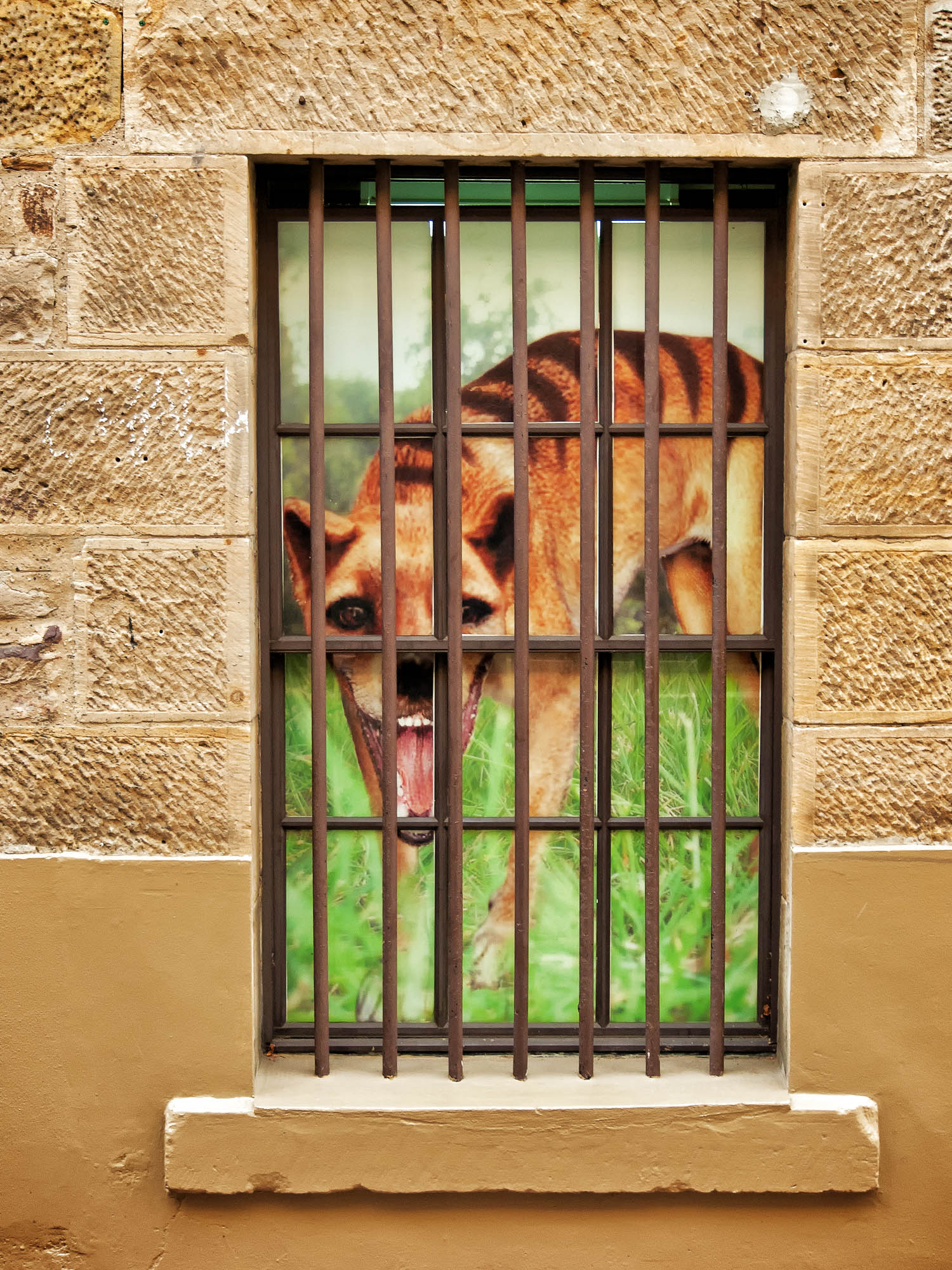
Tasmanians have a very complicated relationship with the Tassie Tiger. Images of the thylacine can be seen everywhere, it’s on beer labels, the state coat of arms, the coat of arms for Launceston, the logo for Tourism Tasmania. In fact it is everywhere. You might, therefore, come to the conclusion that it is a much-loved animal. In a way it is, but the truth is it wasn’t.
The Tasmanian Tiger roams in Salamanca, Hobart, Tasmania.
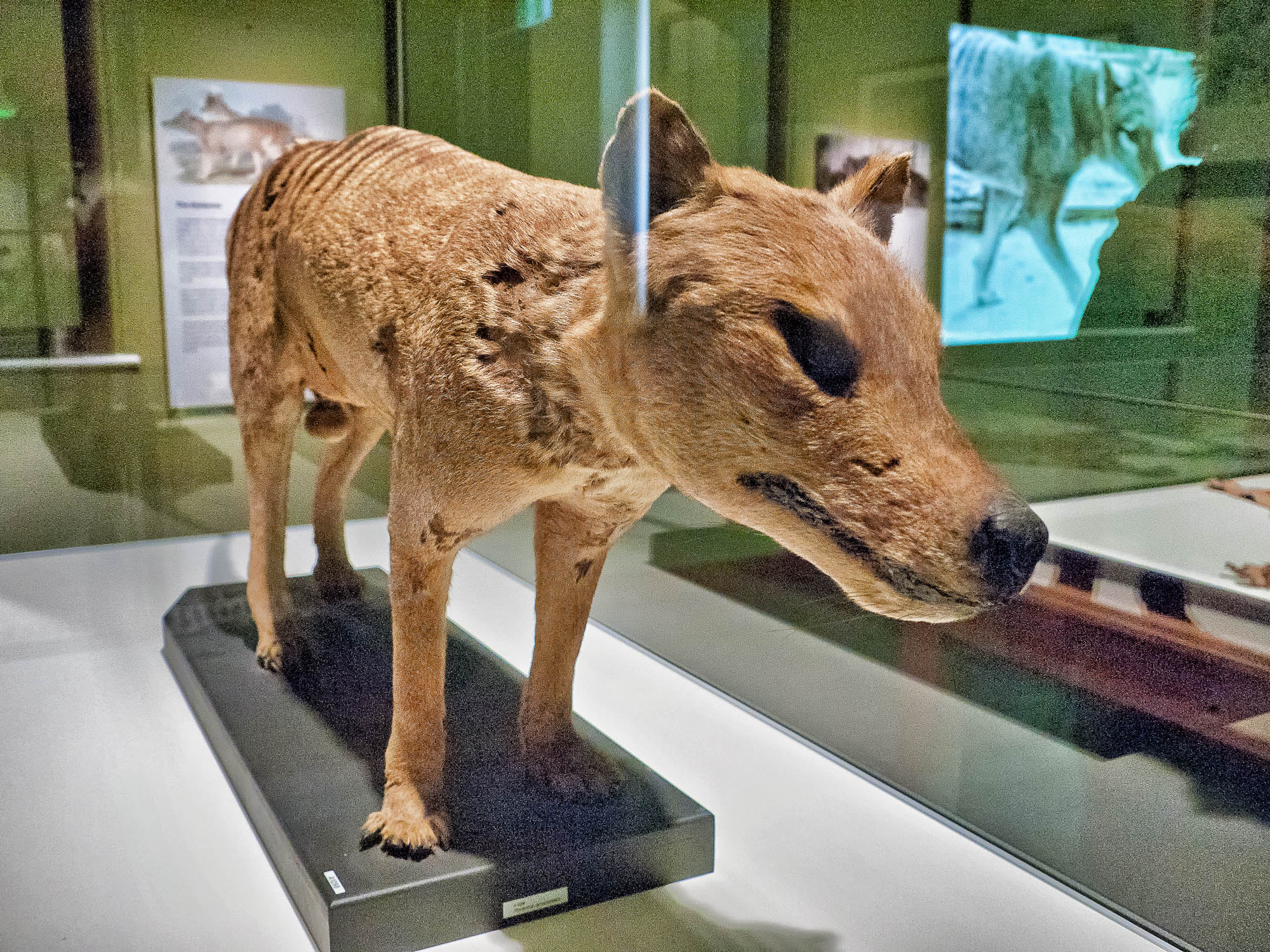
The Thylacine was a shy reclusive animal, the last of its kind – a carnivorous marsupial that was an apex predator and whose relatives went back into the mists of the mammalian era some 5 to 23 million years ago (the Miocene). Computer modelling has shown that the thylacine was not a very strong animal and would have been incapable of handling anything larger than 5Kg and it is now widely believed that they were ambush predators who preyed on small animals such as bandicoots and possums. When the first aboriginal people crossed to the Australian Continent via a land bridge some 40,000 years they brought with them the first dogs, the descendants of what we now call the dingo. The dog was simply a much better and more adaptable predator than the thylacine and by the time British colonisation started they were already extinct on the mainland. When the first settlers in Tasmania saw the thylacine they named it the Tasmanian Tiger or Tasmanian Wolf. There was an apocryphal tale appealing to Victorian gothic drama that can be traced back to just one source that the Thylacine was a blood drinker which preyed on sheep and poultry. That sealed its fate and a bounty was placed upon it and it was hunted vigorously.
A particularly moth eaten stuffed thylacine, or Tasmanian Tiger, in the Tasmanian state museum.
The bounty of £1 for a dead adult and 10 shillings for a dead pup meant that by the 1920’s it was rare to see a thylacine in the wild. In 1930 a farmer by the name of Wilf Batty shot the last wild one. This was bad enough but the tale takes a more tragic turn. In 1933 the Hobart Zoo acquired a thylacine, which was later referred to as Benjamin, which lived there for three years. Inevitably the animal died not of old age but because it was locked out of its shelter on a very cold Tasmanian night. In effect killed by neglect. The last of a species going back millions of years killed because somebody couldn’t be bothered to make sure it was sheltered safely for the night. So after 133 years of settlement, thirty years after a conservation movement was founded seeking its protection and just 59 days after the Tasmanian government signed a conservation order to protect it the last thylacine had died. Optimistically it remained on the endangered list until the 1980’s , but with no confirmed sightings for 50 years it was declared officially extinct.Every now and again there is some crack pot scheme to clone it from DNA harvested from remains in museums, or some millionaire will put a reward for the capture of a live one, but the reality is that the thylacine is long gone because of an indifference to its plight.
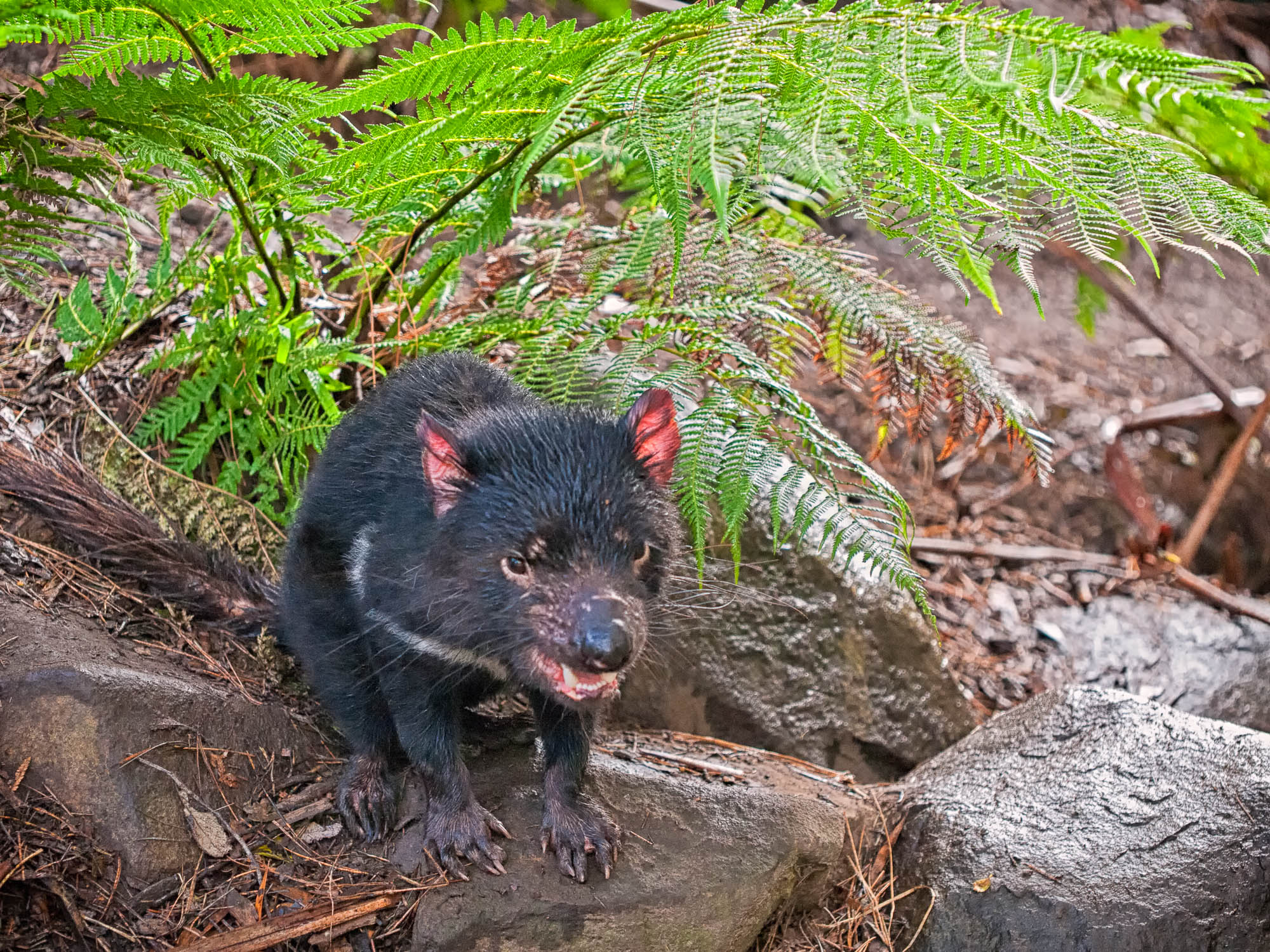
In the mid 1990’s a biologist by the name of Nick Mooney gave an interview to the Hobart Mercury newspaper. Mooney was concerned that the attention the thylacine was getting was diverting the attention away from Tasmania’s other iconic animal – the Tasmanian Devil. He argued that the Devil should be researched and protected. Many people thought that he was barmy as there were more Devils in Tasmania then than at the time of first settlement and farmers were claiming that they were at plague proportions and were a threat to livestock. Fast forward twenty years and the devil is now on the verge of extinction from a combination of devil facial tumour (a transmissible cancer), habitat destruction, traffic fatalities and environmental pollution caused by high levels of flame retardant chemicals found in consumer electronics. These chemicals are banned and were phased out in the 1980’s but their effects are still being felt and it is thought that they play a part in devil facial tumour disease. Because devil populations are declining the gene pool is also diminishing this had laid the Devils very vulnerable to disease.
The devil is an iconic symbol of Tasmania and many organisations, groups and products associated with the state use the animal in their logos. It is seen as an important attractor of tourists to Tasmania.
Today Tasmanians mourn the passing of the thylacine even though there are very few people who are left alive that actually saw one. All that remains are a few preserved specimens in museums, some black and white photos and some grainy film footage. Tourist operators say that the extinction of the devil will severely impact their industry and slowly people are starting to wake up to the fact that the devil is likely to go the same way if something is not done. There has been some research on the on devil facial tumour disease which is fantastic. So is devil saved? Well some scientists believe that the only way for the devil to survive is to quarantine healthy devils in captivity and let the wild population die out. Even if the wild population could survive the current Tasmanian state and Australian Federal governments are working to open up Tasmania’s national parks and world heritage areas to commercial logging. The federal government is also not prepared to fund research into Devil Facial Tumour Disease. So at present your best chance of seeing a Tasmanian devil is either at a zoo, animal sanctuary or dead beside a road. In another twenty years all we could be left with is some video footage and some memories. I would urge every Australian and prospective visitor to Tasmania to write to:
Matthew Groom the Tasmanian minister for the environment
and
Greg Hunt the federal minister for the environment
asking that more funding should be given to ensure the survival of the devil and to ask them not to open the Tasmanian national parks to logging.
They’re not the most loveable of creatures but the world would be a worse place without them.
Dunalley is a small coastal village that sits on the isthmus that takes you to the Tasman Peninsular and is the gateway to the tourist attraction of Port Arthur.
In January 2013 the town was ravaged by bushfire which produced many haunting images of the devastation and suffering. At the time many feared that Dunalley wouldn’t survive. Fast forward to today and Dunalley has under gone an amazing recovery, although as you walk down the main street there are still some vacant blocks where the original has not been rebuilt. If you didn’t know about the bush fires you’d never guess from looking at the place or the people.
The seafood is fresh at the Dunalley Hotel. Dunalley, Tasmania. Proof that humour and kitsch is alive and kicking in Dunalley. Panorama made up of 5 images stitched in Photoshop CS5. Olympus EM-10 with an OLYMPUS M.12-50mm F3.5-6.3 lens. Exposure – manual mode 1/400, f8 at ISO 200.
For many tourists the place is just a quick stop over to use the public toilets or get something to eat at the bakery as they continue the journey on to Port Arthur. But if you have a poke around you can see that Dunalley is a very quirky place indeed. from the zany sculpture outside the Dunalley Hotel to the delightfully strange Fish Market.
The Dunalley Fish Market is a quirky little place – part fish monger, part cafe, part curiosity shop and part museum.
Just before you pull into Dunalley is the turn off to Marion Bay which according to Wikipedia has several claims to fame. Firstly several explorer chap pies from Holland and France pulled up there while on their epic voyages of discovery. Secondly it has outbreaks of army worms, or Mythimna separata if you want to get technical. The caterpillar stage of their life cycle is marked by the fact that they form long lines and voraciously consume any foliage that lies in their path. Sort of like a wriggly form of agent orange. We didn’t see anything like that as we walked along the beach, but there were copious amounts of Wombat dropping – which sort of suggests that wombats like to go to the beach. Who would have thought!
Marion Bay. One of the many creeks that feed into the estuary and then out to sea. Tasmania. Panasonic Lumix LX-5. Exposure – aperture priority 1/160 f8 at ISO 80.
* “The Tide Is High” is a song originally written by John Holt and recorded by The Marions in 1967. The version I like is the one recorded by Blondie and released in 1980. I went and saw Blondie at the Portsmouth Guildhall when I was 16 and I’ve got to say that Debbie Harry in the flesh did weird and wonderful things to a hormonally enraged adolescents psyche. Here’s the official video clip.
I had been in Western Australia for 26 years, and to be honest although I hadn’t seen everything in WA things were starting to feel a little stale. Now I’m in Tasmania and everything is brand new. A change in the environment has suddenly got the creative juices flowing.
Yesterday I went unto Woodvine Reserve. It is a farm that has been held by one family since colonial times and has now been gifted to the Crown as a reserve. To me it is interesting to see how nature is reclaiming the land and gradually traces of human settlement are disappearing. The farm building are largely intact as they show the changes that occurred for the owners over the life of the farm. But the fields, the boundary fences, the farm tracks are all being over grown.
The comforting warning sign on the entrance to the reserve.
Woodvine Farm was gifted to the Crown on the condition that it was to be made a reserve in order to protect the animals that lived there. Prior to proclamation, the property had belonged to his family since it was first settled in 1861.
The back garden of the third house to be built on the farm.
Daffodils growing in what used to be the front garden of the second dwelling to be built at Woodvine.
The first building on the farm was this slab timber structure which provided the first home. When a new dwelling was built it was converted into a sheering shed.
Peat soils support wetlands, button grass moorland and fern fields. Woodvine Reserve.
Waxlip orchid (Glossodia major) found in Woodvine Reserve. Tasmania, Australia.
Small Duck Orchid or Paracaleana minor. Also called Caleana minor in some reference books. Woodvine Reserve, Tasmania.
Hot off of the press – no that’s not right. Hot off of the Mac is my new book Paul’s Guide To Perth – Western Australia. It is available exclusively through the Apple iTunes Book Store for the modest price of $5.99 AUD. It is 232 pages, lavishly illustrated with photos and maps, of things to do out and about in Perth. Click on the image and it will take you to the bookstore.
Description
Perth has the dubious title of being the most isolated capital city in the world, closer to Singapore than to Sydney or Melbourne. When most Australians think of Western Australia they see the Australian equivalent of the American Wild West, a land given over to mining and large-scale agriculture. When they think of Perth they see a mining town inhabited by cashed up bogans and dodgy entrepreneurs. But it is not all flannel shirts, thongs and flakey business deals in Perth, if you take the time to have a closer look you will find excitement, exuberance, and entertainment. So what does Perth have to offer? Well in short everything. Perth boasts more sunny days than any other Australian capital city, and with an average daytime temperature range of 32℃ in summer to 14℃ in winter it is very conducive to a relaxed outdoor lifestyle. In fact the American Consul to Western Australia once said that “Perth has the kind of weather that California thinks it has!”.
Situated on the Swan River Basin, by the indian Ocean and at the foot of the Darling Escarpment Perth has some of the finest beaches in the world and some of the world’s most unique fauna and flora. Paul’s Guide helps the reader discover Perth with detailed descriptions, maps and photographs, information on Perth’s history and the environment.





You must be logged in to post a comment.